50
Advance Bracing system for steel structures
Ms. Priya Kumari
1, Mr. Abhishek Arya
21
M.Tech Student, Dept. of Civil Engg., M.R.I.E.M., Rohtak
1
Asst. Professor, Dept. of Civil Engg., M.R.I.E.M., Rohtak
ABSTRACT
In this paper Braced frame systems are utilized in steel construction. This system is a highly efficient and economical system for resisting horizontal loading, and attempts to improve the competence of a rigid frame by almost eliminate the bending of columns and girders, with the help of additional bracings. It behaves structurally like a vertical truss, and comprises of the common columns and girders, essentially carry in the gravity loads, and diagonal bracing mechanism so that the total set of members forms a vertical cantilever truss to resist the horizontal loading. Shear-walled frame systems are utilized in both reinforced concrete and composite construction. Shear walls may be described as vertical cantilevered beams, which resist lateral wind and seismic loads acting on a building and transmitted to them by the floor diaphragms. Shear walls are generally parts of the elevator and service corps, and frames to create a stiffer and stronger structure.
Keywords: Bracing system, steel structures, reinforced concrete, composite construction.
INTRODUCTION
Bracing System
The bracing system consists of vertical, horizontal and diagonal tubular members connected to jacket legs, forming a stiff truss system. This system transfers the horizontal load acting on the platforms to the piles. There are variations of the platform-bracing pattern, and every system has its advantages and disadvantages. For example, the K brace has fewer members intersecting at joints, so it has reduced welding and assembly costs. But its disadvantage is that K bracing has less redundancy than X bracing. This is based on the results of a BOMEL study in 1999 performed jointly by different oil and gas companies.
The benefits and general functions of the bracing system are:
1. Transmission of the horizontal load to the soil through the pile foundation
2. Provision of structural integrity during fabrication and installation
3. Resistance to the wrenching motion of the installed jacket-pile system
4. Support for the corrosion anodes and well conductors
51 Concentric Bracing
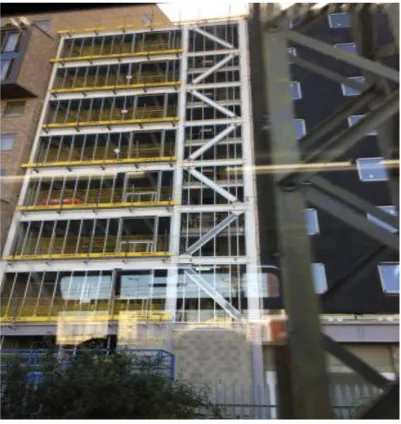
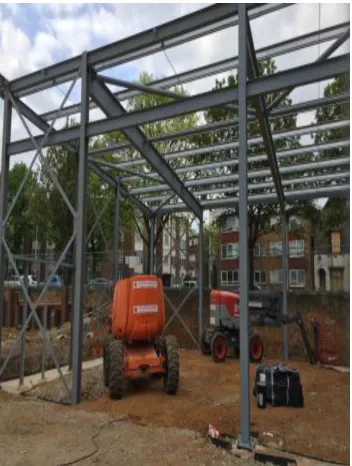
Concentric bracing is oriented in such a way that all members (beams, columns, and bracing) meet at a common point. They provide the lateral resistance mainly through the axial force in the braces. The two major categories of concentric bracing are diagonal bracing and K-bracing. In addition, there is another type of bracing which is called cross bracing (X-bracing). As shown in this figure.
Figure 1: construction site with two concentric bracings
52 Figure 2
LITERATURE REVIEW
53
bracing was proposed. The variation of T/C (tension/compression) ratio was having minimal effect on the strength of the compression member in an X-brace. Whereas in the X-brace with unequal leg angles framed on their long legs showed 40% difference in their compression load capacity for T/C range of 0 to 1.0 for specimens with parallel posts. The effect of the end connection stiffness on the compression capacity was found to be substantial. If the end condition of the compression member is significantly different then the result may show greater influence of T/C. It was concluded that the ASCE Manual No. 52 results are very conservative for slenderness ratio greater than 120 and it is deficient for slenderness ratio less than 120.
Godinez-Dominguez & Tena-Colunga (2008) investigated the behaviour of moment resisting reinforced concrete concentric braced frames in seismic zones. A study was conducted on 27 storey RC building with steel bracing. They varied the percentage of lateral strength provided by the column of moment resisting frame as 25%, 50%, and 75% under non linear static analysis. Weak beam strong column method was adopted. They found that, after first yielding, steel braces kept on increasing their lateral strength (positive slope), whereas the columns, in the majority of the models, often decreased their lateral strength after yielding (negative slope).
Esmaili et al (2008) examined the behaviour of RC shear wall in a tall building. An analytical study was conducted on 56 storey RC shear wall system under non linear analysis. It was observed that, using shear walls for both gravity and bracing system is unacceptable neither conceptually nor economically. The axial load level is increased as decrease in R factor. Redistribution of loads according to creep and sequential loading will intensely change the primitive assumptions on gravity load tributaries and consequently the level of ductility. The critical demands were found to occur in the middle height of the structure.
Objectives of Present Study
To review the existing literature related to bracing system.
To study the effectiveness of bracing system over conventional system.
To study the benefits of bracing system.
Methodology
The present study was carried out to study different aspects related to bracing structural system. To fulfil this objective the following procedure was followed:
I. Study of previous work related to bracing system.
II. different forms of bracing system steel structures.
CONCLUSION
On the basis of the present study, following conclusions are made: The concept of using Steel bracing is one of the advantageous concepts to strengthen or to retrofit the existing structure.
REFERENCES
[1]. Godínez-Domínguez, Eber & Tena-Colunga, Arturo. (2008). Behavior of moment resisting reinforced concrete concentric braced frames (RC-MRCBFS) in seismic zones.
[2]. D. D. Cannon and R. Nickerson, "Results of TLMRC research on X-bracing strength in lattice transmission towers," in IEEE Transactions on Power Delivery, vol. 8, no. 1, pp. 285-293, Jan. 1993.
doi: 10.1109/61.180348.
[3]. Mandeep Sindhu, “Design and study of motor sports and racing car setups”, International Journal of Advanced Science and Research, ISSN: 2455-4227, Volume 2; Issue 4; July 2017; Page No. 145-148.
54
[5]. Salmon, C.G. and Johnson, J.E. (1995). "Steel Structures, Design and Behavior," Fourth Edition, Prentice-Hall, Upper Saddle River, New Jersey, United States, P1010.
[6]. Mandeep Sindhu, “Effects of Road Accidents and Safety Concerning Adolescent”, IJRAR- International Journal of Research and Analytical Reviews, E ISSN 2348-1269, Volume 5 , Issue 2, April – June 2018.
[7]. Smith, B.S. and Coull, A. (1991). "Tall Building Structures: Analysis and Design", John Wiley and Sons, New York, United States.
[8]. Schueller, W. (1986). "High-rise Building Structure", Second Edition, Robert E. Krieger Publishing Company, Malaya, Florida, United States.
[9]. Mandeep Sindhu, “Effect of Efficient and Productive Transport in Economic Development of a Country”, 3rd International Conference on Emerging Trends in Engineering, Technology, Science and Management ICETETSM-2017, IETE Lodhi Road, Delhi, India, 11th June 2017, ISBN: 978-93-86171-48-1.
[10]. Taranath, B.S. (1998). "Steel, Concrete and Composite Design of Tall Building", Second Edition, McGraw-Hill Companies, New York, United States