http://dx.doi.org/10.9717/JMIS.2017.4.2.93
93
I. INTRODUCTION
Domestic agricultural product markets have been in constant competition with international agricultural, since the FTA was taken effect 10 years ago. FTA has brought positive effect as well as negative effect into the domestic market. The total impact on domestic markets is predicted to be 2 trillion 563.5 billion KRW in 10 years. Also, various studies were performed at agricultural technique centers sponsored by local governments to strengthen the competitiveness of domestic agricultural technique [1, 5, 6]. Especially, the growth environment monitoring system based on RFID/USN is studied to increase production amount of agricultural products. Another study of monitoring the growth environment based on data analysis from sensors and RFID installed in cultivation land is performed [1-2]. Many studies on the cultivation diary data recording system have been performed, which enable cultivators to provide users with various information of agricultural products, through the cultivation diary using the growth environment monitoring system.
However, most of data in the cultivation diary have been recorded by hand or input the cultivator's personal computer manually. Misinformation is likely to be given to customers due to cultivators' mistakes from data input, since there is no reliable method for maintaining agricultural products' growth environment data. Thus, the user mobile system based on reliable agricultural products' growth environment data and u-Farm cultivation diary system based on Web 2.0 are suggested. The proposed system is designed by applying object oriented modeling called mini-architecture to enhance reliability of software as well as promote stability of overall system design. The temperature and humidity sensor for the environment sensor data are used to develop the new reliable diary.
II. PREVIOUS WORK
The developed u-farm systems can monitor the farm status in real time from any distance. The system service helps to monitor the conditions in the farm, like the water system, the temperature, the fertilizers and other necessary things in the farm through the portable-equipment based on
A Novel on a Crops Management Growth System using Web and
Design Development Method
Se-Hoon Jung
1, Jong Chan Kim
2, Kim Cheeyong
3Abstract
A new cultivation diary system based on environment sensor data and Web 2.0 with Flex is suggested, to improve the previous system using the subjective data of cultivators. The proposed system is designed by applying an object-oriented model called mini-architecture, in order to enhance the reliability of software as well as promote stability to overall system design. The environment sensor data such as temperature and humidity are used to develop the new reliable diary. Also, an active interface based on Web 2.0 and Android as the user GUI are implemented to maximize the convenience while recording the cultivation diary. The result of the performance evaluation shows that the data from sensors has 99.1% of correlation with that of analogue.
Key Words: u-Farm, Web 2.0, Flex, Cultivation Diary, Sensor
Manuscript received June 29, 2017; Revised June 30, 2017; Accepted June 30, 2017. (ID No. JMIS-2017-0018)
Corresponding Author: Kim Cheeyong, Address: 176, Eongwang-ro, Busanjin-gu, Busan, Tel:82-10-4584-4036, E-mail: [email protected]
1Depement of Multimedia Engineering Sunchon University, Suncheon, Korea, E-mail: [email protected]
2Depement of Computer Engineering Sunchon University, Suncheon, Korea, E-mail: [email protected]
94 wireless communication network. As the quality of the life
has been improved, we are more focused on the speeding of farm facilities and monitoring through the ubiquitous application. Along with this circumstance, the interest of the remote-monitoring of crops condition has been increasing. Nowadays, the agriculture field has grown rapidly with the sophisticated farming tools. The purpose of these u-farm technologies is to provide convenient farming service to the farmers, even though, they are far away or in transit. They can monitor their farm without actually visiting the site.
U-farm system can provide efficient monitoring services through computerized sensing tools and devices. With the development of new sensing, networking and processing technologies farm monitoring has become easy and accessible anytime and anywhere. The u-farm application enables a person to receive services beyond the time and distance, which was the main motivation in building a ubiquitous farm. Ubiquitous farm using body sensor network technologies in daily live context is believed to be the next generation of farm technologies [7].
First, the study of [3] is focused on improving the reliability of the cultivation diary by saving the status of agricultural products, controllable environment data automatically and recording the multi-media data of agricultural products. It is divided into three different classes, ‘physical class' that contains soil sensor, the cultivation land inner sensor and outer sensor, 'middle class' maintains the database, display, sensors, and servers, and 'application class' provides the user GUI.
Secondly, the study of [4] explains the benefits of USN technique such as lessened manpower and effective time usage. Indoor environment information of the cultivation land is collected from the climate sensor and soil sensor. Also, the automated facility control equipment and UMPC enables the users to verify the information of the cultivation land through wireless communication.
III. PROPOSED SYSTEM
3.1. System Structure
The system suggested in this paper is made of 4 phases. First, data of temperature and humidity based on Hmote are stored in the database to reflect the reliable growth environment data in the system. Secondly, the smart phone interface is built for users' and cultivators' mobile convenience. Thirdly, JSP controller interface based on Web 2.0 and Flex are built to provide user interface and data maintenance. Finally, separate web servers are built additionally to maintain the public data of each interface. Figure 1 shows the overall system diagram of the suggested cultivation diary system. Environment
information of the cultivation land is transmitted to the maintenance server of the remote place through Zigbee communication. Data transmitted from the server are temperature and humidity, which are stored in the database after data passing. The stored environment information values are used, when recording the cultivation diary with Flex based on smart phone applications and desktops.
Fig. 1. Proposed system overall structure
3.2. Object-oriented Design Modeling
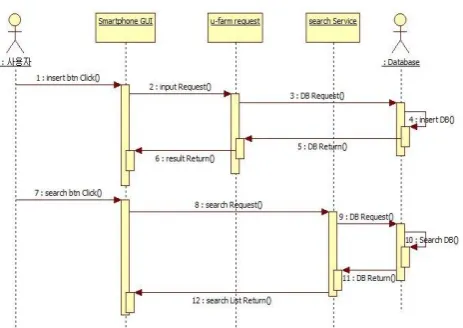
Mobile User Design. Figure 2 is the order diagram which shows the system flow in the event that users click the registration button in GUI and the search button after inputting search words. In case of log-in, data inputted in the cultivation diary by users at start-up screen are saved in the database through request class. Then, the query of inputted data is executed in the database and the result is returned. In case of inquiry, code values of the cultivation diary and inquired data are transmitted as inquiry service objects and the database query is executed in the same way. After all these procedures, the data is returned in the shape of list, which is provided to users through the ListView in smart phone GUI.
http://dx.doi.org/10.9717/JMIS.2017.4.2.93
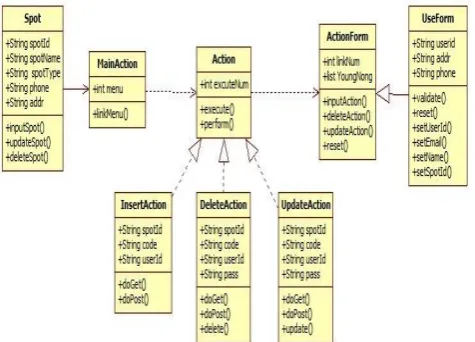
95 Figure 3 is the class diagram which shows the relationships between the property of system classes and methods. Main class runs each functions through Action class including functional classes of insert, modify and delete and verify result through ActionForm class.
Fig. 3. Class diagram of mobile system design
Web 2.0 is designed based on JSP. Figure 4 is the class diagram, which shows the relationships between property of Flex and JSP that includes the classes and methods. When running log-in at start-up page, Controller Template class is initiated. Then, the view relevant to action is executed and menu at the top and introduction page at the bottom are allocated. Web interface is designed with the pattern of MVC. MVC means the pattern running each role of model, view and controller respectively. It is good for rerun since the individual access is possible in case of system maintenance after the development. The function of data exchange is run in Action class and the result is displayed to GUI. JSP is connected to Action classes through Template.
Fig. 4. Class diagram of web 2.0 system design.
System Database Design. Figure 5 is the DB schema which shows pictured database schema. u-farm table accesses to each diary table with foreign key of user ID, place ID and environment information values. The cultivation diary is recorded by joining each table to u-farm table. Sensing table, in which environment information values are stored, is provided to the users as the type of saved sensor code in the same way.
Fig. 5. Overall system database schema.
3.3. System Main Pseudo Code Design
Pseudo code, one of the communication codes, modelled as the design algorithm, to run main functions of the suggested system. Figure 6 on the left side shows the pseudo code of the algorithm displaying the data stored in the database to user’s Web in the structure of XML. Connection(conn) and Statement(stmt), one of the database access objects, are selected to access DB and query is transmitted to DB. The result of the query is compiled in the string variable of retResult and saved in XML format, which is displayed into Web.
96 Figure 6 in the center shows the pseudo code of the
function of registered image upload, when recording the diary. DiskFileUpload is selected to run the upload function and the route of saving images is connected to the name of images. Then, the actual saving route is allocated and the registered images are up-loaded in the server by write method. Figure 6 in the right side shows the pseudo code of the algorithm that provides the environment information from DB to users in the type of the graph in Flex. The function of XML structure displays the environment information in the similar way. Structuralized data is returned to FLEX by HTTPService and provided to users in the type of the graph by drawLinechart method.
Ⅳ
. IMPLEMENTATION AND
PERFORMANCE EVALUATION
4.1. System Result GUI
The system implementation process are as follows. Windows XP Service Pack3 is the operational system and Java, JSP, XML, Flex are used as development languages. Microsoft SQL 2005 is used in DBMS. Google Map Open API is also applied to use mobile user Map and Hmote 2420 is used as the sensor.
Fig. 7. User GUI based on android (Smart phone), search menu GUI, search Result GUI, name of spot input GUI, android result detail information GUI, google map result GUI
Figure 7 shows system search menu based on Android, search result and place insert activities. Search menu designates the subject (name of spot, name of cultivation diary, date) of searching words through its selection bar and inserts the content in text windows, in order to run its search function. In case of list, registration code and user ID are displayed briefly and detailed information is only verified when the list is selected. In the process of inserting place, the input includes place ID, user ID, name of place, address, contact point, and data of types. It is possible to provide
additional information regarding the place by up-loading images of products. Figure 7 shows the result displayed in detailed information, which is popped up, when selecting display list of place by up-loading registered images. The location shows the address of place linked to Google Map, one of OpenAPI types
4.2. Object-oriented Design Modeling
Mobile User Design. Figure 2 is the order diagram which shows the system flow in the event that users click the registration button in GUI and the search button after inputting the search words. In case of log-in, data inputted in the cultivation diary by users at start-up screen are saved in the database through request class. Then, the query of inputted data is executed in the database and the result is returned. In case of inquiry, code values of the cultivation diary and inquired data are transmitted as inquiry service objects and the database query is run in the same way. After all these procedures, the data is returned as list and provided to users through ListView in smart phone GUI.
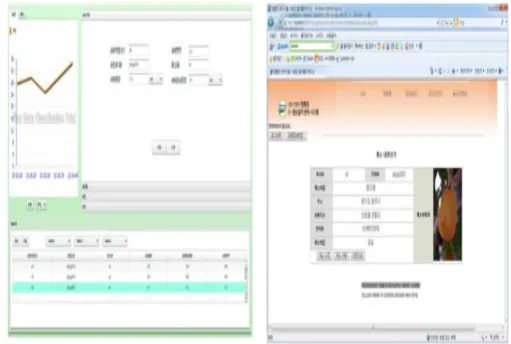
Web 2.0 Flex and Flash are used to develop Desktop interface, in order to provide users with more active and simple GUI. Also, the screen changeover is minimized in the case of menu or event, so the result is provided more quickly than the previous web.
Fig. 8. (Left) Cultivation diary GUI based flex, (Right) Cultivation diary GUI based web
http://dx.doi.org/10.9717/JMIS.2017.4.2.93
97 users after their routes are saved in database. Administrator ID has access to all users' places to modify and delete pages.
4.3. System Performance Evaluation
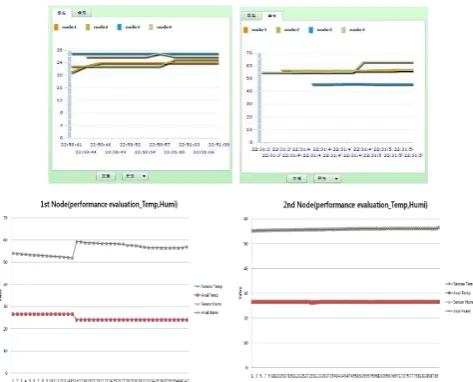
The system suggested in this paper is focusing on improving the reliability regarding the agricultural product growth environment data, flowing into database from each cultivation land. Figure 9 (Up) shows the graph on the basis of Flex displaying the growth environment data (temperature, humidity) between nodes through sensors. 4 nodes installed at each corner of the cultivation land are used for performance evaluation. Analogue thermometers and hygrometers are located next to each sensor to measure data at every one second for higher reliability. Figure 9 (Down) shows the growth environment data measurement based on analogue types of equipment. Figure 9 (Down) shows the result of the performance evaluation, which indicates that data from sensors has 99.1% of correlation with that of analogue types of equipment.
Fig. 9. (Up) Cultivation diary GUI based flex, (Down) Cultivation diary GUI based web.
Ⅴ
. CONCLUSION
The data of environment information was recorded on the basis of cultivator’s subjective determination in the previous cultivation diary. Also, functions mainly focusing on developers were provided in the desktop interface of the previous cultivation diary. Proposed system collects the environment information of the cultivation land through sensors. Also, the active interface based on Web 2.0 and smart phone interface are provided for the convenience of recorders. The recorded diary is stored in database to be used as basic information for the authorization of eco-friendly agricultural products, in order to increase the
reliability of domestic agricultural products. Data of each agricultural product can be accessed in real time through the interface based on Flex. Moreover, the smart phone interface provides users with mobile convenience. Furthermore, another interface based on i-Phone is planned to be developed in order to expand the process between different types of console. Activities based on blog are scheduled to be developed for user's convenience and valuable information.
REFERENCES
[1] M. H. Kim, B. R. Son, D. K. Kim, and J. G. Kim, “Agricultural Products Traceability Management System based on RFID/USN,” Journal of Computing Science and Engineering, Vol.15, No.5, pp.315-404, 2009.
[2] L. R. Garcia and L. Lunadei, "The role of RFID in agriculture: Applications, limitations and challenges,"
Journal of Computers and Electronics in Agriculture, Vol. 79, No. 1, pp. 42-50, 2011.
[3] Y. W. Lee, J. S. Cho, H. H. Shin, H. Yoe, and C. S. Shin, “Construction of Faming-diary Management System Using Ubiquitous Technologies,” In Processing of Lorean Society for Internet Information Conference, Vol. 19, pp.301-305, 2009.
[4] N. H. Yoo, G. J. Song, J. H. Yoo, S. Y. Yang, C. S. Son, J. G. Koh, and W. J. Kim, “Design and Implementation of the Management System of Cultivation and Tracking for Agricultural Products using USN,” Journal of Computing Science and Engineering, Vol. 15, No. 9, pp.415-427, 2009.
[5] J. H. Hwang, H. S. Jeong, and H. Yoe, “Design and Implementation of the Intelligent Plant Factory System Based on Ubiquitous Computing,” Journal of Ambient Intelligence - Software and Applications, Vol. 291, pp. 89-97, 2014.
[6] B. T. An, “A Study of Crop Remote Control System based on Ubiquitous,” Journal of Advanced Informaton Technology and Convergence, Vol. 11. No. 6, pp77-84, 2013.
98
Authors
Se-Hoon Jung, He received his BSc and MSc in Multimedia Engineering from Sunchon National University in 2010 and 2012, respectively. Currently, he is a team manager with the research & development team, Gwangyang Bay SW Convergence Institute, South Korea. His research interests include data analysis and data prediction.
Jong Chan Kim, He received his B.S. degree from Sunchon National University in 2000, his M.S degree from department of computer science, Sunchon National University in 2002, his Ph.D. degree from the Department of Computer Science, Sunchon National University in 2007. He’s a senior research professor of the Automation and System Research Institute at Seoul National University in 2013. His current research interests are image processing, computer graphics, digital clothing, AR, games and HCI.