2012
The Development of Team Trust Over Time and
its Effect on Performance When Using
Michaelsen's Team-Based Learning
Vanessa Preast
Iowa State UniversityFollow this and additional works at:
https://lib.dr.iastate.edu/etd
Part of the
Educational Assessment, Evaluation, and Research Commons, and the
Instructional
Media Design Commons
This Dissertation is brought to you for free and open access by the Iowa State University Capstones, Theses and Dissertations at Iowa State University Digital Repository. It has been accepted for inclusion in Graduate Theses and Dissertations by an authorized administrator of Iowa State University Digital Repository. For more information, please [email protected].
Recommended Citation
Preast, Vanessa, "The Development of Team Trust Over Time and its Effect on Performance When Using Michaelsen's Team-Based
Learning" (2012).Graduate Theses and Dissertations. 12439.
by
Vanessa A. Preast
A dissertation submitted to the graduate faculty in partial fulfillment of the requirements for the degree of
DOCTOR OF PHILOSOPHY
Major: Education (Curriculum and Instructional Technology) Program of Study Committee:
Dale Niederhauser, Co-major Professor Jared Danielson, Co-major Professor
Ana-Paula Correia Holly Bender
Gary Phye
Iowa State University Ames, Iowa
2012
Table of Contents List of Tables iv List of Figures v List of Nomenclature vi Abstract vii Chapter 1. Introduction 1
Chapter 2. Literature Review 6
Cooperative learning 6 Trust 24 Conclusion 37 Chapter 3. Methodology 39 Course Design 39 Participant Selection 41 Measures 42 Procedures 48 Analysis 51 Chapter 4. Results 55
Question 1: Relationship between trust and performance over time 55
Question 2: Relatedness of trust and individual performance 60
Question 3: Team behavior patterns 71
Chapter 5. Discussion 82
Relationship between trust and performance over time 82
Relatedness of trust and individual performance 84
Team behavior patterns 87
Considerations 93
Appendix A. Instruments 103
Teamwork Process Questionnaire 103
Teamwork Prediction Questionnaire 104
Teamwork Survey Post-Analysis 105
Appendix B. Educational Environment Details 106
Detailed Teaching Methods in the Veterinary Clinical Pathology Course 109
General Course Characteristics 109
Team assignment method 111
Teaching strategies used 112
Order of events in class 119
Individual performance and trust measures in observed teams 120
Observation schedule 121
Schedule and course content difficulty 121
Seating choices and social alliances 122
Notes 124
List of Tables
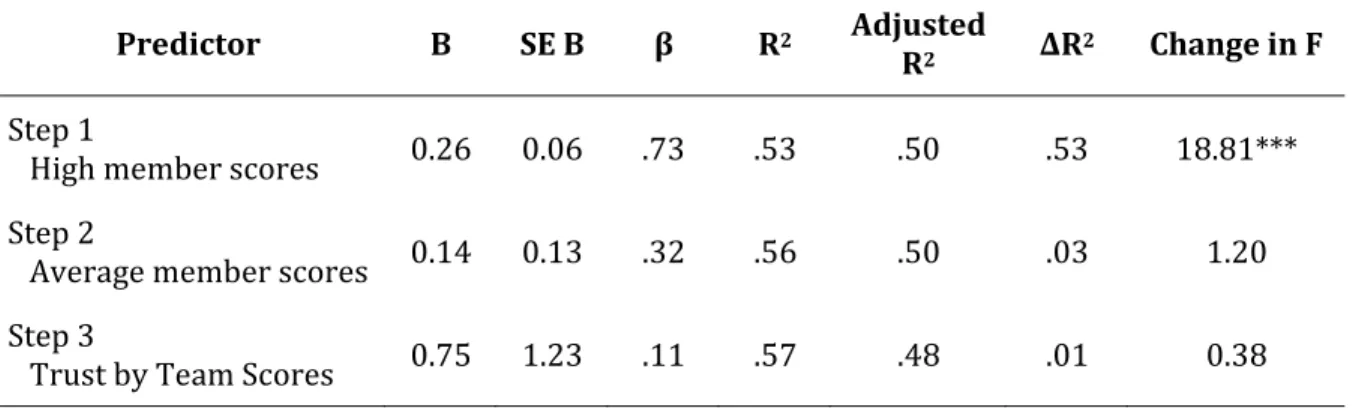
Table 1: Component loadings for the pre-survey trust items ... 43 Table 2: Hierarchical regression analysis using the high member score, average member score
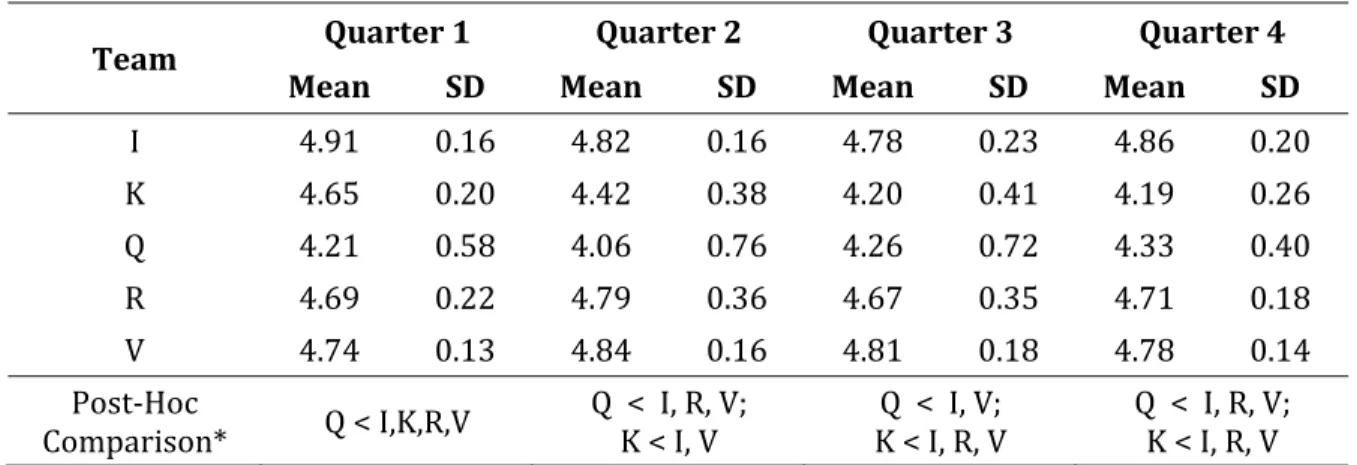
and Trust by Team score to predict group quiz over the semester ... 56 Table 3: Means, standard deviations, and post-hoc comparisons of observed teams’
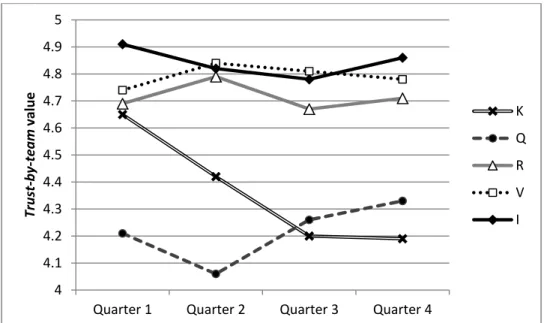
trust-by-team values by quarter ... 58 Table 4: Pearson correlations of the semester mean individual quiz scores and Trust by Team
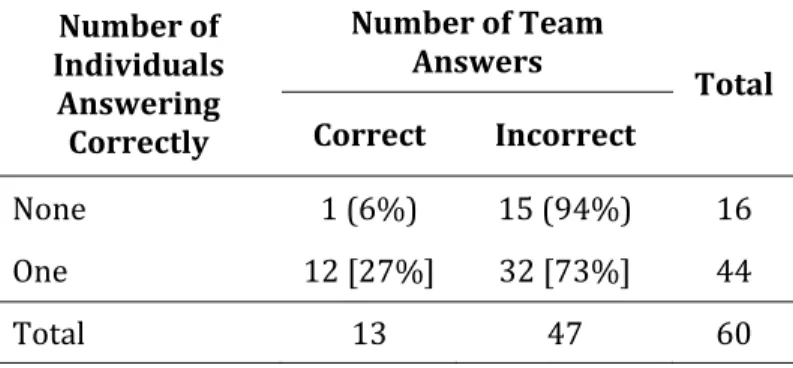
within teams ... 61 Table 5: Frequency of correct and incorrect team answers when there were 0 or 1 correct
List of Figures
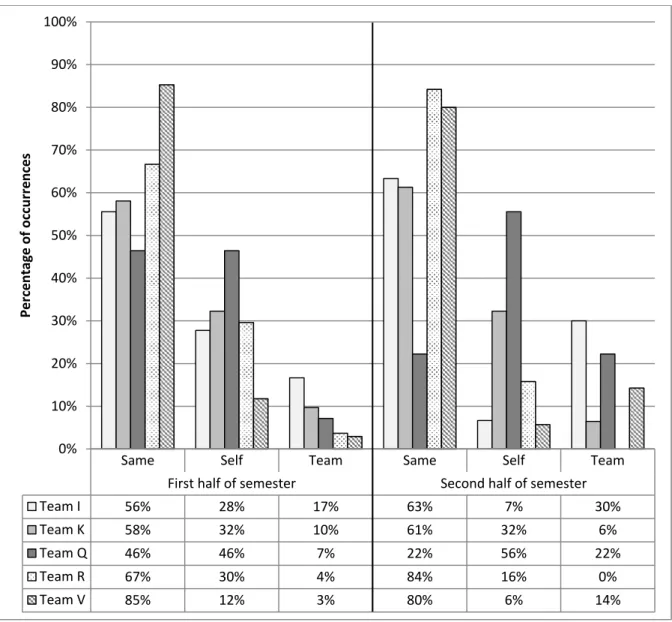
Figure 1. Trust by team within observed teams over time ... 57 Figure 2. Frequency of self-trust to trust-of-team between first and second halves of the
semester ... 60 Figure 3. The frequency of incorrect team answers provided by teams with a certain percentage of correct individuals ... 73 Figure 4. Percent of instances in which a certain number of individuals had same incorrect
List of Nomenclature TBL – Team-Based Learning
RAT – Readiness Assessment Test
iRAT –Readiness Assessment Test taken as an individual gRAT –Readiness Assessment Test taken within the group CDQ – Case Discussion Quiz
iCDQ – Case Discussion Quiz taken by individuals gCDQ – Case Discussion Quiz taken by the group TTQ – Thursday Team Learning Quiz
iTTQ – Thursday Team Learning Quiz taken by individuals gTTQ – Thursday Team Learning Quiz taken by group IF-AT –Immediate Feedback-Answer Technique
Abstract
Proponents of Michaelsen’s Team-Based Learning (TBL) have claimed this teaching method quickly produces highly effective teams which are characterized by high trust among team members. Presumably, the high trust boosts performance because members feel less inhibited during discussions involving sharing personal views and challenging others’ views. These team interactions can determine how well teams utilize their members’ intellectual resources and make decisions. These assertions, while logical and compelling, did not appear to be fully verified within the TBL literature. This exploratory study used mixed qualitative and quantitative methods to describe performance, trust and behavior patterns over time within TBL teams in a second-year veterinary medical course. No variables were experimentally manipulated. Throughout the semester, I measured performance using students’ individual and group quiz scores and measured trust using students’ responses to custom trust surveys. Within the context of this study, there was no significant relationship between trust and performance and no consistent increase in trust over time. To investigate team behaviors, I observed five randomly-chosen teams on a weekly basis for the entire semester. The analysis suggested that some teams increased the speed and density of their intra-team communication and experienced greater member participation with time. The task type (in-lecture “clicker” questions vs. quiz questions) appeared to elicit different team interactions. The data hinted that decision-making may have been based on the majority answer held by members and that individual correct or incorrect members may have difficulty swaying the group. The students’ open-ended responses illustrated fourteen characteristics that teams desired in their members. Although the findings are not generalizable, this study suggests a variety of interesting avenues for future study. For example, researchers may wish to explore how specific behaviors
exhibited by teammates influence group processes, decision-making, trust and performance within TBL.
Chapter 1. Introduction
Imagine walking on a college campus and asking random students, faculty and staff about their experiences working in groups. You would likely receive a wide range of responses from excitement to frustration. Most people recognize working in groups to be a necessity, especially in the workplace, and their personal experiences have shown some group
experiences to be productive and rewarding and others to be a hindrance. At best, groups can produce outcomes far beyond the capabilities of any individual; but, at worst, group work can be deleterious to the group and individual members. Hackman (1983, p. 1456) described one situation exemplifying the best and worst aspects of groups: one workplace group “had established a production norm of fifty units a day” and so successfully discouraged one member’s attempts to produce more such that this member’s “output finally dropped even below the fifty-unit norm;” yet, when she no longer worked with that same group her “output
soon doubled.”
Researchers have documented conflicting evidence of group effectiveness. For example, Arum and Roksa (2011, p. 100) describe “a positive association between learning and time spent studying alone, but a negative association between learning and time spent studying with peers” despite other indications that “greater time spent working in groups leads to more favorable attitudes among students in general and that even minimal group work can have positive effects on student achievement” (Springer, Stanne, & Donovan, 1997, p. 23). Under the right conditions, group interactions may provide new ideas, insights, strategies, solutions or efforts not previously held by any individual member (Hill, 1982; Watson, Cooper, Torres, & Boyd, 2008; Watson, Johnson, & Merritt, 1998). Left alone, some cooperative learning groups will develop into more productive, positive learning environments for members while others will create more limited learning environments (Lisk, 2003; Wheelan & Lisk, 2000). The
inability to consistently provide equally beneficial group learning opportunities for all students may cause some instructors to abandon cooperative learning. By so doing, they also abandon the potential benefits of groups. Rather than avoiding groups in academic environments, instructors need guidance in establishing the conditions for forming and managing effective, well-developed learning groups. Not infrequently, “many well-intentioned faculty assign group projects without providing students the information and guidance prescribed by cooperative learning advocates” (Colbeck, Campbell, & Bjorklund, 2000, p. 61), and it is unsurprising when these haphazard approaches do not allow instructors or students to create the necessary conditions for optimal learning in groups within and outside of the classroom.
Hoping that a new cooperative learning method would help solve their teaching and learning problems, instructors from various fields have turned to Michaelsen’s Team-Based
Learning (TBL), which was described in the book Team-based learning: A Transformative Use of
Small Groups in College Teaching (Michaelsen, Knight, & Fink, 2004). TBL, which promises to harness the power of well-functioning groups and avoid the problems of dysfunctional groups, is an increasingly popular instructional strategy among teachers in higher education and
medical professional schools. Can these instructors feel justifiably confident that the system will meet their needs? Numerous case reports describing instructors’ successful TBL
implementations demonstrate that the technique is adaptable and can promote positive outcomes (Beatty, Kelley, Metzger, Bellebaum, & McAuley, 2009; Conway, Johnson, & Ripley, 2010; Dunaway, 2005; Feingold et al., 2008; Meeuwsen, 2003; Zgheib, Simaan, & Sabra, 2010). Empirical studies have pointed out that TBL teams can outperform their best member
(Michaelsen, Watson, & Black, 1989; Watson, Michaelsen, & Sharp, 1991) and have examined how various factors, such as diversity or time, affect group processes and outcomes
Merritt, 1998; Watson, Kumar, & Michaelsen, 1993). In healthcare environments, TBL has produced equivalent or better learning outcomes than traditional educational interventions, including other small group learning methods (Naik, Teal, Rodriguez, & Haidet, 2011; Pileggi & O'Neill, 2008; Thomas & Bowen, 2011; Willett, Rosevear, & Kim, 2011). These studies tended to answer questions about whether or not the system worked, how well it worked, and how certain team characteristics affected outcomes. Unfortunately for instructors, the TBL literature explaining why this instructional strategy works and what happens among the members during team development is relatively sparse, providing little guidance for determining how and when to use this learning system.
The TBL proponents stress that a unique feature of TBL is its “reliance on the special characteristics of teams to accomplish a special kind of learning,” and TBL can transform less effective “groups” into highly effective “teams.” One of the two characteristics that distinguish “teams” from “groups” is that teams are characterized by “a high level of trust among the members of the group” (Michaelsen, et al., 2004, p. 12). TBL mechanisms supposedly promote trust development “through a series of positive group interactions,” which then promotes “give-and-take discussion” (members freely sharing views and challenging each other’s views) critical for effective group processes and learning. “By adhering to the Four Essential Principles of Team-Based Learning, teachers ensure that the vast majority of groups will develop a level of cohesiveness and trust required to transform groups into effective learning teams” (Michaelsen, et al., 2004, p. 35). As members see “other team members reliably complete tasks over time” (Michaelsen, et al., 2004, p. 77) trust develops and allows members to have the “kind of give-and-take discussion that is essential to group and team effectiveness, regardless of the setting” (Michaelsen, et al., 2004, p. 77). Trust develops because TBL creates the conditions in which members can have positive interactions, and this trust then encourages members to interact in
more effective ways which, in turn, promotes learning and builds greater trust to the point that these high-trust teams tend to perform at a high level.
Although TBL proponents identified trust development over time as an important underlying feature of effective teams, no TBL-specific studies appeared to confirm that the TBL mechanisms do promote trust-building with time and that this does alter the members’
interaction patterns which in turn increase the team’s effectiveness; nor did they measure trust, time, and team performance and their relationships to observed team interactions. Also, few, if any, TBL studies have utilized a formalized observation protocol for collecting data about teams’ interaction patterns over time. Intrigued by this apparent gap in the literature, I sought to better understand how trust, performance and group interactions changed with time when using a Team-Based Learning format. In particular, I chose to investigate the presumption that, over time, TBL increases trust among team members, and that higher trust results in different group interaction patterns and better performance. My research questions included:
1. How does trust level relate to performance and time?
a. Does trust predict group quiz performance?
b. Does trust increase with time?
2. What is the relationship between team members’ trust levels in their team mates and individuals’ quiz performance?
3. What behavior patterns do teams exhibit in relation to TBL activities and time? In the present study, I used mixed qualitative and quantitative methods to examine, on both team and individual levels, the relationship between trust level and learning outcomes within the context of a veterinary medical class using TBL. Learning outcomes were determined based on group and individual quiz scores (performance) in the class. Trust was defined as “the willingness of a party to be vulnerable to the actions of another party based on the expectation
that the other will perform a particular action important to the trustor, irrespective of the ability to monitor or control that other party” (Mayer, Davis, & Schoorman, 1995, p. 712). Trust level was determined based on participants’ responses on a trust survey. Both group
performance and trust were expected to generally increase over time with the possible exception of temporary drops during periods of conflict. The results of this exploratory study may not be generalizable; however, they suggest future avenues for experimental investigations into why TBL and its sub-components produce particular outcomes so that instructors can have realistic expectations and make informed choices about utilizing TBL.
Chapter 2. Literature Review
A pragmatic approach to group learning shapes both my inquiry and interpretation of the literature because my ultimate goal is to understand which instructional changes lead to which learning outcomes. Teasing out how certain teaching techniques effect learning within an instructional system like TBL can be difficult due to its multifaceted nature. Not only does the system contain many different components and implementation details, but also each
component likely interacts with many other factors including human social interactions, how people learn, time, course content, course design, and student characteristics. As a result, potentially relevant literature spans a wide range of topics, including trust, group development, human behavior, instructional design and human learning, each having potential for lifelong study. This review pulls educationally-relevant information from various fields in an attempt to draw practical conclusions for instructors. The topics include cooperative learning, time, group processes, and trust.
Cooperative learning
Various terms, including learning groups, collaborative learning, cooperative learning, and team-based learning, have been used to describe the same general idea of “putting
individual students in a class into small groups for the purpose of promoting more active and more effective learning” (Fink, 2004, p. 5). Although Fink separates TBL from “cooperative learning,” this study categorizes TBL as a highly structured subset of cooperative learning within a wide spectrum of cooperative learning styles. As such, the cooperative learning
literature and small group teaching recommendations should generally apply to TBL. A number of studies show the learning benefits of cooperative learning across disciplines and cooperative learning strategies (Johnson, Johnson, & Smith, 1998; Skon, Johnson, & Johnson, 1981).
In practice, cooperative learning has several general characteristics: (a) a clear set of learning objectives that are accepted by all students, (b) clear and complete task-completion instructions, (c) heterogeneous groups which can interact face-to-face, (d) task structures ensuring positive interdependence, alignment between learning objectives and assessments, and relevant practice opportunities, (e) positive social interaction behavior and attitudes, (f) sufficient time spent on learning and task completion (at least four weeks in same group), (g) individual accountability and opportunity for success, (h) publically rewarded academic
success, and (i) post-group reflection on effective group behaviors and attitudes (Johnson, et al., 1998; Lisk, 2003; Stahl, 1994).
Cooperative learning, however, does not guarantee success for all learning groups. Some groups develop successful learning behaviors, and others do not (Lisk, 2003; Watson & Michaelsen, 1988; Wheelan & Lisk, 2000). As a result, researchers have worked to devise ways to develop successful learning behaviors. In a number of settings, researchers have found that training helps group members learn and work together more effectively (Ashman & Gillies, 1997; Woolley, Gerbasi, Chabris, Kosslyn, & Hackman, 2008). TBL is designed to provide the benefits of well-functioning learning groups without the requirement of training. When the TBL activities are properly designed and implemented, students are expected to automatically develop good group processes which help them function effectively as teams (Fink, 2004, p. 13).
Michaelsen’s Team-Based Learning (TBL). Team Based Learning is comprehensively
described in the book Team-Based Learning: A Transformative Use of Small Groups in College
Teaching (Michaelsen, et al., 2004). TBL is considered to be a particular instructional strategy with a specific combination and sequence of learning activities, not a series of independent small group activities (Fink, 2004). The strategy is described for a typical 15-week semester-long college course which is divided into five to seven units. Overall, four principles are
essential for successful TBL implementation: (a) instructors properly form and manage groups, (b) the process holds students accountable for individual and group work quality, (c) students receive frequent and timely feedback, and (d) assignment are designed to promote learning and team development (Michaelsen, 2004a; Michaelsen & Sweet, 2008). These principles are
accomplished by incorporating the following nine characteristics into the course:
1. Instructor forms diverse small groups. The instructor assigns students to groups of five to seven people in such a way that relevant resources (students’ characteristics, knowledge, background, culture or skills) are relatively evenly divided among the teams. The groups are still small enough for all members to participate.
2. Instructor keeps teams together for the entire course. Students in groups need time to get to know each other well enough to start functioning effectively as a team.
3. Groups complete work during class. All group members should be present for group activities, and it is difficult to coordinate all members outside of class. Also, groups may be more likely to divide up work among individuals when work occurs outside of class.
4. Instructor does not assign roles within groups. Teacher-assigned roles deprive students from the opportunity to learn how to manage group roles and functions effectively and efficiently.
5. Groups complete graded individual quizzes followed by graded group quizzes. Graded group work should constitute a significant percentage of the course grade because groups need an incentive for becoming an effective team. Members are motivated to contribute their best.
6. Students receive immediate feedback. Students are able to engage in analysis of what went wrong when they still can clearly remember the experience. The feedback helps them learn and improve their performance.
7. Students provide graded peer assessments. Individuals are discouraged from social loafing because peers can penalize freeloading individuals and reward contributing members.
8. Groups simultaneously report specific decisions on the same problem. Students are most engaged in discussion when they are wrestling with the same problem and are interested to know what other classmates decided.
9. Instructor designs activities to encourage group decision-making.The activities must not be easily sub-divided or completed by individuals in teams because that
eliminates the group character of the assignment.
The TBL structure incorporates these nine elements within a three-phase sequence (preparation, application, and assessment) for each unit (Fink, 2004). The first phase introduces the students to the primary content material through out-of-class reading and in-class quizzes with feedback. The second phase increases the students’ skills through homework and increasingly complex, in-class group assignments. The third phase assesses the students’ knowledge through a culminating project or examination. These phases are detailed as follows:
When a new unit begins, students enter Phase I (preparation). They must complete out-of-class readings and come to class prepared to begin the “Readiness Assurance Process.” In class, students take a short, often multiple-choice, test on the readings as individuals (iRAT). After students turn in their individual tests, the team members take the same test again as a group (gRAT), preferably using IF-AT (Immediate Feedback-Answer Technique) scratch-off cards, which provide immediate feedback. The individual and group tests are graded in class
and contribute to students’ scores. The group scores are made public. Optionally, groups can try to regain deducted points by convincing the teacher to grant their written appeal in which they use reading assignments to support their answer choices. The preparation phase ends with the instructor offering “corrective instruction” during which the instructor, who now knows what ideas students were unable to understand on their own, offers any additional instruction deemed necessary for students to correctly understand the key concepts. The students, having already struggled with the material, are ready to listen closely to the instructor’s brief, focused statements. “This process occurs five to seven times per course and constitutes the first set of in-class activities of each major instructional unit” (Michaelsen, 2004a, p. 41).
Phase II (application) begins with the assumption that the previous phase helped students acquire the declarative knowledge they needed to move forward. This phase develops students’ procedural and strategic knowledge. Several class sessions are devoted to completing a series of meaningful small group application exercises in which teams use course content to formulate responses to increasingly difficult questions and problems. These activities must be designed so that the small groups all work on the same, significant problem or question and must generate a specific answer which all teams will share with the class simultaneously (Michaelsen, et al., 2004). Then, the instructor leads a discussion during which groups compare their responses, and the instructor offers feedback on the response quality. During this phase, a separate individual-portion-first component is not required, and teams may immediately begin work as a team. It is critical that the application phase utilizes “good application-focused group assignments [which] foster give-and-take discussions because they focus on decision making (not writing) and enable students to share their conclusions in a form that enables prompt cross-team comparisons and feedback” (Michaelsen, 2004a, p. 44).
Finally, the students move into Phase III (assessment) during which the students take an examination or complete one more group activity which contributes to their course grade. This phase determines how much the students learned during the instructional intervention. After completing this phase, the class moves into the next unit and the cycle repeats while integrating previous material with new course material.
Pure TBL incorporates all of the features described above. Yet, “teachers can and have borrowed ‘pieces’ of team-based learning (usually the ‘individual-small group’ sequence for testing)” (Fink, 2004, p. 9). Also, many studies describe various adaptations of TBL, including but not limited to eliminating phases, allowing students self-selecting groups, having more than seven students per team and not using Readiness Assurance, peer evaluations, or graded group work (Abdelkhalek, Hussein, Gibbs, & Hamdy, 2010; Conway, et al., 2010; Parmelee, 2010; Zgheib, et al., 2010). Michaelsen and Richards (2005) warned that educators who partially adopt the TBL system might underestimate the potential of team learning or might incorrectly attribute certain outcomes to TBL. TBL proponents believe that instructors may experience disappointing outcomes (e.g., negative experiences, student resistance, or some combination of feelings of indignation, frustration, and general distaste for the process) if they incompletely or inadequately enact TBL within their course (Lane, 2008). Several specific common
misapplications of TBL include: a) overusing readiness assurance tests (measuring factual memorization) and underusing or poorly designing the assignments, b) omitting peer
evaluations, and c) failing to properly introduce and acclimate students to TBL in the beginning (Michaelsen & Fink, 2008). Yet some researchers believe that the TBL method “allows flexibility for instructors to use selectively 1 or more of the phases, depending on the contextual demands of the course or session” and indicate that such flexibility is particularly important in medical education due to the unique constraints of the field (Thompson et al., 2007, p. 251). There has
been little research to indicate how these differences could impact the outcomes or what are the optimal factors associated with TBL use. For this reason, the course in this study was designed to adhere to the nine critical elements, and any deviations from pure TBL structure are described in detail.
Factors influencing group effectiveness. The literature has demonstrated how some of the components used by TBL affect group effectiveness. These include group diversity, size, and membership stability as well as task type and time.
Diverse groups. TBL uses an in-class team forming method to evenly distribute relevant member assets, liabilities, and characteristics (e.g., gender, ethnicity, work experience, relevant coursework, cultural perspectives, attitudes towards the course, intellectual ability, language fluency) equitably among the teams (Michaelsen, 2004a). Diversity is advantageous to groups because pooling member contributions (e.g., ability and experience) ensures that each group has the necessary resources for completing difficult tasks and working through individual differences helps teams utilize those member resources most effectively. Placing high- and low-ability (IQ) individuals together provides learning benefits for all individuals. Ten-year-old children working in mixed ability pairs performed better on post-tests than those working in homogeneous ability pairs or as individuals (Amaria, Biran, & Leith, 1969). When using TBL strategies in medical education, both the highest and lowest academic quartile students had improved performance, but the lower-quartile students had the greatest learning benefit (Koles, Stolfi, Borges, Nelson, & Parmelee, 2010). In both these situations, the efforts that the above-average individual expends when teaching the below-average individual results in helping each person learn. Furthermore, TBL placed “no burdensome duty” on
higher-performing students because they “clarify their own knowledge by verbalizing and negotiating with peers, are rewarded with grades for their individual and team efforts, and spend no
additional time accomplishing those tasks beyond the live session” (Koles, et al., 2010, p. 1744). When working on long, complex tasks, the varied perspectives available in culturally diverse groups allows them to reach higher performance levels more quickly than non-diverse groups (Watson, Johnson, & Merritt, 1998). Although non-diverse groups working on less complex tasks initially performed better than diverse groups, over time the diverse groups overcame their process problems and improved their performance whereas non-diverse teams developed more individual difference problems (Watson, et al., 2008; Watson, Johnson, Kumar, et al., 1998; Watson, Johnson, & Merritt, 1998; Watson, et al., 1993). The obvious individual differences in diverse groups may have forced them to deal with and overcome those problems earlier in the process; however, the non-diverse teams may have initially ignored the less obvious individual differences, so they failed to develop a method of dealing with individual differences and individualistic activities began to negatively impact their effectiveness.
Group size. Group size can influence both group development and perceived group productivity. TBL recommends group sizes between five to seven members. This generally fits with the optimal group size range (three to six members) found in the literature (Birmingham & McCord, 2004; Bray, Kerr, & Atkin, 1978; Wheelan, 2009). When solving complex problems, groups need to be large enough to contain sufficient resources to be effective; yet, they must remain small enough to maintain a positive social atmosphere and avoid the coordination and developmental problems found in larger groups (Bray, et al., 1978; Hackman & Vidmar, 1970; Wheelan, 2009; Wheelan, Davidson, & Tilin, 2003).
Permanent team membership. In TBL, team member assignments are permanent. This feature may impart the stability and clearly identifiable membership which is important for team effectiveness. Team members and managers of long term work teams considered “boundedness” (clear boundaries distinguishing team members from non-members) and
stability of membership to be positively related to team performance (van Woerkom & Croon, 2009). Social worker teams which were clearer about who was or was not a member learned better, likely because the group was better able to coordinate decision-making and
responsibility-sharing (Foldy & Buckley, 2010). Unclear membership can generate frustration and possibly undermine group effectiveness, especially when the questionable member was a supervisor who did not participate in group meetings but still “exercised a lot of authority over the team” (Foldy & Buckley, 2010, p. 44).
Assignment design. The TBL handbook, Team-Based Learning: A Transformative Use of Small Groups in College Teaching, devotes an entire chapter to creating effective assignments. Carefully attending to task design is very important because the characteristics of a task can influence the way the group approaches the task which, in turn, affects the outcomes (Hackman & Morris, 1975). Instructors can alter group processes and performance by changing the characteristics of a task, and analyzing the tasks to ensure they are appropriate for their intended outcome is an important step in troubleshooting problems during TBL
implementation.
Due to the way individuals and groups approach a task, certain tasks are better suited for individuals and others for groups. Groups’ ability to pool resources and correct errors help them make fewer indefensible hypotheses, categorize and prioritize information, and produce fewer repeated hypotheses than individuals (Hill, 1982; Laughlin, 1973). Thus, groups more successfully solve complex problems having multiple parts and no individual has all the necessary information (Hill, 1982; Watson, Johnson, & Merritt, 1998). However, on
brainstorming tasks, pooling the ideas from individuals working separately produced more high-quality, unique ideas than groups, because the group interactions inhibited brainstorming performance (Hill, 1982). Easy tasks are not appropriate for group learning tasks because the
outcome is largely determined by one competent member and grouping people together merely increases the probability of having at least one competent member (Hill, 1982). Also, when tasks have readily recognizable solutions, higher ability (correct) members were less likely to be inhibited by lower-ability partners (Hill, 1982; Laughlin & Bitz, 1975). For more difficult or multi-step problems, the group was less reliant on particular individuals and benefited from the group’s error-correction function and by having different members who could handle different steps of the problem-solving process (Hill, 1982). Since complex problems are subject to interpretation, the correct member may sometimes be overruled by the incorrect members; correct members were more likely to be overruled in low-ability groups (Hill, 1982).
Overall, individual efforts appear best for generating ideas and group efforts are best for integrating information and for clarifying and justifying evaluations. Task designs can optimize the individual and group benefits. For example, the Nominal Group Technique, which utilizes individual brainstorming followed by group discussion for clarification and evaluation followed by independent voting, was shown to generate significantly more unique ideas and greater participant satisfaction in the decision-making process than in interacting groups (Van De Ven & Delbecq, 1974). When utilizing iRATs followed by gRATs, TBL may be similarly capitalizing on both the individuals’ superior idea generating capacity and the groups’ superior
error-correction ability. Additionally, TBL group activities should require members “to apply a rule or solve a problem” and to “make a concrete decision based on the analysis of a complex issue” (Michaelsen, Fink, & Knight, n.d., p. 6). Unlike “production tasks” intended to generate and present ideas, images or arrangements or “discussion tasks” involving evaluating issues and obtaining consensus, “problem solving tasks” should promote greater effectiveness, efficiency, teamwork and expression of opinions as members identify a course of action to resolve the problem (Hackman & Vidmar, 1970). This is probably because production tasks, such as writing
a story, are naturally individualistic activities, and their original, creative products with high literary quality come along with a negative tone, difficulty working together, and
competitiveness possibly due to the need for divergent thinking (Hackman & Vidmar, 1970). TBL promotes convergent thinking, error correction and teamwork by avoiding tasks that are easily sub-divided, such as presentations and term papers. Instead, the team members must work together to make a specific choice, which they report simultaneously in a simple, succinct manner that can be directly compared to other groups (Michaelsen, et al., n.d.).
Hackman and Morris (1975) described an experiment which demonstrated how differences in the task design affected how groups approached that task. Groups were assigned to a process intervention (strategy instructions, anti-strategy instructions, and control) and a task condition (equal or unequal information distribution). Strategy groups were told to discuss their goals and how to work together, and anti-strategy groups were told not to waste time discussing procedures or strategy. Control groups received no special instructions. The teams were to assemble various electrical components based on a list of components’ quantities and prices and were to maximize the total worth of the components they produced. Team members in the equal information groups received identical lists with item quantities and prices, but members of unequal information groups received lists with different quantities of the components that could be produced. The strategy groups performed well in the unequal task condition as did anti-strategy groups performing in the equal task condition. Interestingly, performance was lowered for the strategy groups in the equal task condition and the anti-strategy groups in the unequal task condition. Control groups were low for both. The anti-strategy intervention helped improve group performance when the task actually required coordination and sharing among group members (i.e., unequal task); but, when the task could be done equally well without such coordination (i.e., equal task), strategy discussions deteriorated the
performance. Thus, for tasks that have an objective need to coordinate and share among group members (i.e., unequal task condition), it is beneficial for groups to engage in process planning discussions prior to completing the task. However, if the task can be completed well without coordinating and sharing among members (i.e., equal task condition), the groups might be better served by not wasting time with discussing strategies prior to engaging in the task. When designing assignments, instructors need to carefully consider how the task characteristics might influence the group processes, and they may need to implement instructional interventions to assist the groups with tasks that require coordination among members.
The task type ultimately influences the kind of learning that may occur. Various knowledge taxonomies have categorized the learning types to assist instructors with selecting appropriate tasks to accomplish the desired learning outcomes (Gagné, Briggs, & Wager, 1992; Phye, 1992; Phye, 1997a, 1997b, 1997c; Smith & Ragan, 2005). When applying Phye’s
functional knowledge taxonomy to TBL, it is evident that TBL components build upon each other to help students progressively attain declarative, procedural and strategic knowledge as they move towards increasing independent, problem solving ability. The activities in this study were designed to produce declarative, procedural and strategic knowledge (see Appendix B for class design details). The students demonstrated declarative knowledge when they completed a) the RATs, which tested recall of their reading material, b) the data abnormality part of Diagnostic Pathfinder homework cases, which required correctly spelled medical terms, and c) the within-lecture clicker questions. Students demonstrated procedural knowledge when generating diagnostic rationales for Diagnostic Pathfinder homework cases because the software guided them through the process of interpreting the cases. Students demonstrated strategic knowledge when they interpreted new cases without guidance and generated convincing rationales during quizzes and passed their final examination.
Practice tasks closely matching an authentic environment can help students successfully access prior knowledge when solving new problems in that environment. Students can better transfer their skills to a novel problem when the strategies used during training are compatible with the transfer task (Phye & Sanders, 1992). Students will learn what they practice, and they will practice what they are graded on (Phye, 1997b). For this reason, instructors who want students to organize their study strategies at a higher-order, problem-solving level must develop graded TBL activities that require students to practice critical thinking skills
(procedural and strategic knowledge). The admonition to maintain consistency between the practice setting and “real world” also extends to the social environment. Students in an
advanced 5th and 6th grade math class tested better individually if they had studied individually
and they tested better as a group if they had studied as a group (Johnson, Johnson, & Scott, 1978). Fortunately, TBL has students practice their problem solving skills both individually and within groups all semester so they are prepared to successfully transfer their knowledge to interpreting novel cases they will encounter in veterinary practice.
Time. Classroom time is a precious commodity which must be used wisely to provide the greatest learning benefit possible. Both the time given to complete a particular task and the amount of time that groups remain together can influence the group effectiveness by affecting team processes, development, or productivity. Presumably, groups need more time than individuals to extract process gains from the time-consuming group discussion process. When given 50 minutes to write solutions to human relations problems, individuals had greater solution quality; but, individuals and ad hoc groups generated equivalent solutions when given 100 minutes (Fox & Lorge, 1962). TBL recommends using about 45 to 75 minutes for the Readiness Assurance process and about one to four hours for the application oriented activities
for each unit (Michaelsen, 2004a). In TBL, the large amount of time devoted to group activities probably allows TBL to extract the maximum process gains from the learning tasks.
Even more than time devoted to tasks, TBL proponents consider having the same
members work together for the entire semester to be important for helping groups develop into high-functioning teams. “When the groups are properly formed, remain intact long enough to become cohesive teams, and are repeatedly given challenging tasks with prompt and clear feedback, then students learn the content, they learn how to use the content, they learn about themselves and how to interact with others on major tasks, and they learn how to keep on keep on learning after the course is over” (Fink, 2004, p. 8). Groups of various size appeared to have an inherent direction and sequence of development independent of its individual members (Wheelan & Krasick, 1993; Wheelan & Williams, 2003). Researchers have categorized these patterns into sequential, cyclic, life cycle, equilibrium, and adaptive/nonsequential group development models (Wheelan, 2005). Group interactions can change and become more effective over time; members of older work groups (together over five months) tended to perceive their groups to have more characteristics of the more productive development stages (Wheelan, et al., 2003). Culturally diverse groups, in particular, demonstrate changes in effectiveness over time such that newly formed groups have different performance
characteristics from longer-term groups, and one should not expect newly formed, culturally diverse groups to solve problems very effectively (Watson, Johnson, Kumar, et al., 1998; Watson, Johnson, & Merritt, 1998; Watson, et al., 1993). Compared to long-term groups, newer group members: (a) have lower trust in and attraction to the group, (b) have little identification with the group or its goals, (c) are motivated by self-interest versus mutual support, (d) base their perceptions of others’ skills on stereotypes versus actual behavioral observations, (e) use socially-focused decision-making behavior relying heavily on the best member instead of
task-focused communication, (f) have low willingness to disagree and focus on areas of agreement, (g) resolve conflict with less effective, face-saving strategies such as voting and compromise rather than consensus, and (h) are less able to complete difficult intellectual tasks due to low commitment to the group and avoiding open discussion (Birmingham & McCord, 2004; Sweet & Michaelsen, 2007).
With time, groups may pass through a conflict stage to reach a high-performance stage when the “group members comfortably and habitually share information with each other and have a relatively good sense of where different kinds of knowledge and expertise lie within the group” (Sweet & Michaelsen, 2007, p. 36). Work groups and academic groups in more advanced development stages were more productive, and more developed work groups tended to be those which were together longer (Lisk, 2003; Wheelan, et al., 2003; Wheelan & Lisk, 2000). Although we know that the amount of time together can affect group performance, we still do not know how many hours groups need to spend together to become productive. Some studies suggest that at least five to eight months may be necessary while others show groups
performing effectively within hours. TBL teams require at least 20-25 hours working together “before they can fully assess and benefit from the resources of all members of the group” (Michaelsen, 2004a, p. 30; Watson, et al., 1991). Various factors ranging from the task type to group composition to environmental conditions may be influencing the amount of time needed to reach productive levels. It is possible that the structure of TBL may be promoting rapid group development, but researchers have not yet directly mapped TBL group development against existing models. Further research is necessary to clarify how groups progress through the group development phases over time when utilizing TBL.
Group process. The factors described above come together to influence the way that the members of a group work together to produce a group outcome. The group interaction
process can impact how member knowledge and skills are utilized for the task and can have lingering positive or negative effects on individual members’ performance. According to Laughlin and Adamopoulos (1980), if individuals who were first incorrect when working individually later worked with a correct group, they had a probability of .80 of being correct in the final individual testing. However, initially correct individuals who subsequently were members in an incorrect group had a probability of .36 of being correct in the final testing. Working in a correct group is advantageous to previously incorrect individuals, but working in an incorrect group can be detrimental to a previously correct individual. When using group learning, educators want to take advantage of the first scenario but want to avoid the latter.
For tasks involving complex skills and high teamwork levels, the mediating role of group process is substantial thus increasing the potential process loss due to inadequately utilizing member skills and knowledge. Group processes also have potential to increase the total member talent available for completing the task. Rather than just gathering together what people already know, the group works to gain knowledge or generate skills that did not previously exist in the group. This increase in total talent (or process gain) is often an
instructor’s desired state when utilizing group learning and is presumably a benefit offered by TBL. The following may explain how TBL influences group processes to produce reliable effectiveness.
First, TBL may optimize group processes by enforcing social conditions most likely to result in productivity. Several cooperative learning theoretical frameworks emphasize the importance of designing learning tasks focused on a common goal (Meeuwsen & Pederson, 2006), and cooperative learning promotes a productive social environment by: (a) linking teammates’ success to each other, (b) holding individuals accountable, (c) ensuring students promote teammates’ success through encouragement, praise and assistance, (d) teaching
students social skills and how to use them properly, and (e) ensuring students take time to engage in group processing (Johnson, et al., 1998). Team-Based Learning formalizes each of these within its structure by utilizing gRATs, iRATS, group discussions with feedback and peer evaluations.
Second, TBL likely improves group effectiveness by adjusting three factors which can affect the interaction process. According to Hackman and Morris (1975), it is possible to improve group effectiveness by manipulating (a) group norms to improve performance strategies, (b) task design to influence member effort, and (c) group composition to influence how groups utilize and develop task-relevant knowledge and skill. TBL accomplishes each of these with its structure. Regarding group norms, the goal is to help members recognize and change existing norms which appear suboptimal for the task. TBL accomplishes this by having a structured system which rewards productive norms and inhibits disruptive norms. For
example, TBL recommends giving practice RATs on the syllabus and then engage students in a structured grade weight setting exercise to discuss and decide how much the individual, group and peer evaluation scores would contribute to the grades. These lower-stakes activities allow members to begin trying out behaviors and discovering if those behaviors are acceptable to the group prior to working on real, graded assignments. Regarding task design, the goal is to ensure that tasks are exciting, fulfilling, and rewarding experiences so that members wish to exert effort in completing the task. TBL recommends that group activities require students to make a specific and simultaneous choice which can be compared among teams so that teams take ownership for their decision. Also, TBL group members receive individual scores, group scores and peer evaluation scores, so group members are held accountable for both their individual and group efforts which should reinforce “good” or “productive” behaviors and help individuals learn how well they are doing. Regarding group composition, the goal is to help teams
maximally utilize the talent in their teams. TBL addresses this by evenly distributing the member resources among the teams, keeping teams together all semester and providing immediate feedback on performance. This may provide a low-threat environment in which members can experiment with new forms of behavior and learn to trust each other.
Third, TBL utilizes methods that provide students with the most positive classroom experiences. Feichtner and Davis (1984) surveyed students at two universities to identify the most and least desirable cooperative learning qualities. The most positive experiences were characterized by instructor-formed groups, permanent groups, group sizes between four to seven members, and heterogeneous groups, plenty of in-class time for group work (averaged about 36% of class time), group work made up large portion of course grade (41-80%), peer grades are included as about 21 to 40% of the course grade, and students receive feedback on their performance. With a few minor differences, TBL recommendations are very similar. Interestingly, the students’ perception of graded group work frequency depended on the task type. “Too few graded group assignments was detrimental to the group development process” did not give sufficient time for teams to become cohesive; yet, too many activities also had a negative affect which the authors presumed was due to student dividing work in an attempt to coordinate their efforts (Feichtner & Davis, 1984, p. 64). Students reported the best experiences in classes with one or fewer class presentations, two or fewer written reports and more than four group exams. These findings further validate TBL recommendations that (a) assignments which can be sub-divided, such as written reports, should be avoided, (b) group work should be performed in class to avoid coordination problems, and (c) reporting on team decisions should be specific and simultaneous, which is difficult with class presentations.
Finally, TBL is probably effective because the group assignment recommendations ensure good learning experiences for all students. In learning groups, members learn from each
other’s expertise and acquire the information and skills they need as they work together to complete the tasks (produce the products) which provide the learning experience (Birmingham & McCord, 2004, p. 74; Colbeck, et al., 2000). This introduces an assessment problem because the group product quality is only a good measure of individual learning insofar as the group product demonstrates the individual effort and learning of team members. The assessments must accurately distinguish between team learning processes and their team performance outcomes because no change in performance might be incorrectly interpreted as no learning taking place (van Woerkom & Croon, 2009). The learning task also must be designed to provide practice opportunities on all aspects of the project for each individual. Subdividing labor to the most skilled group members can produce good products in both workplace and educational environments, but this evades the learning goals because students merely reinforce previous knowledge and learn little new (Colbeck, et al., 2000). Paradoxically, to promote the best learning experiences for members, learning groups might have to risk the project quality or efficiency as they involve their least skilled members in tasks outside their expertise. TBL avoids both the task design problem and the assessment problem. TBL requires that tasks not be sub-dividable so all members should be able to participate in the creation process. Also, TBL utilizes individual assessments (iRATs) in addition to group assessments.
Trust
Trust is one of the features distinguishing TBL “teams” from mere “groups” because teams have “a high level of trust among members of the group” (Fink, 2004, p. 12). Trust is the lubrication that allows team members to be “willing to challenge each other’s views” and thus they can get the maximum learning benefit from engaging in give-and-take discussions (2004a, p. 35). In academic and lay literature discussions about group work, “trust” is often mentioned
as an important component for group effectiveness. Trust becomes a factor in group work because “working together often involves interdependence, and people must therefore depend on others in various ways to accomplish their personal and organizational goals” (Mayer, et al., 1995, p. 710). Arguments in the lay literature (Covey & Merrill, 2006) which claim trust affects the speed and cost of business have been echoed in the trust research. Tschannen-Moran and Hoy (2000) pointed out that distrust causes people to focus on self-protection, which increases costs in business and diverts energy from learning in academia. Organizational theory studies suggested higher trust is related to reduced negotiation costs and conflict levels and to superior information sharing, cooperation, and organizational performance (Gulati & Sytch, 2008). Even Wheelan’s group development model (2005, p. 18) includes “trust and structure” as a stage in which groups have significantly increased capacity to work effectively and productively.
Since people claim trust is important, we would like to measure it. However, to measure trust, we must know what it is. Close examination reveals that “trust” is challenging. The word “trust” has been used as shorthand to describe a phenomenon that most people intuitively recognize as explaining good interpersonal results. Outside of the trust research field,
researchers appear to default to a vague, ubiquitous, largely undefined, idea of trust that seems based on recognizing feelings from their own trusting experiences. Even when scrutinized by trust experts, trust is difficult to pinpoint, and trust researchers disagree about how to
characterize and measure it. This introduces a problem when trying to determine if the “trust” described by the group process researchers is the same as the “trust” described by the trust researchers. As an analogy, a poet may speak of “sunlight,” having experienced the brightness, beauty and warmth of the sun, but a physicist defines sunlight in mathematical formulas and describes it as waves and particles.
Perspectives on trust. The TBL literature and non-trust researchers (lay persons, group process researchers and group development researchers) appear to mostly use the shorthand, intuitive meanings of trust within their frameworks. These frameworks tend to focus on the emotional undertones that exist within the interpersonal interactions. They
associate confidence and security with trust and suspicion with distrust (Covey & Merrill, 2006; Wheelan, 2005). A trust definition relying heavily on human emotion and attitudes can be difficult to measure and may not look the same from context to context. For example, “Trust issues are generally dealt with in more covert ways (such as joking, teasing, or testing) in task groups and in more overt ways in learning and therapy groups” (Wheelan, 2005, p. 14). The TBL literature tends to associate increased trust with increased willingness to engage in discussions and express differing opinions without expressly defining trust. Ultimately, using the shorthand “trust” might contribute to confusing comparisons across studies if different researchers utilize different implicit meanings and expressions of trust, but fail to explicitly define those meanings. Perhaps we think we’re all talking about the same thing and really are not.
Within the realm of trust research, the literature is highly diverse and each researcher’s approach partially describes trust and mechanisms leading to enhanced trust. Trust is a
complex situational and multidimensional construct which is “activated and sustained by a multidimensional set of conditions;” and not only do researchers disagree about what these trust conditions are, but also “there is no instrument for measuring an exhaustive set of them” (Butler, 1991, pp. 644, 647). Viewed through the perspective of their various disciplines, trust researchers have alternatively viewed trust (a) as an individual characteristic (personality psychologists), (b) as expectations about others’ behavior during transactions while focusing on the contextual factors influencing trust development and maintenance (social psychologists), or
(c) in light of the institutions and incentives created to increase trust by reducing the anxiety and uncertainty associated with transactions among relative strangers (economists and sociologists) (Bhattacharya, Devinney, & Pillutla, 1998). Economists also equate trust with people behaving in a prescribed manner, even if the behavior is related to how contracts or rewards and punishments are structured, because economists are more concerned about the costs and benefits of certain behaviors than about inherent trustworthiness. These differences can result in opposing views about the definition of trust. For example, trust researchers disagree about whether or not trust can be present when external mitigating factors, such as incentives or sanctions, are used to enforce desired behavior. This is a particularly important distinction for Team-Based Learning, since the system’s structure is supposed to form groups into high-functioning, trusting learning teams.
Some trust researchers feel that the diversity of viewpoints may not be able to be converged. Having reviewed empirical generalized trust research, Nannestad (2008, p. 432) called it a “huge puzzle that is not even near solution” and concluded that we have little useful knowledge about generalized trust and how it explains social behavior, institutions or social and political change, but Nannestad admitted that recent trust research has identified pieces that do and do not belong to that puzzle. It is possible that “a universal conceptualization of trust and distrust may have difficulty attaining a sufficient level of theoretical and empirical viability for research purposes,“ and that “attempts to ‘stretch’ trust to cover the extant range of usages seem to be at an extremely high risk of producing constructions that are either too elaborate for theoretical purposes or relatively meaningless in the realm of empirical
observation” (Bigley & Pearce, 1998, p. 408). Even if researchers were to agree upon a common definition of trust, “the reality of trust will not be the same at all times and in all places”
trustor and trustee as well as the context of the trusting relationship will determine how trust will play out in any situation.
Trust researchers have offered various schemes to make sense of the wide range of trust research. Most tend to view trust in relation to (a) individual trustor (the entity doing the trusting) characteristics, (b) trustee (the entity being trusted) characteristics, or (c)
characteristics of the environment, relationship, or context. Within TBL teams, each member has influence on the group output and on other members; thus, each member acts as both trustee and trustor. Additionally, the TBL framework provides a context which modulates the trusting relationships. Since there is no consensus approach to trust, this study considers trustor, trustee, and contextual factors to all be important for a trusting situation. The framework used in this study resembles this formula: Trusting situation = trustee characteristics x trustor characteristics x contextual factors. Each of these categories is discussed below.
Trustor characteristics. Theorists focusing on trustor characteristics recognize that “people differ in their inherent propensity to trust” another before they have any information about the other party (Mayer, et al., 1995, p. 715). This propensity is this person’s “general willingness to trust others” (Mayer, et al., 1995, p. 715). An individuals’ values, attitudes, moods and emotions can affect their level of trust in a situation (Jones & George, 1998). Some research describes an individual’s propensity for trust as a stable trait across situations, but others see it as situation specific with effects from personality and situational factors.
Trustee characteristics. Theorists who view trust “as an expectation that is specific to a transaction and the person with whom one is transacting” tend to see “vulnerability is a key element of trust” (Bhattacharya, et al., 1998, p. 460). Vulnerability implies something important can be lost; thus, vulnerability is risky. For this reason, the researchers focus on the perceived
trustee characteristics which make this entity worthy of the risk. Some of the trustee
characteristics that might lead the trustor to trust the trustee include: availability, competence, consistency, discreetness, fairness, integrity, loyalty, honesty, openness, promise fulfillment, receptivity, benevolence, and reliability (Butler, 1991; Tschannen-Moran & Hoy, 2000). Mayer et al. (1995) summarized trustworthiness into three antecedents of trust, namely ability, benevolence and integrity, and noted that these factors can vary along a continuum.
Context characteristics. Theorists focusing on trust as a relationship may envision trust as emerging from prior contact and developing “knowledge-based trust” based on ongoing interaction and on learning more about the partner (Gulati, 1995). The trust experience can be determined by the interplay between simultaneously operating values, attitudes, moods and emotions “to produce an overall state of trust or distrust,” so trust can be a dynamic experience shifting between distrust, conditional trust and unconditional trust (Jones & George, 1998, p. 537).The characteristics of the relationship partners can influence the relationship. For
example, more similar partners “can derive greater stocks of trust from joint history compared to more heterogeneous sets of partners” (Gulati & Sytch, 2008, p. 182). It is important to determine how the parties establish the normative guidelines by which they act within the relationship. The norms can come from within or be influenced by external sources, but researchers disagree about how this relates to trust. Gulati (1995, p. 93) implies that an externally imposed governance structure is distinct from trust: “A detailed contract is one mechanism for making behavior predictable, and another is trust”; so when trust exists “people may not choose to rely upon detailed contracts to ensure predictability”. Yet, this distinction may be less an either-or condition and more like a continuum because “cautious contracting gives way to looser practices as partner firms build confidence in each other…[so] familiarity between organizations through prior alliances does indeed breed trust” (Gulati, 1995, p. 105).
Sheppard and Sherman (1998) proposed another view in which trust takes on four different forms depending on the relationship form and depth. The relationships may be shallow or deep and have dependent or interdependent forms. Each relationship category carries different risks for the trustor, and the risks are additive from one category to the next. For example “deep interdependence” has all the risks of “shallow dependence,” “deep
dependence,” and “shallow interdependence”. In this model, trust is the “acceptance of the risks associated with the type and depth of the interdependence inherent in a given relationship,” so trust exists at several levels with a clear order: “shallow dependence < deep dependence, or shallow interdependence < deep interdependence” (Sheppard & Sherman, 1998, p. 426). Because trust is a relational act that “involves the belief that features of the other, the relationship, or the context in which the relationship is embedded will mitigate the risks associated with that relational form,” it is possible to enhance trust by selecting a trustworthy partner and utilizing institutional mechanisms to create a basis of trust between parties unable to determine trustworthiness themselves (Sheppard & Sherman, 1998, p. 426).
Trust in TBL. Ultimately, the trust literature tends to include the following themes about trust: (a) “trust exists in an uncertain and risky environment”, (b) “trust reflects an aspect of predictability” and is an expectancy which includes some possibility of error , (c) the degree of trust is directly related to the magnitude of the expectancy, (d) the strength of trust is related to an entity’s confidence in the trust, (e) “trust exists in an environment of mutuality” and is “situation and person specific”, and (f) trust is related to good outcomes (Bhattacharya, et al., 1998, pp. 461, 462). The uncertainty and risk are familiar to students in cooperative learning groups who come to a new class, important for their academic programs, and find that their academic success is dependent on working with people they had never met. The TBL structure should support shallow dependent and shallow interdependent relationships within the
framework of Sheppard and Sherman’s (1998) trust model because its built-in, trust-promoting features mitigate the risks associated with the cooperative learning relationship and thereby enhance trust. Shallow dependent relationships exist when TBL encourages reliability and discretion through deterrence (peer evaluations) and the inability to easily leave the relationship (course-long teams). The peer evaluations can penalize parties who perform unreliably or act in disagreeable ways. Shallow interdependent relationships exist when TBL reinforces consistency, transparency, and predictability by forcing team members to engage in discussion and attempt to understand each other’s rationales for group work. Although TBL structures do not necessarily support deep relationships, it is possible some teams reach a level of trust which involves a sense of caring and benevolence towards teammates and having a sense of obligation towards the group. For example, a deep dependent relationship is more evident when a teammate trusts the team to make good choices on group activities during times when he or she must be absent. It is also evident when teammates feel obligated to come to class and participate for their team’s sake, not just their own grades, or when they try to help each other understand and learn the material. It is unlikely there is deep interdependent relationship between teammates on TBL teams.
From an individual perspective within a team, especially at the beginning, members may perceive their outcomes (grades) to be dependent on the other members, so each student (trustor) likely would consider the other students’ (trustee) characteristics (such as consistency and ability) when determining whose arguments to believe during group activities. Thus, TBL teams likely begin as “shallow dependence” relationships because: a) team members must rely on team mates to complete the group work, but have no direct control over another’s behavior, and b) TBL mechanisms ensure the reliability, competence and integrity of the team members. In a dependent relationship, the trustor’s outcomes are contingent upon the trustee’s actions, so
it is a unidirectional dependency. Mayer (1995, p. 712) defines trust as “the willingness of a party to be vulnerable to the actions of another party based on the expectation that the other will perform a particular action important to the trustor, irrespective of the ability to monitor or control that other party”. This definition describes well the “dependent” forms of trust likely to be found in academic groups, and thus formed the trust definition used in this study. If the trust level surpasses the perceived risk threshold, the trustor will engage in risk within a relationship but “the form of the risk taking depends on the situation” (Mayer, et al., 1995, p. 724). When determining trust level, it is not enough to ask “do you trust them?” as this must be further qualified with the question “trust them to do what?” (Mayer, et al., 1995, p. 729). Thus, this study utilized a trust measurement instrument that asked members to indicate how willing they were to rely on each other for contributing positively to the current group activity and allowed them to comment on their choice. The intention was to capture both the team’s collective trust level, but also to indicate what individuals’ trust levels were towards a particular trustee within a certain context.
In his opinion paper, Maccoby (2003, p. 60) explained that an institution can “avoid distrust by enforcing the rules, but it will build trust only by practicing transparency and increasing participation”, and this belief echoes Michaelsen’s ideas and the TBL structure. From this perspective, creating a trust culture involves creating a learning environment in which people are not afraid to make mistakes and they accept the inevitability of constant change. Maccoby suggested principles for building a trusting culture, and these can all be found within the TBL structure. TBL utilizes a distinct and clearly articulated structure for the class which includes the ability of students to write appeals and to participate in establishing grade weights. Thus, everyone (a) knows the goals and strategy, (b) knows the rules and can question