lu
m
e
7
,
Is
su
e
1
,
2
0
1
8
DESIGNING AND EXPLORING A SPEECH CORPUS
Oana NICULESCU Universitatea din Bucureşti
Şcoala doctorală Limbi şi identităţi culturale
Conducători de doctorat : prof. dr.Camelia STAN, Universitatea din Bucureşti / Prof. dr. Ioana Chitoran, Université Paris 7
Résumé
Cette étude concerne les trois aspects suivants : (1) la constitution de corpus – les critères de collection et le filtrage de données audio, les différents problèmes concernant la segmentation du signal de parole, (2) l’exploration de corpus – l’analyse acoustique et la modélisation statistique de données conversationnelles, la comparaison de méthodes d'extraction manuelles vs. automatiques, et (3) la représentativité du corpus pour illustrer la variation phonétique et phonologique en roumain.
Keywords: phonetics, Romanian, corpus design, automatic speech recognition, vowel sequences
1. Overview of the thesis
Our PhD thesis [1] provides an up-to-date analysis of internal (adjacent vowels within the word) and external hiatus (across word boundaries) in contemporary Romanian, at the interface between experimental phonetics and phonology. The objectives of the dissertation are: (1) setting forth a theoretical and terminological account of hiatus in contemporary Romanian, (2) assembling a frequency hierarchy of word-internal hiatus from a normative perspective, (3) studying the dynamics of a norm-usage relation by designing and working on a corpus of spontaneous speech, (4) providing a comparative acoustic analysis of internal hiatus (IntH henceforth) and external hiatus (ExtH), (5) sorting out the contexts that trigger or inhibit different hiatus resolution strategies, (6) highlighting the individuality of Romanian among Romance languages in respect to repair mechanism used by native speakers when avoiding vocalic sequences in continuous speech. Finally, we intend to deliver a manually transcribed and annotated corpus potentially useful for speech processing community.
2. Constructing the corpus
C
SEC Vo
lu
m
e
7
,
Is
su
e
1
,
2
0
1
8
In our research, due to fine acoustic analysis, we settled on the first option, and designed a corpus so as to compare spontaneous speech (C1 henceforth) with careful speech (C2) in terms of hiatus resolution strategies, to establish the contexts that trigger or inhibit different hiatus repair mechanisms, to account for inter- and intra-speaker variation, and to highlight the acoustic properties of IntH and ExtH. The present corpus is the result of numerous pilot studies and pre-inquiry design processes.
For C1, data were collected from 9 speakers, 4 females and 5 males. The age range at the time of the experiment was 26-58, and the recordings took 5 hours and 44 min (approximately 38 min per speaker). The participants were chosen from a close circle of friends and family so as to obtain a spontaneous and natural output. All participants are representative of the southern dialect of Muntenia. The experiment took place in a quiet room, directly onto a laptop, using a stand-mounted microphone, Behringer B1, and an external audio interface, M-Audio Fast 3 Track. Participants were required to talk about their previous summer. They each received a form consisting of 6 circularly displayed questions, so that no order is imposed when performing the task. Participants had to fill in the forms with key words, not full sentences. 15 minutes were given prior to the elicitation of (semi)spontaneous speech. The interview always started with the same question(s) “What do you think of the structure of this interview? Where would you like to start?”.
From the spontaneous corpus one male speaker (age 27, engineer, graduate student) was selected. All vocalic sequences for both IntH and ExtH were extracted from his monologue (40 min of semi-spontaneous speech). These were the tokens for the controlled experiment, namely C2 (100 min of read speech, 35 min for IntH, and 65 min for ExtH). All target words were placed in carrier sentences, 3 repetitions were elicited, and final intonation continuation rise was controlled for. This procedure entailed 420 tokens for IntH, and 824 tokens for ExtH.
3. Exploring the corpus
3.1. Annotation and manual extraction
The recordings were manually transcribed (orthographically) and annotated in an open source software, PRAAT, designed by P. Boersma and D. Weenink for academic use. At this step, for C1 the analysis was twofold, and oriented on various speakers. Manual segmentation and annotation strategies are aimed to cover two levels of analysis: coarse-grained and fine-grained.
lu
m
e
7
,
Is
su
e
1
,
2
0
1
8
moment dat/ [laoendat] “at one point” [2]), or vowel blending (/dowə/ [doo] “two”) occur. The corpus thus processed can prove useful for researchers interested in Romanian and needing a starting point in their studies, training an automatic speech recognition system in forced alignment, or also for pedagogical use (native and foreign students alike).
Fine-grained. Only vowel sequences are marked, namely IntH and ExtH. Segmentation takes place at 4 annotation levels: level 1: ExtH with a pause between the vowel pair (/ku#əs.ta/ “with this”), level 2: ExtH without a pause (/vara asta/ “this summer”), level 3: IntH (/prieten/ “friend”), level 4: plurivocalic sequences incorporating a VV sequence (/roʃia asta/ “this tomato”). The acoustic analysis regarding IntH vs. ExtH was carried out on the fine-grained segmentations.
3.2. Forced aligned extraction
In the present context of interdisciplinary research, when digital humanities are rapidly evolving, there is an interdependency between speech, text, and language technologies. An increasing number of studies deal with automatic alignment, natural language processing, speech synthesis and data mining. The redirecting of speech technologies (e.g. automatic speech recognition, speech synthesis) into the humanities has brought a reciprocal gain (linguistic rules combined with statistical analysis). Annotated corpora prove to be of high relevance in phonetics, and in linguistics in general. Departing from small scale corpora by extending data sets, and combining laboratory methods (laboratory phonology) with big data sets of continuous speech, has been beneficial particularly for phonetic research [3]. The advantage of working within the field of speech processing is that it can help us test various linguistic hypotheses, examine sound change and variation [4], [5], [6].
C
SEC Vo
lu
m
e
7
,
Is
su
e
1
,
2
0
1
8
software). The main package used for data visualization was ggplot2, developed by Hadley Wickham.
Preliminary results obtained from the two methods of approaching the corpus (manual vs. automatic extraction of vocalic sequences) are addressed in the following section.
4. Discussions
After the recordings in C1 and C2 were manually transcribed and annotated, the first statistics were performed on the distribution of IntH and ExtH for all speakers. Preliminary results show that the 2 classes of hiatus pattern differently, in the sense that predominant sequences for IntH (/i.e/, /i.a/, /i.o/) become peripheral for ExtH (/e.a/ is more frequent), and vice versa, meaning that IntH is almost in complementary distribution with ExtH. This finding is relevant not only for the current study but also from a typological perspective. On-going statistical analysis for highlighting the behavior of vocalic sequences in Romanian include: lexical coverage and frequency as function of speaking style; distribution and hierarchy of IntH–ExtH per speaker and cross-speakers; type of hiatus across words, inventory and distribution of other vocalic sequences (diphthongs, triphthongs), cross-comparison of all vocalic sequences.
After the alignment process was carried out on C1 and C2, we looked at duration and formant trajectories (F1, F2) both from spontaneous and controlled data, comparing the manual segmentation with the forced aligned one, so as to provide a complementary acoustic analysis of IntH and ExtH. Even though the analysis is performed on one speaker, the sample is considered representative, corroborating results obtained from works conducted on larger Romanian corpora such as [9], [10].
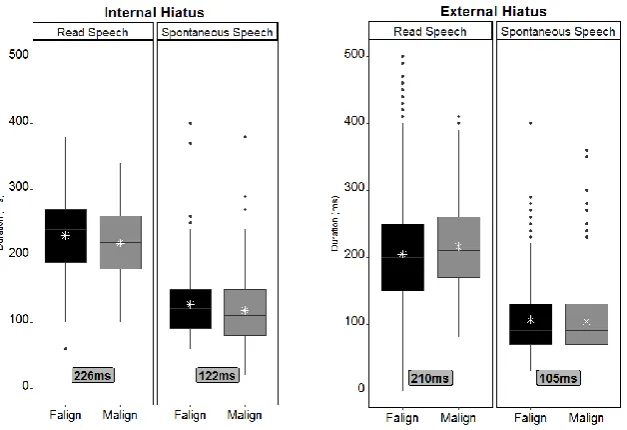
Preliminary findings (fig 1) from the duration analysis of one speaker indicate that: (1) there are no high discrepancies between the two alignments, meaning the ASR system is performing as expected, (2) hiatus in careful speech is longer than in spontaneous speech, (3) independent of speech style, ExtH is shorter than IntH (226ms IntH vs. 210ms ExtH in read speech, and 122ms IntH vs. 105ms ExtH in spontaneous speech).
lu
m
e
7
,
Is
su
e
1
,
2
0
1
8
Fig. 1. Duration of IntH vs. ExtH in read and spontaneous speech with results from forced (Faling) and manual alignment (Malign). The mean value of each alignment is marked with a white asterisk positioned inside the boxplot, close to the median line. The gray box at the bottom represents the mean duration between Falign and
Malign depending on the style of speech.
5. Conclusions
By combining experimental procedures with a corpus-based approach, this work can prove relevant for lines of inquiry addressed at different levels of the linguistics system. Providing an annotated corpus of Romanian can further aid the development of language models, semantic parsers, diacritics recovery, computational lexicology, phonotactic investigation, frequencies, duration and patterns of various segments, among others. The integration of manual and automatic alignment can help test many linguistic intuitions.
C
SEC Vo
lu
m
e
7
,
Is
su
e
1
,
2
0
1
8
6. Acknowledgements
This work was partially funded by the Labex EFL mobility grant. The author is also grateful to the Limsi – Vocapia team for aligning the data (Ioana Vasilescu, Lori Lamel, Bianca Vieru), to Ioana Chitoran, Martine Adda-Decker and Maria Candea for insightful comments and discussion.
References:
ADDA-DECKER, Martine, 2006. De la reconnaissance automatique de la parole à l‟analyse linguistique des corpus oraux. In: Actes des Journées d’Étude sur la Parole.
BENZEGHIBA, Mohamed, et al. 2007. Automatic speech recognition and speech variability: a review. In: Speech Communication, Vol. 49, n° 10-11, p. 763-786.
CHITORAN, Ioana, José Ignacio Hualde, Oana Niculescu, 2015. Gestural undershoot and gestural intrusion – from perception errors to historical sound change. In: Proceedings of ERRARE 2015 "Errors by Humans and Machines in multimedia, multimodal, and multilingual data processing", Vol. 2, From Variation to Errors in Speech Production and Perception, 11-13 September 2015, Sinaia, Romania, p. 123-11-136.
NICULESCU, Oana. Hiatul intern şi hiatul extern în limba română contemporană. O analiză acustică [Internal and external hiatus in contemporary standard Romanian. An acoustic analysis], PhD dissertation, University of Bucharest, Romania, Forthcoming.
OHALA, John, 1996. The relation between sound change and connected speech processes. Institute für Phonetik und digitale Sprachverarbeitung, p. 201-206.
RENWICK, Margaret, et al. 2016. Marginal contrast among Romanian vowels: evidence from ASR and functional load. In: Interspeech 2016 – 17thAnnual Conference of the International Speech Communication Association, San Francisco, USA, Vol. 2016, p. 2433-2437.
TRANDABĂŢ, Diana, et al. 2012. The Romanian Language in the Digital Age. In: META-NET White Paper Studies: Springer.
VASILESCU, Ioana, Bianca Vieru, Lori Lamel, 2014. Exploring pronunciation variants for romanian speech-to-text transcription. In: Proceedings of SLTU -2014, p. 161-168.
VASILESCU, Ioana, Camille Dutrey, Lori Lamel, 2015. Large scale data-based investigations using speech technologies: the case of Romanian. In: Proceedings of the 8th Conference on Speech Technology and Human-Computer Dialogue “SpeD 2015”, Bucharest, October 14-17, p. 6.