Designing and Evaluation of Reliability and Validity of Visual
Cue-Induced Craving Assessment Task for Methamphetamine
Smokers
Hamed Ekhtiari1, Zahra Alam-Mehrjerdi 1, Mehri Nouri ¹, Sanju George 2, Azarakhsh Mokri 3, 4*
1. Neurocognitive Laboratory, Iranian National Center for Addiction Studies (INCAS), Tehran University of Medical Sciences, Tehran Iran 2. Addiction Psychiatry Department, Birmingham and Solihull Mental Health NHS Foundation Trust, Birmingham, UK
3. Clinical Department, Iranian National Center for Addiction Studies (INCAS), Tehran University of Medical Sciences, Iran 4. Rouzbeh Hospital, Psychiatry Department, Tehran University of Medical Sciences, Iran
* Corresponding Author: Azarakhsh Mokri, MD
Clinical Department, Iranian National Center for Addiction Studies (INCAS), Tehran University of Medical Sciences. No. 669, South Kargar Ave, Tehran, 1336616357, Iran.
Tel/Fax: +98 21 55421177. E-mail: [email protected]
Introduction: Craving to methamphetamine is a significant health concern and exposure to methamphetamine cues in laboratory can induce craving. In this study, a task designing procedure for evaluating methamphetamine cue-induced craving in laboratory conditions is examined.
Methods: First a series of visual cues which could induce craving was identified by 5 discussion sessions between expert clinicians and 10 methamphetamine smokers. Cues were categorized in 4 main clusters and photos were taken for each cue in studio, then 60 most evocative photos were selected and 10 neutral photos were added. In this phase, 50 subjects with methamphetamine dependence, had exposure to cues and rated craving intensity induced by the 72 cues (60 active evocative photos + 10 neutral photos) on self report Visual Analogue Scale (ranging from 0-100). In this way, 50 photos with high levels of evocative potency (CICT 50) and 10 photos with the most evocative potency (CICT 10) were obtained and subsequently, the task was designed.
Results:The task reliability (internal consistency) was measured by Cronbach’s alpha which was 91% for (CICT 50) and 71% for (CICT 10). The most craving induced was reported for category Drug use procedure (66.27±30.32) and least report for category Cues associated with drug use (31.38±32.96). Difference in cue-induced craving in (CICT 50) and (CICT 10) were not associated with age, education, income, marital status, employment and sexual activity in the past 30 days prior to study entry. Family living condition was marginally correlated with higher scores in (CICT 50). Age of onset for (opioids, cocaine and methamphetamine) was negatively correlated with (CICT 50) and (CICT 10) and age of first opiate use was negatively correlated with (CICT 50). Discussion: Cue-induced craving for methamphetamine may be reliably measured by tasks designed in laboratory and designed assessment tasks can be used in cue reactivity paradigm, and imaging studies related to methamphetamine dependence.
A B S T R A C T
Article info:
Received:10 April 2009
First Revision: 5 May 2009
Accepted:20 June 2009
Key Words:
Craving, Cue Reactivity, Methamphetamine, Visual Task
M
1.Introduction
ethamphetamine abuse is a serious health problem in Iran and the world (UNODC, 2009). Methamphetamine is a stimulant drug with high abuse and
some very recently emergent techniques such as virtual reality technology (Kuntze et al., 2001; Lee et al., 2004 & Ryan et al., 2009). Craving induction may also be used in functional magnetic resonance imaging studies on neuro-circuits of craving (Bauman et al., 2003) or in clinical settings for desensitizing cue exposure treat-ment (Franken et al., 1999).
Several studies have examined the role of different cues in inducing drug craving in cocaine (Fox et al., 2005 & Saladin et al., 2006), heroin and other opiate users (Fran-ken et al., 2004; Yu et al., 2007; Ekhtiari, et al., 2006, 2008 & Yu Ren et al., 2009), alcohol (Tiffany et al., 2000 & Heinze et al., 2007), nicotine (Chiamulera, 2005 & Tong et al., 2007) and tobacco (Heishman et al., 2006). But we found only very few studies (only 3 studies so far) which have investigated the significant role of meth-amphetamine craving (Hartz et al., 2001; Newton et al., 2006 & Tolliver et al., 2010) in human subjects.
Hartz and his colleagues (2001) conducted a study as-sessing the relationship between the severity of craving and relapse among 31 male and female methamphet-amine dependent patients in treatment and found that craving can significantly predict continued use of meth-amphetamine in methmeth-amphetamine patients in treatment. Newton and his colleagues (2006) in their research on the role of bupropoin in reducing induced subjective effects and cue-induced craving among 20 methamphetamine subjects found that bupropion could reduce cue-induced craving in methamphetamine dependent subjects. Tol-liver and his colleagues (2010) in their study on cue-induced craving and physiological reactivity among 43 methamphetamine abusers found that compared with baseline craving, craving was dramatically increased af-baseline craving, craving was dramatically increased af baseline craving, craving was dramatically increased af ter methamphetamine cue-exposure. No meaningful cor-ter methamphetamine cue-exposure. No meaningful cor ter methamphetamine cue-exposure. No meaningful cor relation was found between physiological reactivity and cue-induced craving but baseline craving was strongly correlated with cue-induced craving.
The present study is aimed to develop a series of visual cues which induce drug craving among methamphet-amine smokers in the controlled experimental condi-tions and provide a task for valid and reliable induction and measurement of methamphetamine craving.
2. Methods
2.1. Subjects
Men aged 18-55 who met DSM-IV.TR criteria for methamphetamine dependence with the past six months prior to study entry were eligible to participate. Only treatment seekers who were recruited from the waiting Craving is understood as an urge to use drug in
depen-dent individuals with multiple biological, psychologi-cal and environmental aspects (Ekhtiari et al., 2006). Although an accurate universally acceptable definition of craving is though (Tiffany et al., 2000 & Abrams, 2000), it is commonly defined as an intense, irresistible and pathological urge to use the favorite drug (Sayette et al., 2000). This is often considered by most clinicians as a crucial feature in contributing to relapse (Elkashef et al., 2008).
One of the early pioneers who studied cue reactivity, Wikler (1948) suggested that cues related to the drug play a critical role in the pathogenesis of drug depen-dence in human and animal subjects. Cues associated with drug use can evoke cue reactivity which has sym-bolic (such as craving and enjoyment), physiological (such as withdrawal signs similar to drug) and behav-ioral signs (drug-seeking and using behavior) (Drum-mond, 2000). On the other hand, cue-reactivity, which is based on classical conditioning response, is a predictor of relapse and can facilitate reinstatement of dependence (Drummond, 2000 & Kuntze et al., 2001). Cue reactiv-ity is a universal phenomenon applicable to all drugs. Some studies have shown that cue exposure among methamphetamine users could induce severe craving (Tolliver et al., 2010).
In recent years, several major theoretical models e.g. phenomenological models, cognitive theories and con-ditioning models have tried to explain craving and it relationship to cue-reactivity (Drummond, 2001). Al-though no single model can comprehensively explain all aspects of drug craving, the classical conditioning model proposed by the Russian scientist Ivan Pavlov delicately explains cue-induced craving (Van Gucht et al., 2008). Such theoretical and methodological approaches have provided definitions and also principles for reliable mea-surement of drug craving (Sayette et al., 2000).
Based on Ludwig’s theory (1988), craving originates from two sources: withdrawal craving (baseline crav-ing) and cue-elicited craving, which are correlated to each other but cue-elicited craving is more likely to pro-voke intense craving and predict relapse phenomenon. Whereas in baseline craving, withdrawal symptoms can provoke reactivity and enhance cue-reactivity craving (Drummond, 2000).
lists of outpatient stimulant use treatment clinic of IN-CAS and from 4 other local private drug use treatment clinics in the capital city of Tehran, Iran were selected as the sample. Subjects were required to meet physi-cian’ medical approval on positive methamphetamine urine screening test for entry in to study. Subjects with current psychiatric disorders, affective disorders, and current dependence on any other drug except nicotine, using medication other than sedatives or failing to meet mental health requirements were also excluded. The study was approved by the institutional review board of Tehran University of Medical Sciences (TUMS) and Research Committee of INCAS. All subjects were given oral and written consent forms prior to study entry.
2.2. Study Design
All study procedure was conducted in the neurocogni-tive laboratory of the Iranian National Center for Ad-diction Studies (INCAS), Tehran University of Medical Sciences (TUMS) between 2008 and 2009. Potential participants were screened using a short structured diag-nostic interview based on DSM.IV.TR criteria to assess psychiatric and substance use symptoms. After strictly following the inclusion and exclusion criteria, 50 eli-gible subjects were included in the study.
2.3. Study Procedure
Before beginning the study, the task was required to de-sign and it was done in four consecutive phases as follow:
First Phase: Visual Cue Selection and Task Design
To develop a list of effective visual cues for craving induction among methamphetamine subjects, five fo-cus group disfo-cussions (FGDs) were held with voluntary participation of 10 active non-treatment seeking meth-amphetamine smokers in the neurocognitive laboratory of INCAS. The focus groups were conducted by an IN-CAS expert psychologist in the field of drug addiction, to discuss possible imagery evocative scripts which may induce subjective craving based on brain-storming, their personal memories of methamphetamine smoking and their experiences on craving inducing situations.
Each participant identified a series of craving induc-ing situations that included methamphetamine-related cues (e.g. viewing methamphetamine, pack, lighter, pipe, methamphetamine smoking, meeting a drug-using peer, watching others preparing and smoking). The cues were developed from specific descriptions of each situation and were used as an example of a trigger for subsequent meth-amphetamine smoking. In the fifth FGD session, the list of
proposed evocative cues reached an acceptable saturated level. The cues that had been proposed at least twice in FGD sessions were selected for the final list to avoid in-cluding cues related to unique personal experiences.
Then, an expert committee consisting of INCAS phy-sicians, psychiatrists and psychologists who were all experts in the field of craving and addiction research, classified evocative visual signs into 4 main categories (Drug, Instruments, Accompanying cues, and act of abuse). Subsequently, the INCAS laboratory profes-sional photography team provided the required photos of real situations of methamphetamine smoking in a private studio. All the pictures were taken with a black background for two main reasons: first, to avoid inter-fering background elements, and second, to make it possible to use these pictures in tight pictures-matched (active vs. neutral) task design for functional magnetic resonance imaging (fMRI) or stimulus-response behav-ioral studies. Sixty active pictures were selected, 12 pic-tures for each category, except “act of abuse” category with 24 pictures, to be assessed in the next step.
For designing the visual cue-induced craving task, a list of neutral cues was also developed by the expert team with similar visual patterns to craving inducing pictures such as taking a pen in hand, a battery on a flat surface and keeping sugar lumps in hand. Three volun-teer participants were asked if these scenes were neutral methamphetamine-free situations, and no participant endorsed these scenes as triggers. Then 12 neutral pho-tos were taken and added to methamphetamine- craving inductive photos in a printed 72 picture task, all with black backgrounds and with the size of 33× 23 cm.
To minimize the carry over effects of craving during cue exposure process and having more intensive crav-ing report for the last pictures, we applied a numbercrav-ing order with 6 blocks of 10 evocative cues and 2 control (neutral) photos in a sequential way from number 1 to 72. Then, each subject received a random number from 1 to 72 (selected number was excluded from number list), and the cue exposure sessions began with the pic-ture that had the allocated number and terminated with the previous picture in the list.
Second Phase: Inclusion of Subjects for Assess-ment of Craving Cues
exposure, by the laboratory interviewer and cue expo-sure session began as follow.
Third Phase: Evaluation of Cues by Methamphet-amine Abusers
Participants were asked to rate the intensity of their craving and their subjective urge for methamphetamine induced by each picture on self report VAS from 0 to 100. The time interval of each cue exposure in the task was between 15 - 20 seconds.
Physical examination and clinical interview were done before and after cue exposure. Subjects who reported craving during the cue exposure or physiological reac-tions such as dizziness, severe heartbeat and flushing, remained in the laboratory until the levels of craving retuned to baseline level. All the participants received a brief psychological intervention for craving reduction before leaving the laboratory.
Fourth Phase: Selection of Cues for Long and Short Craving Induction Tasks
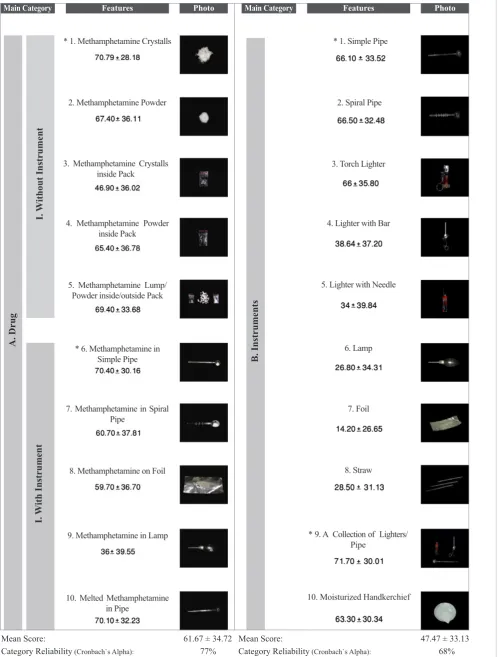
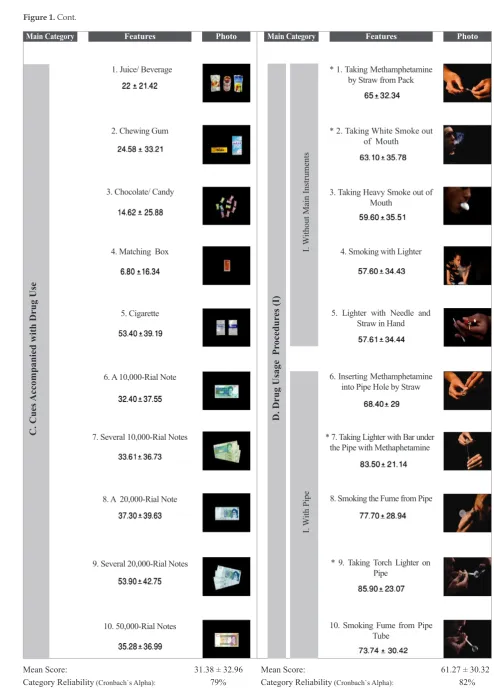
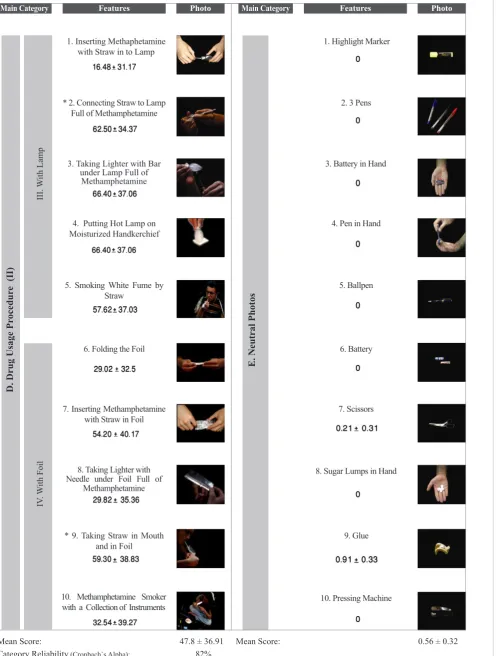
In the final phase, two less evocative pictures were omitted from each category of the 12 active or neutral cues, to reach a task with 50 evocative and 10 neutral pictures in following main categories (See details of each category in figure.1):
1. Methamphetamine outside or inside package with-out instruments (5 pictures)
2. Methamphetamine with instruments (5 pictures)
3. Instruments (10 pictures)
4. Cues accompanied with drug use, such as candies beverages, cigarette, money and etc. (10 pictures)
5. Act of abuse without a seen instrument (5 pictures)
6. Act of abuse with pipe (5 pictures)
7. Act of abuse with used lamps (5 pictures)
8. Act of abuse with foil (5 pictures)
Furthermore, 10 most evocative cues (one or two pic-tures in each category of the task) and 2 neutral picpic-tures (battery and sugar lumps in hand) were selected as the format of short pictorial task which has been marked by sign (*) in figure.1.
2.4. Statistical Analysis:
Mean scores of the 50 active cues (Long Version of Cue Induced Craving Assessment Task or CICT 50), the 10 most provocative cues (Short Version of Cue Induced
Craving Assessment Task or CICT 10) and the mean scores of each category of cues were calculated, all by descriptive methods. Demographics, profile of sub-stance abuse and risky behaviors of the subjects were also analyzed by descriptive statistical methods. Pearson correlation coefficient was calculated to determine the relationship between demographic characteristics e.g. age, years of education, monthly income and sexual ac-tivity with spouse and non-spouse with scores of CICT 50 and CICT 10 (Pearson’s correlation was applied for non normally distributed variables determined by KS test). Independent-sample T-test was used to determine the relationship between living condition, substance abuse profile, risky behaviors and first type of drug use (in the past 30 days and entire life-time) with CICT 50 and CICT 10. ANOVA was also used to determine the relation between marital and employment status with CICT 50 and CICT10. To measure the reliability of the task, Alpha Cronbach’s test was used for each category of the task, CICT 50 and CICT 10 respectively. All data were analyzed by using the SPSS-16 version.
3. Results
The subjects were all male. The mean age of the sample was 28.40 and the mean years of education were 11.32. The majority of the sample (88%) was living with fam-ily, single (46%) and approximately half of them were without employment (42%) at the time of participation in the study (See some demographic keys in Table 1).
Table 1. Details of demographics in participants (n=50).
'ĞŶĚĞƌ
;ŵĂůĞͿ 50(100.0%)
Age 28.40±7.63
ĚƵĐĂƟŽŶ
(years) 11.32±3.10
>ŝǀŝŶŐ ŽŶĚŝƟŽŶƐ
tŝƚŚĨĂŵŝůLJ 44(88.0%)
tŝƚŚĨƌŝĞŶĚƐͬĐŽů
-leagues 1(.2%)
Alone 5(10.0%)
DĂƌŝƚĂů
Status
Married 18(36.0%)
Single 23(46.0%)
^ĞƉĂƌĂƚĞĚ 1(2.0%)
Divorcee 8(16.0%)
ŵƉůŽLJŵĞŶƚ
&ƵůůƟŵĞ 15(30.0%)
^ƚƵĚĞŶƚ 2(4.0%)
WĂƌƚƟŵĞ 12(24.0%)
KƵƚŽĨǁŽƌŬ 21(42.0%)
DŽŶƚŚůLJŝŶĐŽŵĞ
Subjects had initiated methamphetamine use at mean age of 25.34, with 19.6 days of methamphetamine use in the past 30 days prior to study entry and 3.9 years methamphetamine dependence. Majority of the sample (76%) initiated serious drug use with opiates (e.g. opi-um, heroin and crystalline heroin) while some of
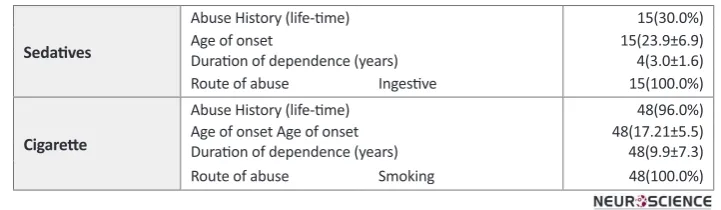
sub-jects (24%) initiated with methamphetamine. Partici-pants also had a history of using other drugs e.g. opium (76%), heroin (32.7%), crystalline heroin (59.2%), co-caine (16%), hashish (56%), alcohol (76%), tramadol (48%), ecstasy (34%), sedatives (30%) and also nico-tine (96%) (See the details in Table 2).
DĞƚŚĂŵƉŚĞƚĂŵŝŶĞ ;DĂŝŶƚLJƉĞŽĨĚƌƵŐͿ
ďƵƐĞ,ŝƐƚŽƌLJ;ůŝĨĞͲƟŵĞͿ 50(100.0%)
ŐĞŽĨŽŶƐĞƚ 50(25.34±8.5)
EŽ͘ŽĨĂďƵƐĞĚĂLJƐ;ŝŶƚŚĞƉĂƐƚϯϬĚĂLJƐͿ 50(19.6±10.1)
ƵƌĂƟŽŶŽĨĚĞƉĞŶĚĞŶĐĞ;LJĞĂƌƐͿ 50(3.9±9.5)
ZŽƵƚĞŽĨĂďƵƐĞ ^ŵŽŬŝŶŐ 50(100.0%)
ŽƐƚŽĨŵĞƚŚĂŵƉŚĞƚĂŵŝŶĞĂďƵƐĞ;ůĂƐƚŵŽŶƚŚͿ(dollars) 416.50(±262.94)
&ŝƌƐƚ,ĂƌĚƌƵŐĂƚ KŶƐĞƚ
KƉŝĂƚĞƐ 38(76.0%)
DĞƚŚĂŵƉŚĞƚĂŵŝŶĞ 12(24.0%)
KƉŝƵŵ
ďƵƐĞ,ŝƐƚŽƌLJ;ůŝĨĞͲƟŵĞͿ 38(76.0%)
ŐĞŽĨŽŶƐĞƚ 38(19.7±4.9)
ƵƌĂƟŽŶŽĨĚĞƉĞŶĚĞŶĐĞ;LJĞĂƌƐͿ 28 (5.81±5.31)
ZŽƵƚĞŽĨĂďƵƐĞ /ŶũĞĐƟŽŶ 5(13.2%)
^ŵŽŬŝŶŐ 33(86.8%)
,ĞƌŽŝŶ
ďƵƐĞ,ŝƐƚŽƌLJ;ůŝĨĞͲƟŵĞͿ 16(32.7%
ŐĞŽĨŽŶƐĞƚ 16(21.7±5.1)
ƵƌĂƟŽŶŽĨĚĞƉĞŶĚĞŶĐĞ;LJĞĂƌͿ 7(3.07±2.3)
ZŽƵƚĞŽĨĂďƵƐĞ
^ŵŽŬŝŶŐ 11(68.7%)
^ŶŝĸŶŐ 2(12.5%)
/ŶũĞĐƟŽŶ 3(18.7%)
ƌLJƐƚĂůůŝŶĞ,ĞƌŽŝŶ
ďƵƐĞ,ŝƐƚŽƌLJ;ůŝĨĞͲƟŵĞͿ 29(59.2%)
ŐĞŽĨŽŶƐĞƚ 29(24.9±7.7)
ƵƌĂƟŽŶŽĨĚĞƉĞŶĚĞŶĐĞ;LJĞĂƌƐͿ 21(2.81±2.27)
ZŽƵƚĞŽĨĂďƵƐĞ ^ŵŽŬŝŶŐ/ŶũĞĐƟŽŶ 27(98.8%)
2(1.2%)
ŽĐĂŝŶĞ
ďƵƐĞ,ŝƐƚŽƌLJ;ůŝĨĞͲƟŵĞͿ 8(16.0%)
ŐĞŽĨŽŶƐĞƚ 8(21.5±4.8)
ƵƌĂƟŽŶŽĨĚĞƉĞŶĚĞŶĐĞ;LJĞĂƌƐͿ 1(1.5±0.0)
ZŽƵƚĞŽĨĂďƵƐĞ
^ŶŝĸŶŐ 3(37.5%)
^ŵŽŬŝŶŐ 4(50.0%)
^ŶŝĸŶŐͬƐŵŽŬŝŶŐ 1(12.5%)
ĂŶŶĂďŝƐ;,ĂƐŚŝƐŚͿ
ďƵƐĞ,ŝƐƚŽƌLJ;ůŝĨĞͲƟŵĞͿ 28(56.0%)
ŐĞŽĨŽŶƐĞƚ 28(17.6±5.9)
ƵƌĂƟŽŶŽĨĚĞƉĞŶĚĞŶĐĞ;LJĞĂƌͿ 9(3.4±4.4)
ZŽƵƚĞŽĨĂďƵƐĞ ^ŵŽŬŝŶŐ 28(56.0%)
ůĐŽŚŽů
ďƵƐĞ,ŝƐƚŽƌLJ;ůŝĨĞͲƟŵĞͿ 38(76.0%)
ŐĞŽĨŽŶƐĞƚ 38(16.5±5.0)
ƵƌĂƟŽŶŽĨĚĞƉĞŶĚĞŶĐĞ;LJĞĂƌͿ 5(9.0±3.0)
ZŽƵƚĞŽĨĂďƵƐĞ /ŶŐĞƐƟǀĞ 38(100.0%)
dƌĂŵĂĚŽůdĂďůĞƚ
ďƵƐĞ,ŝƐƚŽƌLJ;ůŝĨĞͲƟŵĞͿ 24(48.0%)
ŐĞŽĨŽŶƐĞƚ 24(22.9±6.3)
ƵƌĂƟŽŶŽĨĚĞƉĞŶĚĞŶĐĞ;LJĞĂƌƐͿ 4(9.1±16.16)
ZŽƵƚĞŽĨĂďƵƐĞ /ŶŐĞƐƟǀĞ 24(100.0%)
Ecstasy
ďƵƐĞ,ŝƐƚŽƌLJ;ůŝĨĞͲƟŵĞͿ 17(34.0%)
ŐĞŽĨŽŶƐĞƚ 17(20.5±3.4)
ƵƌĂƟŽŶŽĨĚĞƉĞŶĚĞŶĐĞ;LJĞĂƌƐͿ 4(1.9±2.1)
ZŽƵƚĞŽĨĂďƵƐĞ /ŶŐĞƐƟǀĞ 17(34.0%)
A few subjects (16%) had history of injecting drug and very few (2%) reported sharing injecting syringes. History of jailing/arrest (20%) and drug dealing (38%) were also common among subjects. The majority (90%) reported positive life time history of sexual experiences.
Nearly half the sample (44%) reported extra marital sex-ual activity in the past 30 days prior to study entry and the number of condom users (16%) was small but they did not report any positive result in HIV and HCV tests (See the details in Table 3).
^ĞĚĂƟǀĞƐ
ďƵƐĞ,ŝƐƚŽƌLJ;ůŝĨĞͲƟŵĞͿ 15(30.0%)
ŐĞŽĨŽŶƐĞƚ 15(23.9±6.9)
ƵƌĂƟŽŶŽĨĚĞƉĞŶĚĞŶĐĞ;LJĞĂƌƐͿ 4(3.0±1.6)
ZŽƵƚĞŽĨĂďƵƐĞ /ŶŐĞƐƟǀĞ 15(100.0%)
ŝŐĂƌĞƩĞ
ďƵƐĞ,ŝƐƚŽƌLJ;ůŝĨĞͲƟŵĞͿ 48(96.0%)
ŐĞŽĨŽŶƐĞƚŐĞŽĨŽŶƐĞƚ 48(17.21±5.5)
ƵƌĂƟŽŶŽĨĚĞƉĞŶĚĞŶĐĞ;LJĞĂƌƐͿ 48(9.9±7.3)
ZŽƵƚĞŽĨĂďƵƐĞ ^ŵŽŬŝŶŐ 48(100.0%)
Table 2. Cont.
Table 3. Details of risky behaviors among participants (n=50).
ƌƵŐ/ŶũĞĐƟŽŶ;ůŝĨĞͲƟŵĞͿ 8(16.0%)
^ŚĂƌĞĚ/ŶũĞĐƟŶŐEĞĞĚůĞƐ;>ŝĨĞͲƟŵĞͿ 1(2.0%)
:ĂŝůŝŶŐͬƌƌĞƐƚ >ŝĨĞͲƟŵĞ 10(20.0%)
>ĂƐƚLJĞĂƌ 5(10%)
ƌƵŐĞĂůŝŶŐ >ŝĨĞͲƟŵĞ 19(38.0%)
>ĂƐƚLJĞĂƌ 3(6.0%)
WŽƐŝƟǀĞ,ŝƐƚŽƌLJŽĨ^Ğdž;ĞŶƟƌĞʹůŝĨĞƟŵĞͿ 45(90.0%)
EƵŵďĞƌŽ^ĞdžƵĂůĐƟǀŝƚLJ;ůĂƐƚŵŽŶƚŚͿ 1.86± 2.83
EƵŵďĞƌŽĨĞdžƚƌĂDĂƌŝƚĂů^ĞdžƵĂůĐƟǀŝƚLJ;ůĂƐƚŵŽŶƚŚͿ 1.30 ± 1.81
džƚƌĂDĂƌŝƚĂů^ĞdžƵĂůĐƟǀŝƚLJ;ůĂƐƚŵŽŶƚŚͿ 22(44.0%)
ŽŶĚŽŵhƐĞŝŶĞdžƚƌĂDĂƌŝƚĂů^ĞdžƵĂůĐƟǀŝƚLJ;ůĂƐƚŵŽŶƚŚͿ 8(16.0%)
DĞĚŝĐĂůdžĂŵŝŶĂƟŽŶŽĨ,/sdĞƐƚ;WŽƐŝƟǀĞƌĞƐƵůƚͿ 0(0.0%)
DĞĚŝĐĂůdžĂŵŝŶĂƟŽŶŽĨ,sdĞƐƚ;WŽƐŝƟǀĞƌĞƐƵůƚͿ 0(0.0%)
Education Monthly Income
/dϱϬ ^ĐŽƌĞƐ
ŽĞĸĐŝĞŶƚ -.092 .001 .153
WsĂůƵĞ .527 .994 .340
/dϭϬ ^ĐŽƌĞƐ
ŽĞĸĐŝĞŶƚ .019 -.212 .057
WsĂůƵĞ .898 .139 .725
Table 4. Correlations between demographics, score of cue induced craving task with 50 cues (CICT 50) and 10 cues (CICT 10) (n=50).
Table 4 shows the relationship between some demo-graphic characteristics with scores in CICT 50 and CICT 10. Pearson correlation coefficients shows no
Furthermore, ANOVA analysis, indicated no rela-tionship between marital and employment status with scores of CICT50 and CICT10 respectively. We should mention that we divided the subjects in 3 marital groups e.g. married, single and separated and in 3 employment groups e.g. full-wok, part-time and jobless for ANOVA analysis. In contrast, Living with family was associated with higher scores of CICT50 in T-test analysis with
marginal significance (p value=0.057). We should also mention that we divided the subjects in 2 family groups e.g. living with family and not living with family for statistical T-test analysis.
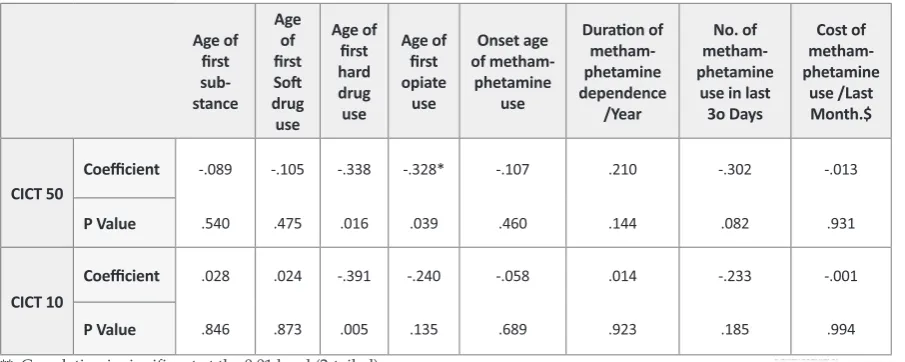
Table 5 shows negative relation between age of first hard drug use (opioid or stimulant) with CICT50 and CICT 10 and age of first opiate use with CICT50.
Table 5. Correlations between substance use details and score of cue induced craving task with 50 cues (CICT 50) and 10 cues (CICT 10) (n=50).
ŐĞŽĨ ĮƌƐƚ ƐƵďͲ ƐƚĂŶĐĞ
ŐĞ ŽĨ ĮƌƐƚ ^ŽŌ ĚƌƵŐ
use
ŐĞŽĨ ĮƌƐƚ ŚĂƌĚ ĚƌƵŐ
use
ŐĞŽĨ ĮƌƐƚ ŽƉŝĂƚĞ
use
KŶƐĞƚĂŐĞ ŽĨŵĞƚŚĂŵͲ ƉŚĞƚĂŵŝŶĞ
use
ƵƌĂƟŽŶŽĨ ŵĞƚŚĂŵͲ ƉŚĞƚĂŵŝŶĞ ĚĞƉĞŶĚĞŶĐĞ
/Year
EŽ͘ŽĨ ŵĞƚŚĂŵͲ ƉŚĞƚĂŵŝŶĞ
ƵƐĞŝŶůĂƐƚ ϯŽĂLJƐ
ŽƐƚŽĨ ŵĞƚŚĂŵͲ ƉŚĞƚĂŵŝŶĞ
ƵƐĞͬ>ĂƐƚ DŽŶƚŚ͘Ψ
/dϱϬ
ŽĞĸĐŝĞŶƚ -.089 -.105 -.338 -.328* -.107 .210 -.302 -.013
WsĂůƵĞ .540 .475 .016 .039 .460 .144 .082 .931
/dϭϬ
ŽĞĸĐŝĞŶƚ .028 .024 -.391 -.240 -.058 .014 -.233 -.001
WsĂůƵĞ .846 .873 .005 .135 .689 .923 .185 .994
&RUUHODWLRQLVVLJQLÀFDQWDWWKHOHYHOWDLOHG &RUUHODWLRQLVVLJQLÀFDQWDWWKHOHYHOWDLOHG
Table 6 shows the relationship between some risky behaviors in the past 30 days prior to study entry and scores of CICT 50 and CICT 10. Pearson correlation coefficients show no meaningful correlation between
risky behaviors e.g. number of extra marital sex and number of condom use in extra marital sex with scores of CICT 50 and CICT 10 respectively. All data in this section relate to the past 30 days prior to study entry.
EŽ͘ŽĨdžƚƌĂ DĂƌŝƚĂů^Ğdž >ĂƐƚDŽŶƚŚ
EŽ͘ŽĨ^Ğdž ǁŝƚŚ^ƉŽƵƐĞ
>ĂƐƚDŽŶƚŚ
EŽ͘ŽĨ^Ğdž >ĂƐƚDŽŶƚŚ
EŽ͘ŽĨ ĐŽŶĚŽŵ ƵƐĞ>ĂƐƚ DŽŶƚŚ
/dϱϬ^ĐŽƌĞƐ ŽĞĸĐŝĞŶƚ -.210 .120 -.074 -.164
WsĂůƵĞ .143 .408 .611 .256
/dϭϬ^ĐŽƌĞƐ ŽĞĸĐŝĞŶƚ -.152 .023 -.101 -.100
WsĂůƵĞ .292 .875 .486 .490
Table 6. Correlations between sexual activities and score of cue induced craving task with 50 cues (CICT 50) and 10 cues (CICT 10) (n=50).
Table 7 shows the relationship between the substances used in the past 30 days prior to study entry and the intensity of cue-induced craving in CICT 50 and CICT 10. The statistical analysis (independent sample T-test)
Table 8 shows the relationship between the substances used, risky behaviors (e.g. jailing/arrest, drug injection, history of sex and history of extra marital sex activity) and the first type of drug used in entire life-time and the intensity of cue-induced craving in CICT 50 and CICT 10. The statistical results (independent sample T-test) indicates, no meaning relationship between the uses of opium , heroin, crystalline heroin, hashish, sedatives in entire life-time, risky behaviors and first type of drug used in entire life time with the cue-induced craving scores of CICT 50 and CICT 10 respectively (See de-tails in Table 8).
ďƵƐĞŝŶůĂƐƚ
ϯϬĚĂLJƐ EĞŐĂƟǀĞ;/dϱϬͿ ;/dϭϬͿWŽƐŝƟǀĞ WsĂůƵĞ
ƌLJƐƚĂůůŝŶĞ
,ĞƌŽŝŶ 44(45.55) 6(37.83) .299 ĂŶŶŶĂďŝƐ
;,ĂƐŚŝƐŚͿ 44(44.35) 6(46.65) .759 ^ĞĚĂƟǀĞƐ 46(44.19) 4(49.63) .543
ďƵƐĞŝŶůĂƐƚ ϯϬĚĂLJƐ
EĞŐĂƟǀĞ ;/dϭϬͿ
WŽƐŝƟǀĞ
;/dϭϬͿ WsĂůƵĞ ƌLJƐƚĂůůŝŶĞ
,ĞƌŽŝŶ 44(67.04) 6(61.83) .451 ĂŶŶŶĂďŝƐ
;,ĂƐŚŝƐŚͿ 44(65.98) 6(69.67) .594 ^ĞĚĂƟǀĞƐ 46(66.17) 4(69.28) .708 Table 7. Comparison between score of cue induced craving task with 50 cues (CICT 50) and 10 cues (CICT 10) (n=50) among those who used other drugs or not in last month.
Table 8. Comparison between score of cue induced craving task with 50 cues (CICT 50) and 10 cues (CICT 10) among the subjects who used other drugs or not in entire life (n=50).
EĞŐĂƟǀĞ;/dϭϬͿ WŽƐŝƟǀĞ;/dϭϬͿ
Opium Abuse 12(57.92) 38(69.10) .030
Heroin Abuse 34(65.07) 16(69.29) .380
ƌLJƐƚĂůůŝŶĞ,ĞƌŽŝŶ 21(64.53) 29(67.79) .474
,ĂƐŚŝƐŚ 21(67.14) 29(65.89) .784
^ĞĚĂƟǀĞƐ 35(66.61) 15(65.97) .897
ƌƵŐ/ŶũĞĐƟŽŶ 42(67.25) 8(62.08) .398
,ŝƐƚŽƌLJŽĨƐĞdž 5(73.54) 45(65.63) .289
,ŝƐƚŽƌLJŽĨdžƚƌĂDĂƌŝƚĂů^Ğdž 27(66.57) 23(66.24) .942
&ŝƌƐƚdLJƉĞŽĨƌƵŐhƐĞ 12(57.92) 38(69.10) .030
ďƵƐĞŝŶĞŶƟƌĞůŝĨĞ EĞŐĂƟǀĞ;/dϱϬͿ WŽƐŝƟǀĞ;/dϱϬͿ WsĂůƵĞ
Opium Abuse 12(38.7937) 38(46.4657) .174
Heroin Abuse 34 (45.7187) 16(42.2990) .511
ƌLJƐƚĂůůŝŶĞ,ĞƌŽŝŶ 21(45.3067) 29(44.1304) .811
,ĂƐŚŝƐŚ 21(44.3595) 29(44.8162) .926
^ĞĚĂƟǀĞƐ 35(45.1489) 15(43.4006) .742
ƌƵŐ/ŶũĞĐƟŽŶ 42(45.8346) 8(38.2708) .251
,ŝƐƚŽƌLJŽĨƐĞdž 5(56.7815) 45(43.2736) .091
,ŝƐƚŽƌLJŽĨdžƚƌĂDĂƌŝƚĂů^Ğdž 27(46.1164) 23(42.8730) .505
Mean Score: 61.67 ±34.72 Category Reliability (Cronbach`s Alpha): 77%
Mean Score: 47.47 ±33.13 Category Reliability (Cronbach`s Alpha): 68% amine smokers with 0-100 Visual Analogue Scale (VAS). Results were presented in Mean ± Sandard Deviation. Starred pictures have been selected as a Pictorial Cues-Induced Craving Assessment Task for Methamphetamine Abusers (CICT 10)
Main Category Features Photo
A. Drug
B. Instruments
I.
W
ithout Instrument
I.
W
ith Instrument
* 1. Methamphetamine Crystalls * 1. Simple Pipe
2. Spiral Pipe
3. Torch Lighter
4. Lighter with Bar
5. Lighter with Needle
6. Lamp
7. Foil
8. Straw
* 9. A Collection of Lighters/ Pipe
10. Moisturized Handkerchief 2. Methamphetamine Powder
3. Methamphetamine Crystalls inside Pack
4. Methamphetamine Powder inside Pack
5. Methamphetamine Lump/ Powder inside/outside Pack
* 6. Methamphetamine in Simple Pipe
7. Methamphetamine in Spiral Pipe
8. Methamphetamine on Foil
9. Methamphetamine in Lamp
10. Melted Methamphetamine in Pipe
Figure 1. Cont.
Main Category Features Photo
1. Juice/ Beverage * 1. Taking Methamphetamine
by Straw from Pack
* 2. Taking White Smoke out of Mouth
3. Taking Heavy Smoke out of Mouth
4. Smoking with Lighter
5. Lighter with Needle and Straw in Hand
6. Inserting Methamphetamine into Pipe Hole by Straw
* 7. Taking Lighter with Bar under the Pipe with Methaphetamine
8. Smoking the Fume from Pipe
* 9. Taking Torch Lighter on Pipe
10. Smoking Fume from Pipe Tube
2. Chewing Gum
3. Chocolate/ Candy
4. Matching Box
5. Cigarette
6. A 10,000-Rial Note
7. Several 10,000-Rial Notes
8. A 20,000-Rial Note
9. Several 20,000-Rial Notes
10. 50,000-Rial Notes
Main Category Features Photo
D. Drug Usage Pr
ocedur
es (I)
C. Cues
Accompanied with Drug Use
I.
W
ithout Main Instruments
I.
W
ith Pipe
Mean Score: 31.38 ±32.96 Category Reliability (Cronbach`s Alpha): 79%
Figure 1. Cont.
8. Taking Lighter with Needle under Foil Full of
Methamphetamine
1. Highlight Marker
2. 3 Pens
3. Battery in Hand
4. Pen in Hand
5. Ballpen
6. Battery
7. Scissors
8. Sugar Lumps in Hand
9. Glue
10. Pressing Machine Main Category Features Photo
1. Inserting Methaphetamine with Straw in to Lamp
* 2. Connecting Straw to Lamp Full of Methamphetamine
3. Taking Lighter with Bar under Lamp Full of
Methamphetamine
4. Putting Hot Lamp on Moisturized Handkerchief
5. Smoking White Fume by Straw
6. Folding the Foil
7. Inserting Methamphetamine with Straw in Foil
* 9. Taking Straw in Mouth and in Foil
10. Methamphetamine Smoker with a Collection of Instruments
E. Neutral Photos
Main Category Features Photo
D. Drug Usage Pr
ocedur
e (II)
III.
W
ith Lamp
IV
.
W
ith Foil
Mean Score: 47.8 ±36.91 Category Reliability (Cronbach`s Alpha): 82%
4. Discussion
Methamphetamine dependence is a crucial health problem with high rates of relapse and intense craving. Although in short term, methamphetamine use increas-es energy and feeling of wellbeing but in long term, it leads to severe dependence, psychotic symptoms and cognitive problems. There is no effective medical treatment for methamphetamine use or dependence (Elkashef et al, 2008). Induced craving is a crucial in-tervening factor for drug relapse during abstinence, so evaluation and measurement of parameters associated with methamphetamine craving can be a valuable tool in the management and intervention programs related to methamphetamine use and dependence.
Craving assessment is centered on two main concepts: general baseline craving and responsiveness of the subject to be made to crave by exposure to external or internal cues. Induced craving is even more important as compared to the weaker baseline craving, but it is correlated with it, so those individuals who experience higher levels of baseline craving are more susceptible to craving induction by cues. In real life, pictorial cues are amongst the most efficient cues for craving induction and development of a series of effective visual cues is important for craving assessment in controlled labora-tory settings and for better understanding of “craving induction phenomenon”.
In this study, we designed and evaluated a visual cue-induced craving task for methamphetamine abusers with visual cues which provoked craving in subjects. The results yielded a reliable task for valid craving in-duction which demonstrates some main aspects of the diverse nature of craving and that can be used in a wide range of studies related to cue-reactivity.
This study’s findings show that cue-elicited craving (cue-reactivity) can be induced by exposing metham-phetamine-dependent subjects to a wide range of visual cues related to methamphetamine. This finding is con-sistent with other empirical findings and research results on the influential role of cues in eliciting cue-reactivity and induction (Bonson et al., 2001; See, 2002; New-ton et al., 2006; Tolliver et al., 2010) which demonstrate that cue-related stimuli evokes craving. Our findings indicate that differences in cue-induced craving were not associated with demographic variables e.g. age, sex, education, marital status and employment. This finding is in line with those of Tolliver and colleagues (2010) who showed that methamphetamine craving was sig-nificantly increased by cue-exposure but no relationship
was found between induced craving and age, gender, education, job status, treatment and days of using meth-amphetamine in the past 30 days before study entry.
In contrast, Guidalini and colleagues (2006) proposed that age, duration of addiction, lower level of educa-tion and daily drug cost are significantly correlated with cocaine use among cocaine users. However Mokri, et al (2008) did not find any correlation between craving intensity and demographic keys among intravenous heroin users but we found that the duration of opiate abuse had a negative effect on craving induction; hence we propose that as addiction progresses along its natural course by shifting from an impulsive reward directed behavior to a compulsive habit, craving responsiveness decreases. But it seems that in our current study, the pic-ture is different in methamphetamine abusers as lower age onset of drug abuse was correlated with higher level of craving responsiveness. Hence the effects of demo-graphic features and substance abuse related variables should be investigated further in future research.
Our study also provides a valuable bank of effective and ecologically validated pictures for methamphet-amine for the first time in the Middle-East and Central Asia. Black-back pictures provided, are beneficial for task design for behavioral and fMRI studies on craving. Furthermore, the intensity of cue reactivity reported by subjects could be showed as a treatment outcome pre-dictor in future studies and clinical practice. These cues could be used in cue desensitization studies to evalu-ate the effectiveness of this treatment paradigm among methamphetamine abusers.
Our visual induced-craving assessment task had the potential to cause relapse among the subjects; so cue ex-posure and craving assessment could have had serious implications for in-treatment subjects. Because of the possibility of relapse, we had to offer brief psychologi-cal intervention to reduce craving and lead it to base-line after cue-exposure sessions. Some of the subjects were not basically cue reactive and this was another challenge we faced, similar to what has been noted in similar stud-ies (Avants et al., 1995). Non reactivity to cues may be due to non - motivational cognitive approaches toward cues (Avants et al., 1995) so it should be regarded as a real phenomenon at least in some cases, not just a denial to response.
awareness about drugs of abuse and mounting these post-ers in treatment clinics (the problem that we have now with some of the posters designed and distributed by UN office for drug and crime (UNODC) with Iranian minis-try of Health support) could enhance craving among in-treatment patients and potentiate the relapse.
We acknowledge that our study had some limitations. First, the assessment and measurement of craving in-tensity was based on subjects self reports and it may be subject to denial and unreliable reports although they were highly motivated to report their subjective desires by our professional and trained interviewers. Second, although reliability of the task was accurately measured by psychometric parameters the same was not true of the task validity.
With high reliability, efficiency and feasibility, the proposed assessment task can help to gain a better un-derstanding of the dimensions of methamphetamine craving. Cross validation with other craving assessment measures such as different craving self reports, semantic craving induction tasks by drug related words, or crav-ing induction tasks with imaginary scripts or parapher-nalia and/or more objective measures such as addiction modified stoop tasks and dot probe tasks could be use-ful next steps. Using the prepared visual cues and tasks for neuroimaging studies (fMRI) of methamphetamine craving neurocircuits or craving modification stud-ies through transcranial magnetic stimulation (rTMS) or transcranial direct current stimulation (tDCS) tech-niques are among our plans for future research.
In conclusion, through this study, we have provided a pictorial task for the evaluation and measurement of subjective craving in a group of current Iranian meth-amphetamine smokers by using visual cues that induce craving. We also identified a list of most potent visual stimuli for this purpose. The findings let researchers as-sess cue-induced craving among methamphetamine us-ers with an acceptable reliability and validity.
Acknowledgment
Authors wish to thank Miss. Haleh Ghorbani for her helpful assistance in designing tables and Mr. Alireza Tavosi for his valuable cooperation with the photogra-phy team.
References
Abrams, D.B. (2000). Transdisciplinary concepts and meas-ures of craving: commentary and future directions. Addic-tion, 95, 237-246.
Avants, S.K., Margolin, A., Kosten, T.R., & Cooney, N.L. (1995). Differences between responders and nonresponders to cocaine cues in the laboratory. Addictive Behaviors, 20, 215-224.
%DXPDQ61HII&)HW]LFN66WDQJO*%DVOHU/9HUH -neck, R., & Schneider, W. (2003). A virtual reality system for neurobehavioral and functional MRI studies. Cyber Psy-chology and Behavior, 6, 259-266.
Bonson, K.R., Grant, S.J., Contoreggi, C.S., Links, J.M.,
Met-FDOIH-:H\O+/.XULDQ9(UQVW0 /RQGRQ('
(2002). Neural systems and cue-induced cocaine craving. Neuropsychopharmacology, 26, Avaliable online at: www.
DFFQSRUJFLWDWLRQV1SS
Chiamulera, C. (2005). Cue reactivity in nicotine and tobacco dependence: a multiple action model of nicotine as a prima-ry reinforcement and as an enhancer of the effects smoking-associated stimuli. Brain Res Rev,48,74-97.
Drummond, D.C. (2000). Human models in craving research, Addiction, 95, 129-144.
Drummond, D.C. (2001). Theories of drug craving, ancient and modern. Addiction, 96, 33-46.
Ekhtiari H., Behzadi A.,Edalati, H., Mokri A. (2006) Cue In-duced Craving among Iranian Intravenous Heroin Users, New Advances in Cognitive Sciences, 2, 62-71.
Ekhtiari, H., Edalati, H., Behzadi, A., Safaei, H., Noori, Mehri., & Mokri, A., (2008). Designing and evaluation of reliability
RIÀYHYLVXDOFXHLQGXFHGFUDYLQJWDVNVIRUGLIIHUHQWJURXSV
of opiate abusers. Iranian Journal of Psychiatry and Clinical Psychology, 14, 337-349.
(ONDVKHI$9RFFL)+DQVRQ*:KLWH-:LFNHQV:
Tiihonen, J. (2008). Pharmacotherapy of methamphetamine: An update. Substance Abuse, 29, 31-49.
Fox, H.C., Talih, M., Malison, R., Anderson, G.M., Kreek, M.J. & Sinha, R. (2005). Frequency of recent cocaine and alcohol use affects drug craving and associated responses to stress and drug-related cues. Psychoneuroendocrinology, 30, 880-891.
)UDQNHQ,+$'H+DDQ+$9DQ'HU0HHU&:+DII
-PDQ30- +HQGHULNV90&XHUHDFWLYLW\DQG
effects of cue exposure in abstinent post treatment drug us-ers. Substance Abuse Treatment, 16, 81-85.
)UDQNHQ,+$+HQGULNV906WDP&- 9DQGHQ%ULQN
W. (2004). A role for dopamine in the processing of drug cues in heroin dependent patients. European Neuropsy-chopharmocology, 14, 503-508.
Hartz, D.T., Fredrick-Osborne, S.L., Galloway, G.P. (2001). Craving predicts use during treatment for methampheta-mine dependence: A prospective repeated-measures, within subject analysis. Drug and Alcohol Dependence, 63, 269-276.
+HLQ]H0:ROÁLQJ.*UXVVHU60&XHLQGXFHG
auditory evoked potentials in alcoholism. Clinical
Neuro-SK\VLRORJ\ZZZHOVHYLHUFRP/RFDWHFOLQSK
Heishman,S.J., Boas, Z.P., Hager, M.C., Taylor, R.C., Single-ton, E.G.,& Moolchan, E.T. (2006). Effects of tobacco craving cues on memory encoding and retrieval in smokers. Addic-tive Behavior, 31, 116-121.
Kuntze, M.F., Stoermer, R., Mager, R., Roessler, A., Mueller Saphan, F., Bullinger, A.H. (2001). Immersive virtual envi-ronment in cue exposure. Cyber Psychology and Behavior, 4, 497-501
Lee, J., Lim. Y., Graham, S.J., Kim, G., Wiederhold, B.K., Wied-erhold, M.D. (2004). Nicotine craving and cue exposure therapy by using virtual environments. Cyber Psychology and Behavior , 7, 705-713.
McLellan, A. T., Kushner, H., Metzger, D., Peters, R., Smith, I., Grissom, G., Pettinati, H., & Argeriou, M. (1992). The Fifth Edition of the Addiction Severity Index. Substance Abuse Treatment, 9, 3, 199-213.
Mokri, A., Ekhtiari, H., Edalati, H. & Ganjgahi, H. (2008). Re-lationship between degree of craving and different dimen-sions of addiction severity in heroin intravenous users. Psy-chiatry and Clinical Psychology, 14, 298-306.
Newton, T.F., Roache, J.D., De La Garza, II R., Fong, T., Wal-lace, C.L., Li Shou, H., Elkashef, A., Chiang, N. K. R. (2006). Bupropion reduces methamphetamine-induced subjective effects and cue-induced craving. Neuropsychopharmocol-ogy, 3, 1537-1544.
Ryan, J.J., Kreiner, D.S., Chapman, M.D., Stark Wroblewski,
. 9LUWXDO UHDOLW\ FXHV IRU EHLQJH GULQNLQJ LQ FRO -lege students. ,Cyber Psychology and Behavior.
Avail-DEOH DW KWWSZZZOLHEHUWRQOLQHFRPGRLDEV
cpb.2009.0211
Saladin, Mi.E., Brady, K.T., Graap, K. & Olasov Rothbaum, B.(2006). A preliminary report on the use of virtual reality technology to elicit craving and cue reactivity in cocaine de-pendent individuals. Addictive Behavior, 31, 1881-1894.
Sayette, M.A., Shiffman, S., Tiffany, S.T., Niaura, R.S., Martin, C.S., Shadel, W.G. (2000). The measurement of drug crav-ing. Addiction, 95, 189-210.
Sayette, M.A., Shiffman, S., Tiffany, S.T., Niaura, R.S., Martin, C.S. & Shadel, W.G. (2000). The measurement of drug crav-ing. Addiction, 95, 189-210.
See, R.E. (2002). Neural substrates of conditioned-cue relapse to drug-seeking behavior. Pharmacology, Biochemistry and Behavior, 71, 517-529.
Tiffany, S.T., Carter, B.L., & Singleton, E.G. (2000). Challenges in the manipulation, assessment and interpretation of crav-ing relevant variables. Addiction, 95, 177-187.
Toliver, B.K., McRae-Clark, A.L., Saladin, M., Price, K.L., Simpson, A.N., DeSantis, S.M., Baker, N.L., Brady, K.T. (2010). Determinants of cue-elicited craving and physi-ologic reactivity in Methamphetamine-dependent subjects in the laboratory. Drug and Alcohol Abuse, 36, 106-113.
Tong, C., Bovbjerg, D.H.& Erblich, J. (2007). Smoking-related videos for use in cue-induced craving paradigms. Addic-tive Behaviors, 32, 3034-3044.
UNODC (2009) World Drug Report 2008, New York, US.
9DQ*XFKW'9DQVWHHQZHJHQ'9DQGHQ%%HFNHUV7
(2008). Conditioned craving cues elicit an automatic ap-proach tendency. Behavioral Res Theories, 46, 1160-1169.
Yu Re, Z., Shi, J., Epstein, D.H., Wang, J. & Lu, L. (2009). Ab-normal pain response in pain-sensitive opiate addicts after prolonged abstinence predicts increased drug craving. Psy-chopharmocology, 204,423-429.