203
Int J Res Med. 2013; 2(2);203-206 e ISSN:2320-2742 p ISSN: 2320-2734MATRIX METALLOPROTEINASES: DO YOU KNOW THEM?
Dharmesh Vasavada
1*, Aditi Dholakia
21
Senior Lecturer Department of Oral Pathology M P Dental College and Hospital, Vadodara, 2 Assistant Professor Department of Pathology, Gotri Medical College, Vadodara.
INTRODUCTION
MMPs were identified in vertebrates in 1962 by Jerome Gross and Charles M Lapiere who both studied degradation of triple helical collagen during tadpole tail metamorphosis (Clinical importance of MMPs). They found an active enzyme in the culture media of tissue fragments of tail fin skin that degraded the triple helix of native type I collagen.1 Matrix Metalloproteinases (MMPs) form an important family of metal-dependent endopeptidases that represent the major class of enzymes responsible for degradation of extracellular matrix (ECM) components. Collectively, MMPs are capable of degrading all ECM proteins. All family members are secreted as inactive proenzymes (zymogens) and are thought to be activated in the tissue by cleavage of the propeptide. All MMPs contain Zn2+ at the catalytic site and, in addition, require Ca2+ for stability and activity.1 Approximately 20 types of MMPs have been identified which are classified according to the pre-synthetic region on chromosomes and substrate specificities. They are labelled with numbers ranging from MMP-1 to MMP-28.
*Corresponding Author
Dr. Dharmesh Vasavada Department of Oral Pathology,
M P Dental College & Hospital , Vadodara, Gujarat, India.
E mail: [email protected]
They are classified into five sub-groups according to functionality and on the basis of their putative substrate specificity and internal homologies as collagenases, stromylisins, matrilysins, gelatinases, membrane associated MMP’s and MMP’s with no group designation.2 The members of the MMPs family are organized into three basic, distinctive, and well-conserved domains based on structural considerations: aminoterminal propeptide, catalytic domain, hemopexinlike domain at the carboxy-terminal (Figure 1). Though structural difference exist between MMPs, all MMPs require zinc and calcium ions to support their enzymatic activity. The enzyme is divided into three domains, N-terminal propeptide, catalytic domain and C- terminal domain.1
Classification
Based on the substrate specificity MMPs are classified into the following types: 3
1. Collagenases
MMP-1 (collagenase-1, interstitial collagenase) MMP-8 (collagenase-2, neutrophil collagenase) MMP-13 (collagenase-3)
2. Gelatinases
MMP-2 (gelatinase A, 72-kDa gelatinase) MMP-9 (gelatinase B, 92-kDa gelatinase)
3. Stromelysins
MMP-3 (stromelysin-1) MMP-10 (stromelysin-2) MMP-11 (stromelysin-3) MMP-12 (metalloelastase)
4. Matrilysins
MMP-7 (matrilysin, PUMP-1)
REVIEW ARTICLE
ABSTRACT
Matrix metalloproteinases (MMPs) are an important family of zinc-dependent endopeptidases that mediate the extracellular matrix (ECM) degradation. The controlled and co-ordinated synthesis, breakdown and remodeling of the extracellular matrix (ECM) are critical events in normal physiological conditions like embryonic development, wound healing and angiogenesis that are brought about by MMPs. These enzymes have also been implicated in pathologic oral processessuch as periodontal tissue destruction, root caries, tumor invasion. MMPs are excreted by a variety of connective tissue and pro-inflammatory cells including fibroblasts, osteoblasts, endothelial cells, macrophages, neutrophils, and lymphocytes. Currently 28 MMP genes have been identified in humans, and most are multidomain proteins. This review describes the members of the MMPs family and discusses substrate specificity, domain structure and function, the activation of proMMPs, the regulation of matrixin activity by tissue inhibitors of metalloproteinases, and their pathophysiological implication.
203
Int J Res Med. 2013; 2(2);203-206 e ISSN:2320-2742 p ISSN: 2320-2734MMP-26 (matrilysin-2)
5. MT-MMPs (Membrane type)
MMP-14 (MT1-MMP) MMP-15 (MT2-MMP) MMP-16 (MT3-MMP) MMP-17 (MT4-MMP) MMP-24 (MT5-MMP) MMP-25 (MT6-MMP)
6. Other MMPs
MMP-18 MMP-19
MMP-20 (enamelysin) MMP-21
MMP-23 MMP-27
MMP-28 (epilysin)
Regulation of MMPs
The activity of the MMPs is regulated at multiple levels including transcription, activation and inhibition.
Transcriptional regulation
At the level of transcription, cytokines and growth factors like TNF-á, IL-1, EGF, bFGF and PDGF can induce the production of MMPs, depending on the situation and cell type. Certain hormones (parathormone , progesterone, glucocorticoids), chemical agents (phorbol esters) as well as cell–cell and cell–matrix interactions can induce or repress the expression of MMPs.3
Proenzyme activation
MMPs are usually produced in latent, non-active form called zymogen. Activation is required for the enzyme function which involves removal of the prodomain. This can be achieved by several proteolytic enzymes, including serine proteinases together with other MMPs.
Inhibitors And Inhibition Of MMP Activity
In the extracellular matrix (ECM), the activity of MMP is controlled by specific inhibitors known as tissue inhibitors of MMPs (TIMPs). TIMPs are small, multi-functional proteins that regulate MMP function both at the level of their activation and in their ability to hydrolyze a particular substrate. Four members of TIMP family have been so far described (TIMP1, TIMP2, TIMP3, TIMP4).1 It is recognized that a pathological breakdown of the ECM can be installed if there is excess of MMP activity in the tissue. The balance between production of MMPs and TIMPs represents a critical point to maintain the homeostasis of the ECM.5 For this reason; there is a great interest in
the development of synthetic inhibitors of MMP, which could be used in medical therapy. Most attention has been given to zinc chelating agents.1 A number of 'second generation' orally bioavailable MMP inhibitors have been evaluated in the clinic. The principal indications for which MMP inhibitors have been evaluated in the clinic are arthritis and cancer. A key issue with several of these agents is the dose limiting side effect of musculoskeletal pain and inflammation.6The ability of MMP inhibitors to restrict invasive tumor growth and metastasis has been demonstrated in a wide variety of animal cancer models.
Role Of Matrix Metalloproteinases
Matrix Metalloproteinases are expressed in response to specific stimuli by resident connective tissue cells as well as the major inflammatory cell types that invade the tissue during remodeling events.7 Evidences for the role of any particular metalloproteinase in a pathological process is provided by findings as the presence of metalloproteinase mRNA in lesional cells and activity of MMPs in lesions.8 Evidences suggest that collagenases could have a fundamental role during ECM degradation since these enzymes have the unique ability to cleave type I collagen that will be further degraded by others proteinases. It is believed that the multiplicity of MMP forms underlines the extreme importance of these enzymes for the maintenance and repair of the ECM.For tumor cells to metastasize, it produces MMPs in order to break away from its neighbours, force its way into the surrounding stroma, and penetrate the basement membrane.
MMPS and Oral Environment
204
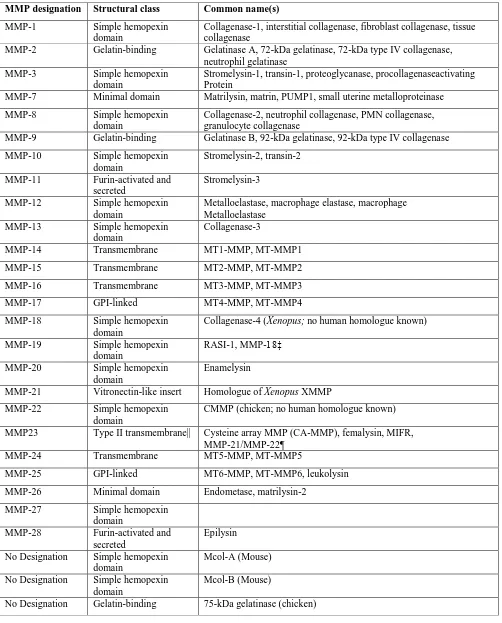
Int J Res Med. 2013; 2(2);203-206 e ISSN:2320-2742 p ISSN: 2320-2734 Table 1: The matrix metalloproteinase family 4MMP designation Structural class Common name(s)
MMP-1 Simple hemopexin
domain
Collagenase-1, interstitial collagenase, fibroblast collagenase, tissue collagenase
MMP-2 Gelatin-binding Gelatinase A, 72-kDa gelatinase, 72-kDa type IV collagenase,
neutrophil gelatinase
MMP-3 Simple hemopexin
domain
Stromelysin-1, transin-1, proteoglycanase, procollagenaseactivating Protein
MMP-7 Minimal domain Matrilysin, matrin, PUMP1, small uterine metalloproteinase
MMP-8 Simple hemopexin
domain
Collagenase-2, neutrophil collagenase, PMN collagenase, granulocyte collagenase
MMP-9 Gelatin-binding Gelatinase B, 92-kDa gelatinase, 92-kDa type IV collagenase
MMP-10 Simple hemopexin
domain
Stromelysin-2, transin-2
MMP-11 Furin-activated and
secreted
Stromelysin-3
MMP-12 Simple hemopexin
domain
Metalloelastase, macrophage elastase, macrophage Metalloelastase
MMP-13 Simple hemopexin
domain
Collagenase-3
MMP-14 Transmembrane MT1-MMP, MT-MMP1
MMP-15 Transmembrane MT2-MMP, MT-MMP2
MMP-16 Transmembrane MT3-MMP, MT-MMP3
MMP-17 GPI-linked MT4-MMP, MT-MMP4
MMP-18 Simple hemopexin
domain
Collagenase-4 (Xenopus; no human homologue known)
MMP-19 Simple hemopexin
domain
RASI-1, MMP-18‡
MMP-20 Simple hemopexin
domain
Enamelysin
MMP-21 Vitronectin-like insert Homologue of Xenopus XMMP
MMP-22 Simple hemopexin
domain
CMMP (chicken; no human homologue known)
MMP23 Type II transmembrane|| Cysteine array MMP (CA-MMP), femalysin, MIFR,
MMP-21/MMP-22¶
MMP-24 Transmembrane MT5-MMP, MT-MMP5
MMP-25 GPI-linked MT6-MMP, MT-MMP6, leukolysin
MMP-26 Minimal domain Endometase, matrilysin-2
MMP-27 Simple hemopexin
domain
MMP-28 Furin-activated and
secreted
Epilysin
No Designation Simple hemopexin domain
Mcol-A (Mouse)
No Designation Simple hemopexin domain
Mcol-B (Mouse)
205
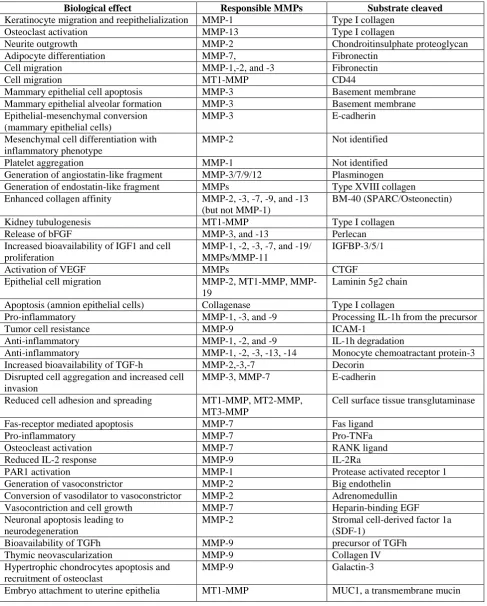
Int J Res Med. 2013; 2(2);203-206 e ISSN:2320-2742 p ISSN: 2320-2734 Table 2: Biological activities mediated by MMP cleavage 5CONCLUSION
This review provides basic information about MMPs and their role in matrix degradation. More research and studies are required to understand their role in both physiological and pathological process. Progress have been made in this area by biochemical studies of MMPs and their 3D
structures that have provided the molecular basis for understanding of how these multi-domain proteinases function and interact with ECM molecules and inhibitors. Structural and functional studies have also provided with clues as to how to manipulate their enzymatic activities. Based on those studies a large number of MMP
Biological effect Responsible MMPs Substrate cleaved
Keratinocyte migration and reepithelialization MMP-1 Type I collagen
Osteoclast activation MMP-13 Type I collagen
Neurite outgrowth MMP-2 Chondroitinsulphate proteoglycan
Adipocyte differentiation MMP-7, Fibronectin
Cell migration MMP-1,-2, and -3 Fibronectin
Cell migration MT1-MMP CD44
Mammary epithelial cell apoptosis MMP-3 Basement membrane
Mammary epithelial alveolar formation MMP-3 Basement membrane
Epithelial-mesenchymal conversion (mammary epithelial cells)
MMP-3 E-cadherin
Mesenchymal cell differentiation with inflammatory phenotype
MMP-2 Not identified
Platelet aggregation MMP-1 Not identified
Generation of angiostatin-like fragment MMP-3/7/9/12 Plasminogen
Generation of endostatin-like fragment MMPs Type XVIII collagen
Enhanced collagen affinity MMP-2, -3, -7, -9, and -13
(but not MMP-1)
BM-40 (SPARC/Osteonectin)
Kidney tubulogenesis MT1-MMP Type I collagen
Release of bFGF MMP-3, and -13 Perlecan
Increased bioavailability of IGF1 and cell proliferation
MMP-1, -2, -3, -7, and -19/ MMPs/MMP-11
IGFBP-3/5/1
Activation of VEGF MMPs CTGF
Epithelial cell migration 2, MT1-MMP,
MMP-19
Laminin 5g2 chain
Apoptosis (amnion epithelial cells) Collagenase Type I collagen
Pro-inflammatory MMP-1, -3, and -9 Processing IL-1h from the precursor
Tumor cell resistance MMP-9 ICAM-1
Anti-inflammatory MMP-1, -2, and -9 IL-1h degradation
Anti-inflammatory MMP-1, -2, -3, -13, -14 Monocyte chemoatractant protein-3
Increased bioavailability of TGF-h MMP-2,-3,-7 Decorin
Disrupted cell aggregation and increased cell invasion
MMP-3, MMP-7 E-cadherin
Reduced cell adhesion and spreading MT1-MMP, MT2-MMP,
MT3-MMP
Cell surface tissue transglutaminase
Fas-receptor mediated apoptosis MMP-7 Fas ligand
Pro-inflammatory MMP-7 Pro-TNFa
Osteocleast activation MMP-7 RANK ligand
Reduced IL-2 response MMP-9 IL-2Ra
PAR1 activation MMP-1 Protease activated receptor 1
Generation of vasoconstrictor MMP-2 Big endothelin
Conversion of vasodilator to vasoconstrictor MMP-2 Adrenomedullin
Vasocontriction and cell growth MMP-7 Heparin-binding EGF
Neuronal apoptosis leading to neurodegeneration
MMP-2 Stromal cell-derived factor 1a
(SDF-1)
Bioavailability of TGFh MMP-9 precursor of TGFh
Thymic neovascularization MMP-9 Collagen IV
Hypertrophic chondrocytes apoptosis and recruitment of osteoclast
MMP-9 Galactin-3
206
Int J Res Med. 2013; 2(2);203-206 e ISSN:2320-2742 p ISSN: 2320-2734inhibitors have been designed and synthesized and some were clinically tested for the treatment of patients with cancer but they showed little efficacy so far. The importance and role of MMPs have to be understood and accordingly new inhibitors of MMPs have to be invented to control the pathological activity of MMPs in events such as dental caries, periodontal breakdown and tumor progression.
REFERENCES
1. Souza A P de, LINE S R P. The Biology of Matrix Metalloproteinases. Rev. FOB 2002; 10(1):1-6.
2. Krizkova S, Zitka O, Masarik M et al. Clinical Importance of Matrix Metalloprotiens. Bratisl Lek Listy 2011; 112(8): 435-440.
3. Varun BR, Bindu J, Nair Sivakumar TT, Anna P Joseph. Matrix Metalloproteinases And Their Role In Oral Diseases: A Review. Oral & Maxillofacial Pathology Journal 2012; 3(1); 186-191
4. Mikala Egeblad and Zena Werb. New Functions for the Matrix Metalloproteinases In Cancer Progression. Cancer 2002; 2:161-174.
5. Hideaki Nagase a, Robert Visse a, Gillian Murphy. Structure and function of matrix metalloproteinases and TIMPs. Cardiovascular Research 69 (2006):562 – 573.
6. Mark Whittaker, Andrew Ayscough. Matrix Metalloproteinases and their Inhibitors –Current Status and Future Challenges. Cell transmissions Vol. 17 No. 1Lisa J McCawley and Lynn M Matrisian.Matrix metalloproteinases: they’re not just for matrix anymore. Current Opinion in Cell Biology 2001, 13:534–540.
7. Birkedal-Hansen H. Role of matrix metalloproteinases in human periodontal diseases. J Periodontal 1993; 64:474-84.
8. Krane SM. Clinical Importance of metalloproteinases and their inhibitors. Ann NY Acad Sci 1994; 732:1-10.
9. Hayakawa T. Matrix metalloproteinases (MMPs) and tissue inhibitors of metalloproteinases (TIMPs) in development and disease of oral tissues. Dent in Japan 1998; 34:167-77.
10. Van der Zee E, Everts V, Beertsen W. Cytokine-induced endogenous procollagenase stored in the extracellular matrix of soft connective tissue results in a burst of collagen breakdown following its activation. J Peridontol Res 1996; 3:483-488. 11. Robert Visse and Hideaki Nagase.Matrix
Metalloproteinases and Tissue Inhibitors of Metalloproteinases : Structure, Function, and Biochemistry.Circ Res. 2003; 92:827-839. 12. Ekaterina Morgunova, Ari Tuuttila, Ulrich