Copyright © 2012 IJECCE, All right reserved
Proposal of a Law Behavior Model for High
Performance Concrete in Uniaxial Compression
Mbessa Michel, Lezin Seba Minsili, Fokwa Didier, Acka Kroa, Bwemba Charles, Agu
Henry Tata and Tamo Tatietse Thomas
Email ID : [email protected]
Abstract - The mechanical behavior model of high performance concrete (hpc) in simple compression proposed in this article is a phenomenological model, based on considerations and physico-mechanical hypotheses and the observations made at the time of the tests, for a simple and convenient application.
This modelling uses the Young modulus of Young of Mbessa [8], descended of the model of Voigt (mixing law) while considering after justification, the concrete like a biphasic material (mortar and coarse aggregate). The model integrates the coefficient of shape of the coarse aggregate and, the absence of a transition zone (halo) constitutes a pledge for the hypothesis of "non-slip" between the two phases. The modulus is validated on a formulation of hpc made with slag [8].
Keywords - Model, behavior law, Young modulus, high performance concrete, mixing law, simple compression, shape coefficient, biphasic material.
I. I
NTRODUCTIONThe modeling of the mechanical behavior of a material generally succeeds to the establishment of a law behavior of the shape f(,)0. This law honest eventually all the mechanical and elastic characteristics of the material and function of the analysis and observations made at the time of the tests. It is in fact about an equation translating the mechanical behavior of the material when it is submitted to a solicitation. The establishment of this law will be especially complex than it will be about the dimension 1, 2, or 3 or that the mechanical behavior of the material will be to one or several successive phases: linear elastic, linear non elastic, non linear plastic, plastic and post-peak if necessary.
Two big and main ways are to follow when one wants to make this kind of survey [5]: the phenomenological method and the micromechanical method. The choice of the method takes into account the user of the model (laboratory, study office or building site).
In the goal to study the mechanical behavior of the hpc, when one observes the phenomena that take place at the time of the mechanical tests and the constraint- deformation curves of the literature [2], [3], [4] and [7], the first intuition is to consider a linear law of the shape = E . However, even though this simplification is made, it is necessary to bring a justification that obliges the author of such a decision therefore to try beforehand to understand the physico-mechanical phenomena that govern the complete break of the material.
II. M
ECHANICALT
ESTING ANDG
ENERALC
ONDITIONSWhen one wants to build a model of behavior of a material, it is first necessary to define a framework for the comprehension tests and interpret the phenomena leading to the complete failure of the structure.
If the rigidity of the press is not a requirement in the case of ordinary concrete, it is a very important when required to test high performance concrete whose characteristic resistances at 28 days are above 100 MPa. This requirement becomes even greater than the specimen dimensions are.
For cylindrical
Specimens 11x22cm, a press capacity of 2500 KN was used at ENTPE Lyon in France.
The method of surfacing is also very important to the success of the test. Two methods were used: i) the simple-lapping and ii) over- lapping the high performance surfacing sulfur.
The results in Table 1 and the observations made during the tests, show that the best results are obtained by simple lapping.
The lapping device (fig. 1) is a machine provided with a diamond wheel which allows for the cutting of the ends of the specimen to be flat and parallel. However when tested, it should ensure proper centering of the specimen between the plates of the press. At 10 MPa load (for example) should also verify that the top plate of the press is properly fitted to the specimen, ie, the contact tube / tray is perfect. In general, if at 25 Mpa loading there was no reported phenomenon of spalling or cracking was not issued, it is a "sign of success of the trial."The result "is more likely" to be characteristic of the resistance of the sample tested.
Copyright © 2012 IJECCE, All right reserved When the sulfur resurfacing is made after lapping, it is
possible to modify the parallelism of the end surfaces of the cylinders, because of the existence of the side surface defects induced by the shrinkage and the action of release of the molding specimens. Indeed, the surfacing process used does not permit the obtention of extremely parallel surfaces given that the initially lateral surface is not regular. If such a specimen is subjected to a compression test, there is initially an alignment adjustment by the press plates characterized by a differential collapse (deformation) and early flaking.
In all cases, the success of a trial is the result of good technical surfacing coupled with maximum rigor in the testing procedure.
Table I presents the results of compression test on cylindrical specimens 11x22 cm at 28 days old:
Table I. Test results of uniaxial compression High Performance Concrete cylinders11x22 cm
Formulation
Compression resitance at 28 days (MPa)
Simple lapping
lapping + sulfur Surfacing
Metakaolinite 129 105
Slag 123 98
Silica fume 95 83
III. P
HYSICALM
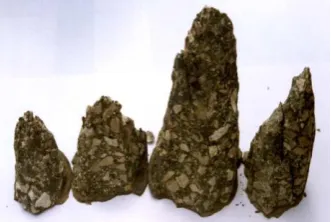
ECHANISMSThe observation of a specimen of High Performance Concrete presents broken concrete pieces larger or smaller (on the scale of the sample) and of highly varied geometry. This seems to be the result of scaling, an abrupt fragmentation, explosion ... In short, the result is not always the same on a series of specimens observed but usually we get two cones (one lower and one higher) as can be seen in Fig. 2.
Fig.2. Specimen of High Performance Concrete after rupture
Before loading, the material is the seat of the physico-mechanical phenomenon due to shrinkage of cement paste (applying stress of the granular skeleton partially preventing the withdrawal, induction of a heterogeneous stress field, microcracking in the dough ... ) [1].
In the presence of longitudinal compression, in a first phase, tensile stresses will develop in the mortar; there is gradual release of local stress due to shrinkage. Due to the increased fragility of the material, the development of microcracks existing outweighs the new creation. These
microcracks will therefore increase with the macroscopic stress and with a preferentially vertical orientation. The randomness of the distribution of microcracks is strongly related to the heterogeneity induced by the above mentioned phenomena. The halo transition has decreased significantly [9] the crack bypasses most aggregates, it passes through them interchangeably. These cracks will join to form macro cracks limiting in the specimen of "columns" of dimensions and varied geometry. Microcracking is accompanied by small columns in flexure responsible for longitudinal and transverse deformations of the specimen and increased lengths of "columns" randomly distributed. Moreover, shrinking induces a confinement in a conical volume in the cylinder head which is well regarded as a stack of "columns" undamaged, recessed on both ends.
The first idea would be to study the phenomenon by the theory of Euler. Thus, when the critical load is not yet reached in the less favorable column, the deformation can be canceled after removal of the load. However, the mutual interference of columns prevents an "Eulerian buckling" [6] without of course reducing the strength of the material.
If we focus on stress-strain curves of the literature, we notice that the stress continues to increase until failure, which is normal because the specimen is considered as a stacking of columns embedded at their ends. The dominant phenomena and prior fracture are vertical cracking and bending of the columns, hence the absence of a softening behavior (decreased effort as a function of longitudinal displacement) observed in conventional concretes and induced the creation of horizontal cracks (contour aggregates). However, the effect of the mutual interference of columns induces a displacement of the crack edges and falling scrap material thereby preventing the reclosing of all the cracks. We can distinguish two main phases up to failure: a linear elastic and nonlinear elastic another, without returning to zero.
IV. V
ALIDATION OFT
HEM
ODELB
EHAVIOR4.1. Elastic linear Phase
It goes to the limit of elastic deformation e = c (with 0<<1).
The Law of behavior in this phase is:
= EbThe yield stress is given by the formula:
=e=Eb cWhere:
Eb is the Young's modulus of concrete and a characteristic representing the ratio of the elastic deformation to the total deformation at the failure. It is called elastic deformation coefficient. Some authors [2] are unanimous on the range of its variation
). 9 . 0 85 . 0
( It is given by the formula:
c e
/4.2. Non-linear elastic phase
Copyright © 2012 IJECCE, All right reserved the relative increase in the volume of the cylinder (due to
bending of columns) only seen in the direction of the load. We can write:
b c
e e
b E
E d
d
1
Therefore:
e
d Eb c e
) (
e c b
e E
ln
c c
b
E
( ) 1 ln
Consider then the stress at break:
) ln 1
(
cEb c 4.3. Simulation of the behavior of High
Performance Concrete in simple compression
4.3.1. Testing and test conditions
The compression test was conducted on a press of 1250 KN servo move. The press has a defect of non- adherence of the two plates to the supports. Landslides are likely to appear during the test and cause eccentric compression.
The specimens are cylindrical and dimensions 7x14 cm. They are equipped with a symmetrical manner, by two ohmic gauges of type 50/120LY41 whose characteristics are shown in Table II.
Table II. Characteristics of the gauges
() K (%) (10-6 /°C)Ts (%) Tc(10-6 /°C)
1200,3 2,091 10,8 -0,2 1040,3
() : Resistance, K : Gauge factor, : Compensation of the temperature, Ts:Transerse sensibility, Tc: Temperature coefficient
4.3.2. Stress-strain curves
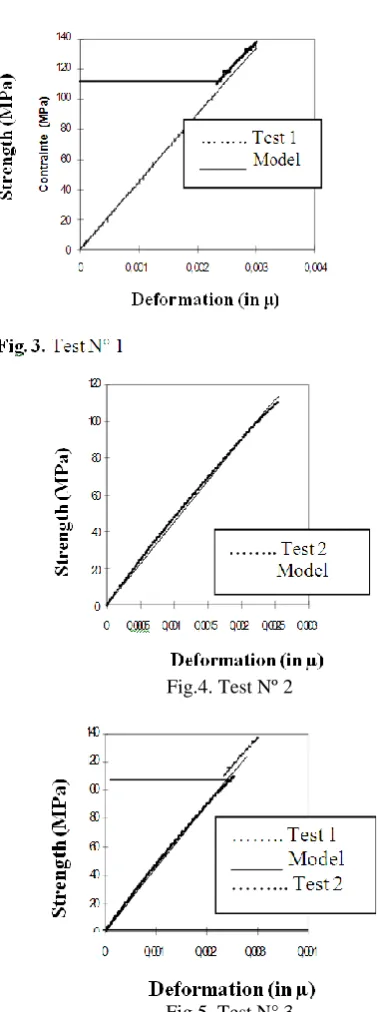
The tests performed ten months after the implementation of concrete gave the results in Table III and Fig 3-5. On the one hand each test was compared to the model and also the appreciation of the leadership of the model tests was made.
Table III. Results of compression test on cylindrical specimens7x14 cm (at 10 months of age)
The coefficient of elastic deformability is taken equal to 0.85.
Fig.4. Test Nº 2
Fig.5. Test N° 3
4.3.3. Results and discussion
Comparing the results of each test with the model shows a good simulation of the behavior of High Performance Concrete (HPC) by this model. The difference obtained in the tests and the average model is not only due to the scale effect (higher for specimens of small dimensions) but also the conditions of the test.
Moreover, when looking closely at the non-linear elastic phase, we find that, besides the volume effect (relative increase in volume due to bending of columns) considered other phenomena occur during compression of specimen and contribute to the decrease of material stiffness.
Copyright © 2012 IJECCE, All right reserved
4.4
.
Post-peak behavior
Although it is not representative of the material, since it "depends more on the structural condition or better, what's left" was not considered in this study.
However, if one is interested also in the notion of vulnerability, for some of rock mechanics as Brace [9] for example, fragility is a process that produces no other change in the material other than separation into two parts; Obert and Stephenson [9] distinguish between fracture and rupture: the fracture is a type of failure (failure) for which there is complete loss of cohesion and new surfaces are created, while for the rupture itself, there is only a partial loss of cohesion. So this is the peak constraints of High
Performance Concrete (HPC) by Obert and
Stephenson. Post-peak resistance of the structure is generally zero and the stress-strain curve is almost vertical.
V. C
ONCLUSIONThe law behavior model of high performance concrete (hpc) in uniaxial compression elaborated is a phenomenological model whose assumptions are mainly based on observations made during testing and the results of the literature. It uses the Young's modulus of Mbessa [8], considering the concrete as a two-phase material (mortar and aggregate). Following the application of this model, it appears that:
Despite the differences observed on the results of compression test, the model is well supported by both tests. The estimation of the coefficient [4], [10] is reasonable. The difference between the experimental curves and the model is due to the non-inclusion of certain phenomena related to cracking of the material.
Finally High Performance Concrete (HPC) has a brittle behavior to sudden failure.
Moreover, although the results given by the behavioral model are satisfactory, it has some limitations:
Not taking into account the phenomena related to cracking of the concrete;
The small scale test samples: 7x14 cm cylindrical specimens;
The choice of the granularity of gravel: 6/10; Not taking into account the post-peak behavior
of the structure.
R
EFERENCES[1] Aitcin, P.-C., Sarkar, S. L. and Laplante, P.. Long-term
characteristics of a very high strength concrete. Concrete International, vol.12, n°1, pp. 40-44. Juanuary 1990.
[2] De Larrard, F. et Malier, Y.. Proprietes constructives des betons a
très hautes performances : de la microstructure a la macrostructure. Les Betons a Tres Hautes Performances : Caracterisation, Durabilite, Application, 2e edition. Par Y. Malier. Paris : Presses de l’Ecole Nationale de Ponts et Chaussees (ENPC), pp. 129-156. 1992.
[3] De Larrard, F., Saint-Dizier, E. et Boulay, C.. Comportement
post-rupture du beton a hautes ou tres hautes resistances arme en compression. Bulletin de Liaison du Laboratoire des Ponts et
Chaussees, pp. 11-20. Mai-Juin 1992.
[4] De Larrard, F.. Formulation et proprietes des betons a tres hautes
performances. Rapport de recherche Paris : LCPC, 335 p, 1988.
[5] François, D., Pineau, A. et Zaoui, A.. Comportement mecanique
des materiaux : viscoplasticite, endommagement, mecanique de la rupture, mecanique du contact. Paris : Hermes, 508 p, 1991.
[6] L’Hermite, R.. Flambage et stabilite: le flambement elastique des
pièces droittes. Paris : Eyrolles, 229 p, 1974 ;
[7] Le Roy, R.. Deformations instantanees et differees des betons a hautes performances. Paris : LCPC, 343 p, 1996.
[8] Mbessa, M.. Roles des ultrafines dans les betons industriels a hautes performances, Editions Universitaires Europeennes, 132 P, Janvier 2011.
[9] Pellegrino, A. Comportement fragile des roches : Degradation
des proprietes elastiques et anisotropie induite par les contraintes. Paris : Laboratoire Central des Ponts et Chaussees, serie geotechnique-GTG1, 1996, 199 p.
[10] Van, A. et Taerwe L.. Influence of high carbon steel fibers on the stress-strain curve for high strength concrete under compression. In: 4th International Symposium on Utilization of High-Strength/High-Performance Concrete, Paris, pp.741-746, 1991.
A
UTHOR’
SP
ROFILEMichel Mbessa
is a Lecturer in the University of Yaounde I in Cameroon; Civil Engineer from the National Advanced School of Engineering of Yaounde, he holds a Diploma (DEA) and a PhD from the INSA Lyon in France. He was, while preparing his thesis, Winner of the first class of the Eiffel scholarship in France. He also holds a degree of Expert in the Procurement of World Bank contracts. He is the author of 04 scientific publications in international journals of references, 02 papers in international conferences, one with acts and the other refereed.
Member of the committee (Reviewer), for ACI Journal.
Consultant Expert to international organizations (African Development Bank) and national (ministries, Consultancy Firms, Enterprises, Public contracts Regulatory board), he is the focal point of the scientific committee of the University of Yaounde I in the Department of Civil Engineering in the National Advanced School of Engineering Yaounde.
Charles Bwemba
is Civil Engineer from the National Advanced School of Engineering, University of Yaounde I in Cameroon. He holds a Diploma of Advanced Studies in Engineering Sciences from the same school; he is a Researcher at the Laboratory of Civil Engineering and Science of Design, and author of two scientific publications. Consultant Expert to international and national bodies (ministries and Consultancy Firms), he is Head of Technical Standardization Unit at the Ministry of Public Works since 2002 in Cameroon, after having been Director of the Centre of Trades of Public Works of Garoua in the same country.
Agu Henry Tata
is a Civil Engineer from the National Advanced School of Public Works Yaounde. Assistant in Charge of Studies at the Technical Standardization Unit at the Ministry of Public Works in Cameroun, person in charge of
Copyright © 2012 IJECCE, All right reserved
Thomas Tamo Tatietse
is Professor of the Universities, Civil Engineer from the National Advanced School of Engineering, University of Yaounde I in Cameroon, he holds a Master of Science and a PhD from the INSA of Lyon in France. He completed his Post Doctoral at Laval University (Canada) holds a HDR of the Polytechnic Institute of Grenoble. Professor and Visiting Scholar at the Universities of Grenoble, Lyon, Liege and Quebec. Winner of the Excellence Award of the AUF and Project Scientist for Scientific Cooperation Inter-University (HPIC), he is the author of 35 scientific publications in international journals of references and 40 papers in international conferences with proceedings.