Building Communication Skills for Science
Students in Videoconference Tutorials
Maureen Bella and Paul Carrb
Corresponding author: [email protected]
aLearning, Teaching and Curriculum, University of Wollongong, Wollongong NSW 2522, Australia
bSchool of Earth & Environmental Sciences, Faculty of Science, Medicine & Health, University of Wollongong,
Wollongong NSW 2522, Australia
Keywords: internationalization, videoconference tutorials, science communication skills, global learning, higher education
International Journal of Innovation in Science and Mathematics Education, 22(4), 65-78, 2014.
Abstract
For several years, students from the International Bachelor of Science degree at the University of Wollongong, Australia, have participated in ‘global learning’ subjects with students from universities in Ireland and the U.S. Weekly international videoconference tutorials have been the main teaching and learning strategy in those subjects. The Australian students explore science topics of international significance and learn through participation in discussion, debates and presentations with their peers in Europe and America, informed by preparatory readings from a broad range of perspectives and guided by academics. Data on the effectiveness of this approach were gathered through online student surveys and staff and student interviews. Coordinators, tutors and students responded positively to the global learning subjects, reporting the development of students’ communication skills and international perspectives. This case study suggests a global learning approach using international videoconference may be an effective strategy for the development of science students’ communication skills and offers recommendations for the adoption of global learning within the sciences.
Background
At the beginning of the 21st century, we face humanitarian and environmental crises on a global scale. The local and the global are no longer separate fronts. Higher education can play a major role in developing graduates with new approaches to problem solving for a more sustainable and equitable future. Late last century the International Association of Universities asserted that higher education must:
integrate an international and intercultural dimension into its teaching, research and service functions [as] a commitment to international solidarity, human security and … a climate of global peace (IAU, 1998, p. 1).
The university experience should enable every student to become more comfortable with global cultural diversity and learn how to benefit from it (Kalantzis & Cope, 2000). University graduates are now seen as requiring international skills and perspectives for the increasingly fluid and dynamic cross-border activities that occur within the global setting. In a knowledge-driven global economy, the education of science and engineering students has serious implications for a nation’s progress (U.S. Congress Joint Economic Committee, 2012). Science education is influenced by national and global policy as well as traditional methods of science education (Carter, 2005). Guest et al. (2006) argue that international experiences of the various cultural contexts of science can enhance students’ understanding of these influences on scientific thinking and propose that internationalisation brings a form of cultural mediation to science discipline and pedagogy. ‘Science educators themselves have
new responsibilities to rethink the position of science education in a more globalised context … for example, what value stances are implicit in what they teach?’ (Carter, 2005 p.561).
Of course international collaboration is not new to scientists. Asimov (1975) tells us the story of the Greek scientist Thales who travelled to Babylon to study astronomy more than 500 years B.C. On his return to Greece he was able to predict an eclipse of the Sun which so disturbed the invading Lydians they were persuaded to sign a peace treaty. However ‘global learning’ programs, that is programs that utilise communication technologies for international student collaboration (Rimmington, 2003; Rimmington & Gibson, 2006), have only recently been utilised, relying as they do on communication technology for cross-border student interaction.
Few studies specifically on global learning appear in the literature. Those that do suggest global learning projects have supported students’ development of multiple perspectives (Gibson, Vialle, & Rimmington, 2003; Gibson, Watters, Alargic, Rogers, & Haack, 2003; Rimmington & Gibson, 2006). A study by Karpova, Crorreia and Baran (2009) suggested global learning teams were able to solve complex problems through virtual collaboration. The use of videoconference tutorials for global science learning in higher education offers one way forward for the development of the communication skills and inter-cultural understanding of science graduates. A report on the use of videoconference for cross-institutional tutorials suggests that videoconference offers an environment for effective communication, allowing for both verbal and non-verbal cues to occur spontaneously in real time (Smyth, 2005). A study of the use of videoconferencing to connect Masters students in Australia and Hong Kong following intensive study on campus in Australia reported interactive higher order discussions (Burke, Lundin, & Daunt, 1997), that is, discussion characterised by “an approach based on critical reflection, deep learning and metacognition” (p.351); that is, to think critically about their own views and whether this reflection leads to improvement in learning. A study of language students concluded that videoconference tutorials had a positive impact on students’ interactional abilities and enabled them to experience constructive, real‐life interactions whilst attending to communicative problems (Kopf, 2012). Yamada (2009) suggests videoconferencing developed practical skills in language learning. A learner-centred group work approach using videoconference for level-1 chemistry students across three Australian sites was reported by Andrews and Klease (1998). Students reported development of an effective learning environment, increased communication and interaction amongst peers and lecturer, and a videoconference environment that “encouraged the development of both critical thinking and problem solving skills as well as encouraging learners towards more independent learning strategies” (p. 94). In regard to the potential for interactive learning, Andrews and Klease (1998) concluded, “there needs to be a more pronounced shift to a learner centred model of teaching and learning with students developing the skills and confidence to share ideas, challenge opinions and propose solutions in a positive and supportive environment” (p. 95).
The current paper reports on some of the findings from a broader evaluation of the International Bachelor of Science (IBSc) program developed and delivered at the University of Wollongong, Australia (UOW) that utilises learner-centred videoconference tutorials to enrich and enhance students’ international science experience. This case study has been developed from the broader program evaluation and focuses on the effectiveness of videoconference tutorials as a means of supporting the development of international perspectives in science and related communication skills. The study contributes to the science education literature by exploring effectiveness of ‘global learning’ pedagogy and raising
some of the challenges to be met for effective facilitation, communication and engagement within the international videoconference tutorial environment. Strategies to overcome the challenges are offered for those interested in utilising videoconference for cross-institutional student engagement within the sciences and beyond. The study underlines challenges that are mainly administrative and logistical and suggests the importance of exploring ways in which the tutorial experience might be structured better and facilitated for maximum learning.
The International Bachelor of Science Degree program
The University of Wollongong implemented the International Bachelor of Science degree in 2009 in collaboration with the University of Colorado (Boulder) and Dublin City University. The program developed as a result of the suggestion from the External Advisory Committee to the Wollongong Faculty of Science to make the student experience more International. Initially, we implemented a pilot, weekly videoconference discussion with groups of 3-5 students at each partner institution. These videoconferences were unstructured and involved informal discussion on a wide range of science topics. Informal feedback from students together with observations by staff prompted us to develop the concept into a full degree program.
The degree offers strong discipline-based training in a selected science major, integrated with a technological application of science and its social context, and a strong international perspective. The program requires students to take a 6 or 12 month student exchange program at one or both of the partner universities. The students participate in three global learning subjects:
• International Perspectives in Science (100-level)
• Bioethical Challenges: a Global Perspective (200-level)
• Research Frontiers in Science (400-level).
In these subjects students participate in weekly videoconference tutorials with their peers at the other universities to explore science topics of international significance. Students engage in presentation and discussion informed by preparatory readings from a broad range of perspectives and guided by academics. A learner-centred approach is taken with responsibility placed on students for carrying and leading discussion. Students are required to prepare for the videoconferences by reading and analysing prescribed references. All references needed to be readily available to all students and so invariably comprised web-based materials, for example, students were required to read the following articles on potable water for the videoconference on this topic.
• http://www.globalissues.org/article/601/water-and-development
• http://www.nrdc.org/international/safewater.asp
• http://www.ncbi.nlm.nih.gov/pmc/articles/PMC1241574/
The students are supported by academic staff within the tutorials who take on the role of facilitator where required. Each of the three partner institutions provides the coordinator/facilitator for one of the three global learning subjects, and an academic staff member to attend each videoconference site.
At the start of semester, students attend a 1-1.5 hour session which provides training in the use of the videoconference technology and an informal meeting with the students at the other universities. Numbers of students has varied up to a maximum of 12 at a site. For the pilot program the academics absented themselves after the technical training to allow students a
level of informality for the initial meeting. After the pilot it was decided a tutor was needed to facilitate the introductions and point the discussion in the appropriate direction. Typically the opening session will involve informal round the room introductions in which students offer some information about themselves and their backgrounds. Local and national idioms and phraseology are explored to support understanding of contexts. Individual and group reports are all marked by the subject coordinator, ranked and recommendations made for marks/grades, but the final marks/grades are determined by the home institution. Assessment related to contribution to videoconferences is determined by fellow students and tutors. Wollongong uses a satisfactory/unsatisfactory grade for each of the global learning subjects to overcome potential problems associated with different academic systems.
Methodology
The case study reported here is from a wider evaluation of the IBSc at the University of Wollongong. Case study method, explained by Stake (1995) as “the study of the particularity and complexity of a single case, coming to understand its activity within important circumstances” (p. xi), was utilised for this study in order to develop a rich and in-depth understanding of the student and staff responses to internationalised curriculum and pedagogy of the degree program.
Qualitative data were gathered in 2013 from five of the six teachers and the three coordinators of the global learning subjects from the three universities involved by face-to-face and telephone interviews, with the exception of two who chose to respond to the interview questions by email. Qualitative data were gathered in 2006/7/8 by group interview and online survey from those students enrolled in the global learning subjects that were offered as a pilot program in those years. In 2012 quantitative data were gathered by online questionnaire from students enrolled in the IBSc in that year and from science graduates who had participated in global learning subjects.
The student survey tool utilised open-ended student survey and interview questions relevant to this study include, for example:
• The ‘Global Learning’ subjects featured videoconference tutorials and an absence of lectures. Please tell us what you think about the Global Learning component of the degree program.
• What skills, knowledge, values, opportunities are you developing from your International BSc degree program?
Staff interview questions relevant to this study include, for example:
• What is your view of the value of the global learning videoconference tutorials?
• How effective are the learning activities? Could they be improved?
• What skills have the students developed as a result of the IBSc program?
• What are the challenges in using videoconference as a tutorial strategy?
Qualitative data from multiple years were organised under pre-set themes from the original evaluation questions. The themes relevant to this study were:
• International perspectives development
• Communication skills development
• Videoconference pedagogy
• Role of the tutor
• Teaching skills development
• Issues and challenges.
The methodological limitations of this study are in the main related to the relatively small numbers of students and staff involved, rendering a statistical analysis unfeasible. As with any case study, there are limits to generalisability. Nevertheless, this case, which utilises rich qualitative data, offers insights beyond the case into an emerging higher education pedagogy for the development of communication and other relevant global skills in the international arena.
In the following discussion, illustrative quotes from student and staff data are labelled as follows: I = Interview response; Q = questionnaire response; for example, student Q3 = response to questionnaire by student #3.
Response and participation rates
Data gathered from the student surveys are included in Table 1. The relatively low response rate for 2006/7/8 is explained in part by the difficulties in contacting some students who were undertaking the study abroad program and did not receive/read the email requesting participation in the survey by the closing date. It was not possible to contact all graduates to request completion of the survey which also affected the response rate of that group.
Table 1: Sourcesofstudentsurveydata
Cohort Students enrolled in GS
subjects
Responses to survey
Survey response rate
2006-8 24 14 58%
2012, 1st & 2nd year 21 14 67%
2012, 3rd & 4th year 24 16 67%
Total students 69 44 64%
2012, IBSc graduates & withdrawn
18 7 39%
Total students & graduates & withdrawn
87 51 56%
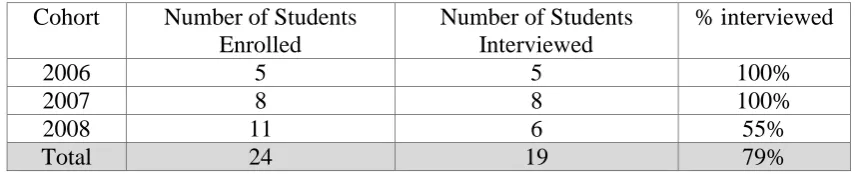
All available students were interviewed by the external evaluator or a research assistant over 2006-8 (Table 2).
Table2:Sources of student interview data 2006-8
Cohort Number of Students Enrolled
Number of Students Interviewed
% interviewed
2006 5 5 100%
2007 8 8 100%
2008 11 6 55%
Total 24 19 79%
In July 2013, the three coordinators and all 6 tutors teaching on the 2012/13 program at all sites were sent an e-mail requesting their participation in an interview (Table 3).
Table3: Sources of staff data 2013
Position No of relevant
staff
Staff interviewed
% interviewed
Science coordinator 3 3 100%
Tutor 6 5 83%
Total 9 8 89%
Results and discussion
The relevant quantitative data set from the student surveys is the response of all students on the question: Please tell us what you think about the Global Learning component of the degree program. Statements were classified as positive or negative comments (Table 4).
Table 4:Summary of positive/negative responses on relevant question from compiled student survey data
+ve Both –
ve & +ve
+ve with suggested improvement
to content
+ve with suggested improvement to
structure and facilitation
Total survey responses
Please tell us what you think about the Global Learning component of the degree program
38 1 3 9* 51
*2 requests for supplementary lectures (one graduate student, one 1/2 year student), 1 request for debates (3/4 year student)
International perspectives
The student responses are from multiple years and different subjects. Over all student cohorts and staff involved, there was a very positive response to the global learning subjects across all years and graduate students. The interview and survey data indicate that a very high level of student collaboration and the development of international understandings and perspectives are reported as the central feature of the videoconference activities. The aspect of the program that received the most favourable comments was the videoconference tutorials within the global learning subjects (Table 4), for example:
I strongly enjoyed and respected the video conference subjects, as they helped to raise issues I would not have been aware of, and having view points from not only different people but different cultural backgrounds definitely gave me a new perspective (graduate Q23).
Teachers and students report that students are building inter-cultural relationships, understanding different cultures and viewpoints, challenging ideas about different cultures and their own culture, for example, one tutor reported that from their observations of student behaviour: “Speaking to people their own age in a different country twice a week goes a long way in helping them understand cultures” (tutor I2). These findings echo the findings in the literature relating to the value of the development of students’ international perspectives through inter-cultural discussion (see for example Bell, 2008, Montgomery, 2009). In general, lecturers, tutors and students reported students learned to participate actively and constructively in discussion, for example: “I think it was a nice change to have the
videoconference as opposed to lectures. It was a lot more interactive and made it a lot more interesting” (student Q39).
In the global learning subjects, students are taught through student engagement and participation in discussion, conversation, and argument. They are informed by preparatory readings from a broad range of perspectives and guided by academics, and they prepare a major individual research paper. In some weeks, students give a seminar with a PowerPoint presentation. The third global learning subject challenges students to explore cutting edge research topics. In the first few video conferences there are presentations by researchers in various fields on recent developments. Students then choose a related topic to follow up and produce a report and presentation. As a result: “The students can differentiate between scientific and popular opinion, which is something many of their peers struggle with” (Coordinator 3).
Coordinators, tutors and students were supportive of the value of the program in developing global perspectives on science and, more broadly, the social and political implications underpinning science issues, for example:
Different points of view is the largest benefit, working with and integrating with people from around the world. From the USA dominant power to a smaller European country and Australia with the mining influence, different weather - the way students in Australia might think about issues such as the carbon tax can be very different. Students are given a window into how to participate actively and constructively, a better way to critically think on your own (tutor I5).
Integral to the development of global perspectives on science is the understanding of the links across subjects and topics. Developing a holistic view of the place of science in the global arena was significant for several students, for example:
It was a rewarding experience to gain perspective on the views of the international students and the format of the classes encouraged us to investigate the topics thoroughly. The areas covered enabled me to draw on the knowledge gained in my other classes and understand how it applied in a social context (graduate Q24).
In encountering and critiquing a range of perspectives on globally significant science issues, students commented on their development of a form of global consciousness and their capacity for analytical thinking, for example:
Videoconferences allow multi-regional issues as part of the global issue (ie Global Warming/Climate Change) to understand how it is affected on the local scale (student Q6).
The development of the ability to critically analyse the variety of information and information sources was noted by coordinators and tutors and was commented on by several students, for example:
I find it easier to identify good and bad sources of information and to differentiate between fact and opinion. I am more confident personally with speaking about my work and presenting it to others (student Q48).
Coordinators agree that students are actively participating and learning, there is peer pressure to be prepared, and there is evident enthusiasm for learning about the topics in depth and from a global perspective.
Developing communication skills
Coordinators agreed the aims of the IBSc were being met in that the students were developing an international frame of mind and international perspective, and that the program was helping students communicate science with students from different disciplines and nationalities, for example: “Students are getting used to defending and explaining what they’re doing and why to people from other disciplines” (Coordinator I1).
In discussing diversity in knowledge forms Becher (1989) refers to the biological sciences as “more wide-ranging than other scientific disciplines - and the extremes are further apart from one another'' (pp 7-8). The interaction of students from different disciplines within the science program, for example biology and chemistry or earth sciences, requires argument and discussion to be understandable across the cohort thus students learn to communicate with students from a wide range of backgrounds and academic cultures.
Students routinely remark on their expansion of understanding and appreciation for an international perspective on topics where they usually held rather restricted or provincial views (Coordinator I2).
On the advantages of the videoconferences, students commented on the value of encountering different international perspectives for the development of communication skills, for example:
I have learned how to communicate, listen, and understand people in the same field as me with differing perspectives and how to collaborate to find a happy medium in working on projects and difficult topics (student Q35).
Coordinators commented on the development of civility in discussions, for example:
They have learned to discuss sensitive topics in a civil, persuasive argument mode of discussion rather than in a hostile, confrontational manner (Coordinator I2).
Students reported increasing levels of their own communication skills and confidence. Lecturers and tutors reported the development of students’ communication skills within the videoconference space including: discussing sensitive topics in a civil manner as noted above, presenting persuasive arguments, making presentations, and leading discussions in videoconference. Students were expected to develop communication skills through the videoconference experience; so the main responsibility for carrying the discussion was with the students. Almost all of the student respondents reported that the videoconference tutorials were effective in developing communication with their international peers, for example:
I think it's a huge learning experience to have to cooperate and be patient to have an effective conversation incorporating time differences - it took some practice! … Really forced into having to work out effective communications in an actual practical situation (student Q9).
The development of communication skills and videoconference etiquette are an important intended learning outcome for the global learning subjects, and the data strongly support this ability as an outcome. At this stage however a judgement cannot be made as to the relative impact of practice, responsibility, ownership and authenticity in the development of these skills.
Videoconference pedagogy and the role of the tutor
As noted above, the videoconference tutorials are deliberately learner-centred, and students are expected to take the lead in the discussions with the tutors adopting a facilitator role. Of course, as in any institution each tutor will have their own style and approach, which means
that there is variety in the level of structure in the tutorials. Variety in structure relates to the level of direction provided by the tutor and the level of student control encouraged, ranging from teacher-directed with direct questions and requests to participate to learner-centred where the tutor only intervenes if required. In general however, the approach was learner-centred and the majority of students responded positively to this approach with no apparent differences across years, for example:
They are a very good way to create partnerships with students at the other universities. The more informal structure and the tutorial format encourage more discussion and sharing of ideas than the lecture format with large groups. The videoconferences are actually a very eye-opening experience, sometimes I think we don't realise how different the opinions of people from other countries are until we can interact with them and get this fantastic chance to ask one-on-one questions (student Q49).
Nevertheless, improvements to the facilitation of discussion within the videoconference tutorials were suggested by 9 of the 51 students from various cohorts, with various ideas offered such as: more instructor guidance to maintain focus and academic rigour, break out groups during videoconference, questions to think through provided with the readings. Some requested more formal activities, for example, a 3/4th year student wrote: “I would like to see much more use of organised debate in this subject - e.g. actually ‘assign’ a side, prepare points and speakers, give rebuttals, etc” (student Q50).
Leask (2009) draws on the results of several research studies to stress the importance of an environment that motivates interaction between international and home students for the development of intercultural competencies. This suggests a thoughtful approach to facilitation is required. The UOW coordinator tries to strike a balance between student control, flexibility and facilitation by the tutors. As noted, each tutor had some autonomy and employed their own style of, and expertise in, facilitation. For example, while some tutors would take a leading role in directing questions at particular students, others would allow the students to respond impromptu. These differences would also relate to the difficulty of the topic under discussion and the availability of resources for students to develop background understanding. A number of students wrote comments indicating a preference for more structure, for example:
I quite like this component of the degree. It was interesting to hear what other students, particularly those in [Ireland] and [US], had to say in regard to the often quite contentious topics discussed. However, I think these subjects could be improved by being more structured as the discussion often got quite off topic (student Q38).
While some students commented that they preferred the videoconference to lectures, two students (one graduate and one 1/2nd year) suggested inclusion of some lectures in the program, not to replace but to augment the videoconference, for example:
I feel that the Global Learning component could have been improved with the inclusion of a few lectures in each subject, to provide a bit more structure and guidance for discussions (student Q12).
One graduate suggested lectures to support the first-year experience:
I know in first year we weren’t very talkative because it was a new experience, so maybe to begin with some of the videoconferences could be replaced with lectures just to get a better understanding of international science issues and give us something further to talk about (graduate Q2).
The coordinators were aware of the absence of available scholarly articles to provide as readings for students in the cutting edge areas of content. After feedback from some students
coordinators provided some presentations by experts in the early tutorials to support students in their thinking about key issues.
One of the questions that concerned the coordinators and tutors relates to the optimum level of facilitative structure to be provided by the tutor, such that interactions in the videoconference environment will be equitable and discussions will stay focused on the key issues. The videoconference tutor’s role has been to facilitate discussion and provide information where needed, but the main responsibility for carrying the discussion has been given to the students. Typically a two-three minute introduction would be given to the topic followed by discussion. The tutor would ask for comments and questions and summarise at the end, thus 10% of the time would involve tutor talk. The two original coordinators have a view that where initially there was a tendency for the few more loquacious students to dominate, staff have become more skilled at getting active participation in discussion by all students.
Nevertheless, several tutor comments suggest some aspects of global learning could be improved, in particular, the structuring of discussion in recognition that there are varied levels of confidence, experience and knowledge amongst the students however, they were unsure of the trade-offs between structured and unstructured tutorials, for example:
In Bioethics there’s not an answer to the questions being posed – the students can go off on many different tangents - in some ways there needs to be that flexibility and a structure in place – the flexibility works well but maybe allows students to go off topic. I don’t know how to get around this – simply because that’s the nature of ethics and philosophy – allowing the students to ramble until they maybe do get a light bulb moment and come to the point (tutor I2).
One tutor noted that each cohort is different: “In previous years some cohorts have not responded well to the loose structure whereas this cohort does” (tutor I3). Another commented on perceived cultural differences between the groups of students: “Irish students tend to hide in a big group and take the easy way out by keeping their mouth shut and looking at the ground” (tutor I1). And another tutor worried:
They should learn from it - the cultures are aligned but different. I am not so sure my students were tuned into be able to do that or had the maturity … The main barrier to student participation is the relative immaturity of the [Irish] students, most of whom had left school within the previous 6 months. Students are often shy to offer opinion through this medium rather than across a desk … I wonder if the big TV screen becomes a psychological barrier to discussion (tutor I5).
Yet the student perspective might be different; for example, one student commented on the difficulty they found in attracting the attention of the tutor within the videoconference where the tutor was at the offshore campus:
I think it’s a very effective second to being with the professor first hand. It’s difficult when you want to communicate with them one on one however if you have a specific question (DCU student).
Teaching skills development
The need for professional development in facilitating videoconference tutorials has been emphasised by Andrews & Klease (1998), who comment on the need for intensive staff development in successfully adopting technologically mediated programs. In this study one tutor commented: “I would just like to know some teaching tactics to help them give more thoughtful answer” (tutor 4). Tutors need skills in facilitating discussions and controlling
‘dominant personalities’, and equalising student participation. One coordinator suggested that training for moderators, especially if they are not core to the IBSc team, would improve the learning experience for all students. “Transnational classrooms are invariably culturally hybrid learning environments, in which the teaching staff and students need to understand each other’s expectations and norms to be able to accommodate effectively” (Ziguras, 2007, p.21). Ward’s (2006) literature review identifies professional training and skills development as priority needs for teachers in multicultural classrooms. The experiences of coordinators, tutors and students suggests that while each tutor has their own personal style there is a delicate balance between student control, flexibility, facilitation and planned structure to the videoconference tutorials and that the tutors from the science disciplines would benefit from some training in the facilitation of discussion of science topics.
Issues and challenges
Interviews with coordinators and tutors identified a range of challenges that were met and mainly overcome since the first global learning subject was introduced at UOW. In the early stages of implementation, each university arranged videoconference facilities in a context where academic calendars, university holidays, public holidays, time zones, and daylight saving patterns were different, making it difficult to coordinate schedules. There were only eight weeks of video conferences because of the different term times. Technical difficulties with video conferences added to the problems. Scheduling three-way videoconferences meant that some of the videoconferences were well outside normal class hours of 8.30am-9.30pm, with some UOW conferences taking place at 11pm. The three-way videoconference tutorials have been replaced by two–way conferences, which have eliminated the problems associated with videoconferencing over three international time zones. Technical difficulties are now recognised as inevitable occasionally, but the technology has also become more streamlined, for example, connections are more reliable.
Timetabling still remains a challenge because of inevitable subject clashes. Due to International Time differences, two of the five weekdays are not suitable for partners. Three-way conferences have been replaced by two-Three-way conferences, as noted; thus UOW students now meet mid-morning with the US group and evening with the Irish group. Wollongong classes commence and conclude on the half-hour whereas the other two partners have classes that commence and conclude on the hour. Videoconferences commence on the hour which results in clashes for UOW students, for example, a chemistry clash with the second half of the videoconference. So students alternate between the two, sharing their notes and discussions from both classes. This is not an ideal situation but has worked well with relatively small groups of dedicated students. In addition, these clashes do reinforce the need for flexibility when dealing with International Time and different academic structures and timetables.
The spectrum of differences can be challenging:
You are dealing with a cohort that’s obviously very mixed, you’ve got three different countries involved, and actually one of the Irish students is a Japanese student in Ireland on exchange … you’re dealing with three different university systems, which work very, very differently. At UOW we don’t have to mark our videoconference subjects, it’s simply satisfactory or unsatisfactory, whereas the two partners do need a mark and grade. They are not insurmountable problems, but it does introduce some issues (Coordinator 1).
In meeting the challenges, a commitment to flexibility and continuous improvement was noted by the UOW coordinator:
I think the biggest thing everyone has to accept is you really do have to have a lot of flexibility … there are going to be issues, there are going to be frustrations, the technology might not work that particular day … there’ll be times when a particular student can’t come to a particular class. In this course the way it runs we can cope with that, because it’s not a fixed laboratory. If you miss a particular videoconference it’s not ideal, but it’s not a disaster either (Coordinator 1).
The commitment by the coordinators to overcoming difficulties was noted in the way difficulties had diminished markedly over the years, such that difficult and frustrating situations, confusion and missed classes arising from technology problems and bank holidays no longer occur. Initially, at least one and possibly two videoconference classes per Global Learning Subject were missed due to these issues.
.
Recommendations
This case suggests a number of recommendations for global learning subjects using videoconference tutorials. These include the need for professional development opportunities for tutors. The study suggests a way forward in seeking improvements to the global learning pedagogy including:
• clarifying the tutor and subject coordinator role;
• staff training in facilitation skills and structuring discussion for equal student participation;
• providing early expert input and pre-readings with key questions; and
• developing strategies for international collaboration in problem-posing, project work and videoconference presentations.
Though not discussed in this paper the broader evaluation suggested further issues for consideration in global learning subjects and international science degree programs, including dealing with systemic difficulties and differences:
• develop detailed subject guides and syllabi to guide students through the program;
• streamline strategies for assessment of participation and the provision of formative assessment;
• moderate assessment across institutions;
• discuss timing and timetabling early and adopt a flexible approach;
• develop risk management strategies for technology failure;
• explore the effectiveness of global learning programs for less motivated students.
Conclusion
This study suggests that utilising videoconference tutorials across international borders for global learning holds great promise as a pedagogy for higher education science programs. In this program students were able to engage in a global learning community and develop a holistic perspective on science. Students were given the opportunity to explore international perspectives on science while developing discipline-based knowledge and to test their values and attitudes against those of science students from other countries. Through reading and discussing cases and scientific articles; receiving expert presentations; working in inter-cultural groups, and communicating about science with their counterparts in videoconference tutorials, students developed the skills to communicate with significant intercultural and international learning as the outcome. In the words of one of the students:
The discussions open your mind to other perspectives and opinions, as well as introducing the ideas you may never have even considered … [I learned] how science is a uniting thread between nations (student Q10).
The use of natural resources such as water was commonly a very topical issue due to the perceived availability of potable water. For example, the Australian students would often refer to households having tanks (meaning water tanks) to help alleviate water shortages, many Irish students could not fathom the need to store water and the American students were usually somewhere in between in their opinion depending on where they grew up in the US. One US student was not familiar with water tanks and was clearly concerned that many Australian households apparently had a need for a military tank. Similarly, the bioethics class often generated strong discussion and debate on such topics as genetically modified crops depending on a student’s background and upbringing.
This study underlines the importance of further exploring ways in which the videoconference tutorial experience might be structured and facilitated for maximum learning with an appropriate balance between learner-centred and teacher-directed discussion for any given mix of students. Where increasing numbers of students might be involved, the role of the facilitator in ensuring a spread of participation becomes critical. It seems important that tutors provide a level of facilitative structure that ensures equity of engagement in international videoconference tutorials. Thus the provision of professional development opportunities for tutors in facilitating inter-cultural videoconferencing is a recommendation for such programs. This case suggests areas of need for further research into effective teaching and learning strategies related to videoconferencing, and in general, for global learning. It is suggested that a framework for skills development for staff along with resources to support teachers in using videoconference tutorials for global learning would be useful.
Many commentators have noted that intercultural contacts do not necessarily lead to intercultural competence (see for example Engle & Engle, 2002; Otten, 2003). At this stage, the universities involved are all English-speaking. One of the changes envisaged for the future includes the addition of more partners, in particular from Asia, to expand the breadth of internationalism. The need for English as the language of instruction is, however, a limitation to the involvement of many universities from the Asia region. Nevertheless, this case demonstrates that videoconference tutorials can offer an exciting and challenging teaching and learning strategy for science education in universities.
Acknowledgements
The authors acknowledge the work of Professor Rob Whelan who introduced the degree program at UOW, Professor Mike Grant (UCB), Professor Fiona Regan (DCU) and Professor Blanaid White (DCU). Thanks go to the students and staff members who kindly agreed to share their experiences of this program.
References
Andrews, T., & Klease, G. (1998). Challenges of multisite video conferencing: the development of an alternative teaching/learning model. Australian Journal of Educational Technology, 14(2), 88-97. Asimov, I. (1975). Asimov's Biographical Encyclopedia of Science and Technology. London: Pan.
Becher, T. (1989). Academic Tribes and Territories: Intellectual Enquiry and the Cultures of Disciplines (2nd ed.). Milton Keynes: Society for Research into Higher Education and Open University Press.
Bell, M. (2008). Beyond the supermarket: Lost opportunities in summer study abroad for singapore sojourners in Australia. International Journal for Asia Pacific Studies, 4(1), 61-78.
Burke, C., Lundin, R., & Daunt, C. (1997). Pushing the boundaries of interaction in videoconferencing: a dialogical approach. Distance Education, 18(2), 350-361.
Carter, L. (2005). Globalisation and science education: Rethinking science education reforms. Journal of Research in Science Teaching, 42(5), 561-580.
Engle, J., & Engle, L. (2002). Neither international nor educative nor educative: study abroad in the time of globalisation. In W. Grunsweig & N. Rinehart (Eds.), Rockin' in Red Square: Critical Approaches to International Education in the Age of Cyberculture (pp. 25-39). Piscataway NJ.
Gibson, K. L., Vialle, W., & Rimmington, G. M. (2003). Gaining multiple perspectives on gifted education through global learning reflection. The Australasian Journal of Gifted Education, 12(2), 34-40. Gibson, K. L., Watters, J. J., Alargic, M., Rogers, G., & Haack, C. (2003). Global learning technology:
Developing pre-service elementary teachers’ reflective practice through cross-cultural exchanges. Paper presented at the Ed-Media 2003 World Conference on Multimedia, Hypermedia and Telecommunications, Honolulu, Hawaii.
Guest, D., Livett, M., & Stone, N. (2006). Fostering international student exchanges for science students.
Journal of Studies in International Education, 10(4), 378-395.
IAU. (1998). Towards a Century of Cooperation: Internationalisation of Higher Education. International Association of Universities. Retrieved 4th September 2001, from,
http://www.unesco.org/iau/internationalization/i_statement.html
Kalantzis, M., & Cope, B. (2000). Towards an inclusive and international higher education. In R. King, D. Hill & B. Hemmings (Eds.), University and Diversity: Changing Perspectives, Policies and Practices in Australia (pp. 30–53). Wagga Wagga: Keon Publications.
Karpova, E., Crorreia, A., & Baran, E. (2009). Learn to use and use to learn: technology in virtual collaboration experience. Internet and Higher Education, 12 (1), 45-52
Kopf, M. (2012). Negotiation of meaning in video-conferencing: the potential of online chats for student interaction. The New Zealand Language Teacher, 38, 60-71.
Leask, B. (2009). Using formal and informal curricula to improve interactions between home and international students. Journal of Studies in International Education, 13(2), 205-221.
Montgomery, C. (2009). A decade of internationalisation: has it influenced students? Journal of Studies in International Education, 13(2), 256-270.
Otten, M. (2003). Intercultural learning and diversity in higher education. Journal of Studies in International Education, 7(1), 12-26.
Rimmington, G. M. (2003). An introduction to global learning. Paper presented at the World Conference of the Society for Information Technology in Teacher Education, USA.
Rimmington, G. M., & Gibson, K. L. (2006). Global learning for gifted education teachers of diverse backgrounds. Paper presented at the 20th Annual Conference on Distance Teaching and Learning, University of Wisconsin. Retrieved 3rd May 2008, from
http://www.uwex.edu/disted/conference/Resource_library/proceedings/04_1355.pdf
Smyth, R. (2005). Broadband videoconferencing as a tool for learner-centred distance education. British Journal of Educational Technology, 36, 805-820.
Stake, R. E. (1995). The Art of Case Study Research. Thousand Oaks, California: SAGE.
U.S. Congress Joint Economic Committee (April 2012). STEM Education: Preparing for the Jobs of the Future. Retrieved January 29th 2014 from,
http://www.jec.senate.gov/public/index.cfm?a=Files.Serve&File_id=6aaa7e1f-9586-47be-82e7-326f47658320
Ward, C. (2006). International students : interpersonal, institutional and community impacts : update of the 2001 literature review. Retrieved November 1st 2007from,
http://www.vuw.ac.nz/cacr/reports/docs/Lit%20review%202006%20pdf%20final.pdf
Yamada, M. (2009). The role of social presence in learner-centred communicative language learning using synchronous computer-mediated communication: experimental study. Computers and Education, 52, 820-833.
Ziguras, C. (2007). Good Practice in Transnational Education: A Guide for New Zealand Providers: Education New Zealand Trust.