Vol.9 (2019) No. 1
ISSN: 2088-5334
21
st
Century Skills Mastery Amongst Science Foundation Programme
Students
Punia Turiman
#, Tengku Siti Meriam Tengku Wook
*, Kamisah Osman
##
Faculty of Education, Universiti Kebangsaan Malaysia, 43650, Bangi, Selangor, Malaysia E-mail: [email protected], [email protected]
*Center for Software Technology and Management, Faculty of Information Science and Technology,
Universiti Kebangsaan Malaysia, 43650, Bangi, Selangor, Malaysia E-mail: [email protected],
Abstract— The rapid growing of knowledge economy that relies on the advancement of ICT has changed the trend of employment
and social life. Employers in this century are looking for competitive, innovative and global employees. As a consequence, students
should be prepared to acquire 21st-century skills so that they can be successful in the employment and social life. Before that, this
study has examined the mastery level of the 21st-century skills amongst science foundation programme students. This study has also
investigated the relationships between former school location and gender on the mastery levels of the 21st-century skills. A total of 240
students from two foundation colleges participated in this quantitative study. The findings indicated that the mastery level of the 21st
-century skills was high. All subdomains of the 21st-century skills were at a high mastery level. However, economy literacy as one of
digital era literacy subdomains showed a moderate level. Meanwhile, creativity as one of the inventive thinking subdomains also showed a moderate level, and interactive communication as one of effective communication subdomains also showed a moderate level. Findings also revealed that there were no significant differences between former school location and gender on the mastery levels of
the 21st-century skills amongst science foundation programme students.
Keywords— 21st century skills; digital age literacy; inventive thinking; effective communication; high productivity.
I. INTRODUCTION
21st-century skills are much demanded in the advancement of our current world that greatly relies on Information and Communication Technology (ICT). The mastery of the 21st-century skills becomes pivotal for the individuals to be competitive in the workplace and ICT is the focus of their development [1]. The growing of the global knowledge society and rigorous integration of ICT require a young generation to possess digital skills essential for employment and involvement in society [2]. Instead, the contemporary labor markets value and reward the employees who acquire advanced technical abilities and also capable of applying higher-order cognitive skills within an ICT context [3]. Therefore, one of the challenges in the education sector nowadays is the enhancement of the 21st-century skills among the students [4]. As derived by North Central Regional Educational Laboratory (NCREL) and Metiri Group, the 21st-century skills comprise of digital era literacy, inventive thinking, effective communication and high productivity [5].
Digital era literacy is defined as the ability to use digital technologies to read, analyze, manage and evaluate available information to produce new information that contributes to the knowledge. Inventive thinking means the ability to manage complexity, curious, creativity and risk-taking, and higher-order thinking and sound reasoning. Effective communication is referred to as the ability in teaming, collaborating and interpersonal skills, accountable in personal and social responsibility, and using technology in interactive communication. High productivity describes an individual’s ability to prioritize planning with the use of real-world technology and produce quality work that able to solve problems [5].
level of critical and creative thinking and not proficient in effective communication [7].
Some researchers have investigated the mastery of the 21st-century skills in these past few years. For instance, a study was carried out that the mastery level of the 21st-century skills among Form Four Physics students (aged 16 years) in Selangor was moderate [8]. There were no significant differences in the mastery level of the 21st-century skills-based on former school location and gender. In another study, it is investigated the mastery level of Form Four Biology students (aged 16 years) in Selangor was also moderate [9]. However, there was a significant difference in the mastery level of the 21st-century skills based on gender.
Another study investigated the mastery of 21st-century skills among Alternative Learning System (ALS) in Northern Philippines [4]. This ALS programme was set up to promote continuing education to the marginalized groups such as children, drop out of school youth, women, special needs people and native community who did not complete their basic education due to poverty and support problems. The findings revealed that their mastery level of the 21st century was low. Regarding gender difference, there were no significant differences in thinking skills, collaboration skills, communication skills, self-direction, global and local connection and ICT skills. However, creativity and innovation skills demonstrated significant differences between male and female learners. The mastery level of creativity and innovation was higher for male learners compared to female learners.
Since the acquisition of the 21st-century skills is vital for the young generation to be competitive in the workplace and participative in life, this paper seeks to investigate the mastery level of these abovementioned skills among science foundation programme students.
This paper’s objective is to report on the following:
• The mastery level of the 21st-century skills amongst science foundation programme students.
• The mastery level of digital era literacy amongst science foundation programme students.
• The mastery level of inventive thinking amongst science foundation programme students.
• The mastery level of effective communication skils amongst science foundation programme students.
• The effects of former school location and gender on the 21st-century skills.
• The effects of former school location and gender on digital age literacy.
• The effects of former school location and gender on inventive thinking.
• The effects of former school location and gender on effective communication skills
• The effects of former school location and gender on high productivity.
II. MATERIAL AND METHOD
A. Research Instrument
The 21st-century skills instrument developed by [10], [11] was administered in this survey method study. The four main domains of the 21st-century skills are displayed in Table 1.
TABLEI THE CONTENT OF THE 21ST
-CENTURY SKILLS INSTRUMENT
Domain No.of item Item no. Cronbach Value
Digital era literacy 24 C1-C24 0.88
Inventive thinking 42 D1-D42 0.92
Effective
communication 15 E1-E15 0.74
High productivity 18 F1-F18 0.89
A Likert scale ranged from 1 to 5 (1=strongly disagree, 2=disagree, 3=neutral, 4=agree, 5=strongly agree) was applied in this study. The mastery of the 21st-century skills was categorized into three levels (high, moderate, low) based on the mean as displayed in Table 2.
TABLEII LEVEL OF MASTERY
Level Mean
High 3.67 – 5.00
Moderate 2.34 – 3.66
Low 1.00 – 2.33
B. Data analysis procedures
The students’ responses from the questionnaires are analyzed using Statistical Package for Social Sciences (SPSS). In descriptive statistics study, mean and standard deviation (sd) were calculated to measure the mastery level of the 21st-century skills. In inferential statistic study, analysis of two-way ANOVA was carried out to find the relationships between former school location and gender on the 21st-century skills. In this study, the researcher defines the former school location as the urban or rural area where the schools were located before these students entering the science foundation programme.
III. RESULTS AND DISCUSSION
A. Profile of Respondent
Fig. 1 Profile of respondent
B. Mastery Level of the 21st Century Skills
The overall mastery level of the 21st-century skills was high (mean = 4.03, sd = 0.32) as reported in Table 3.
TABLEIII MEAN AND SD OF THE 21ST
-CENTURY SKILLS
Domain Mean sd Level
1.Digital era literacy 4.03 0.38 High
2.Inventive thinking 3.98 0.39 High 3.Effective communication 3.96 0.47 High
4.High productivity 3.94 0.35 High
21st century skills 4.03 0.32 High
All domains of the 21st-century skills indicated a high mastery level. Digital age literacy revealed the highest mean (mean = 4.03, sd = 0.38), while high productivity revealed the lowest mean (mean = 3.57, sd = 1.18). As compared to findings in [8], [9] that showed medium, the mastery of the 21st-century skills among science foundation programme students was higher. This may occur due to the age factor that the students are more matured when they have completed their secondary education and further their studies at the college level.
C. Mastery Level of Digital Era Literacy
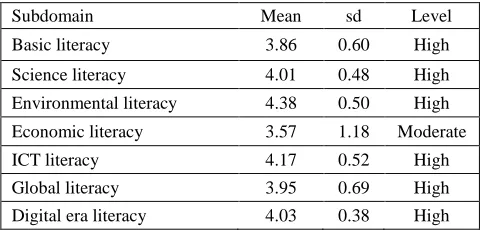
The mastery of digital era literacy was at a high level (mean = 4.09, sd = 0.38). The subdomains and their means of digital era literacy are listed in Table 4.
TABLEIV
MEAN AND SD OF DIGITAL AGE LITERACY
Subdomain Mean sd Level
Basic literacy 3.86 0.60 High
Science literacy 4.01 0.48 High
Environmental literacy 4.38 0.50 High Economic literacy 3.57 1.18 Moderate
ICT literacy 4.17 0.52 High
Global literacy 3.95 0.69 High
Digital era literacy 4.03 0.38 High
Table 5 indicates the overall digital era literacy level was high (mean score = 4.03, sd = 0.38). This means digital era literacy mastery among science programme students was
good. This high mastery level of digital age literacy can be supported by the study carried out by [12] that Malaysia youths use the internet as an essential source of information. They are the Net generation who can easily access the internet to find information. Furthermore, the integration of ICT in the classroom has been emphasized and implemented in Malaysian education system at all level from primary to higher education since a decade ago [13].
All subdomains demonstrated high mastery level except for economic literacy that demonstrated moderate. Economic literacy is students’ knowledge and their understanding regarding basics economic theories and their application in daily lives. This finding is in line with the study carried out by [14] that revealed low economic literacy among Form Six students (aged 19-20 years) in the state of Johore. This finding also affirms the study conducted by [15] that measured economics literacy among undergraduates students (aged 22 years) at the International Islamic University of Malaysia. The economics literacy level was 12 points or 60 % which was still considered low. It can be concluded that the mastery of economics literacy is low among foundation programme and higher institution students. This low literacy could be explained due to the lack of exposure given to students to read or discuss the economic issues. Students might not be encouraged to participate in economic dialogues or forums that discuss how the economy can give impact to their lives eventhough they are not taking the economy course.
D. Mastery Level of Inventive Thinking
Table 5 displays the mastery level of inventive thinking. It reveals that the mastery level of inventive thinking was high (mean = 3.98, sd = 0.69) amongst science foundation programme students.
TABLEV
MEAN AND SD OF INVENTIVE THINKING
Subdomain Mean sd Level
Regulatory 4.30 0.49 High
Curiosity 4.14 0.52 High
Risk taking 3.94 0.50 High Higher order thinking 3.97 0.51 High
Flexibility 3.71 0.54 High
Creativity 3.53 0.39 Moderate High productivity 3.96 0.69 High
All subdomains of inventive thinking were at a high level except for creativity that showed a moderate level. Regulatory has the highest score (mean = 4.30, sd = 0.49) while creativity has the lowest level (mean = 3.53, sd = 0.39). Students demonstrated a moderate level of mastery in creativity. Creativity in this context means students’ ability to use imagination in developing new and original products [5]. Among the items asked in the subdomain of creativity are “ I always produce a new idea in my science class” and “I do not produce a new product from my science knowledge.”
education system in Malaysia is predominantly teacher centered and examination oriented [16], [17]. Little time has been spent on discussing the scientific ideas and interpreting the findings during the practical science class. Besides that, the teaching approach used is mainly less inquiry-based and didactic. Thus, this teaching approach may not be able to encourage students to think creatively until they can create science products or innovative products.
E. Mastery Level of Effective Communication
The mastery level of effective communication was high (mean = 3.94, sd = 0.35). All subdomains were at a high level except for interactive communication was at a moderate level. The subdomains and their means of effective communication are reported in Table 6.
TABLEVI
MEAN AND SD OF EFFECTIVE COMMUNICATION
Subdomain Mean sd Level
Cooperative 4.22 0.47 High
Interpersonal 3.91 0.47 High Responsibility 3.83 0.49 High Interactive communication 3.57 0.59 Moderate
21st century skills 4.03 0.32 High
Cooperative showed the highest score (mean = 4.22, sd = 0.47) while interactive communication showed the lowest score (mean = 3.57, sd = 0.59). Students’ mastery in interactive communication was moderate. Interactive communication refers to the ability to express, deliver, transfer, access and understand information [5]. Among the items for interactive communication are “I rarely discuss any problems or issues in science with colleagues using current technology” and “I know how to use ICT to share or discuss ideas with friends.” Students use the internet more on socializing and entertainment rather than academic purposes [18], [19]. [20] also reported that there was a low correlation between hours spent on the internet for academic purposes among Malaysian higher education institution students. Therefore, the students still do not fully utilize the internet to discuss ideas, problems or issues in subject matters with their colleagues.
F. Mastery Level of High Productivity
The mastery level of high productivity in using technology is demonstrated in Table 7. All subdomains of high productivity were at a high level (mean = 3.96, sd = 0.69). This gave an implication that the mastery level of high productivity in using technology was high amongst science foundation programme students. Use of technology showed the highest mastery level (mean = 4.30, sd = 0.56) and quality production showed the lowest (mean = 3.85, sd = 0.59). Among the items asked in quality production subdomain are “ I am confident that my product is original”, “I use a variety of media (text, audio, video) and other technology to add value to my product” and “I identify the benefits of using my product so that it can solve the existing problems”. Nonetheless, all these subdomains of high productivity in using technology were high.
TABLEVII
MEAN AND SD FOR HIGH PRODUCTIVITY
Subconstruct Mean sd Level
Use of technology 4.30 0.56 High
Prioritizing in planning 4.01 0.49 High
Quality production 3.85 0.59 High
High productivity 3.96 0.69 High
G. Effects of Former School Location and Gender on the
21st Century Skills
Table 8 shows an analysis of a two-way ANOVA for the effect of former school location and gender on the 21st-century skills. The significant degrees for former school location, gender, and interaction of former school location and gender were more than 0.05 (p<0.05). These implied that there were no significant differences between former school location and gender on the mastery of the 21st-century skills.
TABLEVIII
TWO-WAY ANOVA FOR FORMER SCHOOL LOCATION AND GENDER
Main effect
Total square
df Mean square
F value Degree of Significant (p<0.05) Location 0.002 1 0.002 0.017 0.896 Gender 0.021 1 0.021 0.208 0.649
Location* gender
0.130 1 0.195 1.933 0.166
Error 23.75 236 0.101 Total 3925.940 250
Also, there was no interaction between former school location and gender on the mastery of the 21st century skills as shown in Fig. 2. These findings are inconsistent with [9] that revealed a significant difference in the mastery of the 21st-century skills based on gender. Former school location and gender gave no effect on the mastery of the 21st-century skills amongst science foundation programme students. This may result from the prior selection made by MARA during their enrollment in these colleges. They were among the high achievers in the country regardless of gender or former school location they underwent for their secondary education.
Fig. 2 Interaction effect between former school and gender for the 21st
H. Effects of Former School Location and Gender on Digital Era Literacy
Table 9 indicates an analysis of two-way for former school location and gender on digital age literacy. The significant degrees for former school location, gender, and interaction of former school location and gender were greater than 0.05 (p<0.05).
TABLEIX
TWO-WAY ANOVA FOR FORMER SCHOOL LOCATION AND GENDER
Main effect
Total square
df Mean square
F value
Degree of significant (p<0.05)
Location 3.004E-7 1 3.004 0.024 0.999 Gender 0.003 1 0.003 0.024 0.878
Location* gender
0.247 1 0.088 0.908 0.432
Error 33.668 236 0.101 Total 3921.903 240
There were no significant differences in the level of digital era literacy based on former school location and gender. This brought an implication that there were no effects of former school location and gender on digital age literacy. Besides, there was also no interaction between former school location and gender as shown in Fig. 3.
Fig. 3 The interaction effect between former school and gender for digital era literacy
I. Effects of Former School Location on Inventive Thinking
A two-way ANOVA analysis demonstrates in Table 10 that the significant degrees for gender, location and interaction of gender and previous school location were more significant than 0.05 (p<0.05).
TABLEX
TWO-WAY ANOVA FOR GENDER AND PREVIOUS SCHOOL LOCATION
Main effect
Total square
df Mean square
F value
Degree of Significant (p<0.05) Location 0.010 1 0.010 0.006 0.938 Gender 0.007 1 0.007 0.048 0.826
Location* gender
0.305 1 0.305 2.042 0.154
Error 35.240 236 0.149 Total 3574.148 240
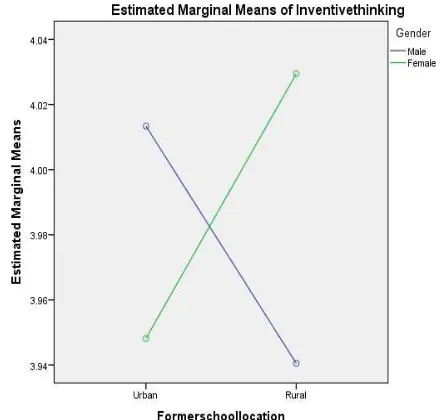
There were no significant differences in the level of inventive thinking based on former school location and gender. Concerning the effect of gender, this finding affirms the study conducted that also revealed no significant difference in inventive thinking among undergraduates students [21. Also, there was no interaction between former school location and gender on the mastery level of inventive thinking as illustrated in Fig. 4. As a consequence, former school location and gender caused no effects on the mastery level of inventive thinking.
Fig. 4 Interaction effect between former school and gender for inventive thinking
J. Effects of Former School Location and Gender on
Effective Communication
TABLEXI
TWO-WAY ANOVA FOR FORMER SCHOOL LOCATION AND GENDER
Main effect
Total square
df Mean square
F value
Degree of significant (p<0.05) Location 0.015 1 0.015 0.125 0.724 Gender 0.076 1 0.076 0.626 0.429
Location* gender
0.137 1 0.137 1.131 0.289
Error 28.581 236 0.121 Total 3754.148 240
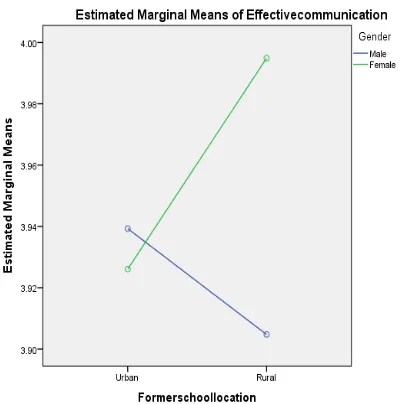
Meanwhile, there was no interaction between former school location and gender as illustrated in Fig. 5.
Fig. 5 Interaction effect between former school and gender for effective communication
K. Effects of Former School Location and Gender on High
Productivity
An analysis of a two-way ANOVA for former school location, gender, and interaction between former school location and gender on high productivity is reported in Table 12. From the table, the significant degrees for former school location and gender were more significant than 0.05 (p<0.05). Due to that, no significant differences in the mastery level of high productivity based on former school location and gender.
TABLEXII
TWO-WAY ANOVA FOR FORMER SCHOOL LOCATION AND GENDER
Main effect
Total square
df Mean square
F value
Degree of Significant (p<0.05) Location 0.008 1 0.008 0.036 0.849 Gender 0.103 1 0.103 0.472 0.493
Location* gender
1.369 1 1.369 6.291 0.013*
Error 51.355 236 0.218 Total 3820.022 240
However, the significant degree for interaction between former school location and gender was less than 0.05 (as highlighted in Table 14). Consequently, there was a significant interaction between former school location and gender on the mastery level of high productivity as demonstrated in Fig. 6. This implied that urban male students showed higher productivity compared to rural male students but vice versa for female students. Rural female students showed higher productivity compared to urban female students. This may occur due to motivational domains such as self-efficacy, interest, and enjoyment in using technology that these rural female students showed a higher mastery level of high productivity [22].
Fig. 6 Interaction effect between former school and gender for high productivity
IV. CONCLUSION
The findings have demonstrated that the mastery level of the 21st-century skills was high amongst the science foundation programme students. All of the subdomains which are digital era literacy, inventive thinking. Effective communication and high productivity also revealed a high mastery level. However, economic literacy as one of the subdomains in digital era literacy showed a moderate level of mastery. Meanwhile, creativity as one of the subdomains in inventive thinking also demonstrated a moderate level of mastery. For active communication subdomains, interactive communication also showed a moderate level of mastery.
In light of these findings, the researchers would like to propose some suggestions to enhance the 21st-century skills amongst the students. The 21st-century skills should be integrated into the curriculum, and its implementation should be given attention. This is a more organized and faster way to enhance the mastery of the 21st-century skills. Curriculum developers should realize the importance of the new set of workforce skills that meet the demand of the employers and thus, the education system should prepare the students with these necessary skills. The 21st-century curriculum should pay attention to students’ knowledge construction and promote students to generate the information that is meaningful for them in developing new skills and literacies [23].
Besides curriculum, a new pedagogical approach that is tailored to the teaching and learning in the 21st century should be implemented. As we go much deeper into the digital era, it is suggested that the new pedagogy will utilize educational technology which can support the student in the transmission of information [24]. For digital age literacy, students should be encouraged to read, interpret, analyze, and evaluate the information from the digital sources. Then, they organize, integrate and synthesize new information that contributes to the knowledge. By using the internet, students can expand their knowledge on current issues and instill social values in multiple areas such as economic, food deficiency, global warming, poverty, issues of health, overpopulation and other social issues [23].
For inventive thinking, teachers can use problem-based solving approach to increase creative and critical thinking. In this approach, students will discuss, disintegrate, analyze, and relate the problems with the real world. Then, they will offer explanations, considerations, judgments and appropriate suggestions on how to solve the assigned problems. Through this approach, students will enhance their curiosity, creative and critical thinking, risk-taking and flexibility. As the world is getting more complex, students should be prepared to solve nonroutine and complex problems they would face in the future workplace and social life.
For effective communication, teachers are encouraged to use cooperative learning or collaborative learning. In cooperative learning, students are divided into groups with different abilities and interests. They will discuss in the group and produce a better and more creative work since everyone has his/her ability and strength compared to work alone [23]. Through this approach, the students will enhance their effective communication subdomains which are cooperative, interpersonal, responsibility and interactive communication. In collaborative learning, students with a broad spectrum of capabilities and aptitudes would share their knowledge and create an understanding among them [25]. Through this pedagogy, the students can enhance their communication and interaction such as to question, explain, justify opinions, articulate and elaborate. Students’ effective communication can be fostered through this cooperative learning and collaborative learning.
For high productivity, production skills emphasize the creation of new contents. Students with ICT production skills could start a blog, generate a spreadsheet, design a website or make a video using suitable software [26].
College and university curricula should encourage students to engage in some form of digital exploration and research such as specific courses, collaborative group projects and problem-solving activities [27]. Through these activities, students can develop their digital skills since they have to utilize technology to gather and share information.
Other than that, teachers can assign project-based learning to students to enhance high productivity and quality production among science students. Students can work on individual or group projects on the assigned science topic. Students may use the internet, a learning management system (LMS), hand-held devices such as probeware and smartphone, digital camera and other technology devices. Students can express their ideas in creative ways using multimedia and authoring tools such as iMovies, WebQuest, keynote presentation, montage and a range of iPad Apps [28]. Students can also create serious games. Serious games are digital applications which contain a set of designed tasks that reflect cognitive functions such as reasoning, problem-solving, decision making and acting in a particular context [29]. Through this project-based, the student will plan, prioritize and manage their project to meet the deadline. Furthermore, they use effective real-world tool to aid the execution of the project and eventually produce relevant, high quality and authentic product.
For future work, this study can be extended to other foundation colleges such as matriculation colleges since they have a bigger population of students that aged 18-19 years. Besides matriculation colleges that fully funded by the government, this study can also be carried out among students of the same age who further their studies at self-funded foundation colleges.
REFERENCES
[1] Lewin, C. and McNicol, S., “Supporting the development of 21st-century skills through ICT.” 2015, In Brinda, T., Reynolds, N., Romeike, R. and Schwill, A. KEY CITY 2014: Key Competencies in Informatics and ICT, pp. 181-98, 2015.
[2] Ester van Laar, Alexander J.A.M. van Deursen, Jan A.G.M. van Dijk, and Jos de Haan, “The relation between 21st-century skills and digital skills or literacy: A systematic literature review”, 2017, in the press.
[3] Claro M., Salinas A., Cabello-Hutt T., San Martín E., Preiss D.D., Valenzuela S. & Jara I., “Teaching in a Digital Environment (TIDE): Defining and measuring teachers' capacity to develop students' digital information and communication skills,” Computers & Education, 2018, DOI:10.1016/j.compedu.2018.03.001.
[4] Tindowen, J. D. J. C., Bassig, J.M. and Cagurangan, J. “Twenty-First-Century Skills of Alternative Learning System Learners,” SAGE Open, July-September 2017, pp. 1–8, 2017.
[5] NCREL. Engauge® 21st-century skills: literacy in the digital age. North Central Regional Educational Laboratory and the Metiri Group. http://www.grrec.ky.gov/SLC_grant/engauge21st_Century_Skills.pdf. 2003.
[6] Ah-Nam, L. and Osman, K., “Developing 21st Century Skills through a Constructivist-Constructionist Learning Environment”, K-12 STEM Education, vol. 3, no. 2, pp.205-216, Apr-Jun 2017. [7] Fong, L.L., Sidhu, G.K. and Fook, C.Y. “Exploring 21st-century
skills among postgraduates in Malaysia”, Procedia - Social and Behavioral Sciences, vol. 123, pp. 130 – 138, 2014.
[8] Soh, T.T.M.. “Persepsi pelajar tingkatan empat terhadap mata pelajaran fizik serta hubungannya dengan Kemahiran Abad ke 21”, Master in Science Education thesis, National University of Malaysia, 2011.
[10] Osman, K., Tuan Soh, T.M. and Mohd.Arsad, N., “Development and validation of Malaysia 21st century skills instrument (M-21CSI) for
science students”, Procedia - Social and Behavioral Sciences, vol. 9. pp. 599–603, 2010.
[11] Arsad, M.N., Osman, K. and Soh, T. M. T. “Instrument development for 21st-century skills in Biology”. Procedia - Social and Behavioral Sciences, vol. 15. Pp. 1470–1474, 2011.
[12] Tan, K.E., Ng, M.L.Y. and Kim, G.S. “Online activities and writing practices of urban Malaysian adolescents.” System, vol.38. no.4, pp 548 – 559, 2010.
[13] Garba, S.A., Byabazaire, Y. and Busthami, A.H. “Toward the Use of 21st Century Teaching-Learning Approaches: The trend of
Development in Malaysian Schools within the Context of Asia Pacific”, vol.10, no.4, pp. 72-79, 2015.
[14] Noh, S. “Literasi ekonomi dan sikap terhadap ekonomi dalam kalangan pelajar”, Master in Education (Economy) thesis, National University of Malaysia, 2017.
[15] Hashim, C.N. and Kayode, B.K. “Economics literacy among students: A Case Study of International Islamic University Malaysia (IIUM),” World Applied Sciences Journal, vol. 28, no. 6, pp. 871-875, 2013. [16] Halim, L., “Development of a Scientific Literate Society: Status and
Challenges,” International Conference on Advances in Education Technology (ICAET 2014), Atlantis Press, 2014.
[17] Heng, L.L., Surif, J. and Seng, H.C. “ Malaysian Students’ Scientific Argumentation: Do groups perform better than individuals,” International Journal of Science Education, vol. 37, no.3, pp. 505-528, 2015.
[18] Jaafar, N.I., “Computer usage and perception among accounting students: A survey in a public university,” Jurnal Pendidikan, vol. 23, pp. 57-69, 2003.
[19] Li, Y. and M. Ranieri, M..” Educational and social correlates of the digital divide for rural and urban children: A study on primary school students in a provincial city of China”, Computers & Education, vol. 60, pp. 197–209, 2013.
[20] Mohd Ayub, A.F., Wan Hamid, W.H., and Hj. Nawawi, M., “Use of the internet for academic purposes among students in Malaysian
institutions of higher education,” The Turkish Online Journal of Educational Technology, vol.13, no.1, pp. 232-241. 2014.
[21] Ghaith, G. "An exploratory study of the achievement of the twenty‐first-century skills in higher
education," Education + Training, vol. 52, no. 6/7, pp.489-498, 2010, doi: 10.1108/00400911011068441
[22] Scherer R., Rohatgi A. and Hatlevik O.E., “Students’ Profiles of ICT Use: Identification, Determinants, and Relations to Achievement in a Computer and Information Literacy Test,” Computers in Human Behavior, 2017, doi: 10.1016/j.chb.2017.01.034.
[23] Ahmed Alismail, H. and McGuire, “P.21st Century Standards and Curriculum: Current Research and Practice”, Journal of Education and Practice, vol.6, no.6, pp. 150-154, 2015.
[24] Alena Y.T. Tan, Esyin Chew, Vineetha Kalavally, "The expectations gap for engineering field in Malaysia in the 21st century", On the Horizon, vol. 25, vol. 2, pp.131-138, 2017.
[25] Päivi Häkkinen, Sanna Järvelä, Kati Mäkitalo-Siegel, Arto Ahonen, Piia Näykki & Teemu Valtonen: Preparing teacher-students for twenty-first-century learning practices (PREP 21): a framework for enhancing collaborative problem-solving and strategic learning skills, Teachers and Teaching, 2016, DOI: 10.1080/13540602.2016.1203772
[26] Sylvia E. Rogers, S.E. “Bridging the 21st Century Digital Divide”,
TechTrends, vol. 60, pp. 197–199, 2016.
[27] Adams Becker, S., Pasquini, L. A., and Zentner, A., “Digital Literacy Impact Study: An NMC Horizon Project Strategic Brief,” vol. 3.5, Austin, Texas: The New Media Consortium, pp. 1-26, September 2017.
[28] Donovan, L., Green, T.D., and Mason.C. “Examining the 21st
-century classroom: Developing an innovation configuration map”, Journal of Educational Computing Research, vol. 50, no.2, pp. 161-178, 2014.