Journal of Education and Training Studies Vol. 4, No. 1; January 2016 ISSN 2324-805X E-ISSN 2324-8068 Published by Redfame Publishing URL: http://jets.redfame.com
192
LewiSpace: an Exploratory Study with a Machine Learning Model in an
Educational Game
Ramla Ghali1, Sébastien Ouellet1, Claude Frasson1
1Université de Montréal, Département d’informatique et de recherche opérationnelle, 2920 Chemin de la Tour, H3C 3J7 (QC), Canada
Correspondence: Ramla Ghali, Université de Montréal, Département d’informatique et de recherche opérationnelle, 2920 Chemin de la Tour, H3C 3J7 (QC), Canada
Received: August 6, 2015 Accepted: August 20, 2015 Online Published: October 19, 2015 doi:10.11114/jets.v4i1.1153 URL: http://dx.doi.org/10.11114/jets.v4i1.1153
Abstract
The use of educational games as a tool for providing learners with a playful and educational aspect is widespread. In this paper, we present an educational game that we developed to teach a chemistry lesson, namely drawing a Lewis diagram. Our game is a 3D environment known as LewiSpace and aims at balancing between playful and educational contents in order to increase engagement and motivation while learning. The game contains mainly five different missions aim at constructing Lewis diagram molecules which are organized in an ascending order of difficulty. We also conducted an experiment to gather data about learners’ cognitive and emotional states as well as their behaviours through our game by using three types of sensors (electroencephalography, eye tracking, and facial expression recognition with an optical camera) and a self report personality questionnaire (the Big Five). Primary results show that a machine learning model namely logistic regression, can predict with some success whether the learner will success or fail in each mission of our game, and paves the way for an adaptive version of the game. This latter will challenge or assist learners based on some features extracted from our data. Feature extraction integrated into a machine learning model aims mainly at providing learners’ with a real-time adaptation according to their performance and skills while progressing in our game.
Keywords: educational game, electroencephalogram, eye tracking, facial expression recognition, logistic regression model, big five questionnaire
1. Introduction
In Human Computer Interaction (HCI), the Intelligent Tutoring Systems (ITS) were among the first sophisticated learning systems. These systems are characterized by their capacity to provide a continuous feedback, hints, helps, etc. to learners. The adaptation was done mainly by using intelligence artificial techniques and more specifically machine learning algorithms. The use of the latter provides these systems with the ‘intelligence’ criterion. Nowadays, the ITS have progressed and moved to another type of environment since 2002: educational games or serious games (SGs). SGs are video games that aim to inform, test and train people while playing. They can be applied in several fields: military, government, education, business, health care, etc. Recently, they are more used for educational reasons (Conati 2002, Ghali et al. 2014, Jackson et al. 2012, Rowe et al. 2009) through their playful aspect, known as ‘Game based Features’ (McNamara et al. 2010).
user’s needs and learning capacity. Moreover, many works focus more on the playful aspect which increases motivation and pleasure but not necessary contributes to improving the learning process which depends mainly on the pedagogical contents. In addition, almost games present a serious problem when translating from game situations to non-game contexts. Furthermore, the students generally spend too much time in using entertainment and playful aspects rather than practicing educational contents.
In order to solve this problem and to develop more effective real time adaptive tools which consist of taking learners’ differences (a Big Five personality was administrated in our work) and focus more of detecting when users need really more pedagogical help in SGs, we proposed in this paper a first version of a 3D puzzle game called LewiSpace. We hypothesize that this game will focus more on learning how to draw Lewis diagrams rather than playful features (which are available when navigating in a 3D environment, changing backgrounds’ colors with the different places and gathering the requested atoms to construct complex molecules). Our goal with the study described in the current paper is to investigate whether it is possible to predict a learner’s success and his desired level of help based on information gathered through different types of data: electroencephalography (The Affectiv Suite from EPOC Emotiv), eye tracking (the indice of workload extracted from pupil diameter), facial expression recognition (through FaceReader software) and self-report big five personality questionnaire. Since this is part of a larger project that aims to develop a game that will be able to adapt in real-time to learners, we first studied in this paper the descriptive results obtained, the importance of each sensor used and how it improves prediction of learner’s success or fail in each mission of our game. We also studied the utility of combining different types of data and the necessity of using them to build the most appropriate real-time users’ adaptation.
This paper is structured as follows: in the next section, we describe some related works and mention the disadvantages of the existing works. Next, we describe LewiSpace game that is designed to teach how to construct Lewid diagrams for some complex molecules. Next, we describe the experiment that we conducted in order to gather data and their pre-processing stage. Finally, the last section presents some descriptive results about learners’ performance distribution in the different missions of our game. We also provide a comparison and a discussion about the different real time statistical machine learning techniques used in this study, how we extract the features from our multimodal kinds of data and how we select the best approach, more specifically concerning the real time machine learning algorithm, the features and the hyper parameters to take into consideration for this type of applications.
2. Previous Works
Recently, the use of educational games or serious games became widespread. These games are beneficial for learning because they incorporate two fundamental aspects: (1) educational aspect interested to learning content and strategies to present to learners, and (2) playful aspect that allows learners to play, explore, take rewards, control the environment, etc. In fact, researchers believe that this last aspect can increase learners’ motivation and engagement (McNamara et al. 2010, Lester et al. 2014, Ghali et al. 2014). This aspect is also known as 'Game-Based Features' (McNamara et al. 2010). Moreover, Prensky, Johnson and Wu (Prensky 2001, Johnson et al. 2008) agree that educational games have not only playful aspects but several criteria and characteristics to increase exploration, immersion and motivation aspects. According to McNamara and Jackson (McNamara et al. 2010), games based features could be grouped into five main categories: (1) Feedback which consists at providing learners with a specific, intelligent and motivational feedback; (2)
Incentives which aims at promoting the aspects of bonuses and rewards. The latter are related to extrinsic motivation and have a direct effect on learners’ self-efficacy, engagement and interest; (3) Taskdifficulty which consist at varying the difficulty of a task and adjust it according to learners’ skills; (4) Control which allows the learner to monitor and manage the environment such as changing the color of background or avatar and finally (5) Environment which focuses at the design and the type of the environment.
Journal of Education and Training Studies Vol. 4, No. 1; January 2016
194
interested to automatically detect learner’s disengagement (Gobert et al. 2015). They build an automatic machine learning detector of disengagement behavior. Their model is based on human labels of behaviors from log files and data mining techniques. Lester and colleagues (Lester et al. 2014) used Elliot and Pekrun model (Elliott et al. 2007) to automatically predict and adapt learners’ emotions. This model has been empirically used with learners’ interaction data with the system which are derived from a subjective method of self-assessment of emotions. Emotions are recorded from learners using a portable device (smartphone game device) every seven seconds. D'Mello and colleagues (D’Mello et al. 2012) have used eye tracking data to automatically detect emotions of boredom and disengagement among learners in interactions with a tutoring system. Automatic tracking of eye movements was integrated into a tutor that identify when a learner is bored, looking or zooming on the screen.
Recently, Jaques and colleagues (Jaques et al. 2014) used also gaze data features in order to predict two main emotions: boredom and curiosity. These emotions are predicted from several machine learning and feature selection algorithms collected from students’ self-reported emotions in Meta tutor system (Azevedo et al. 2010). They obtained an accuracy of 69% for boredom and 73% for curiosity. Finally, (MCQuiggan et al. 2006) used decision trees and Bayesian networks to generate predictive models of self-efficacy. They obtained two families of models: (1) static models that are based on the demographics of the student from pre-test self-efficacy, and (2) dynamic models that combine static data model and physiological data (heart rate and skin conductance). The authors have shown that static models predict self-efficacy of students with an acceptable accuracy rate (73%). However, the dynamic models allow a prediction of self-efficacy with better accuracy rate (83%).
Although these works present a very important way to automatically detect some learners’ negative behaviours or emotions which are not effective for learning, we were not interested in this paper to predict learners’ emotions because our designed game LewiSpace is not emotionally engaged but focus more on educational aspect. The game also detects automatically learners’ emotions through FaceReader software. We use this sensor to extract seven basic emotions (happy, sad, angry, surprised, scared, disgusted, and neutral) in addition to the valence and arousal of each emotion (Lewinski et al. 2014). In (Chaffar et al. 2006) we have also anticipated learners’emotional response using EEG techniques. We also complete the miss detection of some emotions due mainly to mouth occlusion by using the Affectiv Suite provided by Emotiv EEG sensor (Gheeguluscu et al. 2014). Whereas, the usage of gaze data (Tobii Tx300 sensor) more precisely pupil diameter is to measure learner’s state of workload (Bartels et al. 2012) while interacting with our educational game. The following section describes LewiSpace, a 3D educational puzzle game.
3. LewiSpace: An Educational Puzzle Game
3.1 A Description and Design of the Environment
LewiSpace is an educational game which aims mainly to teach learners how to construct chemical structures of molecules using Lewis diagrams (Ghali et al. 2015). The game is mainly designed to be explored by college students who didn’t have any knowledge about how to build Lewis’ diagrams (a chemistry lesson). It has an exploratory environment (3D) developed using Unity 4.5 for the design of the game, integrating EEG and eye tracking sensors data using the Emotiv SDK v2.0 LITE and the Tobii SDK 3.0.
3.1.1 Mission After starting H2O molecule clicking on th throughout the
Figure 3.1.2 Mission In this missio provided with atoms accordi number of ele the octet rule shown to the p
3.1.3 Mission The player ha sulfuric acid ( electrons in or by a symmetri
1: Produce W by exploring e (water) in or hem and deduc e game (see se
2. Atoms in th 2: Warm and D on, the player h the informati ing to their gr ectrons availab and the valen player, allowin
3: Dissolve a s to construct a (H2SO4). This
rder to constru ical diagram L
Water
the environme rder to refill h ce the correct L ection 3.2), in t
he environmen Destruct a Tun has to gather on about the g roup’s number ble on the last a
nce electrons in ng the player to
Figure 3. Me Metal Debris a more comple
structure has 3 uct double bon Lewis structure
Figure 1. The
ent and seeing his spacesuit’s
Lewis diagram the manner of
nt (left) and usi nnel
carbon and hy group of each r and atomic n
atom’s layer (t ndicated by th o melt the tunn
elting a tunnel’
ex molecule w 32 electrons to nds. We notice e.
beginning of t
g tanks of hydr thermal regul m structure (fig
a puzzle.
ing a Lewis dia
ydrogen in or atom and also number of eac the valence she he periodic tab nel’s obstructio
s obstruction u
which lets him d o distribute be ed that until th
the game
rogen and oxy lation system. gure 2) accordi
agram tool to p
rder to produc the periodic t ch one during ell) and to con ble. After prod on with a meth
using a methan
dissolve metal etween the atom his stage, all th
ygen, the playe He has to pla ing to rules tha
produce H2O m
e methane gas table that repre all the missio nstruct the righ ducing the me hane torch (figu
ne torch
l debris. The co ms and the pla he three missio
er is invited to ace atoms in a at are presente
molecule (righ
s (CH4). The p esents the stru
ns. He has to ht diagram acco thane, an anim ure 3).
ompound to pr ayer has to mo ons could be p
produce a grid by d to him
ht)
player is ctures of find the ording to mation is
Journal of Education and Training Studies Vol. 4, No. 1; January 2016
196 3.1.4 Mission 4: Craft a Refrigerant
Here, the player has to craft a refrigerant (C2F3Cl) and use it for his spacesuit to regulate his body temperature. This compound could be seen as less complex than the previous one, but it is the first one to present an asymmetrical structure.
3.1.5 Mission 5: Fill in the Fuel Cell with Ethanol
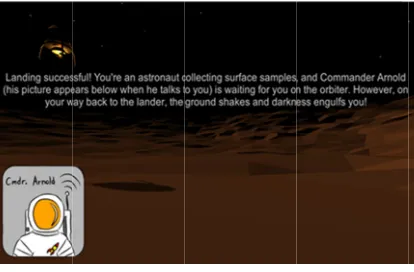
In the last mission, the player is out of the cavern. He finds his lander module on the surface but its fuel cell is empty. As a final task, the player has to gather and construct ethanol (C2H6O). As soon as this is done, the rocket takes off. At this stage, the game is over (see figure 4).
Figure 4. The end of the game
3.2 A Description of the Given Instructions and Rules
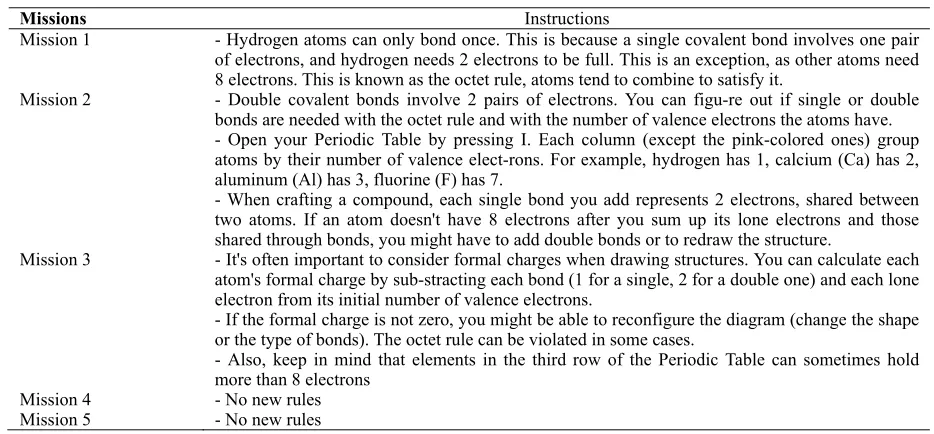
In this section, we will focus more on how we present the educational materials to learners while they progress on the game. Hence, to motivate the students with a playful aspect, we think that this latter is covered when they are navigating on a 3D environment. Every time, they have to look everywhere in the cavern structure to find the appropriate atoms to gather that allow them to construct the requested molecule. The design and the colors of the environments are also attractive and different from each other’s. However, the educational aspect is covered by announcing the rules to use on some missions and the directives mentioned in order (see table 1). The learner has also the option to see the periodic table at any time while building a molecule by pressing a shortcut button that enables him to open or close this informative tool.
Table 1. Instructions and rules presented in LewiSpace mentionned according the missions
Missions Instructions
Mission 1 - Hydrogen atoms can only bond once. This is because a single covalent bond involves one pair of electrons, and hydrogen needs 2 electrons to be full. This is an exception, as other atoms need 8 electrons. This is known as the octet rule, atoms tend to combine to satisfy it.
Mission 2 - Double covalent bonds involve 2 pairs of electrons. You can figu-re out if single or double bonds are needed with the octet rule and with the number of valence electrons the atoms have. - Open your Periodic Table by pressing I. Each column (except the pink-colored ones) group atoms by their number of valence elect-rons. For example, hydrogen has 1, calcium (Ca) has 2, aluminum (Al) has 3, fluorine (F) has 7.
- When crafting a compound, each single bond you add represents 2 electrons, shared between two atoms. If an atom doesn't have 8 electrons after you sum up its lone electrons and those shared through bonds, you might have to add double bonds or to redraw the structure.
Mission 3 - It's often important to consider formal charges when drawing structures. You can calculate each atom's formal charge by sub-stracting each bond (1 for a single, 2 for a double one) and each lone electron from its initial number of valence electrons.
- If the formal charge is not zero, you might be able to reconfigure the diagram (change the shape or the type of bonds). The octet rule can be violated in some cases.
- Also, keep in mind that elements in the third row of the Periodic Table can sometimes hold more than 8 electrons
Mission 4 - No new rules Mission 5 - No new rules
As we mentioned before, the learner is provided at any time he wants by an informative tool, the standard periodic table. This tool describes for each atom the symbol, the atomic number, the mass number or the number of nucleons and the group indicated on the top of each column.
4. Experiment and Data Preprocessing
4.1 Experiment
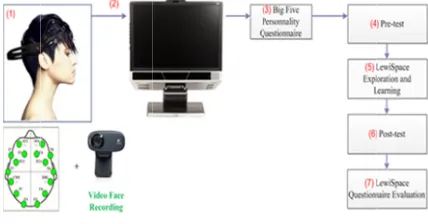
experiment w participated v we requested to college stud study and the experiment, E requires a sal measured usin 2014), which boredom). Ey of 300Hz per diameter in or FaceReader 6 and Jones algo defined by Ek arousal (Lewi The experime tracker, (3) fi molecules (C post-test whic presented on t self-reported d questionnaire
4.2 Data Pre-p
Given the data recorded by th successful tria vector consist gathered durin the Affectiv s learner’s work total of 633 s produced. 7 p segments esse consideration Other missing replaced by th Given the dif failures. This weighting inv Scikit-learn (P
5. Results
In this part, w
where 40 partic oluntarily in th students who h dents). The stu e participant s EEG is recorde ine solution fo ng this device
outputs five h e tracking was second and it rder to measur .0 software by orithm (Viola kman (Ekman
nski et al. 201 ent process is c
ill in a person O2, CCl2F2, C ch is of a simil
the game and c difficulty of e based on a Lik
processing.
a’s sequential he game. For e al. Four seque ting of the 4 ng the game s suite from Em kload, arousal,
sequences (ac participants w ential for a cor
for data analy g data values ( he mean values fficulty and th
presents a sev versely penaliz Pedrogosa et al
we will first pre
cipants (25 ma he study (with have no prior udy was held u
igned the ethi d with the Em or conduction. through TestB high-level featu
s performed us ts robustness to re learner’s wo y recording the et al. 2001). T 1970): happy 4).
composed of 7 nality test (Bi C2H4), (5) exp
ar difficulty of could apply the each presented
kert’s scale (se
nature, the da example, the le ences would th
metrics, med ession: short-t motiv (on a sc , valence and t cross 33 partic were ignored fo rrect synchron ysis in the rest o
e.g. the eye tra s for each featu he nature of th
verely unbalan zes misclassif l. 2011), the Py
esent some des
ales and 15 fem h a compensati
knowledge ab under strict lab ics agreement motiv headset, w
. EEG is samp Bench. The hea
ures (short-term sing Tobii Tx3
o head movem orkload (Bartel e participant w This latter allow
y, sad, angry, s
7 steps: (1) ins ig Five (Olivi ploring our 3D f the pre-test ( em to solve oth d mission of ou
ee figure 5).
Figure 5. The
ata stream was earner could tr
hen be availab dian, standard term excitemen cale from 0 to the seven emot cipants) 60-dim or analysis as nisation of all d
of this paper. acker failing to ure.
he game, whic nced dataset, an
fications accor ython library w
scriptive result
males aged bet ion of 20$ for bout Lewis Dia boratory condit , the participa which is comm pled at a rate adset was also m excitement, 00 which is ch ments and ligh
ls et al. 2012). with a webcam ws us to obtain
surprised, scar
stallation of E er et al. 1999 D environmen (this latter tests her examples) ur game (easy
e experiment p
divided in ind ry and fail thre
ble for analys d deviation, m nt, long-term e o 1), pupil dia
tions mentione mensional vec technical erro data streams. S
o fit a model t
ch encourages nd we used cl rding to the f we used to man
ts gathered from
tween 19 and r each participa agrams (a chem
tions. Once w ant is invited municating to th
of 128 Hz at communicatin , long-term exc haracterized w ht variations. W
. Facial expres m. The face trac n a real time cl red, disgusted,
Emotiv EPOC 9) ), (4) a pre nt and learnin s if the particip and (7) finally y, medium and
protocol
dividual seque ee times for the sis. Each sequ maximum, and excitement, m ameter from th ed above from ctors (15 featu
ors (unrelated So, only 33 pa
to the participa
trials and err lass weighting
frequency of nipulate data a
m our particip
35 years) from ant). As a crite mistry course s e explained th to start our ex he computer th a second and ng to the Affec citement, med with a high ratin
We extract from ssion recogniti cking process lassification of , and neutral w
headset, (2) ca e-test that con ng Lewis diag pant’s understo y, evaluation o d hard ranging
ences according e first task of t uence was then d minimum va meditation, frus he eye trackin m FaceReader ( ures multiplie d to the partic articipants out
ant for a small
rors, most sequ in order to ad each class, an and train mach
ants while inte
m Montreal Un erion for admi supposed to be he whole proce
xperiment. Du hrough Wi-Fi
14 channels c ctiv suite (Ghe ditation, frustra ng sampling fr m this sensor t ion was done u uses the popul f seven basic e with their vale
alibration of T nsist of constr
gram principle ood all the inst of our environm g from 1 to 3)
g to the learne the game, with n reduced to a alues for each stration, boredo ng sensors to (15 features at ed by 4 metric ipants) corrup t of 40 were ta
l amount of tim
uences are lab ddress this issu nd is implem hine learning m
eracting with o
niversity issibility, e learned ess of the uring the and only could be rguluscu ation and requency the pupil using the lar Viola emotions ence and Tobii eye ucting 3 es, (5) a tructions ment and ) using a
Journal of Edu
LewiSpace. S real-time appl
5.1 Descriptiv
As we menti questionnaire appreciation ( 3.083 (medium participants li explained by (20%: 8 from people and n according to d Next, we calc figure, we rep second highes number of fai 14.55(8.55). H noticed that i completed mi we noticed th maximum num
Therefore, we (s) for each m mission 2 is t about the sam surprising for Table 2. The a
Moreover, we and the dura (F(4,666)=25. significant. T samples t-test difference in t(37)=-9.054,
ucation and Tra
Second, we wi lications. Final
ve Results
ioned before which contain (ranked from 1 m appreciated ike the design the value of S
40) succeed t eeds more ex different types culated for eac ported the mea st in term of av
ilure (6.15(5.7 However, miss s a large num ssion 4 and m at there are so mber of trials w
e calculated in mission to study
the easiest one me in term of
us as we assum average succes
e realized an A ation. Results .17;p=0.000**
his means tha t was conducte the scores fo p = 0.000**.
aining Studies
ill show a sui lly, we will dis
(experiment s ns questions ab 1:not appreciat ) and a standa n and the con SD which is a to complete th xplications and
of learners an ch mission som an and the stan
verage of failu 75)) despite it sion 4 and mis mber of partici more particular ome learners h which are wron
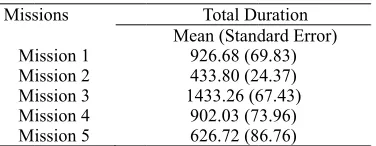
Fi the table below y again the dif e (433.80 s) a f difficulty acc
me that the mi ss time per mis
Miss M M M M M ANOVA to stud
shows that *<0.01) but th
at the mission ed to compare or the pre-test
This result pro
itable machine scuss the impo
section), all th bout the difficu ted at all to 5: ard deviation ( ntent of our g
little bit high. he whole missi d examples (w
d personalities me statistics of ndard deviation ure although it t is very simil ssion 5 are ab ipants decided
ly mission 5 ( ave 0 failures ng achieved fo
igure 6. Statist w the means a fficulty of mis and mission 3
cording to the ission 1 is very ssion sions ission 1 ission 2 ission 3 ission 4 ission 5 dy if the missi
missions dep he results of th ns are not tota e the score imp (M=12.28, S oves that our g
198 e learning mo ortance of each
he participant ulty of each m very apprecia (SD) of 1.204. game. Howeve
. We also notic ions of the gam which is our m
s).
f the average n n M(SD) for e t’s an easy mis lar to mission out the same d to quit in m (8 cases) which
in some missi or our sample o
ics of failure p and standard er sions for our s is the hardest e time spent i y easy to accom
Total Du Mean (Stand 926.68 (6 433.80 (2 1433.26 (6 902.03 (7 626.72 (8 ions are statist pend only on hree popular p ally different provement in SD=23.78) and
game contribu
odel to integra h sensor used fo
ts completed mission of our g
ated). We notic So, we can se er, a small nu ced in general me because it’ main goal for
number of fai ach mission. F ssion (H2O):10 1. Mission 3 in term of me mission 3 (27 c
h is at the end ions and some of people).
per mission rrors of the av sample of stud t one (1433.26 in order to ac mplish. uration dard Error) 69.83) 24.37) 67.43) 73.96) 6.76) tically differen n the number post hoc tests
according to the pre-test an d the post-test utes to improve
Vol. 4
ate with the a for further learn
at the end a game as well a
ced then that w ee clearly that umber didn’t. l that a small n s a difficult le
an improved
lure (see figur For example, m
0.04(9.49). Mi has the high ean of failure.
cases) and a s d of our game. e ones have 29
verage duration dents. We notic 6 s). However, ccomplish them
nt according to r of failure a
(Scheffe, LSD the failure fa nd post-test. T t (M=54.83, S e learners’ sco
4, No. 1; Janu
appropriate fea ner’s help adap
subjective ev as the degree o
we obtained a t a very big nu This factor c number of par esson for non-s version of th
re 6 below). F mission 1 is ra ission 2 has th est number of Whereas, it sh small number . Despite these 9 errors or failu
n of success in ced from this t , missions 1 a m. This result
o the number o and not the D and Tukey) actor. Finally, There was a sig
SD=29.42) con ores for drawin
ary 2016 atures in ptation. valuation f game’s mean of umber of could be rticipants scientific his game rom this nked the he lowest f failure: hould be of them e results, ures (the seconds able that nd 4 are t is very
structures after learning the lesson.
5.2 Selection of the Best Machine Learning Model
Support vector machine (SVM) with a Radial Basis Function (RBF) kernel and logistic regression models were tested with a grid search on values of gamma (for SVMs) and C to produce the highest balanced accuracy with a leave-one-participant-out scheme. This scheme was used in order to promote the selection of a model that can generalize well for a new participant from previous participants. Both algorithms performed similarly. For instance with a RBF SVM, the accuracy is about 54.9% with the hyper-parameters (C=1.0 and gamma=0.05) using all the features issued from 3 sensors. This value is very near to that of logistic regression (56.4%). In the following, we interest only on communicating results for the best logistic regression models, as the focus of this paper is not the comparison of machine learning algorithms. Logistic regression model in our case provides the highest accuracy in all cases as we will see in the next section (by taken into consideration all or some features).
5.3 Comparaison of the Importance of Each Sensor and the Big Five
After selecting the best ML model that allows us to detect if the user needs help or not, we focus on this section to study the features importance that contributes mainly to prediction. In what follows, we present the difference in accuracies in term of substracting each time one feature (sensor feature or Big Five questionnaire). Balanced accuracy is determined by the mean of correct classifications for each class while according both classes the same weight. Overall accuracy is the mean number of correct classifications with weighting for the number of samples (therefore giving more weight for the “failure” class), and the mean participant accuracy is the mean number of correct classifications per participant, ignoring whether or not a participant produced more or less samples in the dataset, similarly to the balanced accuracy. Table 3. Feature selection through classification accuracies
All features (3
sensors ) Ignores pupil diameter Ignores Emotiv Ignores facial expression recognition
Ignores Big Five Questionnaire Balanced
accuracy 0.564 0.564 0.501 0.564 0.584
Overall accuracy 0.603 0.603 0.256 0.603 0.564
Mean participant
accuracy 0.593 0.593 0.312 0.593 0.549
Table 3 shows that ignoring the Emotiv has the highest impact on performance, whereas the other features do not seem to change the accuracies when ignored. Adding five features from the self-reported Big Five Questionnaire (the values along the five dimensions measured by the questionnaire before starting the game), we note that the balanced accuracy is highest, but at the cost of the overall accuracy, which means that the classifier predicts more often that a task will be successful but mispredicts more sequences in total. Ideally, the model should be balanced between those two measures of accuracy. A model that measures only the features from the Emotiv headset was therefore tested and produces the best results so far but still very similar to one which uses all features (using 3 sensors and ignoring the big five questionnaire), with a balanced accuracy of 0.570 , an overall accuracy of 0.635 and a mean participant accuracy of 0.609. However, this indicates that other features are not necessary and might even add noise to the dataset. Table 4 shows its confusion matrix for the logistic regression using only Emotiv Affectiv Suite (The most important feature), predicted values are shown vertically, and true values horizontally.
Table 4. Confusion matrix for a logistic regression model with Emotiv headset features
Failure Success Total number
Failure 0.665 0.335 532 Success 0.525 0.475 101
Total number 407 226 633
From table 4, we can see clearly that failure is easiest to predict (with an accuracy of 66.5% which is higher that the random baseline of 50%), whereas, success is more difficult to predict (value of 47.5% which is less than 50%).
As to the relevance of the other features, we can speculate that brightness changes throughout the game (e.g. some scenes or actions producing various lighting effects) have a larger impact on the pupil diameter, a factor unaccounted during the experiment. We could improve this by controlling the brightness in real time. Facial expressions might also be more useful in a game which is more emotionally engaging which is not the goal of our game. LewiSpace focuses more on educational aspect and how to provide the adequate help to learners according the different situations encountered when playing it.
Journal of Edu
compared wit positive rate a models was m represents a w differences be cases are misc than generaliz
6. Conclusion
In this paper, LewiSpace. L playful aspect tracking, and performance o results in term improved by p by collecting shows that a detecting whe noticed also t however they Future work w order to help perform better
Acknowledge
We acknowled for funding th
References
Azevedo, R., science http://link Bartels, M., &
Plateform Chaffar, S., &
19th Inte Conati, C. (2
16(7-8), D'Mello, S., Internatio Ekman, P. (
151-158. f
ucation and Tra
th the random against the fal measured by th worthless test. etween the part classified. Thi zed models.
ns
we presented LewiSpace is a ts. Our study
facial express of the learner m of failure an
providing mor features from logistic regres en learner have that personality add more nois will involve de or challenge r on our curren
ements dge the CRSH his work.
Johnson, A., C of learning k.springer.com & Marshall, ms. ETRA 201 & Frasson, C. (2
ernational FLA 002). Probabi 555-575. http: Olney, A., W onal Journal of
1970). Unive https://www.p
aining Studies
baseline using se positive rat he area under t . The figure b ticipants. We n s result sugge
Figu
d our education a 3D environm designed also sion recognitio and his need d duration for re help and exa different types ssion model u e more difficu y traits as wel se to our datas eveloping a ve
them accordi nt dataset and o
H (Conseil de R
Chauncey, A., g with Met m/chapter/10.10
S. P. (2012). 2, Santa Barba 2006). Predicti AIRS Conferen ilistic assessm //dx.doi.org/10 Williams, C., &
of Human-Com
ersal facial e paulekman.com
g our best mod te for the diffe the ROC curv below illustrat noticed a lot of sts that we sho
ure 7. ROC cur
nal game aim ment integratin
o to investiga on) and person
of help durin each mission. amples for stu s of physiolog using only Em ulty (failure) an ll as pupil diam
et due to the n ersion of the g ingly. Before on the real-tim
Recherche en S
& Burkett, C. taCognitive 007%2F978-1
Measuring C ara, CA. http:// ing Learners’E nce, AAAI Pres ment of user's
0.1080/088395 & Hays, P. (2
mputer Studies
xpressions of m/wp-content/u
200 del, a logistic erent possible e. An area of tes the width f people with a ould more clo
rves for the 33
med at teaching ng EEG and e ate the use of nality traits (th ng progressing
. From these r udents strugglin
ical sensors an motiv EPOC A nd needs more meter and em nature of our ga
ame that react its developme me data gathere
Sciences Huma
(2010): Self-r tools. In: N -4419-5716-0_ Cognitive Wor
/dl.acm.org/cit Emotionl Resp ss, Melbourne emotions in e 510290030390 012). Gaze tu
70(5), 377-39 f emotion. C
uploads/2013/0
regression (C cutpoints of a 1 represents a of the accura a good accurac sely investigat
3 participants
g players how eyetracking SD f physiological he Big Five Q g in our game.
results, we can ng to complete nd train a mach Affectiv Suite
e help and exa motions do not
ame.
ts in real-time ent, we will h ed in our next e
aines, more pre
regulated learn New Scienc _11
rkload Across tation.cfm?id= ponse in Intelli
, FL , USA , M educational ga 0
utor: A gaze-r 8. http://dx.do
California Me
07/Universal-F
Vol. 4
value of 0.1). a diagnostic te a perfect test, w
acies encounte cy (under the c te individually
to draw Lew DKs and comb l data (electro Questionnaire) . We described n clearly see th
e the tasks. Th hine learning a
as features is amples to unde
improve the a
to the players however focu experiment.
ecisely LEAD
ning with Meta ce of Learn
Different Ey =2168582
gent Distance May 15-17. ames. Applied
reactive intelli i.org/10.1016/
ntal Health
Facial-Express
4, No. 1; Janu
It is a plot of est. Accuracy f whereas an are ered due to in curve) howeve y trained mode
wis diagrams k bining educatio oencephalograp in order to d d also some s hat the game sh his aim will be
algorithm. Our the most suit erstand the les accuracy of ou
s’ physiologica s on models t
S project) and
a-Tutor: Advan ning, pp. 2
ye Tracking H
learning Syste Artificial Inte igent tutoring /j.ijhcs.2012.0 Re-search Di sions-of-Emoti ary 2016
f the true for these ea of 0.5 ndividual r a lot of els rather nown as onal and phy, eye etect the tatistical hould be realized r finding table for sson. We ur model
al data in that will NSERC ncing the 225–247. Hardware ems. The elligence system. 1.004
Elliot, A. J., Motivatio Ghali, R., Ch Learners http://dx. Ghali, R., Ou Machine Short pap Gherguluscu,
Game-Ba http://iwc Gobert, J. D., Science M Jackson, G. T
System: Jaques, N., Co
Intelligen Johnson, W. L Culture.
Heidelbe
Lester, J., Sp environm (264), 4-Lewinski, P., in Fac http://dx. McNamara, D
Classroom http://ww McQuiggan, S Intelligen http://link Oliver, P. J.,
Perspecti http://hec a_1999_B Pedregosa et a Prensky,
http://ww Rowe, J., Mo learning Internatio http://ww onment_ Viola, P., & J IEEE Co 8-14. http
This work is l
, & Pekrun R on.EmotioninE haouachi, M., in Serio .doi.org/10.109 uellet, S., & Fr
Learning Env per.
I., & Muntean ased
c.oxfordjourna , Baker, R. S. Microworlds. E
T., Dempsey K Showdown in onati, C., Harl nt Tutoring Sy L., & Wu, S. Intelligent Tu
erg, 5091, 520-pires, H., Niet ments for elem 18. http://dx.d den Uyl, T. M ceReader. J .doi.org/10.103 D. S., Jackson
m-Based ww.igi-global.c
S., & Lester, nt Tutoring Sy
k.springer.com & Srivastav ives, L., & P ckman.uchicag BIG%20FIVE al. (2011). Scik
M. (2001 ww.amazon.fr/D
ott, B., McQu environment onal Confer ww.researchgat for_Eighth_Gr Jones, M. (200 omputer Societ ps://www.cs.cm
icensed under
R. (2007), E Education, 57-Derbali, L., ous Games,
93/iwc/iwu013 rasson, C. (20 vironment. To
n, C. H. (2014 Learning. als.org/content
., & Wixon, M
Educational P
K. B., & McN iSTART‐ME ley, J., & Azev stem. ITS con
(2008). Asses utoring Syste -529. http://lin tfeld, J., Mino mentary science doi.org/10.1016 M., & Butler, C
Journal of 37/npe000002
, G. T., & Gr Learning: com/chapter/in
J. (2006). Dia ystems. M. Ike m/chapter/10.10 va, S. (1999). Pervin et O. P
go.edu/sites/he E%20TRAIT% kit-learn: Mach 1). Digital
Digital-Game-uiggan, S., Ro for eighth gra rence on te.net/publicat rade_Microbio 01). Rapid obj
ty Conference mu.edu/~efros
a Creative Co
Emotion in th -74. http://dx.d & Frasson, C
The 6th 3
15). LewiSpac o appear in KI
4). A Novel Se
Inter
t/early/2014/04 M. B. (2015).
Psychologist, 5
Namara D. S. E. Computer g vedo, R. (2014
ference 2014. ssing Aptitude ms. B. Wool nk.springer.com
ogue, J., Mot e education: A 6/j.ins.2013.09
. (2014). Auto Neuroscien 8
raesser, A. (20 Digital R ntelligent-tutor
agnosing Self-eda, K. Ashley 007%2F11774 . The Big-Fiv P. John (Eds. eckman2013.uc %20TAXONOM hine learning i l game -Based-Learnin obison, J., Lee
ade microbiol Artificial ion/255576748 ology
ect detection e on Computer s/courses/LBM
ommons Attrib
he Hierarchica doi.org/10.1016 C. (2014). Mo h Internation
ce: An Educat I 2015: the 38
ensor-Based M
ractive
4/14/iwc.iwu0 Operationaliz
0(1). http://dx. (2012). Gam ames, 115-138 4). Predicting A
http://www.cs e for Learning lf, E. Aïmeur m/chapter/10.1 tt, W., & Lob A narrative-cen 9.005
omated facial c nce. Psycho
010). Intelligen Role: Play
ring-games-itag -efficacy in In
y and T.-W. C 4303_56
ve Trait Taxo ), Handbook chicago.edu/fi MY.pdf
in Python, JML based ng-Marc-Pren e, S., & Leste logy. Worksho Intelligence 8_CRYSTAL_
using a booste r Vision and P MV07/Papers/v
ution 3.0 Licen
al Model of 6/b978-012372 otivational Str nal ICAAR
tional Puzzle G 8th German Co
Methodology f
with
13
zing and Detec .doi.org/10.108 me based Pract
8. http://dx.doi Affect from G s.ubc.ca/~conat with a Seriou r, R. Nkambo 007%2F978-3 bene, E. (2014 ntered learning
coding: validat
ology, and
nt Tutoring an ying as g/42686 ntelligent Tuto Chan, Springer onomy: Histo of personality les/uploads/OE
LR (12), 2825 learning. sky/dp/155778 er J. (2009). C op on Intellige in Educa _ISLAND_A_
ed cascade of Pattern Recogn viola-cvpr-01.p
nse.
Approach-Av 2545-5/50005-rategies to Su RT Conferen
Game Combin onference on
for Learner’s M
Compu
cting Disenga 80/00461520.2 tice in a Read i.org/10.1057/9 Gaze Data Duri ti/my-papers/I us Game for F ou and S. La 3-540-69132-7 4). Designing g perspective.
tion of basic e
Economics
nd Games (ITa a Motiv
oring Systems: r Berlin Heide
ory, Measurem y: Theory an ECD_Spencer -2830. http://s New Yo 88634 Crystal island ent Education ation, Brigh _Narrative-Cen simple featur nition, Kauai, pdf voidance Achi -8 upport Engage nce, March
ned with a Mu Artificial Inte Motivation An uters, agement within 2014.999919 ding Strategy 978113700526 ing Interaction ITS-Natasha-2 Foreign Langu ajoie. Springe
_55
g game-based
Information S
emotions and f
s, 7(4), 2
aG). Ch3, Gam vator of
: An Empirica elberg. 4053, 5
ment, and Th nd research (2 r_2015/John_S
cikit-learn.org rk: McGr
: A narrative-nal Games at
hton, UK: ntered_Learnin
res. Proceeding HI, U.S.A., D
ievement ement of 2014. ultimodal lligence, nalysis in 26(4). n Online Tutoring 67.0013 n with an
014.pdf. uage and r Berlin learning Sciences, facs AUs 227-236. ming for Study. al Study. 565-574. eoretical 2nd ed.). Srivastav /stable/. raw-Hill. centered the 14th 11-20. ng_Envir