JIEM, 2013 – 6(1):276-288 – Online ISSN: 2013-0953 – Print ISSN: 2013-8423 http://dx.doi.org/10.3926/jiem.673
- 276 -
Research on bulk-cargo-port berth assignment based on priority of
resource allocation
Chunfang Guo, Zhongliang Guan, Yan Song
School of economics and management, Beijing Jiaotong University (China)
[email protected], [email protected], [email protected]
Received August 2012 Accepted December 2012
Abstract:
Purpose:
This paper is to propose a Priority of Resource Allocation model about how to
utilize the resources of the port efficiently, through the improvement of traditional ant colony
algorithm, the ship-berth matching relation constraint matrix formed by ontology reasoning.
Design/methodology/approach:
Through questionnaires, exploratory factor analysis (EFA)
and priority factor analysis, the authors extract the importance of the goods, the importance of
customers, and types of trades as the main factors of the ship operating priority. Then the
authors combine berth assignment problem with the improved ant colony algorithm, and use
the model to improve ship scheduling quality. Finally, the authors verify the model with
physical data of a bulk-cargo-port in China.
Findings:
Tested by the real data of a bulk cargo port, it shows that ships’ resource using
priority and the length of waiting time are consistent; it indicates that the priority of resource
allocation play a prominent role in improving ship scheduling quality and efficiency.
Research limitations:
The questionnaires is limited in only one port group, more related
influence factors should be considered to extend the conclusion.
- 277 -
Originality:
This paper makes the time of ship in port minimized as the optimization of key
indicators and establishes a dynamic berth assignment model based on improved ant colony
algorithm and the ontology reasoning model.
Keywords:
ship-scheduling system, priority of resource allocation, ontology reasoning, dynamic berth
assignment
1.Introduction
With the accelerating process of global economics, modern port has become an important basis to maintain a leading position in international competition. In recent years, as important national economic materials, bulk materials occupy a very important position in international shipping market. According to statistics, 90% world trade goods is transported by shipping, of which bulk cargo transportation accounts for 1/3, while the main three bulks coal, ore and grain accounted for about 60% of the total bulk cargo transportation (Meng & Ji, 2007). The traditional ship scheduling and production deployment of resources has been unable to meet the frequency that ships go in and go out of port to load and unload cargo. Currently, how to improve the operating efficiency of cargo transportation, thereby to increase the overall level of production scheduling, is the key factor to realize the intelligence of ship scheduling in bulk groceries port.
2.The definition of dynamic berth assignment problem
The core content of ship scheduling in bulk groceries port is berth assignment problem. Berth assignment problem is a decision-making problem to arrange arriving ship dock to the specified berth quay at a time. How to assign its berth time and position dynamically, is of great importance to improve the level of port services and reduce port cost of production. The main factors affecting the berthing are: ship cargo information, ship cargo capacity, the length of the ship, shipping company, weather conditions, the ship's draft, draft berths, berth length. We also need to consider the completed handling capacity, the average handling speed and other factors to ensure the real-time of ship scheduling.
Serial Variable Variable Description Serial Variable Variable Description 1 Vn The number of ships to be docked 8 Tfi Arriving time of ship i
2 Bn The number of available berths 9 Tsi operating start time of ship i 3 V collection of arriving ship 10 Tei Operating finish time of ship i 4 B Collection of available berths 11 Twi waiting time of ship i
5 Vodr Marine resources matching priority 12 Bvj average handling speed of berth j 6 WSi cargo loaded of ship i 13 xijk Ship i receive service at berth j at the
first k place
7 Wli(t) completed Handling capacity of
ship i at the time t 14 yij Possibility of ship Inference drawn from the type of ship i handling at berth j, cargo, ship and berth depth and other Physical conditions
- 278 -
To take total time of ship in the harbor minimum as optimization goals, the total time equal to the sum of waiting time and operating time.
Tsi Tfi Wsi Wli t Bvj
(1)Objective functions:
ijk Vn i Bn j j i i i i x Bv t Wl Ws Tf Ts Min
0 0 (2)
0 0((
) (
)
)
Vn Bni i i i j ijk
i j
Min
Ts
Tf
Ws
Wl t
Lvb x
(3) Constraint conditions: 1 11
1...
Bn Vn ijk j kx
i
Vn
(4)Only one service chance for each ship:
1
1,
1...
Vn ijk i
x
j
Bn
(5)Only one ship in the one berth at one time:
ijk ij
x
y
(6)Limit the range of decision variables,
x
ijk is according toy
ij{0,1}
ij
y
(7)The possibility of ship i handling at berth j, 0 means no and 1 means yes, yij means the
- 279 -
3.Sort of priority based on the ship resources
With the increasing of the port operations, the existing port berths, storage yard, as well as machinery and other resources are relatively scarce, it is inevitable for the inbound operating vessels to wait in line, when port serve the ships, they do not pursuit efficiency of one ship, its performance evaluation should be evaluated by the minimum berth time of the ship in port in a period of time.
3.1.Marine resource usage based on priority factor analysis
In this paper, we use the questionnaires and study cargo transportation scheduling post, analyze the ship scheduling situation from the view of the practical application, extract important factors which affect the sort of ship operations and make weight distribution.
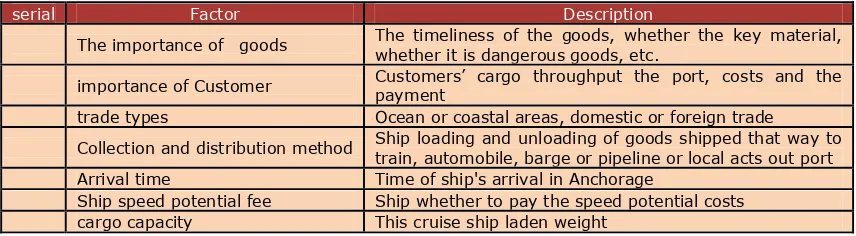
The object of this survey includes the ports corporation scheduling manager, dispatchers of a port, we conduct a survey of the factors that affect the order of ship operationg priority in their professional and work areas, and we analyze the questionnaires by statistical methods. Given that cargo transportation is strong regional and the geographical situations are different (Gan & Qi, 2006). We select the whole Port Group (which involve four sub-Ports Corporation) as a whole object, and get the factors shown in Table 2.
serial Factor Description
The importance of goods The timeliness of the goods, whether the key material, whether it is dangerous goods, etc.
importance of Customer Customers’ cargo throughput the port, costs and the payment trade types Ocean or coastal areas, domestic or foreign trade
Collection and distribution method Ship loading and unloading of goods shipped that way to train, automobile, barge or pipeline or local acts out port Arrival time Time of ship's arrival in Anchorage
Ship speed potential fee Ship whether to pay the speed potential costs cargo capacity This cruise ship laden weight
Table 2. Factors of priority about ship using resources
Importance Very Relatively General Sometime Seldom
Score 5 4 3 2 1
Table 3. Check list of Importance and point
- 280 -
At first, we need to use KMO (Kaiser-Meyer-Olkin measure of sampling adequacy) to test whether the data are suitable for factor analysis or not. According to Kaise (1974), the larger KMO, the more suitable for factor analysis; if KMO is too low, it is not suitable for factor analysis, as shown in Table 5:
Serial KMO Adaptation Degree Serial KMO Adaptation Degree 1 0.9<=kmo<=1 Totally 4 0.6<=kmo<0.7 Barely
2 0.9<=kmo<0.9 Very 5 0.5<=kmo<0.6 Less
3 0.7<=kmo<0.8 General 6 0<=kmo<0.5 Not
Table 4. Check list of KMO and factor analysis sufficiency
Then we use SPSS13.0 to measure KMO value and Bartlett’s spherical test, the result shows that KMO value is 0.737>0.7. Bartlett ball test significance level of sig. = 0.00 <0.05, very significant. According to table 4-5, it is suitable for factor analysis if KMO value is greater than 0.7.
Kaiser-Meyer-Olkin Measure of Sampling Adequacy.(KMO ) 0.737
Bartlett's Test of Sphericity
Approx. Chi-Square 70.023
Df 10
Sig. 0.000
Table 5. KMO and Bartlett's Test
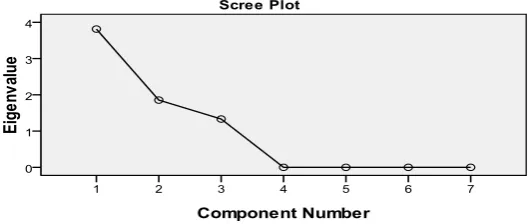
We can conclude from the previous analysis and moderate test, the questionnaire data samples are suitable for factor analysis, then we use SPSS13.0 to make factor extraction to determine the number of factors. The number of Eigen value that greater than 1 is also the number of factors should be extracted. The result of the analysis is shown with gravel map, in Figure 1.
Figure 1. Scree Plot of investigation
- 281 -
extract the first three factors as the main factors of ship operating priority. They are the importance factor of the goods, the importance of customers, and type of trade.
4.Berth assignment based on improved ant colony algorithm
In the field of ship scheduling in bulk and general cargo port group, the essence of dynamic berth assigned problem is to solve the problem that the minimization of the total time of ship stay in port under the ship operating constraints.
4.1.Assignment problem combined with the improved ant colony algorithm
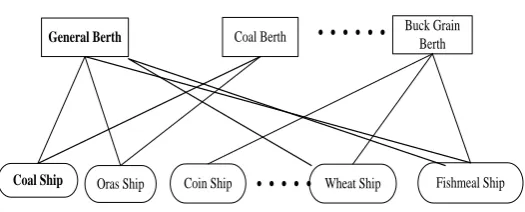
There are alternative relationships between many production resources in discrete production systems. Because berth is the scarcest productive resources of pier, the substitute relationship between the various berths is of a decisive impaction for ship scheduling. It occupies an important position in ship scheduling.
Ship - berth constraints
Coin Ship Wheat Ship
Oras Ship Coal Ship
General Berth Coal Berth Buck Grain Berth
Fishmeal Ship
Figure 2. Relationship of ship and berth
As is Shown in Figure 2, when the port make ship-berth selection, according to the specialized adapt requirements of the port cargo types to the berths, there is docked constraint set between specialized berths and different types of cargo, constraints of the collection contains two aspects:
(1) ships - berth physical condition (boat length, type width and maximum draft and other property and the length of the berth, draft, etc.) must be met;
- 282 - 1 n i i
v
V
, 1 m j jb
B
argc o type
V
B
1 2
arg
(
arg,
arg...
arg)
( )
n
c o type c o c o c o i j
V
B
V
V
V
berth v
b
(8)
vi is ship waiting for berthing operations, berth(vi) is the berth ship vi docked, cargo(vi) is the
information of the goods ship vi carried, Btype is the services type that the berths provide,
formula (8) show that only when the goods information on ship accord to the requirements of loading and unloading cargo information of the berths provided, can the ship choose the berth (Liu, 2008).
Based on the ship - berth constraints concept and the two types of constraints above, we merge the ant colony algorithm and the constraint conditions turns into (9), Ship - berth constraint matrix.
11 12 13 1
21 31 1
...
n ij m mny
y
y
y
y
y
A
y
y
y
0
i
m
0
j
m
1 ship
0 ship
i j ij i j
berth at
not berth at
v can
b
y
v can
b
(9)
Prioritization of the vessel operation
Since the scarcity of port productive resources, it is inevitable for inbound operating ships to wait on line. We put forward the ships resource using priority model based on the Analytic Hierarchy Process to measure the different resources using priority of the ship.
arg
customer c o trade
i i i i
P
v
v
v
- 283 -
Calculate marine resources using priority sequence vodr, Sort the ship in vodr in accordance with
the resources using priority.
When all the ships complete one operation, it is said that the berth assignment problem obtained a solution.
antN-Ant number;
m-Ship number;
n-Berth number;
iteratorTimes-Iteration number;
Q-Total amount of pheromone ant released after the completion of every iteration,
Mean the importance degree of the pheromone, the relative importance of the operations
time, pheromone residual coefficient respectively.
Construct the ship - berth time matrix WorkT(t), as formula (10) shown that, the expected turnaround of ship I at time t, in berth j .
1 1 1 1
1 1 1 1 ( ) n i i j m m n
Ws Wl t Ws Wl t
Lvb Lvb
Ws Wl t Lvb WorkT t
Ws Wl t Ws Wl t
Lvb Lvb
1
0
i i ij i i j j ijWs
Wl t
y
Ws
Wl t
Lvb
Lvb
y
(11)1 Allowed
[ ]
0 N
i i
v
ShipAllowed i
v
ot Al l owed
——Ship visit tableberthFinishTime[j]-Ship j Job completion time
- 284 -
( )
( )
[ ] 1 A
1
( )
( )
[ ]
0
kij ij
ij
ij ij
r allowed
t
t
ShipAllowed i
nd y
t
t
p i
else
(12)ShipAllowed[i]=1-Sjip i can schedule operations
Yij=1 - ship and berth j meet ship—berth matrix A vorderik belongs to Vodr – ants access path
constrains
antTrialTotalTime[it][k]-the first it iterations, the ants k complete a path exploration, the total stop time obtained
antTrialTotalCombine[it][k]- the first it iterations, the ants k complete a path exploration, ship - berth combination obtained
bestTrialTotalTime[it]-the first it iterations, the optimal value of the total stop time obtained
bestTrialTotalTime[it]=min(antTrialTotalTime[it][k])
bestTrialTotalCombine[it]-the first it iterations, bestTrialTotalTime[it] the optimal combination of ship - berth that corresponds.
5.Calculation Example
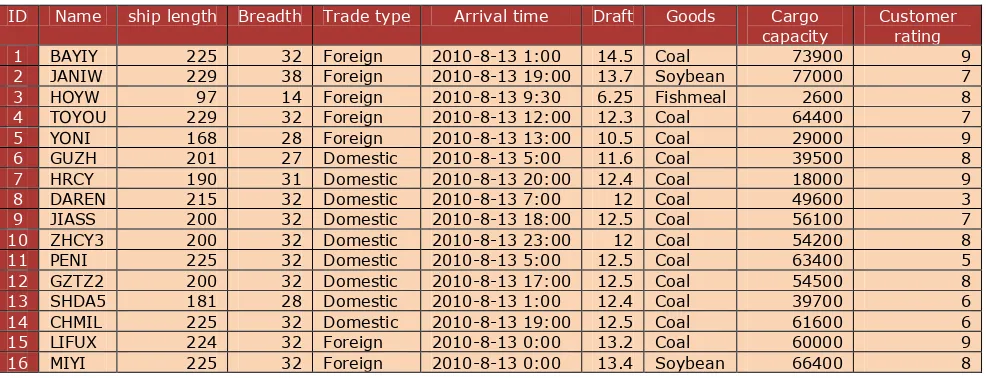
In this section, we use actual data of a bulk cargo port to calculate the solution methods and models in 4.1. As is shown in Table 6, which contains important data as: ship wide, trade type, time of arrival and cargo information, customer rating etc.
ID Name ship length Breadth Trade type Arrival time Draft Goods Cargo
capacity Customer rating
1 BAYIY 225 32 Foreign 2010-8-13 1:00 14.5 Coal 73900 9
2 JANIW 229 38 Foreign 2010-8-13 19:00 13.7 Soybean 77000 7
3 HOYW 97 14 Foreign 2010-8-13 9:30 6.25 Fishmeal 2600 8
4 TOYOU 229 32 Foreign 2010-8-13 12:00 12.3 Coal 64400 7
5 YONI 168 28 Foreign 2010-8-13 13:00 10.5 Coal 29000 9
6 GUZH 201 27 Domestic 2010-8-13 5:00 11.6 Coal 39500 8
7 HRCY 190 31 Domestic 2010-8-13 20:00 12.4 Coal 18000 9
8 DAREN 215 32 Domestic 2010-8-13 7:00 12 Coal 49600 3
9 JIASS 200 32 Domestic 2010-8-13 18:00 12.5 Coal 56100 7
10 ZHCY3 200 32 Domestic 2010-8-13 23:00 12 Coal 54200 8
11 PENI 225 32 Domestic 2010-8-13 5:00 12.5 Coal 63400 5
12 GZTZ2 200 32 Domestic 2010-8-13 17:00 12.5 Coal 54500 8
13 SHDA5 181 28 Domestic 2010-8-13 1:00 12.4 Coal 39700 6
14 CHMIL 225 32 Domestic 2010-8-13 19:00 12.5 Coal 61600 6
15 LIFUX 224 32 Foreign 2010-8-13 0:00 13.2 Coal 60000 9
16 MIYI 225 32 Foreign 2010-8-13 0:00 13.4 Soybean 66400 8
- 285 -
Table 7 is the information about berths as is shown in the table.
Serial Berth Name Berth depth Berth Length Average Operating Efficiency (t/h) Berth Types
1 Berth1 15.5 250 5000 Coal
2 Berth2 13.5 230 4000 Coal
3 Berth3 12.5 165 3500 General
4 Berth4 12 231 2000 Coal
5 Berth5 13 215 5000 Coal
6 Berth6 15 184 6000 Coal
7 Berth7 14 230 4000 Bulk grain
8 Berth8 11 230 3500 Coal
Table 7. Berth data list
Table 8 and9 are the importance of cargo and importance of trade, use 10-point scale, the higher importance degree of goods and trade type, the higher the score.
Serial Cargo name Importance Serial Cargo name Importance
1 Coal 4 4 Steel 9
2 Soybean 4 5 Corn 5
3 Fishmeal 8
Table 8. Importance of cargo
Serial Trade type Importance Serial Trade type Importance
1 Foreign 10 2 Domestic 2
Table 9. Importance of trade
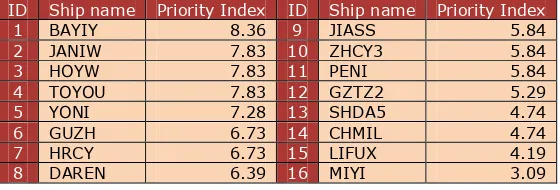
Table 10 is the priority of ship using resources. Higher priority index and higher priority means shorter waiting time before the operations.
ID Ship name Priority Index ID Ship name Priority Index
1 BAYIY 8.36 9 JIASS 5.84
2 JANIW 7.83 10 ZHCY3 5.84
3 HOYW 7.83 11 PENI 5.84
4 TOYOU 7.83 12 GZTZ2 5.29
5 YONI 7.28 13 SHDA5 4.74
6 GUZH 6.73 14 CHMIL 4.74
7 HRCY 6.73 15 LIFUX 4.19
8 DAREN 6.39 16 MIYI 3.09
Table 10. Priority of Ship using resources
- 286 -
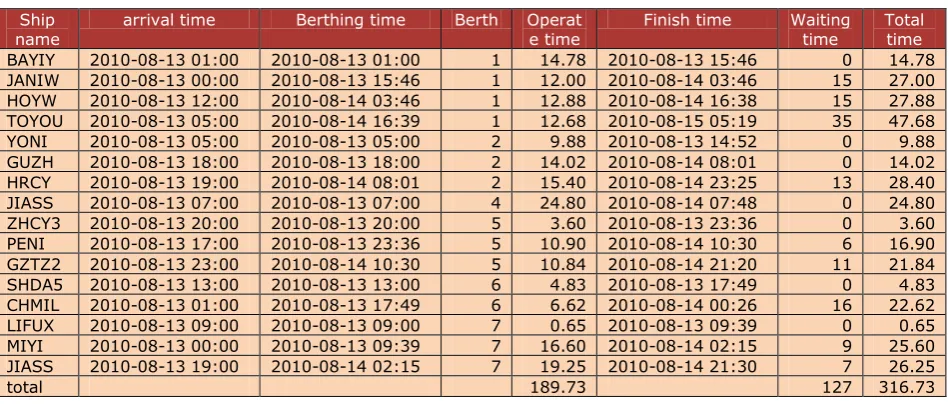
Ship
name arrival time Berthing time Berth Operate time Finish time Waiting time Total time
BAYIY 2010-08-13 01:00 2010-08-13 01:00 1 14.78 2010-08-13 15:46 0 14.78 JANIW 2010-08-13 00:00 2010-08-13 15:46 1 12.00 2010-08-14 03:46 15 27.00 HOYW 2010-08-13 12:00 2010-08-14 03:46 1 12.88 2010-08-14 16:38 15 27.88 TOYOU 2010-08-13 05:00 2010-08-14 16:39 1 12.68 2010-08-15 05:19 35 47.68 YONI 2010-08-13 05:00 2010-08-13 05:00 2 9.88 2010-08-13 14:52 0 9.88 GUZH 2010-08-13 18:00 2010-08-13 18:00 2 14.02 2010-08-14 08:01 0 14.02 HRCY 2010-08-13 19:00 2010-08-14 08:01 2 15.40 2010-08-14 23:25 13 28.40 JIASS 2010-08-13 07:00 2010-08-13 07:00 4 24.80 2010-08-14 07:48 0 24.80 ZHCY3 2010-08-13 20:00 2010-08-13 20:00 5 3.60 2010-08-13 23:36 0 3.60 PENI 2010-08-13 17:00 2010-08-13 23:36 5 10.90 2010-08-14 10:30 6 16.90 GZTZ2 2010-08-13 23:00 2010-08-14 10:30 5 10.84 2010-08-14 21:20 11 21.84 SHDA5 2010-08-13 13:00 2010-08-13 13:00 6 4.83 2010-08-13 17:49 0 4.83 CHMIL 2010-08-13 01:00 2010-08-13 17:49 6 6.62 2010-08-14 00:26 16 22.62 LIFUX 2010-08-13 09:00 2010-08-13 09:00 7 0.65 2010-08-13 09:39 0 0.65 MIYI 2010-08-13 00:00 2010-08-13 09:39 7 16.60 2010-08-14 02:15 9 25.60 JIASS 2010-08-13 19:00 2010-08-14 02:15 7 19.25 2010-08-14 21:30 7 26.25
total 189.73 127 316.73
Table 11. Result of Ship-Scheduling
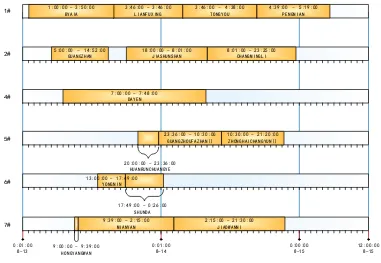
Two questions can be found in the following through the analysis of ship scheduling results list and the Gantt chart:
-3 berth and 8 berth in the working process has not been assigned
3 berth’s length is just165 m, 8 berth’s draft depth is11 meters, in all waiting operations ships, only the length is 97 m, draft 6.25 m Hongyangwan is able to meet the berthing conditions. But Hongyangwan has higher priority, in the beginning of the iteration, it has the priority to choose a good berth (higher operating efficiency) berths. Therefore, the 3 berth and 8 berth in the operations process has not been assigned.
-4 berth and 6 berth utilization is relatively low
4 berth and 6 berth only have one ship assignment, except 6 berth is 184 meters berth length restrictions, ships all reflect tend to choose higher operating efficiency berths; View on berth type, all ships - berth match the conditions of the ship - berth match constraints, indicating that the ship - berth reasoning constraints played a role.
- 287 -
1#
2#
4#
3:46:00 – 4:38:00 TONGYOU 3:46:00 - 3:46:00
LIANFUXING
4:39:00 – 5:19:00 PENGNIAN
5#
6#
7#
HUANRUNCHUANGYE 20:00:00 - 23:36:00
10:30:00 - 21:20:00 ZHONGHAICHANGYUNⅡ
12:00:00 8-15 7:00:00 - 7:48:00
DAYEN
0:00:00 8-15 9:00:00 - 9:39:00
HONGYANGWAN 5:00:00 – 14:52:00
GUANGZHAN
0:01:00 8-14
8:01:00 - 23:25:00 CHANGMINGLI
MIANYAN 9:39:00 - 2:15:00
0:01:00 8-13
2:15:00 - 21:30:00 JIAOWANNI 18:00:00 - 8:01:00
JIASHUNSHAN
23:36:00 - 10:30:00 GUANGZHOUFAZHANⅡ
17:49:00 - 0:26:00 SHUNDA YONGNIN 13:00:00 - 17:49:00 1:00:00 - 3:50:00
BYAIA
Figure 3. Gantt Chart of Ship-Scheduling
6.Conclusion
Result of berth assignment problems is to obtain the loading and unloading order of the ship, expected ship berthing time and docking berth .In this paper, we firstly build a ship scheduling problem model of bulk and general cargo port group. Secondly, based on the maximum and minimum ant colony algorithm, we propose a way to adjustment pheromone allocation to further improve the search capabilities through standard deviation coefficient, which form the improved ant colony algorithm based on the mixing behavior.
Through the questionnaire analysis of ship resource usage priority affecting factor, this paper put forward the ship resources priority model. And then combining with knowledge-based reasoning, it puts forward the ship -berth match collection, and uses the improved ant colony algorithm model to improve the efficiency of the dynamic berth assignment.
Acknowledgments
This research was supported by “the Fundamental Research Funds for the Central Universities” under Grant 2011JBM042.
References
- 288 -
Liu, J. (2008). Improved Virtual Enterprise Partner Selection and integration of genetic algorithm and ant colony algorithm. Beijing University of Aeronautics and Astronautics, 25-79.
Meng, Y., & Ji, Y. (2007). Based on Multi-Agent Container Terminal Production Scheduling.
Wuhan University of Technology, 1-5.
Stutzle, T., & Hoos, H. (1997). The Max-Min ant system and local search for the traveling salesman problem. Proceedings of IEEE-ICEC-EPS’97, 309-314.
Zheng, H. (2003). Port Management. Beijing: Communications Press, 117-205.
Journal of Industrial Engineering and Management, 2013 (www.jiem.org)
El artículo está con Reconocimiento-NoComercial 3.0 de Creative Commons. Puede copiarlo, distribuirlo y comunicarlo públicamente
siempre que cite a su autor y a Intangible Capital. No lo utilice para fines comerciales. La licencia completa se puede consultar en