Sah et al. World Journal of Pharmaceutical and Life Sciences
FORMULATION AND EVALUATION OF SUBLINGUAL TABLETS OF
ISOSORBIDE DINITRATE
Somya Sah*, Ashutosh Badola, Preeti Kothiyal
*
Shri Guru Ram Rai Institute of Technology and Sciences Dehradun.
Article Received on 06/06/2016 Article Revised on 27/06/2016 Article Accepted on 18/07/2016
ABSTRACT
The aim of the present research was to formulate and evaluate
sublingual tablets of Isosorbide Dinitrate, belonging to the class of
anti-angina drug. The tablets were prepared by direct compression
technique. The surfactants in the formulation include the
Croscarmellose Sodium, Sodium starch glycolate, crospovidone in
different ratios. The polymer used in the formulation includes the poloxamer that act as a
surfactant and also the wetting agent that causes the rapid and effective disintegration of the
tablet and the other excipients. The formulation (F5) was found to disperse at the least time of
5+.02 seconds and the total time for disintegration was found to be 3 + .14 minutes. The drug
content was found to be 99.19%. The tablets were showing hardness of 3+.5. The tablets was
found to show the friability of .52+.03 %. In-vitro study profile of the formulation proves that
all the formulations showed the optimal release within specific time duration. The release
kinetic study revealed that formulationF5 showed non fickian release mechanism and show
zero order kinetic. According to the evaluations done on the various formulations it was
observed that the formulation number 5 (F5) showed the best result as the disintegration time
required was less as compared to other formulations.
KEYWORDS: Croscarmellosee sodium; Sodium Starch Glycolate; crospovidone; Non
Fickian diffusion; zero order release.
1. INTRODUCTION
Among the various types form of tablets available, sublingual tablets are among one of the
World Journal of Pharmaceutical and Life Sciences
WJPLS
www.wjpls.org
SJIF Impact Factor: 3.347*Corresponding Author
Somya Sah
Shri Guru Ram Rai
Institute of Technology
immediate onset pharmacological effect. Sublingual tablets come into existence for the
pediatric and geriatric patients and also for patient compliance in the people suffering from
dysphasia, mentally retarded, uncooperative, nauseated or unconscious.[1-4]
The absorption is affected by the lipid solubility and accordingly the permeability of the
solution frequently known as osmosis, the ionization, and the molecular weight of the drug.
The cells of oral epithelium soak up the drug by the process of endocytocis. It is improbable
that the same mechanism is observed throughout the stratified epithelium. Although, it is
believed that acidic stimulation of the salivary glands, accompanying vasodilatation,
facilitates absorption and uptake into the circulatory system. The mouth is lined with a
mucous membrane which is covered with squamous epithelium and contains mucous glands.
The sublingual mucosal tissue is similar to that of buccal mucosa.[5-7] The salivary glands consist of lobules of cells which secrete saliva through the salivary ducts into the mouth. The
three pairs of salivary glands are the parotid, the submandibular and the sublingual which lies
on the floor of the mouth. The more acidic the taste, greater the stimulation of salivary
output; serving to avoid potential harm to acid‐sensitive tooth enamel by bathing the mouth in
fulsome neutralizing fluid. The sublingual artery travels forward to the sublingual gland, it
supplies the arterial branches to the neighboring muscles and to the mucous membranes of
the mouth, tongue and gums. Two symmetrical branches travel behind the jawbone under the
tongue to meet and join at its tip. Another branch meets and anastomoses with the submental
branches of the facial artery. The sublingual artery stems from the lingual artery – the body's
main blood supply to the tongue and the floor of the mouth – which arises from the external
carotid artery. The proximity with the internal carotid artery allows fast access to its route
supplying the greater part of the cerebral hemisphere.[8,9]
2. MATERIAL AND METHOD
Isosorbide dinitrate was received as a gift sample from IPCA Dehradun, India and all the othe
excipients used were received from Central drug house Pvt. Ltd. Delhi (IND).
2.1. Method
Tablets containing 5 mg of Isosorbide dinitrate were prepared by direct compression method.
Three different superdisintegrants were used for the formulation were Croscarmellose
Sodium, Soduim starch glycolate, crospovidone. Poloxamer was used as a polymer that act
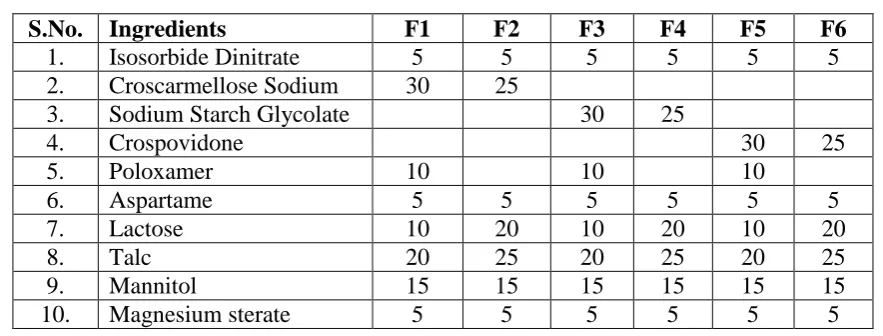
Table 1: Composition of all batches of sublingual tablets of Isosorbide Dinitrate.
S.No. Ingredients F1 F2 F3 F4 F5 F6
1. Isosorbide Dinitrate 5 5 5 5 5 5
2. Croscarmellose Sodium 30 25
3. Sodium Starch Glycolate 30 25
4. Crospovidone 30 25
5. Poloxamer 10 10 10
6. Aspartame 5 5 5 5 5 5
7. Lactose 10 20 10 20 10 20
8. Talc 20 25 20 25 20 25
9. Mannitol 15 15 15 15 15 15
10. Magnesium sterate 5 5 5 5 5 5
Average weight of each tablet= 100 mg
2.2. Pre Compression Parameters[10-15]
A. Angle of repose (θ): angle of repose is defined as the maximum angle between the
surface of the pile of the powder and the horizontal plane. It is used to measure the frictional
force of the powder.
B.
Tan θ = h/r θ = Tan-1
h/r
where θ = angle of repose , h = height of the cone formed, r = radius of the cone base
C. Bulk density: bulk density is defined as the ratio of the mass of the powder to its bulk
volume. The bulk density of the powder predominantly depends on the particles size, shape,
distribution, and there tendency to adhere to one another.
Bulk density = M / V0
Where, M = mass of powder taken V0 = apparent volume
D. Tapped density: tapped density as the name signifies is achieved by mechanical
tapping the graduated cylinder filled with the powder sample. Tapped density was calculated
using the following formula:
Tapped density = Mass of powder/ Tapped volume
E. Carr’s compressibility index: the compressibility index measures the proclivity of the
powder to be compressed. It is specified by the Carr’s compressibility index (CI)
CI = {(Tapped density – Bulk Density) / Tapped Density} *100
F. Hausner ratio: the Hausner ratio is the ratio of the tapped density to the bulk density of
the powder substance under investigation. Hausner ratio can be calculated by the formula:
2.3. Post compression parameters for tablets[16-25]
A. General appearance: All the ingredients used in the formulation were white in color so
there must be no change in the color of the tablet in all the formulations. It proves that all the
excipients used in the formulation are compatible and are not causing any chemical reaction
that could alter the properties of the formulation.
B. Weight variation:. Ten tablets were taken randomly from the batches and weighed on
digital weighing balance machine. The average weight was determined.
C. Uniformity of thickness: The thickness of the individual tablet were measured by
using Vernier Caliper, that measures the thickness. 6 tablets were randomly selected from the
batch and were evaluated for thickness using Vernier Caliper.The average was calculated.
D. Hardness: Hardness of the tablet is evaluated so as to check the loss like chipping,
abstraction or breakage that are more likely to occur. Monsanto hardness tester was used to
check the hardness. And the average hardness was calculated in kg/cm2.
E. Friability: Friability of the tablets is evaluated to check its mechanical strength. Roche
friabilator is used to determine the friability using the following procedure. 20 pre weighed
tablets were placed in the cleaned friabilato. The loss in the weight of the tablets is the
measure of friability and expressed in percentage as following:
% friability = {(initial weight – final weight) / initial weight}*100
% Friability of tablets less than 1% is considered as acceptable.
F. Disintegration time: disintegrants are added in the formulation with the aim to
facilitate the breakup of the tablet upon its exposure to water. For testing the disintegration
time disintegration apparatus was used. Saline phosphate buffer of pH 6.8 was used as
medium. The temp was set up at 37± 2° C. The time taken for complete disintegration of the
tablets with no palatable mass remaining in the apparatus was measured.
G. Drug content: weight accurately a portion of the powder, equivalent to about 5mg of
Isosorbide Dinitrate. Add exactly 50 mL acetic acid, shake for 15 minutes, filter, and use this
filtrate as the sample solution. Separately weigh accurately about 0.09 gm of dried potassium
nitrite, dissolve in 5 mL of water make up the volume from the acetic acid upto 100 mL.
separate out 10 mL of this solution, and make the volume upto 100 mL using acetic acid, use
this solution as the standard solution.
Measure exactly 2mL of the sample solution and the standard solution; add exactly 2.5 mL of
Make them alkaline with about 12 mL of solution of sodium hydroxide while cooling in an
ice bath; add water to make exactly 50 mL measure the absorbance at 405 nm.
H. In vitro study: In-vitro release rate of tablet were carried out using Paddle apparatus
method. The dissolution test was carried out using 900 mL of 6.8 pH phosphate buffer, at 37+
0.5º C and 50 rpm. A required quantity of sample solution was withdrawn from the
dissolution apparatus at a specific time intervals and the withdrawn volume was replaced
with fresh dissolution media. The % release of drug was calculated.
3. RESULT AND DISCUSSION
3.1. Result of bulk powder study.
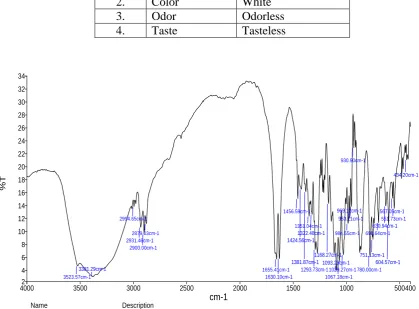
A. Identification: the procured drug sample as Isosorbide Dinitrate was identified by
Organoleptic properties and FTIR spectra of the drug sample.
Table 2. Result of Organoleptic properties.
S.No. Organoleptic properties
1. Description Crystalline Powder
2. Color White
3. Odor Odorless
4. Taste Tasteless
ISDN Name
Sample 012 By Administrator Date Friday, January 29 2016 Description
4000 3500 3000 2500 2000 1500 1000 500400
34 2 4 6 8 10 12 14 16 18 20 22 24 26 28 30 32 cm-1 %T 3381.29cm-1 1093.29cm-1 3523.57cm-1 1067.18cm-1 1655.41cm-1 1630.10cm-1 780.00cm-1 1029.27cm-1 1293.73cm-1 751.13cm-1 2900.00cm-1 2931.46cm-1 604.57cm-1
2879.03cm-1 984.55cm-1 698.64cm-1
969.12cm-1 1351.04cm-1 1322.48cm-1 551.73cm-1 2994.65cm-1 953.11cm-1 630.94cm-1 1168.27cm-1 1456.59cm-1 567.05cm-1 1381.87cm-1 1424.56cm-1 434.20cm-1 930.90cm-1
B. Solubility analysis: Preformulation solubility analysis was done to select the suitable
solvent system to dissolve the drug and also to test solubility in dissolution medium that are
to used. Result of the analysis are shown in table 3.
Table 3: solubility analysis.
S.No. Solvent Solubility
1. Acetone Very soluble
2. Chloloform Freely soluble 3. Toulene Freely soluble
4. Methanol Soluble
5. Ethanol Soluble
6. Diethyl Ether Soluble
7. Water Sparingly soluble
C. Melting point determination: Melting point of the drug was determined by using the
capillary method. Fine powder of the drug was filled in a capillary tube, previously sealed at
one end. The capillary tube was inserted at the sample holder of the melting point apparatus
with a thermometer placed in the apparatus. The temperature at which the powder of the drug
starts to melt was found to be 70- 72 º C. The melting point value of the sample was found to
be nearly as mentioned in the standard reference 70 º C.
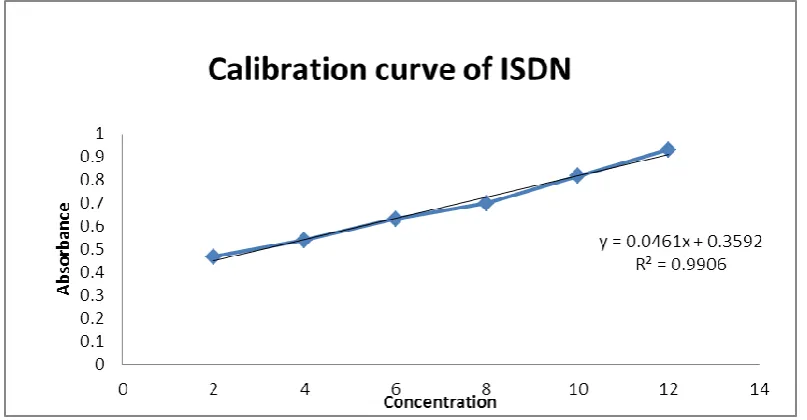
D. UV Spectroscopy: The UV spectroscopy of Isosorbide Dinitrate performed at the
absorbance of 405 nm and the beers range of 2-12 µg/ml.. The calibration curve thus obtained
is shown in figure 4. Absorbance of each concentration plotted by taking absorbance on
y-axis and concentration on x-y-axis.and the regression equation was calculated.
3.2. Result of pre-compression parameters.
The bulk of the drug sample containing (Isosorbide Dinitrate) as the active pharmaceutical
ingredient that were ready to be mould undergo the following pre compression evaluation so
as to achieve optimized product. The evaluations showed the following results.
A. Angle of repose (θ): The obtained value for the angle of repose of Isosorbide Dinitrate
was found to be in the range of 25-30 that revealed that the drug shows good flow property.
The result of the observation is shown in the table 4.
B. Bulk density: The bulk density was found in the range of 0.25 – 0.26. The result
obtained was shown in table 4.
C. Tapped density: The tapped density was found in the range of 0.29 – 0.30. The result
obtained was shown in table 4.
D. Carr’s Index: The Carr’s index was found to be in the range of 13-16 %. The value
proves the powdered drug showed good flow property. The result obtained was shown in
table 4.
E. Hausner Ratio: The Hausner ratio was found to be less than 1.25 % proving the good
flow property. The result obtained was shown in table 4.
Table 4: Pre-compression parameters.
Drug Angle of
repose Bulk density
Tapped
density Carr’s ratio
Hausner ratio
Isosorbide Dinitrate
28.27 .25 .29 13.79 1.16
29.02 .25 .30 16.66 1.2
28.84 .26 .30 13.33 1.15
Avg= 28.71 Avg= .25 Avg= .29 Avg=14.59 Avg= 1.17
The pre compression study of the sample showed that the drug powder to have a good flow
property. All the parameters that were included in the study of the bulk powder showed the
standard range to prove themselves as a good flow able powder. Hence, it can be concluded
that the powder was a good flowing powder.
3.3. Result of post compression parameters
A. General appearance: Around 20 compressed tablets from each batch of formulation
were examined. No variation in the color, shape was observed, and no identifying marks were
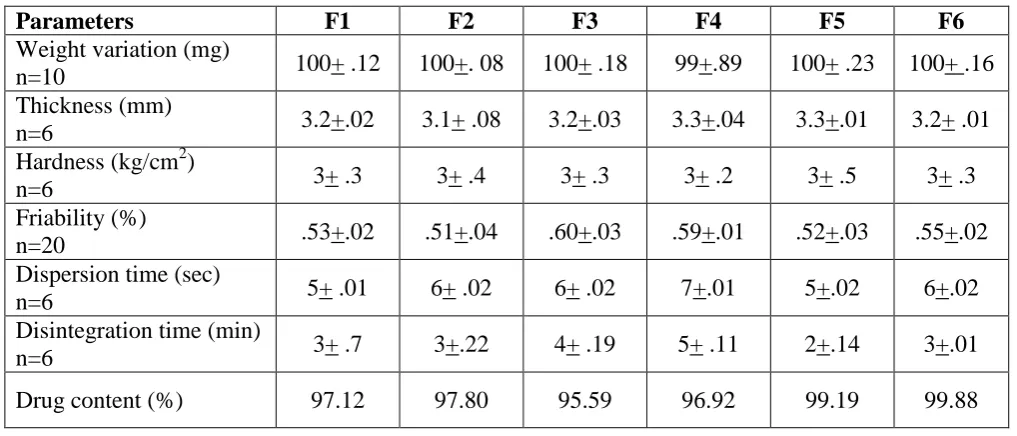
B. Weight variation: 10 tablets were selected from every batch of the formulation and were
evaluated for the weight variation. The tablets showed the variation under the limits as per
described in IP. The result is shown in table 5.
C. Thickness: 6 tablets were selected from every formulation batch and were evaluated for
thickness using Vernier caliper. The tablets deviation in the range of 0.01- 0.05 mm. The
result of the thickness are showed in table 5.
D. Hardness: 6 tablets were selected from the formulation batches and were evaluated for
the hardness parameters using Monsanto hardness tester. The tablets showed variation under
the limits as per described in IP. The results are shown in table 5.
E. Friability: 20 pre weighed tablets were selected from every batch of the formulation and
then were evaluated for the friability. The tablets show the result under the limits as per
described in IP. The result of the test is shown in table 5.
F. Disintegration time: 6 tablets were selected from the batches of formulation and were
evaluated. The result for the disintegration is shown in table 5.
G. Drug content: powder containing drug equivalent to 5 mg of the drug and various
solutions were prepared. The result is shown in table 5
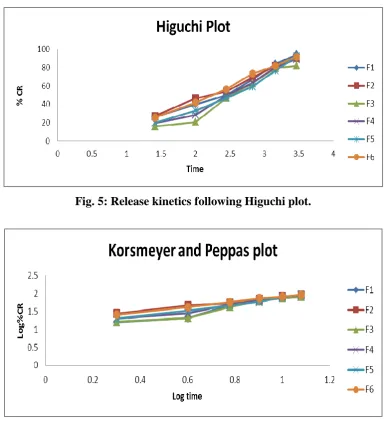
H. In vitro study: the in vitro studies were conducted taking tablet from the batches. The
result of the evaluation of formulations F1 to F6 are give from table 6. Table 7 shows the
various release kinetic. Fig 3-6 shows the graphical representation of relaase of formulation.
Table 5: Post compression parameters.
Parameters F1 F2 F3 F4 F5 F6
Weight variation (mg)
n=10 100+ .12 100+. 08 100+ .18 99+.89 100+ .23 100+ .16
Thickness (mm)
n=6 3.2+.02 3.1+ .08 3.2+.03 3.3+.04 3.3+.01 3.2+ .01
Hardness (kg/cm2)
n=6 3+ .3 3+ .4 3+ .3 3+ .2 3+ .5 3+ .3
Friability (%)
n=20 .53+.02 .51+.04 .60+.03 .59+.01 .52+.03 .55+.02
Dispersion time (sec)
n=6 5+ .01 6+ .02 6+ .02 7+.01 5+.02 6+.02
Disintegration time (min)
n=6 3+ .7 3+.22 4+ .19 5+ .11 2+.14 3+.01
Table 6: In- vitro profile of formulations (F1-F6).
S.No. Time %CR
F1
%CR F2
%CR F3
%CR F4
%CR F6
%CR F7
1 2 26.20 27.17 16.10 19.67 19.84 25.61
2 4 39.81 46.44 20.79 28.35 33.13 41.67
3 6 49.73 54.03 47.07 49.39 47.07 56.54
4 8 67.09 68.85 62.67 63.49 58.96 73.19
5 10 83.83 81.60 79.29 80.32 76.57 81.76
6 12 93.84 90.10 82.02 89.00 91.74 91.50
Fig. 3: Release kinetics following zero order kinetic.
Fig. 5: Release kinetics following Higuchi plot.
Fig. 6: Release kinetics following Korsmeyer and Peppas plot.
Table 7: Table for correlation factor.
Formula tion code
Correlation Factor Korsmeyer
and Peppas (N)
Mechanism
of release Best fit model
Zero (R2)
First (R2)
Higuchi (R2)
F1 .993 .902 .972 1.017 Super case II Zero order
F2 .987 .955 .990 .660 Non Fickian Higuchi
F3 .957 .961 .953 1.010 Super case II First order
F4 .988 .951 .975 .895 Non Fickian Zero order
F5 .996 .879 .977 .850 Non Fickian Zero order
F6 .958 .963 .995 .724 Non Fickian Higuchi
4. CONCLUSION
In-vitro study profile of the formulation proves that all the formulations showed the optimal
formulations (F1,F3) among the 6 formulated batches showed super case II mechanism of
release, while the other formulation (F2, F4,F5,F6) showed non fickian release mechanism.
The kinetic study revealed that each formulation follow different model. Formulation 1 (F1)
follow zero order kinetic. Formulation 2 (F2) follow Higuchi model. Formulation 3 (F3)
follow first order kinetic. Formulation 4 (F4) follows zero order kinetic. Formulation 5 (F5)
follow zero order kinetic. Formulation 6 (F6) follow Higuchi model.
According to the evaluations done on the various formulations it was observed that the
formulation number 5 (F5) showed the best result. The formulation (F5) was found to
disperse at the least time of 5+.02 seconds and the total time for disintegration was found to
be 3 + .14 minutes. The drug content was found to be 99.19%. The tablets were showing
hardness of 3+.5 that passes the limits as per described in the reference standard was taken
from IP. The tablets was found to show the friability of. 52+.03 %.
The reason for the formulation no 5 being the best can be justified as due to the presence of
the polymer poloxamer that decreased the disintegration time and the dispersion time of the
tablets. As the main requirement of the sublingual dosage form was that the time of
disintegration and dispersion should be less. The other factor to be considered include the
weight variation, thickness, hardness, friability and drug content. The formulation F5 passes
all the criteria as per the standard reference from IP.
Fig.7. Disintegration of formulation F5.
5. ACKNOWLEDGEMENT
Acknowledgement is the most beautiful page of any book, dissertation, or project report. Not
being a formality it appears to me the best opportunity to express gratitude to all the
acknowledgement each and every one who have rendered their invaluable contribution in
successful completion of my study.
I take this pleasant opportunity to express regard and gratitude to his holiness Shri Devendra
Dass ji Maharaj, Mahant Darbar Shri Guru Ram Rai ji Maharaj, for providing the required
facilities that enabled me to complete my project work.
It is a great pleasure to utilize this opportunity to express my deep sense of gratitude and offer
my most sincere and humble to my esteemed teacher and guide Dr. Ashutosh Badola,
Assistant professor, Division of Pharmaceutical Sciences, Shri Guru Ram Rai Institute of
Technology and Sciences, Patel Nagar, Dehradun, for his unparallel and excellent guidance,
constant encouragement and support for completion of this project.
I am thankful to Prof. Dr. Preeti Kotiyal, Principal, Division of Pharmaceutical Sciences,
Patel nagar, Dehradun for providing facilities for my project report and for her inspiring
attitude.
I owe a profound depth of gratitude to all staff at Institution for valuable suggestion, help and
support during my project work.
I feel short of words to express my sincere thanks to my all M. Pharm colleagues and friends
for their encouragement and constant support, to complete my work successfully.
I cherished to my heartiest thanks to my teacher Mr. Sayantan Mukopaddhay Assistant
professor, Division of Pharmaceutical Sciences, Shri Guru Ram Rai Institute of Technology
and Sciences, Patel Nagar, Dehradun, for his help and support during my project work.
6. REFERENCE
1. Kurosaki Y, Takatori T, Nishimura H, Nakayama T, Kimura T. Regional variation in oral
mucosal drug absorption permeability and degree of keratinization in hamster oral cavity.
Pharm Res., 1991; 8: 1297‐1301.
2. Shojaie AH. Buccal mucosa as a route for systemic drug delivery: A review. J Pharm
Pharm Sci., 1998; 1(1): 15‐30.
3. Patel N, Pancholi SS. An Overview on: Sublingual Route for Systemic Drug Delivery. Int
journal of Research Pharm & bio Sci., 2012; 2229-307; 3(2): 913-923.
sublingual tablets prepared by direct compression. J Pharm Sci., 1965; 54(3): 447‐451.
5. John DN, Fort S, Lewis MJ, Luscombe DK. Pharmacokinetics and pharmacodynamics of
Verapamil following sublingual and oral administration to healthy volunteers. Br J Clin
Pham., 1992; 33: 623‐627.
6. McElnay JC, Al‐Furaih TA, Hughes CM, Scott MG, Elborn JS, Nicholls DP. The effect
of pH on the buccal and sublingual absorption of captopril. Eur J Clin Pharmacol., 1995;
48(5): 373‐379.
7. Lea L. Sublingual Administration. Colon Health., 1996; 13.
8. Boer D et al. Drug absorption by sublingual and rectal routes. British J Anaesthesia.,
1984; 56: 69‐82.
9. Katz M, Barr M. A study of sublingual absorption I. Several factors influencing the rate
of adsorption. J Am Pharm Assoc Am Pharm Assoc (Baltim)., 1955; 44(7): 419‐423.
10.Biradar SS, Bhagavati ST and Kuppasad IJ. Fast dissolving drug delivery systems: A
brief overview. The Int J Pharmacol., 2006; 4(2).
11.Bhaskaran S, Narmada GV. Rapid Dissolving tablet A Novel dosage form. Indian
Pharmacist., 2002; 1: 9‐12.
12.Devrajan PV and Gore SP, Melt‐ in‐ mouth tablets: innovative oral drug delivery system.
Express Pharma Pulse., 2000; 7(1): 16.
13.Makino T, Yamada M, and Kikuta J. Fast dissolving tablet and its production.
14.US Patent., 1998; 5720974.
15.Kaur T, Gill B, Kumar S, Gupta G.D., Mouth Dissolving Tablets: A Novel Approach To
Drug Delivery., 2011; 3(1): 1-7.
16.Makino T., Yamada M., Kikuta J., Fast dissolving tablet and its production. 1993;
European Patent, 0553777 A2.
17.Meyers GL., Battist GE., Fuisz RC., Process and apparatus for making rapidly dissolving
dosage units and product Thereform. 1995, PCT Patent, WC 95/34293 A1.
18.Mishra DN., Bimodal M., Singh SK., Vijaya K., and Spray dried excipient base: a novel
technique for the formulation of orally disintegrating tablets. Chem Pharm Bull., 2006;
54(1): 99-102.
19.Modi A., Tayade P., Enhancement of dissolution profile by solid dispersion (kneading)
technique. AAPS Pharm. Sci. Tech., 2006; 7(3): 68-72.
20.Takagi H., Kajiyama A., Yanagisawa M., Rapidly diintegrable pharmaceutical
21.Patel MM, Patel DM. Fast dissolving Valdecoxib tablets containing solid dispersion of
Valdecoxib. Indian Journal of Pharmaceutical Sciences., 2006; 68(2): 222-226.
22.Abraham S, Basavaraj BV, Bharath S, Deveswaran R, Sharon F, Madhavan V.
Formulation and Optimization of Sublingual Tablets of Rabeprazole sodium. IntJ pharm
Sci., 2010; 5(2): 50-54.
23.Sarkhejiya NA, Khachar KK, Patel VP. Formulation Development and Evaluation of
sublingual tablets of Riseridone. Research J. Pharm and Tech., 2013; 6(4): 428-434.
24.Bharadwaj V, Shukla V, Goyal N, Salim MD, Sharma PK. Formulation and evaluation of
fast disintegrating sublingual tablets of Amlodipine Besylate using different super
disintegrants. IntJ Pharm & Pharm Sci., 2010; 2(3): 89-92.
25.Bolourtchain N, Haddi N, Forourtan SM, Shafaghi B. Formulation and Optimization of
Captopril Sublingual Tablet Using D-Optimal Design Sublingual Tablet Using D-Optimal