
The Thirty-Third AAAI Conference on Artificial Intelligence (AAAI-19)
Template-Based Math Word Problem Solvers with Recursive Neural Networks
Lei Wang,
1Dongxiang Zhang,
1,2∗Jipeng Zhang,
1Xing Xu,
1,2Lianli Gao,
1Bing Tian Dai,
3Heng Tao Shen
1 1Center for Future Media and School of Computer Science & Engineering, UESTC2Afanti Research
3School of Information Systems, Singapore Management University
{demolwang,zhangjipeng20}@std.uestc.edu.cn,{zhangdo,xing.xu,lianli.gao}@uestc.edu.cn [email protected], [email protected]
Abstract
The design of automatic solvers to arithmetic math word problems has attracted considerable attention in recent years and a large number of datasets and methods have been pub-lished. Among them, Math23K is the largest data corpus that is very helpful to evaluate the generality and robustness of a proposed solution. The best performer in Math23K is a seq2seq model based on LSTM to generate the math expres-sion. However, the model suffers from performance degra-dation in large space of target expressions. In this paper, we propose a template-based solution based on recursive neural network for math expression construction. More specifically, we first apply a seq2seq model to predict a tree-structure tem-plate, with inferred numbers as leaf nodes and unknown op-erators as inner nodes. Then, we design a recursive neural network to encode the quantity with Bi-LSTM and self atten-tion, and infer the unknown operator nodes in a bottom-up manner. The experimental results clearly establish the supe-riority of our new framework as we improve the accuracy by a wide margin in two of the largest datasets, i.e., from58.1%
to66.9%in Math23K and from62.8%to66.8%in MAWPS.
Introduction
Developing computer systems to automatically solve math word problems (MWPs) has been studied by NLP re-searchers since the 1960s (Feigenbaum and Feldman 1963; Bobrow 1964). It requires mapping the human-readable words into machine-understandable logic forms, followed by an inference procedure to derive the numeric answer. An example of math word problem is illustrated in Figure 1. The unknown variablexrefers to the weight of an apple and the math expression involves basic arithmetic operators such as−and/. To solve the problem, we need to identify the relevant quantities from the text and determine the correct operators and computation order among these numbers.
Previous research efforts have been mainly based on statistical machine learning (Kushman et al. 2014; Am-nueypornsakul and Bhat 2014; Zhou, Dai, and Chen 2015; Mitra and Baral 2016; Roy and Roth 2018) and seman-tic parsing (Shi et al. 2015; Koncel-Kedziorski et al. 2015; Roy and Roth 2015; Huang et al. 2017). These methods
∗
Corresponding Author: Dongxiang Zhang
Copyright c2019, Association for the Advancement of Artificial Intelligence (www.aaai.org). All rights reserved.
Figure 1: An example of math word problem.
can achieve satisfactory results on small-scale datasets, yet they require considerable manual efforts for feature ex-traction and template annotation. Furthermore, as evaluated by (Huang et al. 2016), these methods exhibit low generality and robustness. They suffer from sharp performance degra-dation when handling large and diversified datasets.
To reduce human intervention and enable the automatic extraction of discriminative features, applying deep learning (DL) models in MWPs has become a promising research di-rection. (Wang, Liu, and Shi 2017) proposed an end-to-end framework that converts the input of question text into the output of math expression. It is then a natural idea to apply a seq2seq model to encode the text input and decode the hid-den features into a math expression. The drawback is that the seq2seq model is a black-box that lacks interpretability and it cannot guarantee the output is in valid math format and normally requires a post-processing step. (Wang et al. 2018b) modeled the math expression as a tree structure and made the first attempt to apply deep reinforcement learning for iterative tree construction. However, it still requires man-ual feature extraction to design the state representation.
tree for better interpretability as the tree construction process corresponds to the step-by-step solution procedure. In our implementation, we first apply a seq2seq model to predict a tree-structure template, with quantities as leaf nodes and unknown operators as inner nodes. As shown in Figure 1,
(n1hopin3)hopin2 is a template in which the quantities
n1,n2 andn3 can be directly determined from the
ques-tion text. The operators are encapsulated ashopito reduce template space. Each equation template can be represented by an expression tree that can be further serialized in the form of suffix expression. We also propose equation normal-ization to further reduce the number of possible templates. Consequently, our task of template prediction can be con-sidered to be less challenging than the direct generation of math expression as in (Wang, Liu, and Shi 2017). With the derived template, the remaining job is to fill the unknown operators. We design an effective quantity embedding net-work with Bi-LSTM and self attention to vectorize the tree leaf nodes. Then, we propose a Recursive Neural Network (abbreviated as Recursive NN) to infer the inner nodes in a recursive manner. When all the operator nodes are predicted, we obtain a complete expression to generate the answer.
We conduct experiments on two of the largest datasets for arithmetic word problems, in whichMath23Kcontains
23,164math problems andMAWPScontains2,373 prob-lems. The experimental results clearly establish the superior-ity of our new framework when compared to other seq2seq models. The accuracy is boosted from58.1%to66.9%in Math23K and from62.8%to66.8%in MAWPS.
To sum up, we have made the following contributions:
1. We use structural template, which can be serialized into suffix expression, to annotate the math problems.
2. We propose equation normalization and operator encap-sulation to significantly reduce the template space.
3. We made the first attempt to apply Recursive NN in an-swer module for MWP solving.
4. Experimental results show that our proposed framework is remarkably better than the state-of-the-art models.
5. We release the source code of our model in Github1.
Related Work
In this section, we review literature upon MWP solver and present the applications of Recursive NN in natural language processing.
Algebra Word Problem Solver
ARIS (Hosseini et al. 2014) and Formula (Mitra and Baral 2016) are two systems that only support the operators of ad-dition and subtraction. The former used verb categorization and the latter utilized formulas defined in advance. To im-prove the generality, tag-based approach (Liang et al. 2016) was proposed with map rules to convert identified variables and values into logic forms, which were further transformed into logic statements for inference.
1
https://github.com/uestc-db/T-RNN
Another major category of solutions is tree-based. (Roy and Roth 2015) built an expression tree and two classifiers were trained for quantity relevance prediction and opera-tor classification, respectively. A scoring function was pro-posed to rank the candidate trees and champion the one with the highest score as the answer. (Koncel-Kedziorski et al. 2015) enumerated all the possible trees with integer linear programming to find the best solution. UnitDep (Roy and Roth 2017) further took into account the consistence of rate unit associated with the quantities and treated it as a scoring factor. (Wang et al. 2018b) modeled the math expression as a tree structure and made the first attempt to apply deep re-inforcement learning for iterative tree construction. (Wang, Liu, and Shi 2017) was the first to propose a seq2seq model to convert the input of question text into the output of math expression. (Robaidek, Koncel-Kedziorski, and Hajishirzi 2018) applied Bidirectional LSTM w or w/o self attention to encode the problem text and used a softmax function as the classifier for equation template. The model can be superior to seq2seq models in small datasets with fewer number of templates.
The equation set problems are more challenging as they involve multiple unknown variables to resolve. In (Kush-man et al. 2014), a template-based solution was proposed. Given a corpus of predefined equation sets with unknown slots for variables and numbers, it finds a matching tem-plate and infers the unknown slots from text information. In (Zhou, Dai, and Chen 2015), an improved method was proposed to reduce the hypothesis space by only enumerat-ing the permutation of number slots. Without any inference capability, these template-based methods are rather rigid and not extensible for complex scenarios. Upadhyay et al. proposed a structured-output learning framework to learn both explicit and implicit signals jointly (Upadhyay et al. 2016). Overall, these methods are tuned for small datasets to achieve promising results. According to an experimen-tal study in (Huang et al. 2016), their accuracies degrade sharply in a larger and more diverse dataset. The findings imply that this line of research still has great room for im-provement and calls for more general and robust solutions. For more comprehensive review on MWP solvers, readers can refer to a recent survey paper (Zhang et al. 2018).
NLP Applications for Recursive Neural Networks
Figure 2: Framework of MWP solver with Recursive NN.
MWP Solver with Recursive Neural Network
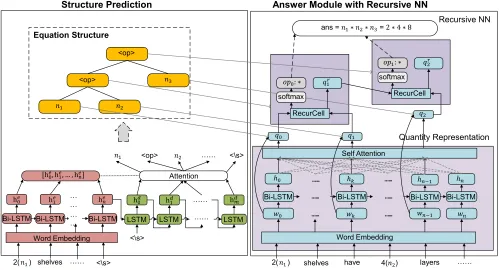
In this section, we present the new MWP solver based on Recursive NN. The whole framework, as illustrated in Fig-ure 2, consists of two primary components. The first com-ponent, namelystructure prediction, converts the input text into a tree-structural template that is serialized by suffix ex-pression. The leaf nodes are quantities whose values can be directly inferred from the problem text. The inner nodes con-tain unknown operators that are to be predicted by the an-swer generation module illustrated in the right side of Fig-ure 2. It contains a quantity embedding network to vectorize the quantities more effectively. The network is constructed by Bidirectional LSTM followed by a self attention layer. After that, we design a recursive neural network to predict the operators by taking advantage of the derived quantity features and structural template. When all the operators have been successfully determined, we obtain a complete math expression which is able to return the final answer. In the fol-lowing, we introduce the structural template representation and explicitly explain each function module in Figure 2.
Equation Template
An arithmetic word problem is often solved by an equation with one unknown variable, a number of quantities and basic operators{+,−,×,÷}. Brackets can also be used to change the operation priority. In the template-based solutions, the problems are annotated with equation templates and models are designed to learn the mapping. In (Kushman et al. 2014)
and (Zhou, Dai, and Chen 2015), templates with multiple unknown slots, such as
u1+u2+n1 = 0
n2×u1+n3×u2−n4 = 0
are pre-defined to solve equation set word problems. In their solutions, they first identify a candidate template and then fill the number slots and unknown slots with the information extracted from the text.
Our structural template has three main differences with their definition. First, since we are handling arithmetic word problems which involve only one unknown variable, there is no need to preserve the unknown slot in the template. Given an equation templatex = n1 −n2−n3, we
sim-plify it as n1 −n2−n3. As to constants in the equation
templates (e.g.,1 andπ), we use additional vectors to rep-resent them, with the same dimension as other quantity vec-tors ni. These vectors will be trained by Recursive NN to
derive the final representation. Second, ournistrictly refers
to thei-th detected quantity from the question text. This is because our template is directly generated by the seq2seq model and we need to be able to automatically ignore the irrelevant numbers in the text. Given an equation template
n1−n3, we know that the second quantityn2 in the text
possibilities of quantity filling in a given template. Third, we encapsulate the detailed operators in the template with an abstract representation of hopi. For example, n1+n2,
n1−n2,n1×n2, andn1÷n2are mapped to the same
tem-platen1hopin2. The operator encapsulation can further
re-duce the number of equation templates to facilitate template prediction. It motivates us to break the math problem solv-ing into two stages with better interpretability, i.e., we can first predict an equation template and then fill the unknown operators.
Equation Normalization
It is possible that a math problem can be solved by multiple choices of equations. For example, the equationsx= 10− 5−2andx= 10−(5+2)are essentially identical and lead to the same answer, but they correspond to different equation templates. To reduce the variety of equation templates, we propose a normalization approach. A side product is that the template prediction model can benefit from the reduction of equation space.
There are two types of common equation duplication that we attempt to resolve in this paper: 1)order duplicationsuch asn1+n3+n2andn1+n2+n3, and 2)bracket duplica-tionsuch asn1+n3−n2andn1 + (n3−n2). To normalize
theorder-duplicatedtemplates, we require that the number tokensniin the template should follow their occurrence
or-der in problem text as much as possible. For example, the equation templates{n1+n3+n2, n2+n1+n3, n2+n3+
n1, n3+n1+n2, n3+n2+n1}should be normalized to
n1+n2+n3. To solve thebracket duplicationproblem, we
simply convert it into an expression tree. The inner nodes are operators and the leaf nodes are quantities. The tree structure determines the calculation priority and there are no brackets involved in the tree nodes. Up to here, we can use expres-sion tree to uniformly represent equation templates w or w/o brackets. Finally, each tree-based template can be serialized to its suffix expression which is stored as a string sequence. It is worth noting that the proposed equation normalization cannot guarantee the uniqueness of the equation template. For example,n1 −n2−n3 andn1−(n2 +n3) are still
represented by different expression trees.
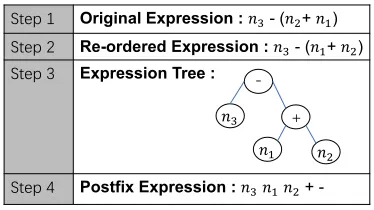
Figure 3 depicts an example of equation normalization. Given an equationx =n3−(n2+n1), it is simplified as
n3−(n2+n1)and then re-ordered asn3−(n1+n2)to
eliminate order duplication. Then, an expression tree is built to remove the brackets. The final template is represented by the suffix expression “n3n1n2+−”, which can be naturally
processed with stack operation. The first three quantities are first pushed into the stack. When the operator “+” is met, the top two quantities are popped and the value ofn1+n2is
pushed back to the stack. Finally, when “−” arrives, the top two quantities are popped andn3−(n1+n2)is calculated.
Template Prediction
We propose a seq2seq model based on popular recur-rent neural networks (abbreviated as Recurrecur-rent NN, with instances like LSTM, GRU and Bi-LSTM) to transform the problem text into a suffix expression which corre-sponds to a tree structure. The goal of the seq2seq model
Figure 3: An example of equation normalization.
is to estimate the conditional probability P(Y|X), where
X = {x1, x2,· · · , xn} is an input sequence and Y = {y1, y2,· · ·, ym}is its corresponding output sequence.
To yield this conditional probability, we first obtain the fixed-dimensional representation vector of the input prob-lem description {x1, x2,· · ·, xn}given by the last hidden
state vectorheof RNN, and then compute the probability of {y1, y2,· · ·, ym}as below :
p(y1, y2,· · ·, ym|x1, x2,· · ·, xn) =
m Y
t=1
p(yt|he, y1,· · ·, yt−1)
wherep(yt|he, y
1,· · ·, yt−1)distribution is represented by
a softmax function over all the vocabulary candidates. In practice, there is no clear preference for the selection of Recurrent NNs. We have witnessed the wide application of LSTM, GRU and Bi-LSTM in various seq2seq models. For example, (Wang, Liu, and Shi 2017) used LSTM as the encoder and GRU as the decoder for math problem solving. Alternatively, (Robaidek, Koncel-Kedziorski, and Hajishirzi 2018) evaluated the adoption of LSTM as the encoder and decoder at the same time. A proper selection may often require significant engineering efforts and hyper-parameter tuning. In our implementation, we use Bi-LSTM as the en-coder and LSTM as the deen-coder because Bi-LSTM can cap-ture the term dependency in both directions.
The output of the seq2seq model is passed to a sequence-to-sequence attention layer to better capture the relationship between the question words and the equation template.
βij = hdi−1h e j
αij =
exp(βij) n
P
k=1
exp(βik)
ci = n
X
j=1
αijhej
hdi = f(hdi−1, ci, yi−1)
whereβijis the attention weight of every encoder vector. We
compute a new context vector at each decoding step. First, with a dot product operationhd
i−1hej, we compute a score
for each hidden state vectorhejof the encoder. Then, we nor-malize the sequence ofαiusing a softmax and computecias
ciwith the previous hidden state vectorhdi−1and outputyi−1
by a non-linear function to obtain the hidden vectorhd i.
It is noticeable that similar to the issue raised in (Wang, Liu, and Shi 2017; Wang et al. 2018a), the output of our seq2seq model may not be a valid equation template, i.e., it cannot be converted into a tree in which the inner nodes are operators and the leaf nodes are quantities. If the tem-plate prediction fails and an invalid temtem-plate is generated, we terminate the math problem solver and consider that the problem cannot be solved by our model. From the experi-mental results, we will see that our seq2seq model can gen-erate valid templates most of the time. The failure rate in Math23K is only0.7%.
Answer Generation with Recursive NN
The answer generation module consists of two function components. First, we use Bi-LSTM with self attention mechanism to derive effective quantity embedding. Second, given the new quantity features, a recursive neural network is proposed to infer the unknown operators in the template. In the following, we explain how each component works.
The input to the quantity embedding layer is the raw ques-tion words. We have a vocabulary V. The given input se-quence X = {x1, x2,· · · , xn} is transformed into a
se-quence of vectors {w1, w2,· · · , wn} through a word
em-bedding matrixEfor linear projection, i.e.,wt=Ext. The
word vectors wt act as the input of Bi-LSTM to generate
hidden featuresH ={h1, h2,· · · , hn}. Note that the word
embedding and Bi-LSTM encoder in the answer generation module are similar to those in the template prediction mod-ule. The difference lies in how to further processH. In the template prediction,H is decoded by LSTM and an atten-tion layer to generate the suffix expression. Here, the ob-jective is to generate effective embeddings for the quanti-ties. Given the outputH from Bi-LSTM, eachhi actually
corresponds to the i-th termwi in the question text. From
the equation template, we are aware of the positions where the quantities are located. In other words, we can extract
Hq = {hq 1, h
q 2,· · · , h
q
l}fromH based on the position
in-formation ofni in the equation template. WithH andHq,
we conduct self attention (Lin et al. 2017) that is able to cap-ture the the long distance dependencies.
A = softmax(HqHT)
C = AH
Q0 = tanh([C, Hq]W1+b)
whereHT is the transpose ofH. MatrixAis the attention
weight matrix computed by the multiplication of Hq and
HT. Then, the context vectorCis the weighted sum ofH.
These two vectorsC andHq are concatenated to generate the temporary quantity representationQ0 through non-linear projection. Finally, the new quantity representation is com-puted by
Q=Wq⊕Q
0
whereWq are the quantity embeddings extracted from text
embeddingsW.
With the new quantity vectorsQ={q1, q2,· · ·, ql}with
l quantities and the suffix expression generated from tem-plate prediction, we are ready to introduce how recursive NN is applied to infer the unknown operators. Note that the suffix expression in fact determines the access order of leaf nodes which is in a bottom-up manner. Given the expres-sion(n1hopin3)hopin2,n1andn3will be first accessed
by the recursive NN to determine the operator and gener-ate a new quantityn1
cas their parent node. Then,n1c andn2
are accessed to determine their operator. When the two un-known operators are determined, we obtain a complete math expression that allows us to calculate the answer.
In our recursive NN, the representation of parent node is calculated by
qc =tanh(W2([ql, qr] +b)
whereqlandqrare the quantity representation for the child
nodes. Withqc, we can estimate the probability of an
opera-tor for the parent node via a softmax function:
P(oc|ql, qr) =softmax(W3qc)
This process is performed recursively until all the operators of inner nodes have been predicted.
In the training of the answer generation module, the pa-rameters in the answer generation module, including Bi-LSTM, self attention and recursive NN, are trained jointly by minimizing the loss function
J(θ) =−1
k
k
X
i=1
logP(oc(i)|ql(i), qr(i))
wherekdenotes the number of inner nodes in the tree.
Experimental Study
In this section, we conduct experiments on two of the largest datasets for arithmetic word problems. All the experiments were conducted on the same server, with4CPU cores (Intel Xeon CPU E5-2650 with2.30GHz) and32GB memory.
Datasets
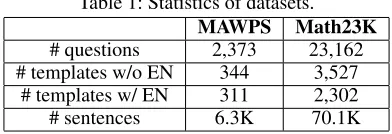
The statistics of the two datasets are shown in Table 1. We report the number of templates w or w/o equation nor-malization (abbreviated as EN). We can see that when EN is applied, the number of templates in Math23K is reduced from3,527to2,302, by around35%.
Table 1: Statistics of datasets.
MAWPS Math23K
# questions 2,373 23,162 # templates w/o EN 344 3,527
# templates w/ EN 311 2,302 # sentences 6.3K 70.1K
Parameter Setting
In the template prediction module, we use a pre-trained word embedding with128 units, a two-layer Bi-LSTM with256
hidden units as encoder, a two-layer LSTM with512hidden units as decoder. As to the optimizer, we use Adam with learning rate set to1e−3,β1 = 0.9andβ2 = 0.99. In the
answer generation module, we use a embedding layer with
100units, a two-layer Bi-LSTM with160hidden units. SGD with learning rate0.01and momentum factor0.9is used to optimize this module. In both components, the number of epochs, mini-batch size and dropout rate are set100,32and
0.5respectively. Since Math23K has split the problems into training and test datasets when it was published, we simply follow its original setup. For MAWPS, we use5-fold cross validation.
Accuracy of MWP Solving
We compare our structural template based Recursive NN with recent deep learning models proposed for the large-scale datasets. These methods can be classified into two cat-egories based on either generation model or classification model. The former relies on a seq2seq model to directly generate the math expression. The latter first classifies the problem text into one of the pre-defined templates with ex-plicit operators and then fills the unknown numeric vari-ables. DNS (Wang, Liu, and Shi 2017) was the first seq2seq generation model proposed for arithmetic word problem solving in Math23K. In (Robaidek, Koncel-Kedziorski, and Hajishirzi 2018), both generation and classification models are evaluated in MAWPS and Math23K. The authors im-plemented two types of their own generation models as the baselines, using LSTM and CNN, respectively. Their classi-fication models are implemented using Bi-LSTM w or w/o self attention. The experimental results are reported in Ta-ble 2. As pointed out in (Robaidek, Koncel-Kedziorski, and Hajishirzi 2018), not all the test equation templates appear in the training dataset and the model accuracy is upper bounded by an oracle accuracy.
Among the seq2seq generation models, DNS performs much better than simple LSTM or CNN. One of the rea-sons is that LSTM and CNN are used as baseline models in (Robaidek, Koncel-Kedziorski, and Hajishirzi 2018) and may not be well optimized. In our offline experiment, we im-plemented our own version of LSTM-based seq2seq model
Table 2: Math problem solving accuracy.
MAWPS Math23K
Oracle 84.8 87.0
Seq2seq
LSTM 25.6 51.9
CNN 44.0 42.3
DNS 59.9 58.1
Deep RL MathDQN 60.25
-Classification Bi-LSTM 62.8 57.9
Self-Att 60.4 56.8
Our Approach
T-RNN 66.8 66.9
- EN 63.9 61.1
- Bi-LSTM 31.1 34.1
- Self-Att 66.3 65.1
Retrieval Jaccard 45.6 47.2
Cosine 38.8 23.8
Hybrid DNS+Retrieval 59.9 64.7
T-RNN+Retrieval 67.0 68.7
and can achieve an accuracy of50.1%in MAWPS without much tuning effort. MathDQN (Wang et al. 2018b) achieves slightly higher accuracy than seq2seq models in MAWPS. Similar to T-RNN, it also relies on the concept of expression tree for answer generation, which has been shown to be ro-bust and widely adopted by previous solvers. The difference is that MathDQN applies DQN to guide tree construction. Its performance in the Chinese dataset Math23K is not re-ported because it uses hand-crafted feature extraction strat-egy as proposed by (Roy and Roth 2015), which works only for English dataset.
The classification models can achieve higher accuracy in the small dataset, i.e., in MAWPS. However, when the dataset size increases with more templates as in Math23K, they become inferior to the generation model DNS. It im-plies the classification models are more sensitive to the in-crease of template space.
We denote our approach by T-RNN and we can see from Table 2 that it performs significantly better than the exist-ing generation and classification models, boostexist-ing the accu-racy from62.8 to66.8 in MAWPS and from58.1 to66.9
in Math23K. This is owning to the effectiveness of template prediction, quantity embedding and recursive NN for oper-ator inference. We also examine the effect of equation nor-malization, Bi-LSTM and self attention in the answer gen-eration module. We can see that EN plays a more significant role in the dataset with more templates. When it is applied, the accuracy in Math23K can improve from 61.1 to 66.9. The Bi-LSTM network is also crucial to obtain effective quantity embedding. If we directly apply the self attention layer on top of the question word embeddings, the accuracy drops sharply. The self attention itself also has minor effect on accuracy enhancement.
and Shi 2017), the retrieval model is used if the similarity between a candidate and the query problem is larger than the threshold; otherwise, DNS is used. We also conduct an experiment to evaluate the performance of our model when combined with retrieval approach. Results show that there is noticeable improvement in the Math23K dataset.
Break-down Analysis
We report the accuracy of template prediction by the seq2seq model in Table 3. If the predicted template exactly matches the annotated template, we consider it a positive hit. It is in-teresting to observe that the accuracy of template prediction is even lower than the final accuracy of problem solving in MAWPS, i.e.,65.8 < 66.8. The reason is that a problem can be correctly solved by multiple different templates, but only one of them is annotated. For example,10−5−2is equal to10−(5 + 2)but they correspond to different suf-fix expressions. The finding implies that the seq2seq model is flexible in learning the tree structures even when not all the correct annotations are provided. We also report the per-centage of illegal templates in the two datasets. We can see that Math23K has many more training samples and very low percentage of illegal templates are generated in this dataset.
Table 3: Accuracy of template prediction module.
MAWPS Math23K
Accuracy w/o EN 62.2 59.6
Accuracy w EN 65.8 69.1
Percentage of illegal templates 9.0 0.7
Given the set of problemsPt whose templates are
cor-rectly predicted, we derive a subset of Pt, denoted by Ps
which contains the problems correctly solved. We use|Pt|
|Ps|to
represent the accuracy of the answer generation module. As shown in Table 4, the accuracy in Math23K reaches as high as 94.4. This verifies the effectiveness of Bi-LSTM, self-attention and recursive NN in the answer generation module.
Table 4: Accuracy of the answer generation module.
MAWPS Math23K
Accuracy of Recursive NN 84.9 94.4
In Table 5, we examine the performance of our MWP solver with the increasing length of templates, which is de-fined as the number of operators in a template. We investi-gate the cases where the length increases from1to10and report the percentage of templates with the particular length in the whole test dataset. We can see that around90percent of the problems in Math23K are associated with a template with no greater than3operators. Around half the problems require two operators to generate the answer. There is an obvious accuracy descending pattern, from80.9downward to37.9, when the length of templates increases from1to4. When the length further increases from4and6, the accuracy is located in the range[33,40]. When the problems become more complex, with length≥ 7, they cannot be correctly solved by our approach.
Table 5: Accuracy for increasing length of templates.
Math23K
# Operators Proportion (%) Acc (%)
1 19.9 80.9
2 49.6 73.6
3 19.9 53.3
4 5.8 37.9
5 3.3 39.4
6 0.9 33.3
7 0.2 0
8 0 0
9 0.1 0
10 0.2 0
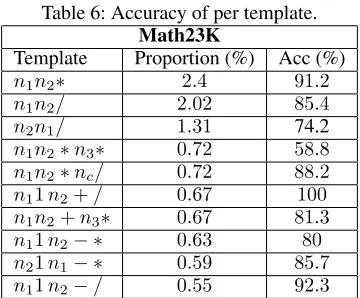
Similar to the work in (Huang et al. 2017), we show the top-10most frequent templates in Table 6 and report the ac-curacy of our method when solving each type of template without operator encapsulation. We observe that the tem-platen11n2+/can be perfectly solved by our model. The
“1” in the template means it does not explicitly appear in the problem text. An example question matching the template is like “112is greater than a number by12%. What’s the number?”. These questions basically follow the similar text pattern and thus are relatively easy to solve. However, our model does not perform well for the templaten1n2∗n3∗,
with accuracy58.8. The reason is that the problems related to this template are rather diversified in terms of problem description. Without sufficient amount of training data, the seq2seq model is not able to well capture the relationship between the quantities.
Table 6: Accuracy of per template.
Math23K
Template Proportion (%) Acc (%)
n1n2∗ 2.4 91.2
n1n2/ 2.02 85.4
n2n1/ 1.31 74.2
n1n2∗n3∗ 0.72 58.8
n1n2∗nc/ 0.72 88.2
n11n2+/ 0.67 100
n1n2+n3∗ 0.67 81.3
n11n2− ∗ 0.63 80
n21n1− ∗ 0.59 85.7
n11n2−/ 0.55 92.3
Error Analysis
challenging for existing MWP solvers and our model is not exceptional. Third, the semantic understanding of the prob-lem text is not perfect and still has much room for improve-ment. Hence, the relation between the quantities may not be well captured, leading to wrong template prediction and op-erator inference.
Conclusion
In this paper, we proposed to use tree structure template rep-resented by suffix expression for math word problem anno-tation. To reduce the number of templates and improve the accuracy of template prediction, we proposed equation nor-malization and operator encapsulation. The unknown oper-ators in the template are inferred by a recursive neural net-work. We conducted extensive experiments on two of the largest datasets and the results showed that our proposed model outperformed the existing deep learning approaches by a wide margin.
Acknowledgement
This work is supported in part by the National Natural Science Foundation of China under grants No. 61602087, 61632007, the Fundamental Research Funds for the Central Universities under grants No. ZYGX2016J080, and the 111 Project No. B17008.
References
Amnueypornsakul, B., and Bhat, S. 2014. Machine-guided solution to mathematical word problems. InPACLIC, 111– 119.
Bobrow, D. 1964. Natural language input for a computer problem solving system. 146–226.
Feigenbaum, E. A., and Feldman, J. 1963. Computers and Thought. New York, NY, USA: McGraw-Hill, Inc.
Goller, C., and Kuchler, A. 1996. Learning task-dependent distributed representations by backpropagation through structure. Neural Networks1:347–352.
Hosseini, M. J.; Hajishirzi, H.; Etzioni, O.; and Kushman, N. 2014. Learning to solve arithmetic word problems with verb categorization. InEMNLP, 523–533.
Huang, D.; Shi, S.; Lin, C.; Yin, J.; and Ma, W. 2016. How well do computers solve math word problems? large-scale dataset construction and evaluation.
Huang, D.; Shi, S.; Lin, C.; and Yin, J. 2017. Learning fine-grained expressions to solve math word problems. In
EMNLP, 805–814.
Koncel-Kedziorski, R.; Hajishirzi, H.; Sabharwal, A.; Et-zioni, O.; and Ang, S. D. 2015. Parsing algebraic word problems into equations. TACL3:585–597.
Koncel-Kedziorski, R.; Roy, S.; Amini, A.; Kushman, N.; and Hajishirzi, H. 2016. MAWPS: A math word problem repository. InNAACL, 1152–1157.
Kushman, N.; Zettlemoyer, L.; Barzilay, R.; and Artzi, Y. 2014. Learning to automatically solve algebra word prob-lems. InACL, 271–281.
Liang, C.; Hsu, K.; Huang, C.; Li, C.; Miao, S.; and Su, K. 2016. A tag-based statistical english math word problem solver with understanding, reasoning and explanation. In
IJCAI, 4254–4255.
Lin, Z.; Feng, M.; dos Santos, C. N.; Yu, M.; Xiang, B.; Zhou, B.; and Bengio, Y. 2017. A structured self-attentive sentence embedding. CoRRabs/1703.03130.
Mitra, A., and Baral, C. 2016. Learning to use formulas to solve simple arithmetic problems. InACL.
Robaidek, B.; Koncel-Kedziorski, R.; and Hajishirzi, H. 2018. Data-driven methods for solving algebra word prob-lems. CoRRabs/1804.10718.
Roy, S., and Roth, D. 2015. Solving general arithmetic word problems. InEMNLP, 1743–1752.
Roy, S., and Roth, D. 2017. Unit dependency graph and its application to arithmetic word problem solving. In AAAI, 3082–3088.
Roy, S., and Roth, D. 2018. Mapping to declarative knowl-edge for word problem solving.TACL6:159–172.
Shi, S.; Wang, Y.; Lin, C.; Liu, X.; and Rui, Y. 2015. Auto-matically solving number word problems by semantic pars-ing and reasonpars-ing. InEMNLP, 1132–1142.
Socher, R.; Huval, B.; Manning, C. D.; and Ng, A. Y. 2012. Semantic compositionality through recursive matrix-vector spaces. InEMNLP-CoNLL, 1201–1211.
Socher, R.; Perelygin, A.; Wu, J.; Chuang, J.; Manning, C. D.; Ng, A. Y.; and Potts, C. 2013. Recursive deep models for semantic compositionality over a sentiment treebank. In
EMNLP, 1631–1642.
Socher, R.; Manning, C. D.; and Ng, A. Y. 2010. Learning continuous phrase representations and syntactic parsing with recursive neural networks. InNIPS.
Upadhyay, S.; Chang, M.; Chang, K.; and Yih, W. 2016. Learning from explicit and implicit supervision jointly for algebra word problems. InEMNLP, 297–306.
Wang, L.; Wang, Y.; Cai, D.; Zhang, D.; and Liu, X. 2018a. Translating math word problem to expression tree. In
EMNLP, 1064–1069.
Wang, L.; Zhang, D.; Gao, L.; Song, J.; Guo, L.; and Shen, H. T. 2018b. MathDQN: Solving arithmetic word problems via deep reinforcement learning. InAAAI.
Wang, Y.; Liu, X.; and Shi, S. 2017. Deep neural solver for math word problems. InEMNLP, 845–854.
![‘ Quis custodiet ipsos custodes ?’ (Juvenal Satires :§345) (Who guards [nurtures] the guardians?): Developing a constructivist approach to learning about ministerial and spiritual formation](data:image/gif;base64,R0lGODlhAQABAIAAAP///wAAACH5BAEAAAAALAAAAAABAAEAAAICRAEAOw==)