
ISSN: 2374-2208(Print), 2374-2194(Online) Copyright © The Author(s). All Rights Reserved. Published by American Research Institute for Policy Development DOI: 10.15640/jibe.v5n1a4 URL: https://doi.org/10.15640/jibe.v5n1a4
Merger and Acquisition in the TICET or Service Market – Important Aspects of ass
Newly Developed Holistic Process Model Including a Benchmark Analysis
Maksim Saat
1& Jürgen Himmelsbach
2Abstract
Despite the importance of Merger and Acquisition (M&A) empirical research studies and literature analyses show a surprisingly low success rate of implemented transactions in enterprises in the service sector. One reason for that might be the missing of a holistic model for national and international M&A processes which considers the special features of M&A transactions in the testing service market and the service sector market in general. Against this background the aim of the paper is to show important success factors of a newly developed holistic model for national and international M&A processes (transactions), especially for enterprises in the testing service market (TICET market) and the service sector market in general. This new holistic model important includes different success factors. The focus in this paper is the developed and implemented country analysis concept, the risk management concept and the role of innovation management for acquisitions. Moreover, the results of M&A transactions supported by the developed holistic M&A process model will be analysed, measured and objectivised with the help of a case study to demonstrate the usefulness of the model. As part of the case study the results of M&A transactions carried out by two big TICET companies are analysed. The presented success factors and individual measures can especially be used by enterprises from the testing service market and service market in general. This is of great importance due to the increasing worldwide consolidation rate of markets and consequently of enterprises especially before the background of the technology development in connection with increasing complexity. Therefore it can be expected that the future demand for sustainable M&A transactions will further increase.
Keywords: Holistic Merger and Acquisition Model, Risk Management Model, Country Analysis Model, Innovation Management, Competition Analysis, Benchmark Analysis
1. Introduction
2015 was another record year for M&A transaction reaching a volume of nearly US$ 5,000 billion [1]. A lot of publications and studies support the enormous importance of M & A transactions in the context of realizing growth [2, 3 4]. The implementation of M&A transactions helps to develop enterprises when organic growth begins to stagnate. Overall, M&A should be a very successful strategy for the development of enterprises. But in reality, an analysis of the numerous available empirical research studies and further literature shows a high failure rate of implemented M&A transactions. For example, a study made by J.P. Morgan shows a failure rate in the implementation of M&A transactions of approximately 40% (comparable with a study Dreher, Ernst [5]); the failure rate of M&A transactions in the service sector is even higher, at around 50% [6, 7, 8]. One starting point to reduce the danger of failed M&A transaction is the process models for acquisitions that companies use. In the relevant scientific literature most publications on the topic of M&A only present a rough and not detailed M&A process model and they vary from author to author. For example the author Picot [9] focuses only on parts of a holistic M&A process model especially on the basis of reorganization issues.
1
Department of Business Administration, Tallinn University of Technology, Tallinn, 12618, Estonia
The author Grill [10] presents human resources aspects being part of a holistic M&A process model. In the meantime the authors Bauer, Düsterlho demonstrate the reorganization and distressed issues as part of M&A process model [11]. Furthermore the authors Berens, Brauner, Strauch [12] show a focus on the due diligence process as necessary part of an M&A process model but not further important issues. The five phase approach developed by Aiello and Watkins shows a complete concept of M&A processes, but it is rather rough [13].Including these models the authors conducted an intense research, but no detailed and holistic model could be found which considers the special features of M&A processes in the testing service market and in the service sector market in general. Considering all circumstances, the authors of the paper aims at presenting the most relevant parts of a newly developed holistic model for national and international M&A processes especially for the testing service market (TICET market) and for the service sector market in general in the first step. Before that, the current situation on the M&A transactions on the TICET market is described briefly in the paper.
In the second step, the results of the developed holistic M&A process model will be analysed, measured and objectivised using a benchmark analysis, and management instruments will be highlighted. As part of the benchmark analysis, the results of M&A transactions carried out by enterprise A (more than 10.000 employees) and by its main competitor in the business field – enterprise B (more than 16.000 employees) – were used [14, 15].
1.1 The Situation of the Mergers and Acquisition in the TICET Market
The future prospects for the world-wide TICET market continue to be positive; this is due to the favourable overall conditions, such as shifting locations for productions and a growing interweaving of performances (globalisation), higher legal requirements or higher quality and safety demands by end-users. The focus of demand for TICET services exists mainly in economically strong and export-oriented regions, such as Europe, Asia, America and many emerging market countries. The world-wide TICET market is often characterised by relatively high entry barriers because large investments for testing plants and a world-wide network (technical experts) are needed in order to offer a variety of services. Under these circumstances, it is a big challenge to find qualified employees all over the world. An established brand name with its connected integrity represents a differentiation factor and is therefore an important success factor, offering an important advantage. The bargaining power of clients in many areas and countries is rather low. Moreover, the services in the TICET market are often stipulated by legal requirements and thus, the risk of manufacturers with regards to quality and liability is reduced. In relation to the product costs of a product series, the costs of services are relatively low. Due to the limited number of providers and testing resources there is little danger through substitutes and in-sourcing in many countries. The in-sourcing of testing services by the enterprises would be time- and cost intensive, and in many cases it would even be impossible due to legal requirements. Furthermore, in many liberalised areas a fragmented provider structure exists, with the possibility to grow inorganically through acquisitions alongside organic growth. In some but not all segments of the TICET market comparatively high growth rates and profit margins can be achieved with stable cash flow.
When turning to the global M&A market, after the financial crisis the market had a strong positive development with a record year 2015. The world-wide volume rose to nearly US$ 5,000 billion and the number of mega deals (deals over US$ 10 billion) was over 70 [1]. Especially the USA contributed to these numbers with their own record year. The European M&A market also grew, but is far behind the US market and the Asian market [16]. For the German M&A market the year 2015 was successful, but no record were reached. In contrast to the international markets the number of deals in Germany increased, but the volume per deal decreased ([17]).
The world-wide market for TICET services is estimated by the investment bank at least €100 billion [18,19]. From this volume approx. 40% is available freely in the market place, and 60% is in-house, which means the services are carried out by the industrial enterprises themselves. Although the structure of the TICET market is global, it is at the same time exceptionally fragmented. The market participants can be divided into the categories of global players, multi-geographic specialists and local specialists.
In this kind of environment enterprises that are not publicly traded – e.g. our enterprises used for the benchmark analysis– are highly sought-after objects for competitors and especially of Private-Equity-Companies. Therefore both enterprises have changed their enterprise structure and have established foundations as shareholders in order to protect themselves against hostile takeovers.
2. Newly Developed Holistic National and International M&A Process Model
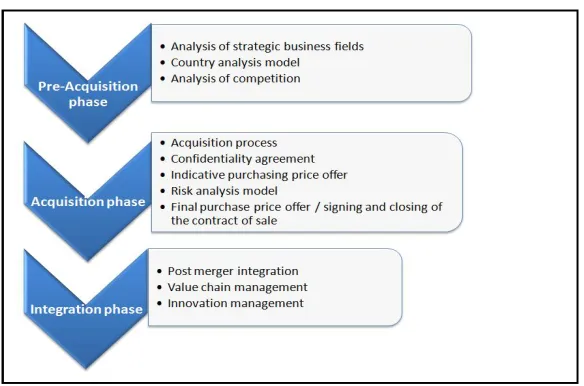
Following, the most important aspects of the holistic M&A process model developed by the authors specifically for enterprises in the testing service market and additionally for the service market is presented together with many success factors. Then, a benchmark analysis of two big TICET enterprises is conducted to analyse the usefulness of the M&A process model. The focuses of the newly developed holistic national and international M&A process model are the following three phases presented in the figure below:
Figure 1. Holistic national and international M&A process model (Author’s illustration)
With the support of the authors, this paper, in the following, lays emphasis on the newly developed and implemented country analysis model, the risk management model and the role of innovation management in the face of the acquisition process. The other aspects of the newly developed holistic model for national and international M&A processes will not be presented in detail in this article.
2.1. Country Analysis Model – As Part of the Newly Developed Holistic M&A Process Model
Before the start of the acquisition within the holistic M&A process model using the developed country analysis, the first step is an analysis of the strategic business fields in an enterprise. Besides determining the mission and vision and the code of conduct in order to achieve the long-term objectives of the enterprise, the identification of the medium term enterprise strategy of the strategic business fields is of high important. This strategy that is often referred to by the term portfolio management plays a relevant role for enterprises which are active in several business fields [21]. Portfolio management for enterprises tries to improve the ability in a larger time- and activity scope to stabilize its activities with regards to finance and personnel by actively managing its portfolio of business activities. The portfolio approach presents the idea that enterprises should have an optimal mixture of business activities defined by four criteria: risk diversification, yield opportunity (return), growth opportunity and financial feasibility [22].
Therefore a country analysis model was developed with the support of the authors including parameters defined for this purpose in order to rank countries in accordance with their attractiveness. Important parameters in the creation of this ranking of countries involved the following:
No danger of war
Political stability
No closed markets
Compatibility with the value system of the enterprise (code of conduct)
No exclusion criteria of the IAEA (authorities)
Existing nuclear safety program
Economic viability (e.g. hourly rates, inflation, etc)
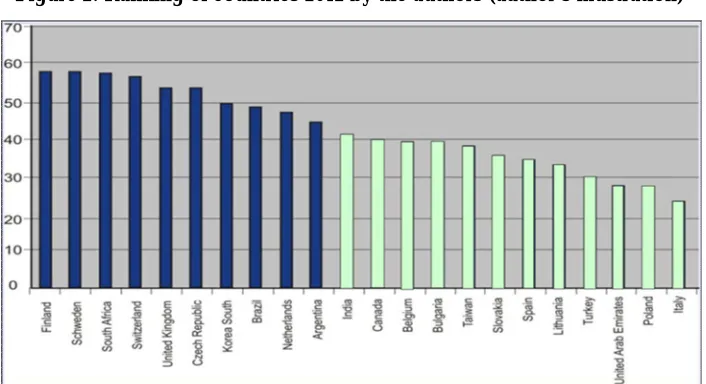
On the basis of these and other parameters and with the help of key figures the countries were assessed and a ranking was established. Each individual parameter received awarding points in order to determine the key figures, whereby a parameter could reach a maximum of 10 points. For the quality of the analysis certain criteria were used to award points as objectively as possible. For example, when focusing on the parameter economic viability, an analysis of the achievable hourly rates was carried out in the different countries. Subsequently, points were awarded for economic viability based on the yield perspective. The ranking of countries ended in the following result:
Figure 2. Ranking of countries 2012 by the authors (author’s illustration)
Figure 3. A Concept for Partner Selection [24]
The “Short List” arranges those candidates chronologically in order to determine, about which enterprise detailed information will be gathered and with whom contact will be sought. There are different external data bases that can be used for that like: EULER HERMES, BÜRGEL, Elektronischer Bundesanzeiger, Creditreform, M&A DATABASE, Merge rmarket. After analysing the results of the “Short List” it is possible that none of the candidates appears as the optimal choice because of different strength and weaknesses oraversion to an acquisition. In case of such a situation all of the available options should be checked systematically if there are possible solutions for each of the candidates.
2.2. Risk Management Model - As Part of the Newly Developed Holistic M&A Process Model
2.2.1 Regulation of Risk Management
In recent years, the introduction of risk management systems became part of different national laws and requirements or recommendations by professional associations in many countries. In Germany, provisions from the newly decreed control and transparency in business act (KonTraG) have been incorporated into the stock corporation act (Section 91 (2) AktG) "according to which the board of management of a public limited company has to take suitable action — in particular introduction of a monitoring system — to ensure that any development jeopardising the continued existence of the company will be detected at an early stage"[25]. Furthermore, the provisions are also integrated in Sections 289 and 317 of the German Commercial Code (HGB)[26]. In 2002, the German Corporate Governance Code gave additional substance to the KonTraG [27]. Additional regulations followed, most recently such as the German Accounting Law Modernization Act (BilMoG) or the 8th EU Company Law Directive (Directive on Statutory Audit) which also have an effect on the installation of a risk management system [28]. According to this, the board of management of a public limited company is obligated to report on existing risks and, now also, chances in the annual report to the annual financial statements. The prevailing legal opinion is that the risk management system has to apply to all subsidiaries world-wide in case of being the origin of any endangered development for the parent company. Against this background, the relevance of group-wide risk management for acquisitions of enterprises becomes visible.
Internationally, the regulations regarding risk management have also been extended. One example is the Sarbanes-Oxley Act (SOA or SOX) that has been adopted in the U.S focusing on all companies traded on an American stock exchange, including their subsidiaries all over the world [29]. Overall, the new regulations made risk management much more important on a global scale in recent years.
2.2.2. Risk Management Model in Connections with Acquisitions
The due diligence follows the goal of identifying all risks of an enterprise and how to minimize them or include them into the calculation of the enterprise value. The due diligence processes often need the cooperation of the enterprise with external advisors such as auditing and law firms to perform due diligence checks and risk analyses. In the following, risk management or risk analysis in the acquisition processes which show great importance for every enterprise is the focus of the authors. Due to the complexity to include all risks of an enterprise in the analysis, it is necessary to identify them with a systematic process, which was developed and implemented by the authors to reduce the risks concerning acquisitions in their enterprise. For this the issues will be classified by external and internal influences on the enterprise (see Figure below):
Figure5.Identification of Risks
(Source: Own diagram based on internal documents of the author’s enterprise)
Concerning the risk levels and risk fields established, all the relevant risks must be identified, measured and describe as precisely as possible.
External Influences On The Enterprise
The risk level on "global environment" scale, focussing on the issues of macroeconomic development, technological development and political-legal development, have a high relevance for every enterprise. Further factors are the issues of socio-cultural and ecological development that have to be considered.
Macroeconomic development includes a number of factors, especially the cyclical risks which lead to the fluctuation of economic variables (e.g. gross domestic product) of a national economy and foreign currency and inflation risks [26]. For the assessment of such risks for a country in which an acquisition should take place publicly available information provided by financial or research institutions can be used to estimate the country-specific risk potential. The assessment of the technological developments and the associated technological risks is, in most cases, based on the Know-How of the author’s enterprise which is supported by publicly available studies. In other cases where own Know-How is not extensive enough, for example due to the set-up of a new business division through acquisition, enterprises often cooperates with external advisors to receive expert reports on the further technological development of the market in question.
To identify the political-legal risks by enterprises the following list can be used (for an additional detailed explanations see [31]):
Fiscal risks: Fiscal measures by governments may present a risk to enterprises.
Transfer risks: Governments may make retransfer of invested capital, e.g. in the form of distribution of profits, difficult.
Expropriation and terrorism risks
Corruption risks: Regular publication of country rankings provides an overview which likewise is very important to enterprises due to the corporate governance and compliance obligations.
For the complete risk analysis, the political-legal risks are also determined, analysed, assessed and compiled. When focussing on the risk field of socio-cultural developments, circumstances and changes in demographic features (e.g. age structure) or social values, attitudes and norms (e.g. attitudes to the environment) are the centre of attention. Moreover, ecological developments arising from the exploitation of finite resources or changed environmental and climatic conditions (e.g. environmental disasters) can represent risks for an enterprise. At the risk level regarding "competitive environment", the competitors, suppliers and customers issues are often of great relevance to enterprises. Therefore, a detailed analysis of the competitor, supplier and customer situation in a country is performed in the context of the acquisition process. For instance, the general price, service and quality level of testing services, the possibility of new customers entering (entry barriers) or the customers' market power and payment behaviour are analysed in connection with this.
Internal Influences On The Enterprise
The high importance of the "enterprise internal" risk level in case of acquisitions is the reason why during an acquisition process a due diligence check extended by a risk analysis for the enterprises to be acquired is carried out jointly with local public accountants and lawyers. The internal influences on an enterprise start with the risks resulting from an enterprise's strategy/corporate governance, from the questions of composition of the service portfolio to the choice of location of enterprise investments and so on. Risks related to human resources or cultural aspects are important for all service based enterprises because the business model depends on the provision of services carried out by people. Accordingly, the risk of losing key persons (Know-How carriers) at enterprises to be acquired must be uncovered by the risk analysis and has to be reduced by contractually binding these key persons to the enterprise at least for a certain time. Such agreements which serve to reduce the risk potential are decisive if an acquisition should be performed or not. Financial risks or risks with regard to the assets of the enterprise to be acquired are another field that is examined by the management of enterprises, jointly with public accountants. In this case the balance sheet is the centre of interest, due to items such as the intrinsic value of receivables from customers or fixed assets (e.g. values of buildings, machines, technical installations and the equipment of the IT system), risks arising from under-insurance or pension plans. External lawyers might be needed, especially for the determination of business process or project risks or organisation risks. Possible risks may also arise from the operational and the organisational structure or lie in the business processes along the value-added chain. Additional risks can be found in individual current or future project, environmental or quality management.
At the end of the M&A process, all identified risks connected to external and internal influences on the enterprise have to be analysed and assessed and summed up in a report. Supported by these reports, the board of management and, if existing, the supervisory board of enterprises have to make a decision whether the acquisition will be made or not. To support the whole acquisition process before it starts a close shortcut between the enterprises risk management and the acquisition management should exist.
2.3. Innovation Management - As Part Of The Newly Developed Holistic M&A Process Model
Innovation management is a decisive factor for future success for enterprises often representing the basis for sustained economic growth. With rapid technological advances new technological possibilities and problem solutions arise. This development ends in new products often accompanied by new services. Other innovation drivers, especially for enterprises in the testing service market, include regulations, laws or norms introduced by the legislator that have to be met by the enterprises. That is the reason why the topic of innovation should always be part of enterprise’s strategy. To support the innovative surround of an enterprise, the establishment of an innovation culture is helpful. Moreover, it is important to see innovations from a holistic perspective and at all levels of the enterprise [32]. The term innovation literally means “renewal”, and it is based on the Latin terms “novus” and “innovation” – something newly created. The terms can be used to describe new kinds of products or services, processes, contract forms, sales channels, organisational structures, etc. [33].
The tasks of innovation management compromise the systematic supports and guidance of the entire innovation process starting with the generation of new ideas until their implementation in new products of services in the testing service market. The aim in the long run is to strengthen and to improve the market position of the enterprise [35].
According to the authors, that set up a similar culture in his enterprise, an innovation-friendly enterprise culture begins with the creativity and competency of its employees and is supported by the help of special investments in further training programs and e.g. special bonus payments for innovation ideas to employees. In 2010, €5.6 million was invested in internal and external training courses for employees at the author’s enterprise (2015: €6.4 million) [36].
Due to existing organisation structure in enterprises and the variety of products a central innovation management should be established that overviews innovation in business fields and business divisions. The central innovation management has a broad range of responsibility from the promotion of an innovation culture in the enterprise, the identification of new innovation fields to the coordination of activities, in order to generate innovation across the business divisions. Such a central organisation structure can have an additional value due to their connection with different business divisions because in general various business fields/divisions are almost not connected with each other. Due to this reason, the central innovation management can support the identification and execution of sustainable M&A transactions.
The importance of the innovation management for M&A transaction can be clarified by examples of the enterprises that are analysed in the case study. Both enterprises have acquired numerous targets during the analysed period. These acquisitions allowed both enterprises to enhance their service portfolios and set up the possibility to reach new markets though new customer groups and regions. With the contribution by the authors the acquisitions by enterprise A not only expanded existing business fields with new services, it was also possible to develop new business divisions. For example, with an acquisition in the new business field of raw materials the enterprise managed to acquire numerous new services; one of these is the mining service. This led to the possibility to combine this new service with existing ones. The mining service was interlocked with permanent disposal site from the field of nuclear energy to create a new service with a competitive advantage. This new service is of great interest in Germany concerning the phasing out of nuclear energy until 2022 and the accompanying search for suitable permanent disposal sites, so that such a new service offer appears promising.
The acquisitions of enterprises were decisive for the development and offer of this and other innovative services, without it would not have been possible due to the enterprise lack of resources in personnel and time and necessary Know-How. This example shows that in the service sector it is of great importance to identify the value creation and innovative potentials during the M&A process. Furthermore, the need to deal with the cultural aspects must be emphasized because the employees of an acquired enterprise are the actual value. In the light of cross border acquisitions, it is even more important to identify cultural differences at an early stage and deal actively with them and support mutual understanding. The competition of enterprise A, enterprise B, had other intentions for their acquisitions. Its business fields were strengthened by new services and existing ones were completed through acquisitions, but the development of new business fields was not the aim. Enterprise B has focused on acquisitions in America and in Asia, in order to benefit from the growth in these regions [37]. With these investments enterprise B reached new customer groups, to whom it can offer its new services. Without these acquisitions the internationalization of the group within such a short time and with such a high turnover volume would not have been possible.
The success of the submission of a purchasing price offer or the purchase of another corporation depends on the involvement of the M&A Team. Considering the relevance of the M&A department it should be installed including a direct connection to the CFO or CEO of the enterprise. During the implementations of M&A transactions in enterprises an interconnection between M&A department and the Finance and Legal Department should be established to support each other. Moreover, additional project-related support for the M&A team can be delivered by employees, which will be responsible for the operational integration of the acquired company. A comparable system that has been implemented at the enterprise A with support by the author of the paper has contributed to the success in the implementation of acquisitions that can be seen in the case study. Against this background, the authors of the paper stated that a stringent innovation management contributes to the fulfilment of customers’ needs and helps to optimise costs during the acquisition process, resulting in an increase in the enterprise’s results and profits. All in all, a stringent innovation management is the basis for a successful, sustainable acquisition policy.
3. Comparing Merger & Acquisition Transactions Using A Benchmark Analysis
After describing important parts of the newly developed holistic M&A processes model, the case study demonstrates the effectiveness of the model by comparing the development of two enterprises in a phase of strong inorganic growth. In this section the results of the M&A transactions will be analysed, measured and objectivised with the help of a specifically developed benchmark analysis in order to make value contributions of M&A transactions directly visible for enterprises. This will then allow the comparison of different M&A strategies. The time span of the analysis has been set by the author for a period of seven years. Against this background, the author’s enterprise, enterprise Ais compared to its biggest competitor in the business field enterprise B. The results of M&A transactions are summarised, measured, analysed and objectivised using the most important economic key performance indicators in the balance sheet, the income statement and profitability key performance indicators including standard procedures which are used to evaluate the enterprises. Both enterprises are very suitable for comparison in this case study, because they both play a leading role in the global testing service market, they have similar product portfolios and enterprise backgrounds. The results of the analysis and benchmark of the economic key figures is presented in the figure below:
Figure6. Economic Key Performance Indicator (Author’s illustration based on [38])
Economic key performance indicator Enterprise A Enterprise B
start/endpoint start/endpoint
Consolidated balance sheet:
Goodwill (in € million) -- 56.8 1.2 1.5.6
Net financial position (in € million) 70.4 29.4 75.6 113.8
Ratic of goodwill to equity capital(%) -- 48.7 0.6 28.8
Reinsurance quota for pension provisions (%) 95.7 77.7 48.3 75.5
Consolidated Profit –and loss statement:
Turnover (in € million) 600.7 922.6 978.3 1552.5
Growth turnover (%) 1.6 8.5 5.7 10.1
Write-offs on Goodwill (in € million) -- -- 0.5 12.2
Annual profit (in € million) 3.7 35.9 43.5 74.6
Productivity ratio:
Return on turnover (%) 0.6 3.5 4.5 4.8
Return on equity (%) 2.7 30.8 21.7 15.8
For the initial situation the authors state that enterprise A accounts for lower economic key performance indicators in the consolidated balance sheet regarding the statement of financial position and the ratio of Goodwill to equity capital, and a higher reinsurance quota of the pension provisions, and no Goodwill. When focussing on the economic key performance indicators of the consolidated profit and loss (income) statement enterprise A ranks clearly behind enterprise B; something that is historically conditioned. A similar picture is revealed regarding the profitability ratios.
During the analysed time period, enterprise A that used the new holistic M&A model as basis for their execution of acquisitions conducted 28 majority participations in companies with a turnover volume of approx. €190.Enterprise Bacted similar acquiring a comparable number of majority participations with a comparable turnover volume during the period. The overall investment by enterprise A reached more than €115 million and the one of enterprise B was more than €240 million for the implemented acquisitions.
The acquisitions, as an important effect, led to Goodwill in the amount of €56.8 million at enterprise A in its consolidated balance sheet, and enterprise B balances €135.6 million in the same position. It is important to mention that during the relevant time period enterprise A did not experienced any write-offs of Goodwill, while enterprise B suffered under write-offs in the amount of €38.9 million due to a purchasing price that was too high and a lack of intrinsic value. This underlines the usefulness and success of the risk analysis model and other success factors, which were developed and implemented with the help of the authors in enterprise A as part of the holistic M&A process model.
At the end of the analysed time span, both enterprise A and B continue to have a positive statement of financial position despite having substantial investments. In direct comparison with its competitor enterprise B and other competitors, enterprise A still shows a very high reinsurance quota for the pension provisions reflecting the high relevance of this key performance indicator and its sense of social responsibility towards its employees. Due to the higher profitability level, enterprise B could increase its equity capital substantially compared to enterprise A. The acquired enterprises in both enterprises have contributed significantly to that. In the face of acquisitions, the ratio between the Goodwill and the equity capital has increased (enterprise A: 48.7% and enterprise B: 28.8%) in both enterprises This key performance indicator underlines the effect that write-offs on Goodwill – if such should become necessary in the future – can have on the equity capital of both enterprises.
As mentioned previously, the change of strategy supported by the authors of enterprise A succeeded by achieving almost the same increasing rates as its competitor enterprise B. Therefore, enterprise A hardly lost any market share during the relevant time period. When comparing the sources of growth, enterprise A had the higher increasing rate during the observed time period through M&A activities (32% points in comparison with 20% points for enterprise B) while at enterprise B the higher organic increasing rate was higher (39% points in comparison to 22% for enterprise A). Enterprise A also reached an increased result level, with contribution of the newly acquired corporations, but the level of results of enterprise B is still higher. The profitability ratios show a similar picture, where again enterprise A decreased the distance to the standard of enterprise B. Considering the key performance indicator return on investment, the level of enterprise B was exceeded by enterprise A. Without the acquisitions the gap between enterprise A and its competitor enterprise Band other competitors would have considerably widened, regarding such key performance indicators as the consolidated profit and loss (income) statement and the profitability ratios. Based on a sustained acquisition policy, the success of the M&A transactions could reduce the gap for most of the economic key performance indicators that were part of the study, and thus, enterprise A could successfully defend its market position.
All in all, through the newly developed benchmark analysis and the measurement with standard evaluation methods the authors are able to state that that enterprise A chose a careful method for its M&A transactions and regarding the purchasing prices that were paid, while enterprise B pursued a more aggressive purchasing prices strategy with two-digit result multiples. Despite the conservative acquisition approach enterprise A had attractive M&A transactions, which contributed significantly to the growth of the enterprise and to its further technological development.
Finally, it can be stated by the authors that no write offs of any Goodwill were necessary at enterprise A due to the support of the developed and implemented holistic M&A process model in connection with further success factors. This shows the usefulness of the holistic M&A process model. In contrast, enterprise B was forced to write off Goodwill in the amount of €38.9 Mio. Compared to the investment volume, its failure rate regarding M&A transactions reached approximately 15% - 20%. Still, both enterprises outperformed the market with their implementations of M&A transactions regarding their failure rates compared to the average of enterprises in the service market, which according to Jansen [7] had a failure rate of around 50% (as well[6, 8]).
With the help of the newly developed holistic M&A process model, whose effects and impacts were tested and objectified for third parties by being measured and analysed with the help of standard procedures, enterprise A did not have to record failures on the basis of the above calculations during the observed time period concerning the implementation of their M&A transactions.
4. Summary
Despite the relevance of M&A transaction literature study and analysis of numerous empirical studies describe a high failure rate of at least 40% to 50%of the implemented M&A transactions (e.g. [6, 7, 8]). To solve this problem the relevant scientific literature describes some more or less detailed structured theoretical models for M&A processes but there are no detailed and holistic concepts for national and international M&A processes which consider the special features of M&A transactions in the testing service market and the service market in general. M&A activities in the testing service market that had an estimated volume of €100 billion have become more relevant due to a stronger consolidation and intensifying of competition. For this background the authors aim at developing such a holistic national and international M&A process model for enterprises in the testing service market and the service market to reduce the high failure rate of implemented M&A transactions. As first part of the holistic M&A model, the country analysis model was presented. Especially in the face of the world-wide growth potential through M&A transactions, the evaluation and analysis of the strategic business fields in different countries is important. This model which was developed with the support of the authors comprises various parameters and key figures to evaluate and rank countries. In countries with the highest rankings the first priority is the examination of a possible entry into that market, e.g. through M&A transactions (close interlocking of the enterprise strategy with M&A transactions has specific importance to efficiently use the resource of the enterprise).
During the transaction phase a detailed risk analysis should be included. The implementation of a risk analysis model as developed and shown by the authors is an important success factor. Due to this reason, the rather typical risk checks such as an examination of the financial and tax data and the legal foundations will be expended through a detailed examination of the Human-Resource-Assets. The latter is especially relevant in connection with M&A transactions in the service sector and related cultural aspects with regards to the targeted company because the business model is based on services performed by people. With the contribution by the authors enterprise a uses special check list for this, which were specifically developed for the testing service market and the service market in general.
Finally, it is stated by the authors that with the help of the newly developed holistic M&A process model in connection with further success factors (e.g. risk management model, country analysis model, innovation management)enterprise A did not have to record failures during the observed time period concerning the implementation of their M&A transactions, while the failure rate of enterprise B, the main competitor in the business field, has reached approximately 15% - 20% of the investment volume as shown in the section before.
Both enterprises with comparable business activities and with more than 140 years of enterprise history play a leading role in the global testing service market. Thus, the holistic M&A process model implemented in enterprise A is working properly.
References
Thomson Reuters (c): What’s driving deal making? Prepared by Thomson Reuters Deals Intelligence and Breaking views, as of 13.01.2016, URL:
http://dmi.thomsonreuters.com/Content/Files/Trends%20in%20Deal%20Making_Full%20Year%202015.pdf, last visited 04.08.2016, pp. 3-5.
The Boston Consulting Group, “Growing Through Acquisitions, The Successful Value Creation Record of Acquisitive Growth Strategies”, BCG Report May 2004, p. 6.
The Boston Consulting Group: From Buying Grotwh to Building Value: Increasing Returns With M&A, by Kengelbach, Jens, Kreienburg, Georg, Gjerstad, Ketil, Nielsen, Jesper, Walker, Decker, Walker, Stuart, as of 12.10.2015, URL: https://www.bcgperspectives.com/content/articles/merger-acquisitions-divestitures-from-acquiring-growth-growing-value/, last visited 29.06.2016, pp. 4.
Financial Gates GmbH,“M&A im deutschen Mittelstand, Erfahrungswerte beim Aufbau von „European Players“ mit Hilfe von Zukäufen im Ausland“, FINANCEStudien, Reihe im F.A.Z.-Institut, Frankfurt am Main 2005. Dreher, Maximilian, Ernst, Dietmar: Mergers & Acquisitions, Konstanz: UVK Verlagsgesellschaft with UVK/Lucius,
2014, ISBN: 978-3-8252-4203-9, pp. 38.
P. Gibbs, “European mergers of equals have ideal fundamentals to create value, yet Some disappoint”, Internal Analysis J.P. Morgan, 10. July 1998.
S. Jansen, “Mergers & Acquisitions, Unternehmensakquisitionen und -kooperationen. Eine strategische, organisatorische und kapitalmarkttheoretische Einführung“, 5th updated and considerable revised edition, Wiesbaden: Gabler Verlag, 2008, ISBN: 978-3-8349-0365-5, p. 340.
C. Kummer, F. Eiffe, W. Mölzer, “Mergers & Acquisition Leitfaden zum Kauf und Verkauf von Unternehmen“, 2nd revised edition, Zürich and Wien, LexisNexis ARD ORAC, 2011, ISBN: 978-3700748533, pp. 1.
G. Picot, “Unternehmenskauf und Restrukturierung, Handbuch zum Wirtschaftsrecht“, 4th edition, München: C. H. Beck Verlag, 2013, ISBN: 3-406-43260-3.
D. Grill, “Human Ressourcen Controlling bei M&A, Erfolg durch Steuerung des Humankapitals“, AV Akademikerverlag, 2013, ISBN 978-3-639-39555-6.
C. Bauer, J. von Düsterlho, “Distressed Mergers & Acquisitions Kauf und Verkauf von Unternehmen in der Krise“, Springer Verlag Berlin, 2013, ISBN: 978-3-8349-3421-5.
W. Berens, H. Brauner, J. Strauch (publisher), “Due Diligence bei Unternehmensakquisitionen“, 7th edition, Stuttgart: Schäffer-Poeschel Verlag, 2013, ISBN 978-3-7910-3258-0.
R. J. Aiello, M. D. Watkins, “The fine art of friendly acquisitions“, in: HBR, Heft 11/12, 2000 page 101-107. Annual report of TÜV NORD AGpublished in 2011.
Annual report of TÜV SÜD AG published in 2011.
Düsterhoff, Henning, Wolffson, Jannik: M&A-Welt in zwei Geschwindigkeiten – Jahresrückblick auf das deutsche M&A-Geschehen 2015, in: M&A Review, 1-2/2016, volume 27, p.23.
Thomson Financial, Institute for Mergers, Acquisitions and Alliances (IMAA), taken from M&A-Statistics, URL: http://www.imaa-institute.org/statistics-mergers-acquisitions.html#Top MergersAcquisitionsEurope, last visited: 08.10.2013.
CEOC International: White Paper: Trends & Challenges for the third party TIC Sector, and its implications for CEOC International, September 2015, URL: http://www.ceoc.com/documents/White%20Paper-%20Trends%20and%20Challenges%20for%20the%20third%20party%20TIC%20sector_September%20201 5.pdf, last visited 27.07.2016, p. 4.
NOMURA: TIC Sector, Discussion Materials, March 2016, p. 9.
A. Gälweiler, “Strategische Unternehmensführung“, revised and updated Markus Schwaninger, 3rd edition, Bielefeld: Campus V4.erlag GmbH, 2005, ISBN: 978-3-593-37761-2, pp. 76.
P. Zehnder, “Strategisches-, Marketing- & Verkaufsmanagement”, St. Galler Business School (publisher), presentation for the TÜV NORD GmbH as of 3.-4. February 2006, p. 3.
M. Porter, “Competitive Strategy, Techniques for analyzing industries and competitors”, 1st edition, New York: THE FREE PRESS, 1998, ISBN: 0-684-84148-7, p. 47.
K. Lucks, “M&A – Nur systematisches Vorgehen bringt Erfolg“, Harvard Business Manager, volume 24, 2002, pp. 44.
Holtbrügge, Dirk, Welge, Martin K.: Internationales Management – Theorien, Funktionen, Fallstudien, 5th edition, Stuttgart: Schäffer-Poeschel Verlag, 2010, ISBN: 978-3-7910-2883-5, p. 415.
Schmitz, Thorsten, Wehrheim, Michael: Risikomanagement – Grundlagen, Theorie, Praxis, Stuttgart: Verlag W. Kohlhammer, 2006, ISBN: 978-3-17-019330-7, p. 20.
Enz, Rouven: Risikomanagement in Projekten. Ein Konzept zur systematischen Identifikation, Bewertung und Behandlung von Risiken, Duisburg: WiKu-Verlag, 2008, ISBN: 978-3-86553-257-2, p. 30.
Arbeitskreis Externe und Interne Überwachung der Unternehmung (AKEIÜ) der Schmalenbach-Gesellschaft für Betriebswirtschaftslehre e. V.: Aktuelle Herausforderungen im Risikomanagement – Innovationen und Leitlinien, Köln, in: DB issue nr. 23, as of 11.06.2010, p. 1245-1252, p. 1245.
Hull, John: Risikomanagement Banken, Versicherungen und andere Finanzinstitutionen, 2nd edition, München: Pearson Studium, 2011, ISBN: 978-3-86894-043-5, p. 453.
W.Schmitting, “Perspektiven eines Risikomanagements im Rahmen von Unternehmensakquisition und Due Diligence,” in: W. Berens, H. Brauner, J. Strauch (publisher), “Due Diligence bei Unternehmensakquisitionen“, 6th edition, Stuttgart: Schäffer-Poeschel Verlag, 2011, ISBN: 978-3-7910-3045-6.
T. Kühlmann, H.D. Haas, “Internationales Risikomanagement, Auslandserfolg durch grenzüberschreitende Netzwerke”, München: Oldenbourg Verlag, 2009, ISBN: 978-3-486-58875-0.
Witten, Elmar, Mathes, Volker, Mencke, Marco: Betriebliches Innovationsmanagement, Wie Sie erfolgreich neue Produkte und Dienstleistungen entwickeln, 1st edition, Berlin: Cornelsen Verlag, 2007, ISBN: 978-3-589-23665-7, p. 10.
Hauschildt, Jürgen, Salomo, Sören: Innovationsmanagement, 5th revised and updated edition, München: Franz Vahlen Verlag, 2011, ISBN: 978-3-8006-3655-6, pp. 3.
European Commission: Green Paper on Innovation, Luxembourg December 1995, p. 1.
Müller-Prothmann, Tobias, Dörr, Nora: Innovationsmanagement, Strategien, Methoden und Werkzeuge für systematische Innovationsprozesse, München: Carl Hanser Verlag, 2009, ISBN: 978-3-446-41799-1, pp. 9. Annual reports of TÜV NORD, published in 2010-2015, p. 46-48.
Annual report of TÜV SÜD, 2010, p. 66
![Figure 3. A Concept for Partner Selection [24]](https://thumb-us.123doks.com/thumbv2/123dok_us/9781970.1963543/5.612.201.414.127.228/figure-concept-for-partner-selection.webp)
