The Thirty-Third AAAI Conference on Artificial Intelligence (AAAI-19)
Selective Refinement Network for High Performance Face Detection
Cheng Chi,
1,3∗Shifeng Zhang,
2,3*†Junliang Xing,
2,3Zhen Lei,
2,3Stan Z. Li,
2,3Xudong Zou
1,3 1Institute of Electronics, Chinese Academy of Sciences, Beijing, China2CBSR & NLPR, Institute of Automation, Chinese Academy of Sciences, Beijing, China 3University of Chinese Academy of Sciences, Beijing, China
Abstract
High performance face detection remains a very challenging problem, especially when there exists many tiny faces. This paper presents a novel single-shot face detector, named Selec-tive Refinement Network (SRN), which introduces novel two-step classification and regression operations selectively into an anchor-based face detector to reduce false positives and improve location accuracy simultaneously. In particular, the SRN consists of two modules: the Selective Two-step Classi-fication (STC) module and the Selective Two-step Regression (STR) module. The STC aims to filter out most simple neg-ative anchors from low level detection layers to reduce the search space for the subsequent classifier, while the STR is designed to coarsely adjust the locations and sizes of anchors from high level detection layers to provide better initialization for the subsequent regressor. Moreover, we design a Recep-tive Field Enhancement (RFE) block to provide more diverse receptive field, which helps to better capture faces in some extreme poses. As a consequence, the proposed SRN detector achieves state-of-the-art performance on all the widely used face detection benchmarks, including AFW, PASCAL face, FDDB, and WIDER FACE datasets. Codes will be released to facilitate further studies on the face detection problem.
Introduction
Face detection is a long-standing problem in computer vi-sion with extensive applications including face alignment, face analysis, face recognition, etc. Starting from the pio-neering work of Viola-Jones (Viola and Jones 2004), face detection has made great progress. The performances on several well-known datasets have been improved consis-tently, even tend to be saturated. To further improve the per-formance of face detection has become a challenging issue. In our opinion, there remains room for improvement in two aspects: (a)recall efficiency: number of false positives needs to be reduced at the high recall rates; (b)location accuracy: accuracy of the bounding box location needs to be improved. These two problems are elaborated as follows.
On the one hand, the average precision (AP) of current face detection algorithms is already very high, but the pre-cision is not high enough at high recall rates,e.g., as shown
*These authors contributed equally to this work. †Corresponding author
Copyright © 2019, Association for the Advancement of Artificial Intelligence (www.aaai.org). All rights reserved.
(a) Effect on Class Imbalance (b) Recall Efficiency
(c) Adjusted Anchor (d) Location Accuracy
Figure 1: The effects of STC and STR on recall efficiency and location accuracy. (a) The STC and STR increase the positives/negatives ratio by about 38 and3 times respec-tively, (b) which improve the precision by about20%at high recall rates. (c) The STR provides better initialization for the subsequent regressor, (d) which produces more accurate lo-cations,i.e., as the IoU threshold increases, the AP gap grad-ually increases.
false positives. To address this issue, researchers propose several solutions. R-CNN-like detectors (Girshick 2015; Ren et al. 2017) address the class imbalance by a two-stage cascade and sampling heuristics. As for single-shot detec-tors, RetinaNet proposes the focal loss to focus training on a sparse set of hard examples and down-weight the loss as-signed to well-classified examples. RefineDet (Zhang et al. 2018) addresses this issue using a preset threshold to filter out negative anchors. However, RetinaNet takes all the sam-ples into account, which also leads to quite a few false posi-tives. Although RefineDet filters out a large number of sim-ple negative samsim-ples, it uses hard negative mining in both two steps, and does not make full use of negative samples. Thus, the recall efficiency of them both can be improved.
On the other hand, the location accuracy in the face detec-tion task is gradually attracting the attendetec-tion of researchers. Although current evaluation criteria of most face detection datasets (Jain and Learned-Miller 2010; Yang et al. 2016) do not focus on the location accuracy, the WIDER Face Challenge1 adopts MS COCO (Lin et al. 2014) evaluation
criterion, which puts more emphasis on bounding box loca-tion accuracy. To visualize this issue, we use different IoU thresholds to evaluate our trained face detector based on RetinaNet on the WIDER FACE dataset. As shown in Figure 1(d), as the IoU threshold increases, the AP drops dramati-cally, indicating that the accuracy of the bounding box loca-tion needs to be improved. To this end, Gidaris et al. (Gidaris and Komodakis 2015) propose iterative regression during in-ference to improve the accuracy. Cascade R-CNN (Cai and Vasconcelos 2018) addresses this issue by cascading R-CNN with different IoU thresholds. RefineDet (Zhang et al. 2018) applies two-step regression to single-shot detector. However, blindly adding multi-step regression to the specific task (i.e., face detection) is often counterproductive.
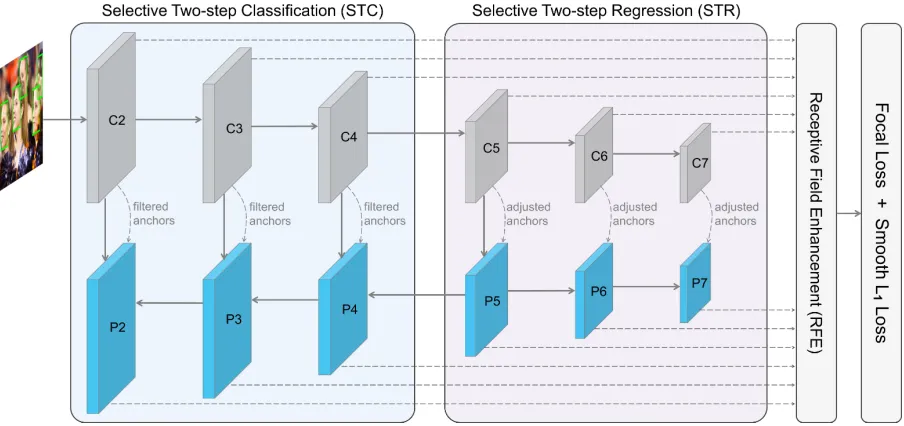
In this paper, we investigate the effects of two-step clas-sification and regression on different levels of detection lay-ers and propose a novel face detection framework, named Selective Refinement Network (SRN), which selectively ap-plies two-step classification and regression to specific levels of detection layers. The network structure of SRN is shown in Figure 2, which consists of two key modules, named as the Selective Two-step Classification (STC) module and the Selective Two-step Regression (STR) module. Specifically, the STC is applied to filter out most simple negative samples (illustrated in Figure 1(a)) from the low levels of detection layers, which contains88.9%samples. As shown in Figure 1(b), RetinaNet with STC improves the recall efficiency to a certain extent. On the other hand, the design of STR draws on the cascade idea to coarsely adjust the locations and sizes of anchors (illustrated in Figure 1(c)) from high levels of detection layers to provide better initialization for the sub-sequent regressor. In addition, we design a Receptive Field Enhancement (RFE) to provide more diverse receptive fields to better capture the extreme-pose faces. Extensive experi-ments have been conducted on AFW, PASCAL face, FDDB, and WIDER FACE benchmarks and we set a new state-of-the-art performance.
1
http://wider-challenge.org
In summarization, we have made the following main con-tributions to the face detection studies:
• We present a STC module to filter out most simple nega-tive samples from low level layers to reduce the classifi-cation search space.
• We design a STR module to coarsely adjust the locations and sizes of anchors from high level layers to provide bet-ter initialization for the subsequent regressor.
• We introduce a RFE module to provide more diverse re-ceptive fields for detecting extreme-pose faces.
• We achieve state-of-the-art results on AFW, PASCAL face, FDDB, and WIDER FACE datasets.
Related Work
Face detection has been a challenging research field since its emergence in the 1990s. Viola and Jones pioneer to use Haar features and AdaBoost to train a face detector with promis-ing accuracy and efficiency (Viola and Jones 2004), which inspires several different approaches afterwards (Liao, Jain, and Li 2016; Brubaker et al. 2008). Apart from those, another important job is the introduction of Deformable Part Model (DPM) (Mathias et al. 2014; Yan et al. 2014a; Zhu and Ramanan 2012).
Recently, face detection has been dominated by the CNN-based methods. CascadeCNN (Li et al. 2015) improves de-tection accuracy by training a serious of interleaved CNN models and following work (Qin et al. 2016) proposes to jointly train the cascaded CNNs to realize end-to-end opti-mization. MTCNN (Zhang et al. 2016) proposes a joint face detection and alignment method using multi-task cascaded CNNs. Faceness (Yang et al. 2015) formulates face detection as scoring facial parts responses to detect faces under severe occlusion. UnitBox (Yu et al. 2016) introduces an IoU loss for bounding box prediction. EMO (Zhu et al. 2018) pro-poses an Expected Max Overlapping score to evaluate the quality of anchor matching. SAFD (Hao et al. 2017) devel-ops a scale proposal stage which automatically normalizes face sizes prior to detection. S2AP (Song et al. 2018) pays attention to specific scales in image pyramid and valid lo-cations in each scales layer. PCN (Shi et al. 2018) proposes a cascade-style structure to rotate faces in a coarse-to-fine manner. Recent work (Bai et al. 2018) designs a novel net-work to directly generate a clear super-resolution face from a blurry small one.
Additionally, face detection has inherited some achieve-ments from generic object detectors, such as Faster R-CNN (Ren et al. 2017), SSD (Liu et al. 2016), FPN (Lin et al. 2017a) and RetinaNet (Lin et al. 2017b). Face R-CNN (Wang et al. 2017a) combines Faster R-R-CNN with hard negative mining and achieves promising results. Face-Boxes (Zhang et al. 2017a) introduces a CPU real-time de-tecotor based on SSD. Face R-FCN (Wang et al. 2017b) applies R-FCN in face detection and makes according im-provements. The face detection model for finding tiny faces (Hu and Ramanan 2017) trains separate detectors for different scales. S3FD (Zhang et al. 2017b) presents
Figure 2: Network structure of SRN. It consists of STC, STR, and RFE. STC uses the first-step classifier to filter out most simple negative anchors from low level detection layers to reduce the search space for the second-step classifier. STR applies the first-step regressor to coarsely adjust the locations and sizes of anchors from high level detection layers to provide better initialization for the second-step regressor. RFE provides more diverse receptive fields to better capture extreme-pose faces.
problem of small faces. SSH (Najibi et al. 2017) models the context information by large filters on each prediction mod-ule. PyramidBox (Tang et al. 2018) utilizes contextual infor-mation with improved SSD network structure. FAN (Wang, Yuan, and Yu 2017) proposes an anchor-level attention into RetinaNet to detect the occluded faces. In this paper, in-spired by the multi-step classification and regression in Re-fineDet (Zhang et al. 2018) and the focal loss in RetinaNet, we develop a state-of-the-art face detector.
Selective Refinement Network
Network Structure
The overall framework of SRN is shown in Figure 2, we describe each component as follows.
Backbone. We adopt ResNet-50 (He et al. 2016) with 6-level feature pyramid structure as the backbone network for SRN. The feature maps extracted from those four residual blocks are denoted as C2, C3, C4, and C5, respectively. C6 and C7 are just extracted by two simple down-sample
3×3convolution layers after C5. The lateral structure be-tween the bottom-up and the top-down pathways is the same as (Lin et al. 2017a). P2, P3, P4, and P5 are the feature maps extracted from lateral connections, corresponding to C2, C3, C4, and C5 that are respectively of the same spatial sizes, while P6 and P7 are just down-sampled by two3×3 convo-lution layers after P5.
Dedicated Modules. The STC module selects C2, C3, C4, P2, P3, and P4 to perform two-step classification, while the STR module selects C5, C6, C7, P5, P6, and P7 to conduct two-step regression. The RFE module is responsible for en-riching the receptive field of features that are used to predict the classification and location of objects.
Anchor Design. At each pyramid level, we use two specific scales of anchors (i.e.,2Sand2√2S, whereSrepresents the total stride size of each pyramid level) and one aspect ratios (i.e.,1.25). In total, there areA = 2anchors per level and they cover the scale range8−362pixels across levels with respect to the network’s input image.
Loss Function. We append a hybrid loss at the end of the deep architecture, which leverage the merits of the focal loss and the smooth L1loss to drive the model to focus on more
hard training examples and learn better regression results.
Selective Two-Step Classification
Introduced in RefineDet (Zhang et al. 2018), the two-step classification is a kind of cascade classification implemented through a two-step network architecture, in which the first step filters out most simple negative anchors using a preset negative thresholdθ = 0.99to reduce the search space for the subsequent step. For anchor-based face detectors, it is necessary to tile plenty of small anchors over the image to detect small faces, which causes the extreme class imbalance between the positive and negative samples. For example, in the SRN structure with the1024×1024input resolution, if we tile2anchors at each anchor point, the total number of samples will reach300k. Among them, the number of pos-itive samples is only a few dozen or less. To reduce search space of classifier, it is essential to do two-step classification to reduce the false positives.
However, it is unnecessary to perform two-step classifica-tion in all pyramid levels. Since the anchors tiled on the three higher levels (i.e., P5, P6, and P7) only account for11.1%
two-step classification on the three higher pyramid levels, and if applied, it will lead to an increase in computation cost. In contrast, the three lower pyramid levels (i.e., P2, P3, and P4) have the vast majority of samples (88.9%) and lack of ade-quate features. It is urgently needed for these low pyramid levels to do two-step classification in order to alleviate the class imbalance problem and reduce the search space for the subsequent classifier.
Therefore, our STC module selects C2, C3, C4, P2, P3, and P4 to perform two-step classification. As the statisti-cal result shown in Figure 1(a), the STC increases the posi-tive/negative sample ratio by approximately38times, from around1:15441to1:404. In addition, we use the focal loss in both two steps to make full use of samples. Unlike Re-fineDet (Zhang et al. 2018), the SRN shares the same clas-sification module in the two steps, since they have the same task to distinguish the face from the background. The ex-perimental results of applying the two-step classification on each pyramid level are shown in Table 2. Consistent with our analysis, the two-step classification on the three lower pyramid levels helps to improve performance, while on the three higher pyramid levels is ineffective.
The loss function for STC consists of two parts,i.e., the loss in the first step and the second step. For the first step, we calculate the focal loss for those samples selected to perform two-step classification. And for the second step, we just fo-cus on those samples that remain after the first step filtering. With these definitions, we define the loss function as:
LSTC({pi},{qi}) =
1
Ns1
X
i∈Ω
LFL(pi, l∗i)
+ 1
Ns2
X
i∈Φ
LFL(qi, li∗),
(1)
whereiis the index of anchor in a mini-batch,piandqiare the predicted confidence of the anchoribeing a face in the first and second steps, l∗i is the ground truth class label of anchori,Ns1andNs2are the numbers of positive anchors in
the first and second steps,Ωrepresents a collection of sam-ples selected for two-step classification, andΦrepresents a sample set that remains after the first step filtering. The bi-nary classification loss LFL is the sigmoid focal loss over
two classes (facevs.background).
Selective Two-Step Regression
In the detection task, to make the location of bounding boxes more accurate has always been a challenging problem. Cur-rent one-stage methods rely on one-step regression based on various feature layers, which is inaccurate in some challeng-ing scenarios,e.g., MS COCO-style evaluation standard. In recent years, using cascade structure (Zhang et al. 2018; Cai and Vasconcelos 2018) to conduct multi-step regression is an effective method to improve the accuracy of the detec-tion bounding boxes.
However, blindly adding multi-step regression to the spe-cific task (i.e., face detection) is often counterproductive. Experimental results (see Table 4) indicate that applying two-step regression in the three lower pyramid levels im-pairs the performance. The reasons behind this phenomenon
are twofold: 1) the three lower pyramid levels are associated with plenty of small anchors to detect small faces. These small faces are characterized by very coarse feature repre-sentations, so it is difficult for these small anchors to per-form two-step regression; 2) in the training phase, if we let the network pay too much attention to the difficult regression task on the low pyramid levels, it will cause larger regression loss and hinder the more important classification task.
Based on the above analyses, we selectively perform two-step regression on the three higher pyramid levels. The moti-vation behind this design is to sufficiently utilize the detailed features of large faces on the three higher pyramid levels to regress more accurate locations of bounding boxes and to make three lower pyramid levels pay more attention to the classification task. This divide-and-conquer strategy makes the whole framework more efficient.
The loss function of STR also consists of two parts, which is shown below:
LSTR({xi},{ti}) =
X
i∈Ψ
[l∗i = 1]Lr(xi, gi∗)
+X
i∈Φ
[l∗i = 1]Lr(ti, gi∗),
(2)
whereg∗i is the ground truth location and size of anchori, xiis the refined coordinates of the anchoriin the first step, tiis the coordinates of the bounding box in the second step,
Ψrepresents a collection of samples selected for two-step regression,l∗i andΦare the same as defined in STC. Similar to Faster R-CNN (Ren et al. 2017), we use the smooth L1
loss as the regression lossLr. The Iverson bracket indicator
function[l∗
i = 1]outputs1when the condition is true,i.e., l∗i = 1(the anchor is not the negative), and 0 otherwise. Hence[l∗i = 1]Lrindicates that the regression loss is ignored
for negative anchors.
Receptive Field Enhancement
At present, most detection networks utilize ResNet and VG-GNet as the basic feature extraction module, while both of them possess square receptive fields. The singleness of the receptive field affects the detection of objects with different aspect ratios. This issue seems unimportant in face detection task, because the aspect ratio of face annotations is about
1:1in many datasets. Nevertheless, statistics show that the WIDER FACE training set has a considerable part of faces that have an aspect ratio of more than2or less than0.5. Con-sequently, there is a mismatch between the receptive field of network and the aspect ratio of faces.
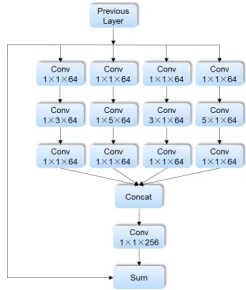
Figure 3: Structure of RFE module.
layer, the feature maps from four branches are concatenated together. Additionally, we apply a shortcut path to retain the original receptive field from previous layer.
Training and Inference
Training Dataset. All the models are trained on the training set of the WIDER FACE dataset (Yang et al. 2016). It con-sists of393,703annotated face bounding boxes in32,203
images with variations in pose, scale, facial expression, oc-clusion, and lighting condition. The dataset is split into the training (40%), validation (10%) and testing (50%) sets, and defines three levels of difficulty: Easy, Medium, Hard, based on the detection rate of EdgeBox (Zitnick and Doll´ar 2014).
Data Augmentation. To prevent over-fitting and construct a robust model, several data augmentation strategies are used to adapt to face variations, described as follows.
1) Applying some photometric distortions introduced in previous work (Howard 2013) to the training images.
2) Expanding the images with a random factor in the inter-val[1,2]by the zero-padding operation.
3) Cropping two square patches and randomly selecting one for training. One patch is with the size of the image’s shorter side and the other one is with the size determined by multiplying a random number in the interval[0.5,1.0]
by the image’s shorter side.
4) Flipping the selected patch randomly and resizing it to
1024×1024to get the final training sample.
Anchor Matching. During the training phase, anchors need to be divided into positive and negative samples. Specifi-cally, anchors are assigned to ground-truth face boxes us-ing an intersection-over-union (IoU) threshold ofθp; and to background if their IoU is in[0, θn). If an anchor is unas-signed, which may happen with overlap in[θn, θp), it is ig-nored during training. Empirically, we set θn = 0.3 and θp = 0.7 for the first step, and θn = 0.4 andθp = 0.5
for the second step.
Optimization. The loss function for SRN is just the sum of the STC loss and the STR loss,i.e.,L=LSTC+LSTR. The
backbone network is initialized by the pretrained ResNet-50 model (Russakovsky et al. 2015) and all the parame-ters in the newly added convolution layers are initialized by the “xavier” method. We fine-tune the SRN model using SGD with0.9 momentum,0.0001weight decay, and batch size 32. We set the learning rate to 10−2 for the first 100
epochs, and decay it to10−3and10−4 for another20and
10epochs, respectively. We implement SRN using the Py-Torch library (Paszke et al. 2017).
Inference. In the inference phase, the STC first filters the regularly tiled anchors on the selected pyramid levels with the negative confidence scores larger than the thresh-oldθ = 0.99, and then STR adjusts the locations and sizes of selected anchors. After that, the second step takes over these refined anchors, and outputs top2000high confident detections. Finally, we apply the non-maximum suppression (NMS) with jaccard overlap of0.5to generate the top750
high confident detections per image as the final results.
Experiments
We first analyze the proposed method in detail to verify the effectiveness of our contributions. Then we evaluate the final model on the common face detection benchmark datasets, including AFW (Zhu and Ramanan 2012), PASCAL Face (Yan et al. 2014b), FDDB (Jain and Learned-Miller 2010), and WIDER FACE (Yang et al. 2016).
Model Analysis
We conduct a set of ablation experiments on the WIDER FACE dataset to analyze our model in detail. For a fair com-parison, we use the same parameter settings for all the ex-periments, except for specified changes to the components. All models are trained on the WIDER FACE training set and evaluated on the validation set.
Ablation Setting. To better understand SRN, we ablate each component one after another to examine how each pro-posed component affects the final performance. Firstly, we use the ordinary prediction head in (Lin et al. 2017b) instead of the proposed RFE. Secondly, we ablate the STR or STC module to verify their effectiveness. The results of ablation experiments are listed in Table 1 and some promising con-clusions can be drawn as follows.
Table 1: Effectiveness of various designs on the AP perfor-mance.
Component SRN
STC ! ! !
STR ! ! !
RFE !
Easysubset 95.1 95.3 95.9 96.1 96.4
Mediumsubset 93.9 94.4 94.8 95.0 95.3
Hardsubset 88.0 89.4 88.8 90.1 90.2
(a) AFW (b) PASCAL face (c) FDDB
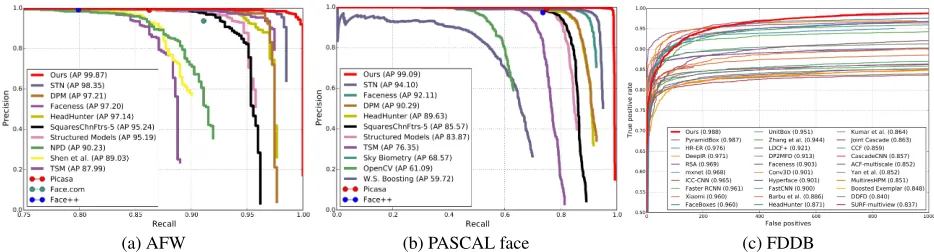
Figure 4: Evaluation on the common face detection datasets.
shown in Table 2, indicating that applying two-step classifi-cation to the low pyramid levels improves the performance, especially on tiny faces. Therefore, the STC module selec-tively applies the two-step classification on the low pyramid levels (i.e., P2, P3, and P4), since these levels are associ-ated with lots of small anchors, which are the main source of false positives. As shown in Table 1, we find that after using the STC module, the AP scores of the detector are im-proved from95.1%,93.9%and88.0%to95.3%,94.4%and
89.4%on the Easy, Medium and Hard subsets, respectively. In order to verify whether the improvements benefit from reducing the false positives, we count the number of false positives under different recall rates. As listed in Table 3, our STC effectively reduces the false positives across differ-ent recall rates, demonstrating the effectiveness of the STC module.
Table 2: AP performance of the two-step classification ap-plied to each pyramid level.
STC B P2 P3 P4 P5 P6 P7
Easy 95.1 95.2 95.2 95.2 95.0 95.1 95.0 Medium 93.9 94.2 94.3 94.1 93.9 93.7 93.9 Hard 88.0 88.9 88.7 88.5 87.8 88.0 87.7
Table 3: Number of false positives at different recall rates.
Recall (%) 10 30 50 80 90 95
#FP of RetinaNet 3 24 126 2801 27644 466534
#FP of SRN (STC only) 1 20 101 2124 13163 103586
Selective Two-step Regression. We only add the STR mod-ule to our baseline detector to verify its effectiveness. As shown in Table 1, it produces much better results than the baseline, with0.8%,0.9%and0.8%AP improvements on the Easy, Medium, and Hard subsets. Experimental results of applying two-step regression to each pyramid level (see Table 4) confirm our previous analysis. Inspired by the de-tection evaluation metric of MS COCO, we use4IoU thresh-olds{0.5, 0.6, 0.7, 0.8}to compute the AP, so as to prove that the STR module can produce more accurate localiza-tion. As shown in Table 5, the STR module produces consis-tently accurate detection results than the baseline method.
The gap between the AP across all three subsets increases as the IoU threshold increases, which indicate that the STR module is important to produce more accurate detections. In addition, coupled with the STC module, the performance is further improved to96.1%,95.0%and90.1%on the Easy, Medium and Hard subsets, respectively.
Table 4: AP performance of the two-step regression applied to each pyramid level.
STR B P2 P3 P4 P5 P6 P7
Easy 95.1 94.8 94.3 94.8 95.4 95.7 95.6
Medium 93.9 93.4 93.7 93.9 94.2 94.4 94.6
Hard 88.0 87.5 87.7 87.0 88.2 88.2 88.4
Table 5: AP at different IoU thresholds on the WIDER FACE Hard subset.
IoU
0.5
0.6
0.7
0.8
RetinaNet
88.1
76.4
57.8
28.5
SRN (STR only)
88.8
83.4
66.5
38.2
Receptive Field Enhancement. The RFE is used to diver-sify the receptive fields of detection layers in order to capture faces with extreme poses. Comparing the detection results between fourth and fifth columns in Table 1, we notice that RFE consistently improves the AP scores in different sub-sets,i.e.,0.3%,0.3%, and0.1%APs on the Easy, Medium, and Hard categories. These improvements can be mainly at-tributed to the diverse receptive fields, which is useful to cap-ture various pose faces for better detection accuracy.
Evaluation on Benchmark
(a) Val: Easy (b) Val: Medium (c) Val: Hard
(d) Test: Easy (e) Test: Medium (f) Test: Hard
Figure 5: Precision-recall curves on WIDER FACE validation and testing subsets.
PASCAL Face Dataset. It has1,335labeled faces in851
images with large face appearance and pose variations. We present the precision-recall curves of the proposed SRN method and six state-of-the-art methods and three commer-cial face detectors (i.e., SkyBiometry, Face++ and Picasa) in Figure 4(b). SRN achieves the state-of-the-art results by improving 4.99% AP score compared to the second best method STN (Chen et al. 2016).
FDDB Dataset. It contains5,171faces annotated in2,845
images with a wide range of difficulties, such as occlusions, difficult poses, and low image resolutions. We evaluate the proposed SRN detector on the FDDB dataset and compare it with several state-of-the-art methods. As shown in Figure 4(c), our SRN sets a new state-of-the-art performance,i.e.,
98.8%true positive rate when the number of false positives is equal to1000. These results indicate that SRN is robust to varying scales, large appearance changes, heavy occlusions, and severe blur degradations that are prevalent in detecting face in unconstrained real-life scenarios.
WIDER FACE Dataset. We compare SRN with eighteen state-of-the-art face detection methods on both the valida-tion and testing sets. To obtain the evaluavalida-tion results on the testing set, we submit the detection results of SRN to the au-thors for evaluation. As shown in Figure 5, we find that SRN performs favourably against the state-of-the-art based on the average precision (AP) across the three subsets, especially on the Hard subset which contains a large amount of small faces. Specifically, it produces the best AP scores in all sub-sets of both validation and testing sub-sets,i.e.,96.4%(Easy),
95.3%(Medium) and90.2%(Hard) for validation set, and
95.9%(Easy),94.9%(Medium) and89.7%(Hard) for test-ing set, surpasstest-ing all approaches, which demonstrates the superiority of the proposed detector.
Conclusion
In this paper, we have presented SRN, a novel single shot face detector, which consists of two key modules, i.e., the STC and the STR. The STC uses the first-step classifier to filter out most simple negative anchors from low level de-tection layers to reduce the search space for the second-step classifier, so as to reduce false positives. And the STR ap-plies the first-step regressor to coarsely adjust the locations and sizes of anchors from high level detection layers to pro-vide better initialization for the second-step regressor, in or-der to improve the location accuracy of bounding boxes. Moreover, the RFE is introduced to provide diverse recep-tive fields to better capture faces in some extreme poses. Ex-tensive experiments on the AFW, PASCAL face, FDDB and WIDER FACE datasets demonstrate that SRN achieves the state-of-the-art detection performance.
Acknowledgement
References
Bai, Y.; Zhang, Y.; Ding, M.; and Ghanem, B. 2018. Finding tiny faces in the wild with generative adversarial network. In
CVPR.
Brubaker, S. C.; Wu, J.; Sun, J.; Mullin, M. D.; and Rehg, J. M. 2008. On the design of cascades of boosted ensembles for face detection. IJCV.
Cai, Z., and Vasconcelos, N. 2018. Cascade R-CNN: delving into high quality object detection. InCVPR.
Chen, D.; Hua, G.; Wen, F.; and Sun, J. 2016. Supervised transformer network for efficient face detection. InECCV.
Gidaris, S., and Komodakis, N. 2015. Object detection via a multi-region and semantic segmentation-aware CNN model. InICCV.
Girshick, R. B. 2015. Fast R-CNN. InICCV.
Hao, Z.; Liu, Y.; Qin, H.; Yan, J.; Li, X.; and Hu, X. 2017. Scale-aware face detection. InCVPR.
He, K.; Zhang, X.; Ren, S.; and Sun, J. 2016. Deep residual learning for image recognition. InCVPR.
Howard, A. G. 2013. Some improvements on deep convo-lutional neural network based image classification.CoRR. Hu, P., and Ramanan, D. 2017. Finding tiny faces. InCVPR.
Jain, V., and Learned-Miller, E. 2010. Fddb: A benchmark for face detection in unconstrained settings. Technical re-port, University of Massachusetts, Amherst.
Li, H.; Lin, Z.; Shen, X.; Brandt, J.; and Hua, G. 2015. A convolutional neural network cascade for face detection. In
CVPR.
Liao, S.; Jain, A. K.; and Li, S. Z. 2016. A fast and accurate unconstrained face detector.TPAMI.
Lin, T.; Maire, M.; Belongie, S. J.; Hays, J.; Perona, P.; Ra-manan, D.; Doll´ar, P.; and Zitnick, C. L. 2014. Microsoft COCO: common objects in context. InECCV.
Lin, T.; Doll´ar, P.; Girshick, R. B.; He, K.; Hariharan, B.; and Belongie, S. J. 2017a. Feature pyramid networks for object detection. InCVPR.
Lin, T.; Goyal, P.; Girshick, R. B.; He, K.; and Doll´ar, P. 2017b. Focal loss for dense object detection. InICCV.
Liu, W.; Anguelov, D.; Erhan, D.; Szegedy, C.; Reed, S. E.; Fu, C.; and Berg, A. C. 2016. SSD: single shot multibox detector. InECCV.
Mathias, M.; Benenson, R.; Pedersoli, M.; and Gool, L. J. V. 2014. Face detection without bells and whistles. InECCV.
Najibi, M.; Samangouei, P.; Chellappa, R.; and Davis, L. S. 2017. SSH: single stage headless face detector. InICCV.
Paszke, A.; Gross, S.; Chintala, S.; and Chanan, G. 2017. Pytorch.
Qin, H.; Yan, J.; Li, X.; and Hu, X. 2016. Joint training of cascaded CNN for face detection. InCVPR.
Ren, S.; He, K.; Girshick, R. B.; and Sun, J. 2017. Faster R-CNN: towards real-time object detection with region pro-posal networks.TPAMI.
Russakovsky, O.; Deng, J.; Su, H.; Krause, J.; Satheesh, S.; Ma, S.; Huang, Z.; Karpathy, A.; Khosla, A.; Bernstein, M. S.; Berg, A. C.; and Li, F. 2015. Imagenet large scale visual recognition challenge. IJCV.
Shi, X.; Shan, S.; Kan, M.; Wu, S.; and Chen, X. 2018. Real-time rotation-invariant face detection with progressive calibration networks. InCVPR.
Song, G.; Liu, Y.; Jiang, M.; Wang, Y.; Yan, J.; and Leng, B. 2018. Beyond trade-off: Accelerate fcn-based face detector with higher accuracy. InCVPR.
Szegedy, C.; Liu, W.; Jia, Y.; Sermanet, P.; Reed, S. E.; Anguelov, D.; Erhan, D.; Vanhoucke, V.; and Rabinovich, A. 2015. Going deeper with convolutions. InCVPR. Tang, X.; Du, D. K.; He, Z.; and Liu, J. 2018. Pyramidbox: A context-assisted single shot face detector. InECCV. Viola, P. A., and Jones, M. J. 2004. Robust real-time face detection.IJCV.
Wang, H.; Li, Z.; Ji, X.; and Wang, Y. 2017a. Face r-cnn.
CoRR.
Wang, Y.; Ji, X.; Zhou, Z.; Wang, H.; and Li, Z. 2017b. Detecting faces using region-based fully convolutional net-works. CoRR.
Wang, J.; Yuan, Y.; and Yu, G. 2017. Face attention network: An effective face detector for the occluded faces. CoRR. Yan, J.; Lei, Z.; Wen, L.; and Li, S. Z. 2014a. The fastest deformable part model for object detection. InCVPR. Yan, J.; Zhang, X.; Lei, Z.; and Li, S. Z. 2014b. Face detec-tion by structural models.IVC.
Yang, S.; Luo, P.; Loy, C. C.; and Tang, X. 2015. From facial parts responses to face detection: A deep learning approach. InICCV.
Yang, S.; Luo, P.; Loy, C. C.; and Tang, X. 2016. WIDER FACE: A face detection benchmark. InCVPR.
Yu, J.; Jiang, Y.; Wang, Z.; Cao, Z.; and Huang, T. S. 2016. Unitbox: An advanced object detection network. In
ACMMM.
Zhang, K.; Zhang, Z.; Li, Z.; and Qiao, Y. 2016. Joint face detection and alignment using multitask cascaded convolu-tional networks. SPL.
Zhang, S.; Zhu, X.; Lei, Z.; Shi, H.; Wang, X.; and Li, S. Z. 2017a. Faceboxes: A CPU real-time face detector with high accuracy. InIJCB.
Zhang, S.; Zhu, X.; Lei, Z.; Shi, H.; Wang, X.; and Li, S. Z. 2017b. S3FD: Single shot scale-invariant face detector. In
ICCV.
Zhang, S.; Wen, L.; Bian, X.; Lei, Z.; and Li, S. Z. 2018. Single-shot refinement neural network for object detection. InCVPR.