Engineering and Technology Journal ISSN: 2456-3358
Linear Analysis of Composite Laminated Plates Using First Order
Shear Deformable Theory
Osama Mohammed Elmardi Suleiman Khayal
Department of Mechanical Engineering, Faculty of Engineering and Technology, Nile Valley University, Atbara - Sudan
ARTICLE INFO ABSTRACT
corresponding Author:
Osama Mohammed Elmardi Suleiman Khayal
Department of Mechanical Engineering, Faculty of Eng & Tech., Nile Valley University, Atbara - Sudan
Dynamic Relaxation (DR) method is presented for the analysis of geometrically linear laterally loaded, rectangular laminated plates. The analysis uses the Mindlin plate theory which accounts for transverse shear deformations. A computer program has been compiled. The convergence and accuracy of the DR solutions of isotropic, orthotropic, and laminated plates for elastic small deflection response are established by comparison with different exact and approximate solutions. The present Dynamic Relaxation (DR) method shows a good agreement with other analytical and numerical methods used in the verification scheme.
It was found that: The convergence and accuracy of the DR solution is dependent on several factors which include boundary conditions, mesh size and type, fictitious densities, damping coefficients, time increment and applied load. Also, the DR small deflection program using uniform meshes can be employed in the analysis of different thicknesses for isotropic, orthotropic or laminated plates under uniform loads in a fairly good accuracy.
صخلم
ًكٍياٌُذنا ءاخشخسلإا بىهسأ واذخخسأ ىح تقسىنا ِزه ًف(DR) تٍحئاششنا حاىنلأن ًطخنا مٍهحخهن واظخَإب عصىي ًضشػ مًح اهٍهػ ظهسًنا
.
حاىنلأن ٍٍنذُي تٌشظَ مٍهحخنا وذخخسٌ (Mindlin
plate theory) محهن بىساح جياَشب مًػ ىح .ضشؼخسًنا ضقنا ثاهىشح شٍثأح ًٍضخح ًخنا تٍسٍئشنا ثلاداؼًهن يدذؼنا .
حاىنلاا ٍي غساو فٍط مٍهحخب جياَشبنا تقدو بساقح ٍي ققحخنا ىح ذقو
تهثاًي تٍبٌشقحو تطىبضي لىهحب اهخَساقيو ةشٍغصنا ثافاشحَلاا ثار .
ةذٍج جئاخَ جياَشبنا ًطػأ لىهحنا كهخن تقفاىي .
ًكٍياٌُذنا ءاخشخسلاا بىهسأ واذخخسإب محنا تقدو بساقح ٌأ تساسذنا ِزه ًف ذجو(DR) ذًخؼٌ تًٍهىنا ثافاثكنا ، ٌٍذؼب ًف حىهّن تٍكبشنا ثاًٍسقخنا ، تٌذحنا طوششنا مًشح مياىػ ةذػ ىهػ ظهسًنا مًحناو تٍُيضنا ةداٌضنا ، داًخلاا ثلاياؼي .
ءاخشخسلاا جياَشب واذخخسأ ٍكًٌ اضٌأ
حاىنلأ تفهخخي ثاَاخث مٍهحح ًف تًظخًُنا ثاًٍسقخنا ثار حاىنلأن ةشٍغصنا ثافاشحَلان ًكٍياٌُذنا تبكشي حاىنأو ٌٍذياؼخي ٍٍهاجحا ًف تَشًنا صاىخنا تٌُابخي ، تَشًنا صاىخنا تهباشخي تٍحئاشش تنىبقي تقذب تًظخُي لاًحأ جحح ثاقبطنا ةدذؼخي وأ ةدشفي
.
NOTATIONS
a, b plate side lengths in x and y directions respectively.
i, j1,2,6
Aij Plate in plane stiffnesses.
5 5 4 4 ,A
A Plate transverse shear stiffnesses.
i, j 1,2,6
Dij Plate flexural stiffnesses.
y x y x
Mid – plane direct and shear strains
z y z
x
, Mid – plane transverse shear strains.
12 2 1,E ,G
E In – plane elastic longitudinal,
transverse and shear modulus.
23 13,G
G Transverse shear modulus in the x – z
and y – z planes respectively.
y x y
x M M
M , , Stress couples.
y x y
x N N
N , , Stress resultants.
q Dimensionless transverse pressure.
y x Q
Q , Transverse shear resultants.
v
u, In – plane displacements. w Deflections
w Dimensionless deflections. z
y
x, , Cartesian co – ordinates. t
Time increment.
, Rotations of the normal to the plate mid – plane.
y x
Poisson’s ratio.
u,
v,
w,
,
In plane, out ofplane and rotational fictitious densities.
y x y
x
, , Curvature and twist
components of plate mid – plane.
y x
, Dimensionless direct stresses in the x and y directions respectively
z y z x y
x
, , Dimensionless in plane and out of plane shear stresses.
INTRODUCTION
There are many situations in engineering applications where no single material will be suitable to meet a particular design requirement.
However, two materials in combination may possess the desired properties and provide a feasible solution to the materials selection problem. A composite can be defined as a material that is composed of two or more distinct phases. It is usually a reinforced material that supported in a compatible matrix, assembled in prescribed amounts to give specific physical, mechanical and chemical properties.
Many composites used today are at the leading edge of materials technology, with their performance and cost appropriate to overwhelming applications such as that in space industries. Nevertheless, heterogeneous materials combining the best aspect of dissimilar constituents have been used by nature for millions of years ago. Ancient societies, imitating nature, used this approach as well: The book of exodus explains the usage of straw to reinforce mud in brick making without which the bricks would have almost no strength. Here in Sudan, the population from ancient ages dated back to Meroe civilization, and up to now used zibala (i.e. animal dung) mixed with mud as a strong building material.
high strength and rigid laminated composite plate. Each lamina is fiber reinforced along a single direction, with adjacent layers usually having different fiber orientations. For these reasons, composites are continuing to replace other materials used in structures such as steels, Aluminum alloys… etc. In fact composites are classified as the potential structural materials of the future as their cost continues to decrease due to the continuous improvements in production techniques and expanding rate of sales.
Three – dimensional theories of laminated plates in which each layer is treated as homogeneous anisotropic medium (Reddy [12]) are intractable as the number of layers becomes moderately large. Thus, Reddy [12] concluded that a simple two dimensional theory of plates that accurately describes the global behavior of laminated plates seems to be a compromise between accuracy and ease of analysis. Numerical results obtained using refined finite element analysis (D.J. Vuksanovic [13], and [14]) and their comparison with exact three dimensional analysis pointed out that the higher order theory provides results which are accurate and acceptable for all ranges of thickness and modular ratio.
Putcha and Reddy [15] classified the two dimensional analyses of laminated composite plates into two categories: (1) the classical lamination theory, and (2) shear deformation theories (including first and higher order theories). In both theories the laminates are assumed in a state of plane stress, the individual lamina is linearly elastic, and there is perfect bonding between layers. The classical laminated plate theory (CLPT), which is an extension of the classical plate theory (CPT) applied to laminated plates was the first theory formulated for the analysis of laminated plates by Reissner and Stavsky [16] in 1961, in which they utilized the Kirchhoff – love assumption that normal to the middle surface before deformation remain straight
and normal to the middle surface after deformation, but it is not adequate for the flexural analysis of moderately thick laminates. However, it gives reasonably accurate results for many engineering problems specially those related to thin composite plates, as proved by Srinivas and Rao [5], Reissner and Stavsky [16], Hui – Shen Shen [17], and Ji – Fan He, and Shuang – Wang Zheng [18]. This theory ignores the transverse shear stress components and models a laminate as an equivalent single layer. The high values of modular ratios classify classical laminate theory as inadequate for the analysis of composite plates as verified by Turvey and Osman [1],[4],[19], Reddy [12], Pagano [20], and Taner Timarci and Metin Aydogdu [21].
The theory used in the present work comes under the class of displacement based theories which are classified according to Phan and Reddy [22]. In this theory, which is called first order shear deformation theory (FSDT), the transverse planes, which are originally normal and straight to the middle plane of the plate, are assumed to remain straight but not necessarily normal after deformation, and consequently shear correction factors are employed in this theory to adjust the transverse shear stress, which is constant through thickness. Numerous studies involving the application of the first order theory to bending and buckling analyses can be found in the works of Reddy [6], Reddy and Chao [23] Prabhu Madabhusi – Raman and Julio F. Davalo [24], and J. Wang, K.M. Liew, M.J. Tan, S. Rajendran [25].
SMALL DEFLECTION THEORY
Equilibrium Equations 0 0 1 0 0 0 y y y x x y x x y x y y x y x x Q y M x M Q y M x M q y Q x Q y N x N y N x N Strain Equations
The small deflection strains of the mid – plane of the plate are as given below:
2 x y z x v y u y z y v x z x u y x y x x w y w z y z x
The Constitutive Equations
The laminate constitutive equations can be represented in the following form:
z x z y x y j j j i j i j i j i i i A A A A Q Q D B B A M N 55 45 45 44 (3)
Where Ni denotes Nx , Ny and Nxy and Mi
denotes Mx , MyandMxy . Aij , Bij
andDij,
i, j1,2,6
are respectively the membrane rigidities, coupling rigidities and flexural rigidities of the plate. j
Denotes x , y and y + x
. A44, A45
and A55 denote the stiffness coefficients, and are
calculated as follows:
, 4,5
, 1 1
j i dz c K K A z k kz ij
n k j i j i
Where cijthe stiffness of a lamina is referred to
the plate principal axes and Ki , Kj is the shear
correction factors.
Boundary Conditions
All of the analyses described in this paper have been undertaken assuming the plates to be subjected to identical support conditions in the flexural and extensional senses along all edges. The three sets of edge conditions used here are designated as SS1, SS2 and SS3 and are shown in Figure (1) below:
SS1
SS3
Fig. (1) Simply supported boundary conditions
DYNAMIC RELAXATION SOLUTIONS OF THE PLATE EQUATIONS
In the present work, a numerical method known as Dynamic Relaxation (DR) coupled with finite differences is used. The DR method was first proposed in 1960s and then passed through a series of studies to verify its validity by Turvey and Osman Refs. [1], [4] and [19] and Rushton [9], Cassel and Hobbs [10], and Day [11]. In this method, the equations of equilibrium are converted to dynamic equations by adding damping and inertia terms. These are then expressed in finite difference form and the solution is obtained through iterations.
Numerical techniques other than the DR include finite element method, which is widely used in several studies i.e. of Damodar R. Ambur et al [26], Ying Qing Huang et al [27], Onsy L. Roufaeil et al [3]… etc. In a comparison between the DR and the finite element method, Aalami [28] found that the computer time required for finite element method is eight times greater than for DR analysis, whereas the storage capacity for finite element analysis is ten times or more than that for DR analysis. This fact is supported by Putcha and Reddy [15] and Osama Mohammed Elmardi {[29] – [41]} who they noted that some of the finite element formulation requires large storage capacity and computer time. Hence due to
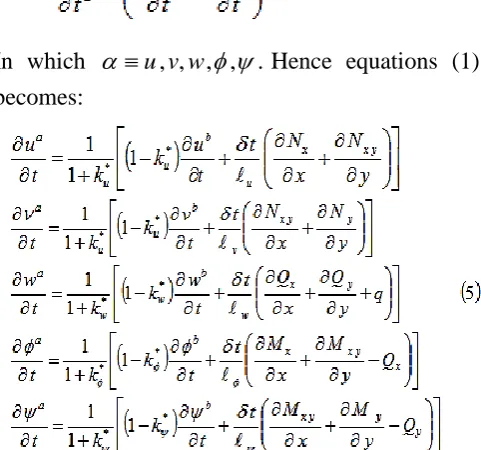
less computations and computer time involved in the present study, the DR method is considered more suitable than the finite element method. The plate equations are written in dimensionless forms. Damping and inertia terms are added to Eqns. (1). Then the following approximations are introduced for the velocity and acceleration terms:
In which u,v,w,,.Hence equations (1) becomes:
In Eqns. (4) and (5) the superscripts a and b refer respectively to the values of velocities after and
before the time stept,
and
k
*
(
1
/
2
)
k
t
1. The displacements atthe end of each time incrementt are evaluated using the following simple integration procedure:
6 tt
b b
a
The complete equation system is represented by equations (5), (6), (2) and (3). The DR algorithm operates on these equations is as follows:
Step 1: set initial conditions (usually all variables are zero).
Step 3: compute displacements from equation (6). Step 4: Apply displacement boundary conditions. Step 5: compute strains from equations (2).
Step 6: compute stress resultants, etc. from equations (3).
Step 7: Apply stress resultants … etc., boundary conditions.
Step 8: check if velocities are acceptably small (say < 10-6).
Step 9: If Step 8 is satisfied print out results, otherwise repeat steps (2 – 8).
VERIFICATION OF DYNAMIC RELAXATION (DR) METHOD USING SMALL DEFLECTION THEORY
The present DR results are compared with similar results generated by other DR and / or alternative techniques including approximate analytical and exact solutions so as to validate the DR program. In the following discussion a wide range of small deflections are dealt with including isotropic, orthotropic, and laminated plates subjected to static uniformly distributed loading scheme. Table (1) shows the variations in the central deflections of a moderately thick isotropic plate
h/a0.1
with simply supported condition (SS1). These results suggest that a 55 mesh over one quarter of the plate is quite enough for the present work (i.e. less than 0.3% error compared to the finest mesh available). In table (2) the comparison of the present DR deflections and stresses with that generated by Turvey and Osman [1] and Reddy [2] is presented for a uniformly loaded plate of thin
i.e. h/a0.01
, moderately thick
i.e. h/a0.1
, and thick laminates
i.e. h/a0.2
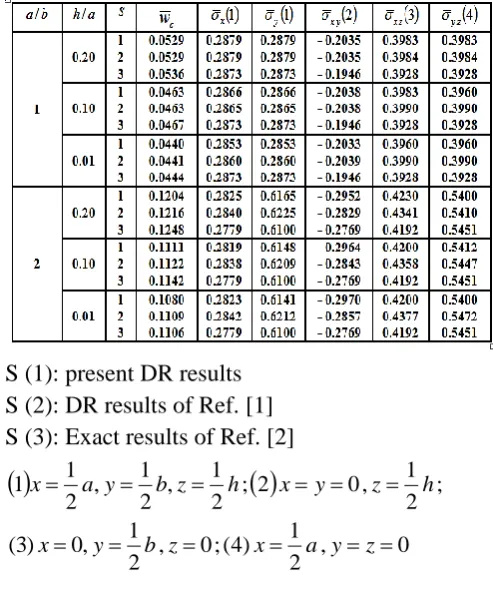
using simply supported condition (SS1). The present DR results of central deflections and stresses showed good agreement with the other results even though the plate is square or rectangle. Another comparison analysis for small deformations of thin and moderately thick square simply supportedisotropic plates (SS1) between the present DR method, and Roufaeil [3] two and three node strip method is shown in table (3). Again, these results provide further confirmation that a DR analysis based on a 55quarter – plate mesh produces results of acceptable accuracy.
In the following analyses, several orthotropic materials were employed; their properties are given in table (4). Exact FSDT solutions are available for plates simply supported on all four edges (SS2). By imposing only a small load on the plate, the DR program may be made to simulate these small deflections. In table (5), the computations were made for uniform loads and for thickness / side ratios ranging from 0.2 to 0.01 of square simply supported in – plane free plates made of material I with
q 1.0
. In this case the central deflections of the present DR method are close to those of Turvey and Osman [4], and Reddy [2]. Another small deflection analysis is shown on table (6), and it was made for uniformly loaded plates with simply supported in – plane fixed condition (SS1) of material II and subjected to uniform loading
q 1.0
. In this analysis, the four sets of results are the same for the central deflections and stresses at the upper and lower surfaces of the plate and also the same for the mid – plane stresses. Nevertheless, the exact solution of Srinivas and Rao [5] is not in a good agreement with the others as far as stresses are concerned. These differences may be attributed to the exact solution theory adopted in Ref. [5].Most of the published literature on laminated plates are devoted to linear analysis and in particular to the development of higher order shear deformation theories. Comparatively, there are few studies on the nonlinear behavior of laminated plates and even fewer are those which include shear deformations. The elastic properties of the material used in the analyses are given in table (4). The shear correction factors
are 52 5/6 2
4 k
In table (7) which shows a comparison between the present DR method and finite element results of Ref. [6] for a simply supported condition (SS3) plate. There are four antisymmetric angle ply laminates of material III which are subjected to a small uniform load
q 1.0
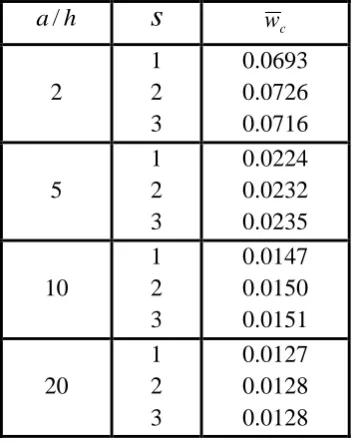
. The central deflections and stresses are recorded for different thickness ratios including thick, moderately thick, and thin laminates. These results are compared with Reddy’s finite element results [6] and are found in a good agreement despite the different theory adopted in the latter case.Another comparison analysis of central deflections between the present DR method, Zenkour et al [7] using third order shear deformation theory and Librescu and Khdeir [8] which are made of material IV are illustrated in table (8). The three results showed a good agreement especially as the length to thickness ratio increases.
Table (1) DR solution convergence results for a simply supported (SS1) square plate subjected to
uniform pressure
3 . 0 1
. 0 / , 0 .
1 h a andv
q
Mesh size
c
w
2
2 0.04437
3
3 0.04592
4
4 0.04601
5
5 0.04627
6
6 0.04629
7
7 0.04638
8
8 0.04640
Table (2) comparison of present DR, Turvey and Osman [1], and exact values of Reddy [2] small deflection results for uniformly loaded simply supported (SS1) square and rectangular plates of
various thickness ratios
3 . 0 , 0 .
1
q
S (1): present DR results S (2): DR results of Ref. [1] S (3): Exact results of Ref. [2]
0 ,
2 1 ) 4 ( ; 0 , 2 1 , 0 ) 3 (
; 2 1 , 0 2
; 2 1 , 2 1 , 2 1 1
z y a x z
b y x
h z y x h z b y a x
Table (3) Dimensionless central deflection of a square simply supported isotropic plate (SS1)
q 1.0,v0.3,k2 0.0.833
h
a/ Present DR Results
3 – node strip Ref.
[31]
2 – node strip Ref. [31]
100 0.00403 0.00406 0.00406
10 0.00424 0.00427 0.00426
Table (5) comparison of present DR, Turvey and Osman [4], and Ref [2] center deflections of a simply supported (SS2) square orthotropic plate made of material I for different thickness ratios when subjected to uniform loading
q 1.0
.Thickness ratio
a h/
Uniform Loading
DR wcpresent
DR wcRef. [4]
exact
wc
Ref. [2] 0.2 0.017914 0.017912 0.018159 0.1 0.009444 0.009441 0.009519 0.08 0.008393 0.008385 0.008442 0.05 0.007245 0.007230 0.007262 0.02 0.006617 0.006602 0.006620 0.01 0.006512 0.006512 0.006528
Table (6) comparison of present DR, Ref. [4], Ref. [2], and exact solutions Ref [5] for a uniformly loaded simply supported (SS1) orthotropic plate made of material II when subjected to uniform loading
q 1.0
a
b/ h/ a S wc x
1
xz
21 0.05 1 2 3 4 0.0306 0.0306 0.0308 0.0308 0.3563 0.3562 0. 3598 0.3608 0.4387 0.4410 0.4351 0.5437 0.10 1 2 3 4 0.0323 0.0323 0.0326 0.0325 0.3533 0.3534 0.3562 0.3602 0.4393 0.4395 0.4338 0.5341 0.14 1 2 3 4 0.0344 0.0344 0.0347 0.0346 0.3498 0.3498 0.3516 0.3596 0.4367 0.4374 0.5328 0.5223 2 0.05 1 2 3 4 0.0629 0.0629 0.0636 0.0636 0.6569 0.6568 0.6550 0.6567 0.6506 0.5637 0.5600 0.7024
0.10 1 2 0.0657 0.0657 0.6566 0.6566 0.5623 0.5628 3 4 0.0665 0.0664 0.6538 0.6598 0.5599 0.6927 0.14 1 2 3 4 0.0692 0.0692 0.0703 0.0701 0.6564 0.6564 0.6521 0.6637 0.5613 0.5613 0.5597 0.6829
S (1): present DR results S (2): DR results of Ref [4]
S (3): Finite element solution Ref [2] S (4): Exact solution Ref [5]
, 02 1 , 0 2 ; 2 1 , 2 1 , 2 1
1x a y b z h x y b z
Table (7) Comparison of present DR, and Reddy finite element results Ref. [6] for
45 / 45 / 45 /45 simply supported (SS3)
square laminate made of material III and subjected to uniform loads and for different thickness ratios
q 1.0
a
h/ s 3
10
c
w x
10.20 1
2
9.0809 9.0000
0.2022 0.1951
0.10 1
2
4.3769 4.2000
0.2062 0.1949
0.05 1
2
3.2007 3.0000
0.2081 0.1938
0.04 1
2
3.0574 2.9000
0.2090 0.1933
0.02 1
2
2.8371 2.8000
0.2063 0.1912
S (1): present DR results.
S (2): Reddy [6] as read from graph. (1)
Table (8) Non – dimensionalized deflections in
three layers cross – ply
0 /90 /0
simply supported (SS1) square laminates of material IV under uniform load
q 1.0
h
a/
s
wc2
1 2 3
0.0693 0.0726 0.0716
5
1 2 3
0.0224 0.0232 0.0235
10
1 2 3
0.0147 0.0150 0.0151
20
1 2 3
0.0127 0.0128 0.0128
S (1): present DR results linear analysis S (2): Librescu L and Khdeir A.A [8]
S (3): A.M. Zenkour, and M. E. Fares [7] results.
CONCLUSIONS
A Dynamic relaxation (DR) program based on finite differences has been developed for small deflection analysis of rectangular laminated plates using first order shear deformation theory (FSDT). The displacements are assumed linear through the thickness of the plate. A series of new results for uniformly loaded thin, moderately thick, and thick plates with simply supported edges have been presented. Finally a series of numerical comparisons have been undertaken to demonstrate the accuracy of the DR program. These comparisons show the following:-
1. The convergence of the DR solution depends on several factors including boundary conditions, mesh size, fictitious densities and load.
2. The type of mesh used (i.e. uniform or graded mesh) may be responsible for the considerable
differences in the mid – side and corner stress resultants.
3. For simply supported (SS1) edge conditions, all the comparison results confirmed that deflection depends on the direction of the applied load or the arrangement of the layers.
4. The DR small deflection program using uniform finite difference meshes can be employed with less accuracy in the analysis of moderately thick and flat isotropic, orthotropic or laminated plates under uniform loads.
5. Time increment is a very important factor for speeding convergence and controlling numerical computations. When the increment is too small, the convergence becomes tediously slow, and when it is too large, the solution becomes unstable. The proper time increment in the present study is taken as 0.8 for all boundary conditions. 6. The optimum damping coefficient is that which produces critical motion. When the damping coefficients are large, the motion is over – damped and the convergence becomes very slow. And when the coefficients are small, the motion is under – damped and can cause numerical instability. Therefore, the damping coefficients must be selected carefully to eliminate under – damping and over – damping.
7. Finer meshes reduce the discretization errors, but increase the round – off errors due to the large number of calculations involved.
ACKNOWLEDGEMENT
REFERENCES
1. Turvey G.J. and Osman M.Y., Elastic large defection analysis of Isotropic rectangular Mindlin plates, International Journal of Mechanical sciences, vol. 22, 1990, PP. 1 – 14.
2. Reddy J.N., A refined non – linear theory of plates with transverse Shear deformation, International Journal of solids and structures, vol. 20, No 9 / 10, 1984, PP. 881 – 896.
3. Onsy Roufaeil, Thanh Tran – Cong, Finite strip elements for laminated composite plates with transverse shear strain discontinuities, composite structures, vol.56, 2002, pp. 249 – 258.
4. Turvey G.J. and Osman M.Y., Large defection analysis of orthotropic Mindlin plates, proceedings of the 12th energy resources technical conference and exhibition, Houston, Texas, 1989, pp. 163 – 172.
5. Srinivas S. and Rao A.K., Bending, vibration and buckling of simply Supported thick orthotropic rectangular plates and laminates vol.6, 1970, pp. 1463 – 1481.
6. Reddy J.N., A penalty plate – bending element for the analysis of laminated anisotropic composite plates, International Journal for numerical methods in Engineering, vol. 15, 1980, PP. 1187 – 1206.
7. Zenkour A.M. and Fares M .E. “Non – homogeneous response of cross – ply laminated elastic plates using a higher order theory”, composite Structures, vol. 44, 1999 pp. 297 – 305.
8. Librescu L. Khdeir A.A. Analysis of symmetric cross – ply laminated Elastic plates using a higher – order theory. Part I
– stress and Displacement”, composite structure, vol. 9, 1988, pp. 189 – 213. 9. Rushton K.R., Large deflection of variable
thickness plates, International Journal of mechanical sciences, vol. 10, 1968, PP. 723 – 735.
10.Cassel A.C. and Hobbs R.E., Numerical stability of dynamic Relaxation methods in engineering, vol. 35, No. 4, 1966, pp. 1407 – 1410.
11.Day A.S., An Introduction to Dynamic Relaxation, the engineer, vol. 219, No. 5688, 1965, pp. 218 – 221.
12.Reddy J.N. A simple higher order theory for laminated composite plates, Journal of Applied Mechanics, vol. 51, No 745, 1984, pp. 745-752.
13.Vuksanovic Dj, linear analysis of laminated composite plates using single layer higher order discrete models, composite structures, vol.48, 2000, pp. 205-211.
14.Vuksanovic Dj, linear analysis of laminated composite plates using single layer higher order discrete models, composite science and technology, 1998, pp. 377 – 382.
15.Putcha N.S. and Reddy J.N., A refined mixed shear flexible finite element for the nonlinear analysis of laminated plates, computers and structures, vol. 22, No.4, 1986, pp. 529 – 538.
16.Reissner E. and Stavsky Y., Bending and
stretching of certain types of heterogeneous
Aeolotropic plates, Journal of applied Mechanics, vol. 28, 1961, pp. 402 – 408. 17.Hui – Shen Shen, large deflection of
composite laminated plates under transverse and in plane loads and resting
on elastic foundation, computers structures,
18.Ji – Fan He, Shuang – Wang Zhang, Symmetric deformation analysis of symmetric laminated plates including transverse shear and normal effects, computers structures, vol. 45, 1999, pp. 205 – 226.
19.Turvey G.J. and Osman M.Y., large deflection effects in anti-symmetric cross ply laminated strips and plates, I.H. Marshall, composite structures, vol.6, paisley college, Scotland, Elsevier science publishers, 1991, pp. 397 – 413.
20.Pagano N. J, Exact solutions for rectangular bi directional composites and sandwich plates, Journal of composite materials, vol.4, 1970, pp. 20 – 34.
21.Taner Timarci, Metin Aydogdu, Buckling of symmetric cross ply square plates with various boundary conditions, composite structures, vol. 68, 2005, pp. 381 – 389. 22.Phan N.D. and Reddy J.N., Analysis of
laminated composite plate using higher order shear deformation theory, international Journal of numerical method in engineering, vol.21, 1985, pp. 2201 – 2219.
23.Reddy J.N. and Chao W.C., Nonlinear bending of thick rectangular laminated composite plates, International Journal of nonlinear mechanics, vol.16, No, 314, 1981, pp. 291- 301.
24.Prabhu Madabhusi – Raman, and Julio F. Davalos, static shear correction factor for laminated rectangular beams, composites: part B, 27B, 1996, pp. 285 – 293.
25.Wang J., Liew K.M., Tan M.J., and Rajendran S., Analysis of International Journal of mechanical sciences, vol. 44, 2002, pp. 1275 – 1293.
26.Damodar R. Ambur, Navin Jaunkey, Mark Hilburger, Carlos G. Davila, Regressive failure analysis of compression loaded
composite curved panels with and without cutouts, composite structures, vol. 65, 2004, pp. 143 – 155.
27.Ying Qing Huang, Shenglin Di, Chang Chun Wu, and Huiya Sun, Bending analysis of composite laminated plates using a partially hybrid stress element with interlaminar continuity, computer and structures, vol. 80, 2002, pp. 403 – 410. 28.Aalami B., large deflection of elastic
plates under patch loading, Journal of structural division, ASCE, vol.98, No. ST 11, 1972, pp. 2567 – 2586.
29.Osama Mohammed Elmardi Suleiman, Verification of dynamic relaxation method in isotropic, orthotropic and laminated plates using small deflection theory, International Journal of Advanced Science and Technology, volume 72; 2014, pp. 37 – 48.
30.Osama Mohammed Elmardi Suleiman, Nonlinear analysis of rectangular laminated plates using large deflection theory, International Journal of Emerging Technology and Research, volume 2, issue 5; 2015, pp. 26 – 48.
31.Osama Mohammed Elmardi Suleiman, Validation of Dynamic Relaxation (DR) Method in Rectangular Laminates using Large Deflection Theory, International
Journal of Advanced Research in Computer
Science and Software Engineering , volume 5, issue 9; September 2015, pp. 137 – 144.
32.Osama Mohammed Elmardi Suleiman, Nonlinear analysis of rectangular laminated plates, Lap Lambert Academic Publishing, Germany, and ISBN: 978-3-659-76787-6; 2015.
33.Osama Mohammed Elmardi Suleiman, Text Book on Dynamic Relaxation
Publishing, Germany, and ISBN: 978-3-659-94751-3; 2016.
34.Osama Mohammed Elmardi Suleiman, Introduction and Literature Review on Buckling of Composite Laminated Plates, Lap Lambert Academic Publishing, Germany, and ISBN: 978-3-659-86387-5; 2016.
35.Osama Mohammed Elmardi Suleiman, Bibliography and Literature Review on
Buckling of Laminated Plates,
International Journal of Science and Engineering, volume 2, issue 8; August 2016, pp. 104 – 112.
36.Osama Mohammed Elmardi Suleiman, Theories of Composite Plates and Numerical Methods Used on Bending and
Buckling of Laminated Plates, International
Journal of Engineering Research And Advanced Technology (IJERAT), volume 2, issue 10; October 2016, pp. 1 –12. 37.Osama Mohammed Elmardi Suleiman,
Dynamic Relaxation Method, Anchor Academic Publishing, Germany, ISBN (eBook) 9783960675846, and ISBN (Book); 2016.
38.Osama Mohammed Elmardi Suleiman Khayal, Convergence and Accuracy of Dynamic Relaxation Technique in Determination of Central Deflection of Composite Rectangular Lamina, Internati- onal Journal of Scientific Research Engineering & Technology (IJSRET), Volume 5, Issue 10, October 2016, pp. 502 – 509.
39.Osama Mohammed Elmardi Suleiman, Deflection and Stress Analysis of Fibrous
Composite Laminates, International Journal
of Advanced Research in Computer Science and Software Engineering (IJARCSSE), volume 6, issue 8; August 2016, pp. 105 – 115.
40.Osama Mohammed Elmardi Suleiman, Imperfection of composite laminated plates,International Journal of Engineering Research And Advanced Technology (IJERAT), volume 2, issue 9; September 2016, pp. 6 –10.
41.Osama Mohammed Elmardi Suleiman, Analysis of composite Laminated Plates, International Journal of Advances in Scientific Research and Engineering (IJASRE), volume 2, issue 8; September 2016, pp. 24 –41.
Author
Osama Mohammed Elmardi Suleiman was born in
Atbara, Sudan in 1966. He received his diploma degree in mechanical engineering
from Mechanical Engineering
College, Atbara, Sudan in 1990. He also received a bachelor degree in
mechanical engineering from
Sudan University of science and
technology – Faculty of
engineering in 1998, and a master degree in solid mechanics from Nile valley university (Atbara, Sudan) in 2003. He contributed in teaching some subjects in other universities such as Red Sea University (Port Sudan, Sudan), Kordofan University (Obayed, Sudan), Sudan University of Science and Technology (Khartoum, Sudan) and Blue Nile university (Damazin, Sudan). In addition he supervised more than hundred and fifty under graduate studies in diploma and B.Sc. levels and about fifteen master theses. He is currently an assistant professor in department of mechanical engineering, Faculty of Engineering and Technology, Nile Valley University. His research interest and favorite subjects include structural mechanics, applied mechanics, control engineering and instrumentation, computer aided design, design of mechanical elements, fluid mechanics and dynamics, heat and mass transfer and hydraulic machinery. He works also as a consultant and a technical manager of Al – Kamali workshops
![Table (6) comparison of present DR, Ref. [4], Ref. [2], and exact solutions Ref [5] for a uniformly loaded simply supported (SS1) orthotropic plate made of material II when subjected to uniform loading q0.1](https://thumb-us.123doks.com/thumbv2/123dok_us/8867898.1812032/8.595.36.280.430.757/comparison-present-solutions-uniformly-supported-orthotropic-material-subjected.webp)