Copyright © The Author(s). All Rights Reserved. Published by American Research Institute for Policy Development DOI: 10.15640/ppar.v7n1a4 URL: https://doi.org/10.15640/ppar.v7n1a4
A Dialogical Interaction Analysis of Security and Developmental Implications of
Farmers/Herdsmen Conflict in Kogi State, Nigeria
Dr. Idakwoji
1, S. P.
Abstract
This research work is an excerpt of the earlier study carried out by this author (Idakwoji, S.P) and three others, Ojomah, B.A, Usman. Y.P. and Orokpo, O.F.E. titled: Farmers/Herdsmen Conflict in Kogi State: Security and Developmental Implications. The data presented in the earlier study formed background information used in this latest presentation. Thus, as a participant researcher, this author used the dialogical interaction analysis of George Herbert Mead and Bakhtin to present the results of the study. The theory of dialogism is premised on the tenet that social world is made up of multiple voices, perspectives and subjective world. Hence, to exist is to engage in continuous dialogue which is the basis for human transformation, fusing with parts of others. The theory of dialogism views humanity as fundamentally indeterminate and unfinalisable, and that human coexistence can only be actualized through a free discursive act and not in predefined context. Hence, dialogue is seen as a fundamental means of a constitutive change. It is on this premise that Lederach (2003) asserted that many of the skill-based mechanisms that reduce violence are rooted in communicative capacities to exchange ideas, find common definitions and move toward solutions. Relying on the premises of dialogism, this study identified the causes of the conflict between farmers and herdsmen in Kogi State, examined the security and socio-economic implications of the conflict on development of the state. The results revealed unique information relating to the perceptions of the conflict groups which provided in-depth understanding of the nitty-gritty of the causes of the conflict in Kogi State. Thus, the results showed that the crux of the conflict centers on the struggle for economic use of land resources by the conflict groups. And that failure of government at all levels as societal regulator and moderator to play its role in terms of provision of stable set of institutional rules to address this crux of the conflict give way to other incidental factors such as deficient/poor policy implementation, ecological/demographic and security related. In order to bring about the much desired peace and harmonious coexistence between farmers and herdsmen, a number of recommendations were proffered amongst others which include the establishment of grazing reserves as interim measure and eventually providing ranching for herds as permanent solution, as well as improved animal husbandry, setting up of Alternative Dispute Resolution Mechanism and declaration of state of emergency on farmers/herders conflict to fast-tract solutions to the crisis.
Keywords: Dialogue, social world, coexistence, reduction of violence, purposeful relationships. Introduction
The herdsmen/farmers conflict in Kogi State, Nigeria in the past few years especially for the last seven years constitute a very great security challenge and threat to peace, stability and socio-economic development of the State. There have been hues and cry of massive killings arising from the conflicts between herders/farmers across various parts of the State.
Notably among the communities are Agojeju-Idaka and Ogane-Enugu in Dekina Local Government Area of Kogi State, Ajichekpa, Opada and Agbenema in Omala Local Government Area of Kogi State and a host of other communities in the state. Other areas affected by the conflict in the North Central Zone include, Benue, Kwara, Nasarawa, Niger, Plateau and the Federal Capital Territory, Abuja, with heavy casualty figures, (Chinweizu, 2015, Abiodu, 2016).
Other parts of the country such as,Ukpabi Nimbo in Uzo-uwani Local Government Area of Enugu State, Oyo, Ekiti, Ondo, Osun, Abia, Anambra, Delta, and Edo states respectively had also experienced the farmers/herders conflicts. Virtually all states in Nigeria have had (or are still experiencing) the herdsmen/farmers conflict, (Abraham, 2017). Various analysts have attributed the causes of the conflicts to different factors, such as fresh water scarcity (Audu, 2013), destruction of crops, water contamination by cattle, zero land for grazing, disregard for traditional authorities (Ofuoku and Isife, 2009). Yet others attributed the conflicts to struggle over control of land resources (Adisa, 2012). Those who see the conflict from land resources control argued on the presumption that farmers belief that they are the traditional owners of the land and belief in the old order which gives them inheritance of land as ancestry hereditary, patrimonial and transmissible and opposed to any unauthorized intrusion on their lands by herders . The herdsmen on their part want free access to any fallow land to graze their cattle and resist the old order of land as ancestry, hereditary and transmissible. Some scholars argued that it is these two conflicting interests by these two critical users of land resources that lead to the conflicts.
The rapid escalation, spread and bizarre dimension that the herdsmen/farmers conflicts have taken in recent time, and the sophisticated nature of the weapons being used as well as the impunity with which the dastardly acts are carried out constitute serious security and developmental challenges to Kogi State, more especially as an agrarian state. Many farming communities in the state have been apprehensive due to the conflict. As rightly observed by International Cooperation and Development (ICD) (2017), instability, insecurity, violence, organized crime not only deter investors, hinder trade, divert public social expenditure and obstruct access to development but also weaken democracy, human rights and the rule of law.
Given the foregoing scenario and the challenges the conflict poses for socio-economic development of Kogi State and Nigeria at large, this study was carried out to identify the major factors responsible for the incessant farmers/herders conflict and its security and developmental implications on the state and proffer solutions.
Objectives of the Study
This study was principally carried out to identify the causes of conflict between herdsmen/farmers in Kogi State. More specifically, the study examined the security and socio-economic implications of the conflict on the development of Kogi State, and proffer remedial solutions to stem the tide of the conflict.
Summary of Literature
Agricultural Development and Nomadic Pastoralism
Nomadic pastoralism is a form of agriculture where livestock, such as cattle, sheep, goats and camels are taken to different locations in order to find fresh pastures. Nomadic pastoralism according to New World Encyclopedia is commonly practiced in regions with little arable land, typically in developing world. The New World Encyclopedia also identified three basic kinds of nomads, namely hunter gatherers, pastoral nomads and peripatetic nomads. Nomadic hunter gatherers have been identified as the original life style of most indigenous people world over as they subsist harvesting seasonally available wild plants and game. Pastoral nomads on the other hand, raise herds and move with them with the intent of not depleting pastures beyond recovery in any one area hence, their continuous movement from place to place; while peripatetic nomads travel from place to place with their major preoccupation of offering trades and services wherever they go. That is why peripatetic nomads are commonly found in industrialized states, while pastoral nomads are commonly found in less developed societies such as Nigeria.
From historical antecedents, nomadism appears to have been the earliest type of human society. However, most such cultures are now extinct with only a few tribes such as Fulani in Nigeria still living with these types of life style. As human societies evolve, different life styles emerged, many of them sedentary rather than nomadic. Thus, the development of modern agriculture, industrialization and national borders have come to change the hitherto life style., (The World Encyclopedia) Pastoral nomadism therefore declined severely in the 20th century for both
Hence, industrialization, developments in systematic and mechanized agriculture, improvement in technology which aided in rapid transformation of societal activities all combined to make nomadism obsolete and incompatible with the evolution of modernity. However, in Nigeria the tribe mostly associated with pastoral nomadism is the Fulani who predominantly engage in cattle rearing.
Causes of Farmers/Herders Conflict in Nigeria
Literatures have shown that conflicts between farmers and herders in Nigeria emanate from various factors ranging from economic, ethno-religious, socio-cultural, to resource control. Literature has shown that the basis of conflict may differ, but it is always a part of human society.
Moritz, (2010) opined that if farmers/herders conflict could be entirely explained by structural factors, we could expect all conflicts in the same stressful context to display not only similar causes, but also similar levels of engagement and violence and similar outcomes that in many instances conflict outcomes under the same conditions result in a wide variety of outcomes. In some countries such as Ghana, crop damages have, on many occasions resulted in wide-spread violence between farmer youths and Fulbe herders (Tonah, 2006, in Ofuoku and Isife, 2009). In Nigeria resource control, especially land resource has been at the centre of the conflict between herders and farmers (Hellstrom, 2001, in Tenuche, 2009). In the same manner, Ruttan and Mulder, (2009) explain farmers/herders conflict in terms of games theory. The theory predicts the circumstances influencing wealthy livestock owners using violence to prevent less wealthy owners from grazing on a particular pasture during dry seasons and used such behaviours as means to trigger communal conflicts, since they (herders) view the entire interaction as a game of survival.
Thus, literatures have revealed that the causes of farmers/herders conflict are complex and multi-dimensional products of structural, resource control and processes which cannot be explained or pinned down solely in terms of one or two factors. Therefore, a general theory of farmers/herders conflict must be situated both in structural, processual and resources variables (Noordoyn, (2005). While structural variables are necessary in explaining the causes, processual variables can explain the outcomes. The underlying structural reasons for farmers/herders conflict have therefore arisen due to demise of the symbiotic relations between herders and farmers across West Africa, (Barrot, (1992). Barrot further observed that as livestock ownership among farmers has increased, they no longer need manure contracts. Moreover, farmers now compete directly with herders for grazing lands which have been slowly disappearing due to population growth and expansion of agriculture. The competition over these scarce resources therefore leads to the escalation of the farmers/herders conflicts.
Other factors that have contributed to the escalation of conflict between farmers and herders in Nigeria as revealed in literature include increases in the herder‟s sizes due to improved conditions of cattle and climate change which put more pressure on the land (Isah, 2012). Other studies also identified the breakdown of traditional social ties which has brought about the disappearance of the symbiotic ties between headers and farmers as one of the causes of the conflict, coupled with the abuse of traditional host/stranger relationships (Seddon and Sumberg, 1997). Again, another school of thought attributed the conflict to climate change and poor climate governance which has pushed the herdsmen from the core north to look for greener pastures in the Middle Belt and other regions in the South (ICG, 2017). The common point of convergence in literature is that farmers/herdsmen conflicts cannot be attributed to or situated in one or two factors. Hence, the multidimensional factors responsible for the causes of the conflict.
Security and Developmental Challenges of Farmers/Herders Conflict
Incessant conflict between farmers and herdsmen across various parts of the country in the recent past has become a very serious and devastating security and developmental challenge to the country. A situation, which is gradually becoming hydra-headed.
This had started brewing in many parts of Nigeria, as ethnic leaders were indicating intents to form militia groups to defend their communities (the Source, 2014; Vanguard, 2016, ICG, 2017). The common point of agreement among scholars according to Abraham, (2017) resonates with the widely held opinion that traces the background of Fulani herders to Futa Jalon in the present day Guinea. The innate behavior of the Fulani herders from Futa Jalon as literatures revealed was that they initially settle down for grazing as strangers in unused space of lands and after some time, they breach pre-existing security protocols and order and would move to conquer any less powerful land owners and tribes, (Mandal, 1990; Sotunde, 2016). This behavior trait according to Sotunde, (2016), is still characteristic of Fulani herders in Nigeria which has consistently defined their strategy by firmly occupation of a given space of land before hostilities across hinterland communities in Nigeria. Another area of convergence among scholars and researchers has been the militant nature of Fulani herders which was partly blamed on Soninka (Torodbe) Muslim Fulani herdsmen, (Tordoff and Fage, 2013). History has shown that early Fulani herders did not oppose or challenge their landlords‟ rights to impose tax on lands allocated to them for grazing, but it was Soninka who considered such tax as high and gradually instigated the Fulani herders against Jalonke hosts, (Tordoff and Fage 2013). Literature has shown that the Fulani herdsmen that migrated to Nigeria were already familiar with the act of organized mercenary fighting force which was what they applied during Uthman Danfodio‟s Jihad War in Northern Nigeria (Spring, 1993). This mercenary approach had been consistently used in different places across Nigeria by herders on host communities. A typical example, according to Emeni (2012), is the study of crisis in Batern in Riyon Local Government Area of Plateau State. The same mercenary approach was said to have been used by the Fulani herders in their conflict with Nimbo community in Uzo-uwani Local Government Area of Enugu State in 2016 (Sandra and Oyiyepo, 2016), as well as Benue and Kogi States, {Olaniyi and Akubo, 2018).
From available literature, it has been observed that between 2011 to 2016, herders/farmers conflict have occurred in virtually all states of the federation, including Kebbi State which had only one of such conflict in 2014, (S.B. Morgan Intelligence Reports, 2016) corroborated by Abraham (2017). Thus, the security threat posed by herdsmen/farmers attacks in various parts of the country may create a hydra – headed security challenge that may be more devastating than Boko Haram crisis if not tackled early enough because of its spread (Asabo, 2017). The spread of the attacks as reported by Abraham (2017) indicated that nearly all states of the country are facing this challenge which is a time bomb that must be proactively tackled to prevent explosion.
Socio-Economic Implications of the herders/farmers Conflict
The Socio-economic implications of herders/farmers conflict include reduction in output and income, disease outbreak, loss of lives and property, loss of livelihood opportunities, loss of houses, (Ofuoku and Isife (2009). Other socio-economic implications include displacement of communities, refugee problems, increase in crimes, famine, malnutrition, illnesses and death. The conflict also has substantial economic effect on government revenues. As reported by Mercy Corps (2015), the Federal Government of Nigeria was losing about $13.7 billion revenue annually as a result of farmers/herders conflict in Benue, Kaduna, Nasarawa, and Plateau States, while the affected States were also losing about 47% of their internally generated revenues annually. The consequences of herders/farmers conflict on the economy, according to Dulta and Husain, (2009) include driving out of foreign investors, decrease in availability of productive labour and diminished skilled manpower, resulting in poverty, underdevelopment, unemployment and misery.
Research Methodology
Research Design. This study is a survey research Study Area
Sources of Data Collection
The data for this study were generated from primary and secondary sources.
The primary data were obtained direct from the subjects selected for the study using dialogic interaction approach, while the secondary sources comprised information obtained from documented sources such as text books, journal articles, bulletins, inter-net and other documented sources.
Instruments for Data Collection: Interview was the major instrument used for primary data collection in this study. The interview was conducted with semi structured guided study questions. The services of interpreters/translators were employed where necessary.
Population of the Study
The population of the study was drawn from the entire farmers and cattle breeders (herders) who constitute the primary conflict groups and other secondary respondents in the study area. The population framework was drawn from all registered herders with Miyetti Allah Cattle Breeders Association of Nigeria, and all registered farmers with the Farmers Registration Council of Nigeria in the study area. Secondary respondents were drawn from traditional rulers, community leaders and security agents; the Nigeria Police, Nigeria Security and Civil Defense Corps (NSCDC), and the State Security Service, (SSS) within the areas of the study.
Population Sampling Techniques
The techniques used in sampling the population for the study were the critical case and maximum variation sampling methods. The methods were deemed more appropriate for this study because of the peculiar characteristics of the subjects studied.
Method of Data Presentation and Analysis
The data collected in this study were presented and analyzed using qualitative and quantitative methods. The qualitative method employed was the dialogical interactive analysis approach as propounded by George Herbert Mead and Bakhtin (1931). The major objective of dialogism is to create an atmosphere of active listening and emphatic understanding with a view to preventing misunderstanding and to make a rapport in all the situation of dialogue. This approach enabled the researchers to get to know the characters and their emotions. Thus, dialogical approach closely analyses utterances or actions for their embedded communicative significance (Hermans and Dimaggio, 2007). The quantitative method employed Statistical Package for Social Sciences (SPSS) version 16. Thus, descriptive statistics was used to analyze the data with a bench mark of 3.5 (upper limit of mean of 3.00) as the decision rule; while chi-square was used to test the significance level of the responses so as to determine the strength of the responses for causal relationships.
Theoretical Framework of Analysis
The framework of analysis used in this study was based on the theory of dialogism as propounded by George Herbert Mead and Bakhtin, (1863 – 1931). The theory is premised on the tenet that social world is made up multiple voices, perspectives and subjective world. It is based on the result of egalitarian dialogue which different people provide arguments based on validity claims as opposed to power claims, (Mandelker, 1995). The dialogic work, according to its proponents, carries on a continual dialogue with other works and does not merely answer, correct, silence or extend previous works, but inform and is continually informed by previous works, corroborating Eliot (1965) who held that the past should be altered by the present as much as the present is directed by the past.
The major objective of dialogism is therefore to create an atmosphere of active listening and emphatic understanding with a view to preventing misunderstanding and to make rapport in all the situations of dialogue with a view to knowing the characters and their emotions.
Dialogical interaction analysis reveals the socio-psychological characteristics of a person or group of persons. Hence, dialogical analysis is an interpretative methodology which closely analyses utterances (written or spoken) for their embedded communicative value. It enables the researcher to understand how the respondents think about themselves, their perceptions of each other as well as about other third parties (such as government and its officials) who have some roles to play in relation to their issues.
Thus, the focus of dialogical analysis goes beyond the question of how people speak and what they say. It uses
dialogue as a metaphor for understanding phenomena beyond communication itself (dialogical self) internal dialogues, self-talk, misunderstanding, trust and distrust, knowledge production and relations between groups in society, Markova and Gollespie (2007), Gollespie and Cornish (2014). Dialogue is mainly aimed at driving at comprehension and mutual understanding.
This theory is very apt for the analysis of this study as it shows that to coexist entails continuous dialogues; which serves as the major instrument for fussing with others and achieve the desire of human transformation for peaceful coexistence.
Data Presentation and Analysis
This section of the study focused on the presentation and analysis of data collected and to draw findings there from. For clarity of purpose, the objectives of the study have been restated thus:
1. The study was set out to identify the causes of farmers/herders conflicts in Kogi State.
2. Examine the security and socio-economic implications of the conflict on development of the state. 3. Proffere remedial measures to stem the tide of farmers/herders conflict in Kogi State.
Social Characteristics of Respondents
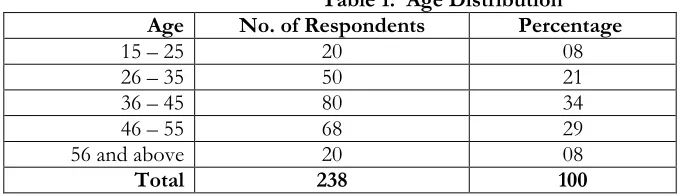
Table 1: Age Distribution
Age No. of Respondents Percentage
15 – 25 20 08
26 – 35 50 21
36 – 45 80 34
46 – 55 68 29
56 and above 20 08
Total 238 100
Table 1 above, 20 respondents, which represent 8% are within the age range of 15 – 25, 50 respondents (21%) are in the age bracket of 26 – 35 years, 80 respondents representing 34% are within the ages of 36 – 45, 68 respondents (29%) fall within the ages of 46 – 55, while 20 respondents (08%) are 56 years and above. The foregoing analyses have shown that the respondents are predominantly people within the productive ages.
Table 2: Marital Status
Marital status No. of Respondents Percentage
Married 209 88
Single 10 04
Divorcee 08 03
Widow 11 05
Total 238 100
Table 3: Sex Distribution
Sex No. of Respondents Percentage
Male 218 92
Female 20 08
Total 238 100
Table 3 shows that 218 (92%) of the respondents are male while 20 (08%) are female. The analysis shows that males are the dominant people in both farming and cattle rearing activities in Kogi State.
Table 4: Educational Level Distribution Educational
Qualification Farmers, Traditional Rulers/Community Respondents
Leaders/Security Agents % Cattle Breeders %
Degree/HND 30 17 03 05
ND/NCE 42 23 17 29
WASC/WAEC O/L 85 47 30 51
FSLC 22 13 09 15
Total 179 100 59 100
In the educational level distribution, 30 (17%) of the respondents are farmers, traditional rulers, community leaders and security agents have either first degree or HND while 3 or 5% of the herders/cattle breeders have same qualifications. Again, 42 or 23% of the farmers, traditional rulers, community leaders and security agents possess either ND or NCE, 17 or 29% of the herders/cattle breeders/breeders possess the same ND or NCE. 85 respondents or 47% of the farmers, traditional rulers/community leaders and security agents have WAEC certificate. 30 respondents or 51% of the herders/cattle breeders possess WAEC certificate. Finally, 22 respondents or 13% of the farmers and their categories have FSLC, while 9 respondents or 15% of the herders/cattle breeders have FSLC. This analysis shows that majority of the respondents have basic Western education for effective communication in English Language.
Table 5: Occupational Distribution
Occupational/Role No. of Respondents Percentage (%)
Farmers 130 55
Cattle breeders/Herders 59 24
Traditional Rulers 14 06
Community Leaders 14 06
Security Agents 21 09
Total 238 100
In the occupational distribution, 130 or 55% of the respondents are farmers, 59 or 24% of them are herders/ cattle breeders, 14 or 6% are traditional rulers, another 14 or 6% of the respondents are community leaders while 21 or 9% of the respondents are security agents.
Causes of Farmers/Herders Conflicts
Table 6: Causes of farmers/herders conflicts (farmers, community leaders and traditional rulers perception).
Table 6 below shows the mean score and SD of the causes of farmers/herders conflict in Kogi State as perceived by the farmers, traditional rulers and community leaders.
Perceived Causes Mean SD Remarks
Crop destruction by herds 3.6 .56736 Major factor
Violation of grazing agreement 3.5 .88464 Major factor
Refusal to pay compensation by herders 2.8 1.21277 Insignificant factor
Indiscriminate grazing by herdsmen 3.6 .58330 Major factor
Destruction of water sources by herds 3.7 .61098 Major factor
Cattle killing by farmers 2.0 1.22887 Insignificant factor Reprisal attacks due to poor dispute
resolution 3.7 .61098 Major factor
Over grazing on fallow lands 3.7 .57161 Major factor
Violent reaction to dispute by herdsmen 3.7 .55642 Major factor
Violent reaction to dispute by farmers 3.2 .90907 Insignificant factor
Rape of women by herdsmen 2.1 1.23940 Insignificant factor
Poor handling of dispute by security
agencies 3.6 .56736 Major factor
Inadequate capacity of security agents 3.5 .79302 Major factor
Soil degradation and land scarcity 3.5 .82198 Major factor
Politicization of dispute/conflict 3.7 .5542 Major factor
Ethno-religious divide 2.8 .122591 Insignificant factor
Population growth of human and herds 3.5 .88580 Major factor
Climate change 3.5 .88464 Major factor
Changing patterns of farming/grazing 3.5 .88565 Major factor
Inadequate institutional framework for
dispute resolution 3.5 .73333 Major factor
Lack of proper understanding of grazing
desire by traditional rulers 3.5 .79302 Major factor
Table 7: Causes of farmers/herdsmen conflict (herders perspective)
Causes Mean SD Remarks
Crop destruction 3.3 1.17444 Fairly significant
Refusal to pay compensation 2.8 1.21276 Insignificant
Refusal by farmers to allow free grazing 3.6 .61636 Major factor
Restriction by farmers to water sources for cattle use 3.6 .61636 Major factor
Cattle rustling 2.9 .93631 Insignificant
Cattle killing by farmers 2.4 .94253 Insignificant factor
Farming on grazing reserves/routes 3.0 1.16695 Not too significant
Inappropriate demarcation of grazing lands 3.6 .48290 Major factor
Violent reaction to dispute by farmers 3.4 .87333 Not too significant
Violent reaction to dispute by herders 3.2 .90907 Not too significant
Poor handling of dispute by security agencies/other constituted
authorities 3.5 .81733 Major factor
Inadequate institutional framework for dispute resolution 3.5 .81733 Major factor
Rape of women by herdsmen 2.0 1.17444 Insignificant factor
Climate change affecting range land 3.6 .62343 Major factor
Population increase of human and herds 3.7 .75139 Major factor
General development activities affecting land 3.5 .81733 Major factor
Ethnic and religious differences 2.2 1.25037 Insignificant factor
Politicization of farmers/herders conflicts 3.5 .75100 Major factor
Lack of capacity of security agents to provide security 3.5 .70400 Major factor
Reprisal attacks due to poor dispute resolution 3.5 .65050 Major factor
Lack of clear policy on grazing land 3.5 .65319 Major factor
Traditional rulers do not always understand the grazing desires
of herders 3.5 .67907 Major factor
Changing patterns of farming/grazing 3.6 .62343 Major factor
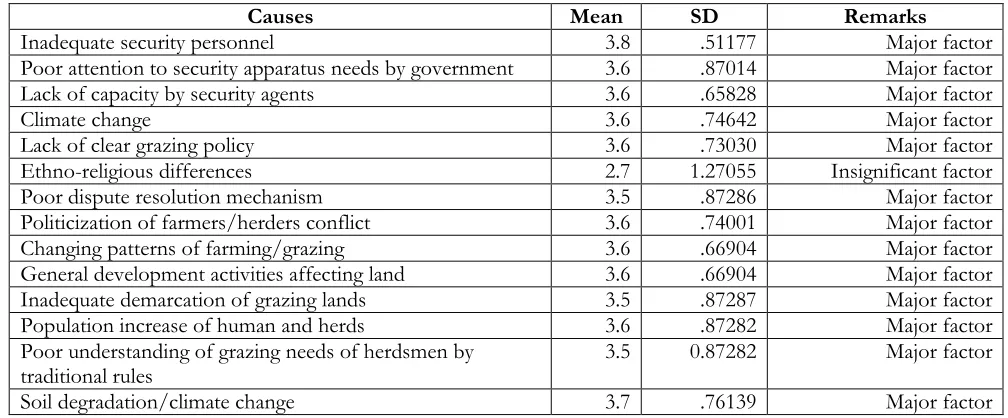
Table 8: Causes of escalation of farmers/herders conflicts (security agencies perspective).
Causes Mean SD Remarks
Inadequate security personnel 3.8 .51177 Major factor
Poor attention to security apparatus needs by government 3.6 .87014 Major factor
Lack of capacity by security agents 3.6 .65828 Major factor
Climate change 3.6 .74642 Major factor
Lack of clear grazing policy 3.6 .73030 Major factor
Ethno-religious differences 2.7 1.27055 Insignificant factor
Poor dispute resolution mechanism 3.5 .87286 Major factor
Politicization of farmers/herders conflict 3.6 .74001 Major factor
Changing patterns of farming/grazing 3.6 .66904 Major factor
General development activities affecting land 3.6 .66904 Major factor
Inadequate demarcation of grazing lands 3.5 .87287 Major factor
Population increase of human and herds 3.6 .87282 Major factor
Poor understanding of grazing needs of herdsmen by
traditional rules 3.5 0.87282 Major factor
Soil degradation/climate change 3.7 .76139 Major factor
Security Implications
Table 9: Security implications of farmers/herders conflicts
Security Implications Mean SD
Loss of human lives 3.6 .73775
Stresses security agents 3.6 .8535
Leads to development of militancy 3.6 .7632
Heightens tension in the state 3.6 .70988
Creates instability 3.5 .78344
Leads to infiltration of criminals from external forces 3.6 .73775
Creates ethno-religious suspicion 3.7 .7377
Leads to arms proliferation/arms running 3.6 .83459
Socio-Economic Implications
Table 10: Socio-economic implications of farmers/herders conflicts
Socio-economic Implications Mean SD
Disruption of economic activities 3.8 .51603
Loss of livelihood opportunities 3.6 .78122
Loss of property 3.7 .67684
Increase in poverty and diseases 3.5 .89339
Traumatizes the people 3.6 .83407
Leads to migration 3.5 .84442
Loss of revenue to government 3.5 .93570
Strains farmers/herders relationships 3.7 .53888
Leads to closure of schools/dropouts 3.6 .69048
Stresses government resources 3.5 .78439
Leads to individual/group frustration 3.6 .75292
Desired Remedies
Table 11:This table shows the preferred desired remedies to the conflict as perceived by the conflict groups (farmers/herders).
Desired Remedies Mean SD
Establishment of grazing reserves /Establishment of ranches 3.7 .67816
Continuous use of open grazing 1.4 1.02497
Use of judicial/legal dispute resolution 1.8 1.13231
Use of Alternative Dispute resolution method 3.6 .95353
Strengthen capacity of security agents 3.6 .70692
Effective intelligence network of locals and security agencies 3.6 .7032
Definite policy on grazing lands 3.6 .74816
Formation of standing committees of stakeholders to dialogue and
constantly review strategies for harmonious coexistence 3.6 .74730
Quick response to early warning signals by governments 3.6 .74283 Adequate awareness to stakeholders on any policy initiative before
implementation 3.5 .84513
Curbing illegal arms proliferation 3.7 .55229 Results
From the analysis of the data collected in this study, it has been found that the causes of farmers/herders
conflict in Kogi State and indeed, Nigeria are myriad but the crux of the conflict centers on economic use of land resources. This has been discovered to be the major trigger of the conflict which metamorphosed into other incidental factors which are: 1. PoliPolicy framework factors
2. Deficient response/poor policy implementation factors 3. Ecological/environmental factors, and
4. Security related factors
Security implications of the farmers/herders conflicts include loss of lives, overstressing of security agencies, encouraging the development of militancy, and arms proliferation/arm running, creating suspicions and making the state tensed and volatile.
The social and economic implications of the conflict as the study revealed include economic stagnation, loss of livelihood opportunities, loss of revenues to government, food shortages and hunger, increased poverty, school closures and dropouts among the school children.
Discussion of Results, Conclusion and Recommendations. Economic Use of Land Resources Factors
This study revealed that factors relating to economic use of land resources have been the crux of the causes of the conflict between farmers and herdsmen. The major areas of interest to the conflicting groups which centered on land use and accessibility include crop destruction by herds; indiscriminate grazing on farm lands, destruction of water sources, overgrazing on fallow lands, restriction to free grazing on land, restriction to water sources for cattle use and obstruction to free grazing on fallow lands. The findings of this study also validates the earlier study by Zayyad (2018) who found that the present conflict between herdsmen and farmers in Nigeria could be termed „resources war‟ - land and access to it, though politics, tongue and faith have crept into it, if land issues are resolved, the conflict fizzles out. Thus, we can conclude that the major factor that is the trigger of the conflict is the struggle over the control and use of land resources for purpose of economic benefits. The two groups (farmers and herders) see land resources as their main sources of livelihood and survival and oppose to anything that does not give them easy access to land. .In the dialogue between this research team and the respondents, emphasizes of the respondents was on the desire to have access to adequate land for their respective uses as the matter that was all encompassing in the minds of the conflicting groups. Thus, it was found that the major trigger of the conflict is land and its availability
for economic value to the conflicting groups. If the issue of access to land can be resolved, conflict between farmers and herdsmen in Nigeria will whittle down.
Policy Framework Factors
The set of factors regarded as policy framework related are inadequate institutional policy framework for conflict resolution, lack of clear policy on grazing lands in the State, lack of or inappropriate demarcation of grazing lands, and lack of proper understanding of the grazing desires of herdsmen by traditional rulers who usually give lands to herdsmen for grazing settlement. .The interaction of this research group with the various critical stakeholders revealed that both Federal and State Governments have not provided any policy framework which clearly demarcate or designate certain portions of land exclusively as grazing lands/reserves or routes in the State. This makes it difficult for herders to lay claim to any portion of land exclusively meant for grazing purposes, leading to competition between farmers and herders on the available lands.
This was also vividly captured in the International Crisis Group Report (2017) where it was observed that most of the 415 grazing reserves established by the then Northern Regional Government in the 1960s had since been overtaken by development or lost to changes in the structure of government. Out of the so-called 415 grazing reserves, only 114 were said to be formally documented/demarcated but the government did not or failed to put up any legislative framework providing for the exclusive use of the said lands for grazing or prevent any encroachment. Thus, such lands have been utilized for other development programs and projects, shrinking the available lands for farming and grazing. The interaction of this research group with respondents also revealed that traditional rulers who release lands to herdsmen for grazing settlement do not fully understand the enormity and complexity of grazing desires of the herdsmen before accepting them for settlement. This was clearly explained by community leaders, traditional rulers and security agents who noted that in most cases grazing agreements between the traditional rulers and the herdsmen are violated as a result of lack of definite boundaries where cattle graze.
Deficient Response Factors
The factors included in this category are, poor handling of disputes by constituted authorities, politicization of farmers/herders conflict and inadequate capacity of security agents to handle crises emanating from farmers/herders conflict. The study found from the dialogical interactions that constituted authorities handling farmers/herders conflict have not been able to bring about the much desired settlement and peace because the authorities involved in dispute management most of the times fail to honesty and sincerely manage disputes, which most times escalate into conflict situation. Interview conducted among farmers and herders revealed that failure to resolve disputes to the satisfaction of the disputants (dispute groups) always degenerate into conflict. As explained by the duo – conflicting groups, they accused the constituted authorities such as Police, Civil Defense, and Court of turning disputes between farmers and herders into avenue to make money and cause more confusion as justice was more on sale to the „highest bidder‟ rather than genuine desire to settle disputes with a view to arriving at amicable resolution. The poor handling and mismanagement of disputes always lead to bottled up grievances.
The respondents lamented that when disputes are reported to security agencies/constituted authorities, they fail to tackle the dispute with transparency. The lack of transparency and mismanagement by the dispute managers always lead to bottled up grievances which usually result into reprisal and counter reprisal attacks.
The dialogical interaction of this research group with the conflict groups (farmers and herders) further revealed that farmers/herders conflicts have been turned into political issues by the political class at various levels, Federal, State and Local Government. The two conflict groups accused the political class (the people in government) at various levels of having little or no regard for both farmers and herdsmen as they (political office holders) tend to look at the farmers and herdsmen as “commoners” whose interests are not of significant value, can be ignored, sidestepped or sidelined. The conflict groups saw the approach of government to the solution of farmers/herders conflicts as too paternalistic, without due consultations with the critical stakeholders before decisions affecting them are reached, and that even when decisions are made they are more of political propaganda without concrete actions.
This situation made the farmers and herders believe that people in political offices are only playing politics with the issues affecting their means of livelihood, thus, creating avenue for survival of the fittest. The political manipulation of herders/farmers conflict was succinctly captured by Olorode (2018), when he noted that because of the class war, both the ruling class and their media insist on ethno-religious rather than a class rendition of the issue of herdsmen/farmers conflict. Olorode noted that the preferred rendition by the ruling class deepens the crisis as the contending groups try to criminalize one another without genuine attempt to resolve the conflict itself.
Incidental Factors
These are factors that are not directly linked to farmers or herdsmen, but contribute to the escalation of the conflict.
Rural Banditry
It was found that rural banditry in the northern region/states which started over the past two decades with little or no commensurate security match has led to the spillover of such atrocities to other parts of the country, especially the Middle Belt Region and Kogi state with mounting audacity. The inability of the Federal/State Governments to tackle the challenge of rural banditry with decisive actions has emboldened banditry and become a major contributory factor and driver of herders/farmers conflict .Dialogue with the respondents revealed that bandit elements which have become institutionalized in the northern region snowballed into Kogi State and have become ready and willing tools for use for any criminal activities, such as, hired mercenary in the hands of conflict groups. The activities of bandits therefore pose a great threat and challenge to national security.
Ecological/Demographic Factors
Other factors incidental to the crisis relating to ecological/demographic include soil degradation, climate change, general development activities affecting land, changing patterns of farming/grazing, population increase and its attendant consequences which the study found, had been well documented over the years but government at all levels failed to respond to these early warning signals affecting farm/range lands. The study found from both literature and dialogue with the respondents that the Nigerian government has neglected policy on soil governance which requires collaboration between governments (Federal, State and Local Authorities), industries and citizens to ensure implementation of coherent policies and encourage practices that regulate the usage of land resources and promote sustainable land management/development, as rightly observed by Bonn (2011). In the European Union‟s environmental policies, soil is recognized as a non-renewable resource, but its governance is to be maintained at a national level.
Thus, the finding of this study also corroborated the Crisis Group Report (2017) which noted that the Meteorological Agency reported in 2008 that over the preceding 30 years, the annual rain season in Nigeria dropped from an average of 150 to 120 days, turning over 350,000sq km of already arid region into deserts or desert-like conditions, due to drought and desertification. The said Report indicated that estimates suggested that 50 – 75 percent of land areas in core north of Bauchi, Borno, Gombe, Jigawa, Katsina, Kano, Sokoto, Yobe, Kebbi and Zamfara States were becoming desert, forcing numerous pastoralists to migrate to the Middle Belt and Southern regions. Despite this report, government failed to take any proactive measures thus, this has triggered increasing competition and dispute over the use of land resources between sedentary farmers and herdsmen.
Hence, ecological and demographic related factors such as climate change, desertification, population increase of human and herds, general development activities affecting land, changing patterns of farming/grazing generally brought more pressure on the use of land resources. These environmental factors have also led to the loss and inadequacy of grazing lands in the hitherto areas where herders were using for grazing making the competition sterner
and stiffer. These „warning signals‟ were well documented and reported by researchers but the poor response rate of
Porous nature of Nigerian Boarders
The study found that the porous nature of the county‟s boarders contribute immensely to the infiltration of foreigner herdsmen into the country. This has been attributed to ECOWAS Treaty on Free movement of goods and services. This was equally acknowledged by the Nigerian President.
Security implications of farmers/herders conflicts
The study revealed that farmers/herders conflict have a number of security implications which impinge on the security architecture and development of the state and the nation at large, as any challenge in any part of the country has negative impact on the overall security architecture of the nation as a systemic entity.
Such implications as found in this study include loss of human lives. This has a very devastating and catastrophic effect on the psyche of the people which cannot be easily forgotten as any loss of family member creates a permanent damage in the life of the people. For instance, it was reported that not fewer than 904 persons were killed violently across eight states of Nigeria between January 1, 2018 and April 25, 2018 due to farmers/herders crises. The eight states were Benue, Adamawa, Kaduna, Kwara, Kogi, Nasarawa, Plateau and Taraba (The Eagle Online, 2018). Such reported incidents are not only bizarre, but devastating and no doubt, impact negatively on the psyche of the residents.
Another security implication of the farmers/herders conflict as revealed in this study is that it stresses the Nigeria security agents. This was due to lack of capacity of security agents to respond adequately to the security challenges they encounter on daily basis. Dialogue with respondents revealed that apart from farmers/herders conflict, security agents face other security challenges such as rural banditry, cattle rustling, political brigandage, robbery, kidnapping and other violent crimes which have become common in many parts of Kogi state in particular thus overstressing the fragile capacity of security agents.
Yet, another security implication emanating from the conflict is that it encourages the development of militancy across the state. It was found from the interactions of this research group with the respondents that various localities where these conflicts have taken place have developed the attitude of self-defense, while other neighbouring communities prepare in advance to react to any such challenge. This state of affairs encourages the development and formation and militia groups in various parts of the state, which portends security threat to the state and the nation at large. Findings of this study also corroborated the report in the Sources, March 31, (2014), Vanguard, April 27, (2016) and International Crisis Group Report, (2017) respectively, where it was reported that militia groups are being raised in various parts of the country where farmers/herders conflicts persist.
The study also found with nostalgia that farmers/herders conflicts which have spread to many parts of the state heighten tension in the state and makes the state volatile. The volatility arising from the tensed situation in the state has created a state of suspicion between the farmers/indigenous people and the herdsmen, which has led to ethnic/religious suspicion between the farmers/indigenous people and the herdsmen. Thus, peaceful co-existence between farmers/herders has been threatened. The dialogical interactions between the researchers and respondents revealed that the suspicion was derived from the fact that cattle rearing in the state is predominantly in the hands of one ethnic group, the Fulani, who are mostly Muslims. This has led to suspicion of plan of ethnic domination by the Fulani group. This is where the hypothesis of cynical plan of domination by Fulanis and Islamise the people emanated from, but this insinuation has not been proved by any scientific evidence, and therefore cannot be substantiated.
Dialogue with the farmers/herders revealed that the conflict create opportunity for infiltration of criminals from external forces into the state. This had arisen due to mercenary hiring by the conflict groups who engage the services of hired mercenaries to fight their courses. The interaction of this study group with the conflict groups exposed us to the fact that hired mercenaries are mostly criminals from external forces who exploit the opportunity of their understanding/familiarity with the conflict environments to infiltrate the communities and perpetuate other criminal acts such as kidnapping, cattle rustling, robbery etc, which have become recurring decimal in Kogi State.
The efforts of the security agencies to mop up such illegal arms have not yielded the desired results, especially due to lack of political will and political interference. The study further found that politicians‟ interference with the affairs of the security agencies to mop up illicit arms in the state made it impossible for the security agencies to carry out their constitutional duties effectively as some people in the state with illegal arms are regarded as „political loyalists‟ of the powers-that-be and have become “the untouchables, or sacred cows”.
More worrisome is the country‟s dysfunctional law enforcement and criminal justice system which failed to arrest and prosecute any of the perpetrators of these crimes. This singular act and other related political interferences made it difficult for security agents to carry out their duties more diligently.
Socio-economic implications
The socio-economic implications of the farmers/herders conflicts include disruption of economic activities, loss of livelihood opportunities and property. This state of affairs had arisen from frequent attacks on farming communities which have made it impossible for the farmers to go about their normal farming businesses which formed the bulk of their means of economic survival and livelihood.
Farmers lamented that at any attack either by herdsmen or herds, their crops are destroyed, homes are burnt and property worth millions of Naira are either destroyed or carted away. This situation had led to some inhabitants deserting their homes and become displaced persons leading to increased poverty and diseases in the state.
Apart from the farmers, the herdsmen also had suffered some economic losses due to the conflict. The interview conducted with the herders stakeholders revealed that herders also lost some herds and valuable items anytime crisis occurs. The herders also lamented that the crises prevent them from settling down to face their grazing activities and has made them to be dislocated physically and psychologically.
The above situations, according to the conflict groups, brought about strained relationships between farmers and herders leading to individual and group frustrations, culminating into food shortages and hunger in the state. This state of affairs also affect the general economic activities of the state as investors, both local and foreign are scared to invest in the state.
In addition to socio-economic implications on farmers and herders, the conflicts also have some economic implications on government which include loss of revenue to government. The disruption of economic activities arising from the impact of the conflict on farmers and herders has led to diminishing revenue accruable to the state government from these sources of revenues. Kogi State is an agrarian state and generates a substantial percentage of its internally generated revenue from agricultural produce. The Kogi State Government proposed to generate 15% of its internally generated revenue in 2018 from agriculture (Agro Nigeria, 2018). Stakeholders lamented that the proposal to boost the IGR by 15% in 2018 from agriculture would be a mirage if the farmers/herders conflicts are not properly tackled as the areas of focus of government for such produce which include cashew, rice, cassava, sugarcane, sesame seeds and other crops would be difficult to attain in the face of the crisis situation which affect the sources of production. As rightly observed by Okigbo (2016), farmers/herders conflict if resolved can produce a gain of up to $13.7bn annually to Nigeria, quoting a study by Mercy Corps, which reported an average of 47% loss in taxes in the Middle Belt zone. This also corroborated the Governor of Benue State, Samuel Ortom who said that Benue State lost N95 billion to herdsmen attacks between 2012 – 2014 (Uja and Ehikioya, 2017).
Recommendations
1. The Federal Government, through the instrumentality of National Assembly should enact a new and definite policy on the use of land resources as it relates to grazing lands and general animal husbandry.
2. As a temporary measure, grazing lands should be acquired and clearly demarcated in selected areas in the state where fallow lands exist for cattle grazing. This measure becomes necessary to restrict cattle roaming until ranches are established in selected designated areas. This should be for a maximum period of four years preparatory for establishment of ranches. Adequate consultations must be made by the government with the critical stakeholders in communities where there are sufficient fallow lands which must be with the consent of traditional custodians of the land and community leaders before establishing the grazing lands.
engage in dialogue and sensitization with the cattle breeders to educate them on benefits of ranching over roaming cattle/open grazing system to convince them to accept the new method of grazing as well as the symbiotic relationship for the farmers. This could be done through sponsorship of critical stakeholders on inter-country visits, especially the leaders of cattle breeders/farmers to appreciate and understand the benefits of ranching on the productivity of cattle as well as the economic benefits therein to the cattle breeders, farmers and other stakeholders. 4. Traditional rulers, though the custodian of lands, should consult widely with their community leaders/members
before accepting to allocate grazing settlement for herdsmen and their cattle. Such acceptance and settlement should be done only where there are enough fallow lands which could be used exclusively for grazing to avoid cattle roaming into crop farms.
5. The State Government should constitute/set up committees to be known as Farmers/Herders Dispute Resolution Commission or Board with its sub-committees in all the Local Governments and District levels to handle disputes arising between farmers and herders in the state. Membership of the Committees/Boards must be selected based on the credibility, integrity and honesty of purpose of the individuals; the membership must be drawn from elite farmers and herders alike, devoid of any political/partisan bias. This should involve tested and trusted individuals including religious leaders of repute. The committees should be saddled with the responsibility of constantly researching and reviewing strategies to building peaceful and purposeful relationships for harmonious co-existence between farmers and herders.
6. Adequate security should be provided to all nooks and crannies of the state to secure peoples‟ lives and property. This should be done by recruiting more security personnel in all levels and areas of security agencies such as Police, Army, Civil Defense, etc. The government should equally reinvigorate the Nigeria security agencies by strengthening their capacity to combat security challenges. The capacity building should be done in the areas of adequate, provision of needed security apparatus and gadgets including modern technology gadgets and training of personnel to enable them function more effectively.
Security issues should be seen as a continuous exercise that should not be handled on reactionary approach as is being practiced currently. Security operatives should be made to be more efficient and proactive through effective intelligence gathering. This should be done in collaboration with the usage of local intelligent informants so as to be able to nip criminals/crimes in the bud with ease. The locals are the closest to the grassroots and they have firsthand information and reliable intelligence about criminals around them. Such information will assist the security agents in the discharge of their duties to curb crimes, as insecurity gives ways to conspiracy.
7. Political office holders should stop politicizing farmers/herders conflict. Issues affecting the means of livelihood of farmers and herdsmen should be given the needed desired political attention. The Federal/State Governments (in States where farmers/herders conflict exist), should declare State of Emergency on the matter in order for the governments to intervene in providing the recommended solutions as proffered in this paper. The emergency declaration will enable the government (state) to focus more attention to address this challenge. On this note, the fast growing grasses proposed by the Minister of Agriculture should be given desired attention to encourage ranching along with more other improved method of animal husbandry as practiced in developed climes.
8. The issue of rural banditry in the northern region/states which has spilled-over into the north central and Kogi state in particular should be tackled with urgency by the Federal Government. Rural banditry in the northern region has become security threat in Nigeria and ready tools for destabilization. The Federal Government must therefore deploy the necessary security forces to bring down the rural banditry in from becoming a monster. All security forces including Air Force, Military and State Security Services, the Nigeria police should be deployed to face the bandits and bring them down before they degenerate beyond control.
9. Federal Government should take decisive action to combat desertification which is responsible for the exodus of the herdsmen and their herds from the core north to the Middle Belt and other parts of the country.
The Federal Government/State should respond urgently to the issue of desertification and climate change which have provoked considerable losses in economic and means of livelihood of the citizenry. Nigeria, must therefore take the lead in the implementation of the Great Green Wall (GGW) which is aimed at rehabilitating 22,500sq km of degraded land by 2020 as recommended by Nigeria‟s National Agency for the Great Green Wall as reported in The Guardian, January 30, 2017, (Essen, 2017).
African Union “to compel member countries to take steps to prevent their herdsmen from grazing into neighboring countries”. This should not end up as a mere political statement; follow up action is therefore needed to actualize that dream urgently.
11. It is therefore recommended that decisive actions be taken by Kogi state government in collaboration with the Police authorities to ensure that all illicit arms and weapons in the State are mopped up urgently. The state government in collaboration with the Inspector General of Police should give a definite deadline for the mop of all illicit arms and weapons by security agents. Any deviant must be brought to book to serve as deterrent to others. The Nigeria Police must carry out this task professionally and should not succumb to any political pressure of regarding some people with illicit arms as “sacred cows and untouchable”. The law must be allowed to take its course.
Conclusion
This study identified the major and incidental factors responsible for the conflict between farmers and herders in Kogi state and examined their security and socio-economic implications. The study found that the major factor that usually trigger the conflict is the struggle over the economic use of land resources as the conflict groups regard land resources as their major economic sources of livelihood. Other incidental factors include poor policy framework, deficient response/poor policy implementation, inadequate security and ecological/demographic factors such as climate change, soil degradation, population increase of human and herds and general development activities affecting land. The conflict always escalate due to lack of response to early warning signals and poor management of disputes on the part of government at the state and Federal and state levels which lead to bottled up grievances culminating into “survival of the fittest” as explained in Social Darwinism, which is used to justify Laissez-faire economies and racism.
It is therefore, my conviction that if the recommendations proffered in this study are brought to the attention of relevant critical stakeholders/authorities and are implemented, they would constitute panacea to the farmers/herders conflict in Kogi State and Nigeria at large.
References
Abiodun, A. (2016), Fulani Herdsmen: Troubled Sports awaiting government‟s attention, Vanguard News, March, 19. Abraham, A.J. (2017), Patternization and Threats of Fulani Herdsmen attacks to Contemporary Security in Nigeria,
CARD Internal Journal of Social Sciences and Conflict Management, Vol. 2 No.2 June.
Adisa, R.S. (2012), Land Use Conflict between Farmers and Herdsmen – Implications for Rural Development in Nigeria, Rural Development, Contemporary Issues and Practice, http://www.intechopen.com
AgroNigeria (2018), https://www.intechopen.com
Amaza, M. (2016), Nomadic Conflict, Nigeria‟s Next security Challenge at a Tipping Point and be as Deadly as Boko Haram, Quartz Africa https//www.qz.com
Bonn (2011), Conference, The Water-Energy and Food Security Nexus – Solutions for Green Economy Nov. 16 – 18.
Chinweizu, C. (2015), Fulani Herdsmen provoke Ethnic conflict, VOA, https://www.facebook.com Emeni, N.F. (2012), The Last Director, Trafford Publication, United States.
Essen, C. (2017), National Assembly Targets 25m people by 2020 for Great Green Wall Projects, https://guardian.ng,The Guardian 30 January.
Gollispie, A. and Cornish, F. (2014), Sensitizing Questions: A Method to Facilitate Analyzing the Meaning of an Utterance, Integrative Psychological and Behavioural Sciences, in Press.
Hammonda, P.B. (1961), Yatenga: Technology in the Culture of a West African Kingdom, Free Publications, United States.
Hermans, A.M.J and Dimaggio, G. (2007), Review of general Psychology, Journal Sage Publishing Company.
International Cooperation and Development (2017), Conflict, Crisis and Security Develsopment – Nexus, https://ec.europa.eu.
Isah, M.A. (2012), No Retreat No Surrender: Conflict for Survival between Fulani pastoralists and Farmers in Northern Nigeria, European Scientific Journal vol. 8 No. 1.
Mandal, R.B. (1990), Patterns of Regional Geography: An International Perspective, Concept Publication, United States.
Mandelker, A. (1995), Bakhtin in Context, Across the Disciplines, https//en.m.wikiped.
Markova, I. and Gollespie, A. (2007), Trust and Distrust, Socio-cultural Perspectives, Information Age Publishing, Chofere.
Mercy Corps (2015) in (International Crisis Group (2017), The Economic Costs of Conflict: Evidence on Violence, Livelihoods and Resilience in Nigeria‟s Middle Belt.
Moritz, M. (2010), Understanding Herder-Farmer Conflicts in West Africa: Online of a processed Approach, Human Organization, Vol. 69. No. 2, Society of Allied Anthropology.
Morkova, I. and Gollespie, A. (2007), Trust and Distrust: Socio-Cultural Perspectives (Advances in Cultural Psychology, Constructing Human Development), Information Age Publishing, Chorfore.
Offuoku, A.U. and Osife.B.I. (2009), Causes, Effects and Resolution of Farmers – Nomadic Cattle-Herders conflict in Delta State, Nigeria; International Journal of Sociology and Anthropology, Vol. 1 No. 2, 47 – 54.
Olaniyi, S. and Akubo, J. (2018), Fulani Herdsmen Kill 32 in Kogi State Attack, The Guardian, March 16.
Olorode, O. (2018), Herdsmen-Farmers‟ Clashes Today: Ecology, Class and Categorical Politics in Contemporary Nigeria, Lecture Delivered at the Symposium Organized by ASSU, Jos, https://newsbreaks.ng.
Ruttan, L.M. and Mulder, M.B. (2000) Grassland Conservation and the Pastoralist Commons in W.J. Suther Lands and L.M. Gosling, Behaviour and conservation, Cambridge University Publication, U.K. Pp. 34 – 45.
Sandra, J. and Oyiyepo S., (2016), The New Terror Threat: This Day Newspaper, http:/www. thisdaylive.com/index.hp/2016/05/02/the-new-terror-threat. Accessed 11 January, 2017.
S.B. Morgan Intelligence Report, (2016), Deaths and Herdsmen, April 10, http://sbminter.com.wpcontent/uploads/2016.
Sedon, D. and Sumberg, J. (1997), Overseas Development Group, School of Dev. Studies, University of East Anglia Project Report 1997, Norwich, UK.
Sotunde, (2016), Reuters News, „Nomadic Conflict, Nigeria‟s Next Security Challenge is at a Tipping Point and could be as Deadly as Boko Haram, http://qz.com/670768, accessed 15, Dec. 2016.
Spring, C. (1993), African Arms and Armoury, Museum Publication United States, PP.27-30.
Tordoff, W. and Fage, J.D. (2013), A History of Africa (Fourth Edition) Routledge Publication, UK, PP. 195 – 203. The Eagle Online (2018), Over 904 Killed Across Eight States in First Four Months of 2018 – Group,
https://www.theeagelonline.com.ng, April 30. The Source (Abuja), “New Terror” 31 March, 2014.
Uja, E. and Ehiakioya, A. (2017), Benue Lost N95b in Herdsmen Attacks, The Nation, 22 March, thenationanonline.net.com.
Vanguard, June 13, (2018), Benue has Lost OverN400bn to Herdsmen Attacks – Gov. Ortom. www.vanguard.com, June 13.