IJPAR |Vol.7 | Issue 3 | July - Sep -2018 Journal Home page: www.ijpar.com
Research article Open Access
Formulation and
in-vitro
evaluation of stavudine extended release tablets
Sarad Pawar Naik Bukke
1*, Dr. Rajesh Asija
2, Dr. M. Purushothaman
3 1Department of Pharmaceutics, Pratishta Institute of Pharmaceutical Sciences, Durajpalli (V), Suryapet.
2
Department of Pharmaceutics, Maharshi Aravind Institute of Pharmacy, Jaipur
3
Department of Pharmaceutics, Scient Institute of Pharmacy, Ibrahimpatnam, RangaReddy.
*Corresponding Author: Sarad Pawar Naik Bukke
ABSTRACT
During the past two decades, there has been a steady increase in both the number of antiretroviral medications and the number of possible regimens available to manage human immunodeficiency virus (HIV) and acquired immune deficiency syndrome (AIDS). But still, regimen fails due to some reasons such as toxicity, adverse effects, and consequent difficulties with patient adherence. Stavudine is the Food and Drug Administration approved drug for clinical use for the treatment of HIV infection, AIDS, and AIDS related conditions, either alone or in combination with other antiviral agents. The side effects of Stavudine are dose dependent and a reduction of the total administered dose reduces the severity of the toxicity. To reduce the frequency of administration and to improve patient compliance, a once daily sustained release formulation of Stavudine is desirable. Hence, in the present work, an attempt has been made to develop once daily sustained release matrix tablets of Stavudine using putative hydrophilic matrix materials such as hydroxyl propyl methyl cellulose (HPMC) K15M, Sodium CMC and PEO. The prepared extended release tablets were then evaluated for various physical tests like diameter, thickness, weight variation, hardness, friability, and drug content uniformity. The results of all these tests were found to be satisfactory. Formulation and evaluation properties given best result by the extended release tablets of Stavudine.
Keywords:
PEO, Extended release, HPMC K4M, Sodium CMC, StavudineINTRODUCTION
Solid dosage forms are popular because of ease of administration, self-medication, pain avoidance as compared with parenteral, and low cost. [1] One of the most common approaches used for prolonging and controlling the rate of drug release is to incorporate a drug in hydrophilic colloid
(HPMC K15M) and PEO available anti - human immunodeficiency virus (HIV) drugs can be classified into the following three categories: nucleoside reverse transcriptase inhibitors, non-nucleoside reverse transcriptase inhibitors, and protease inhibitors. Most of these drugs bear some significant drawbacks such as relatively short half-life, low bioavailability, poor permeability and
design drug delivery systems for antiHIV agents to: (a) reduce the dosing frequency, (b) increase the
bioavailability and decrease the
degradation/metabolism in the gastrointestinal tract, (c) improve the central nervous system (CNS) penetration and inhibit the CNS efflux, and (d) deliver them to the target cells selectively with minimal side.[3] Stavudine (D4T, thymidine) is the Food and Drug Administration approved drug for clinical use for the treatment of HIV infection, acquired immune deficiency syndrome (AIDS) and AIDS related conditions, either alone or in combination with other antiviral agents. Stavudine is typically administered orally as a capsule and an oral solution. The virustatic drug has a very short half life (1.30 hours). However, patients receiving Stavudine develop neuropathy and lactic acidosis. The side effects of Stavudine are dose dependent and a reduction of the total administered dose reduces the severity of the toxicity. [4] To reduce the frequency of administration and to improve patient compliance, a once daily sustained release formulation of Stavudine is desirable. The drug is freely soluble in water, and hence judicious selection of release retarding excipients is necessary to achieve a constant in vivo input rate of the drug. The most commonly used method of modulating the drug release is to include it in a matrix system. Because of their flexibility, hydrophilic polymer matrix systems are widely used in oral controlled drug delivery to obtain a desirable drug release profile, cost effectiveness, and broad regulatory acceptance.5 Hence, in the present work, an attempt has been made to develop once daily sustained release matrix tablets of Stavudine using putative hydrophilic matrix materials such as HPMC K15M, PEO and Sodium CMC.
MATERIALS AND METHODS
Materials used in this study were obtained from the different sources. Stavudine was a gift sample from Pharma Train Lab, Hyderabad, India. HPMC
K 15M, Sodium CMC & PEO were procured from (LAB INDIA).
Preparation of Stavudine controlled release
tablets
Dissolution studies on stavudine Matrixtablet formulations were performed in a calibrated 8 station test apparatus (LAB INDIA) equipped with paddles (USP apparatus II method) employing 900ml of 0.1N HCl as a dissolution medium. The paddles were operated at a 50rpm and the temperature was maintained at 37±0.5°C throughout the experiment. Samples were withdrawn at regular intervals for 12hrs and replaced with equal volume of same dissolution medium to maintain the constant volume throughout the experiment. Samples withdrawn at various time intervals were suitably diluted with same dissolution medium and the amount of drug released was estimated by ELICO double beam spectrophotometer at 266nm. The dissolution studies on each formulation were conducted in triplicate and the average of 3 values were taken for studies.
RESULT AND DISCUSSION
Controlled release Matrixtablets for Stavudine were prepared by direct compression method. The direct compression process used for the preparation of matrix tablets was found to be ideal and is easy to reproduce. Polymers such as Hydroxy Propyl Methyl Cellulose (HPMC K15 M), PEO and sodium CMC were used in the preparation of matrix tablets with incorporation of Sodium bicarbonate as a gas generating agent and combination of sodium bicarbonate and citric acid as effervescent agents. All the powder blends exhibited good flow properties. These polymers were found to be ideal for the preparation of controlled release matrix tablets. Twenty five Matrixtablet formulations were prepared with Stavudine by employing various polymers at different concentrations.
Table 01: Flow Properties of Powder Blends of Stavudine Controlled Release matrixtablets S.NO
Formulation
Angle of repose (θ)
Hausner’s ratio
Compressibility Index (%)
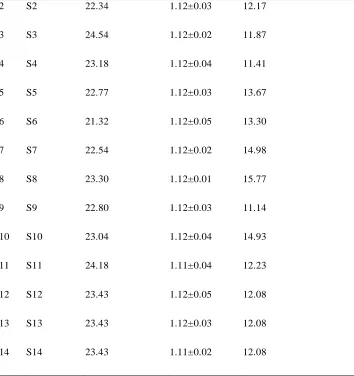
2 S2 22.34 1.12±0.03 12.17
3 S3 24.54 1.12±0.02 11.87
4 S4 23.18 1.12±0.04 11.41
5 S5 22.77 1.12±0.03 13.67
6 S6 21.32 1.12±0.05 13.30
7 S7 22.54 1.12±0.02 14.98
8 S8 23.30 1.12±0.01 15.77
9 S9 22.80 1.12±0.03 11.14
10 S10 23.04 1.12±0.04 14.93
11 S11 24.18 1.11±0.04 12.23
12 S12 23.43 1.12±0.05 12.08
13 S13 23.43 1.12±0.03 12.08
14 S14 23.43 1.11±0.02 12.08
Table 02: Flow Properties of Powder Blends of Stavudine Controlled Release MatrixTablets S.NO
Formulation
Angle of repose (θ)
Hausner’s ratio
Compressibility Index (%)
1 S15 22.57 1.12±0.03 13.63
2 S16 21.36 1.12±0.03 11.57
3 S17 25.74 1.12±0.02 13.37
4 S18 22.14 1.12±0.04 12.61
5 S19 21.74 1.12±0.03 12.27
6 S20 24.62 1.12±0.05 12.37
7 S21 23.74 1.12±0.02 13.42
9 S23 24.85 1.12±0.03 12.81
10 S24 24.54 1.12±0.04 13.83
11 S25 27.68 1.11±0.04 13.27
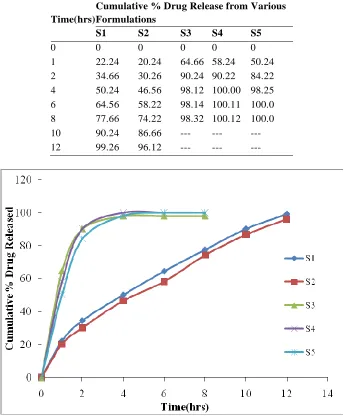
Table 03: Drug Release Profile of Stavudine Controlled Release MatrixTablets
Time(hrs)
Cumulative % Drug Release from Various Formulations
S1 S2 S3 S4 S5
0 0 0 0 0 0
1 22.24 20.24 64.66 58.24 50.24
2 34.66 30.26 90.24 90.22 84.22
4 50.24 46.56 98.12 100.00 98.25
6 64.56 58.22 98.14 100.11 100.0
8 77.66 74.22 98.32 100.12 100.0
10 90.24 86.66 --- --- ---
12 99.26 96.12 --- --- ---
Graph 01: Release Profiles from Various Controlled Release MatrixTablet Formulations of Stavudine
Discussion
Dissolution studies were performed on all the Matrixtablets of Stavudine formulations by using 0.1 N HCl as dissolution medium by USP paddle method (apparatus II). Matrix tablet
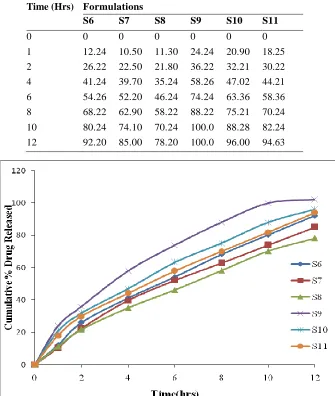
Table 04: Drug Release Profile of Stavudine Controlled Release MatrixTablets
Time (Hrs)
Cumulative % Drug Release from Various Formulations
S6 S7 S8 S9 S10 S11
0 0 0 0 0 0 0
1 12.24 10.50 11.30 24.24 20.90 18.25
2 26.22 22.50 21.80 36.22 32.21 30.22
4 41.24 39.70 35.24 58.26 47.02 44.21
6 54.26 52.20 46.24 74.24 63.36 58.36
8 68.22 62.90 58.22 88.22 75.21 70.24
10 80.24 74.10 70.24 100.0 88.28 82.24
12 92.20 85.00 78.20 100.0 96.00 94.63
Graph 02: Release Profiles from Various Controlled Release MatrixTablet Formulations of Stavudine
Discussion
Formulations S6 to S11 containing Eudragit RSPO and HEC as polymers with constant concentration of PEO extended the drug release
upto 12 hours It was observed that the drug release from the matrix tablets were decreased as the concentration of Eudragit RSPO is increased in all the formulations.
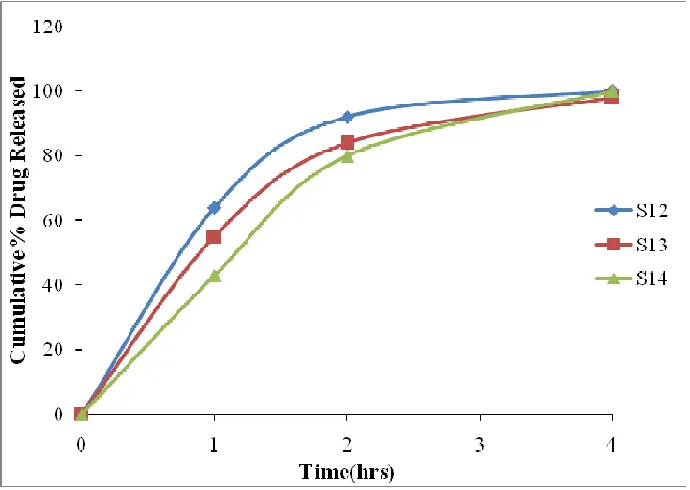
Table 05: Drug Release Profile of Stavudine Controlled Release Matrix Tablets Time
(Hrs)
Cumulative % Drug Release from Various Formulations S12 S13 S14
0 0 0 0
1 64.12 55.24 43.21
2 92.22 84.26 80.24
Graph 03: Release Profiles from Various Controlled Release MatrixTablet Formulations of Stavudine
Discussion
Formulations L12 to L14 containing PEO with failed to extend the drug release upto 12 hours.
Table 06: Drug Release Profile of Stavudine Controlled Release MatrixTablets
Time (Hrs)
Cumulative % Drug Release from Various Formulations
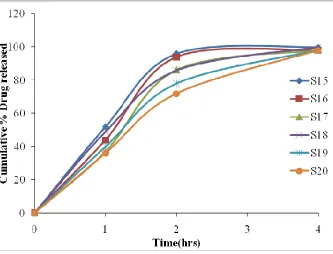
S15 S16 S17 S18 S19 S20
0 0 0 0 0 0 0
1 52.21 44.62 37.24 49.32 40.62 36.22
2 96.22 94.52 86.20 86.22 78.24 72.26
Graph 04: Release Profiles from Various Controlled Release MatrixTablet Formulations of Stavudine
Discussion
Formulations S15 to S20 containing HPMC K 100 M and PEO alone with varying concentration
of HPMC K 100 M failed to extend the drug release upto 12 hours.
Table 07: Drug Release Profile of Stavudine Controlled Release MatrixTablets
Time (Hrs)
Cumulative % Drug Release from Various Formulations
S21 S22 S23 S24 S25
0 0 0 0 0 0
1 16.8 14.22 13.82 23.64 46.32
2 31.22 28.94 21.62 42.2 62.97
4 52.24 39.4 33.64 60.22 76.64
6 63.66 50.22 46.22 74.46 87.31
8 72.26 61.12 54.10 82.22 98.22
10 80.24 73.68 66.58 90.24 98.00
Graph 05: Release Profiles from Various Controlled Release MatrixTablet Formulations of Stavudine
Discussion
Formulation S21 to S24 containing combination of polymers Eudragit RSPO and PEO exhibited the drug release upto 12 hours
Evaluation
of
Various
Dissolution
Parameters
Various dissolution parameters such as zero order rate constant, first order rate constant, Higuchi constant and Peppa’s constant were calculated from the dissolution data obtained from various formulations.
A plot of cumulative percent drug released vs time (hrs) was plotted and the zero order release rate constant (K0) was calculated from the slope.
A plot of log% unreleased vs time (hrs) was plotted for all the formulations and the first order release rate constant (K1) were obtained by multiplying slope with 2.303.
A plot of cumulative amount of drug released vs square root of time was plotted for all the formulations and the
Higuchi constant was calculated from the slope [Higuchi, 1963].
A plot of log Q vs log time was plotted for all the formulations and the ‘n’ values were noted from y-intercept of the straight line. [Korsmeyer, 1983]
The following mathematical expressions were used to calculate various dissolution parameters from the dissolution data [Suvakanta D et al., 2010]
Evaluation
of
Physical
Properties
of
Stavudine Controlled Release MatrixTablets
Table 08: Physical Properties of the Stavudine Controlled Release MatrixTablets
S.NO Formulation Weight uniformity(mg) Hardness (kg/cm²) Friability (%)
Drug content
(mg/tablet)
1 S1 203±2.0 6.0±0.3 0.12 39.2±0.5
2 S2 204±2.0 6.0±0.3 0.12 40.2±0.5
3 S3 202±2.0 6.0±0.3 0.18 36.4±0.5
4 S4 200±2.0 6.0±0.3 0.17 39.9±0.2
5 S5 200±2.0 6.0±0.3 0.15 41.2±0.3
6 S6 202±2.0 6.0±0.3 0.18 38.8±0.5
7 S7 200±2.0 6.0±0.3 0.16 39.6±0.5
8 S8 201±2.0 6.0±0.3 0.18 40.8±0.3
9 S9 200±2.0 6.0±0.3 0.14 39.5±0.5
10 S10 203±2.0 6.0±0.3 0.16 40.4±0.5
11 S11 202±2.0 6.0±0.3 0.18 39.2±0.5
12 S12 200±2.0 6.0±0.3 0.16 41.2±0.5
13 S13 202±2.0 6.0±0.3 0.16 41.2±0.5
14 S14 200±2.0 6.0±0.3 0.16 41.2±0.5
Table 09: Physical Properties of the Stavudine Controlled Release MatrixTablets.
S.NO Formulation Weight uniformity(mg)
Hardness Friability Drug content
(kg/cm²) (%) (mg/tablet)
1 S15 201±2.0 6.0±0.3 0.15 40.5±0.2
2 S16 202±3.0 6.0±0.3 0.13 39.4±0.3
3 S17 199±3.0 6.0±0.3 0.16 41.3±0.2
5 S19 198±4.0 6.0±0.3 0.13 39.9±0.4
6 S20 199±43.0 6.0±0.3 0.15 41.5±0.3
7 S21 200±3.0 6.0±0.3 0.18 40.4±0.2
8 S22 201±3.0 6.0±0.3 0.19 39.7±0.5
9 S23 198±2.0 6.0±0.3 0.16 40.4±0.2
10 S24 199±3.0 6.0±0.3 0.14 40.2±0.3
11 S25 202±2.0 6.0±0.3 0.19 39.4±0.5
All the batches of matrix tablets were evaluated for the physical parameters such as weight uniformity, hardness, friability and drug content uniformity. All the matrix tablets were evaluated for weight uniformity. The weight ranges of all the matrix tablets were uniform and were within the IP limits. Hardness of the tablets was evaluated by using Monsanto hardness tester. The hardness of all the tablet formulations was in the range of 6.0±0.3 kg/cm2. Weight uniformity of all the tablet formulations was in the range of 200.0 ± 3.0 respectively. Friability test for all the matrix tablets were performed to determine the ability of tablets to withstand abrasion during packing and transportation. The test was carried
out in Roche friabilator. Friability loss of the tablet formulations was negligible and was in the range of 0.1-0.2%. Surface damages to the tablets were found to be negligible and the friability loss values were within the IP limits. Drug content estimated for all the tablet formulations was highly uniform with less than 3% variation. The drug content for the prepared matrix tablets of Lamivudine and Stavudine were evaluated by UV spectrophotometric method. The drug content in all the Matrixtablet formulations were within the claimed limits. The physical parameters evaluation values for all the formulations were given in the tables 08 and 09.
REFERENCES
[1]. Indurwade NH, Rajyaguru TH, Nakhat PD. Novel approach fast dissolving tablets. Indian drugs 39, 2002, 405-9.
[2]. Pradhan R, Budhathoki U, Thapa P. Formulation of once a day controlled release tablet of indomethacin based on HPMC mannitol. Kathmandu: Kathmandu University Science, Eng Tech 2008, 55-67.
[3]. Devi KV, Pai RS. Antiretroviral need for an effective drug delivery. Indian J Pharm Sci 68, 2006, 1-6.
[4]. Samanta AK, Kumar A, Dora J, Choudhury SD, Goswami SK. Dosage form design on controlled release delivery system of Stavudine. Pharmbit 18, 2008, 124-33.
[5]. Reddy KR, Mutalik S, Reddy S. Once daily sustained release matrix tablets of nicorandil formulation and in vitro evaluation. AAPS Pharm Sci Tech 4, 2003, 1-9.
[6]. Lachman L, Lieberman HA. Pharmaceutical dosage forms. Tablets 1, 1998, 42-56. [7]. Indian Pharmacopoeia.Delhi: The Controller of Publications; 1996, A-80.
[8]. Banker GS, Anderson NR. In: Lachman L, Liberman HA, Kanig JL, editors. The theory and Practice of industrial pharmacy. Mumbai: Varghese Publishing House; 3, 1987, 297.
[9]. Perez-Marcos B, Ford JL, Amstrong DJ, Elliott PE, Rostron C, Hogan JE. Release of propranolol hydrochloride from matrix tablets containing hydroxyl propyl methyl cellulose K4M and carbopol 974. Int J Pharm 111, 1994, 251-9.
tablets of stavudine: formulation and in vitro evaluation. Asian J Pharm 4(3), 2010, 219-223.
[11]. Samanta AK, Kumar A, Dora J, Choudhury SD, Goswami SK. Dosage form design on controlled release delivery system of Stavudine. Pharmbit 18, 2011, 124-33.