
Development and Validation of RP – HPLC Method for the estimation of Oxyclozanide in Pure and Pharmaceutical formulation
7
0
0
Full text
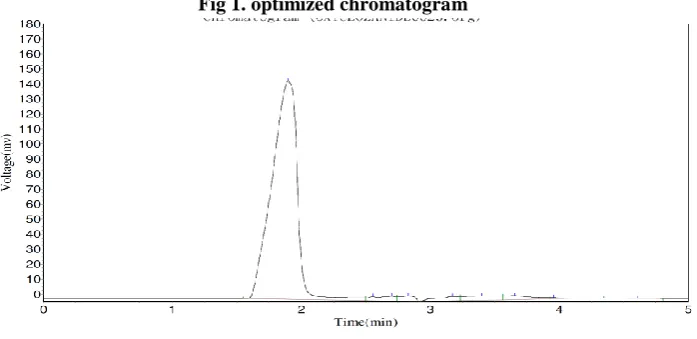
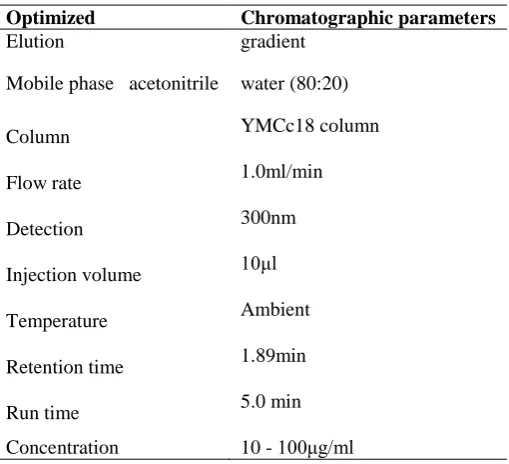
(2) Anusha.G, et al / Int. J. of Pharmacy and Analytical Research Vol-3(2) 2014 [185-191]. The objective of this study was to develop reverse phase high performance liquid chromatography method for the estimation of oxyclozanide in pure and pharmaceutical dosage form without any derivatization and having the short retention time. This method was found to be linear, precise, accurate, sensitive, specific, and robust, and therefore suitable for routine analysis.. Working standard solutions of oxyclozanide were prepared by accurately transferring the (0.1,0.2,0.4,0.6,0.8 and 1.0 ml) aliquots of the standard stock solution into a series of six 10 ml volumetric flasks. The volume was made up to mark with mobile phase to obtain concentration range of 10 –100 µg/ml.. Preparation of sample solutions 20 tablets were weighed individually and their average weight was calculated. Then the tablets were grounded and weight equivalent to 141.25mg of oxyclozanide was taken into 25mL volumetric flask and then the sample was diluted to 25ml with mobile phase to get concentration of 1000µg/ml and used for analysis.. MATERIALS AND METHOD HPLC Instrumentation and Chromatographic conditions The analytical separations were carried out on a waters 2487 HPLC system equipped with Photo Diode Array detector. The output of signal was monitored and integrated using LC – solutions 2000 software. The analytical column was YMC C18 (250 × 4.6mm, 5µ). Mobile phase consisted Acetonitrile and water in the ratio of 80:20. Mobile phase was mixed, filtered through 0.45µmembrane filter and degassed under ultrasonication. The mobile phase was used as diluent. The flow rate was 1.0 ml/min and runtime was 5 minute. The column was maintained at ambient temperature. UV detection was measured at 300 nm and the volume of sample injected was 10 μl.. RESULTS AND DISCUSSION HPLC method optimization. development. and. To optimize the chromatographic conditions, different columns, mobile phases, flow rates etc., were tested. Acetonitrile and water in the ratio of 80:20 was preferred as mobile phase because it resulted in a greater response to oxyclozanide after several preliminary investigatory runs compared with the different mobile phase combinations. The effect of the flow rate was studied in the range 0.9 to 1.5ml/min and 1.0ml/min was preferred to be effective. Under these conditions, the analyte peak obtained was well-defined and free from tailing. The retention time (RT) was found to be 1.89 min. The optimized chromatographic parameters were listed in table 1. Preparation of standard stock solution 25mg of oxyclozanide was weighed accurately and dissolved in 25ml of mobile phase to get the concentration of 1000 µg/ml. Resultant solution was filtered through Whatman filter paper. The standard chromatogram for oxyclozanide (100 μg/ml) was shown in figure 2.. Preparation of working standard solution. Fig 1. optimized chromatogram. 186.
(3) Anusha.G et al / Int. J. of Pharmacy and Analytical Research Vol-3(2) 2014 [185-191]. Table 1: Optimized chromatographic parameters Optimized Elution. Chromatographic parameters gradient. Mobile phase acetonitrile. water (80:20) YMCc18 column. Column. 1.0ml/min. Flow rate. 300nm. Detection Injection volume Temperature Retention time. 10μl Ambient 1.89min 5.0 min. Run time Concentration. 10 - 100μg/ml system. Retention time (RT), tailing factor (T), and peak asymmetry (AS), resolution (RS) were evaluated. The system suitability test was performed using five replicate injections of standards before analysis of samples. The system suitability method acceptance criteria set in each validation run were: capacity factor > 2.0, tailing factor ≤ 2.0 and theoretical plates > 2000. In all cases, the relative standard deviation (R.S.D) for the analytic peak area for two consecutive injections was < 2.0%. System suitability parameters were shown in table 2.. Validation of the method When method development and optimization are complete, it is necessary to accomplish method validation. The validation studies include linear range (correlation coefficient), method precision (RSD, %), method accuracy (% recovery and RSD, %), sensitivity studies (LOD & LOQ), and robustness.. System suitability studies System-suitability tests are an integral part of method development and are used to ensure adequate performance of the chromatographic. Table 2: System suitability parameters Parameters Values Retention time 1.89min HPLC system. Excellent correlation between oxyclozanide peak area and concentration was observed with R2 = 0.998 (Figure.3). The regression equation was found to be Y =18861 x +33523. Statistical data are presented in table 3 and the calibration curve was shown in figure 3.. Linearity The linearity of the method was evaluated by preparing six series of standard solutions of oxyclozanide in the range of 10 – 100 µg/ml in mobile phase and injecting the solutions into the. Table 3: Linearity results for oxyclozanide s.no concentration Area 1 10 207406 2 20 437484 3 40 786045 4 60 1506426 5 80 1945004 6 100 2065987. 187.
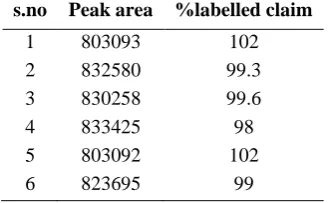
(4) Anusha.G, et al / Int. J. of Pharmacy and Analytical Research Vol-3(2) 2014 [185-191]. Fig 2. Calibration curve for oxyclozanide. y = 18861x + 33523 R² = 0.9987. 2500000. area. 2000000 1500000 1000000 500000 0 0. 20. 40. 60. 80. 100. 120. cocentration (µg/ml). relative standard deviation (% RSD) for peak responses was calculated. Results of system precision studies were shown in table 4.. PRECISION System precision: (Repeatability). To study precision, five replicate standard solutions of oxyclozanide (40 µg/ml) were prepared and analyzed using the proposed method. The percent Table 4: Results of system precision for oxyclozanide s.no. Retention time(min). Area(Mv. sec). 1. 1.193. 1023654. 2. 1.923. 1.45897. 3. 1.857. 1056488. 4. 1.857. 1023654. 5 6. 1.913 1.848. 1023564 1023654. Mean. 1.8854. 1032833.5. Standard deviation. 0.047545968. 14609.88216. % RSD. 1.645189498. 1.414543. solutions of 100µg/ml. The result was reported in terms of relative standard deviation (% RSD). The intraday and inter-day precision of the Results of method precision studies were shown in proposed method was determined by analyzing the table 5. corresponding responses 6 times on the same day and on different days for concentration of sample Table 5: Results of Method precision for oxyclozanide. Method precision: (Reproducibility). s.no. Peak area. %labelled claim. 1 2 3 4 5 6. 803093 832580 830258 833425 803092 823695. 102 99.3 99.6 98 102 99. 188.
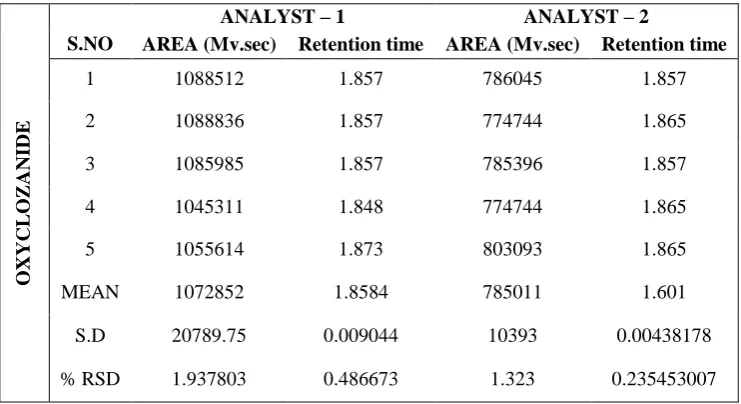
(5) Anusha.G et al / Int. J. of Pharmacy and Analytical Research Vol-3(2) 2014 [185-191]. concentration of sample solutions 40 µg/ml. The percent relative standard deviation (% RSD) for The intermediate precision of the proposed method peak responses was calculated. The results for was determined by performing the method by two intermediate precision were shown in table 6. analysts (Analyst 1 and Analyst 2) for Table 6: Results of Intermediate precision for oxyclozanide. Intermediate precision. OXYCLOZANIDE. S.NO. ANALYST – 1 AREA (Mv.sec) Retention time. ANALYST – 2 AREA (Mv.sec) Retention time. 1. 1088512. 1.857. 786045. 1.857. 2. 1088836. 1.857. 774744. 1.865. 3. 1085985. 1.857. 785396. 1.857. 4. 1045311. 1.848. 774744. 1.865. 5. 1055614. 1.873. 803093. 1.865. MEAN. 1072852. 1.8584. 785011. 1.601. S.D. 20789.75. 0.009044. 10393. 0.00438178. % RSD. 1.937803. 0.486673. 1.323. 0.235453007. replicate analysis (n=3). Known amount of standard drug solution (40µg/ml) was added to a pre analyzed sample solution (40 and 60 µg/ml) and percentage drug content was measured. The closeness of obtained value to the true value indicates that the proposed method is accurate. Recovery studies were shown in table 7.. ACURACY Accuracy of the method was confirmed by the standard addition method, which was carried out by performing recovery studies at 2 different concentrations 40 and 60 µg/ml of these expected, in accordance with ICH guidelines, by. % Recovery = [(Ct –Cpa)/ Cs] × 100. Where, Ct = Total concentration of analyte Cpa = Concentration of pre-analysed sample Cs = Concentration of standard added to pre-analysed sample. Table 7: Results of recovery studies for oxyclozanide by using RP –HPLC method s.no 1 2 3 4 5 6. std 40 40 40 40 40 40. level 40 40 40 60 60 60. Amount added 40 40 40 60 60 60. Total recovery 81.3 83.93 81.39 98.3 102.46 100.8. recovered 41.3 43.93 41.39 58.3 62.46 60.8. %recovery 103.25 109.825 103.475 97.1 104.1 101.3. checked by changing parameters like flow rate of mobile phase and detection wavelength Change in the detection wavelength by ± 2nm (298 nm and 300 nm). ROBUSTNESS The robustness study was performed to evaluate the influence of small but deliberate variation in the chromatographic condition. The robustness was. 189.
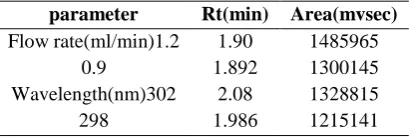
(6) Anusha.G, et al / Int. J. of Pharmacy and Analytical Research Vol-3(2) 2014 [185-191]. . After each change, sample solution was injected and % assay with system suitability parameters were checked.. Change in flow rate by ± 0.1 ml/minute (1.2 ml/min and 0.9 ml/minute). Robustness values were given in table 8 Table 8: Results of Robustness for oxyclozanide parameter Rt(min) Area(mvsec) Flow rate(ml/min)1.2 1.90 1485965 0.9 1.892 1300145 Wavelength(nm)302 2.08 1328815 298 1.986 1215141. Limit of Detection and Quantitation Detection and Quantitation limit were calculated by the method based on the standard deviation () and. slope of the calibration plot, using the formula. Limit of Detection × 3.3/S Limit of Quantitation × 10/S Where = the standard deviation of the response. S = the slope of the calibration curve (of the analyte). Table 9: Results of LOD, LOQ for oxyclozanide S.No. LOD. LOQ. 1. 0.081. 0.075702 be present in the sample matrix. Chromatograms of standard and sample solutions were compared in order to provide an indication of specificity of the method.. Specificity Specificity of an analytical method is its ability to measure the analyte accurately and specifically in the presence of component that may be expected to. Assay of pharmaceutical formulation pharmaceutical dosage form and the % Assay results were shown in table 10.. The proposed validated method was successfully applied to determine oxyclozanide in their. Table 10: Results of % assay by using RP – HPLC method Drug. Sl.No. Amount found(mg). Test area. Standard area. % Assay (AT /AS*100) 98.64%. Oxyclozanide. 1. 999.99. 774744. 785396.563. 2. 999.99. 803093. 102.25%. 3. 999.99. 786045. 100.08%. cost-effective due to short retention time which enabled analysis of oxyclozanide samples with a small amount of mobile phase. From the % RSD values of precision and recovery studies the method was found to be precise and accurate. The low detection and quantification limits achieved. CONCLUSION A simple, rapid, accurate, and precise RP-HPLC method for the analysis of oxyclozanide in pure and in pharmaceutical dosage forms had been developed and validated in accordance with ICH guidelines. The RP-HPLC method developed is. 190.
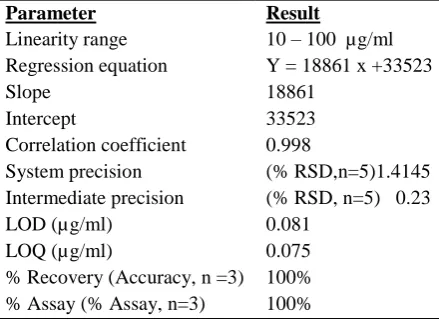
(7) Anusha.G et al / Int. J. of Pharmacy and Analytical Research Vol-3(2) 2014 [185-191]. indicate the method is very sensitive. The robustness data gathered during method validation showed that the method is not susceptible to small changes in chromatographic conditions. The. proposed RP-HPLC method developed by the author is suitable for routine analysis and quality assessment of oxyclozanide in pharmaceutical products.. Table 12: Summary of validated parameters for proposed method Parameter Linearity range Regression equation Slope Intercept Correlation coefficient System precision Intermediate precision LOD (µg/ml) LOQ (µg/ml) % Recovery (Accuracy, n =3) % Assay (% Assay, n=3). Result 10 – 100 µg/ml Y = 18861 x +33523 18861 33523 0.998 (% RSD,n=5)1.4145 (% RSD, n=5) 0.23 0.081 0.075 100% 100%. REFERENCES [1]. Parsons CG, Danysz W, Quack G. Memantine is a clinically well Tolerated N‐methyl‐D‐aspartate (NMDA) receptor antagonist‐a review of preclinical data. Neuropharmacology. 38; 1999: 735‐767. [2]. Sonkusare SK, Kaul CL, Ramarao P. Dementia of Alzheimer's disease and other neurodegenerative disorders‐memantine. Pharmacol Res. 51; 2005: 1‐17. [3]. Erickson CA, Posey DJ, Stigler KA, Mullett J, Katschke AR, Mc Dougle CJ. A retrospective study of memantine in children and adolescents with pervasive developmental disorders. Psychopharmacology. 191; 2007: 141‐147. [4]. Zdanys K, Tampi RR. A systematic review of off‐label uses of memantine for psychiatric disorders.Prog Neuropsychopharmacol Biol Psychiatry. 32; 2008: 1362‐1374. [5]. R F Suckow, M F Zhang, E D Collins, M W Fischman, T B Cooper. Sensitive and selective liquid chromatographic assay of memantine in plasma with fluorescence detection after pre-column derivatization. J Chromatogr B Biomed Sci Appl. 729 (1-2); 1999: 217-224 [6]. Afshin Zarghi, Alireza Shafaati, Seyed Mohsen Foroutan,Arash Khoddam, and Babak Madadian. Sensitive and Rapid HPLC Method for Determination of Memantine in Human Plasma Using OPA Derivatization and Fluorescence Detection. Application to Pharmacokinetic Studies. Sci Pharma. 78(4); 2010: 847–856. [7]. Belen Puente, Esther Hernandez, Susana Perez, Luis Pablo, Esther Prieto, Maria Angeles Garcia, And Miguel Angel Bregante. Determination of memantine in plasma and vitreous humour by HPLC with precolumn derivatization and fluorescence detection. Journal of Chromatographic Science. 49; 2011: 745-752 *******************************. 191.
(8)
Figure

+4
Related documents
Because there is no ground truth published for overlapping com- munities in the whole network and we have demonstrated that our communities well represent the ground truth, we make
Background: A systematic review assessing autologous versus alloplastic bone for secondary alveolar bone grafting in patients with cleft lip and palate was published in 2011
However, when survival data for patients with non-metastatic gastric malignancy (stages 1A-3B) is analysed this shows that despite com- parable disease stage, patients who present as
Summary: This paper proposes that ethics education has a new contribution to make, in supporting and promoting ethical practice – as it is defined in and by the everyday actions
Conclusions: The findings from this study indicate the importance of “ pushing ” active classroom teachers from the design to the mapping arena by instituting curriculum
Keywords: Cardiac surgery, Postcardiotomy cardiogenic shock (PCS), Extracorporeal membrane oxygenation (ECMO), Intra-aortic balloon pumping (IABP), Concurrent initiation,
Abstract: This paper consists of the design and implementation of a simple conditioning circuit to optimize the electronic nose performance, where a temperature modulation method
