244
ISSN: 2250 – 2688CODEN: CRPSBZ (USA)
Received: 31/08/2018 Revised: 28/09/2018 Accepted: 29/09/2018 Published: 08/10/2018
Pravin Pawar and Gharge Varsha Gourishankar Institute of Pharmaceutical Education & Research, Limb, Satara, Maharashtra, India-415015
Correspondence Gharge Varsha Gajanan
Gourishankar Institute of Pharmaceutical Education & Research, Limb, Satara, Maharashtra, India-415015
Email: [email protected]
DOI: 10.24092/CRPS.2018.080301
Website: www.crpsonline.com
Quick Response Code:
Formulation and Evaluation of Mesalamine Loaded pH
Dependent Colon Specific Pulsatile Drug Delivery System
Pravin Pawar and Gharge Varsha
ABSTRACT
The aim of these research of an oral colon specific, pulsatile device to attain time and or site specific release of Mesalamine, based on chronopharmaceutical consideration. The basic design consists of an insoluble hard gelatin capsule body, filled with Eudragit microcapsules of Mesalamine and sealed with a hydrogel plug. The entire device was enteric coated, so that the variability in gastric emptying time can be overcome and a colon-specific release can be achieved. The Mesalamine microcapsules were prepared in three batches, with Eudragit L-100 and S-100 (1:2) by changing drug to polymer ratio and evaluated for the particle size, drug content and in vitro release profile and from the obtained results; one better formulation was selected for further fabrication of pulsatile capsule. Different hydrogel polymers were used as plugs, to maintain a suitable lag period and it was found that the drug release was controlled by the proportion of polymers used. In vitro release studies of pulsatile device revealed that, increasing the hydrophilic polymer content resulted in delayed release of Mesalamine from microcapsules. Pulsatile, colon-specific release has been achieved from a capsule device over a 2–24 h period, consistent with the demands of chronotherapeutic drug delivery.
Key words: Mesalamine, Eudragit, microcapsules, Pulsatile, Colon-specific, Chronotherapeutics
1. INTRODUCTION
A pulsatile drug delivery system delivers drug in rapid and burst manner within a short time period immediately after a programmable lag phase. There are many situations where drug is needed to be released immediately (after bursting the delaying film coat) at specific site. Modified release dosage forms show different release profiles depending on their type. Sustain release dosage forms may maintain nearly constant plasma drug concentration in therapeutic window for prolonged time. Pulsatile release dosage forms release drug in pulsatile manner and maintain
plasma drug level within therapeutic range. 3,5 Such type of pulsatile drug delivery system contains
two components one is of immediate release type and other one is pulsed release which releases the drug in response to change in pH. In case of pH dependent system advantage has been taken of the fact that there exists different pH environment at different parts of the gastrointestinal tract. By selecting the pH dependent polymers drug release at specific location can be obtained. Examples of pH dependent polymers includes cellulose acetate phthalate, polyacrylates, sodium carboxymethylcellulose eudragit. These polymers are used as enteric coating materials so as to
provide release of drug in the small intestine. 17
Colon-specific drug delivery systems (CDDS) is one of the site-specific drug delivery systems. Along with many applications in local and systemic delivery of drugs the CDDS would also be advantageous when a delay in absorption is desirable from a therapeutic point of view as for the treatment of diseases that have peak symptoms in the early morning and that exhibit circadian rhythm, such as nocturnal asthma, angina and rheumatoid arthritis.So by developing the pulsatile device for specific colonic delivery, plasma peak is obtained at an optimal time, number of doses per day can be reduced; saturable first pass metabolism and tolerance development can
also be avoided.15
245
Modified-release oral dosage forms, increasing interest has presently turned to systems designed to achieve time specific (delayed, pulsatile) and site-specific delivery of drugs. These systems constitute a relatively new class of devices the importance of which is especially connected with the recent advances in chronopharmacology. In the last decade numerous studies in animals as well as clinical studies have provided convincing evidence, that the pharmacokinetics and/or the drug’s effects-side effects can be modified by the circadian time and/or the timing of drug application within 24 h of a day On the other hand, colon-specific drug delivery systems (CDDS) have been developing as one of the site-specific drug delivery systems. Along with many applications in local and sys- temic delivery of drugs the CDDS would also be advantageous when a delay in absorption is desirable from a therapeutic point of view as for the treatment of diseases that have peak symptoms in the early morning and that exhibit circadian rhythm. So by developing the pulsatile device for specific colonic delivery, plasma peak is obtained at an optimal time, number of doses per day can be reduced; saturable first passmetabolism and tolerance development can also be avoided. 9,11
`
The necessity and advantage of CDDS have been well recognized and reviewed recently There were currently few strategies to achieve colonic specificity such as bacterially triggered, pressure controlled, pH dependent and time dependent CDDS Recent studies with sensitive and reliable equipment contradict the traditional view and provide evidence of a decrease in pH at the gastrointestinal region between the ileum and the colon. Apparently the colon has a lower pH value (6.5) than that of the small intestine (7.0–7.8). Based on the concept that a formulation on leaving the stomach arrives at the ileocaecal junction in about 6 h after administration and difference in pH throughout GIT, a time and pH dependent pulsatile device proposed for colonic targeting was designed, for achieving the
selective delivery of drugs to colon, which is a
chronopharmaceutical approach for the better treatment of
Hypercholesterolemia.11 The designed capsule device consists of a
non-disintegrating capsule body and a soluble cap. The microencapsulated drug formulation prepared by using pH sensitive methacrylic acid copolymers (Eudragit L-100 and S-100) as coat and Mesalamine as core material, is filled within the capsule body and separated from the water-soluble cap by a hydrogel plug. The entire capsule was enteric coated to prevent variable gastric emptying. The enteric coating prevents disintegration of the soluble cap in the gastric fluid. On reaching the small intestine, the capsule will lose its enteric coating and the water-soluble hydrogel polymer plug inside the capsule swells to create a lag phase that equals the small intestinal transit time. This plug ejects on swelling and releases the microencapsulated drug from the capsule in the colon. Further, the controlled release of
Mesalamine was achieved for up to 24 h as it was
microencapsulated in the pH sensitive polymer.10,12
Mesalamine is a member of the drug class known as statins. It is used for lowering cholesterol. Mesalamine inhibits the rate determining enzyme (HMG CoA reductase) located in hepatic tissue that produces mevalonate, a small molecule used in the synthesis of cholesterol and other mevalonate derivatives. This lowers the amount of cholesterol produced which in turn lowers the total amount of LDL cholesterol. Mesalamine is a competitive inhibitor of HMG CoA reeducates.cholesterol synthesis occurs
during night time,especially it is higher at early morning. 13,14
Hypercholesterolemia or high cholesterol occurs when there is too much cholesterol in the body cholesterol is soft, waxy, fat like substance natural component of all the cells of the body. Our body makes all the cholesterol its needs any added cholesterol, which comes from the food can cause harm. High cholesterol raises your risk for heart diseases, heart attack& stroke when their too much cholesterol circulating in the blood can create sticky
deposit (called plaque) along the artery walls.7
A pulsatile drug delivery system that can be administered at night (before sleep) but that release drug in early morning would be a promising chronopharmaceutics system. Pulsatile systems are basically time-controlled drug delivery systems in which the system controls the lag time independent of environmental factors like pH, enzymes, gastrointestinal motility, etc. Food has been shown to reduce the rate and extent of Mesalamine absorption. Administration of Mesalamine with food produces a 25% reduction in Cmax (rate of absorption) and a 9% reduction in AUC (extent of absorption). However, food does not affect the plasma LDL-C lowering efficacy of Mesalamine. Evening Mesalamine dose administration is known to reduce the Cmax (rate of absorption) and AUC (extent of absorption) by 30% each. Mesalamine undergoes high intestinal clearance and first-pass metabolism, which is the main cause for the low systemic availability. the colon specific delivery of Mesalamine can be avoid the first pass metabolism, So in present study Mesalamine has been found to be suitable drug candidate for the development of chronomodulated
drug delivery. 4, 16
2. MATERIALS AND METHODS
2.1 Materials
246
S.D. Fine Chem. Ltd., Mumbai. Cellulose acetate phthalate (CAP) for enteric coating was purchased from Rajesh Chemicals, Mumbai. hard gelatine capsules of 300mg capacity was obtained from Government collage of pharmacy, karad. The rest of the chemicals were obtained from the following commercial supplier and used as received without further purification: light liquid paraffin (loba chemicals), Span 80 (Research Lab. Mumbai), acetone, petroleum ether (S.D. Fine Chem. Ltd., Mumbai) were of analytical grade.2.2 Method of Preparation
Accurately weighed Eudragit L-100 and S-100 in 1:2 ratios were dissolved in 10 ml of methanol to form a homogenous polymer solution. Core material, i.e. Mesalamine was dispersed in it and mixed thoroughly. This organic phase was slowly poured at
15◦C into liquid paraffin (100 ml) containing 1%(w/w) of Span- 80
with stirring at 1000 rpm to form a uniform emulsion. Thereafter, it was allowed to attain room temperature and stirring was continued until residual acetone evaporated and smooth-walled, rigid and discrete microcapsules were formed. The microcapsules were collected by decantation and the product was washed with petroleum ether (40–60 ◦C), four times and dried at room temperature for 3 h. The microcapsules were then stored in a desiccators over fused calcium chloride. Three batches were prepared with different proportions of core to coat materials (drug: polymer = 1:0.5, 1:0.75 and 1:1 (w/w) named AM-1–3,
respectively). 1, 12
2.3 Evaluation of microcapsules
2.3.1 Particle size and external morphology
Determination of average particle size of Mesalamine microcapsules was carried out by optical microscopy. SEM studies were carried out by using JEOL JSM T-330 A Scanning microscope (Japan). Dry microcapsules were placed on an electron microscope brass stub and coated with gold in an ion sputter. Picture of microcapsules were taken by random scanning of the stub.10
2.3.2 Drug content
` In a 100 ml volumetric flask, 30 mg of crushed microcapsules were taken, and volume was made up to mark withpH6.8. The flask was shaken for 12 h using an orbital shaker incubator. Then the solution was filtered and from the filtrate appropriate dilutions were made and absorbance was measured at 240nm by using UV
absorption spectroscopy. 1,2
2.3.3 In vitro release studies
In vitro dissolution profile of each formulation was
determined by employing USP XXIII rotating basket method (900 ml of pH 6.8-phosphate buffer, 100 rpm, 37±0.5 ◦C). Microcapsules equivalent to 40 mg of Mesalamine were filled into dialysis bags (12,000 molecular cut-offs) and loaded into the basket of the dissolution apparatus. Five millilitres of the sample was withdrawn from the dissolution media at suitable time intervals and the same amount was replaced with fresh buffer. The absorbance of the filtrate was determined at wavelength of 240 nm by using UV–vis spectrophotometer, against pH 6.8 as blank. The amount of drug present in the filtrate was then determined from the calibration curve and cumulative percent of drug release was
calculate..10
Preparation of cross-linked gelatine capsules
`Twenty-five milliliters of 15% (v/v) formaldehyde was taken into desiccator and a pinch of potassium permanganate was added to it, to generate formalin vapors. The wire mesh containing the empty bodies of the 00 size hard gelatin (about100 in number) capsule was then exposed to formaldehyde vapors. The caps were not exposed leaving them water-soluble. The desiccator was tightly closed. The reaction was carried out for 12 h after which the bodies were removed and dried at 50OC for 30 min to ensure completion of reaction between gelatine and formaldehyde vapors. The bodies were then dried at room temperature to facilitate removal of residual formaldehyde. These capsule bodies were capped with
untreated caps and stored in a polythene bag.10
2.3.4 Test for formaldehyde treated empty capsule bodies
Various physical tests such as, identification attributes, visual defects, dimension changes, solubility studies were carried out.2
2.3.5 Qualitative chemical test for free formaldehyde
247
solution. The comparison should be made by examining tubesdown their vertical axis.2
2.3.6 Formulation of pulsatile drug delivery system
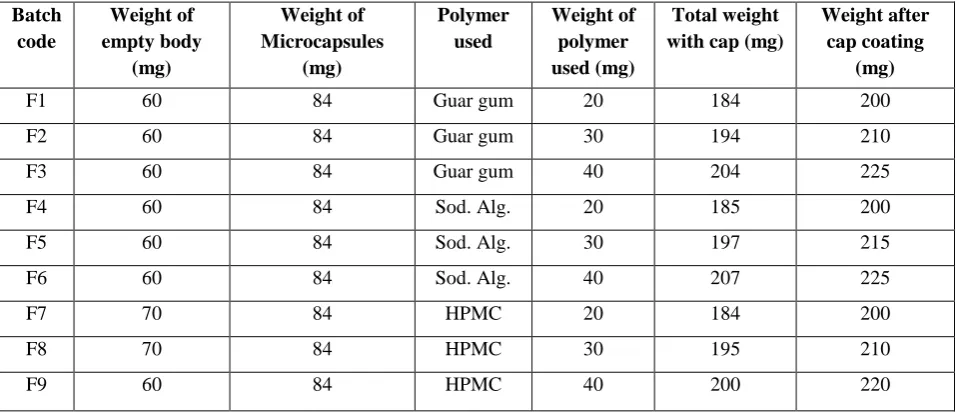
The bodies and caps of formaldehyde treated hard gelatine capsules of were separated manually. Microcapsules (AM-3) equivalent to 40mg of Mesalamine were accurately weighed and filled into the treated bodies by hand filling. The capsules containing the microcapsules were then plugged with different amounts (20, 30 and 40 mg) of various polymers, i.e., guar gum, hydroxyl propyl methyl cellulose and sodium alginate. The joint of the capsule body and cap was sealed with a small amount of the 5% ethyl cellulose ethanolic solution. The sealed capsules were completely coated by dip coating method with 5% CAP in 8:2 (v/v) mixture of acetone: ethanol, plasticized with dibutyl phthalate (0.75%), to prevent variable gastric emptying. Coating was repeated until an 8–12% increase in weight is obtained. % weight
gain of the capsules before and after coating was determinedwhich
is shown in table no.1.
2.3.7 In vitro release profile of pulsatile capsule
Dissolution studies were carried out by using USP XXIII dissolution test apparatus (paddle method). Capsules were tied to paddle with a cotton thread so that the capsule should be immersed completely in dissolution media but not float.In order to simulate the pH changes along the GI tract, three dissolution media with pH 1.2, 7.4 and 6.8 were sequentially used, referred to as sequential pH change method When performing experiments, the pH 1.2 medium was first used for 2 h (since the average gastric emptying time is 2 h), then removed and the fresh pH 7.4 phosphate buffer saline (PBS) was added. After 3 h (average small intestinal transit time is 3 h), the medium was removed and fresh pH 6.8 dissolution medium was added for subsequent hours. Nine hundred millilitres of the dissolution medium was used at each time. Rotation speed was 100 rpm and temperature was maintained at 37±0.5 ºC. Capsules were tied to paddle with a cotton thread in each dissolution vessel to prevent floating. Five millilitres of dissolution media was withdrawn at predetermined time intervals and fresh dissolution media was replaced. The withdrawn samples were analyzed at 240nm, by UV absorption spectroscopy and the cumulative percentage release was calculated over the sampling
times.12
3. RESULT AND DISCUSSION
As indicated in introduction, the aim of the work described here was to design a new pulsatile, colonic drug delivery device, for the better treatment of Hypercholesterolemia. The
pulsatile capsule designed here combines two approaches previously attempted: pH-sensitive delivery and time dependent delivery. The system was fabricated into two steps: first, Mesalamine was entrapped within pH dependent methacrylic acid copolymers (Eudragit L-100 and S-100 soluble at pH above 6 and 7, respectively); second, microcapsules were filled in non-disintegrating capsule body, and sealed with hydrogel plug and the entire capsule was coated with cellulose acetate phthalate for the enteric coating.
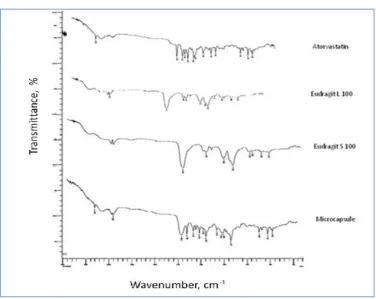
In case of Drug-Excipient compatibility study, it was observed that there were no changes in these main peaks in IR
spectra of microcapsules, which show there were no physical
interactions because of some bond formation between drug and
polymers. The peaks obtained in the spectra of drug and polymers mixtures correlates with the peaks of drug spectrum. This indicates that the drug was compatible with the formulation components. IR studies indicated no interaction between drug and polymers shown in figure no 1 and 2.
3.1 Physicochemical properties of eudragit microcapsules
To prepare pH dependent microcapsules the O/O (oil in oil) emulsion solvent evaporation technique was used since it yields more uniform particles. The method is correctly referred as O/O instead of W/O (water in oil) since a polymeric solution in organic solvent is considered as oil in microencapsulation terminology. The organic phase containing pH dependent Eudragit L/S-100 in combined ratio of 1:2 and dispersed Mesalamine was emulsified into an external oil phase. Liquid paraffin was used as the dispersion media or external phase. Petroleum ether was used to clean the microparticles since it removes liquid paraffin without affecting the integrity of the microparticles.
The arithmetic mean particle size of the formulations was determined by the optical microscope fitted with stage micrometer. The average mean particle sizes of the microcapsules were found to be 161.88, 183.45, and 238.10_µm for formulations 1, AM-2, and AM-3, respectively. The mean particle size of the microcapsules significantly increased with increase in polymer concentration due to high viscosity of medium at a higher polymer concentration resulting in enhanced interfacial tension and diminished shearing efficiency Scanning electron microscopy was performed to characterize the surface of the formed microcapsules. Particles of TM-1 were rough surfaced and crystals of the drug are visible on surface indicated that the concentration of polymeric solution is insufficient for complete encapsulation, whereas TM-2 is also rough but less crystalline as compared to TM 1.The TM-3 were found to be spherical, smooth and discrete. Some aggregates
of polymer were found in TM-2. Scanning electron
248
3.2 Percentage practical yields and drug contentThe drug content was found to be high in all the cases probably due to polymer loss by adherence to the container as a result of viscous nature of slurry. Amount of microcapsules to be
taken for in vitro release studies and further development of
pulsatile capsule was calculated based on content of drug present in each formulation shown in table no.2.
3.3 In vitro release studies for microcapsules
In vitro release studies were carried out using USP XXIII
dissolution assembly. The release profile obtained for all the Three
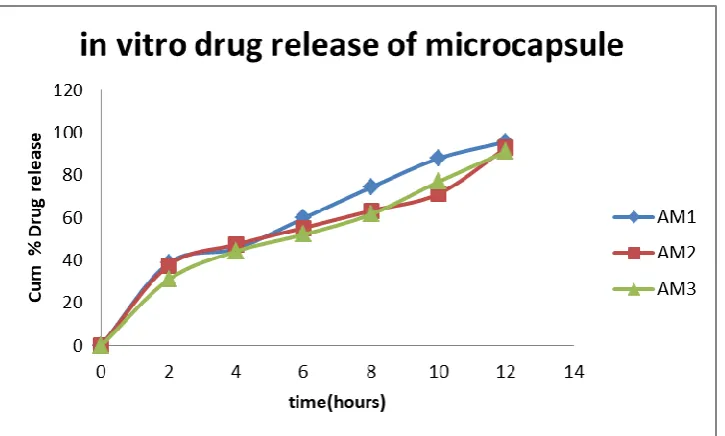
formulations were shown in Fig. It was observed that the drug
release from the formulations decreased with increase in the amount of polymer added in each formulation The release of drug from polymer matrix takes place after complete swelling
Comparative in vitro release profiles for the Eudragit
microcapsules.
Results shown are mean of three experiments, errorbars omitted for clarity,of the polymer and as the amount of polymer in the formulation. increase the time required to swell also increase thereby decrease in the drug release. In the first two hour drug release was 38.76%, 37.69%, and 31.05% for AM-1, AM-2 and AM-3, respectively. The overall cumulative % release for AM-1, AM-2, and AM-3 wereNfound to be 95.76%, 92.87%, and 91.13% at the end of 12th hour. . shown in figure no 6.
In vitro release study was analyzed using various
mathematical models. The regression coefficients for formulation AM-1 to AM-3 of zero-order plot were found to be 0.946, 0.914 and 0.960, respectively. The regression coefficients for formulations AM-1–3 of first-order plot were found to be 0.578, 0.557 and 0.599, respectively. Higuchi matrix plot regression coefficients of formulations AM-1–3 were found to be 0.983, 0.968, and 0.973, respectively. The regression coefficients for formulations AM-1–3 of Hixson Crowell plot were found to be 0.677, 0.618, and 0.648 respectively. The regression coefficients for formulations AM-1–3 of korsmeyer peppas plot were found to be 0.766, 0.724, and 0.746 respectively which is shown in figure no 6.
3.4 Formaldehyde treatment of hard gelatin capsule
Formalin treatment has been employed to modify the solubility of the gelatin capsules. Exposure to formalin vapors results in an unpredictable decrease in solubility of gelatin owing to the cross-linkage of the amino groups in the gelatin molecular chain with aldehyde groups of formaldehyde by Schiff’s base condensation. In about 100 capsule bodies treated with
formaldehyde, about ten were found to be shrunk or distorted. Capsule of 100 mg capacity showed a significant decrease in length and diameter after treatment. The solubility tests were carried out for normal capsules and formaldehyde treated capsules for 24 h. It was observed that in all the case of normal capsules, both cap and body dissolved within 15 min where as in formaldehyde treated capsules, only the cap dissolved within 15 min, while the capsule body remained intact for about 24 h and hence indicates the suitability for colon targeting.
3.5 Evaluation of modified pulsatile capsule
On the basis of drug content, particle size morphology, in
vitro release and release kinetics, formulation AM-3 was selected
as better formulation for designing pulsatile device. In vitro release
profiles of pulsatile device during 24 h studies were found to have very good sustaining efficacy. The results obtained for all the nine
formulations (F1–F9) are shown in Fig., indicating The plots of
comparative in vitro release profile for formulation F1–F3 (a), F4–
F6 (b) and F7–F9 (c), which contains guar gum, sodium alginate and HPMC respectively as hydrogel plugs at different proportions. During dissolution studies, it was observed that, the enteric coat of the cellulose acetate phthalate was intact for 2 h in pH 1.2, but dissolved in intestinal pH, leaving the soluble cap of capsule, which also dissolved in pH 7.4, then the exposed polymer plug absorbed the surrounding fluid, swelled and released the drug through the swollen matrix. After complete wetting of the plug, it formed a soft mass, which was then easily ejected out of the capsule body; releasing the eudragit microcapsules into simulated colonic fluid (pH 6.8 phosphate buffer). With all the formulations, there was absolutely no drug release in pH 1.2, thus indicating the efficiency of 5% CAP for enteric coating.
3.6 Formulations with guar gum as hydrogel plug
With formulations F1 (20 mg), F2 (30 mg), at the end of
5th there was 6.47% and 4.25% cumulative drug release was found
In case of F1 and F2 it was observed that polymer concentration was sufficient to retard the drug release in small intestinal fluid and the plug ejected out in colonic fluid, releasing the entire drug in colonic pH, in a controlled manner. At the end of 24 h, 93.55% and 95.02% of drug release was found in F1 and F2,respectively. With F3, a decrease in expelling power of plug was observed which might be due to inadequate wetting of the polymer. It was observed that plug ejected after 6 h and at the end of 24 h 87.94% of drug release was observed shown in figure no.7
3.7 Formulations with sodium alginate as hydrogel plug
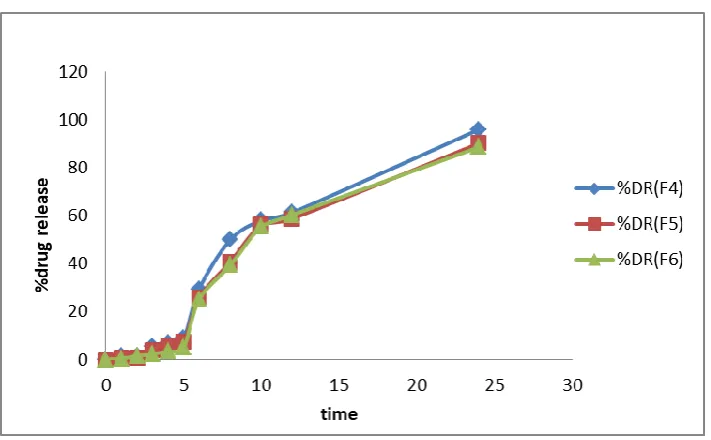
With formulation F4 (20 mg), F5 (30 mg), at the end of 5th
249
end of 24th hour F4 formulation had released 95.97% of drug,
whereas F5 formulation released 90.16% of drug up to 24 h in controlled manner. In case of F6 (40 mg), hydrogel plug ejected out in between 6th and 8th hour, indicating decrease in expelling power of plug. At the end of 24th hour 88.61% of drug was released shown in figure no.8.
3.8 Formulation with HPMC as hydrogel plug
`With formulations F7 (20 mg), F8 (30 mg) and F9 (40
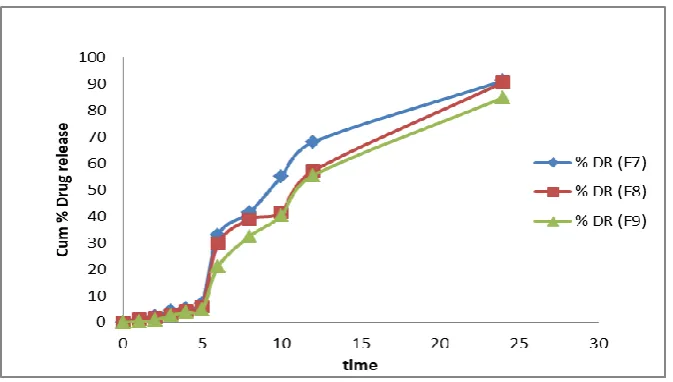
mg),at the end of 5th hour around 7.03%, 5.92%, 4.49% of drug release was observed respectively. F7 released 91.24% of drug within 20 h where as F8 and F9 released 90.57% and 84.84% of drug at the end of 24th hour. shown in figure no.9
4. CONCLUSION
The present investigation demonstrates that the
Mesalamine microcapsules could be successfully colon targeted by
design of time and pH dependent modified chronopharmaceutical formulation. In conclusion, pulsatile drug release over a period of 2–24 h, consistent with the requirements for chronopharmaceutical drug delivery was achieved from insoluble gelatin capsules, in which microencapsulated Mesalamine was sealed by means of a suitable hydrogel plug, thus allowing pulsatile and in the case of gastro resistant systems, colon-specific drug delivery to be attained. Thus the designed device can be considered as one of the promising formulation technique for preparing colon-specific drug delivery systems and hence in chronotherapeutic management of hypercholestromia is done.
CONFLICT OF INTEREST
The authors declare that there is no conflict of interests regarding the publication of this paper.
Table 1.Composition for modified pulsatile device on the basis of design summary
Batch code
Weight of empty body
(mg)
Weight of Microcapsules
(mg)
Polymer used
Weight of polymer used (mg)
Total weight with cap (mg)
Weight after cap coating
(mg)
F1 60 84 Guar gum 20 184 200
F2 60 84 Guar gum 30 194 210
F3 60 84 Guar gum 40 204 225
F4 60 84 Sod. Alg. 20 185 200
F5 60 84 Sod. Alg. 30 197 215
F6 60 84 Sod. Alg. 40 207 225
F7 70 84 HPMC 20 184 200
F8 70 84 HPMC 30 195 210
F9 60 84 HPMC 40 200 220
HPMC: hydroxy propyl methylcellulose; Sod. Alg.: sodium alginate. Microcapsules equivalent to 40 mg of drug used
Table 2.Results of drug content for Mesalamine microcapsules
Formulation Absorbance Concentration (g/ml)
Practical drug content (g/ml)
Theoretical drug content (g/ml)
%Drug content
AM 1 0.511 16.69 83.48 20 83.48
AM 2 0.483 15.79 92.14 17.14 92.14
250
Fig. 1. : IR spectra of pure Mesalamine
251
Fig.3 & 4. Scanning electron micrographs of theophylline microcapsules for AM 1 formulations
Fig. 5. Scanning electron micrograph of AM 3
252
Fig. 7. Comparative in vitro release profile of formulations F1, F2, F3
253
Fig. 9. Comparative in vitro release profile of formulations F7, F8, F9
REFERENCES
1. Mastiholimath VS. Time and pH dependent colon specific, pulsatile delivery of theophylline for nocturnal asthma International Journal of Pharmaceutics. 2007; 328: 49-56.
2. Nagaraja G. Design and evaluation of time programmed pulsincap system for chronotherapeutic delivery of losartan potassium Journal of Chemical and Pharmaceutical Research, 2013;5(6):76-87.
3. Rasve G. Pulsatile Drug Delivery System: Current Scenario. International Journal of Pharma and Bio Sciences. 2011; 2(3): 332-343. 4. Mukhopadhyay S. Formulation and Evaluation of Pulsatile Drug
Delivery System for Sequential Release of Atorvastatin International Journal of Pharmaceutical. 2014; 3 (2): 594-606.
5. Senthilnathan B. Design And Development Of Pulsatile Drug Delivery Of Glibenclamide Using Pulsincap Technology. International journal of pharmTech research. 2012; 4:1606-1613.
6. Jagdale SC. Formulation and Evaluation of Modified Pulsincap Drug Delivery System of Rizatriptan Benzoate. International Journal of Pharmacy and Pharmaceutical Sciences. 2014; 6(5): 48-52.
7. Sandeep P. Formulation and evaluation of rosuvastatin drug delievery system by using press coating technique international journal of research in pharmaceutical science, 6-52.
8. Indian Pharmacopoeia. Govt of India, Minisrty of health and welfare Delhi, controller of publication. 2010; (2) :149,274,849.
9. Najmuddin M. Development and evaluation of pulsatile drug delivery
system of flurbiprofen Research Journal of Pharmaceutical, Biological and Chemical Sciences. 2010; 284-290.
10. Qureshi J. Development and Evaluation of Chronotherapeutic Drug Delivery System for the Management of Nocturnal Asthma. Tropical Journal of Pharmaceutical Research October 2012; 11 (5): 703-712 11. Gohel H. Review on Colon Targeted Drug Delivery System by
Combine approch of Ph and Microbial. Int. J. Inv. Pharm. Sci., 2013; 1(3):217-220.
12. Bodkhe AA. pH dependent, colon specific, delivery of Ornidazole and Ciprofloxacin Hydrochloride in stomach Scholars Research Library, Der Pharmacia Lettre, 2010, 2(3): 101-105
13. Villa J and Prately RE. Ezetimibe/simvastatin or Atorvastatin for the treatment of hypercholesterolemia in patients with the metabolic syndrome: the VYMET study. Curr Diab Rep. 10(3):173-175.
14. McCormack T, Harvey P and Gaunt R. Incremental cholesterol reduction with Ezetimibe/simvastatin, Atorvastatin and rosuvastatin in UK General Practice: randomised controlled trial of achievement of Joint British Societies cholesterol targets. Int j clin pract. 64(8):1052-61. 15. Sarkar BK. Colon Targeted Drug Delivery System, Research Journal of
Pharmaceutical, Biological & Chemical Sciences. 2013; 2(4):365-372. 16. Lennernas H. Clinical Pharmacokinetics of Atorvastatin Clin
Pharmacokinet. 2003; 42(13):1141-1160.