i
I
i
I
LAUTECH Journal of Engineeing anrl T'echnology 5(I) 2009:5i - 57
EFFECT OF SOME PROCESSING
YARIABLES ON ANGLE OF REPOSE
AND
COEFFICIENT OF FRICTION OF DRIED FER]\,IENTED CASSAVA
GRANUES
*D. O. Idowu aud M.A. Adejumobi
Department of A gricultural Engineerin g,
Ladoke Akintola University of Technology, Ogbomoso, Oyo State.
E :mail idowu, david@yaho omail.com
ABSiTRACT
The angle of repose and coefficient of frictiort gain importance during lood handling, storage, processing and
durtng process of designing these type of machines. Therefore, this study was corrclucted to investigate the effect of
sonte processing variables; drying temperature, de*,atering prcssurc, size reductiott ond fermeutstioil period o,t
angl.e of repose and coeflicient of frictiott of dried fermented cassava crumbles, A 2" factorinl experiment was desigtt
to investigate tlte effect of tltese varisbles on tlrc coefJicient of friction and angle of yepose. Each vuriables was examine at two levels; drying temperature (5f C antl 800C), ilewatering pressure (SMPa and lLMPa), size reductiort (Hammer mill and Renting in water) and fermentatiori periods (3days and Sdays) yielding l6 experimental samples. The data were statistically analyzed using Yates algorithm. The results obtained showed that the cofficieryt of
friction on wood is higher than the coeflicient olfrlction on steel, A chonge in drying temperf,ture from 50'C to
80"C increase coefJicient of friction by 19% otr tvood, rvhile hammer millirtg the fresh cassavo root before fermentatiort increase the cofficient of frictiott on steel by 7,5%. All the two, three and four interaction effect tvere pulled togetlter to test the signiJicance of the ntain eflect. It was found that drying temperature and fermentatiotr period was significant at lok level on steel, while only drying tenrperature was sigttificant at I% Ievel on the tuood
However, it was fotutd that a change in fermentation days from 3 days to 5 days reduces the angle of repose by 10%,
Key words: Angle of repose, Cofficient olfriction, Drying temperalure, Size reduction.
Fer,m entation Deriod. Dewaterinp oressure,
*Cc,respondlng Author
INl'RODUCTION
Cassava (Manihot Esculenta Crantz) is sometimes
classified as a crop for developing countries and for
conisumption only by rural people whereas the large
crop of cassava grown annually in the tropics is
actLrally consumed in all its forms by nearly all income
leve:ls. lt has been reported.tl.rat Nigeria wlth annual
production of about 42 million .metric tones of cassava
roots is the largest produccr in Africa (CBN 2003). An
estimated 157 million tones of cassava roots were
produced in 1990 (Annon, 1990). Human consumption
acbounts for 60% ofproduction; the remaining is being
useri as animal feed or in industry (Cooke and Cock, r 9 8 9 ) ,
Cassava being a highty perishable crop is very difficult
to store fresh. About 23% of cassava harvest is usualiv
lost due to food deterioration of the roots, ln nrany
West African Countries cassava processing is a femalc
donrinated house hold enterprise using traditional
methods. At present, the demand for cassava products
far outstrips the annual production because of new openings for cassava exportation (Aderinola et a/
2006). Increase in demand for the cassava products as
foo,l and feeds calls for better ways of handling and
processi ng cassava.
ln the processing of cassava into dried fermented
casr;ava tlour, tbllowing processing variables are
involved; fermentation period, drying temperatule ,
dewatering pressure and size reduction.
To design effective handlirrg equipment for cassava
processing, the knowledge of the angle of repose and
coefficient of friction is useful (Ezeaku 1996; Dakogoi
2001). The nature and the belraviour of agricultural
nraterials make it imperative for specific experiments
to be conducted and the data so generated are based on
the peculiarities of the production processes and the
type of product. The coefficient of friction is a major
index indicating incidence of motion. It is the angle
measured from the lrorizontal at which a granular
material will begin to slide and/or role r.rpon itself after
it has been allowed to consolidate. (Mohsenin, 1986;
Herderson and Perry 1982; Umugbai 2005). The flow
of a granulated or unconsolidated material fi'om a birr
by gravity or a loaded auger started by power source
depends on static friction. The knowledge of coefficient of friction is useful in design of storage
structures, hoppers, material handling equipment, and
separators base on difference in surface texture of
materials.
The angle of repose is needed as baseline data in
optimal design of machines handling and storage of
agricultural nraterial. Also, in the design of sorne
agricultural handling machine and storage bin for
dried cassava root; the engineer will need some
Idorru D. O & Adejamobi M.A/LAUTECH Journal of Engineeing ancl Tecltnology 5(1) 2009:53 - 57
information on the angle of repose of Crieci cassava root. Granular material exhibits sorne
frictional properties between itself and the bulk and
between the surface over which they flow on the
other hand. This paper presents results on the effect
of some processing variable; drying temperature,
dewatering pressure, size reduction methods and
ferrrrentation period on the coefficient of friction and
angle of repose of dried fermented cassava granules.
Methods employed were selected for simplicity,
accuracy ofresults and wide acceptability.
EXI]ERIMENTAL PROCEDURE
Sanrpling Technique
Freshly harvested cassava tubers were bought from
Igbara-Oke Central Market in Ifedore Local
Golernment of Ondo State, Nigeria. The cassava was
plarted in March 2003 and harvested in November,
2 0 0 5 .
Exp,erimsrltl Design
Sonre noticeable processing variables that might
influence the mechanical properties of dried fermented
cassava root are drying temperature, size reduction,
dewatering pressure arrd fermentation time. ln order to
deterntine the main effects and interaction effect of
lactors on angle of repose and coefficient of friction of
dried fermented cassava flour. A 24 factorial
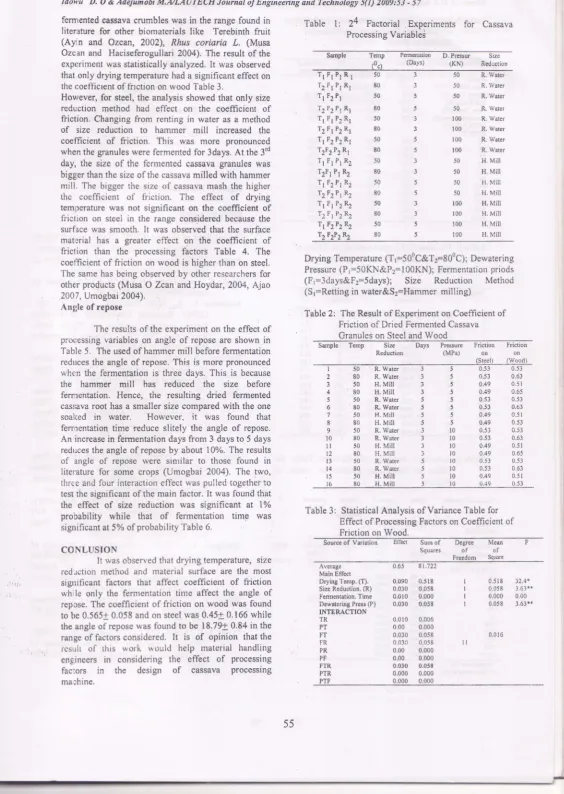
expr:riment was designed (Tablel) to investigate the
effect ofthe processing variables selected,viz; drying
temperature (500C and 800C); dewatering pressure
(5MPa and l0MPa); size reduction methods (Hammer
mill and Renting in water) and fermentation period (3
days and Sdays) ,
Processing
The roots were peeled and washed manually. The
ranlge of factors considered for this were selected based
on t:he review of literature and preliminary laboratory investigations,
Sizr: Reduction
Two methods of size reduction were applied on the
fresh cassava; reduction by mechanical means using
Harnmer mill that was fabricated at the Department of
Agricultural Engineering, Obafemi Awolowo
University, Ile-lfe and renting in water.
Fermintation Conditions
The samples prepared above were divided into two,
one part was allowed to ferment for 3 days and another
allowed fermenting for 5 days. The fermentation was
done at the room temperature of 30"C t 2'C'
Dervatering Pressure
Rernoval of water by pressing as an aid to the
dehydration was done by applying pressure of 5MPa
and lOMPa using a laboratory hydraulic press fabr:icated at Agricultural Engineering Department,
Obnfemi Awolowo University ,Ile-Ife, Nigeria .
Drying Temperature
Ea,:h sample prepared above was divided into two,
one dried at temperature of 500C and another dried at
tempcrature of 80uC in the shelves of a Calenkamp
mo:sture extraction oven. The drying of the I'ermented
casrtava granules was done using a tin layer of about
oven, Drying was deemed to be completed when there
was uo further loss in weight after three consecutive
i n t e r v a l r e a d i n g . : . . i r i . , \ . - ,
Static Coefficient of Friction
The static coefficient of friction of cassava granule on
two structural surfaces, namely, plywood and
galvanized sheet metal were measul'ed using the
inclined plane apparatus (Figurel). For this
measurement one end of the friction surface was
attached to an endless screw. The dried fermented
cassava granules were placed on the surface and were
gradually raised by the screw. The angle between the
surface and the horizontal were read when the dried
fermented cassava granules started sliding over the
surface. The tangent value of the angle measured was
taking to be the coefficient of static friction of the
dried fennented cassava granules. This nrethod has
being used by other researchers (Bargeh 200 l; Dutta el
al 1988; Ajao 200'l; Musa O. Zean and
Heciseferogullari 2004).
Angle of Repose
Angle of repose is the angle with the horizontal at
which the material will stand when piled. The angle of
repose (0) was determined by filling a 100 mm
d i a r n e t e r a n d 6 0 0 m m l o n g t o p l e s s a n d b a s e l c s s
cylinder with dried fermented cassava granule and
gently lifted to allow the sample to form a cone. The
diameter and the height of the cone were measured and
the angle of repose was calculated thus:
"'taB\
$ = ;nfi-r 1-1
t D J
Wherc H is the height of ,the cone.'and D is the
diameter of the cone. This method has bcing used by
Ajao 2007;Ozguven and Kubilay 2004.
The result of this experiment was statistically analyzed
using Yates algorithm to determine the main and
interaction effect of drying temperature, size reduction
method, fermentation time and dewatering pressure on
the angle ofrepose.
RESULTS AND DISCUSSION
Effect of' Processing Factors on Coefficient of Friction
The result of effect of processing variables on coefficient of friction on wood and steel was
investigated. The result of the experiment is as shown
in Table 2. It was found that drfng temperature, size
reduction method and dewatering pressure have effect
on the coefficient of friction of dried fermented
cassava granule on wood in the range of temperature
considered. Contrary to expectation, it was found that at higher temperature the coefficient of
friction was high. This may be dne to an
observed static electricity which increased with dryrng temperature in the dried fermented cassava
crumbles . This may need further research work to
verified types of charges involved. The higher the
drying temperature the iower the final moisture content
and tlie higher the coefficient of friction in tlre range of
Idox'u D. O & Adejumobi M.A/LAUTECH Journal of Engineering and Technology 5(I) 2009:53 - 57
fermented cassava crumbles was in the range found in
literature for other biomaterials like Terebinth fruit
(Ayin and Ozcan, 2002), Rhus corioria tr. (Musa
Ozcan and Haciseferogullari 2004). The result ofthe
exprrriment was statistically analyzed. It was observed
that only drying temperature had a significant effect on
the r:oefficrent of tiiction on wood Table 3.
Hovrever, for steel, the analysis showed that only size
redu.ction method had effect on the coefficient of
friction. Changing from renting in water as a method
of size reduction to hammer mill increased the coelficient of friction. This was more pronounced
when the granules were fermented for 3days. At the 3'd
day, the size of the fermented cassava granules was
bigger than the size of the cassava milled with hammer
mill. The bigger the size of cassava mash the higher
thc coefficient of friction. The effect of drying
temperature was not significant on the coefficient of
frictron on steel in the range considered because the
surface was smooth. It was observed that the surface
mat,lrial has a greater effect on the coefficient of friclion than the processing factors Table 4. The coellcient of friction on wood is higher than on steel.
The same has being observed by other researchers for
oth€jr products (Musa O Zcan and Hoydar, 2004, Ajao
2007, Umogbai 2004).
AnJ;le of repose
The results of the experiment on the effect of
pror:essing variables on angle of repose are shown in
Table 5. The used of hammer mill before fermentation
reduces the angle of repose. This is more pronounced
whe n the fermentation is three days. This is because
the hammer mill has reduced the size before
femrentation. Hence, the resulting dried fermented
cassiava root has a smaller size compared with the one
soal<ed in water. However. it was found that
ferrnentation time reduce slitely the angle of repose.
An increase in fermentation days from 3 days to 5 days
reduces the angle ofrepose by about l0%o. The results
of angle of repose were similar to those found in litelature for some crops (Umogbai 2004), The two,
thre e and four interaction effect was pulled together'to
test the significant of the main factor. It was found that
the effect of size reduction was significant at lo/o probability while that of fermentation time was
significant at 5% ofprobability Table 6.
C O N L U S I O N
It was observed that drying temperature, size
red.rction rnethod and material surface are the most
significant factors that affect coefficient of friction
while only the fermentation time affect the angle of
repose. The coefficient of friction on wood was found
to tre 0.565+ 0.058 and on steel was 0.451 0.166 while
the angle of repose was found to be 18,79+ 0.84 in the
range of factors considered. It is of opinion that the
lcsr.rlL of this work would help material handling
eng,ineers in considering tlre effect of processing
fac,:ors in the design of cassava processing ma,;hine.
Table l: 24 ' Factorial Experiments for Cassava
Processing Variables
Sanple Temp
(oc)
Fcmfllalion D, Pressur Size
(Davs) (KN) Reduction
T l F t P l R l
T 2 F l P l R l
T t F 2 P l
T 2 F 2 P t R l
T l F I P ? R l
T 2 F l P 2 R l
T l F 2 P 2 R l
T 2 F 2 P 2 R l
T 1 F l P l R 2
TzFl Pl R2
T F D ' l ' 2 ' l ' r 2D
T 2 F 2 P l R 2
T l F l P 2 R 2
T2 Fl P2 R2 Tt F2 P2 R2 T 2 F 2 ? 2 \
50 R. Water
50 R. lvater
50 R. Water
50 R, watcr
100 R, Water
100 R. Water
100 R, Water
100 R, Water
s 0 H . M i l l
5 0 H , M i l l
5 0 H , N 4 i l l
50 H. N4ill
100 Ft. Milt
| 00 H. lvlill
't00
H. \4ill
1 0 0 H . M i l l
5 0 8 0 5 0 8 0 5 0 8 0 5 0 80 5 0 EO 5 0 8 0 50 8 0 5 0 8 0 3 3 5 5 3 3 5 5 3 3 5 5 3 3 5 5
Drying Temperature (Tr:500C&T2:800C); Dewatering
Pressure (Pr=50KN&Pz:l00KN); Fermentation prrods
(F,=3days&F2=5days); Size Reduction Nlethod
(Sy:Retting in water&Sr:Hammer milling)
Table 2: The Result of Experiment on Coefficient of
Friction of Dried Fermented Cassava
Granules on Steel arrd Wood
Sarnple Temp Sire Days Pressute Friction Friction
Reductiou (MPa) ou on
( S t e e l ) ( w o o d )
3 3 3 J 5 5 5 5 o 7 8 9 l 0 I I l 2 I J t 4
I t r i 6
50 R. Water
80 R. Water
50 H. Mill
8 0 H . M i [
50 R. Water
80 R. Water
50 H. Miil
8 0 H . M i l l
50 R. Water
80 R. Water
5 0 H . M i [
8 0 F I . M i I I
50 R. Watsr
80 R. Water
5 0 H . M i l l
8 0 H . M i l l
l 0 l 0 l 0 l 0 l 0 l 0 1 0 l 0
0 , 5 3 0 . 5 3 0 . 5 3 0 . 6 3 0 . 4 9 0 . 5 1 0.49 0.65 0 . 5 3 0 - 5 3 0,53 0.63 o . 4 9 0 . 5 t 0.49 0.53 0 , 5 3 0 . 5 3 0 . 5 3 0 . 6 3 0 . 4 9 0 . 5 1 0 . 4 9 0 . 6 5 0 . 5 3 0 . 5 3 0 . 5 3 0 . 6 3 0 . 4 9 0 . 5 1 0 . 4 9 0 . 5 3
Table 3; Statistical Analysis of Variance Table for
Effect ofProcessing Factors on Coefficient of
Friction on Wood,
Source of Variation Effffl Sunr of Degree Mean
Squares of of
Freedont Sqrurc
Average Main Effsct Drying Temp. (T).
Size Reduction. (R)
Fementation. Time Dewatering Press (P) INTERACTION TR PT FT T R P R P F FTR PTR PTF
0 . 6 5 8 t . 7 2 2
0 , 0 9 0 0 . 5 t 8 0,030 0.058 0 . 0 1 0 0 , 0 0 0 0,030 0.058
0 . 0 1 0 0 . 0 0 6 0.00 0.000 0.030 0.058 0 0 1 0 0 . 0 5 8 0.00 0.000 0.00 0.000 0.030 0.058 0.000 0.000 0.000 0.000
0 . 5 1 8 3 2 . 4 * 0 . 0 5 8 3 . 6 : i * i 0.000 0.00 0 . 0 5 8 3 . 6 3 * {
0 . 0 1 6
1 . " ,
Idowtt D. O & Adelunobt
M.A/LAaTECH
foarnal of Enghefing and Technologt
5(I) 2009:53
- 37
Table4: Statisticsl
Analysis of Variance
Table Effect
. of ProcessingFactors
on Coefficient
of
Friction
on Steel
Sourcc ofvariacc Efrct Sun of DF
' Squarcs I'loro ofS{uarca Avcrqie
Main Uffiect Drying Tanp (I) . Sizo Reduc,(R) Fonn. 'Iimc (FI) Dcwat*ing pross(P) INTELACTION EFFECT FR PR
0.50E
0.00 {.04 0.00 0.00
66.59 0.t0 0.00 0.00
.0.00 0.00 0.00 0.00 0.00 0.00 o f n 0 ( n 0.00 0.00 0.00 0.00 0.00 0.00 0,00 0.00 0.00 0.00 0.00 0.00
FRTP 0.00 0.00 I 0,00
Table 5: The Result of Experimenting
on Effect of
Dried Fermented
Cassava
on Angle of
Reponse.
FIXED PI-ATE
Figure l: The inclined plane
REFERENCES
Cental Bank of Nigeria (CBN). (2005). Annuat Report
and Statemsnt of Account CBN, Publication.
Annon. (1990). Food and Agricultural Organization of
United Nation production year Book.
Cooke RD and Cock LN. (1989). Cassava crops up
again, New Science 17;63-68
Aderinola E. A, M.M. Fasoranti and S .O. Ojo.
. (2006). Resource Prodlctivity in Cassava
Based farming Systems in Ondo State. Implipation For The Cassava Expansion
Programmed in Nigeria.
Ezeaku C. A (1996). Static Coeffrcient of Crop Grains on Selected surfaces. A Seminar Paper Presented at Federal Polytechnic Bauchi. Dakogol F. A. (2001). Determination of some
Engineering Properties of Shea . 'Nuts
{Butyrospermum paradoxii}. M. Eng. Thesis,
Department of Agricultural Engineering, Federal University of Technology, Minna. Nigeria.
Mohsenin, N.N (1986). Physical Properties of Plant
and Animals Materials, Structure, Physical Characteristics and Mechanical Properties.
Gordon and Breach Science Publishers lnc.
Henderson, S. M. and Pery, R.L.. (1980). Agricultural
Process Engineering 3'o edition. The AVI Publishing Company, Incorporated, West
. port, Connecticut. Pg. 108-122.
Umugbai, V.l. D.2005. Development of an angle of
friction measurins device, Proceedines of the '
5e lnternational bonference and 26d"Annual:.. :.
General Meeting of the Nigerian Institution of' "
Agricultural Engineers. Volume 26,
Bargeu E. A (2001) Physical Properties of Bambara'
Groundnuts; Journal ofFood Engineering 471
321-322
Dutta, S. K., Nema, N.K., and Bhardwaj, R. J, (198E),
Plrysical Properties of grain. Journal of Agricultural Engineering Research, 39; 259-268.
66.59 0 . 1 0 0.00 0.00
PF TR Ft'
m
FTR PIR PTF PER
0.00 0.00 0.00 0.00 0.00 0.00 0.00 0.00 0.00 0.00
-T-2 80 R. W6tcr 3 5 20.2
3 50 H.MiU 3 s ri.g
Sanpb TGap Sizc
Reduction
4 80 H. Mi[ 5 50 R. Wdc[ 6 80 R Wr&r 7 50 lL Milt 8 80 H. Mill. 9 50 R Wccr l0 80 R Water
50 It. Mill
80 H. Miil
Dryr Procsro Aoglo (MPa) of
3 5 : 1 8 . 0 5 18.9 5 lE.9 5 18.0 5 t7.9 l0 'r9.9 l0 20.0 t 0 r 8 . 0 r0 r8,2 t 0 t 9 . t r 0 1 9 . 0 l 0 1 7 . 9 l 0 1 8 . 3 t3 50 R. Wlter
14 80 R- Wdcr rs 50 H. Mitl 16 80 H. MiIl
Table
6: Statistical
Analysis of Variance Table for
Effect of Processing
Factors on Angle of
Repose.
Sourco ol'Vuigtiol
Aveeago MainEfhx DryingTanp. fl-), Size Redur:. (R) Dcwatcring Prcsr (P) Ferm. Timc(F) INTERACTION TR
PT FT FR PR l,l' FTR r'TR P F' PFR FRTP
Effoct Sunof Squrres
18.750 18.7T2
D€gr6 M.q of F of Squre Frcedosr
0.000 0.000 . 1 . 5 1 4 4 . 0 0.000 0.00 -0.500 16.00
0,000
144.000 81.8r* 0.000
16.00 9.090rr
0.000 0.000 0.000 0.s50 0.000 0.000 0.000 0.000 0.000 0.000 0,000
0.000 0.000 0.000 19.360 0.000 0.(xx) 0.000 0.000 0.000 0.000 0.000 . Signillc{ot l%
SAMPI-E BOX
ldowu D, O & Adejumobi M.A/L/IUTECH Journal of Engineering and Technologlt 5(I) 2009:53 - 57
Ajao Adedapo. (2007). Investigation on the effect of moisture on mechanical and Aerodgnamic Properties of Africa Star Apple Seed. An
M.sc Thesis in the Department of Agricultural
Engineering University of Ibadan, Ibadan.
Musa OZcan and haydar Haciseferogullari. (2004) A Condiment Sumac (Rhus Coriaria Q. Fruits.
Some Physio-chemical Properties of Bulg.
Journal of Plant Phvsiol 30:3474-E4.
Ozguven F,, and kubilay,V.(2004). Some physical,
Mechanical and aerodynamic properties of
PineQtinus pinea) nuts. Journal of food
Engineering,68, l9l -l96
Aydin C and O Zcani M. (2002). Some Physico Mechanical properties of Terebinth {Pistacia
Terebinthus) Fruit Journal of Food
Engineering.