Preliminary account of Late Devonian palynomorph assemblages from the
Bedford Shale and Berea Sandstone Formations of
central
Ohio,
U.S.A.
STEWART G. MOLYNEUX', WALTER L. MANGER' & BERNARD OWENS' 'British Geological Survey, Keyworth, Nottingham, England.
'Dept. of Geology, University of Arkansas, Fayetteville, Arkansas 72701, U.S.A.
ABSTRACT-Diverse assemblages of well preserved miospores and microplankton have been obtained from a series of samples collected across the boundary between the Bedford Shale and Berea Sandstone Formations in central Ohio. The miospores indicate a Late Devonian (pre-Carboniferous Tournaisian)* age for each of the samples. The microplankton support this age determination. A number of microplankton species not previously recorded from North America are present.
INTRODUCTION
Four samples collected across the boundary between the Bedford Shale and Berea Sandstone Formations in central Ohio have yielded well preserved assemblages of both miospores and microplankton. The boundary between these formations has been placed by various authors in either the Upper Devonian or the Missi- ssippian.
De Witt (1970) concluded, on the basis of conodont evidence reported by Haas (1947), that only the basal few feet of the Bedford Shale Formation was of Late Devonian age with the remainder of the Bedford Shale and the entire Berea Sandstone Formation being Early Mississippian (Carboniferous) in age. This conclusion was based on the occurrence in the basal Bedford Shale, of Spathognathodus anteposecornis Scott, a species that is characteristic of the latest Devonian Protognathodus
fauna in the Upper Mississippi Valley. Conodonts have not been reported from the upper part of the Bedford Shale or Berea Sandstone Formations.
Eames (1978), in contrast, has reported an Upper Devonian age, based on palynological evidence, for the entire Bedford Shale and Berea Sandstone in northern Ohio. Previous palynological work in Ohio by Winslow (1962) and in southern Ontario by McGregor (1967, 1970 and 1979) on the Bedford Shale and Berea Sand- stone Formations and their lateral equivalents would tend to support this conclusion when direct comparisons are drawn with the well established biostratigraphies in the Ardenno-Rhineland areas of Belgium and West Germany. The samples from Big Walnut Creek, Sunbury, discussed in the present account clearly indicate a Late Devonian (Tn l a
-
lower Tn lb) age. Additional sampling in the Berea Sandstone would benecessary before any attempt could be made to define precisely the Devonian-Carboniferous (Mississippian) boundary.
LITH OSTRAT I
GRAPHY
The Bedford Shale and Berea Sandstone Formations have been interpreted as the deposits of an elongate delta system prograding southward across the Ohio Black Shale of the Appalachian Basin during the Late Devonian and Early Carboniferous (Pepper et al.,
1954). At its type locality in northeastern Ohio, the Bedford Shale Formation consists of 85ft. of grey and bluish-grey shale with grey, irregularly bedded siltstones at its base. Elsewhere in north-central Ohio, red colour- ation predominates in the Bedford Shale, but this feature decreases in intensity eastward into Pennsylvania and southward into Kentucky. The sandstone and silt- stone contents increase in the same direction. The contact with the underlying Ohio Black Shale is regarded as gradational and conformable throughout most of Ohio, with black shale stringers occurring in the basal part of the Bedford Shale (Pepper et al., 1954, p. 159; Hoover, 1960, p. 27).
The Berea Sandstone consists primarily of fine to medium-grained, pale-coloured, quartz sandstone, very variable in thickness. Generally the lower part of the Berea Sandstone is a massive cross-bedded sandstone interpreted as the infill of channels eroded into the Bedford Shale and in some cases older formations. The upper part of the Berea Sandstone is dominated by thin- bedded, oscillation-ripple bedforms thought to rep- resent a transgressive phase of the Bedford-Berea deposition (Pepper et al., 1954).
- 7
- 6
- 5 - 4
Li
-3
k!
- 2 - 1
- 0 The Bedford Shale -Berea Sandstone coqtact is sharp
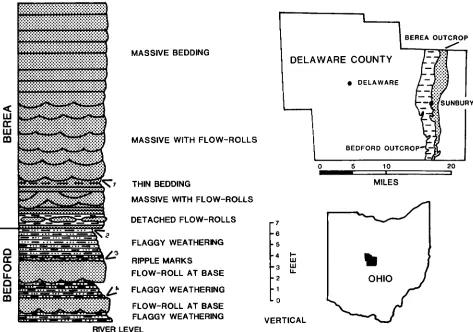
and markedly erosional in northern Ohio, but becomes conformable and gradational to the south, with similar lithological sequences developed in the upper part of the Bedford Shale and the lower part of the Berea Sand- stone. In southern Ohio and northern Kentucky, the two formations are thin and cannot be differentiated. At the Sunbury exposure (see Fig. 1) the contact does not appear to be erosional although channelling has been reported in the area (Pepper et al., 1954). The formation boundary is there taken at the upward change from flaggy weathering shaly siltstones and thin sandstones to more massive sandstones with flow rolls.
SAMPLE DETAILS
The Bedford Shale-Berea Sandstone boundary is well exposed in a bluff on the west side of Big Walnut Creek immediately downstream from the Croton Road bridge at Sunbury, Ohio (SE
b,
SE $, sec. 1, T4N, R17W, Sunbury, 1973,71' quadrangle, Delaware County). Four samples were collected as indicated in Fig. 1.1. Thin shale within Berea Sandstone immediately below massive sandstone with flow rolls.
2. Shale at top of Bedford Shale, immediately below 3. Silty shale, 3 ft. below the top of the Bedford Shale, 4. Silty shale 6ft. 4in. below the top of the Bedford Figured material is housed in the Palynological Collec- tions of the British Geological Survey, Keyworth, Nottingham, England, and registered in the series MPK 4007-4030. Representative assemblage slides from all four samples will be deposited in the collections of the British Geological Survey, Keyworth and the Depart- ment of Geology, University of Arkansas, Fayetteville, Arkansas, U.S.A.
the contact.
resting on a ripple marked surface. Shale.
MASSIVE BEDDING
MASSIVE WITH FLOW-ROLLS
THIN BEDDING
MASSIVE WITH FLOW-ROLLS
STRATIGRAPHIC PALYNOLOGY
a) Miospores
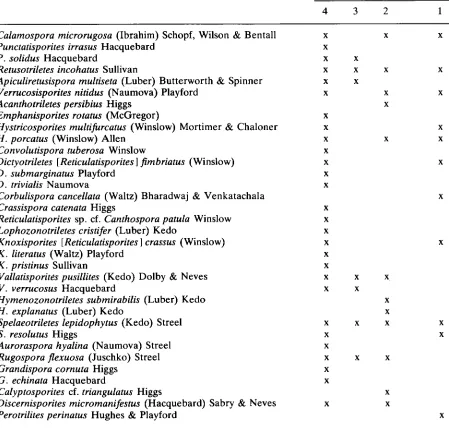
The composition of the miospore assemblages from the four samples studied are represented diagrammatically in Table 1. All the assemblages are well preserved, but
DETACHED FLOW-ROLLS
FLAGGY WEATHERING
RIPPLE MARKS FLOW-ROLL AT BASE
FLAGGY WEATHERING
FLOW-ROLL AT BASE FLAGGY WEATHERING RlVER LEVEL
DELA
-7
BEREA OUTCROPI
WARE COUNTY0 DELAWARE
0 5 10 20
MILES
1
Table 1.
MIOSPORE TAXA
Stratigraphic distribution of miospores
Bedford Berea
4 3 2 1
Calamospora rnicrorugosa (Ibrahim) Schopf, Wilson & Bentall Punctatisporites irrasus Hacquebard
P. solidus Hacquebard
Retusotriletes incohatus Sullivan
Apiculiretusispora rnultiseta (Luber) Butterworth & Spinner Verrucosisporites nitidus (Naumova) Playford
Acanthotriletes persibius Higgs Emphanisporites rotatus (McGregor)
Hystricosporites rnultifurcatus (Winslow) Mortimer & Chaloner H. porcatus (Winslow) Allen
Convolutispora tuberosa Winslow
Dictyotriletes [Reticulatisporites
I
firnbriatus (Winslow) D. subrnarginatus PlayfordD . trivialis Naumova
Corbulispora cancellata (Waltz) Bharadwaj & Venkatachala Crassispora catenata Higgs
Reticulatisporites sp. cf. Canthospora patula Winslow Lophozonotriletes cristifer (Luber) Kedo
Knoxisporites [Reticulatisporites
I
crassus (Winslow)K . literatus (Waltz) Playford
K . pristinus Sullivan
Vallatisporites pusillites (Kedo) Dolby & Neves V. verrucosus Hacquebard
Hymenozonotriletes submirabilis (Luber) Kedo H . explanatus (Luber) Kedo
Spelaeotriletes lepidophytus (Kedo) Streel
S. resolutus Higgs
Auroraspora hyalina (Naumova) Streel Rugospora flexuosa (Juschko) Streel Grandispora cornuta Higgs
G. echinata Hacquebard
Calyptosporites cf. triangulatus Higgs
Discernisporites micromanifestus (Hacquebard) Sabry & Neves Perotrilites perinatus Hughes & Playford
that from sample 4 (6ft. 4ins. below the top of the Bedford Shale) is the most diverse. The commonest components of all four assemblages are representatives of the species Spelaeotriletes lepidophytus. The Bedford Shale assemblages (samples 2 , 3 and 4) are characterised by the following miospore association: Retusotriletes incohatus, Apiculiretusispora rnultiseta, Hystricosporites rnultifurcatus, Convolutispora tuberosa, Dictyotriletes [Reticulatisporites
3
firnbriatus, D . trivialis, Crassispora catenata, Reticulatisporites sp. cf. Canthospora patula, Lophozonotriletes cristifer, Vallatisporites pusillites, V . verrucosus, Spelaeotriletes lepidophytus, S. resolutus, Auroraspora hyalina, Rugospora flexuosa and Grandi-X X
X
X X
X X X
X X
X X
X X X X X X X X X X X X X X X
X X X
X X
X X
X X X
X X
X X X
X X X X X X X X X X X X X X X X
spora echinata. In the uppermost Bedford shale sample (sample 2, adjacent to the contact with the Berea Sand- stone) the assemblages are supplemented by the appear- ance of Acanthotriletes persibius, Hyrnenozonotriletes explanatus, H . submirabilis and Calyptosporites cf. triangulatus.
appearance in this sample and Emphanisporites sp.,
Hymenozonotriletes explanatus, Vallatisporites pusillites, Rugospora jlexuosa and Calyptosporites triangulatus,
present in the Bedford Shale, are absent here. The difference between the assemblages from these two formations may reflect stratigraphical distribution of the components, but may equally be the result of environ- mental controls.
Comparison with other North American assemblages
The most extensive previous study of late Devonian
-
early Mississippian palynomorph assemblages in the north-central United States is that of Winslow (1962) based on material from surface and borehole sections in central and northeast Ohio. One of Winslow’s sections (Locality 9) was in Franklin County, adjacent to Sunbury, where a comparable Bedford Shale and Berea Sandstone interval was examined together with part of the overlying Sunbury Shale. The results obtained from this section compare closely with those of the presentstudy. Spelaeotriles lepidophytus (recorded as Endo- sporites lacunosus) with Dictyotriletes fimbriatus (Reticulatisporites firnbriatus), Vallatisporites pusillites (Cirratriradites hystricosus and Lycospora sp. A),
Reticulatisporites sp. cf. Canthospora patula, Knoxi- sporites [ Reticulatisporites
I
crassus and Emphani- sporites rotatus (Radforthia radiata) were reported in both the Bedford Shale and Berea Sandstone. Only one species, Hystricosporites multifurcatus, which in the present study was recorded in the Bedford Shale and basal Berea Sandstone, was found to have a different range, being restricted to the Bedford Shale in Winslow’s account. The presence of Vallatisporites pusillites in Winslow’s Berea Sandstone assemblages supports the view that its absence from that formation in the Sunbury area is more probably the result of ecological controls than the result of its stratigraphical distribution.McGregor (1 970) has reviewed the distribution of
Spelaeotriletes lepidophytus from the Late Devonian rocks of Canada. He reported that Spelueotriletes
Explanation of Plate 1
Fig. 1. Emphanisporites rotarus (McGregor) McGregor, 1973. Specimen MPK 4007. Sample 1. England Finder co-
Fig. 2. Spelaeotriletes lepidophytus (Kedo) Streel, 1974. Specimen MPK 4008. Sample 2. England Finder co-
Fig. 3. Spelueotriletes lepidophytus (Kedo) Streel, 1974. Specimen MPK 4009. Sample 2. England Finder co-
Fig. 4. Emphanisporites rotatus (McGregor) McGregor, 1973. Specimen MPK 4010. Sample 1. England Finder co-
Fig. 5. Knoxisporites [Reticulatisporites] crassus (Winslow, 1962). Specimen MPK 401 1. Sample 4. England Finder
Fig. 6. Dictyorriletes [Reticulatisporites] fimbriatus (Winslow, 1962). Specimen MPK 4012. Sample 3. England
Fig. 7. Hymenozonotriletes explanatus (Luber) Kedo, 1963. Specimen MPK 4013. Sample 3. England Finder co-
Fig. 8. Hystricosporires porcatus (Winslow) Allen, 1965. Specimen MPK 4014. Sample 3. England Finder co-
Fig. 9. Hystricosporites rnultifurcatus (Winslow) Mortimer & Chaloner, 1967. Specimen MPK 4015. Sample 3.
Fig. 10. Unelliurn elongaturn Wicander, 1974. Specimen MPK 4016. Sample 2. England Finder co-ordinates N38/2
Fig. 11. Stelliniurn cornptum Wicander & Loeblich, 1977. Specimen MPK 4017. Sample 4. England Finder co-
Fig. 12. Umbellasphaeridiurn saharicum Jardine, Combaz, Magloire, Peniguel 8t Vachey, 1972. Specimen MPK
Fig. 13 Exochoderrna irregulare Wicander, 1974. Specimen MPK 401 9. Sample 4. England Finder co-ordinates ordinates N26/3 ( x 500).
ordinates M33/4 ( x 500).
ordinates N26/0 ( x 500).
ordinates M41/0 ( x 500).
co-ordinates M3 1 /O ( x 500).
Finder co-ordinates 01 6/3 ( x 500).
ordinates 029/2 ( x 500).
ordinates Q39/0 ( x 500).
England Finder co-ordinates N24/0 ( x 500).
( x 490).
ordinates 04311 ( x 780).
4018. Sample 4. England Finder co-ordinates 042/1 (x490).
lepidophytus, Dictyotriletes [ Reticulatisporites
1
firn-briatus, Lophozonotriletes cristifer and Vallatisporites pusillites were characteristic components of miospore
assemblages from the Kettle Point Formation in the Courtright Borehole, southern Ontario. The succeeding Bedford Shale has a similar assemblage, and in addition contains Retusotriletes incohatus, Hystricosporites (Dicrospora) multifurcatus, Knoxisporites (Archaeo- zonotriletes) literatus, and ?Hyrnenozonotriletes explanatus. Spelaeotriletes lepidophytus, Dictyotriletes [Reticulatisporites
1
firnbriatus and Vallatisporites pusillites were recorded also from the Berea Sandstone in the nearby Gibraltar Borehole. Independent bio- stratigraphical evidence for the age of these formations is extremely sparse, being limited to conodont evidence from the Kettle Point Formation (Winder, 1966), where the presence of Spathognathodus inornatus (Branson & Mehl) is taken to indicate an uppermost Upper Devonian age.Close comparisons can also be drawn with miospore assemblages documented by Streel & Traverse (1978) in their study of the Devonian
-
Mississippian transition in the classic Horseshoe Curve section near Altoona, Pennsylvania. The assemblages recovered from the Lower Sandstone Member and the Middle Sandstone and Shale Member of the Pocono Formation are closely comparable with those from the Bedford Shale and Berea Sandstone of the present study. Streel & Traverse recorded the presence of abundant Spelaeotriletes lepidophytus and Cirratriradites hystricosus ( = Vallati- sporites pusillites) in the Middle Sandstone and Shale Member, where they are accompanied by infrequent representatives of Rugospora flexuosa and Knoxisporites literatus. They noted the presence of Cirratriradites hystricosus ( = Vallatisporites pusillites) without Spelaeo- triletes lepidophytus in the Lower Sandstone Member, a situation which is anomalous compared with their relative distributions in western Europe. The highest sample from the Middle Sandstone and Shale Member of the Pocono Formation yielded an assemblage dominated by Dictyotriletes sp. and Hyrnenozonotriletes explanatus, in which neither Spelaeotriletes lepidophytusnor Vallatisporites were present. Streel & Traverse assigned an Fa 2c age to the Lower Sandstone Member, an upper Tn l a
-
lower Tn l b age to the Middle Sand- stone and Shale Member, and an upper Tn 1 b-
Tn 2 age to the uppermost part of that member. Direct compari- sons with central Ohio imply that the Bedford Shale and the lower part of the Berea Sandstone should be similarly assigned an upper Tn l a-
lower Tn l b age.In western Europe, Spelaeotriletes lepidophytus and
Vallatisporites pusillites are common components in sediments dated on independent conodont and fora- miniferal evidence as Fa 2d
-
Tn l a in the Dinant Basin of Belgium and northern France. In other areas (i.e. the Namur Basin and Sauerland), both species are knownalso to extend into the lower part of Tn 1 b. Both species have been utilised as zonal indices with their simul- taneous appearance defining the Vallatisporites pusillites - Spelaeotriletes lepidophytus (PL) Miospore Zone, the base of which is close to the base of Fa 2d. Other taxa from this zone in Belgium that were also recorded in the present Ohio samples include Rugospora flexuosa, Retusotriletes incohatus, Auroraspora hyalina and, in the uppermost part of the zone, isolated representatives of Hymenozonotriletes explanatus (see Clayton et al.
1977). In Belgium, the PL Zone is succeeded by the
Dictyotriletes trivialis
-
Hyrnenozonotriletes explanatus(TE) Miospore Zone, in which assemblages are charac- terised by abundant Hyrnenozonotriletes explanatus and
Dictyotriletes sp. This zone has, for facies reasons, a limited application and the alternative Verrucosisporites nitidus - Vallatisporites vallatus (NV) Miospore Zone erected in the South Munster Basin of southern Ireland is more widely used. Clayton et al. (1974) have sub- divided this zone into two subzones, the lower of which, the Spelaeotriletes lepidophytus
-
Verrucosisporites nitidus (LN) Subzone, has its base defined by the appearance of Verrucosisporites nitidus, which is present in the Bedford Shale and Berea Sandstone assemblages examined here. This subzone is also charac- terised by the continued occurrence of Spelaeotriletes lepidophytus and Vallatisporites pusillites (albeit with a lower frequency than in the preceeding PL Zone). Although a precise independent dating of the Irish sequence of miospore zones is not possible, it is probable that the LN Subzone of the NV Miospore Zone is of Late Devonian (lower Tn lb) age. The close similarity with the assemblages from the upper part of the Bedford Shale and the lower part of the Berea Sandstone would appear sufficient justification for a comparable lower Tn l b age assignment.b) Microplankton
Table 2.
MICROPLANKTON TAXA Bed ford
Stratigraphic distribution of microplankton
Berea
4 3 2 1
Cymatiosphaera spp.
Duvernaysphaera radiata Brito
Exochoderma irregulare Wicander
Florisphaeridium ? sp.
Gorgonisphaeridium ohioense (Winslow) Wicander
G . winslowii S t a p h , Jansonius & Pocock
Leiosphaeridia spp.
Maranhites mosesii (Sommer) Brito
Multiplicisphaeridium spp.
Polyedrixium aff. embudum Cramer
Pterospermella spp.
Puteoscortum polyankistrum Wicander & Loeblich
Stellinium comptum Wicander & Loeblich
Stellinium micropolygonale (Stockmans & Williere) Playford
Tasmanites spp.
Umbellasphaeridium saharicum Jardine et al. Unellium elongatum Wicander
Veryhachium roscidum Wicander
Veryhachium sp.
G . spp.
u.
sp.Winslow’s (1 962) account of the Upper Devonian and Lower Mississippian palynology of Ohio is concerned mainly with miospores. Nevertheless, it does contain descriptions and illustrations of several acritarch species from the Bedford Shale and Berea Sandstone, including
Unellium elongatum (as Hystrichosphaeridiurn cf. H.
longispinosum) and Gorgonisphaeridium ohioense (as
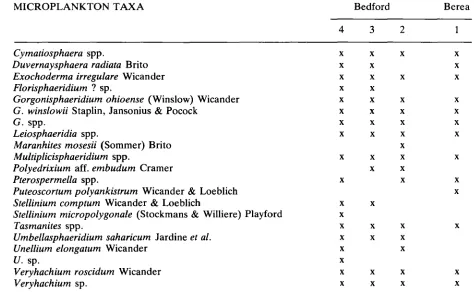
Hystrichosphaeridium ohioense), both of which have been recorded in the present study. More recently, Wicander (1 974, 1975) has reported specifically on the microplankton from the Bedford Shale and the under- lying Cleveland and Chagrin Shale Members of the Ohio Black Shale. In common with the present study, Wicander noted that levels of microplankton species diversity and abundance are low in the Bedford Shale. Wicander’s material was obtained from the Barberton test core 3, drilled in Summit County, northeastern Ohio. Comparison of sample depths given by Wicander
(1975) with stratigraphical data presented by Winslow
(1 962) indicates that Wicander’s uppermost sample was
collected immediately below the contact of the Bedford Shale with the Berea Sandstone, a position equivalent to that of sample 2 in this study. Wicander (1975) recorded only six taxa in his uppermost sample, five of which are
X X X X X X X X X X X X X X X X X X X X X X X X X X X X X X X X X
X X
X
X X
X X
X X
X X
X X
X
X X
X
X X
X
X X
X
X
X X
X X
also present in sample 2. These are Exochoderma irregulare, Gorgonisphaeridium ohioense, Leiosphaeridia
spp., Tasmanites spp. and Veryhachium roscidum. The sixth of Wicander’s species, Pterospermella capitana ,
has not been recorded in this study, but the genus
Pterospermella is represented in both the Bedford Shale and Berea Sandstone. Another species present in sample 2, Unellium elongatum, was also described by Wicander from the Bedford Shale, but he recorded its latest occurrence within the top loft. of the Bedford Shale, not immediately below the Berea Sandstone as in this account. The occurrence of all these taxa in samples 3 and/or
4
is however consistent with Wicander’s record of their occurrence in the Bedford Shale.The major difference between Wicander’s study and the present account lies in the occurrence of species not previously recorded from the Bedford Shale or Berea Sandstone. However, four species do have North American records. Stellinium comptum, Stellinium micropolygonale (as Stellinium octoaster) and Puteo- scortum polyankistrum have been recorded from the Antrim Shale of FrasnianIFamennian age in Indiana (Wicander & Loeblich, 1977). Stellinium micropoly-
Alberta (Staplin, 1961, as Veryhachium octoaster), from the Late Devonian Chagrin and Cleveland Shales under- lying the Bedford Shale in Ohio (Wicander, 1974,1975 as Stellinium octoaster), and from the Emsian, Eifelian and Givetian of the Moose River Basin, Ontario (Play- ford, 1977). The present record of these species in the Bedford Shale and Berea Sandstone is later than their previous North American records, and implies either reworking or an upward extension of their ranges. In the case of Stellinium micropolygonale, an upward extension of its range is quite possible since the species has been recorded from the latest Devonian elsewhere (e.g. Lanzoni & Magloire, 1969; Playford, 1976 and see the discussion below). The fourth species with a previous North American record, Gorgonisphaeridium winslowii,
was recorded from the Lower Mississippian Banff Formation of Alberta (Staplin et al., 1965). Species recorded herein that do not have prior North American records, include Duvernaysphaera radiata, Maranhires mosesii and Umbellasphaeridium saharicum
.
Several species have well documented occurrences outside North America. Five species have been recorded by Lanzoni & Magloire (1 969) from the Upper Devonian and Lower Carboniferous of the Grand Erg Occidental in the Algerian Sahara. According to these authors,
Duvernaysphaera radiata and Maranhites mosesii are present in the Upper Famennian, Strunian (i.e. pre- Carboniferous Tournaisian, Tn l a and lower Tn lb) and
Lower Tournaisian (i.e. Carboniferous), Gorgoni- sphaeridium ohioense (recorded as “Baltisphaeridium
sp. No. 419-47”) occurs in the Upper Famennian and Strunian, and Stellinium micropolygonale ( = Very- hachium octoaster) and Umbellasphaeridium saharicum
(recorded as “acritarche a entonnoirs’ no. 441-33”) are restricted to the Strunian. Subsequent work in the Algerian Sahara has extended the range of some of these species. Jardine et al. (1 974) recorded Duvernaysphaera radiata between the Couvinian or Givetian and the Strunian, Stellinium micropolygonale ( = Stellinium octoaster) between the Siegenian and the Strunian,
Maranhites mosesii between the Frasnian and the Strunian and Umbellasphaeridium saharicum between the Frasnian or Famennian and the Strunian. Attaret al.
(1980) confirmed that Maranhites mosesii is present in the Lower Tournaisian of the Basin d’Illizi, also in the Algerian Sahara, whereas Umbellasphaeridium saharicum
does not occur above the Strunian. Attar et al. also illustrated a specimen of Gorgonisphaeridium winslowii
from the Strunian.
Outside North Africa, Duvernaysphaera radiata, Maranhites mosesii and Umbellasphaeridium saharicum
are present in the Middle and Upper Devonian of Brazil (Sommer, 1956; Brito, 1967a, 1967b). Stellinium micropolygonale has a widespread and long-ranging occurrence although it appears to be restricted to the Devonian (see Playford, 1976; Wicander & Loeblich,
Explanation of Plate 2
Fig. 1. Cymatiosphaera sp. Specimen MPK 4020. Sample 4. England Finder co-ordinates H54/0 ( x 780). Fig. 2. Stellinium micropolygonale (Stockmans & Williere, 1960) Playford, 1977. Specimen MPK 4021. Sample 4.
Fig. 3. Pterospermella sp. Specimen MPK 4022. Sample 1. England Finder co-ordinates 04211 ( x 490).
Fig. 4. Puteoscortum polyankistrum Wicander & Loeblich, 1977. Specimen MPK 4023. Sample 1. England Finder
Fig. 5. Duvernaysphaera radiata Brito, 1976b. Sample 1. Specimen MPK 4024. England Finder co-ordinates E46/0
Fig. 6. Muranhites mosesii (Sommer, 1956) Brito, 1967a. Specimen MPK 4025. Sample 2. England Finder co-
Fig. 7. Puteoscortum polyankistrum Wicander & Loeblich, 1977. Specimen MPK 4026. Sample 1. England Finder Fig. 8. Gorgonisphaeridium winslowii Staplin, Jansonius & Pocock, 1965. Specimen MPK 4027. Sample 2. England
Figs. 9,12. Polyedrixium aff. embudum Cramer, 1964. Specimen MPK 4028. Sample 2. England Finder co-ordinates
Fig. 10. Tasmanites sp. Specimen MPK 4029. Sample 2. England Finder co-ordinates 066/0 ( x 490).
Fig. 11. Gorgonisphaeridium ohioense (Winslow, 1962) Wicander, 1974. Specimen MPK 4030. Sample 2. England England Finder co-ordinates T60/3 ( x 1200).
co-ordinates J37/2 ( x 780).
( x 780).
ordinates 04210 (x 490).
co-ordinates S59/3 ( x 780). Finder co-ordinates 042/4 ( x 780).
U51/3 ( x 490).
1977; Martin, 1981 for summaries of the geographical and stratigraphical distribution of this species). In Western Australia, Playford (1 976) has recorded
Gorgonisphaeridium ohioense and Stellinium micropoly- gonale ( = Stellinium octoaster) from the latest Devonian (Famennian Fa 2d to Strunian Tn l a or early Tn lb) of the Canning Basin. In Belgium, Vanguestaine (1978)
has recorded Gorgonisphaeridium ohioense, Stellinium micropolygonale ( = Stellinium octoaster) and Very- hachium roscidum from the Upper Famennian (Fa 2c, Fa 2d) and the Strunian (Tn la) in the Dinant Basin, and Martin (1 98 1) has recorded Exochoderma irregulare, Stellinium comptum, Stellinium micropolygonale and
Unellium elongatum in the upper part of the Lower Famennian on the southern margin of the Dinant Basin.
CONCLUSIONS
The miospores recorded in this account from the Bedford Shale and Berea Sandstone provide the princi- pal evidence for a Late Devonian (pre-Carboniferous Tournaisian) age and most of the microplankton recorded are consistent with this. Gorgonisphaeridium ohioense, Stellinium micropolygonale and Umbella- sphaeridium saharicum do not occur above the Late Devonian in sections which cross the Devonian -
Carboniferous boundary in North Africa (Lanzoni &
Magloire, 1969; Attar et al., 1980) and in Western Australia (Playford, 1976). The ranges of other species present, as documented above, coincide in part with the latest Devonian. Stellinium comptum and Puteoscortum polyankistrum are the exceptions, and have not been
recorded previously above the Famennian.
The ages proposed herein and by Eames (1978) for the Bedford Shale and Berea Sandstone in central and northeastern Ohio mean that the published ranges of several species need to be revised. These are the species for which a Mississippian occurrence is based solely on Wicander’s (1974,1975) record of their presence in the Bedford Shale which he regarded as being of Mississip- pian age following Winslow’s (1962) account. They include Exochoderma irregulare, Gorgonisphaeridium ohioense, Veryhachium roscidum and Unellium elon- gatum. There is, so far, no evidence that any of these or the other species described by Wicander range upwards into the Carboniferous.
Wicander & Loeblich (1977) have commented on the apparent rarity of cosmopolitan microplankton species in the Late Devonian, pointing out that only five species occurring in the Late Devonian of North America had been recorded elsewhere in the world. However, Vanguestaine (1 978) and Martin (1 98 1) have recorded a number of North American species in the Late Devonian of Belgium, and the present work documents the occurrence in North America of species previously recorded from North Africa, South America and
Australia. There are still considerable differences between worldwide Late Devonian microplankton assemblages. A number of species described from North America have yet to be recorded elsewhere, but some taxa appear to be more widespread than hitherto realised. Further work is needed to clarify the extent of microplankton provincialism in the late Devonian.
REFERENCES
Attar, A., Fournier, J., Candilier, A. M. & Coquel, R., 1980. Etude palynologique du DCvonian terminal, et du Carboni- fere infkrieur du bassin d’Illizi (Fort-Polignac) AlgCrie. Rev. Inst. Fr. Pet., 35, 585-618.
Brito, I. M. 1967a. Novo subgrupo de acritarcha do Devoniano do Maranhilo. A n . Acad. Brasil Ci., 39, 163-6.
Brito, I. M. 1967b. Silurian and Devonian acritarcha from Maranhao Basin, Brazil. Micropaleontology, 13, 473-82. Clayton, G., Higgs, K. J., Gueinn, K. J. & Van Gelder, A.
1974. Palynological correlations in the Cork Beds (Upper Devonian - ?Upper Carboniferous) of southern Ireland. Proc. R . Ir. Acad., Sec. B. 74, 145-155.
Clayton, G., Coquel, R., Doubinger, J., Gueinn, K. J., Loboziak, S., Owens, B. & Streel, M. 1977. Carboniferous Miospores of Western Europe: illustration and zonation. Meded. Rijks Geol. Dienst., 29, 1-71.
Conil, R., Groessens, E. & Pirlet, H. 1977. Nouvelle charte stratigraphique du Dinantien type de la Belgique.Ann. SOC. Geol. Nord., 96 (4), 363-371.
Cramer, F. H. 1964. Microplankton from three Paleozoic formations in the province of L e h , N.W. Spain. Leidse Geol. Meded., 30, 253-361.
De Witt W., Jr. 1970. Age of the Bedford Shale, Berea Sand- stone and Sunbury Shale in the Appalachian and Michigan Basins, Pennsylvania, Ohio and Michigan. US. Geol. Surv. Eames, L. E. 1978. A palynologic interpretation of the
Devonian - Mississippian boundary from northeastern Ohio, U S A . (abst.) Palynology, 2, 218-219.
Haas, W. H. 1947. Conodont zones in the Upper Devonian and Lower Mississippian formations of Ohio. J . Paleont., 21,
Hoover, K. V. 1960. Devonian
-
Mississippian Shale sequence in Ohio. Ohio Geol. Surv., Inf. Circ., 27, 1-154.Jardine, S., Combaz, A., Magloire, L., Peniguel, G. & Vachey, G. 1972. Acritarches du Silurien terminal et du DCvonien du Sahara algerien. C . R . 7e Congr. Int. Carb. Stratigr. Geol. (Krefeld 1971), 1, 295-311.
Jardine, S., Combaz, A., Magloire, L., Peniguel, G. & Vachey, G. 1974. Distribution stratigraphique des acritarches dans le Paleozoique du Sahara algCrien. Rev. Palaeobotan. Palynol., 18, 99-129.
Lanzoni, E. & Magloire, L. 1969. Associations palynologiques et leurs applications stratigraphiques dans le DCvonien supCrieur et Carbonifkre infkrieur du Grand Erg Occidental (Sahara algkrien). Rev. Inst. Fr. Pet., 24; 441-68.
Martin, F. 1981. Acritarches du Famennien infkrieur a Villers- sur-Lesse (Belgique). Bull. Inst. r . Sci. nut. Belg., 51, 1-49. Bull., 1294-G, G1-Gll.
131-14 1.
McGregor, D. C. 1967. Composition and range of some Devonian spore assemblages in Canada. Rev. Palaeobotan. Palynol., 1, 173-183.
McGregor, D. C. 1970. Hymenozonotriletes lepidophyrus Kedo and associated spores from the Devonian of Canada. in Colloque sur la Stratlgraphie du Carbonifere. Congres et Colloques Univ. Liege, 55, 315-326.
McGregor, D. C. 1979. Devonian miospores of North America. Palynology, 3, 31-52.
Pepper, J. F., De Witt, W. Jr., & Demaret, D. F. 1954. Geology of the Bedford Shale and Berea Sandstone in the Appalachian Basin. U.S. Geol. Surv. Prof. Pap., 259, 1-111.
Playford, G. 1976. Plant microfossils from the Upper Devonian and Lower Carboniferous of the Canning Basin, Western Australia. Palaeontographica, Abt. B., 158, 1-71.
Playford, G. 1977. Lower to Middle Devonian acritarchs of the Moose River Basin, Ontario. Bull. geol. Surv. Can., 279,
Sommer, F. W. 1956. Novas especies de Tasmanites do Devoniano do Para. A n . Acad. Brasil Ci., 28, 455-63. Staplin, F. 1961. Reef controlled distribution of Devonian
microplankton in Alberta. Palaeontology, 4, 392-424. Staplin, F., Jansonius, J. & Pocock, S. A. J. 1965. Evaluation of
some acritarchous hystrichosphere genera. N. Jb. Geol. Paliiont. Abh., 123, 167-201.
Stockmans, F. & Williere, Y. 1960. Hystrichosphkres du DCvonien belge (Sondage de 1’Asile d’aliCnCs a Tournai). Senckenberg. lerh., 41, 1-11.
Streel, M. & Traverse, A. 1978. Spores from the Devonian/ Mississippian transition near the Horseshoe Curve section, Altoona, Pennsylvania, U.S.A. Rev. Palaeobotan. Palynol.,
26, 21-39.
Vanguestaine, M. 1978. Acritarches du Famennien superieur du sondage de Tohogne (Belgique) et correlation biostrati- graphique transcontinentale. Palinologia, num. extraord. 1,
Wicander, E. R. 1974. Upper Devonian - Lower Mississippian acritarchs and prasinophycean algae from Ohio, U.S.A. Palaeontographica Abt. B, 148, 9-43.
Wicander, E. R. 1975. Fluctuations in a late Devonian-early Mississippian phytoplankton flora of Ohio, U.S.A. Palaeo- geogr. Palaeoclimatol. Palaeoecol., 17, 89-108.
Wicander, E. R. & Loeblich, A. R. 1977. Organic-walled microphytoplankton and its stratigraphic significance from the Upper Devonian Antrim Shale, Indiana, U.S.A. Palaeontographica Abt. B, 160, 129-65.
Winder, C. G. 1966. Conodont zones and stratigraphic variability in Upper Devonian rocks, Ontario. J . Paleontol., Winslow, M. R. 1962. Plant spores and other microfossilsfrom the Upper Devonian and Lower Mississippian rocks of Ohio.
US. Geol. Surv. Prof. Pap., 364, 1-93. 87 PP.
48 1-48 7.