ISSN 2185-3762
Becoming a Language Learning Advisor: Insights from a Training Program in Brazil
Walkyria Magno e Silva, Federal University of Pará, Belém, Brazil
Eduardo Castro, Federal University of Pará, Soure, Brazil
Corresponding author: [email protected]
Publication date: December, 2018.
To cite this article
Magno e Silva, W., & Castro, E. (2018). Becoming a language learning advisor: Insights from a training program in Brazil.Studies in Self-Access Learning Journal, 9(4), 415-424.
To link to this article
http://sisaljournal.org/archives/dec18/silva_castro
This article may be used for research, teaching and private study purposes. Please contact the authors for permission to re-print elsewhere.
Becoming a Language Learning Advisor: Insights from a Training
Program in Brazil
Walkyria Magno e Silva, Federal University of Pará, Belém, Brazil Eduardo Castro, Federal University of Pará, Soure, Brazil
Abstract
Advising in language learning is a relatively new field in applied linguistics that has attracted a great deal of attention recently as a result of its focus on individual language learning trajectories. It is an effective way of fostering learner autonomy, motivation and
self-regulation as it encourages reflection on the language learning process. In this regard, proper training must be provided for language learning advisors. This paper briefly describes a training program conducted with fourteen pre-service language advisors at a university in northern Brazil. Using a focus group interview and an open questionnaire, the authors explore its effects on those who participated in that training program, by reporting on participants’ initial advising trajectories. Implications for future training is discussed.
Keywords: language advising, learning advisor, training program, self-access center.
Over the last few years, advising in language learning has been implemented in several
universities around the world. Because of its focus on individual and personal learning
trajectories, several authors have given a great deal of attention to language advising (e.g.
Castro, 2018; Kato & Mynard, 2016; Magno e Silva & Borges, 2016; Mozzon-McPherson &
Vismans, 2001; Mynard & Carson, 2012). It is a learning resource usually taking place in
self-access centers that aims to help learners to become more aware, reflective, and effective
regarding their language learning, so they can become more autonomous, motivated and
self-regulated learners (Ciekanski, 2007; Kato & Mynard, 2016; Mozzon-McPherson, 2007). By
engaging in advising sessions, the learner is encouraged to be an active agent in charge of
choosing, designing and evaluating learning plans with the support of a language advisor, a
person who guides learners’ learning processes, rather than directs it (Mynard, 2012).
The language advisor’s role is different from that of a teacher as advisors do not tell
learners what they should do, but encourage reflection on the learning process and, thus,
agency on the learners’ side (Kato, 2012; Kato & Mynard, 2016; Mozzon-McPherson &
Vismans, 2001). They do so by helping learners to “define their needs, formulate learning
and the learning process, and make decisions for further learning” (Tassinari, 2016, p. 77). As
language advisors put into practice a set of unique skills that differentiate them from language
teachers, Kato (2012) highlights the importance of specific initial and ongoing advising
training programs. This paper describes the first training program for language advisors
offered at a university in Brazil. More specifically, this paper attempts to explore how
participants experienced that training by reporting on their initial trajectories as language
advisors.
In the interest of clarity, we first briefly describe the context where the training
program took place. Next, we show the steps undertaken and, in the third section, we show
the results implementing such a program.
Background: The Autonomous Learning Support Base (BA3)
The Autonomous Learning Support Base (BA3) at the Federal University of Pará in
Belém, Brazil, is the self-access center open for language learners of this university. Tracing
its origins back to 2004, BA3 was created as a space for encouraging learner autonomy from a
social learning perspective (Magno e Silva, 2018). In its early stages, the support consisted of
strategic training through a learning contract established between a learner and a tutor,
whether a teacher or a voluntary student-assistant (Magno e Silva, 2008). However, it soon
became clear that students needed training that focused on more than learning styles and
strategies as they kept reacting to tutors’ directions without taking steps towards their own
paths in learning.
Back in 2008, the hypothesis was that learners were not autonomous because they
were not motivated enough to move from the pre-actional to the actional phase of motivation
(cf. Dörnyei, 2001). Inspired by that, we studied motivation in order to understand its
relationship with autonomy and eventually better support our language learners’ learning
processes. At the end of the project in 2011, we agreed that autonomy and motivation are
complementary constructs, one feeding into the other (Magno e Silva, 2012). However, we
also noticed the nonlinear nature of such a relationship as learners were still not autonomous,
even though motivation had been the focus of their training at that time.
The need to provide more personal and individual support for the development of
autonomy, self-regulation, and motivation became apparent in our research group when Ana
learning and the role played by emotions in this process (Murphey, 2006). The first author of
this paper also remembered a talk about advising in language learning given by Marina
Mozzon-McPherson in Brazil a few years before when she first heard about language
advising. After looking for some basic references in the field that were available online, we
then initiated our self-training in advising.
As there is no other advising center in Brazil, we had to train ourselves through
reading articles and books on advising, participating in discussions about such materials, and
later reflecting on our initial practices, but it was the first author’s 2013 visit to the University
of Hull that consolidated our advising practices. Since then, advising in language learning has
been systematically offered for language learners of our institution, leading to positive results
in their learning trajectories (cf. Magno e Silva, Dantas, Matos & Martins, 2013; Magno e
Silva, Matos & Rabelo, 2015; Castro & Magno e Silva, 2016; Castro, 2018, among others).
Currently, there are 10 language advisors at our self-access center attending around 15
learners.
The language advising service is optional and usually offered to students majoring in
teaching foreign languages. That means that these learners are pursuing a degree in order to
become foreign language teachers. The advising service consists of individual meetings
between an advisor and a student where they work together until the student feels confident
enough to continue his or her learning without the advisor’s support. It is noteworthy to
mention that they are fixed pairs and the student can take as many sessions as he or she feels
necessary. Advising sessions are usually weekly, last from 20 to 45 minutes and can be
conducted in Brazilian Portuguese or in a foreign language, according to learner’s language
competencies and preferences.
Training Program for Language Learning Advisors
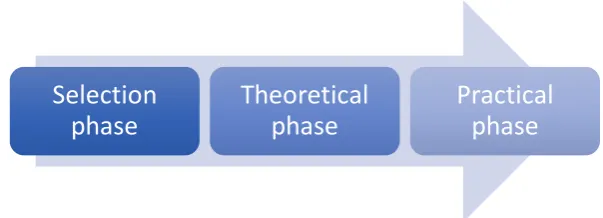
The training program for language advisors lasts four months and is divided into three
Figure 1. Stages of the Training Program for Language Learning Advisor
Stage 1: Selection phase
The first phase involved a call for applications in which people were asked to send a
motivation letter to the first author stating the reasons why they wanted to participate in the
training program. When applying, pre-service language advisors were directed to a selection
of basic texts on advising they should read before the second phase of the training program
strategies (e.g. Aoki, 2012; Kato, 2012; Kato & Mynard, 2016; Kelly, 1996; Magno e Silva,
2012; Mozzon-McPherson, 2007; Mynard, 2012; Stickler, 2001). They were then invited to
take part in a focus group interview conducted by the first author and five other experienced
language advisors. The aim of this interview was to observe some potential characteristics,
such as being a good listener, empathetic, flexible, trustworthy, humble, motivating, tolerant
to ambiguity, among other traits. Moreover, the interview also aimed to identify some beliefs
about language learning and teaching, as well as their motivation for participating in the
training. They all sat around an oval table with advisors and trainees intermingled.
The rationale for having a focus group interview was based on our belief that every
language advisor can be a language teacher, but not all language teachers can be language
advisors. In the focus group interview, pre-service language advisors were asked about (a)
their language learning experience, (b) what they expected from the training program, (c) their
best and worst experiences as language learners, (d) what it meant to be an effective language
teacher and advisor, (e) the difference between teaching and advising, and (f) how foreign
languages should be learned and taught. Participants talked freely about their ideas on the
topics and reacted to others’ opinions. Senior advisors refrained from interfering in the
conversation but kept a close eye on trainees’ use of language and especially on how they
reacted to others’ statements. Table 1 below presents the profile of trainees who participated
in the first stage of the training program.
Selection
Table 1.
Participants of the Training Program
Major Male Female
English 1 7
French 0 4
Spanish 1 1
Stage 2: Theoretical discussion phase
The second stage of the training program involved the theoretical preparation that
language advisors should have in order to effectively work with learners. This stage took the
form of a group discussion, which was divided into two sub-phases. In the first one, an
experienced language advisor guided the discussion with a small group of trainees, based on
the texts previously read by them. In the second one, a whole-group discussion took place
where questions were addressed. The theoretical phase focused on language advising,
including the role of advisor and advisee, dialogue, tools, and advising process.
In this stage new advisors were encouraged to gain awareness of the difference
between the discourse of advising and that of language teaching (cf. Kato, 2012). The
theoretical preparation entails a reflection on one’s own beliefs about language learning and
teaching, which may facilitate or hinder the emerging role as a language advisor. It is not
unusual to encounter misconceptions on the role of advisors as those who adopt a directive
approach to language learning (i.e. tell students what exactly they should do) or deal with
issues that go beyond the scope of language learning.
This session produced two hours of vibrant discussion and resulted in the expression
of several insecurities about the effectiveness of the job, as participants felt somewhat puzzled
by the new perspective they were facing.
Stage 3: Practical phase
The practical stage aimed at putting advising into action and was organized into two
sub-phases. The first took the form of a role play where new advisors were paired with each
other, one playing the part of “the advisor” and the other “the learner”. Under the supervision
of an experienced language advisor, they were encouraged to address real cases prompted by
experienced language advisors who also asked participants reflective questions regarding their
practice (such as: What strategy did you implement? Why did you choose this one? What
other strategy could you have used?) By doing this, they could make informed decisions
regarding their practice.
Table 2.
Examples of cards for role-playing in the language advisor training program
✓ Learner says: “I don’t understand anything that the teacher says in the classroom”. ✓ Learner says: “I can’t understand academic texts written in a foreign language”. ✓ Learner says: “I’ve been studying so hard, but I can’t get good grades in the foreign
language exams”.
✓ Learner says: “I will not study a foreign language here anymore. I will study it in a
different course. After I learn the language, I will come back here to finish my major”.
✓ Learner says: “I want to improve my vocabulary”. ✓ Learner says: “I can’t write in a foreign language”.
✓ Learner says: “I couldn’t do the assignments because I have no time”.
In the second sub-phase, the pre-service language advisors observed the language
advising sessions of more experienced language advisors. The learners were clearly informed
beforehand about the objectives and focus of the observation. The pre-service language
advisors were urged to take notes on what can be considered as relevant aspects for their
preparation, namely, how the language advisors initiate, develop and close a session, which
advising strategies are implemented, and how goals and learning plans are set. When the
advising session was over, senior advisors and trainees could exchange ideas and clarify the
trainee’s doubts if necessary.
Pre-service language advisors observed as many sessions as they felt necessary. A
minimum of two was established, but most of them were present for at least three encounters
in order to get a feeling of progress in the process. The trainees themselves were the ones to
tell when they were ready to start advising.
What Have We Learned from This Experience? Implications for Future Training
Programs
After the training program, an online questionnaire was sent to the participants to
understand their experiences as well as their suggestions for improvement. Some of the
suggestions given were related to the time constraints for the theoretical discussion phase, as a
couple of participants felt more time could be dedicated for such. Although this phase could
have been extended, it is undeniable that one learns how to advise by doing it, as long as
mentoring is provided. This practical characteristic of the training program was highlighted
by all the participants as a positive feature of the training. For future training programs, it
would be ideal to include more time for theoretical discussion and practical advising
activities.
Another positive result was that participants perceived the training program as an
opportunity for professional development, highlighting not only the motivation to become
language advisors, but also how they would implement some of the ideas into their language
classrooms. One of the participants stated, “I decided to participate in the training because I
have studied about the subject and I wish to experience what I have read. Besides that, it is a
way of contributing a little bit to our society and to make a difference in someone’s life”.
Another participant reported, “I hope to present to my students more efficient learning
strategies and help them to become more autonomous in relation to their own learning”.
These comments highlight some positive effects on the participants.
Initially, fourteen pre-service language advisors took part in the training but only five
are currently advising at BA3. As the others came from different institutional affiliations, it
was already expected that they would implement what they had learned in their own contexts.
Therefore, having five more language advisors in the current team is beyond a positive result,
not only because more language learners will be attended to, but also because they found a
way of developing as professionals in advising. For example, one of the participants wrote her
final undergraduate paper on the effects of the training program in her professional life,
another has been conducting master’s degree research on the intersection between advising
and learning regulation, and three of them are finalizing a manuscript reporting their
Conclusion
The training program reported in this paper represents the first attempt of a systematic
training program for language advisors in Brazil. Although this represents a first step towards
the role of language advisor in this particular context, it is important to highlight that this is
not an isolated, unique moment for training. Language advisors, whether they are less or more
experienced, should continue reflecting on their practices, on what works best for their
learners, acknowledging the catalyst nature of their role.
Notes on the Contributors
Walkyria Magno e Silva is a professor of Applied Linguistics at the Federal University of
Pará, Brazil, where she teaches doctoral and masters students in the graduate program, and
also undergraduate TEFL students. Her research interests include autonomy, motivation, and
language advising in foreign language learning. In the last few years she has analyzed these
themes under the complexity systems paradigm. She has published in journals and books in
her country and abroad.
Eduardo Castro is a teacher of English language and literature at the Federal University of
Pará, Brazil, where he also acts as a language advisor at the self-access center of that
institution. His research interests include motivation, language advising, and affect in
References
Aoki, N. (2012). Can-do statements for advisors. In C. Ludwig & J. Mynard (Eds.), Autonomy in
Language learning: Advising in action (pp. 154–163). Canterbury, UK: University of
Kent.
Castro, E. (2018). Complex adaptive systems, language advising, and motivation: A longitudinal case study with a Brazilian student of English. System, 74(3), 138–148.
https://doi.org/10.1016/j.system.2018.03.004
Castro, E., & Magno e Silva, W. (2016). O efeito do aconselhamento linguageiro na trajetória de aprendizagem de uma estudante de inglês [The effect of language advising on the
trajectory of a student of English]. In W. Magno e Silva & E. Borges (Eds.),
Complexidade em ambientes de aprendizagem de línguas adicionais (pp. 139–158).
Curitiba: Editora CRV.
Ciekanski, M. (2007). Fostering learner autonomy: Power and reciprocity in the relationship between language learner and language learning adviser. Cambridge Journal of
Education, 37(1), 111–127. https://doi.org/10.1080/03057640601179442
Dörnyei, Z. (2001). Teaching and researching motivation. Harlow, UK: Pearson Educational Limited.
Kato, S. (2012). Professional development for learning advisors: Facilitating the intentional reflective dialogue. Studies in Self-Access Learning Journal, 3(1), 74–92. Retrieved from https://sisaljournal.org/archives/march12/kato/
Kato, S., & Mynard, J. (2016). Reflective dialogue: Advising in language learning. New York, NY: Routledge.
Kelly, R. (1996). Language counselling for learner autonomy: The skilled helper in self-access language learning. In: R. Pemberton, E.S.L. Li, W. W. F. Or & H. D. Pierson (Eds.)
Taking control. Autonomy in language learning (pp. 93-113). Hong Kong: Hong Kong
University Press.
Magno e Silva, W. (2012). Autonomia, motivação e aconselhamento linguageiro na sala de aula de línguas estrangeiras [Autonomy, motivation, and language advising in foreign language classrooms]. In E. Mendes & J. C. C. Cunha (Eds.), Práticas em sala de aula de línguas:
Diálogos necessários entre teoria(s) e ações situadas (pp. 201–220). Campinas: Pontes.
Magno e Silva, W. (2016). Conselheiros Linguageiros como potenciais perturbadores de suas próprias trajetórias no sistema de aprendizagem [Language advisors as potential disturbers of their own trajectories in the learning system]. In W. Magno e Silva & E. Borges (Eds.),
Complexidade em ambientes de ensino e de aprendizagem de línguas adicionais (pp. 199–
220). Curitiba: Editora CRV. https://doi.org/10.24824/978854441014.1
Magno e Silva, W. (2017). The role of self-access centers in foreign language learners
autonomization process. In C. Nicolaides & W. Magno e Silva (Eds.), Innovations and
challenges in applied linguistics and learner autonomy (pp. 183–230). Campinas: Pontes
Magno e Silva, W. (2018). Autonomous learning support base: Enhancing autonomy in a TEFL undergraduate program. In G. Murray & T. Lamb (Eds.), Space, place and autonomy in
language learning (pp. 219–232). London, UK: Routledge.
Magno e Silva, W., & Borges, E. (Eds.) (2016). Complexidade em ambientes de aprendizagem de
línguas adicionais [Complexity in additional languages learning environments]. Curitiba:
Editora CRV.
Magno e Silva, W., Dantas, L., Matos, M. C., & Martins, M. (2013). Aconselhamento linguageiro no processo de aprendizagem de inglês [Language advising in the process of learning English]. Trabalhos em linguística aplicada, 52(1), 53–72. https://doi.org/10.1590/S0103-18132013000100004
Magno e Silva, W., Matos, M. C., & Rabelo, J. (2015). Trajetórias de aprendizagem,
aconselhamento linguageiro e teoria da complexidade [Learning trajectories, language advising and complexity theory]. Revista brasileira de linguística aplicada, 15(3), 361– 709. https://doi.org/10.1590/1984-639820156336
Mozzon-McPherson, M. (2007). Supporting independent learning environments: An analysis of structures and roles of language learning advisers. System, 35(1), 66–92.
https://doi.org/10.1016/j.system.2006.10.008
Mozzon-McPherson, M., & Vismans, R. (Eds.) (2001). Beyond language teaching towards
language advising. London, UK: Central Books.
Murphey, T. (2006). Language hungry! An introduction to language learning fun and self-esteem. Chichester, UK: Helbling Languages.
Mynard, J. (2012). A suggested model for advising in language learning. In J. Mynard & L. Carson (Eds.), Advising in language learning: Dialogue, tools and context (pp. 26–40). Harlow, UK: Pearson.
Mynard, J., & Carson, L. (Eds.) (2012). Advising in language learning: Dialogue, tools and
context. Harlow, UK: Pearson.
Stickler, U. (2001). Using counselling skills for language advising. In M. Mozzon-McPherson & R. Vismans (Eds.), Beyond language teaching towards language advising (pp. 40–52). London, UK: Central Books.