DETERMINATION OF WORK INDEX OF GRAPHITE FROM
SAMAN-BURKONO (NIGERIA) USING MODIFIED BOND'S METHOD
M. O. Adeoti
1,*, O. A. Dahunsi
2, O. O. Awopetu
3, F. O. Aramide
4, O. O. Alabi
5,
O. T. Johnson
6and A. S. AbdulKareem
71,
D
EPARTMENT OFM
ECHANICALE
NGINEERING,
F
EDERALP
OLYTECHNIC,
B
IDA,
N
IGERS
TATE,
NIGERIA
2,
D
EPT.
OFM
ECHANICALE
NGINEERING,
F
EDERALU
NIVERSITY OFT
ECHNOLOGY,
A
KURE,
O
NDOS
TATE,
NIGERIA
3,
D
EPT.
OFI
NDUSTRIAL&
P
RODUCTIONE
NGR’
G,
F
ED.
U
NIV.
OFT
ECHNOLOGY,
A
KURE,
O
NDOS
TATE,
NIGERIA
4,5,
D
EPT.
OFM
ETALLURGICAL&M
ATERIALSE
NGR’
G,
F
ED.
U
NIV.
OFT
ECHNOLOGY,
A
KURE,
O
NDOS
TATE,
NIGERIA
6,
D
EPARTMENT OFM
INING ANDM
ETALLURGICALE
NGINEERING,
N
AMUNDJEMBOM
ENGELA,
O
NGWEDIVA,
NAMIBIA
7,
D
EPT.
OFC
HEMICALE
NGINEERING,
F
EDERALU
NIVERSITY OFT
ECHNOLOGY,
M
INNA,
N
IGERS
TATE,
NIGERIA
E-mail addresses: 1 [email protected] 2 [email protected], 3 [email protected], 4 [email protected], 5 [email protected],
6 [email protected], 7 [email protected]
ABSTRACT
This report covers the work index determination of Saman-Burkono graphite. The test sample was obtained from Saman-Burkono in Ningi Local Government Area of Bauchi state, while reference material (coal) was sourced from Okaba coal mine, Ankpa Local Government Area of Kogi State. A known weight of graphite sample and coal were crushed, pulverized and ground using the laboratory milling machine. The two samples were grinded with two cells of diameter 3.5cm and 222g weight. The analysis of the feed size fort the two samples was found graphically to be 180μm and 175μm, and ball mill discharge was 130μm and 140μm respectively. The work index of a coal as reference material was 7.65 kWh/ short ton, this was used to calculate the work index of the graphite which was found to be 11.047 kWh/short ton, being the required energy to comminute one ton of graphite.
Keywords: Comminution, Graphite, Saman-Burkono, Nigeria, Modified Bonds method
1. INTRODUCTION
The insufficiency of energy resources in this present decade has led to the proper analysis of the energy requirements for use in engineering processes. One important aspect of the mineral industry is the comminution which invariably becomes the highest consumer of energy. NapierMunn [1] stated that 30 -50 per cent of the total plant power consumption for mineral processing plants and up to 70 per cent for hard ores is attributed to comminution. Comminution in the mineral processing plant is the sequence of crushing and grinding process, it is a process in which solid material are reduced in size, Crushing is a process whereby the particle size of run-off-mine ore is reduced to such a level that grinding can be carried
out until the mineral and gangues are substantially produced as separated particles [2, 3]. The grindability parameter which expresses the resistance of the material to crushing and grinding is known as Work index., numerically, it is the kilowatt hour per short ton required to reduce the material from theoretically infinite size to 80% passing 100 micron [3], work index determination using modified Bond's method can be compared to the method used by Berry and Bruce [4]. In this method, it requires the use of a reference ore of known grindability. Grindability can be defined as the ease with which materials can be broken into smaller particle sizes and the data obtained from these tests are used to calculate the required energy and grinding efficiency [5].
Vol. 38, No. 3, July 2019, pp.
609 – 613
Copyright© Faculty of Engineering, University of Nigeria, Nsukka,Determination of the required energy to effect rock-breakage is of fundamental importance in process design and which is achieved through work index. It was observed by Whittles that about 1.5 per cent of the annual electrical energy production in the United States of America is used in comminuting processes in the minerals industry [6] . Graphite is a crystalline and an allotropes of carbon that occurs as mineral, they can be used in many ways because of its resistance to high temperature, corrosive chemicals and its non-wettedness.
Graphite materials are good conductivity of heat and electricity with good refractory properties. The usefulness of graphite is dependent largely upon its types, the flake type is found to possess extremely low resistivity decreasing with increase in flaky particles; it finds a large use in the manufacture of carbon electrodes, plates and brushes required in the electrical industry and dry cell batteries. In the manufacture of plates and brushes, however, flake graphite has been substituted to some extent by synthetic amorphous, crystalline graphite and acetylene black. Graphite electrodes serve to give conductivity to the mass of manganese dioxide used in dry batteries. The manufacture of crucibles is served best by flake graphite, although crystalline graphite is also used [7]. Graphite crucibles are manufactured by pressing a mixture of graphite, clay and sand, fixing the pressed articles at a high temperature. They are used for melting non- ferrous metals, especially brass and aluminum. Coarse-grained flake graphite from Malagasy is regarded as standard for crucible manufacture [8].
Therefore, energy required to grind one tonne of an ore from a given feed size to a specified product size is a material property that needs to be determined for different mineral deposits. This work aimed at the determination of work index of Saman-Burkono graphite ore. The study used Okaba coal as a reference material with a comparative method to determine the Bond’s work index.
2. MATERIALS AND METHODS 2.1 Sample Collection
The graphite sample utilized in this research was obtained from the main bulk at Saman-Burkono graphite deposit in Ningi Local Government Area of Bauchi State, Nigeria, about 20 Kilometers away from Bauchi along Kano road with a coordinate of 11o 11’
reference material was sourced from Okaba coal mine, Okaba town in Kogi State, using random sampling method. The samples were collected in lumps size at different lode (Bulk deposit) locations of 10meters apart and 30meters depth within the deposit
2.2 Sample Preparation
The graphite samples were crushed to size reduced from boulders to 10 mm size, this was further ground to pulverized size. Part of the pulverized sample was weighed for sieve analysis and part was weighed for ball mill operation for further size reduction (grinding).
2.3 Procedure for the Determination of Work Index Using Modified Bond's Method
The modified Bond’s method for determining work index of an ore involves the use of reference ore of known grindability. Experimental procedures were as follows:
1. 100 g each of ore of graphite and coal samples were crushed and pulverized.
2. An identical weight of both samples were taken and sized by sieving into a number of size fractions using automatic sieve shaker for 10 minutes.
3. Each size fraction of the test and reference ores were weighed and the values noted as the “feed”.
4. The “feed” test and reference ore were each gathered together and introduced into laboratory ball mill machine and ground for one hour.
5. The test and the reference ores from the laboratory ball mill machine were sized and each sieve fraction was weighed and the value noted as “product” or "discharge."
6. Sieve Size Analysis: The ground samples were sieved into the following sieve size fractions; 180 μm, 125 μm, 90 μm, 63 μm and 45 μm and these were arranged using root two (√2) method and were sieved for 10 minutes using automatic rotap sieve shaker.
2.4 Calculations of Result From Table 1:
X = log 𝑃 (𝑋2−𝑃 (𝑋1) log(𝑋2)−log(𝑋1)
Size2 = (𝑃𝑒𝑟𝑐𝑒𝑛𝑡𝑎𝑔𝑒 𝑃𝑎𝑠𝑠𝑖𝑛𝑔 𝑠𝑖𝑧𝑒 2)2
(𝑝𝑒𝑟𝑐𝑒𝑛𝑡𝑎𝑔𝑒 𝑃𝑎𝑠𝑠𝑖𝑛𝑔 𝑆𝑖𝑧𝑒 1)2 X Size1
X µm = ( 80/100
67.54/100)𝑠𝑞𝑢𝑎𝑟𝑒 X 125
= (0.8
0.68) 𝑠𝑞𝑢𝑟𝑒 𝑋 125= 1.38 x 125 = 173.01 µm
From Table 2:
125 µm = 75.04 %, X µm = 80% =( 80/100
75.04/100 ) square X 125= 142.07 µm
From Table 3.
If 125 µm = 78.74, Then X = 80% X µm = ( 80/100
78.74/100)
2 x 125= ( 0.8 0.7874)
2x 125 = 129.03 µm
From Table 4
If 180 = 80.2%, X µm = 80% = (10080
80.2 100
)
2
X 180 = (0.8
0.82) x 180 = 171.33 µm
If r is the reference ore and t is the ore under test. From bond’s equation: Then;
𝑊 = 𝑊𝑖𝑡= 𝑊𝑖𝑟= [
10
√𝑃−
10
√𝐹 ] (1)
𝑊𝑖𝑡= 𝑊𝑖𝑟= 10
√𝑃𝑟− 10
√𝐹𝑟 10
√𝑃𝑡− 10
√𝐹𝑡
(2)
where: Wir = work index of the reference ore
Wit= work index of the test ore
Pr= the diameter of the Okaba ore through which 80% of the product passes through 100µm
Pt= the diameter of the test ore through which 80% of the product passes through 100µm
Fr = the diameter of the reference ore through which 80% of the feed passes through 100µm
Ft = the diameter of the test ore through which 80% of the feed passes through 100µm
Wr = work input in kilowatt hour per short ton for the reference ore.
Wt = work input in kilowatt hour per short ton for the test ore.
Ft = 173.01 µm
Pt = 142.07 µm
Fr = 171.3 µm
Pr = 130µm
Substituting the values into equation 2.
𝑊𝑖𝑡= 𝑊𝑖𝑟= 10 √129.8− 10 √171.3 10 √142.07− 10 √173.01
= 7.65 x 1.444 = 11.047 kWh/ton
3. RESULTS AND DISCUSSIONS 3.1 Results
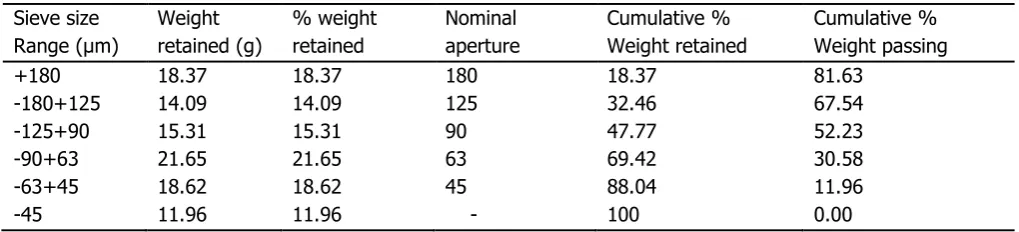
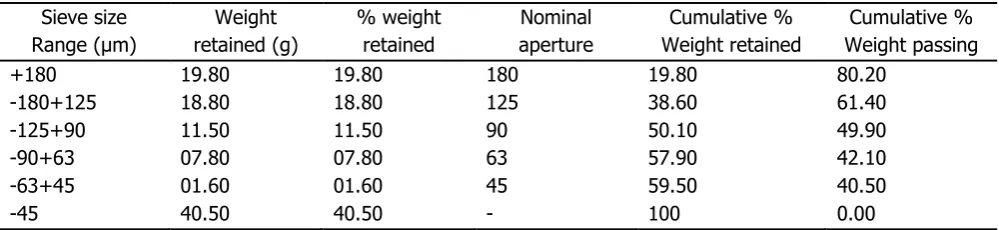
Results of experiments carried out are presented in Tables 1 – 4.
Table 1: Result of sieve size analysis of the ‘’feed’’ test material (Graphite). Sieve size Range (µm) Weight retained (g) % weight retained Nominal aperture Cumulative % Weight retained Cumulative % Weight passing
+180 18.37 18.37 180 18.37 81.63
-180+125 14.09 14.09 125 32.46 67.54
-125+90 15.31 15.31 90 47.77 52.23
-90+63 21.65 21.65 63 69.42 30.58
-63+45 18.62 18.62 45 88.04 11.96
-45 11.96 11.96 - 100 0.00
Table 2: Result of sieve size analysis of the "product" test material (Graphite).
Sieve size Range (µm) Weight retained (g) % weight retained Nominal aperture Cumulative %Weight Retained Cumulative %Weight passing
+180 7.84 7.84 180 7.84 92.16
-180+125 17.12 17.12 125 24.96 75.04
-125+90 15.56 15.56 90 40.52 59.48
-90+63 25.15 25.15 63 65.67 34.33
-63+45 16.40 16.40 45 82.07 17.93
Table 3: Result of sieve size analysis of the feed reference material (Okaba Coal)
Sieve size Range (µm)
Weight retained (g)
% weight retained
Nominal aperture
Cumulative % Weight retained
Cumulative % Weight passing
+180 19.80 19.80 180 19.80 80.20
-180+125 18.80 18.80 125 38.60 61.40
-125+90 11.50 11.50 90 50.10 49.90
-90+63 07.80 07.80 63 57.90 42.10
-63+45 01.60 01.60 45 59.50 40.50
-45 40.50 40.50 - 100 0.00
Table 4: Result of sieve size analysis of the "product" reference material (Okaba Coal)
Sieve size
Range (µm) retained (g) Weight % weight retained aperture Nominal Weight retained Cumulative % Weight passing Cumulative %
+180 06.00 06.00 180 06.00 94.00
-180+125 15.26 15.26 125 21.26 78.74
-125+90 20.03 20.03 90 41.29 58.71
-90+63 23.40 23.40 63 64.69 35.31
-63+45 11.77 11.77 45 76.46 23.54
-45 23.54 23.54 - 100 0.00
4. DISCUSSIONS OF RESULTS
Tables 1– 4 shows the results in tabular form, the results shows the particle size fractions of the graphite material and the coal as reference ore, show a normal distribution pattern, indicating that the particle size fractions responded to the theories of comminution. That is, the energy consumed in size reduction is proportional to the area of new surface produced [9]. The 80% passing is obtained to be 171.3 μm and 129.8 μm for the reference material (Feed & Product) and 173.01μm, 142.07 μm for the test ore respectively. This gave an average work index of the as-received Saman-Burkono graphite to be 11.047 kWh/ton. The computed work index is within work indices of other graphite mineral used as standard that fall between 1.75-45.03 kWh/ton sighted in the literatures [1, 10, 11]. The value obtained proved that 11.047 kWh/hr. of energy is required to reduce one tonne of the as – received graphite ore sample from 80% passing sieve size 173.01 µm to 80% passing sieve size of 142.07 µm. This ore is therefore by this result termed as ore “type B” of Denver grindability curves [9, 10, 13].
5. CONCLUSION
In conclusion, the determination of work index of
From the results of the experiments the work index was found to be 11.047 kWh/ton; considering the economic implication it indicates that the cost of energy used to comminute one ton of the study ore to 80 % passing 100 microns will cost ₦303.79k at a unit cost of ₦27.5k per energy- being a unit cost of power consumption by industries in Nigeria [12].This parameter is significant for use in the design of a process route for the beneficiation of the Saman– Burkono graphite.
6. REFERENCES
[1] Napier-Munn, T. J., Morell, S., Morrison, R. D., and Kojovic, T. (1996): Mineral Comminution Circuits: Their Operation and Optimisation. JKMRC Monograph Series in Mining and Mineral Processing, 2 University of Queensland, Australia. [2] Wills, B. A., and Napier-Munn, T. Y. (2006): Mineral Processing Technology, 3rd Edition, Elsivier Publisher Limited, Burlington, U.S.A., pp 108-115. [3] Magdalimovic, N. M. (1989): Calculation for Energy
required for grinding in ball mill. International Journal of Mineral Processing, Vol 25, No. 2, pp 41-43
Ores. Canadian Mining Journal, Vol.8, No. 7, pp 63-65.
[5] Alabi, O. O., Shehu Y. A., Binta H., (2012): Determination of Bond Index of Wasagu Manganese Ore in Kebbi State, Nigeria.
International Journal of Scientific and Engineering Research, Vol. 3, No. 10, pp 1 – 8.
[6] Whittles, D. N., Kingman, S. W., & Reddish, D. J. (2003): Application of numerical modelling for prediction of the influence of power density on microwave-assisted breakage. International Journal of Mineral Processing, Vol. 68, pp 71-91 [7] Andrews, P. R. A. (2010): Review of Developments
in Casseterite Flotation in Respect of Physico-chemical Considerations, Minerals, Materials and Industry, IMM London, pp 345- 347
[8] Broekaert, E. (2004): New Processes for Casseterite Ore Flotation in Mineral Processing and Extractive Metallurgy, ed. M. J. Jones and P. Gill, IMM, London, pp 453-458.
[9] Alabi, O. O., Yaro, S. A., Dungka, G. T., Asuke, F. and Dauda, E. T. (2015): Determination of work-index of Gyel – Bukuru columbite ore in Plateau State, Nigeria, Journal of Mineral and Materials Characterisation and Engineering, Vol. 3, pp 194 – 203.
[10] Thomas, D. G., Asuke, F. and Yaro, S. A. (2014): Determination of Some Conceptual Mineral Processing Parameters of Soba-Wanka Pyrochlore-Col Tan Mineral Ore Deposit.
2014 Nigeria Engineering Conference, Vol. 2, pp 32-41.
[11] Ministry of Mines and Steel Development (2012): Road Map for the Development of Solid Minerals and Metals Sector. Stack Holders Forum, Abuja, Vol. 3, pp 4-9.
[12] Thomas, D. G., Asuke, F., and Yaro, S. A. (2016): Determination of Work Index of Zarara Complex Ore Deposit, Kaduna. Nigerian Society of Mining Engineers (NSME) Conference, Abuja.
[13] Obassi E., Gundu, D.T. and Akindele U.M. (2015): Determination of Work index of Arufu lead ore, Nasarawa State, North-central, Nigeria,
International Journal of Engineering and Science, Vol. 4, Issue 2, pp 10-14.
[14] Todorovic D, Trumic M., Andric L., Milosevic V., and Trumic Milan, (2016): A Quick method for Bond work index approximate value Determination, Physiochemical Problems of Mineral processing, Vol. 3, No.1, pp 321-332.