Effectiveness, Efficiency and Instruction Appeal of
Blended Learning Model
https://doi.org/10.3991/ijoe.v16i04.13389
Wasis Djoko Dwiyogo (*), Carolina Ligya Radjah Universitas Negeri Malang, Malang, Indonesia
Abstract—The practice of learning, to acquire success, has so far been measured by the level of effectiveness with a percentage range from 0% to 100% and converted into values E to A. While in the science of knowledge, learning outcome is measured by effectiveness, efficiency, and attractiveness. Dwiyogo's research [1][2] and 2015 developed a tuition design model that combines face-to-face schooling using offline resources(print, audio, video, computer) and online knowledge training (internet and smart phones) known as Blended Learning-Based Instruction Design Models. Numerous studies have been conducted to test the potency, capability, and fascination of learning. However, the objectives of this study with respect to Dwiyogo’s model are:(1) Examining experts on its usage, (2) Applying the model in courses, and (3) Testing the productivity, and capability. This research makes use of the survey and quasi-experimental design methods. The data consists of a total of 3 ex-perts, 113 students, and 6 teachers with result showing that the blended learning model using eight items produced huge output (= 4.750, SD = 0.361).Based on the components of the expert test, it can be concluded that the learning model developed is appropriate and can be implemented. Student opinion with respect to this model showed a high level of agreement (= 3.415, SD = 0.536). This shows that students who applied blended learning based instruction models re-sponded positively to its implementation. Therefore, this technique can enhance knowledge thereby, making the act of efficient, effective, and instruction ap-peal.
Keywords—Blended Learning Based Learning, Effective, Efficient, and In-struction Appeal.
1
Introduction
In order to develop the right knowledge acquisition model, proper analysis should be carried out on future schooling trends with respect to learning strategy and content. There is a tendency that the current education teaching technique has shifted from traditional to modern, also known as the era of knowledge, where students learn from any location (classroom, library or at home), irrespective of the time, and from any professional i.e. lecturers, experts, practitioners or the society using various sources, for example the internet, CDs, radio, television, laboratory. The educational technique which combines various academic sources and modes is called blended learning from the word “blended” which means combination or mixture and “learning” which means to learn or study. However, it literally refers to the educational activity that combines face-to-face schooling technique and computer-based model (online and offline). Thorne [5] describes this model as an opportunity to integrate the innovative and technological advances offered by online acquisition with the interaction and participation offered in traditional learning. In addition, Bersin [6] defines it as:
“…The combination of different training “media” (technologies, activities, and types of events) to create an optimum instruction program for a specific audience. The term “blended” means that traditional instructor-led training is being supplemented with other electronic formats. In the context of this book, blended learning programs use many different forms of e-learning, complemented with other live formats”
The study on the contributions of blended-learning components show that the most contributing technique are assignments (mean score=4.72), textbooks (mean score=4.54), face-to-face presentation (mean score=4.42) and face-to-face lecture with instructors (mean score=4.15). Online video also contributed towards learning (mean score=3.83) while online textbook gives average contribution (mean score=3.32). Despite the fact both afforded a low percentage of 46.5%, the learners occasionally make use of video and online textbooks. In higher institutions, this edu-cational technique comprises of once-a-week face-to-face lecture with students utiliz-ing online learnutiliz-ing for projects or other assignments [7].Some of the advantages of using the blended learning strategy are
a) To achieve knowledge acquisition purpose,
b) To change the pattern of schooling from teacher to student-centered,
c) To balance learner’s education independence and to motivate students [8][9][10] Dziuban et al.[11].
This academic technique is utilized for the following reasons
1. To enrich knowledge management 2. To facilitate access to educational tools 3. To improve learning interaction 4. Personal agency
5. Cost effectiveness 6. To ease revisions [9]
inception of printing devices, lead to the use of textbooks. Furthermore, the develop-ment of audio and audio-visual technology, along with the computer, internet and mobile phones (smartphone) in the 21st century enables the easy and flexible acquisi-tion of skills through these gadgets. Unfortunately, most teachers in various educa-tional backgrounds are yet to acquaint themselves with the use of textbooks and vari-ous online sources. In order to develop knowledge skills using varivari-ous technological learning sources, a sensitive model that combines both traditional and modern educa-tional techniques called blended-learning-based model should be developed. This prototype combines three major learning sources, namely face-to-face, offline and online.
The findings of Dwiyogo’s studies [1],[2] showed that the most current educational trends consists of face-to-face, offline (computer interactive) and online (internet) knowledge techniques. The traditional, face-face strategy has recently shifted to-wards offline and online learning. Online learning, therefore, combines face-to-face meeting, with teacher’s ability to manage academics should be directed towards blended learning. Based on the data from the respondents, 11% understood the con-cept associated with the new model, 41% are yet to get acquainted, while 48% have become familiar with the tool. With regards to its development need in solving aca-demics problems, 97% were of the opinion that it assisted in solving academic diffi-culties. The remaining 3% disagrees with this as they stated that there is no need in adapting to the new model since they will retire in a short time. Limited school facili-ty is another reason for the disagreement. However, the hesitation to use technology as an integral part of learning can be traced to the need for academicians to make use of current technological trends.
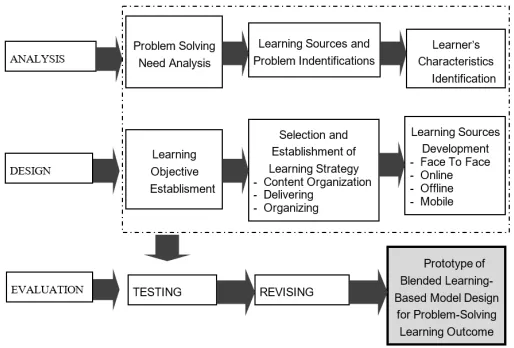
The need analysis blended with the developed knowledge acquisition theories. The model is flexible and enables developers to make adjustments. This is illustrated in Fig. 1.
In general, the model development is conducted in three stages, namely:
1. Analysis 2. Design 3. Evaluation
2
Analysis
This is the first stage which consists of
1. Problem-solving
2. Learning source and problems identification 3. Characteristics identification
2.1 Problem-solving need analysis
In this stage, the researcher conducts the following activities i.e.
1. Analyzes the current condition
2. Identify some aspects to master (knowledge, attitude and skills)
3. Identify differences between the purpose, current and expected conditions 4. Decide and take notes on some advantages related to the performance 5. Deciding the priorities to overcome the current problems.
The data collection methods in this stage are phone calls, direct interviews, emails, questionnaires, videos as well as observations.
2.2 Learning sources and problems identification
This stage analyzes information from particular parties and media. It involves
1. Identifying teachers as learning source which includes their capabilities to develop online, offline and mobile learning sources
2. Identifying learning sources i.e. Textbooks, audio, audio-visual, computer, the in-ternet, smart phone/ tablet at the schools
3. Identifying web and other learning sources.
2.3 Learner’s characteristics identification
In this stage, the researcher conducts an analysis on the learner’s initial capabilities and characteristics which is pivotal in deciding the academic starting point. Data on the population characteristics were used which comprises of learner’s age, stage, interest, occupation, health, learning motivation, achievement, initial capability, capa-bilities in literacy, socio-economic status and/or foreign language mastery. In addi-tion, it is important to determine some information on the learner’s attitude towards the materials to be studied.
3
Design
The second development stage is the design phase which consists of:
1. Learning purpose 2. Selection strategy 3. Source development
3.1 Learning purpose
The purpose of this stage is to identify and organize previous educational steps based on their level of importance. These include cognitive, affective, and psychomo-tor strands (based on The Bloom’s Taxonomy) or verbal information, intellectual capability, cognitive strategy, attitude and psychomotor (The Gagne’s Taxonomy).
3.2 Selection strategy
Organizing the content means elaborating the steps required to achieve the knowledge. Learning analysis is carried out using component of variables comprising of two functions namely
1. To deliver educational content to students,
2. To provide the right information/materials to capture learners’ capabilities through assignment and test.
The delivery strategy involves physical contact, teachers/lecturers, educational ma-terials and other academic activities. In other words, media is one of the essential components used in the learning process.
The management process includes
1. Scheduling 2. Notetaking
3.3 Learning source development
The source of learning that facilitates learners are face-to-face, online and offline techniques. The activity carried out in the stage is selecting the most appropriate source or materials that match the availability of the technology in a educational envi-ronment. The bases of the analysis are availability and accessibility to technological tools. The result of the analysis is to decide the most suitable media to develop with the development carried out in four stages. The first is making storyboard or describ-ing process for deliverdescrib-ing learndescrib-ing materials into images to enable everyone have a clear idea of the programs being developed. This involves formulating both visual images and audio recording into well-organized manner in line with learning stages. The second is the production stage which involves every element of the program and combines all into one unified device. The third is the testing and reviewing stage which involves editorial, functional and technical examination. The goal is to evaluate some errors inherent the program and to ensure the revisions were correctly conduct-ed. The final stage implements the media into learning activities using software capa-ble of producing the multimedia. VideoMakerFX is used to create the user interface, with animations created for each icon. AutoPlay Studio version 8 is the software used to create the overall outlook of the interactive multimedia, while video-recording is carried out using desktop-based outlook with the help of ScreenCastOMatic. Finally, the Ncesoft Flipbook Maker is used for the e-book outlook.
4
Evaluation
In the evaluation stage, the following activities are to be carried out:
1. Testing 2. Revising
3. Producing a prototype of the model
4.1 Testing
The evaluation carried out is formative using the revision purpose. In the study, the formative evaluations are in the form of experts’ reviews, individual, small-group and field tests.
4.2 Revising
Based on the reviews from experts, individual, small-group and field tests, the re-searcher gained some feedbacks used to enhance the proposed model.
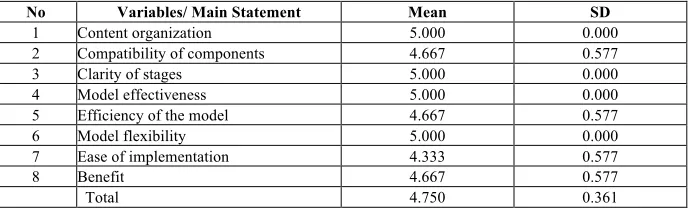
generally stated that the model could be implemented with a high level of agreement. This is illustrated in Table 1.
Table 1. The Results of the Experts’ Evaluation toward Blended-Learning-Based Model De-sign for Problem-Solving Learning Outcome
No Variables/ Main Statement Mean SD
1 Content organization 5.000 0.000
2 Compatibility of components 4.667 0.577
3 Clarity of stages 5.000 0.000
4 Model effectiveness 5.000 0.000
5 Efficiency of the model 4.667 0.577
6 Model flexibility 5.000 0.000
7 Ease of implementation 4.333 0.577
8 Benefit 4.667 0.577
Total 4.750 0.361
Based on Table 1, the data shows that the highest score is in items number 1, 3, 4, and 6 (= 5,000, SD = 0,000) while the lowest average is in the variable related to implementation (= 4,333, SD = 0,000). Overall the results of expert tests on eight items showed high results (= 4.750, SD = 0.361). Based on the components of the expert test, it can be concluded that the learning model developed is appropriate and can be implemented at a later stage.
This is a development research conducted from 2014-2016. It is based on needs analysis, learning theories, and outcomes. Data analysis used is the descriptive statistics which reviews data related to averages and standard deviations.
5
Learning Outcomes
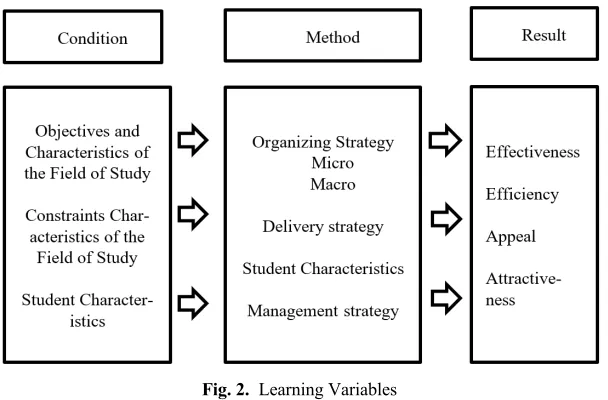
Learning outcomes are defined as effects used as indicators under different condi-tions. This effect can be an intentionally designed and can also be a real using certain learning methods. If the reference is desired, then this result must be set before devel-oping the educational technique. Therefore, the chosen method is the optimal strategy used to achieve earlier set results. This can be classified into three, namely
1. Effectiveness 2. Efficiency 3. Attractiveness
5.1 Learning effectiveness.
Measurement of learning effectiveness must always be associated with the set objectives. Seven indicators can be used to determine the effectiveness of learning, namely:
3. Conformity with procedures 4. Quantity of performance 5. Quality of final results 6. The level of transfer 7. The level of retention
5.2 Learning efficiency
Learning efficiency is measured by the ratio between effectiveness and the amount of time students use or the amount of learning costs or resources used. Thus there are 3 indicators used to determine the level of efficiency, namely:
1. Time 2. Personnel 3. Resources
What is the amount of time needed by students to achieve the set goals? How many personnel are involved in the implementation process? What is the use of the educa-tional resources? The answers to these questions will provide an overview of the level of efficiency inherent the program.
5.3 Attractiveness
Learning attractiveness is measured by observing the ability of students under-standing the model. However, in its delivery, will largely depend on the quality of the academic tool. To describe its attractiveness pressure is placed on the quality of the field of study.
Fig. 2. Learning Variables
Learning outcomes is a combination of various academic methods measured by its effectiveness. The difference in each technique, lie on its level of efficiency and at-tractiveness.
6
Research Design
This study uses two types of researches. The first was conducted from 2015-2018 using data collected from teaching students during the second semester of postgradu-ate sports education, Stpostgradu-ate University of Malang.
Subsequent research obtained data by implementing the blended learning model on the learning outcomes for effectiveness, efficiency, and learning attractiveness. In this study therefore, four students were involved as executors from 2018-2019. Data was collected through documentation studies, observations, questionnaires, and semi-structured interviews.
7
Participants
The survey subjects were all 113 post graduate students (S2) in Sports Education in State University of Malang who participated from 2015 to 2018. The survey provided data related to the application of the blended-based learning.
8
Data Analysis
fulfilled the reliability requirements indicated by Cronbach's α which is 0.902. Data collected through questionnaires was obtained through interviews, observations, and documentation.
9
Result
The first phase of this study aims to analyze the developed blended learning model. This stage contains survey conducted on113 postgraduate students of the Sports Edu-cation study program class of 2014 to 2018
The survey results showed that students agreed with all the listed items as illustrat-ed in Table 2. Some respondents who disagreillustrat-ed (score 2) appearillustrat-ed on the item cost efficiency (= 3.468, SD = 0.608), clarity description (= 3,400, SD = 0.581), ease of implementation ((= 3.243, SD = 0.553), and increase motivation (= 3.327, SD = 0.537).
Table 2. The Results of the Students’ Opinions toward Blended-Learning-Based Model
No Variables/ Main Statement N Min Max Mean SD
1 Effective 113 3.00 4.00 3.500 0.504
2 Interactive 113 3.00 4.00 3.467 0.503
3 Flexible 113 3.00 4.00 3.450 0.502
4 Time efficiency 113 3.00 4.00 3.467 0.503
5 Cost efficiency 113 2.00 4.00 3.468 0.608
6 Clear description 113 2.00 4.00 3.400 0.581
7 Easy to implement 113 2.00 4.00 3.243 0.553
8 Increase motivation 113 2.00 4.00 3.327 0.537
Total 3.415 0.536
Based on the Table 2, it can be concluded that student opinion with respect to the model was high with all items averaging (= 3.415, SD = 0.536). This shows that overall, learners gave a positive response to its implementation.
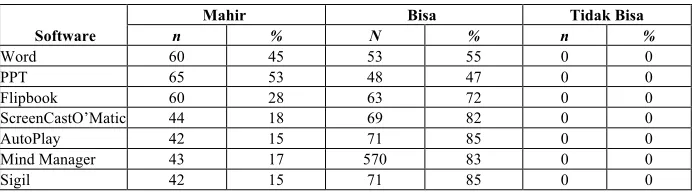
In connection with follow-up survey data, students are advised to master how to utilize the software. Data from the survey on self-assessment is presented in Table 3. PowerPoint is the program with the most proficiency level (53%). The software with the least proficiency level is AutoPlay and Sigil (15%)
Table 3. Results of the Survey on Self-Assessment of Self-Ability
Software
Mahir Bisa Tidak Bisa
n % N % n %
Word 60 45 53 55 0 0
PPT 65 53 48 47 0 0
Flipbook 60 28 63 72 0 0
ScreenCastO’Matic 44 18 69 82 0 0
AutoPlay 42 15 71 85 0 0
Mind Manager 43 17 570 83 0 0
In addition to survey, a case study was conducted to provide information with re-spect to its implementation. Through this research, students conduct learning designs using developed models, then observed its outcomes, including the level of effectiveness, efficiency, and attractiveness. Students who carried out the thesis using Dwiyogo Model [2], were Kristiono [12], [13], Setiawam [14], Samiun [15], and Gusdiyanto [16]. The six undergraduates are postgraduate sports education students at the State University of Malang. The study conducted is a type of research and development (R & D) using the model developed by Dwiyogo [2].
The purpose of Kristiono’s research is to produce a blended learning product (face-to-face, offline, and online) in sports nutrition science subjects, and to test its produc-tivity, and capability. This study makes use of a conceptual model in line with model developed by Dwiyogo [2]. The design steps are:
1. Problem solving needs analysis
2. Identifying learning resources and constraints 3. Recognizing trainee characteristics
4. Setting objectives 5. Selecting
6. Evaluating strategies
While the evaluation phase comprises of:
1. Trial 2. Revision
3. Learning prototype based on the model.
Steps 1 to 3 is the analysis phase, 4 through 6 are the design stage, while stages 7 through 9 are evaluations phases.
The results are to create products for learning sports nutrition-based courses. The components include:
1. Face-to-face methods using printed books,
2. Offline strategies using the studio auto play 8.5 application containing material, photos and videos,
3. Online learning methods by utilizing the Edmodo virtual class to share material and evaluate online quizzes.
The courses presented include sports physiology, sports nutrition, nutrition for health and fitness, supplements and doping, malnutrition, nutrition in sports, water and electrolytes, and management of eating athletes. This product is accessible to teachers and students irrespective of their destination. The results on effectiveness tests obtained by researchers from 3 meetings differed.
During the first meeting, the following were obtained:
4. The value of 90 letters A (14.8%) 5. The value of 80 letters A (31.42%) 6. Value of 70 letters B (34.28%) 7. The value of 60 letters C (14.28%) 8. Value of 50 letters D (2.85%)
The overall average value of the student class at the first meeting is obtained the value of letter B (74.85%)
In the second meeting, is the following was obtained:
1. The lowest value of 70 letters B 2. The highest value of 100 letters A 3. The value of 100 letters A (8.57%) 4. The value of 90 letters A (37.14%) 5. The value of 80 letters A (37.14%) 6. The value of 70 letters B (14.28%)and
7. The overall average value of the student class at the second meeting is the value of letter A (84%)
Finally the following was obtained in the third meeting:
1. The lowest value of 80 letters A 2. The highest value of 100 letters A 3. The value of 100 letters A (5.71%) 4. The value of 90 letters A (40%) 5. The value of 80 letters A (45.71%)
6. The overall average value of the student class at the second meeting is the value of letter A (85.14%)
The results of the Efficiency test at the first meeting are as follows:
1. The longest total time 67 minutes 54 seconds and the fastest time 67 minutes 1 second;
2. In the second meeting the total time to study and work on the questions was 73 minutes 9 seconds and the fastest was 55 minutes 9 seconds, and
3. In the third meeting the total time of study and work was 70 minutes for the longest time and 57 minutes 30 seconds for the shortest.
Face-to-face attraction, obtained:
1. Very interesting 300 points (71.42%) 2. Attractive 90 points (21.42%).
Offline attraction was:
1. Very interesting 372 points (66.42%) 2. Attractive 135 points (23.57%)
1. Very interesting 176 points (62.85%) 2. Attractive 165 (58.92%)
For the overall results of individual points:
The highest points was 36; and the lowest 29. The amount obtained is 1159 points with a maximum number of 1260 points. The average of all data obtained gets very valid percentage (91.98%) criteria.
The model increased efficiency of the previous 16 meetings, within a relatively short time. The research was conducted with the aim of developing Adaptive physical education textbook that uses blended learning model for students of the Faculty of Sport Science, State University of Malang. The model developed by Dwiyogo [2] was used in this study.
The results of this study produced three teaching materials products, namely:
1. Face-to-face learning,
2. Interactive multimedia in the form of auto play for offline knowledge 3. Edmodo for online skill acquisition.
The application of blended learning based adaptive physical education teaching materials is able to improve student learning outcomes which include effectiveness, efficiency, and attractiveness and are tested on 70 samples. The components obtained are:
1. The first meeting in chapters 2 and 3 comprises of face-to-face components with an average score of 87.43% with the final value A and the average length of reading and working on sola 1.00.40 1 hour 40 minutes,
2. The second meeting in chapters 4 and 5 of the offline component had an average score of 89.50% with the final value A and an average reading length of 0.59.45 (fifty nine minutes forty-five seconds), and
3. The third meeting in chapters 6 and 7 of the online component with an average score of 92.36% while the final value A had an average reading and working length of 0.58.15 (58 minutes 15 seconds).
For the attractiveness component, the percentage of attractiveness of blended learn-ing-based adaptive physical education teaching material was obtained by 94% with very valid criteria.
The various product suggestions during broader dissemination need to be evaluated to obtain data conformity on environmental conditions. Similar research is expected to assess the psychomotor. Masgumelar [13] conducted a research with the aim of:
1. Developing game modification products in physical education, sports, and health 2. Testing the effectiveness of these products. Dwiyogo [2] blended learning
devel-opment model was utilized with data obtained from 80 senior high school students and 4 experts.
1. Printed books equipped with a QR code for face-to-face education
2. Interactive multimedia for offline knowledge acquisition, and edmodo for online learning.
The results of the study on product trials were given to 80 subjects, with the fol-lowing results:
1. 90.97% small group trials 2. 91.18% large group trials
The results of the effectiveness test obtained an average of all the meetings with the lowest score (B) while 5 students had A grades. Overall, the achievement of the average learning outcomes is 90.73 with credit A. Efficiency test to read the material and work on the first meeting questions, produced an average time of 1:08:32 1 hour 80 minutes 32 seconds, the second produced an average time of 1:06:04 or 1 hour 6 minutes 4 seconds, while the third produced an average time of 1:04:56 or 1 hour 4 minutes 56 seconds. When compared with the learning time of 2x50 minutes or 1 hour and 40 minutes, efficiency is achieved.
Attractiveness test results:
1. Face to face meeting had an average of 92.88% which was very interesting, 2. The second meeting (offline) had an average of 93.48%
3. Meeting III (online) had an average of 93.69%
Suggestions from this study are:
1. Before developing the product attention should be paid to the material that needs to be tested
2. Research and development using the blended learning approach should be able to pay more attention to the conditions,
3. In the test further effectiveness should use a comparison group, therefore the prod-ucts manufactured can be more meaningful in improving learning outcomes.
The study was conducted by Samiun [15] with the aim of developing a blended learning based athletic media for Physical Health Education students and Recreation in IKIP Budi Utomo Malang. The method used in this study refers to Dwiyogo's blended learning development model [2].Before conducting field tests, product trials were carried out on.
1. Trial design
2. Product expert evaluation 3. Product plan revision
4. Small group trials of 20 students 5. Product revisions
6. Large group trials of 40 students 7. Final product revision
Developing a blended learning model based on athletic learning media health and physical education students in IKIP Budi Utomo Malang, consists of face to face (print media), offline (auto play) and online (edmodo). The results of the learning effectiveness test with an average value of 90.68 in the category of "very complete", is reduced by the average value used by students in a meeting. It can be concluded that in the first meeting lecturer’s time was 01.30.00-0.51.15 with an efficiency of 00.38.51, (38 minutes 5 first 1 second), the second it was 01.30.00-0.40.30, with an efficiency of 00.49.30, (49 minutes 30 seconds), thirdly the lecturer’s time was 01.30.00-0.31.50 get time efficiency 00.58.10, (five first eight minutes ten seconds) while the final meeting time was 01:30. 00-0.24.29with an efficiency of 00.36.01 (36 minutes 1 second). It was a concluded that time efficiency occurs in athletic subjects.
The test results of the development of learning product development obtained the average percentage results:
1. 94.58% meeting I (face to face) 2. 94.52% meeting II (offline)
3. 90.5% meeting III (online) with very interesting criteria.
The results of the small group trials obtained an average percentage of 93.33 in-cluding very feasible categories. The results of a large group trial obtained an average percentage of 93.22 including very feasible categories. Furthermore, it can be con-cluded that blended learning-based on athletic subject products are suitable. The last research was conducted by Gusdiyanto [16] with the of producing a learning product based on blended learning (face-to-face, offline, and online) in sports nutrition science subjects, as well as testing the effectiveness, efficiency, and attractiveness of devel-opment products produced in learning outcomes. The method in this research uses a conceptual model that refers to the development of a blended learning based design model [2]. The research subjects were 50 physical and health education students and 3 validation experts including learning experts, material experts and media experts.
The results of sports social anthropology courses produce the following product specifications:
1. Face-to-face method using printed books as learning resources,
2. Offline learning methods using media studio auto play 8.0 application containing material, photos, and videos to support clarity on the material,
3. Online learning methods by utilizing the Edmodo virtual class which can be used to share material and evaluation/online quizzes.
The material presented includes basic concept sociology and sports anthropology, social process and interactions, leadership, aberration and aggression, political rela-tions, mass media relarela-tions, economy relations s, and gender issue in sports. This product is arranged for teachers and students who can be accessed anywhere and anytime.
face-to-face method with the material in chapters 2, 3 and 4, the average value obtained are:
1. Lowest at 70 with credit B 2. Highest at 100 with credit A
3. Overall value and average of 82.38 credit A.
The second meeting used the offline method through interactive multimedia auto play with the material in chapters 5, 6, and 7 with the following average values:
1. The lowest at 70 B credits,
2. The highest at 100 credits with A, and 3. An overall average of 83.90 credits A-.
The third meeting using online methods with the material in chapters 8 and 9 ob-tained an average value.
1. The lowest at 75 B + credits, 2. The highest at 100 credit A, and
3. Overall and average of 85 credits A in the "very complete" category.
The efficiency test results obtained from the total time used by students are as fol-lows: The first meeting using face-to-face method with the average time in chapters 2, 3 and 4 obtained an average time of 01.09.47 or 1 hour 9 minutes 47 seconds when compared with the time used by lecturers (2x50 minutes) with a time efficiency is 00:30:13 or 30 minutes 13 seconds. The second meeting using offline methods with the material in chapters 5, 6 and 7 obtained an average time of 1:04:39 or 1 hour 4 minutes 39 seconds when compared with the time used by lecturer lecturers (2x50 minutes) with an efficiency timeframe of 00:35:21 or 35 minutes and 21 seconds. The third meeting through an online method with an average time of 00:56:37 56 minutes 37 seconds when compared with the time used by lecturers (2x50 minutes) with t a time efficiency of 00:43:24 or 43 minutes 24 seconds. It can be concluded that there is time efficiency when using the blended learning method. The test results of the devel-opment of learning product develdevel-opment obtained the average percentage results, (1) 92.29% meeting I (face to face), (2) 93.14% meeting II (offline), (3) 94.43% meeting III (online). The overall average test of product attractiveness was 93.29% with very interesting criteria.
From the research and development results carried out, it can be concluded that the product developed for sports social anthropology is feasible and can be used by teach-ers and students. It is currently used in the Department of Physical and Health Educa-tion, State University of Malang.
10
Conclusion
be concluded that the model developed is appropriate and can be implemented at a later stage. Student opinion with respect to this prototype showed a high level of agreement on all items (= 3.415, SD = 0.536). This illustrates that a good number of learners have applied this model effectively.
11
References
[1]W. D. Dwiyogo, “Analisis kebutuhan Pengembangan Model Rancangan Pembelajaran Berbasis Blended Learning (PBBL) untuk Meningkatkan Hasil Belajar Pemecahan Masalah.,” Malang Bur. Res. community Serv. State Univ. Malang., 2013.
[2]W. D. Dwiyogo, “Pengembangan Model Rancangan Pembelajaran Berbasis Blended Learning (PBBL) untuk Meningkatkan Hasil Belajar Pemecahan Masalah.,” Malang Bur. Res. community Serv. State Univ. Malang., 2014.
[3]I. N. S. Degeng, “Landasan Teoritik Disain Pembelajaran.,” Malang Grad. Program. Inst. Educ. Teach. Train. Malang., 1991.
[4]C. M. Reigeluth, “Instructional-design Theories and Models: An Overview of Their Current Status.,” Hillsdale, New Jersey Lawrence Erlbaum Assoc. Publ., 1983.
[5]K. Thorne, “Blended Learning: How to integrate online & traditional learning.,” London Kagan Page Limited., 2003.
[6]J. Bersin, “The Blended Bearning Book: Best Practices, Proven Methodologies, and Lessons Learned.,” San Fr. Pfeiffer, 2004.
[7]E. Molenda, M., & Boling, “Creating. In A. Januszewski & M. Molenda (Eds.), Educational technology: A definition with commentary.,” New York Routledge., pp. 82– 130, 2008. https://doi.org/10.4324/9780203054000
[8]P. Murphy, “The Hybrid Strategy: Blending Face-to-Face with Virtual Instruction to Improve LargeLecture Courses,” 2003.
[9]R. Voos, “Blended Learning: What is It and Where Might It Take Us? Sloan-C View,” vol. 2, no. 1, pp. 2–5, 2003.
[10]C. Dziuban, J. L. Hartman, and P. D. Moskal., “Blended Learning. Research Bulletin.,” 2004.
[11]I. D. Kristiono, “Pengembangan Pembelajaran Berbasis Blended Learning Mata Kuliah Ilmu Gizi Olahraga Untuk Mahasiswa Pendidikan Jasmani, Kesehatan dan Rekreasi.,”
Tesis. Jur. Pendidik. Olahraga, Pascasarj. Univ. Negeri Malang., 2018.
https://doi.org/10.33503/jpjok.v2i1.180
[12]N. K. MasGumelar, “Pengembangan Modifikasi Permainan pada Pembelajaran Pendidikan Jasmani dan Olahraga dan Kesehatan (PJOK) menggunakan Blended Learning untuk Siswa Sekolah Menengah. Tesis tidak diterbitkan.,” Malang Pascasarj. Univ. Negeri Malang., 2019 https://doi.org/10.5614/jskk.2018.3.1.2
[13]W. . Setiawam, “Pengmembangan Pembelajaran Karate Berbasis Blended Learning Mahasiswa Pendidikan Profesi Guru Pendidikan Jasmani dan Kesehatan.,” Tesis tidak diterbitkan. Malang Pascasarj. Univ. Negeri Malang., 2019. https://doi.org/10.179 77/um040v2i1p62-66
[14]K. Samiun, “Pengmbangan Media Pembelajaran Mata Kuliah Atletik Berbasis Blended Learning di IKIP Budi Utomo Malang.,” Tesis tidak diterbitkan. Malang Pascasarj. Univ. Negeri Malang., 2019. https://doi.org/10.30734/jpe.v6i2.568
12
Authors
Wasis Djoko Dwiyogo is affiliated with the Universitas Negeri Malang. Author area of interest is eLearning and developing.For contact email at,
Carolina Ligya Radjah is affiliated with the Universitas Negeri Malang. Author
is interested to learning online in blended model.