Motivation, Perception and Expectation of Visitors in Heritage Sites, Case: Bunk’ Art
Phd Majlinda Muka
“Aleksander Moisiu” University, Department of Tourism, Albania [email protected]
Phd Necila Cinaj
“Aleksander Moisiu” University, Department of Tourism, Albania [email protected]
Doi:10.5901/ajis.2015.v4n3s1p697
Abstract
This paper aim to survey the motivation, perception and expectation of visitors in the historical site of Bunk’ Art, an atomic bunker built during 1960-1970 in Tirana, Albania turned into a historical museum in November 2014. Exploring visitor’s perceptions of the site in relation with historic heritage is an important factor for understanding tourist motivations and behavior for further management of the site. The survey was conducted with tourist visitors directly at the specific site using questionnaires. Data were analyzed using statistical package for social science. Results indicate that identified motives were “educational experience”, “heritage experience” and “recreational experience”. The visitors considered the site part of their heritage and a good motivation for visiting it in the future.
Keywords: Bunk’Art, motivation, experience, heritage, tourism.
1. Introduction
Heritage tourism is considered as a rapidly growing sector of tourism making up a very important component of tourism for many countries. Some researchers define heritage tourism simple as people visiting heritage places or viewing historical resources. Heritage tourism is based on visits by people who want to learn something new or enhance their lives in some ways (Timothy, 2011). Heritage tourism is define as an economic activity that makes use of socio-cultural assets to attract visitors (Fyall at al., 1998), also other researchers suggested that heritage tourism is a phenomenon based on visitors’ motivations and perceptions rather than a specific site or attribute (Poria et al., 2001). Based on the importance and perceptions of visitors another definition for heritage tourism is being based on nostalgia for the past and the desire to experience diverse cultural landscapes and forms (Zeppel at al., 1991).
The heritage tourism literature to date has focused on the role of heritage in society, cultural and heritage markets, planning, interpretation, community involvement and issues of authenticity (Alzua at al., 1998). Although is little known about the consumers of heritage. In a survey, Kerstetter at al. (2001) have stated that there is a paucity of research analysing the nature of the relationship between factors such as visitor characteristics, visitor behaviour, motivations and the experiential nature of heritage tourism; as demand for heritage products increase it is required more in depth understanding the characteristics of visitors.
This paper aims to explore visitor’s perceptions of the site in relation with historic heritage as an important factor for understanding tourist motivations and behavior for further management of the site.
2. Literature Review
According to the researchers sites hold personal values, beliefs and memories for the visitor. Different authors presents a wide range of reasons for visiting historic heritage sites, so understanding the motivations for a visit is quite important for tourism research. Visits are motivated by a desire to enhance ones on cultural self, to learn something new, to satisfy one’s curiosity, or simply to use up excess time. In short, heritage tourism encompasses a multitude of motives, resources and experiences and is different for every individual and every place visited (Timothy, 1997). The most common reasons to visit a heritage site reported in the literature are education (i.e. the tourists’ willingness to learn) and entertainment (i.e. the tourists’ desire to be entertained). But other reasons, linked to the attributes of the artefacts presented related to someone’s heritage may also play a part. Poria at al., (2006) have stated that the desire of tourists to be exposed to their own heritage and thus to be involved in a personal ‘heritage experience’ is another good reason. According to the researchers in environmental psychology, Scott at al., (1997) explained that the relationship between individuals and environment is related to one’s experience. In heritage tourism literature is argued that the tourists’ perceptions of a site and their activities relative to it are important for understanding of their behaviour (Poria et al., 2001a).
3. Research Method
The specific site chosen for the focus of the study is the Bunk’Art, a secret underground bunker built decades ago to survive a possible nuclear attack by the Soviet Union or the United States, the attack that never came. The bunker with 5 security doors, named in the years of the communist regime as "Object 0774", is five floors below ground and has over 106 rooms. The bunker is designed and set up to accommodate all the command line of the government in case of a potential chemical bombing or atomic attack to the Albanian capital: this is confirmed by the presence of a big number of rooms, some of which are designated as emergency apartment for the dictator Enver Hoxha, the Prime Minister and at the same time for all the political and military nomenclature of the country.
Everything is kept secret for 36 years after the official inauguration was done on 24 June 1978. The idea to build this bunker is borrowed from the military of the time during the communist dictatorship after a visit conducted in North Korea. The structure was built between 1972 and 1978, it’s consists of 106 rooms distributed into five levels, including also an assembly-auditorium hall with total area of 2685 square metres.
In all rooms of the museum are exhibited weapons, uniforms, documents, various maps and other details serving at the time, video installations, images, objects and digital equipment to recreate a historical journey of emotional content which represents the case of a reflection and recognition of national history even for the youngest.
The museum’s objective is to commemorate the main historical events in the period between 1939 and 1944 with passages of the before Italian invasion and after Nation Liberation. The messages are transmitted within symbolize the isolation of communist Albania, but also the constant confrontations between the Communist bloc and the West bloc during the Cold War. On November 2014, the "Bunk’Art" opened its doors as a museum. The museum is now considered one of heritage sites in Tirana and more than 60,000 people visited the site until January 2015.
Understanding specific tourist motivations can help planning better products and services and more efficient marketing communication. To explore visitor’s perceptions of the site in relation with historic heritage as an important factor for understanding tourist motivations and behaviour for further management of the site, a research survey through structured questionnaires was conducted.
4. Analysis
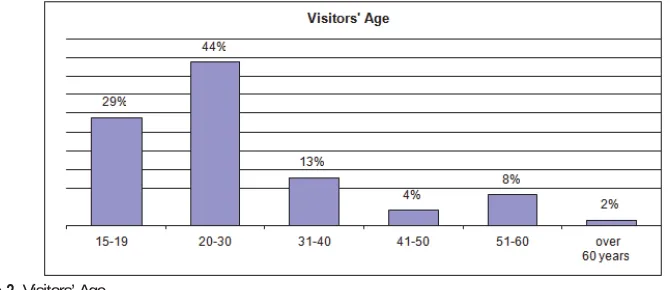
In the survey were included 87 participants (visitors), (58.3% female and 41.7% male). Of the sample 36.8% were graduated, 8.4% were post graduated and 54.7% had high school education. Dominant visitor age was 20-30 years old or (44%), and about 89% were of Albanian nationality. All the participants had never visit before the Bunk’Art museum.
Figure 1. Respondents’ home country
The reason of very few foreign visitors obviously is related to the fact that the museum has recently open and were the earliest days of visit after the inauguration. The fact that a military object was transformed into a national historical museum means closer connection with the domestic visitors.
Figure 2. Visitors’ Age
The presence of young visitors, dominant age were 20-30 years (44%) and 15-19 years (29%), argued the fact that tendency to learn details of the history of a period which has left traces in overall development of socio-economic conditions and political ones of the country is significantly expressed in these ages, associated with shocking existence of such an object. We noticed a new approach to the integration of new age to visits heritage buildings as an expression of the demand for heritage tourism. The limited number of the respondents may affect the results of the study.
According to the source information, the majority of visitors got information for the museum from media 52%, from friend and relatives 36,9% from advertisement 7,2% and very few got information from travel agency only 2% of the respondents.
Respondents Home country
1 3
7
76
0 10 20 30 40 50 60 70 80
Figure 3. Information Source
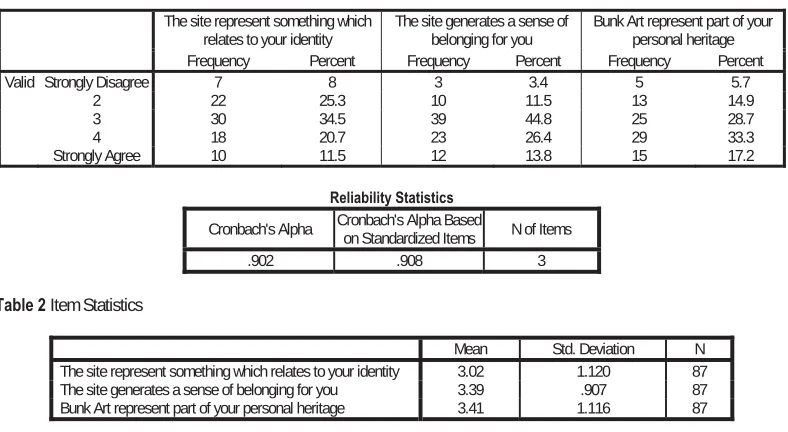
First question used in questionnaire aimed to understand visitor perceptions in relation to own heritage and to identify reasons for the visit. Respondents should answer based on Likert scale where 1 indicated “Strongly Disagree” and 5”Strongly agree”. Based on the mean score of respondents (Table 2) Bunk Art museum is considered a heritage site that generates own emotions related to historic identity.
To determine the reliability of scale (as it was chosen multiple Likert scale answers in the survey) the Cronbach’s Alpha is used to measure the internal consistency. As it seen from the data in table1, the value of Cronbach’s Alpha is 0.902, which indicates a high level of internal consistency, so the questions used measure the same latent variable.
Table 1. Visitors site perception
The site represent something which
relates to your identity The site generates a sense of belonging for you Bunk Art represent part of your personal heritage
Frequency Percent Frequency Percent Frequency Percent
Valid Strongly Disagree 7 8 3 3.4 5 5.7
2 22 25.3 10 11.5 13 14.9
3 30 34.5 39 44.8 25 28.7
4 18 20.7 23 26.4 29 33.3
Strongly Agree 10 11.5 12 13.8 15 17.2
Reliability Statistics
Cronbach's Alpha Cronbach's Alpha Based on Standardized Items N of Items
.902 .908 3
Table 2 Item Statistics
Mean Std. Deviation N
The site represent something which relates to your identity 3.02 1.120 87
The site generates a sense of belonging for you 3.39 .907 87
Bunk Art represent part of your personal heritage 3.41 1.116 87
day out, to entertain or to relax. As it seen educational element occupies important place among the motivations of the visit, serving as the most important reason for the site visits in which is represented a considerable part of history of the country.
Test reliability of variables, Cronbach’s Alpha is 0.924 which confirm strong correlation between variables.
Table 3. Visitor Motivations
N Mean Std. Deviation
You want to learn about history of Albania 87 3.93 .643
You feel that you should visit the site 87 3.90 .890
You think is important to visit the site 87 3.86 1.014
You want to learn about site's background 87 3.82 1.105
You decided to visit because of its historical background 87 3.78 .908
You want to learn about WWII 87 3.43 1.148
You visit Bunk Art because it's part of your own heritage 87 3.36 1.120
You feel emotionally involved 87 3.26 1.401
You want to entertain 87 3.24 1.355
You decided to visit because is a new tourist attraction 87 3.15 1.498
You want to relax 87 3.09 1.030
You have decided to visit museum because feel a sense of belonging to the site 87 3.09 1.063
You want to have a day out 87 3.00 1.191
Reliability Statistics
Cronbach's Alpha Cronbach's Alpha Based on Standardized Items N of Items
.924 .933 13
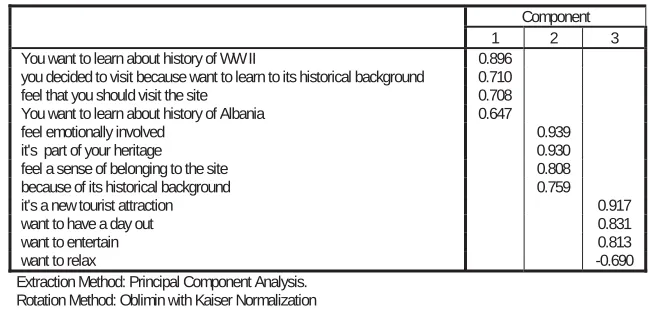
For better understanding and to explain the correlation between variables used, a Factor Analysis is undertaken. Factor Analysis attempts to bring interrelated variables together under more general, underlying variables. The determination about number factors is made according Eigenvalue larger than one (Guttman-Kaiser rule), the Principal Component Analysis is applied using oblique rotation. To determine variables included in each factor were included those above 0.4 (which explain around 16% of variance) (Field, 2000). Three factors were identified explaining 66.4% of variance. (The first factor 52.1%, second one 7.9% and third factor 6.4%).
Table 4. Factor Analysis for Motivation
Component
1 2 3
You want to learn about history of WW II 0.896
you decided to visit because want to learn to its historical background 0.710
feel that you should visit the site 0.708
You want to learn about history of Albania 0.647
feel emotionally involved 0.939
it's part of your heritage 0.930
feel a sense of belonging to the site 0.808
because of its historical background 0.759
it's a new tourist attraction 0.917
want to have a day out 0.831
want to entertain 0.813
want to relax -0.690
Extraction Method: Principal Component Analysis. Rotation Method: Oblimin with Kaiser Normalization Rotation Converged in 5 Iteration
investigation between variables. As indicated by the analysis of factors an important element underlying motivation for the visit is connected to learn the history of Albania and especially the site’s background history and what it represented by the time. Another underlined factor motivation for visit was experience of Heritage, considering the site part of the historical heritage emotional feeling involved in connection with. Part of visitors considered the site as a new tourist attraction with historical value and as such constitutes a leisure motive for the visit, while none of the visitors did not considered an important motivation relax, so the main focus remain in the importance of educational experience and heritage ones.
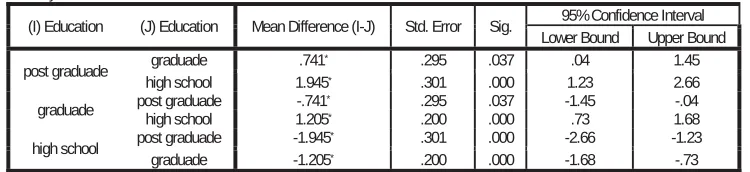
Respondents were asked to evaluate their overall motivation to visit Bunk’Art in a scale, divided in three sections: poor motivated, relatively motivated and highly motivated. Correlation between socio-demographic data and visitor’s site perception were examined. Although appeared statistically significant (p< 0.05) in One Way Anova Test, relationship between visitor’s site perception and level of education appear with light differences between groups. So, those respondents whose got post graduate and graduated education perceive more the site as being part of their heritage compare to high school group.
Table 5. correlation between socio-demographic variable (Education) and site perception variable: Bunk Art represent part of your personal heritage
N Mean Std. Deviation Std. Error 95% Confidence Interval for Mean Minimum Maximum Lower Bound Upper Bound
post graduade 11 4.55 .522 .157 4.19 4.90 4 5
graduade 41 3.80 .715 .112 3.58 4.03 2 5
high school 35 2.60 1.090 .184 2.23 2.97 1 5
Total 87 3.41 1.116 .120 3.18 3.65 1 5
Table 6. Statistic correlation
Dependent Variable: Bunk Art represent part of your personal heritage Tukey HSD
(I) Education (J) Education Mean Difference (I-J) Std. Error Sig. 95% Confidence Interval Lower Bound Upper Bound
post graduade graduade .741* .295 .037 .04 1.45
high school 1.945* .301 .000 1.23 2.66
graduade post graduadehigh school 1.205-.741** .295.200 .037.000 -1.45.73 1.68 -.04
high school post graduade -1.945* .301 .000 -2.66 -1.23
graduade -1.205* .200 .000 -1.68 -.73
*The mean difference is significant at the 0.05 level.
Strong correlation is seen between Education level and Heritage Factor (Pearson’ r=0.745, p=0.000) significant at 0.01 level (2-tailed). The results indicated moderate relationship between Education level and Educational Factor (Pearson’ r=0.587, p=0.000) significant at 0.01 level (2-tailed) and weak correlation between Education level and Entertainment Factor is seen (Pearson’ r=-0.267, p= 0.013) significant at 0.05 level (2-tailed).
Relationship between motivation factors identified and overall visit motivation is verified. Relationship between Educational Factor and overall motivation is statistically significant, (Pearson’ r= 0.288, p=0.004) correlation is significant at 0.05 level (2-tailed).The main reason for the visit to the site reflected by visitors is associated with educational behavior, learning about history (the site historical background, history of Albania as well as the history of the WWII and Albanian role during it). Statistically significant correlation is verify between overall motivation and Heritage Factor, (Pearson’ r=0.329, p=0.002), what it proves that beside educational elements another basic motivation for the site visits is considered its historical heritage. There was no statistically significant relationship observed between overall motivation and Entertainment Factor, despite the fact that the leisure pursuit were identified as reasons for carrying out the visit.
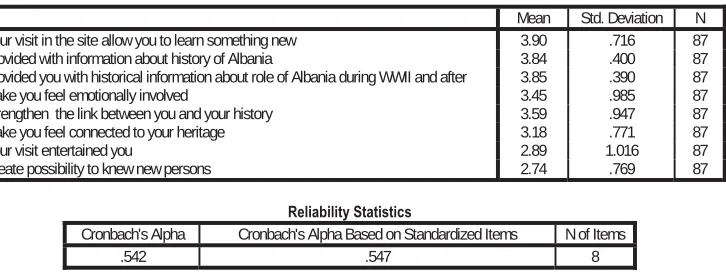
reliability shows value of Cronbach’s Alpha 0.542, which means good correlation between variables.
Table 7. Experience from the visit
Mean Std. Deviation N
Your visit in the site allow you to learn something new 3.90 .716 87
Provided with information about history of Albania 3.84 .400 87
Provided you with historical information about role of Albania during WWII and after 3.85 .390 87
Make you feel emotionally involved 3.45 .985 87
Strengthen the link between you and your history 3.59 .947 87
Make you feel connected to your heritage 3.18 .771 87
Your visit entertained you 2.89 1.016 87
Create possibility to knew new persons 2.74 .769 87
Reliability Statistics
Cronbach's Alpha Cronbach's Alpha Based on Standardized Items N of Items
.542 .547 8
Data from Table 7 shows that visitors provided historical information about role of Albania during WWII and after, enhanced the link between history and their knowledge. After visit performed they felt emotionally involved and connected to the site heritage. In the meantime, visit performed included them in an entertainment activity giving the possibility to be introduced to a new touristic attraction as well as to know different people. So people included in visiting heritage site seeks other experiences rather than learning/educational and heritage experiences.
A Factor Analysis technique was performed to understand better the correlation between variables under a common underlying variable. The determination about number of factors is made according Eigenvalue larger than one (Guttman-Kaiser rule), the Principal Component Analysis is applied using promax rotation. To determine variables included in each factor were included those above 0.4. As it shown in table 7, three main factors were determinate explaining 54.2% of variance. Eigenvalue: first factor (2.198), second factor (1.088) and the third factor (1.078).
Table 7. Factor Analysis for tourists experience on site
Component
1 2 3
Make you feel connected to your heritage .822
Make you feel emotionally involved .726
Strengthen the link between you and your history .490 .401
Provided you with historical information about role of Albania during WWII and after .690
Provided with information about history of Albania .555
Your visit entertained you .536
Your visit create possibility to knew new persons .816
Your visit in the site allow you to learn something new .466 -.413 -.475
Extraction Method: Principal Component Analysis. Rotation Method: Promax with Kaiser Normalization. Rotation converged in 6 iterations.
information process has happened, they enriched historical information through entire environment exposed, and doing so they have proved entertainment experience –third Factor. Also, knowing new persons is an associated fact and an entertainment experience too.
Table 8. Site perception correlations to Learning experience
Your perception regarding the site Learning Experience
Your perception regarding the site
Pearson Correlation 1 .238*
Sig. (2-tailed) .026
N 87 87
Learning Experience
Pearson Correlation .238* 1
Sig. (2-tailed) .026
N 87 87
* Correlation is significant at the 0.05 level (2-tailed).
Statistically significant correlation is seen between site perception and “Learning “experience, (Pearson’ r=0.238, p<0.05). The more visitors considered the site part of own heritage the more willingness they express in learning experience.
Table 9. Site perception Correlations to Emotional Experience
Site perceptions Emotional experience
Site perceptions
Pearson Correlation 1 .645**
Sig. (2-tailed) .000
N 87 87
Emotional experience
Pearson Correlation .645** 1
Sig. (2-tailed) .000
N 87 87
** Correlation is significant at the 0.01 level (2-tailed).
Strong correlation is seen between site perceptions and “Emotional” experience (Pearson’ r=0.645, p=0.000). Visitors have perception of site as being part of their history, they involved in emotional experience during the site visit.
5. Results
The "past" represented to Bunk Art museum motivated visitors in different aspects. Three main reasons were identified during the survey that leads visitors /tourists to visit the site: Educational factor, Heritage and Recreational factors. Each one of them presents differentiation regarding the motives involved based on individual perceptions of visitors in relation to the site.
Heritage experience as a motivation factor identified includes the reasons for visit related to the perception of the site as own heritage.
Reasons included to the Educational factor were related to learning motivations; meanwhile the third group encompasses reasons not related to the first two groups. At its base lie Entertainment motives.
By socio-demographic factors, education level has a direct connection with the perception of the site. The higher the education level the stronger the perception of the site as part of heritage (p <0:05). Also is noticed statistically significant correlation between education level and the identified factors Educational and Recreational, although the relationship to Recreational experience factor is weak and negative.
This is the first attempt to make visitors segmentation based in their perception of the site. Based on the motivation and experiences factors identified it is argued that individuals differs and have different experiences and expectations performing the visit.
The undertaken study present an opportunity to have a better understanding of the motivations for visits at the heritage site as well as the experiences gained offers a better line for marketing and site management.
survey can be seen as rather guiding than generalized. The survey was the first one to be implemented to Bunk’Art museum as such there is no other study to compare the results with. Further research may explore the relationship between site perception factors and expectation from visit among visitors for better understanding and managing the heritage site and to better satisfy visitor desires.
Suggestions provided by the visitors with the aim of improving performance, converge on the necessity of interpretive guides accompanying during the site visit as a very important and stimulant factor of emotions involvement to feel more connected to the heritage site.
The findings of this survey can serve as a resource guide for decision-making institutions that are responsible for the management of site.
References
Alzua, A., O'Leary, J., A. Morrison (1998). Cultural and Heritage Tourism: Identifying Niches for International Travelers. The Journal of Travel and Tourism Studies, 9 (2), 2-13.
Field, A., (2000).Discovering statistics using SPSS for windows. London. SAGE publications. Fyall, A., Garrod, B (1998). Heritage tourism: At what price? Managing Leisure 3 (4), 213-228.
Hall, C. M., McArthur, S (1998). Integrated heritage management: Principles and practice. London: The Stationary Office. Johnson, P., Thomas, B (1990). Measuring local employment impact of tourist attractions. Regional Studies, 24, (5) 395-403 Johnson, P., Thomas, B (1992). Choice and demand in tourism. London. Mansell Publishing Limited.
Kerstetter, D.L., Confer, J.J., and A.R. Graefe (2001). An exploration of the specialization concept within the context of heritage tourism. Journal of Travel Research, 39(3), 267-274.
Poria, Y (2001). Challenging the present approach to heritage tourism: Is tourism to heritage places heritage tourism? Tourism Review, 56(1/2), 51-53.
Poria, Y., Butler, R., Airey, D (2001a). Clarifying heritage tourism : a comment. Annals of Tourism Research, 28 (4), 1047-1049. Poria, Y., Reichel, A., Biran, A ( 2006). Heritage site management – Motivations and Expectations. Annals of Tourism Research,
33(1), 162–178.
Scott, M.J., D.V. Canter, D.V (1997). Picture or place? A multiple sorting study of landscape. Journal of Environmental Psychology, 17, 263-281.
Timothy, D. J (1997). Tourism and the personal heritage experience. Annals of Tourism Research, 24 (3), 751-754. Timothy, D J (2011). Cultural Heritage and Tourism. Channel View Publication.