R E S E A R C H A R T I C L E
Open Access
Development and psychometric testing of
an abridged version of Dundee Ready
Educational Environment Measure (DREEM)
Kathiresan Jeyashree
1*, Hemant Deepak Shewade
2and Soundappan Kathirvel
3Abstract
Background:Dundee Ready Educational Environment Measure (DREEM) is a 50-item tool to assess the educational
environment of medical institutions as perceived by the students. This cross-sectional study developed and validated an abridged version of the DREEM-50 with an aim to have a less resource-intensive (time, manpower), yet valid and reliable, version of DREEM-50 while also avoiding respondent fatigue.
Methods:A methodology similar to that used in the development of WHO-BREF was adopted to develop the
abridged version of DREEM. Medical students (n= 418) from a private teaching hospital in Madurai, India, were divided into two groups. Group I (n= 277) participated in the development of the abridged version. This was performed by domain-wise selection of items that had the highest item-total correlation. Group II (n= 141) participated in the testing of the abridged version for construct validity, internal consistency and test-retest reliability. Confirmatory factor analysis was performed to assess the construct validity of DREEM-12.
Results:The abridged version had 12 items (DREEM-12) spread over all five domains in DREEM-50. DREEM-12
explained 77.4% of the variance in DREEM-50 scores. Correlation between total scores of DREEM-50 and DREEM-12 was 0.88 (p< 0.001). Confirmatory factor analysis of DREEM-12 construct was statistically significant (LR test of model vs. saturatedp= 0.0006). The internal consistency of DREEM-12 was 0.83. The test-retest reliability of DREEM-12 was 0.595, p< 0.001.
Conclusion:DREEM-12 is a valid and reliable tool for use in educational research. Future research using DREEM-12 will establish its validity and reliability across different settings.
Keywords:DREEM, Abridged version, Psychometric testing, Confirmatory factor analysis, Educational environment
Background
Education environment refers to the diverse physical locations in which the students learn. The educational environment of an institution has direct and indirect influence(s) upon the knowledge gained by the stu-dents including the motivation to learn, personal safety and their well-being [1]. Dundee Ready Educa-tional Environment Measure (DREEM) is one of the tools developed specifically to assess the educational environment of medical institutions as perceived by the students.
DREEM has 50 items grouped under five domains namely students’ perception of learning (SPoL; n= 12), students’perception of teachers (SpoT;n= 11), students’ academic self-perception (SASP;n= 8), students’ percep-tion of atmosphere (SPoA; n= 12), and students’ social self-perception (SSP; n= 7). It is a generic and culturally non-specific tool which has been translated and vali-dated in at least eight languages and is used worldwide [2]. In addition to being used to diagnose the deficien-cies of the current educational environment, DREEM has also been used to compare different groups, to monitor the same cohort over a period of time and to assess factors influencing the educational environment [3, 4]. DREEM was used among undergraduates [5] in-cluding nursing [6, 7] and dental students and various * Correspondence:[email protected]
1Department of Community Medicine, Velammal Medical College Hospital
and Research Institute, Madurai 625009, India
Full list of author information is available at the end of the article
post graduate medical students [8, 9] to explore their perceptions of educational environment.
Though universally accepted and used, investigators followed their own analysis and reporting system of DREEM data [10]. Few studies questioned the five-factor structure and construct validity of the original DREEM tool and also tried to develop abridged versions of DREEM [11–14]. The other studies have developed an abridged version but the properties of the abridged ver-sion have not been tested on another cohort. These abridged versions have not been validated nor have they been widely in use.
Our study developed and validated an abridged ver-sion of the DREEM-50 with an aim to have a less resource-intensive (time, manpower), yet valid and liable, version of DREEM-50 while also avoiding re-spondent fatigue.
Methods
Study design and setting
A cross-sectional study was conducted for development of an abridged version of DREEM at a private, tertiary care teaching institute in Madurai, a city in Tamil Nadu state of India. It is one of the two major and the only private institution teaching medicine and allied health sciences in the city. Every year, 150 students are selected through a competitive examination for the undergraduate course in medicine—Bachelor of Medicine and Bachelor of Surgery (M.B, B.S.).
Study participants
A list of the 450 undergraduate medical students cur-rently enrolled in the institute (third, fourth and sixth semester) as on August 2016 was obtained, and all dents were invited to participate in the study. These stu-dents were divided into two groups group I (stustu-dents of the fourth and seventh semester, n= 300) and group II (students of third semester,n= 150).
Data collection
The DREEM-50 item version was administered to both groups after obtaining written informed consent, and two separate datasets were maintained. The au-thor was present during the consent process to en-sure that clarifications were provided to queries, if any. Students who did not consent and those unavail-able after three attempts of contact were excluded from the study.
Statistical analysis
Double data entry and validation was done using EpiData version 3.1 (EpiData Association, Odense, Denmark). Items that had to be reverse coded were done so before entry. The data was analysed using STATA (version 12.1,
copyright 1985–2011 StataCorp LP USA, serial number: 30120504773). Number and proportion were calculated for sociodemographic characteristics like gender and semester. Mean and standard deviation were calculated for age and for score of each item, domain and total scale of DREEM-full and abridged version.
Development of an abridged version
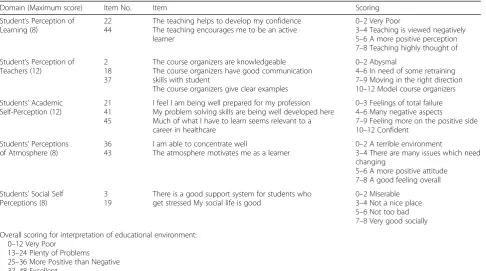
For the development of the abridged version, the authors followed a procedure similar to that adopted in the de-velopment of WHOQOL-BREF, an abridged version of WHOQOL-100, which measures quality of life (QOL) [15]. Item-total correlation (r) and domain-total correl-ation (r) were calculated (group I dataset). Two items with the highest item-total correlation values were se-lected from each of the five domains of the DREEM questionnaire. When two items had the same correlation value, both were included. Thus, the authors arrived at a 12-item version of DREEM (DREEM-12). The face and content validity of this abridged version was assessed by the three authors, in their capacity as subject experts each with a minimum of 3 years’ experience in medical education.
Validity and reliability of DREEM-12
DREEM-50 and DREEM-12 scores were calculated on group II dataset. Internal consistency was measured using Cronbach’s alpha. The percentage of variance in DREEM-50 that is explained by the abridged ver-sion was calculated using R square. DREEM-12 alone was administered on group II to get the second set of scores of DREEM-12 to check for test-retest reli-ability (r).
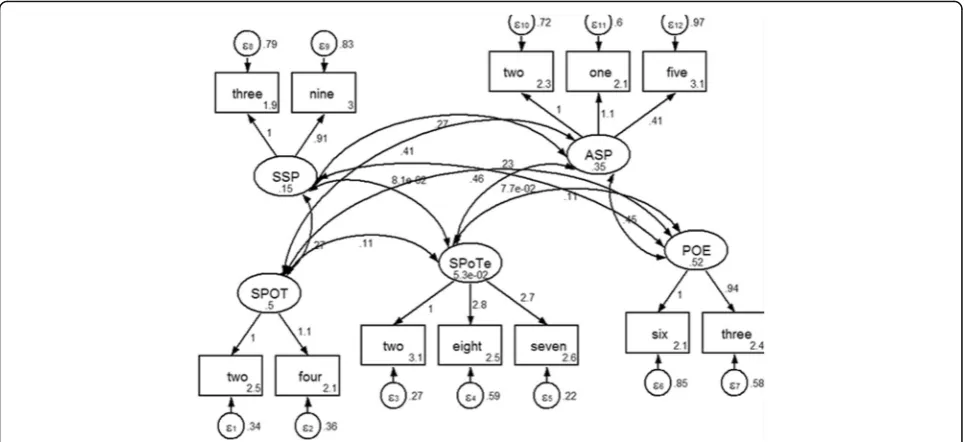
Confirmatory factor analysis was performed to assess the construct validity of DREEM-12. A five-factor first-order model was fit to assess the DREEM-12 structure using the items selected for each DREEM-12 component (items), i.e. SPoT (two), SPoT (three), SASP (three), SPoE (two) and SSP (two).
Ethics
Ethics approval was obtained from institute ethics committee of Velammal medical college hospital and research institute, Madurai, Tamil Nadu. Writ-ten informed consent was taken from the students and the consent process was approved by the ethics committee.
Results
The item-total correlation and domain-total correl-ation of the items selected for inclusion in DREEM-12 are given in Table 2. Correlation between total scores of DREEM-50 and DREEM-12 was 0.88 (p< 0. 001). Domain–domain correlation between DREEM-50 and DREEM-12 were 0.75 (SPoL), 0.7 (SPoT), 0. 79 (SASP), 0.66 (SPoA) and 0.62 (SSP). Regression analysis revealed that DREEM-12 explained 77.4% of the variance in DREEM-50. The internal consistency of DREEM-12 was 0.83 as compared to 0.86 of DREEM-50.
The item wise and overall scoring system of DREEM-12 was devised in line with the DREEM-50 (Table 3). When calculated for group II, 50 and DREEM-12 scores yielded the same interpretations on the stu-dents’ perceptions about the educational environment: overall and at domain level (Table4).The test-retest reli-ability of DREEM-12 was 0.595,p< 0.001.
Confirmatory factor analysis of DREEM-12 construct was statistically significant (LR test of model vs. satu-rated:χ2(44) = 80.88, Prob>χ2= 0.0006) (Fig.1).
Discussion
This study developed and validated DREEM-12, an abridged version of DREEM-50, using two subsets of
a population of undergraduate medical students and established good model fit of DREEM-12 by con-firmatory factor analysis.
Our study, besides developing an abridged version of DREEM-50, has also confirmed its factor structure and established its validity and reliability. We have employed robust data quality management, through double data entry and validation, and statistical techniques to prove the same. Our study has enrolled students from different years of medical education and thus can be considered representative of the perceptions of students in different stages of medical education.
The study was limited to only students from a single teaching institution in India. However, ours being a study on educational environment, it is also necessary to point out that the quality standards of a medical col-lege with respect to curriculum, teaching methodology, infrastructure, staffing and assessment methods are strictly governed to be uniform by the Medical Council of India. These standards are uniform for all the col-leges countrywide. All colcol-leges, government and pri-vate, are to abide by these standards, failing which the recognition of the institute is cancelled and the given institute will no more be able to admit candidates. Hence, it will be safe to say that the educational envir-onment offered in colleges across the country are to be uniform. The students are admitted into the under-graduate medical course by a nationwide common competitive entrance examination—National eligibility entrance test. The students do come from different sociodemographic and cultural backgrounds in different parts of the country. But, we do not expect that to sig-nificantly affect their perception of their environment. Thus, while the internal validity of our study is com-mendable, further multi-centric research is required to
Table 1Profile of study participants - undergraduate medical students from Madurai, India in 2016 (n= 418)
Characteristics Group In= 277 Group IIn= 141
Mean age (SD) in years 19.2 (0.8) 18.1 (0.64)
Gender (%) Male 104 (37.5) 54 (38.3)
Female 173 (62.5) 87 (61.7)
Group I–fourth and sixth semester students; group II–third semester students
SDstandard deviation
Table 2Domain-wise list of items in DREEM-50 that had the highest item-total and domain-total correlations
Domain Item no Item Item-total
correlation
Domain-total correlation
Students’perception of learning 44 The teaching encourages me to be an active learner 0.646 0.711
22 The teaching helps to develop my confidence 0.556
Students’perception of teachers 2 The course organisers are knowledgeable 0.510 0.611
37 The course organisers give clear examples 0.450
18 The course organisers have good communication skills with student 0.450
Students’academic self-perception 21 I feel I am being well prepared for my profession 0.435 0.599
41 My problem solving skills are being well developed here 0.430
45 Much of what I have to learn seems relevant to a career in healthcare 0.430
Students’perception of atmosphere 36 I am able to concentrate well 0.500 0.633
43 The atmosphere motivates me as a learner 0.487
Students’social self-perception 3 There is a good support system for students who get stressed 0.419 0.556
establish the generalisability of the results outside the country.
The psychometric properties of original DREEM-50 were investigated in few studies. Confirmatory factor analysis found that the five-factor structure of DREEM-50 showed poor model fit in studies conducted in Malaysia and Australia [12, 14]. Both these studies came up with an abridged version of DREEM-50 with a good model fit (Table 5). The Malaysian study de-rived a 17-item abridged version with good model fit with each domain having three items except the stu-dents’ perception of atmosphere which had five
items. Similarly, the Australian study derived 12-item abridged version with only four domains after remov-ing student’s social self-perception. The difference in the items chosen in our study, Malaysian and Austra-lian abridged versions might have been due to the following reasons- the methodology of choosing items into the abridged version was different in the three studies. In our study, we had followed the method used in development of WHO QOL BREF. We in-cluded items based on their item-total correlations. While the Malaysian version retained the five-domain structure of the original DREEM, the Australian
Table 3Items selected to form DREEM-12 and the applicable scoring system
Domain (Maximum score) Item No. Item Scoring
Student’s Perception of Learning (8)
22 44
The teaching helps to develop my confidence The teaching encourages me to be an active learner
0–2 Very Poor
3–4 Teaching is viewed negatively 5–6 A more positive perception 7–8 Teaching highly thought of
Student’s Perception of Teachers (12)
2 18 37
The course organizers are knowledgeable The course organizers have good communication skills with student
The course organizers give clear examples
0–2 Abysmal
4–6 In need of some retraining 7–9 Moving in the right direction 10–12 Model course organizers
Students’Academic Self-Perception (12)
21 41 45
I feel I am being well prepared for my profession My problem solving skills are being well developed here Much of what I have to learn seems relevant to a career in healthcare
0–3 Feelings of total failure 4–6 Many negative aspects
7–9 Feeling more on the positive side 10–12 Confident
Students’Perceptions of Atmosphere (8)
36 43
I am able to concentrate well
The atmosphere motivates me as a learner
0–2 A terrible environment
3–4 There are many issues which need changing
5–6 A more positive attitude 7–8 A good feeling overall
Students’Social Self Perceptions (8)
3 19
There is a good support system for students who get stressed My social life is good
0–2 Miserable 3–4 Not a nice place 5–6 Not too bad 7–8 Very good socially
Overall scoring for interpretation of educational environment: 0–12 Very Poor
13–24 Plenty of Problems 25–36 More Positive than Negative 37–48 Excellent
Table 4Comparison of DREEM-50 and DREEM-12 scores and their interpretation calculated for group II
SN Domain DREEM-50 DREEM-12
Mean score (SD) Interpretation Mean score (SD) Interpretation
1 Students’perception of learning 30.5 (5.4) A more positive perception 5.1 (1.6) A more positive perception
2 Students’perception of teachers 25 (4.8) Moving in the right direction 8.4 (2.1) Moving in the right direction
3 Students’academic self-perception 21.1 (4.2) Feeling more on the positive side 8.1 (1.9) Feeling more on the positive side
4 Students’perception of atmosphere 28.2 (5.9) A more positive attitude 4.8 (1.6) A more positive attitude
5 Students’social self-perception 16.8 (3.6) Not too bad 4.7 (1.7) Not too bad
Total 121.7 (18) More Positive than Negative 31.1 (6.3) More Positive than Negative
version had done away with the social self-perception domain. Since our study revealed equally good domain-total correlation for all domains, similar to the Malaysian study, we chose to retain all domains in our abridged version. Eight (items 3, 19, 22, 37, 41, 43, 44 and 45) out of the 12 items selected in our study (Table 3) also figure in the Malaysian 17-item version [11, 12]. None of the items in the Australian abridged version are present in the current DREEM-12 except for item 22 [14]. Our abridged version is short like the Australian version and maintained the five-domain structure of the original version like the Malaysian version.
A study from Ireland also mentioned the poor con-struct validity of the DREEM-50 and found some 17 items having poor fit indices (< 0.7). This study failed to propose an abridged version (33 items) mentioning two reasons, namely, the weakest items may not be same for
different settings and fear of affecting the factor struc-ture [13].
Reports on test-retest reliability of DREEM are vari-able. A study from Brazil reported moderate test-retest reliability of 0.43 [16]. Contrarily, a study valid-ating the Greek translation of DREEM, reported 0.90 [17]. While a generally accepted cut-off of 0.7 is followed, there are no standards laid for test-retest re-liability cut off for instruments measuring psycho-logical parameters [18].
Conclusion
DREEM-12, developed as an abridged version of DREEM-50, was found to explain 77.5% of the variance of the scores of the original version and also retained its factor structure, validity and reliability. Future research using DREEM-12 will establish its validity and reliability across different settings.
Fig. 1Confirmatory factor analysis of DREEM-12 construct. SSP-Social Self Perception, ASP-Academic Self perception, SPOT-Students’Perception of Teachers, SPOTe-Students’Perception of Teaching, POE- Perception of Environment three-3, ninet-19, twone-21, fone-41, ffive-45, twtwo-22, ffour-44, two-2, eightn-18, tseven-37, tsix-36, fthree-43. LR test of model vs. saturated: chi2(44)=80.88, Prob > chi2 = 0.0006
Table 5Comparison of items in the abridged version of DREEM developed in our study with those in Malaysian and Australian versions
Domains Item number(s)
India (current study) Malaysia Australia
Students’perception of learning 22, 44 20, 22, 44 13, 22, 24, 48
Students’perception of teachers 2, 18, 37 6, 37, 40 8, 29, 32, 39
Students’academic self-perception 21, 41, 45 26, 41, 45 21
Students’perception of atmosphere 36, 43 30, 33, 42, 43, 49 30, 34, 35
Students’social self-perception 3, 19 3, 19, 46 –
Abbreviations
DREEM:Dundee Ready Educational Environment Measure; M.B., B.S.: Bachelor of Medicine and Bachelor of Surgery; QOL: Quality of life; SASP: Students’ academic self-perception; SPoA: Students’perception of atmosphere; SPoL: Students’perception of learning; SPoT: Students’perception of teachers; SSP: Students’social self-perception; WHOQOL-BREF: World Health organisation Quality of Life- BREF
Acknowledgements
We thank the students for participating in the study. We thank the Department for International Development (DFD), UK, for funding the Global Operational Research Fellowship Programme at the International Union Against Tuberculosis and Lung Disease (The Union), Paris, France, in which HDS works as an senior operational research fellow.
Funding None.
Availability of data and materials
The complete double-entered data and validation report are available with the corresponding author. Please contact her for data requests.
Disclaimer
The contents of this paper do not necessarily reflect the views of the Velammal Medical College Hospital and Research Institute, PGIMER Chandigarh or The Union.
Authors’contributions
KJ, HDS and SK conceived the study. KJ was involved in data collection and entry. KJ, HDS and SK were involved in data analysis and interpretation. KJ prepared the first draft. All authors critically reviewed the draft and gave approval for the final draft to be published.
Ethics approval and consent to participate
Ethics approval was obtained from the institute ethics committee of Velammal Medical College Hospital and Research Institute, Madurai, Tamil Nadu, India. Written informed consent was taken from the students, and the consent process was approved by the ethics committee.
Consent for publication
Not applicable. No individual person’s personal details, images or videos are being used in this study.
Competing interests
The authors declare that they have no competing interests.
Publisher’s Note
Springer Nature remains neutral with regard to jurisdictional claims in published maps and institutional affiliations.
Author details 1
Department of Community Medicine, Velammal Medical College Hospital and Research Institute, Madurai 625009, India.2Department of Operational
Research, International Union Against Tuberculosis and Lung Disease (The Union), South-East Asia Office, C-6 Qutub Institutional Area, New Delhi 110016, India.3Department of Community Medicine, School of Public Health, Postgraduate Institute of Medical Education and Research (PGIMER), Chandigarh UT, India.
Received: 9 February 2018 Accepted: 21 March 2018
References
1. Mayya S, Roff S. Students’perceptions of educational environment: a comparison of academic achievers and under-achievers at kasturba medical college, India. Educ Health (Abingdon). 2004;17:280–91.https://doi.org/10. 1080/13576280400002445.
2. Roff S, McAleer S, Harden RM, Al-Qahtani M, Ahmed AU, Deza H, et al. Development and validation of the Dundee Ready Education Environment Measure (DREEM). Med Teach. 1997;19:295–9.https://doi.org/10.3109/ 01421599709034208.
3. Whittle SR, Whelan B, Murdoch-Eaton DG. DREEM and beyond; studies of the educational environment as a means for its enhancement. Educ Health (Abingdon). 2007;20:7.http://www.ncbi.nlm.nih.gov/pubmed/17647175 4. Till H. Identifying the perceived weaknesses of a new curriculum by means
of the Dundee Ready Education Environment Measure (DREEM) inventory. Med Teach. 2004;26:39–45.https://doi.org/10.1080/01421590310001642948. 5. Varma R, Tiyagi E, Gupta JK, James PA, Kreiter CD, Shipengrover J, et al.
Determining the quality of educational climate across multiple undergraduate teaching sites using the DREEM inventory. BMC Med Educ. 2005;5:8.https://doi.org/10.1186/1472-6920-5-8.
6. Hamid B, Faroukh A, Mohammadhosein B. Nursing students’perceptions of their educational environment based on DREEM model in an Iranian university. 2013.https://tspace.library.utoronto.ca/handle/1807/54827. Accessed 26 Oct 2016.
7. O’Brien a P, Chan TM, Cho M a. Investigating nursing students’perceptions of the changes in a nursing curriculum by means of the Dundee Ready Education Environment Measure (DREEM) inventory: results of a cluster analysis. Int J Nurs Educ Sch. 2008;5:Article25. https://doi.org/10.2202/1548-923X.1503.
8. Jeyashree K, Patro B. The potential use of DREEM in assessing the perceived educational environment of postgraduate public health students. Med Teach. 2013;http://www.tandfonline.com/doi/full/10.3109/0142159X.2012. 737058. Accessed 20 Jan 2016
9. Khan AS, Akturk Z, Al-Megbil T. Evaluation of the learning environment for diploma in family medicine with the Dundee Ready Education Environment (DREEM) inventory. J Educ Eval Health Prof. 2010;7:2.https://doi.org/10.3352/ jeehp.2010.7.2.
10. Miles S, Swift L, Leinster SJ. The Dundee Ready Education Environment Measure (DREEM): a review of its adoption and use. Med Teach. 2012;34(9): e620–34.https://doi.org/10.3109/0142159x.2012.668625.
11. Yusoff MSB. Psychometric properties of DREEM in a sample of Malaysian medical students. Med Teach. 2012;34:595–6.https://doi.org/10.3109/ 0142159X.2012.675104.
12. Yusoff MSB. The Dundee Ready Educational Environment Measure: a confirmatory factor analysis in a sample of Malaysian medical students. Int J Humanit Soc Sci. 2012;2:313–21.
13. Hammond SM, O’Rourke M, Kelly M, Bennett D, O’Flynn S. A psychometric appraisal of the DREEM. BMC Med Educ. 2012;12:2.https://doi.org/10.1186/ 1472-6920-12-2.
14. Vaughan B, Mulcahy J, McLaughlin P, Miles S, Swift L, Leinster SJ, et al. The DREEM, part 2: psychometric properties in an osteopathic student population. BMC Med Educ. 2014;14:100. https://doi.org/10.1186/1472-6920-14-100.
15. THE WHOQOL GROUP. Development of the World Health Organization WHOQOL-BREF quality of life assessment. The WHOQOL Group. Psychol Med. 1998;28:551–8.
16. Filho G, Vieira J, Schonhorst L. Psychometric properties of the Dundee Ready Educational Environment Measure (DREEM) applied to medical residents. Med Teach. 2005;27:343–7.https://www.researchgate.net/profile/ Joaquim_Vieira3/publication/7721219_Psychometric_properties_of_the_ Dundee_Ready_Education_Environment_Measure_DREEM_applied_to_ medical_residents/links/54c238f30cf219bbe4e64ad7/Psychometric-properties-of-the-Dundee-Read. Accessed 5 Mar 2018
17. Dimoliatis IDK, Vasilaki E, Anastassopoulos P, Ioannidis JPA, Roff S. Validation of the Greek translation of the Dundee Ready Education Environment Measure (DREEM). Educ Heal. 2010;23:348.http://www.ncbi.nlm.nih.gov/ pubmed/20589604. Accessed 5 Mar 2018