INTRODUCTION
Impinging jets have received considerable attention due to their inherent characteristics of high rates of heat transfer besides having simple geometry. Various industrial processes involving high heat transfer rates apply impinging jets. Heat transfer rates in case of impinging jets are affected by various parameters like Reynolds number, nozzle plate spacing, radial distance from stagnation point, Prandtl number, target plate inclination, confinement of the jet, nozzle geometry, curvature of target plate, roughness of the target plate, low scale turbulence intensity i.e., turbulence intensity at the nozzle exit. Gardon and Cobonpue¹ have reported the heat transfer distribution between circular jet and flat plate for the nozzle plate spacings greater than 2 times the diameter of jet, both for single jet and array of jets. They have used specially designed heat flux gauge for the measurement of local heat transfer
Study and Model Formulation for Curved Surface Using
Computational Fluid Dynamics (CFD)
R.E. SHELKE¹* and L.B. BHUYAR²
¹Government I.T.I. Morshi Road, Amravati - 444 603 (India).
²Department of Mechanical Engineering PRM Institute of Technology and Research, Badnera Amravati - 444 701 (India).
(Received: April 10, 2009; Accepted: May 15, 2009)
ABSTRACT
Impinging jets on curved surfaces are important in many industrial applications. Experimentation have been carried out for heat transfer evaluation between the impinging air jets and curved surfaces in the prior research. An attempt has been made towards the model development using Computational Fluid Dynamics (CFD) to validate the experimental results obtained for curved surface in the present study. This attempt is made because, the physical model experimentation is time consuming and cumbersome as well as costlier affair. Hence, if the CFD model is developed in accordance with the results obtained earlier and if it is in good agreement with the same then using the same procedure, the CFD models for flat and rough surface can also be formulated, thereby, reducing the efforts of actual experimentations in future.
Keywords: Impinging air jet, Heat transfer, Computational Fluid Dynamics (CFD).
rates from a constant wall temperature plate. Gardon and Akfirat² studied the effect of turbulence on the heat transfer between two dimensional jet and flat plate. They also studied effect of multiple two-dimensional jets on the heat transfer distribution³. Baughn and Shimizu4 and Hrycak5
have conducted experiments of heat transfer between round jet and flat plate employing different methods of surface temperature measurement. Lyttle and Webb6 have studied the effect of very
low nozzle plate spacing (Z/D < 1) on the local heat transfer distribution on a flat plate impinged by a circular air jet and found that in the acceleration range of the nozzle plate spacing (Z/D < 0.25), maximum Nusselt number shifts from the stagnation point to the point of secondary peak with the effect being more pronounced at higher Reynolds number. Experimental work on impinging jets is done by Mar tine7 and Viskanta9 alongwith review by
studied the effect of the modified surface on the heat transfer between impinging circular nozzle and the flat plate. Yang G11 have experimentally
evaluated slot jet impingement cooling on concave surface and studied the effect of nozzle configuration and curvature on heat transfer rate.The present knowledge concer ning Computational Fluid Dynamics is inadequate.So, an attempt is made for model formulation for the curved surface.
CFD has now become an integral part of the engineering design and analysis12-13. Engineers
can make use of the CFD tools to simulate fluid flow and heat transfer phenomena in a design and predict the system perfor mance before
manufacturing. The advantages of CFD are numerous, namely, fewer iterations to the final design, shorter time to launch the product, fewer expensive prototypes and so on. Furthermore, CFD provides a cost-efficient means of testing new designs and concepts that would otherwise be too expensive and hazardous to investigate.
Cfd Analysis of Slot Jet Impingement Cooling on Curved Surface
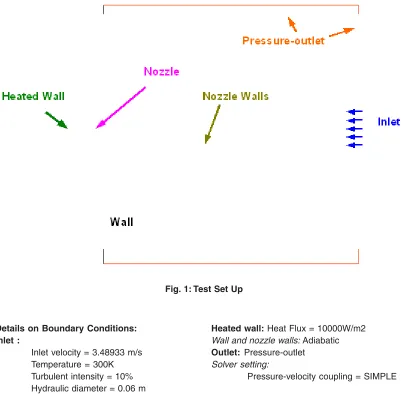
2 dimensional CFD simulation of slot jet impingement cooling on concave surface is performed using Ansys FLUENT Post software. Geometry and boundary conditions are obtained from11 .Test set up is given in Fig. 1.
Fig. 1: Test Set Up
Details on Boundary Conditions: Inlet :
Inlet velocity = 3.48933 m/s Temperature = 300K Turbulent intensity = 10% Hydraulic diameter = 0.06 m
Heated wall: Heat Flux = 10000W/m2 Wall and nozzle walls: Adiabatic Outlet: Pressure-outlet
Solver setting:
Discretization: Pressure → Standard
Momentum → Second Order Upwind
Turbulence Kinetic Energy → Second Order Upwind Turbulence dissipation rate → Second Order Upwind Energy → Second Order Upwind
Under relaxation factors: Pressure → 0.5 Density → 1 Body Forces → 1 Momentum → 0.5
Turbulence Kinetic Energy → 0.6 Turbulence dissipation rate → 0.6 Turbulence Viscosity → 1 Energy → 1
RESULTS AND DISCUSSION Turbulence intensity contours (%)
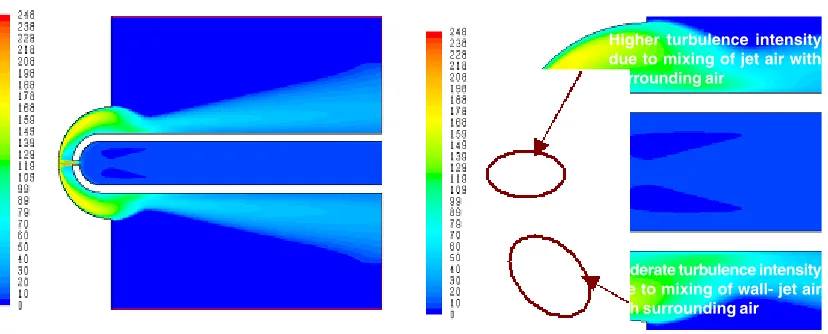
These are shown in the following figure 2. It has been observed that higher turbulence intensity is due to mixing of jet and surrounding air. Higher the turbulence intensity, higher is the Nusselt number, which causes to enhance the heat transfer rate.
Nusselt Number Profile Comparison
2 dimensional CFD simulation of slot jet impingement cooling on the concave surface is reported using Ansys FLUENT Post software at the required and specified boundary conditions. Inlet velocity is calculated from the known Reynolds number. Adiabatic wall conditions are applied on wall and nozzle walls. Realizable k-∈ model is used for resolving the turbulence. Velocity contours, velocity vectors, turbulence intensity contours and temperature contours have been observed in the present CFD analysis. It has been observed that the results obtained from the CFD analysis are quite on the better side compared to the experimental results. It means that there is a good agreement in the results obtained in the CFD analysis with that of the earlier experimental results. It has been observed that the maximum temperature exists in the zone which is far away from the stagnation point. The turbulence intensity countours are the representative of the mixing of jet air with the surrounding air. Higher turbulence intensity represents the higher rate of mixing which in turn enhances the heat transfer rate. The Nusselt number profile comparision at Z/B = 4 and Reynolds number of 23400 is as shown in the figure 3. It is observed from the figure 3 that the Nusselt number in CFD analysis is in good agreement compared with the experimental results.
Higher turbulence intensity due to mixing of jet air with surrounding air
Moderate turbulence intensity due to mixing of wall- jet air with surrounding air
CONCLUSIONS
CFD analysis of slot jet impingement cooling on the curved surface is reported using Ansys FLUENT Post software at the required and
specified boundary conditions. The results obtained from the CFD analysis are in good agreement with the experimental results. This procedure can be adopted with confidence for predicting the values for any kind of surface.
Fig. 3: Variation in Nusselt number at Z/B = 4 and Reynolds number = 23400
1. R. Gardon and J. Cobonpue, Heat Transfer Between a Flat Plate and Jets of Air Impinging on It, Int. Developments in Heat Transfer, ASME. 454-460 (1962).
2. R Gardon and C.Akfirat, The Role of Turbulence in Determining the Heat Transfer Characteristics of Impinging Jets, Int. J. Heat and Mass Transfer, 8: 1261- 1272 (1965). 3. R Gardon and C. Akfirat, Heat Transfer
Characteristics of Impinging Two Dimensional Air Jets", J. of Heat Transfer, 88: 101-108 (1966).
4. J. W. Baughn and S. Shimizu, " Heat Transfer Measurements From a Surface With Uniform Heat Flux and an Impinging Jet", J. of Heat Transfer, 111: 1096-1098 (1989).
5. P. Hr ycak, Heat Transfer from Round
REFERENCES
Impinging Jets to a Flat Plate, Int. J. Heat Mass Transfer, 26: 1857-1865 (1983). 6. D. Lytle, B. W. Webb, Air Jet Impingement
Heat Transfer at Low Nozzle Plate Spacings, Int. J. Heat and Mass Transfer, 37: 1687-1697 (1994).
7. H. Martine, Heat and Mass Transfer between Impinging Gas Jets and Solid Surfaces, Adv. Heat Transfer, 13: 1-60 (1977).
8. K. Jambunathan, E. Lai, M. A. Moss, B.L. Button, A Review of Heat Transfer Data for Single Circular Jet Impingement, Int. J. Heat and Fluid Flow, 13: 106- 115 (1992). 9. R. Viskanta, Heat Transfer to Impinging
10. L. G. Hansen, B. W. Webb, Air Jet Impingement Heat Transfer from Modified Surfaces, Int. J. Heat Mass Transfer, 36: 989-997 (1993).
11. Yang G., Choi M., Lee J. S., "An Experimental Study of Slot Jet Impingement Cooling on Concave Surface: Effect of Nozzle
Configuration and Curvature", International Journal of Heat and Mass Transfer, 42: 2199-2209 (1999).
12. www.google.com, www.cfdreview.com 13. Ghoshdastidar P.S., "Computer Simulation