ISSN: 2306-9007 Tessema, Beraki, Tewolde & Andemariam (2014) 2023
I
www.irmbrjournal.com December 2014I
nternationalR
eview ofM
anagement andB
usinessR
esearchVol. 3 Issue.4
R
M
B
R
Causes of Corruption from Entrepreneurs’ Perceptions:
Theoretical and Practical Implications.
MUSSIE T. TESSEMA
Ph.D., Business Administration Dept, Winona State University, MN. Som323F. Email: [email protected]
Tel. 507-457-2571
MENGSTEAB TESFAYOHANNES-BERAKI
Ph.D., Susquehanna University Email: [email protected]
SEBHATLEAB TEWOLDE
Ph.D., Department of Accounting, University of Asmara Email: [email protected]
KIFLEYESUS ANDEMARIAM
Ph.D., Department of Management, University of Asmara Email: [email protected]
Abstract
This study assesses the extent to which ten selected factors affect corruption in Least Developed Countries (LDCs). The study uses Eritrea as a case study and delves into the causes and challenges of corruption in LDCs. The findings of the study support several previously conducted studies in that each factor examined had a moderate to high positive correlation with corruption, where r ranged between .47 and .59. In
addition, the ten variables together explain about 73 percent change in perceived corruption (R2= .73). The
study acknowledges that corruption is multifaceted and complicated, involving economic, political, and social-cultural factors and has no „quick fix‟ and thus needs proper planning, determination, resilience, and above all, political will. Implications of these findings and future research directions are discussed.
Key Words: Governance, Accountability, Corruption, LDCs, Eritrea, Entrepreneurs, Business Eethics.
Introduction
ISSN: 2306-9007 Tessema, Beraki, Tewolde & Andemariam (2014) 2024
I
www.irmbrjournal.com December 2014I
nternationalR
eview ofM
anagement andB
usinessR
esearchVol. 3 Issue.4
R
M
B
R
Although corruption is not a new phenomenon, it has actually risen in recent years, especially in the Least Developed Countries (LDCs). The question, first and foremost, is: what do we mean by LDCs? According to the UN (2010), LDCs are countries that suffer conditions of extreme poverty, ongoing and widespread conflict, extensive political corruption, and lack political and social stability. The form of government in such countries is often authoritarian in nature, and may even be a dictatorship. Thirty-three of the nations on the African continent fall under the rubric of LDCs. Corruption in most LDCs has become the greatest challenge to leaders and citizens, threatening to undermine effective governance. It is also a threat to both economic development and the process of establishing an enduring democracy. It must also be noted that corruption is not uniquely LDCs affair, but rather global in nature. However, societies which are relatively free of corruption are anchored on respect for civil liberties, accountable government, a wide range of economic opportunities, and structured political competition. These are mainly, but not exclusively, characteristics of developed western states (Transparency International, 2012).
Eritrea, the case being studied, gained political independence in 1991 and became a sovereign State in 1993, after a 30-year liberation war with Ethiopia. The country inherited a weak private sector and a very low human capital base (World Bank, 1998). To reverse this situation, the Eritrean government took a number of initiatives including embarking on a multifaceted nation-building and reconstruction process and the introduction of a 1994 Macro-policy that emphasizes a private sector-driven economy (GoE, 1994). In the first seven years of Eritrea‟s independence (1991-1998), political conditions were relatively conducive, peace and stability prevailed, and the private sector started to flourish (World Bank, 1998). As a result, Eritrea‟s economy grew by 7 percent on average (UN, 2002). During that time, many Eritreans, who had lived overseas, began to return home to work in the public service or in the private sector or simply as consultants (Tessema & Soeters, 2006). The number of small and medium enterprises (SMEs) increased (Ghebretensae, 2005). As a result, many scholars and world leaders, like President Bill Clinton, cited Eritrea as a beacon of Africa (Tseggai, 1999). After the border war with Ethiopia (1998-2000), however, the situation changed. Eritrea‟s initial promise of growth, peace and stability were, unfortunately, disrupted. Although the two countries signed a peace agreement, mediated by the OAU and the UN in December 2000, the situation has actually been of „no war - no peace‟. As a consequence, Eritrea‟s economic and political situations have deteriorated (Rena, 2007; Tekeste, 2010; Tessema et al., 2014). The main factors that have contributed to the deteriorating Eritrean economic and political situations are the border war with Ethiopia, government refusal to implement the 1997-ratified-Eritrean Constitution, mismanagement of the government/governance problem, arresting the so called G-15 that include ministers and military generals, banning all private newspapers, imprisonment of all private journalist, discouraging the private sector, excessive government intervention in all aspects of the economy, indefinite national military service, and UN-imposed sanctions on Eritrea (Heritage Foundation, 2012; Abraha, 2010a&b; Mekonnen, 2008; Tekeste, 2010).
The deteriorating Eritrean economic and political situation created opportunities for corrupt activities. Eritrea long maintained a reputation for a relatively low level of corruption. In recent years, however, graft appears to have increased. Eritrea was ranked 126th out of 180 countries surveyed in Transparency International‟s 2009 Corruption Perceptions Index. However, three years later (2012), Eritrea was ranked 134th (Transparency International, 2012). According to the Transparency International‟ (2012) Corruption Perceptions Index (CPI), Eritrea‟s corruption perception ranking increased from 2.9 to 2.5 "on a scale from 10 (very clean) to 0 (highly corrupt) between 2007 and 2011.
ISSN: 2306-9007 Tessema, Beraki, Tewolde & Andemariam (2014) 2025
I
www.irmbrjournal.com December 2014I
nternationalR
eview ofM
anagement andB
usinessR
esearchVol. 3 Issue.4
R
M
B
R
have good knowledge of what is happening in Eritrea. Specifically, the paper attempts to answer which variables and to what extent they are correlated with perceived corruption. The paper is based on the perceptions of 210 owners/managers of SMEs engaged in different business activities: manufacturing, trading and distribution, tourism and hospitability, transportation and communication, construction and maintenance, and agribusiness and forestry.
Literature Review
Interest in factors affecting corruption has increased. This is mainly due to the fact that the effect of corruption is recognized nationally and internationally. In recent years, there have been significant increases in the attention paid to corruption, in part due to, series of high level corruption cases in industrialized countries, an increasing awareness of the costs of corruption throughout the world, and the political and economic changes which many countries are undergoing. The question is: what do we mean by corruption? Corruption is a term that has been perceived in various ways by various scholars. Its conceptualization has attracted competing and numerous views and approaches. For example, according to Khan (1996:12), corruption is an act which deviates from the formal rules of conduct governing the actions of someone in a position of public authority because of private motive such as wealth, power or status. Transparency International (2012) also defines corruption as the misuse of public power for private benefit. Corruption is also defined in the wider sense by Global Infrastructure Anti-Corruption Centre (GIACC) (2012) to include bribery, extortion, fraud, deception, collusion, cartels, abuse of power, embezzlement, trading in influence and money laundering. Corruption is considered as an enemy of economic development because of its various vices. Countries that condone corruption are often besieged with a lot of economic, political and social vices (Rudolph & Moeti-Lysson, 2011).
Corruption can be described in many ways such as general disease of body politics, public exploitation and abuse of public office for private gain. It includes bribery, smuggling, fraud, illegal payments, money laundering, drug trafficking, falsification of documents and records, false declaration, evasion, underpayment, deceit, forgery, concealment, aiding and abetting of any kind to the detriment of another person, community, society or nation (Johnston, 1997; Dandago, 1997). There are also many types of corruption: abuse of power, ill-treatment of subordinates and indecent treatment of people‟s needs, self-award of contract, malicious withdrawal or carpeting of personnel files, unnecessary delay of actions on certain demands, fraudulent distortion of facts and figures, nepotism, embezzlement and other financial misappropriation (Groenendijk, 1997; Ruzindana, 1998; Waliggo, 1999; World Bank, 2000). The cost of corruption to the society (in terms of both tangible and intangible costs) is extremely high. Intangible costs include the loss of trust in democracy, in leaders, in institutions, and in fellow citizens. Tangible costs include the impact on trade and investments, administrative efficiency, good governance, and equality of citizens (UN, 2012; Thomas, 2010). The above studies indicate that there is a growing body of literature on corruption. They also suggest that corruption is a complex yet poorly articulated notion.
Corruption as an issue has been studied both as dependent and dependent variable. As an independent
variable, corruption explains outcomes such as economic development, political/democratic development,
trust in public officials, etc. (e.g., Chinhamo & Shumba, 2007; Rudolph & Moeti-Lysson, 2011; Rossouw, 1999; Waliggo, 1999; Osei, 1999). As a dependent variable, corruption is explained by factors such as low salary of public officials, monopoly of power, discretionary power and weak accountability of public officials, etc. (Purohit, 2007; Alcazar & Andrade, 2001; Johnson, 1997; Dandago, 1997; Groenendijk, 1997; Ruzindana, 1998; Waliggo, 1999). In this study, however, corruption is studied as a dependent variable.
ISSN: 2306-9007 Tessema, Beraki, Tewolde & Andemariam (2014) 2026
I
www.irmbrjournal.com December 2014I
nternationalR
eview ofM
anagement andB
usinessR
esearchVol. 3 Issue.4
R
M
B
R
as a dependent variable being affected by ten variables (See Figure-1). Given the objective of the current study and the context of LDCs, we developed the model presented in Figure-1 after reviwing the relevant literature. The model assumes that external factors (economic, political, and socio-cultural) affect the ten variables, which in turn influence corruption. Put it differently, the more a country is developed economically, the more policy makers and public officials are committed and willing to develop and excute laws and regulations that are reviewed by independennt judiciary and media, the more the society are educated and morally ethical, the more likely the ten variables can be effective and discourage corrupt acts. It must be noted that the ten variables are a sort of „checklist‟ that influence corruption. In the words of Hiltrop (1996), the checklist chosen for a research should depend on the problems being researched and the kinds of predictability sought. Argyrous (2000: 5) also suggests that “the choice of variables to investigate is affected by a number of complex factors: theoretical framework, pre-specified research agenda and curiosity-driven research. Nevertheless, the three motivations are obviously not mutually exclusive”. The proposed ten variables are discussed as follows:
Figure-1: Factors affecting corruption
Accountability of Public Officials
Accountability and transparency values of good governance and sustainable development not only buttress responsive public policy and high levels of public sector performance but also play a crucial role in preventing the onset of systemic corruption (UN, 2012). A number of studies, however, indicated that there is a lack of accountable public officials in most LDCs (Alcazar & Andrade, 2001; Amnesty International, 2011; Johnston, 1997; Dandago, 1997; Ruzindana, 1998; Waliggo, 1999; Osei, 1999; Rowe, 2011; Rossouw, 1999). Based on the above finding, the following hypothesis is forwarded:
Hypothesis 1: Lack of accountable public officials will be positively correlated with perceived corruption.
High Concentration of Power
High concentration or monopoly of power gives public officials the opportunity to create circumstances that entice taxpayers into corrupt practices (Prohito, 2007; Alcazar & Andrade, 2001; Johnson, 1997; Dandago, 1997). A lack of clearly defined roles, functions, and duties of public officials creates an environment ripe for abusive behavior (Pashev, 2005). A high degree of discretionary power and the lack of adequate monitoring and reporting mechanisms are vital in providing opportunities for corruption. The greater the discretion, the greater the opportunity public officials have to provide favorable interpretations
External factor
Economic
Political
Socio-cultural
Factors affecting corruption
Lack of accountable public officials High concentration of power Lack of independent judiciary Ineffective HRM in public sector Ineffective corruption reporting system Lack of independent media
Poor socio-economic policies
Ineffective public administrative agencies Ineffective customs & tax system Low salaries of public officials
ISSN: 2306-9007 Tessema, Beraki, Tewolde & Andemariam (2014) 2027
I
www.irmbrjournal.com December 2014I
nternationalR
eview ofM
anagement andB
usinessR
esearchVol. 3 Issue.4
R
M
B
R
of government rules and regulations to businesses in exchange for illegal payments. A number of studies also reveal that there is high concentration of power in most LDCs (Prohito, 2007; Alcazar & Andrade, 2001; Dandago, 1997). Therefore, the following hypothesis is proposed:
Hypothesis 2: High concentration of power by vested interests will be positively correlated with perceived corruption.
Independence of Judiciary
The separation of powers is a model for a good governance of a state. The model was first developed in ancient Greece and came into widespread use by the Roman Republic as part of the unmodified Constitution of the Roman Republic. Under this model, the state is divided into three branches (executive, legislature, and judiciary), each with separate and independent powers and areas of responsibility so that no branch has more power than the other branches (Chinhamo & Shumba, 2007). Separation of powers is designed to prevent arbitrary or tyrannical rule and to protect the governed. Most LDCs have in the recent past adopted constitutional democracy where the constitution is regarded as the supreme law of the land and makes all government organs subject to the constitution. As a matter of principle, the judiciary is the guardian of the constitution and rule of law. However, in carrying out this important duty, judiciaries in the LDCs face several challenges which hamper their effectiveness such as disobedience of court orders especially by the executive arm of government. Besides, the power to enforce courts' decisions resides in the executive. Culture of impunity and corruption were also cited as some of the factors that hinder the effectiveness of the judiciary in safeguarding the principle of separation of powers and rule of law in the region (Rudolph & Moeti-Lysson, 2011; Rowe, 2011; Wendoh, 2006). Therefore, it could be argued that in most LDCs there is a lack of independent judiciary. Hence, the following hypothesis is forwarded:
Hypothesis 3: Lack of independent judiciary will be positively correlated with perceived corruption.
Human Resources Management (HRM) System in the Public Service
The public service in many LDCs has been politicized (Das, 1998; Tessema & Soeters, 2006) and “politicization has resulted in total erosion of traditional civil service values such as political neutrality, probity, rectitude, and objectivity” (Das, 1998: 19). Political appointments not only reduce work efficiency, they also facilitate corruption, as they did in Tanzania, where entrance into the police or the legal profession required joining the party (Sedigh & Muganda, 1999). Thus, the following hypothesis is proposed:
Hypothesis 4: Lack of effective HRM system in the public service will be positively correlated with perceived corruption.
Corruption Reporting System
According to GIACC (2012), a proper corruption reporting system is necessary to enable an organization to prevent and detect corruption. It will also provide officers and employees with some assurance that the organization intends to implement its anti-corruption policy properly. The system may be an internal system, or it may be contracted out to a specialist reporting company. This reporting system should form part of the organization‟s Anti-Corruption Program (Purohit, 2007). Several studies however underscored that there is a lack of effective corruption reporting system in LDCs (Johnston, 1997; Thomas, 2010; Purohit, 2007). Based on the above research findings, the following hypothesis is forwarded:
ISSN: 2306-9007 Tessema, Beraki, Tewolde & Andemariam (2014) 2028
I
www.irmbrjournal.com December 2014I
nternationalR
eview ofM
anagement andB
usinessR
esearchVol. 3 Issue.4
R
M
B
R
Independence of Media
It is widely accepted that the presence of an independent and free media is critical for enhancing accountability and transparency of a government (Border without Borders, 2012), which in turn could minimize the rate of corruption. As previously indicated, accountability also requires a free and vibrant media able to investigate freely and without fear, report, question, and denounce. Although there has been some change in a number of LDCs, there is a lack of independent and free media (Reporters without Borders, 2012; International Transparency, 2012). Thus, the following hypothesis is proposed:
Hypothesis 6: Lack of independent judiciary will be positively correlated with perceived corruption.
Socio-Economic Policies
Different governments or societies have applied different economic models or systems during different periods of time. The most important ones are: Planned economy (which is also referred to as a command economy, centrally planned economy, or command and control economy), market economy, and mixed economy. In planned economies, central economic planning by the state or government controls all major sectors of the economy and formulates all decisions about the use of resources (Myant & Drahokoupil, 2010; Myers, 2004). Since the late 1980s (the collapse of the Soviet Union), many governments presiding over planned economies began marketization and moving toward market-based economies by allowing individual enterprises to make the pricing, production, and distribution decisions, granting autonomy to state enterprises and ultimately expanding the scope of the private sector through privatization (Myers, 2004). This is because the centrally planned (command) economy model was found to be ineffective and inefficient (Myant & Drahokoupil, 2010; Myers, 2004). The command economic system has failed to achieve the expected results (Myers, 2004). This may suggest that the type of national economic system that countries pursue could make a real difference. Prior research also indicated that poor socio-economic policies may create opportunities for corruption (Becker, 1994; Davies, 2001). Thus, the following hypothesis is proposed:
Hypothesis 7: Poor socio-economic policies will be positively correlated with perceived corruption.
Public Administrative Agencies
Public administrative agencies are agencies that implement government policies and programs. They are expected to provide public services with the utmost possible efficiency and at the least possible cost either of money or of energy. That is, they should provide public service that is faster, more responsive, and caring (Manning, Ranjana & Gokcekus, 2000). A number of studies, however, stated that in many LDCs do not have effective public administrative agencies and supportive institutional infrastructure (Grindle, 1997; Praha, 2004; Tessema et al., 2014). The ineffectiveness of vital public administrative agencies and unsupportive institutional infrastructure are more likely to create opportunities for corruption, hence, the following hypothesis is forwarded:
Hypothesis 8: Ineffective public administrative agencies will be positively correlated with perceived corruption.
Customs and Tax System
ISSN: 2306-9007 Tessema, Beraki, Tewolde & Andemariam (2014) 2029
I
www.irmbrjournal.com December 2014I
nternationalR
eview ofM
anagement andB
usinessR
esearchVol. 3 Issue.4
R
M
B
R
prevent the creation of lucrative networks increases the likelihood of staff indulging in corrupt practices (Purohit, 2007). In many LDCs, the unwillingness of taxpayers to comply with the law and hence their readiness to bribe tax collectors in order to reduce their tax liability are important causes of corruption (Purohit, 2007). Therefore, failure to properly administer the tax defeats its purpose and threatens the canon of equity. It allows the government to collect taxes only from easy-to-tax sectors and people who cannot avoid paying. Corruption in customs administration is a major problem in many LDCs (Purohit, 2007; Stasavage & Daubree, 1998). Based on the above studies, the following hypothesis is forwarded:
Hypothesis 9: Ineffective customs and tax system will be positively correlated with perceived corruption.
Salary of Public Officials
Since the late 1980s, the economy of most LDCs has continued declining. The eroding purchasing power of the salaries of public servants in most LDCs has led many public servants to seek compensation in supplements (Grindle, 1997; Das, 1998). Due to the above situation, many civil servants turn to other activities such as moonlighting and non-government work during office hours (Das, 1998: 18). Henderson (1993, quoted in Beugre & Offodile, 2001: 537) argues that
“We have to separate practice from principles. Consider a country in which there are pitifully low wages for public officials. They can only support themselves and their families by accepting bribes, and only by paying them bribes will the public get things done. It has become normal practice, but no one likes it and no one thinks it is normally right… Circumstances have thrown principles and practice out of point. Therefore, matters have been worse by the drop in real wages of public servants in recent years”.
When the salaries are not measured against representative family budget, and the workers feel the work they do and the responsibilities they carry are not fairly compensated, corruption becomes rampant and glaringly open. In countries where salaries have been frozen for some time, corruption has increased almost proportional to the number of years salaries have been frozen (Das, 1998; Purohit, 2007). This may suggest that when public officials are poorly paid, they are more likely to subsidize their income through corruption. In many LDCs, the salaries of public servants cannot keep pace with the inflationary trend in the country, which erodes purchasing power of public servants (Tessema et al., 2014). In such circumstances, employees may look for other ways to generate additional income. Thus, the following hypothesis is proposed:
Hypothesis 10: Low salary of public officials will be positively correlated with perceived corruption.
Research Design and Methodology
Subjects and Procedure
This study is based on a sample of 210 owners/managers of small and medium Eritrean enterprises (SMEs) engaged in different business activities: manufacturing, trade and distribution, tourism and hospitability, transportation and communication, construction and maintenance, and agribusiness and forestry. According to Ghebretensae (2005), 40 percent of the Eritrean entrepreneurs were small-scale enterprises (with 5-10 employees); 40 percent were medium-scale enterprises (with 20-99 employees) and 20 percent were large enterprises (with 100 or more employees).
ISSN: 2306-9007 Tessema, Beraki, Tewolde & Andemariam (2014) 2030
I
www.irmbrjournal.com December 2014I
nternationalR
eview ofM
anagement andB
usinessR
esearchVol. 3 Issue.4
R
M
B
R
Measures
Drawing on the literature review and guided by the research framework, first the variables/concepts considered relevant to the study have been identified, defined conceptually, and operationalized. The second step was the preparation of the questionnaire and execution of a pilot study on 30 respondents. A pilot study was done in order to test whether [a] the questionnaire would enable us to gather data related to causes of corruption in Eritrea, and [b] the respondents understand the concepts and measurements. After conducting the pre-test or pilot study and making all necessary adjustments, 300 questionnaires were distributed to the respondents. The questionnaire we administered contained ten variables. The equation therefore consists of the ten variables as predictor variables and perceived corruption as dependent variable. Respondents were asked to indicate the degree to which they agreed or disagreed with the ten variables included in the model (see Table 1). All the variables were measured on a five-point Likert scale ranging from 1, “strongly disagree,” to 5, “strongly agree”.
Methods of Data Analysis
In conducting this study, we conducted a number of statistical analyses such as descriptive statistic (e.g.., mean and standard deviations), correlation matrix, and regression analysis. For the above statistical analyses, IBM Statistics SPSS 20 was used.
Results
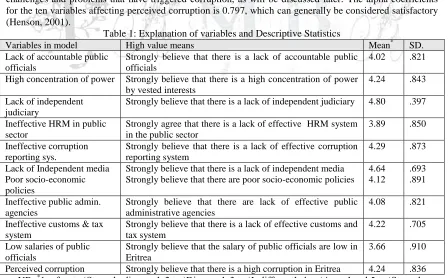
Table 1 depicts explanation of the variables included in the model and the descriptive statistics (means, standard deviations). As table 1 discloses, the overwhelming majority of the variables were rated fairly high (mean values range between 3.66 and 4.89 on a-5 point scale), which in turn signals the magnitude of the challenges and problems that have triggered corruption, as will be discussed later. The alpha coefficients for the ten variables affecting perceived corruption is 0.797, which can generally be considered satisfactory (Henson, 2001).
Table 1: Explanation of variables and Descriptive Statistics
Variables in model High value means Mean* SD. Lack of accountable public
officials
Strongly believe that there is a lack of accountable public officials
4.02 .821
High concentration of power Strongly believe that there is a high concentration of power by vested interests
4.24 .843
Lack of independent judiciary
Strongly believe that there is a lack of independent judiciary 4.80 .397
Ineffective HRM in public sector
Strongly agree that there is a lack of effective HRM system in the public sector
3.89 .850
Ineffective corruption reporting sys.
Strongly believe that there is a lack of effective corruption reporting system
4.29 .873
Lack of Independent media Strongly believe that there is a lack of independent media 4.64 .693 Poor socio-economic
policies
Strongly believe that there are poor socio-economic policies 4.12 .891
Ineffective public admin. agencies
Strongly believe that there are lack of effective public administrative agencies
4.08 .821
Ineffective customs & tax system
Strongly believe that there is a lack of effective customs and tax system
4.22 .705
Low salaries of public officials
Strongly believe that the salary of public officials are low in Eritrea
3.66 .910
Perceived corruption Strongly believe that there is a high corruption in Eritrea 4.24 .836 NB: *1 refers to „Strongly disagree‟, 2 to „Disagree‟, 3 to „Indifferent‟, 4 to „Agree‟ and 5 to „Strongly
ISSN: 2306-9007 Tessema, Beraki, Tewolde & Andemariam (2014) 2031
I
www.irmbrjournal.com December 2014I
nternationalR
eview ofM
anagement andB
usinessR
esearchVol. 3 Issue.4
R
M
B
R
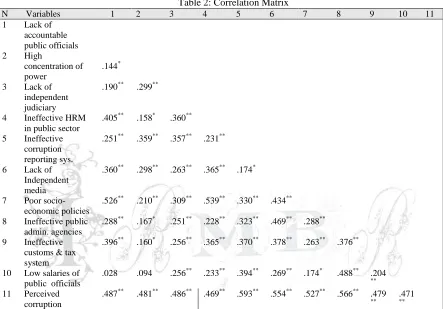
Table 2 presents the correlations between the variables included in the analysis. As shown in Table 2, a correlation matrix shows the relationship between the ten variables and perceived corruption. Although there are relationships between the ten variables and perceived corruption, the extent of the relationship varies (Table 2). As indicated in Table 2, the ten variables were significantly correlated with corruption and r ranges between .47 and .59 suggesting that they had a moderate to high correlation with perceived corruption. For example, corruption reporting system is significantly correlated with perceived corruption (r = 0.59, p = 0.000 < 0.01).
Table 2: Correlation Matrix
N Variables 1 2 3 4 5 6 7 8 9 10 11
1 Lack of accountable public officials
2 High
concentration of power
.144* 3 Lack of
independent judiciary
.190** .299** 4 Ineffective HRM
in public sector
.405** .158* .360** 5 Ineffective
corruption reporting sys.
.251** .359** .357** .231**
6 Lack of Independent media
.360** .298** .263** .365** .174* 7 Poor
socio-economic policies
.526** .210** .309** .539** .330** .434**
8 Ineffective public admin. agencies
.288** .167* .251** .228** .323** .469** .288** 9 Ineffective
customs & tax system
.396** .160* .256** .365** .370** .378** .263** .376** 10 Low salaries of
public officials
.028 .094 .256** .233** .394** .269** .174* .488** .204
**
11 Perceived corruption
.487** .481** .486** .469** .593** .554** .527** .566** .479
**
.471
**
NB: ** Correlation is significant at the 0.01 level; *Correlation is significant at the 0.05 level (2-tailed); n=210.
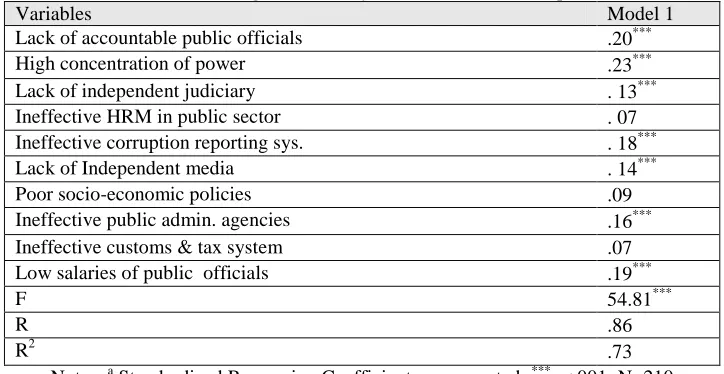
In Table 3, we conducted regression analysis to test the extent to which the ten variables included in the model explain the change in perceived corruption. Before we performed the regression analysis, we examined the variables for outliers, multicollinearity, and fit between their distributions and the assumptions of regression. No potentially problematic outliers were found, as Cook‟s distance was well below 1.0 for all cases (Tabachnick & Fidell, 2007).
ISSN: 2306-9007 Tessema, Beraki, Tewolde & Andemariam (2014) 2032
I
www.irmbrjournal.com December 2014I
nternationalR
eview ofM
anagement andB
usinessR
esearchVol. 3 Issue.4
R
M
B
R
Table 3: Results of Regression Analysis on “Perceived corruption level”
Variables Model 1
Lack of accountable public officials .20***
High concentration of power .23***
Lack of independent judiciary . 13***
Ineffective HRM in public sector . 07
Ineffective corruption reporting sys. . 18***
Lack of Independent media . 14***
Poor socio-economic policies .09
Ineffective public admin. agencies .16***
Ineffective customs & tax system .07
Low salaries of public officials .19***
F 54.81***
R .86
R2 .73
Notes: a Standardized Regression Coefficients are reported; ***p<.001; N=210
Discussion
The current study attempts to examine the extent to which the proposed ten variables included in our model are correlated with perceived corruption as well as the extent to which they explain the change in perceived corruption. To that end, we performed a correlation analysis (Table 2) and regression analysis (Table 3). The findings of this study indicate that each variable examined had a moderate to high positive correlation with perceived corruption where r ranged between .47 and .59 (Table 2). In addition, seven out of the ten variables show a statistically significant positive impact in explaining perceived corruption and are greater than or equal to ß= .13 (Table 3). The above findings suggest that the more the ten variables are effective, the lower is the perceived corruption. Hence, these findings are consistent with the predicted relationships. Reasonably good support for the propositions of the model was found.
ISSN: 2306-9007 Tessema, Beraki, Tewolde & Andemariam (2014) 2033
I
www.irmbrjournal.com December 2014I
nternationalR
eview ofM
anagement andB
usinessR
esearchVol. 3 Issue.4
R
M
B
R
As shown in Table 3, high concentration (monopoly) of power is found to have a significant correlation with perceived corruption (ß=.23). The Eritrean Constitution requires the separation of powers between the different government organs (legislative, executive, and judiciary). However, the prevailing practices are not consistent with the constitution. The Eritrean government consists of the Executive Council, which has a mere 19 members and demonstrates high consolidation of power (Campbell, 2005). Tekeste (2010) also argues that the sole and only entity that exists and exerts power is the chairman of the only political party, People‟s Front for Democracy and Justice (PFDJ), President Isaias Afewerki. Tekeste (2010) further notes this very chairman has usurped the powers of the Congress, the Central Committee and the Executive Committee of his organization. There are no checks and balances within the PFDJ organization right now, since no scheduled meetings and reporting of activities take place. Eritrea is ruled by an authoritarian regime through arbitrary edicts and rules. Hence, Purohit (2007) argues that since the monopoly of power of public officials encourages them to indulge in wrongdoing, the first step in combating corruption has to be to curb the monopoly power of these officials. Rowe (2011) further underlined that the system of governance and the political institutions of Eritrea need to be reformed so as to include a real separation of powers between the executive, legislative and judicial branches.
Lack of media was found to be significantly correlated with perceived corruption (r = 0.55, p = 0.000 < 0.01) as reported in Table 2. This is mainly due to the fact that the media is almost non-existent in Eritrea at this moment. According to the 2012-worldwide-press-freedom-index, Eritrea ranked last, i.e., 179th (Reporters without Borders, 2012). Eritrea is the worst abuser of media freedocm in the world, permits no independent media and the state-run newspapers and television network do not allow stories that challenge the nation's leadership or its policies. Reporters without Borders (2012) further notes that around 30 journalists are currently detained in appalling conditions and four of them have died as a result of the extremely cruel conditions. And thus, Eritrea is Africa's biggest prison for the media. The basic freedoms of the press were officially suspended in 2001 after some former members of Eritrea's ruling party began pressing for more democracy. Any hint of opposition is seen as a threat to national security. The privately-owned media no longer exist. There are just state media whose content is worthy of the Soviet era (Human Rights Report, 2010; Reporters without Borders, 2012).
Another interesting finding of the current study is that a lack of accountability and transparency in the governance system were also found to significantly influence perceived corruption (ß= .20) as shown in Table 3. This finding is consistent with prior studies (Prohito, 2007; Alcazar & Andrade, 2001; Johnson, 1997; Dandago, 1997). It could also be argued that if there is no independent judiciary and media and monopoly of power, one cannot expect accountable and transparent government. Especially after 2001, the Eritrean president has lost confidence in his government. As a result, he has taken a number of measures that could adversely affect the economic, social, and political development in Eritrea. Those measures include openly refusing implementing the Eritrean Constitution, arresting the so called G-15, weakening institutions like the legislative and judiciary, banning all private newspaper, arresting all private journalists, allowing military officials to take part in the public service administration and excessive intervention in commercial activities that could have been done by the private sector (Abraham, 2010 a&b; Tekeste, 2010; Transparency International, 2012; Human Rights Report, 2010).
ISSN: 2306-9007 Tessema, Beraki, Tewolde & Andemariam (2014) 2034
I
www.irmbrjournal.com December 2014I
nternationalR
eview ofM
anagement andB
usinessR
esearchVol. 3 Issue.4
R
M
B
R
Table 2 also reveals that poor socio-economic policies are significantly correlated with perceived corruption (r = 0.53, p = 0.000 < 0.01). In 1994, the Eritrean government clearly disclosed its commitment to the private sector-led economy and declared that its role would be in those areas in which the private sector is not interested to invest (GOE, 1994). Accordingly, it took a number of measures such as the introduction of the 1994 Macro-policy that emphasizes private sector-led economy and demarcating the border line among the party (PFDJ) and the government (Ghebretensae, 2005; GoE, 1994; the Economist, 1995; World Bank, 1998). The ministry of defense took weapons and military vehicles, and the PFDJ took the companies that were established during the armed struggle and all the financial resources and establishing new firms with left-over boats and vehicles (Economist, 1995). After the border war with Ethiopia (1998-2000), however, the situation has been changed. The government has been intervening excessively in almost all aspects of the economy (Abraham, 2010a). It has been following a militarist command economy model, which is improperly planned, poorly coordinated and extremely mismanaged approach, with its serious negative impacts on the economic development in general and the private sector in particular, in the social, cultural as well as political conditions in the country (Abraha, 2010a &b; Transparency International, 2012). Eritrea continues to follow an economic system that the rest of the world has abandoned. Abraha (2010a) remarked that instead of rectifying its mistakes and taking corrective measures, the state continued the mismanagement of the Eritrean economy by opening state-owned staple food shops and issuing a proclamation that prohibits keeping and transacting in hard currencies. The 2012 Heritage Foundation Index of Economic Freedom ranks Eritrea as the second-worst country in sub-Saharan Africa for economic freedom. The World Bank ease of doing business project index also ranks Eritrea 180th. The 3 countries that had worse ranking than Eritrea in 2011 were Guinea Bissau (181), Central African Republic (182) and Chad (183) (World Bank, 2012). The government‟s control over foreign exchange effectively gives it sole authority over imports. At the same time, those in favor with the regime are allowed to smuggle goods into the country at great profit, which in turn has increased corruption. Pervasive corruption and cronyism continue to erode the foundations of economic freedom. The government-controlled economy leaves little room for private investment. It could also be argued that the greater the administrative controls over the economy, the greater the problems of monitoring and accountability, because a greater share of economic planning decisions depend on bureaucrats. That is, excessive intervention in all aspects of the economic life could be counterproductive and tend to create opportunities for corrupt act. Becker (1994: 18) remarked that "corruption is common whenever big government infiltrates all facets of economic life, never mind the political and business systems." Hence, the IMF (2003) strongly suggests that there is a need to avoid the dominance of publicly owned or managed enterprises, which could distort competition, hamper market entry, and give rise to new inefficiencies.
As shown in Table 3, salary of public officials show a significant impact in explaining perceived corruption (ß=.19). Like in most LDCs, Eritrean public servants in general and the public officials in particular are paid low (Tessema et al., 2014). This is mainly due to the fact that Eritrean public service salary scales have not been adjusted (since 1997) regardless of the high inflation rate. For example, according to the World Factbook (CIA, 2011), the average inflation rate in Eritrea was 20 percent. As previously indicated, in countries where salaries have been frozen for some time, corruption has increased almost proportional to the number of years salaries have been frozen. In such situation, public officials may look for other ways to generate additional income. The salaries of public servants have continuously deteriorated over the years, mainly due to failing to keep pace with inflation. Prah (2004: 3) argues that in most LDCs, middle level officials can still barely feed, let alone adequately house, clothe and educate their family. Purohit„s (2007) study shows that the incentives for corruption are considerably greater where salaries do not allow public servants to live above the poverty level.
Conclusions and Implications for the Study
ISSN: 2306-9007 Tessema, Beraki, Tewolde & Andemariam (2014) 2035
I
www.irmbrjournal.com December 2014I
nternationalR
eview ofM
anagement andB
usinessR
esearchVol. 3 Issue.4
R
M
B
R
corruption is multifaceted and complicated, involving economic, political, and social-cultural factors. Previous studies underscored that corruption impedes economic development, undermines stability and erodes trust in public institutions (Thomas, 2010; UN, 2012). Effectively addressing corruption has become a development imperative. This may imply that LDCs must attempt to improve the effectiveness of the proposed ten variables if they are to minimize the opportunities for corrupt act. This in fact demands political commitment and willingness of politicians and public servants who put into effect government policies and programs. This study underscores that corruption being a complex issue has no "quick fix" and needs proper planning, determination, resilience and above all, political will. Thus, there is the need for an array of reforms that can be effective in curbing both incentives and opportunities for corruption.
The current study may also suggest that that corruption is worse in countries where institutions such as the legislature and the judiciary are weak, where there is weak check and balance, where rule of law and adherence to formal rules are not rigorously observed, where there is no independent media, where political patronage is standard practice, where public servants are poorly paid, where the independence and professionalism of the public sector has been eroded, where there is monopoly of power, where ethics are undermined, where civil society lacks the means to bring public pressure to bear, and where there is no effective corruption reporting. This paper argues that in curbing corruption, each country has to evolve the measures best suited to its own local requirements. However, some policies that could be adopted by all LDCs plagued with corruption are: strengthening institutions such as legislative and judiciary, designating corruption a national crime, reducing monopoly of power, making public servants accountable and salaries competitive, severely punish corrupt officials, setting up an independent anticorruption organization, encouraging independent and free media, and establishing and properly implementing code of ethics.
Limitations and Future Research Directions
While this study is an important step forward in understanding the extent to which the proposed ten variables are correlated with the perceived corruption in Eritrea, it has some limitations. First, like any survey study, there may be response bias. However, some authors have suggested the potential for common method bias should not necessary invalidate a study‟s findings (e.g., Cohen & Spector, 2001). Second, this study was conducted in only one LDC (Eritrea) and that restricts the generalization of the findings to other LDCs. Thus, in order to generalize and validate the findings of this study, we suggest that a similar study be conducted in other LDCs. That is, additional research is needed to examine the robustness of the findings and generalizations. In spite of the above limitations, however, this study addresses several gaps in literature related to corruption in LDCs. This study goes beyond discussing the causes of corruption by examining the extent to which the proposed variables are correlated with perceived corruption. And thus, it can be seen as an important contribution to the literature on corruption in general and that of the LDCs in particular.
References
Abraha, D. (2010a). Command Economy as Failed Model of Development Lessons Not Yet Learned: The Case of Eritrea. Journal of Management Policy & Practice, 11(5): 49-68.
Abraha, D. (2010b). Leadership Crises and Nation Building in a Politically Turbulent Environment: The Case of the so Called Peoples Front for Democracy and Justice (PFDJ) Central Office in Eritrea.
Journal of Leadership, Accountability and Ethics, 8(1): 108-123.
Abraha, D. (2010c). Establishment processes in a one party economy: the case of Eritrea. African Journal
of Economic and Management Studies, 1(1): 91-111.
Alcazar, L. & Andrade, R. (2001). Induced Demand and Absenteeism in Peruvian Hospitals. In Di Tella, R. & Savedoff, W. D. (eds.). Diagnosis Corruption. Washington, DC: Inter-American Development Bank.
ISSN: 2306-9007 Tessema, Beraki, Tewolde & Andemariam (2014) 2036
I
www.irmbrjournal.com December 2014I
nternationalR
eview ofM
anagement andB
usinessR
esearchVol. 3 Issue.4
R
M
B
R
Argyrous, G. (2000). Statistics for Social and Health Research: With a Guide to SPSS. London: Sage Publications Ltd.
Becker, G.S. (1994). To Root Out Corruption, Boot Out Big Government. Business Week, 31 January: 18. Beugre, C. & Offodile, O. (2001). Managing for organizational effectiveness in sub-Saharan Africa: A
cultural-fit model. International Journal of Human Resource Management, 10(4): 535-550.
Campbell, Patricia J., 2005, „Gender and Post-Conflict Civil Society: Eritrea,‟ International Feminist Journal of Politics 7(3):377-99.
Chinhamo, O. & Shumba, G. (2007). Institutional working definition of corruption, Anti-Corruption Trust of Southern Africa. Retrieved on November 21, 2014 from
http://www.actsouthernafrica.org/Working%20Paper%201-%20Draft%20Institutional%20Working%20definition%20of%20Corruption.pdf.
Cohen, C.Y. & Spector, P.E. (2001). The role of justice in organizations: A meta-analysis. Organizational
Behavior & Human Decision Processes, 86: 278-321.
Dandago, K. I. (1997). Fraud and its Genesis- Some Ambitious solutions. Paper presented at a Seminar organized on Fraud Prevention and Control by Kag-Gift Consult, Educational Resources Centre, Minna.
Daniel R. Mekonnen (2008). Transitional Justice: Framing a Model for Eritrea. University of Free State (unpublished LL.D. dissertation).
Das, S.K. (1998). Civil Service Reform and Structural Adjustment. New York: Oxford University Press. Davies, R.W. (2001). The Making of Economic Policy. In G. R. Paul (ed.), Behind the Façade of Stalin‟s
Command Economy. Stanford, CA: Hoover Institution Press.
Dirar, L. & Tesfagabir, K. (2011). Introduction to Eritrean Legal system and research. Retrieved November 3, 2014 from http://www.nyulawglobal.org/globalex/Eritrea.htm#_edn66.
Economist (1995). The Red Sea Trading Party, 335(7913). (5/6/95).
Ghebretensae, B. (2005). Exporting promotion for SMEs in Eritrea with focus on information provision,
financing and network of main actors. MA Thesis University of KwaZulu Natal, Durban.
Global Infrastructure Anti-Corruption Centre (GIACC) (2012). Anti-Corruption Tools Reporting
corruption. Retrieved November 8, 2014 from http://www.giaccentre.org/reporting.php
Government of Eritrea (GoE) (1994). Eritrean Macro-Policy. Asmara, Eritrea. Government of Eritrea (GoE) (1997). Ratified Eritrean Constitution. Asmara, Eritrea.
Grindle, M. S. (1997). The good governance imperative: Human resources, organizations, and institutions. In M. S. Grindle (Ed.), Getting good government: Capacity building in the public sector of developing
countries (pp.3-28). Cambridge, MA: Harvard University Press.
Groenendijk, N.S. (1997). A Principle-Agent Model of Corruption. In Crime, Law and Social Change, 27: 217-218.
Haben, S. (2010). Special Courts in Eritrea. Retrieved November 21, 2014 from http://www.asmarino.com/articles/673-special-courts-in-eritrea
Henson, R. K. (2001). Understanding internal consistency reliability estimates: A conceptual primer on coefficient alpha. Measurement and Evaluation in Counselling and Development, 34: 177-189.
Heritage Foundation (2012). Quick facts about Eritrea. Retrieved on November 20, 2014 from http://www.heritage.org/index/country/eritrea.
Hiltrop, J. (1996). A Framework for Diagnosing Human Resource Management Practices. European
Management Journal, 14(3): 243-254.
IMF (2003). IMF Country Report- Eritrea: Selected issues and statistical appendix. No. 03/166, Washington, DC.
Ingraham, P.W., Selden, S.C. & Moynihan, D.P. (2000). People and Performance: Challenges for the Future Public Service-the Report from the Wye River. Public Administration Review, 60(1): 54-60. Johnston, M. (1997). What can be done about entrenched corruption? A paper presented at the 9th Annual
Bank Conference on Development Economics, The World Bank: Washington, DC.
Kaufmann, D.; Pradhan, S. & Ryterman, R. S. (1998). New Frontiers in Diagnosing and Combating
Corruption. World Bank PREM Note No. 7: Washington, DC.
ISSN: 2306-9007 Tessema, Beraki, Tewolde & Andemariam (2014) 2037
I
www.irmbrjournal.com December 2014I
nternationalR
eview ofM
anagement andB
usinessR
esearchVol. 3 Issue.4
R
M
B
R
Manning, N.; Ranjana M. & Gokcekus, O. (2000). Public officials and their institutional environment: An analytical model for assessing the impact of institutional change on public sector performance. World Bank Policy Research Working Paper No. 2427
Myant, M. & Drahokoupil, R. (2010). Transition Economies: Political Economy in Russia, Eastern
Europe, and Central Asia. Hoboken, New Jersey: Wiley.
Myers, D. (2004). Construction Economics. UK: Spon Press.
Osei, J. (1999). Fraud and Traditional African Ethics. In Rossouw, G.J. & Carabine, D. (eds), Fraud and
the African Renaissance (pp.25-41), Kampala: UMU Press.
Prah, K. K. (2004). African wars and ethnic conflicts - Rebuilding failed states. Human Development
Report 2004. African Regional Background Paper, UNDP.
Purohit, M. C. (2007). Corruption in tax administration. In Saha, A. (ed.), Performance Accountability and
Combating Corruption (pp. 285-302).
Rena, R. (2007). Higher Education in Africa, A case of Eritrea. Journal of Educational Planning and
Administration, XXI (2): 125-140.
Reporters without Borders (2012). Press Freedom Index 2011/2012. Retrieved on November 18, 2014 from http://en.rsf.org/press-freedom-index-2011-2012,1043.html
Rossouw, G.J. (1999). Defining and Understanding Fraud. In Rossouw, G.J. & Carabine, D. (eds), Fraud
and the African Renaissance (pp.13-24), Kampala: UMU Press.
Rudolph. L.B. & Moeti-Lysson, J. (2011). The workings and achievements of the anti-corruption
departments, Botswana case study directorate on corruption and economic crime. Paper presented at
the 2011 BEN-Africa conference, Zanzibar, Tanzania.
Sedigh, S. & Alex, M. (1999). The Fight against Corruption in Tanzania. In S. Rick; & K. Sahr, Curbing
Corruption: Towards a Model for Building National Integrity. Washington, DC: World Bank.
Stasavage, D. & Daubree, C. (1998). Determinants of Customs Fraud and Corruption: Evidence from Two
African Countries. Working Paper 138. Paris: OECD Development Centre.
Stone, R. (1998). Human Resource Management. New York: John Wiley and Sons.
Tabachnick, B.G, & Fidell, L.S. (2007). Using multivariate statistics (5th ed.). Boston, MA: Pearson/Allyn & Bacon.
Tekeste, M. (2010). The Coup D´état in Eritrea. Retrieved on November 23, 2014 from http://www.sanfranciscotelegram.com/articles/view/146298
Tessema, M, Tsegai, G., Ready, R., Embaye, E., & Windrow, B. (2014). Effect of employee background on perceived organizational justice: managerial implications. International Review of Administrative Sciences, 80(2): 443–463.
Tessema, M. T. & Soeters, J. (2006). Practices and challenges of converting former fighters into civil servants and their management afterwards: The Case of Eritrea. Public Administration and
Development, 26(4), 359-371.
Thomas, E. (2010). High levels of corruption in South African business and the role of culture. Paper presented at the 10th annual BEN-Africa conference in Nairobi, Kenya.
Transparency International (2012). 2011 Corruption Perceptions Index. Retrieved on November 21, 2014 from http://cpi.transparency.org/cpi2011/results/
Tseggai, A. (1999). Human resource development: Priorities for policy. In M. Doornbos & A. Tesfai (Eds.), Post-conflict Eritrea: Prospects for reconstruction and development, Trenton (pp.215-238). Trenton, N.J.: Red Sea Press.
UN (2010). Least Developed Countries: Country profiles. Retrieved on November 24, 2014, from http://www.unohrlls.org/en/ldc/related/62/
Human Rights Report (2011). 2010 Human Rights Report: Eritrea. Retrieved on November 21, 2014 from
http://www.state.gov/j/drl/rls/hrrpt/2010/af/154345.htm
Waliggo, J.M. (1999). The Historical Roots of Unethical Economic Practices in Africa. In Rossouw, G.J. & Carabine, D. (eds), Fraud and the African Renaissance (pp.43-53), Kampala: UMU Press.
ISSN: 2306-9007 Tessema, Beraki, Tewolde & Andemariam (2014) 2038
I
www.irmbrjournal.com December 2014I
nternationalR
eview ofM
anagement andB
usinessR
esearchVol. 3 Issue.4
R
M
B
R
Wilson, J. Q. (1989). Bureaucracy: what government agencies do and why they do it, New York: Basic Books.
World Bank (1998). Eritrea-Private Sector Reconstruction Credit, Finance and Private Sector
Development. Asmara, Eritrea.
World Bank (2000). Reforming Public Institutions and Strengthening Governance: A World Bank Strategy.
http://www-wbweb.worldbank.org/prem/prmps
World Bank (2000). Technical Annex for a Proposed Credit to Eritrea for an Emergency Reconstruction Program.