COMPUTER SCIENCE & TECHNOLOGY
www.computerscijournal.org
March 2013, Vol. 6, No. (1): Pgs. 49-54 An International Open Free Access, Peer Reviewed Research Journal
Published By: Oriental Scientific Publishing Co., India.
INTRODUCTION
In general everyone know that the health care industrys and its services plays a vital role in satisfying our daily needs. As technology keeps on changing its our responsibility to move our business to enrich and absorb the benefits from that particular technologies. Before migrating ourselves to any new appraches that best suites and satisfies our business needs it’s a mandatory responsibility of every one to get awareness regarding that technology and also analysing the exact myths and comparing it to reality competitve world.
Migrating Health Care by Analysing
MYTHS in Cloud Technology
N. JASWANTH, J. DURGA and D. KIRAN KUMAR
Department of CSE, Sree Vidyanikethan Engineering College, Tirupati, India.
(Received: March 05, 2013; Accepted: March 15, 2013)
ABSTRACT
Now a days the healthcare industry is facing significant pressures to lower the costs associated with providing healthcare, adopt new systems that support electronic medical records (EMR), and share data quickly and securely with other healthcare and government agencies and complainces like HIPAA. the healthcare industry has not been quick to adopt new technologies as it relates to infrastructure to support back-office operations. This paper enriches in focusing the health care sectors and its adoptions to cloud technology especialy in IaaS. Creating awarness and embeding the health care firms to the most smarter cloud technology this proposed approaches focus on discussing various cloud benefits to kickstart the health care firms as per their changing demands most effectively.
Key words: Healthcare, cloud technology, electronic medical records, HIPAA, Iaas
The Cloud has become an everyday resource that helps enable our daily routines. Consider how things such as electricity, water, natural gas, telephone service, and television are provided by companies that specialize in delivering those services, and you can begin to wrap your mind around the parallels with cloud computing.
computing helps in logging in to the computer applications you desire. With Cloud Computing, one can enjoy web services, sales force or office automation programs, even blog sites, spam filtering, data storage services one simply logs into your choice of computer applications. This piece of technology prevents wastages in finance, because it saves money that we spend on other cable services for which we will need to pay monthly annual subscriptions1.
Many industry experts walk through in analysing why the Healthcare industry is choosing the cloud, how your business can benefit, and what you can do to compete more effectively. The healthcare industry is facing significant pressures to lower the costs associated with providing healthcare. Additionally, healthcare organizations are finding it necessary to collaborate with other organizations in order to effectively provide services for their patients. This means a change to the legacy, on-premise systems of the past.
Reducing service time for patient care is another aspect in the fight to keep costs low, and every delay in getting back results from a lab, or having to manually convert patient information from one format to another, creates more problems for the healthcare provider.
Many healthcare organizations are finding it harder to get/stay in compliance with newer government regulations when they are relying on legacy technology, vs newer technology which was built with such regulations in mind[2]. Large healthcare providers are looking for ways to consolidate their technology infrastructure which is spread across multiple geographic regions, and small healthcare providers are looking to access the technology they need to stay in business, without the costs that are typically associated with the hardware and software approved for use in medical environments.
Related
Increasingly, healthcare organizations are finding it necessary to encrypt data on servers, desktops and mobile devices – not only to comply with current healthcare and government regulations such as HIPAA and HITECH3, but
because it is prudent and vital to avoid the exposure of patient data should a laptop or other mobile device become lost. Managing security and privacy of patient information is no simple task for any organization, much less for healthcare organizations with overburdened technology teams. Apart from above other challenges are striving to get itself to better ways. challenges as per 2012 year includes:
´ Changing the model for delivering care ´ Planning for growth
´ Delivering quality patient care at an affordable cost
´ Minimising risk and reducing cost of regulatory complaince
´ Exploring mergers and acquisitions to improve financial performance
The cloud can actually be a means of reducing exposure risks, as cloud providers make significant investments in implementing physical, technical and administrative safeguard technologies to help protect patient information. A better data management makes healthcare a perfect candidate for cloud computing. Both patients and doctors can access medical images, reports, records, and care management advice through cloud computing.More expert studies, analysis and survey reports shows that Cloud Computing in Health Care to Reach $5.4 Billion by 2017. In 2011, 4 percent of the health care industry used cloud computing, but that number will jump to 20.5 percent a year4.
As we analysed the benefit of adopting cloud technology to health care firms its also a mandatory to analyse few myths about the CSP.
´ What is cloud computing and its working criteria?
´ How my organisation will benefit from cloud?
´ How cloud will affect my organisational operations in future?
´ Security reisks and privacy concerns of my data?
´ Analysing quality levels of CSP that you opt?
Because of the stringent security and privacy needs, it is important for healthcare organizations to carefully select vendors that specialize in the Healthcare industry, and are compliant with the various regulations and guidelines relevant to this industry, including HIPAA (Health Insurance Portability and Accountability Act), PSQIA (The Patient Safety and Quality Improvement Act), and the HL7 EHR Interoperability Model. Because of the aforementioned security, privacy and compliance concerns, many solutions from the public cloud will not be effective or appropriate for the healthcare industry. Cloud providers will either have to be healthcare specific, have a strong track record securely serving healthcare organizations, and/or be able to partner with healthcare organizations to provide private or hybrid cloud environments. For example, some ofthe cloud providers that claim to support healthcare organizations are not prepared to sign a Business Associate Agreement (BAA) which is essential to HIPAA compliance. Others may put forward a business associate agreement that was not developed with industry participation, while some vendors might sign a BAA put forth by a covered entity without proper due diligence to win the business, on the hopes that they will never be audited.
Implementation
Although their exists many number of cloud vendors we need to carefully focus on most renowed providers that cuts up your investment as much as possible and at same time not compromising the quality and security as well.
Several vendors are providing their EHR
solutions as cloud-based offerings, which will be a boon to hospitals and clinics which would otherwise have to make significant IT investments to build that technology in-house.
Advantages of using EMR
Reduced implementation time Much lower initial costs, especially for smaller organizations Partnership of compliance Better scalability, without initial over-provisioning of equipment. hClouds5 are providing one of the most
promising opportunities to reduce technology and treatment costs within health care. Consider the following examples:
Athenahealth has become a fast-growing HIT vendor by offering SaaS-based practice management and EMR software. Acceptance of this cloud-based solution brings about at least two distinct advantages over existing systems: 1) low upfront fees since little to no technology is installed onsite (i.e., “affordable”), and 2) a living database of insurance payment rules that is continually updated based on the denials of its clients. If a requirement changes for submitting a claim, athena can apply that knowledge across its entire client base (i.e., “adaptable”).
All states and many municipalities are establishing health information exchanges (HIEs), which are cloud-based information clearinghouses where information can be more easily shared between hospitals, health systems, physicians, and clinics (i.e., “open”). There are dozens of vendors and service providers building cloud HIE solutions, and multiple HIEs are now live. Though it is early to assess the true value of an HIE, the concept should improve patient care by making information sharing more timely and efficient. Hospitals and physicians are starting to see cloud-based medical records and medical image archiving services (i.e., “open” and “portable”) coming on line from the likes of HP, GE, and Iron Mountain6.
which allows you to seamlessly build and manage an interconnected network in addition to accelerating development, deployment and management of distributed applications using Microsoft .NET frameworks on these networks. It is market oriented since it allows you to build,
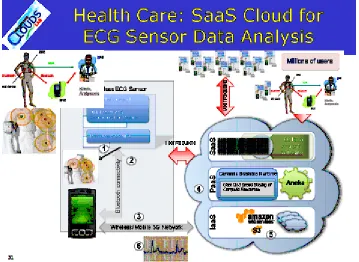
schedule, provision and monitor results using pricing, accounting, QoS/SLA services in private and/or public (leased) network environments[7]. This can be used in the health care and life sciences sectors. Lets see the case study of aneka health and life sciences.
Fig. 1: Aneka Health Care: SaaS Cloud for ECG Sensor Data Analysis
Apart from above Many pharmacology vendors including Eli Lilly, Johnson & Johnson, and Pfizer are starting to tap the cloud to improve research and drug development (i.e., “scalable” and “affordable”). Commercial cloud vendors including Amazon, IBM, and Oracle have developed pharma-specific clinical research cloud offerings with the goal of lowering the cost and development of new drugs8.
Advantages
The use of various cloud computing solutions will help in eliminating the time and efforts needed to roll a healthcare IT application in a hospital. It will help in standardizing the infrastructure for healthcare IT solutions in contrast with the current highly diversified scenario. It
ensures availability of hardware with high end servers, huge data stores, bulk licenses and cost-effective utilizations of infrastructure for the health sector. The investment costs are distributed across hospitals and thus get reduced for each hospital. Service Provider take over the headache of patching, upgrading, fixing, scaling, software and hardware and managing data security and backup.
Agility improves with users able to rapidly and inexpensively re-provision technological infrastructure resources. An additional benefit of cloud computing is that the Peak-load capacity increases. Reliability improves through the use of multiple redundant sites, which makes it suitable for business continuity and disaster recovery.
Security is often as good as or better than traditional systems, in part because providers are able to devote resources to solving security issues that many customers cannot afford. Sustainability comes about through improved resource utilization, and more efficient systems.
For smaller hospitals and physician practices, in particular, cloud-based applications can beextremely cost-effective. These organizations typically don’t have the IT staff, required to support new technologies; and the cloud removes the burden of hiring internal IT staff to maintain and service in-house infrastructure for mission-critical applications, such as email. In the cloud model, providers only pay for what they use.
The EMR which is a crucial part of the HMIS is data storage intensive. Compared to locally-housed resources, “cloud” services typically improves security because SaaS providers will be able to devote resources to solving security issues that many customers cannot afford. By implementing high-level encryption across connections, as well as housing the data in a dis-aggregated and encrypted structure, the “cloud” implements all the security requirements. Access to medical data is tightly controlled.
A patient’s EHR data might be shared between practices taking care of that patient. This can beeasily achieved by having the SaaS model in place. With the cloud hosted EMR, the government and the medical fraternity will be able to have access to state wide medical information of the people, across the country. This facilitates analysis of the patterns of illness and mitigation plans. The medical fraternity can also utilize the data to improve the medical methodology9.
Laboratory results forms a crucial part of the patient treatment. Using cloud the patient’s laboratory data can be centrally stored and shared between
practitioners taking care of that patient and the patient directly.
Disadvantages
Security is one of the main concerns of Cloud Computing. This makes it necessary to maintain a secure, safe, and authorized environment for the prevention of information leakage.
Another drawback with Cloud Computing approach is, that at the end user loses control over the remote servers, their software, or their security factors10. A huge amount of data gets accumulated
in these central servers over the years and it may eventually be difficult (or even impossible) to migrate massive amounts of data from the provider.
CONCLUSION
There is a tremendous promise for cloud computing infrastructure in the healthcare industry and is an ideal tool to leverage computing power at low cost. Cloud computing would help hospitals to achieve more efficient use of their hardware and software investments and to increase profitability by improving the utilization of resources to the maximum. By pooling the various healthcare IT resources into large clouds, hospitals can reduce the cost and increase utilization as the resources are delivered only, when they are required. Cloud computing in terms of health care will serve as the foundation for much of the work in areas, such as record sharing, analysis, and diagnostics.Future work can be done by encouraging in bringing up many approaches, frameworks that can cause an effective colloborations between multiple helath care firms.
REFERENCES
1. http://www.frost.com/sublib/display-market-insight-top.do?id=135578323
2. http://cloudcomputing.syscon.com/node/ 2026409
3. https://www.egestalt.com/hipaa-hitech-compliance.html
4. http://www.eweek.com/c/a/Health-Care-IT/ Cloud-Computing-in-Health-Care-to-Reach-54-Billion-by-2017-Report-512295/ 5.
www.cloudbook.net/resources/stories/can-cloud-computing-help-fix-health-care 6.
http://ictpost.com/2012/10/19/cloud-
computing-is-making-big-inroads-in-health-it/
7. http://www.cloudbus.org/spandey/research/ ecg-application/ecg-on-clouds.html 8. d l . a c m . o r g / c i t a t i o n . c f m ? i d =
2304777.2304862
9. http://www.enttoday.org/details/ar ticle/ 1 7 8 8 4 6 5 / C l o u d _ C o m p u t i n g _ i n _ t h e _ Health_Care_Setting_ Advantages_ and_ Disadvantages.html