MLlib: Machine Learning in Apache Spark
Xiangrui Meng† [email protected]
Databricks, 160 Spear Street, 13th Floor, San Francisco, CA 94105
Joseph Bradley [email protected]
Databricks, 160 Spear Street, 13th Floor, San Francisco, CA 94105
Burak Yavuz [email protected]
Databricks, 160 Spear Street, 13th Floor, San Francisco, CA 94105
Evan Sparks [email protected]
UC Berkeley, 465 Soda Hall, Berkeley, CA 94720
Shivaram Venkataraman [email protected]
UC Berkeley, 465 Soda Hall, Berkeley, CA 94720
Davies Liu [email protected]
Databricks, 160 Spear Street, 13th Floor, San Francisco, CA 94105
Jeremy Freeman [email protected]
HHMI Janelia Research Campus, 19805 Helix Dr, Ashburn, VA 20147
DB Tsai [email protected]
Netflix, 970 University Ave, Los Gatos, CA 95032
Manish Amde [email protected]
Origami Logic, 1134 Crane Street, Menlo Park, CA 94025
Sean Owen [email protected]
Cloudera UK, 33 Creechurch Lane, London EC3A 5EB United Kingdom
Doris Xin [email protected]
UIUC, 201 N Goodwin Ave, Urbana, IL 61801
Reynold Xin [email protected]
Databricks, 160 Spear Street, 13th Floor, San Francisco, CA 94105
Michael J. Franklin [email protected]
UC Berkeley, 465 Soda Hall, Berkeley, CA 94720
Reza Zadeh [email protected]
Stanford and Databricks, 475 Via Ortega, Stanford, CA 94305
Matei Zaharia [email protected]
MIT and Databricks, 160 Spear Street, 13th Floor, San Francisco, CA 94105
Ameet Talwalkar† [email protected]
UCLA and Databricks, 4732 Boelter Hall, Los Angeles, CA 90095
Editor:Mark Reid
Abstract
Apache Spark is a popular open-source platform for large-scale data processing that is
well-suited for iterative machine learning tasks. In this paper we presentMLlib, Spark’s
open-source distributed machine learning library. MLlibprovides efficient functionality for
a wide range of learning settings and includes several underlying statistical, optimization,
and linear algebra primitives. Shipped with Spark,MLlibsupports several languages and
provides a high-level API that leverages Spark’s rich ecosystem to simplify the development
of end-to-end machine learning pipelines. MLlib has experienced a rapid growth due
to its vibrant open-source community of over 140 contributors, and includes extensive documentation to support further growth and to let users quickly get up to speed.
Keywords: scalable machine learning, distributed algorithms, apache spark
1. Introduction
Modern datasets are rapidly growing in size and complexity, and there is a pressing need to develop solutions to harness this wealth of data using statistical methods. Several ‘next generation’ data flow engines that generalize MapReduce (Dean and Ghemawat, 2004) have been developed for large-scale data processing, and building machine learning functionality on these engines is a problem of great interest. In particular, Apache Spark (Zaharia et al., 2012) has emerged as a widely used open-source engine. Spark is a fault-tolerant and general-purpose cluster computing system providing APIs in Java, Scala, Python, and R, along with an optimized engine that supports general execution graphs. Moreover, Spark is efficient at iterative computations and is thus well-suited for the development of large-scale machine learning applications.
In this work we present MLlib, Spark’s distributed machine learning library, and the
largest such library. The library targets large-scale learning settings that benefit from data-parallelism or model-parallelism to store and operate on data or models. MLlib
consists of fast and scalable implementations of standard learning algorithms for common learning settings including classification, regression, collaborative filtering, clustering, and dimensionality reduction. It also provides a variety of underlying statistics, linear algebra, and optimization primitives. Written in Scala and using native (C++based) linear algebra libraries on each node, MLlib includes Java, Scala, and Python APIs, and is released as
part of the Spark project under the Apache 2.0 license.
MLlib’s tight integration with Spark results in several benefits. First, since Spark is
designed with iterative computation in mind, it enables the development of efficient imple-mentations of large-scale machine learning algorithms since they are typically iterative in nature. Improvements in low-level components of Spark often translate into performance gains in MLlib, without any direct changes to the library itself. Second, Spark’s vibrant
open-source community has led to rapid growth and adoption of MLlib, including
contri-butions from over 140 people. Third, MLlib is one of several high-level libraries built on
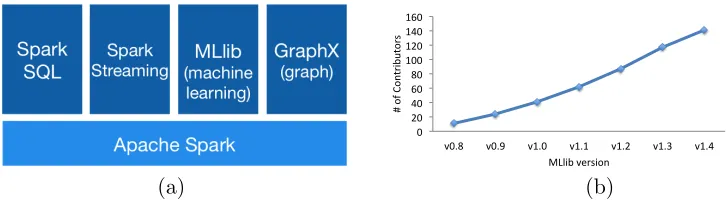
top of Spark, as shown in Figure 1(a). As part of Spark’s rich ecosystem, and in part due to
MLlib’s spark.mlAPI for pipeline development, MLlib provides developers with a wide
0" 20" 40" 60" 80" 100" 120" 140" 160"
v0.8" v0.9" v1.0" v1.1" v1.2" v1.3" v1.4"
#"
of
"C
on
tr
ib
uto
rs
"
MLlib"version"
(a) (b)
Figure 1: (a) Apache Spark ecosytem. (b). Growth inMLlib contributors.
2. History and Growth
Spark was started in the UC Berkeley AMPLab and open-sourced in 2010. Spark is designed for efficient iterative computation and starting with early releases has been packaged with example machine learning algorithms. However, it lacked a suite of robust and scalable learning algorithms until the creation of MLlib. Development of MLlib began in 2012
as part of the MLbase project (Kraska et al., 2013), and MLlib was open-sourced in
September 2013. From its inception,MLlibhas been packaged with Spark, with the initial
release of MLlib included in the Spark 0.8 release. As an Apache project, Spark (and
consequently MLlib) is open-sourced under the Apache 2.0 license. Moreover, as of Spark
version 1.0, Spark andMLlib are on a 3-month release cycle.
The original version of MLlib was developed at UC Berkeley by 11 contributors, and
provided a limited set of standard machine learning methods. Since this original release,
MLlibhas experienced dramatic growth in terms of contributors. Less than two years later,
as of the Spark 1.4 release, MLlib has over 140 contributors from over 50 organizations.
Figure 1(b) demonstrates the growth in MLlib’s open source community as a function of
release version. The strength of this open-source community has spurred the development of a wide range of additional functionality.
3. Core Features
In this section we highlight the core features of MLlib; we refer the reader to the MLlib
user guide for additional details (MLlib, 2015).
Supported Methods and Utilities. MLlib provides fast, distributed implementations of
common learning algorithms, including (but not limited to): various linear models, naive Bayes, and ensembles of decision trees for classification and regression problems; alternat-ing least squares with explicit and implicit feedback for collaborative filteralternat-ing; andk-means clustering and principal component analysis for clustering and dimensionality reduction. The library also provides a number of low-level primitives and basic utilities for convex optimization, distributed linear algebra, statistical analysis, and feature extraction, and supports various I/O formats, including native support for LIBSVM format, data integra-tion via Spark SQL (Armbrust et al., 2015), as well as PMML (Guazzelli et al., 2009) and
MLlib’s internal format for model export.
Algorithmic Optimizations. MLlib includes many optimizations to support efficient
recommendation makes careful use of blocking to reduce JVM garbage collection overhead and to leverage higher-level linear algebra operations. Decision trees use many ideas from the PLANET project (Panda et al., 2009), such as data-dependent feature discretization to reduce communication costs, and tree ensembles parallelize learning both within trees and across trees. Generalized linear models are learned via optimization algorithms which parallelize gradient computation, using fast C++-based linear algebra libraries for worker computations. Many algorithms benefit from efficient communication primitives; in par-ticular tree-structured aggregation prevents the driver from being a bottleneck, and Spark broadcast quickly distributes large models to workers.
Pipeline API. Practical machine learning pipelines often involve a sequence of data pre-processing, feature extraction, model fitting, and validation stages. Most machine learning libraries do not provide native support for the diverse set of functionality required for pipeline construction. Especially when dealing with large-scale datasets, the process of cobbling together an end-to-end pipeline is both labor-intensive and expensive in terms of network overhead. Leveraging Spark’s rich ecosystem and inspired by previous work (Pe-dregosa et al., 2011; Buitinck et al., 2013; Sparks et al., 2013, 2015), MLlib includes a
package aimed to address these concerns. This package, called spark.ml, simplifies the development and tuning of multi-stage learning pipelines by providing a uniform set of high-level APIs (Meng et al., 2015), including APIs that enable users to swap out a stan-dard learning approach in place of their own specialized algorithms.
Spark Integration. MLlibbenefits from the various components within the Spark
ecosys-tem. At the lowest level, Spark core provides a general execution engine with over 80 oper-ators for transforming data, e.g., for data cleaning and featurization. MLlib also leverages
the other high-level libraries packaged with Spark. Spark SQL provides data integration functionality, SQL and structured data processing which can simplify data cleaning and preprocessing, and also supports the DataFrame abstraction which is fundamental to the spark.ml package. GraphX (Gonzalez et al., 2014) supports large-scale graph processing and provides a powerful API for implementing learning algorithms that can naturally be viewed as large, sparse graph problems, e.g., LDA (Blei et al., 2003; Bradley, 2015). Ad-ditionally, Spark Streaming (Zaharia et al., 2013) allows users to process live data streams and thus enables the development of online learning algorithms, as in Freeman (2015). Moreover, performance improvements in Spark core and these high-level libraries lead to corresponding improvements inMLlib.
Documentation, Community, and Dependencies. TheMLlibuser guide provides
exten-sive documentation; it describes all supported methods and utilities and includes several code examples along with API docs for all supported languages (MLlib, 2015). The user guide also listsMLlib’s code dependencies, which as of version 1.4 are the following
open-source libraries: Breeze, netlib-java, and (in Python) NumPy (Breeze, 2015; Halliday, 2015; Braun, 2015; NumPy, 2015). Moreover, as part of the Spark ecosystem,MLlib has active
0" 10" 20" 30" 40" 50"
0" 200" 400" 600" 800" 1000"
Tim
e"(se
conds)"
Ra7ngs"(Millions)"
Mahout"v0.9" MLlib"v1.1" MLlib"v1.4"
5.6x%
1.2x% 3.2x%
2.8x% 2.5x%
MLlib%v1.0% 0%
1% 2% 3% 4% 5% 6%
Logis5c%
Regression%Regression%Ridge% Decision%Trees% ALS% KMeans%
Spe
edup&
MLlib%v1.1% speedup%
(a) (b)
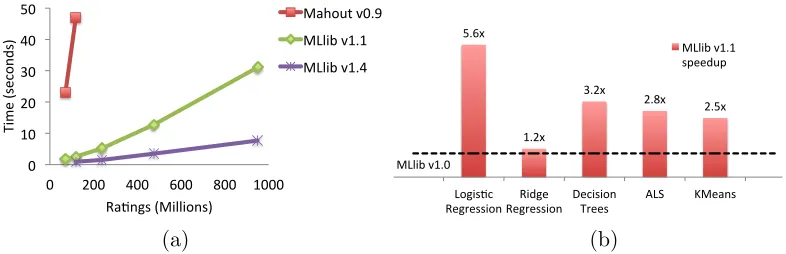
Figure 2: (a) Benchmarking results for ALS. (b) MLlib speedup between versions.
Finally, a massive open online course has been created to describe the core algorithmic concepts used to develop the distributed implementations withinMLlib(Talwalkar, 2015).
4. Performance and Scalability
In this section we briefly demonstrate the speed, scalability, and continued improvements in
MLlibover time. We first look at scalability by considering ALS, a commonly used
collab-orative filtering approach. For this benchmark, we worked with scaled copies of the Amazon Reviews dataset (McAuley and Leskovec, 2013), where we duplicated user information as necessary to increase the size of the data. We ran 5 iterations of MLlib’s ALS for various
scaled copies of the dataset, running on a 16 node EC2 cluster with m3.2xlarge instances using MLlib versions 1.1 and 1.4. For comparison purposes, we ran the same experiment
using Apache Mahout version 0.9 (Mahout, 2014), which runs on Hadoop MapReduce. Benchmarking results, presented in Figure 2(a), demonstrate that MapReduce’s scheduling overhead and lack of support for iterative computation substantially slow down its perfor-mance on moderately sized datasets. In contrast, MLlib exhibits excellent performance
and scalability, and in fact can scale to much larger problems.
Next, we compare MLlib versions 1.0 and 1.1 to evaluate improvement over time. We
measure the performance of common machine learning methods in MLlib, with all
exper-iments performed on EC2 using m3.2xlarge instances with 16 worker nodes and synthetic datasets from the spark-perf package (https://github.com/databricks/spark-perf). The results are presented in Figure 2(b), and show a 3× speedup on average across all algorithms. These results are due to specific algorithmic improvements (as in the case of ALS and decision trees) as well as to general improvements to communication protocols in Spark and MLlibin version 1.1 (Yavuz and Meng, 2014).
5. Conclusion
MLlibis in active development, and the following link provides details on how to contribute:
References
Michael Armbrust, Reynold Xin, Cheng Lian, Yin Yuai, Davies Liu, Joseph Bradley, Xian-grui Meng, Tomer Kaftan, Michael Franklin, Ali Ghodsi, and Matei Zaharia. Spark SQL: Relational data processing in spark. In ACM Special Interest Group on Management of Data, 2015.
David M. Blei, Andrew Y. Ng, and Michael I. Jordan. Latent dirichlet allocation. Journal of Machine Learning Research, 3, 2003.
Joseph Bradley. Topic modeling with LDA: MLlib meets GraphX. https://databricks. com/?p=3135, 2015.
Mikio Braun. jblas. http://jblas.org/, 2015.
Breeze. Breeze. https://github.com/scalanlp/breeze/wiki, 2015.
Lars Buitinck et al. API design for machine learning software: experiences from the scikit-learn project. arXiv:1309.0238, 2013.
Spark Community. Spark community. https://spark.apache.org/community.html, 2015.
Jeffrey Dean and Sanjay Ghemawat. Mapreduce: Simplified data processing on large clus-ters. In USENIX Symposium on Operating Systems Design and Implementation, 2004.
Jeremy Freeman. Introducing streaming k-means in spark 1.2. https://databricks.com/ ?p=2382, 2015.
Joseph E. Gonzalez, Reynold S. Xin, Ankur Dave, Daniel Crankshaw, Michael J. Franklin, and Ion Stoica. Graphx: Graph processing in a distributed dataflow framework. In
Conference on Operating Systems Design and Implementation, 2014.
Alex Guazzelli, Michael Zeller, Wen-Ching Lin, and Graham Williams. PMML: An open standard for sharing models. The R Journal, 1(1), 2009.
Sam Halliday. netlib-java. https://github.com/fommil/netlib-java, 2015.
Tim Kraska, Ameet Talwalkar, John Duchi, Rean Griffith, Michael Franklin, and Michael Jordan. MLbase: A Distributed Machine-learning System. In Conference on Innovative Data Systems Research, 2013.
Mahout. Apache mahout. http://mahout.apache.org/, 2014.
Julian McAuley and Jure Leskovec. Hidden factors and hidden topics: Understanding rating dimensions with review text. In ACM Recommender Systems Conference, 2013.
Xiangrui Meng, Joseph Bradley, Evan Sparks, and Shivaram Venkataraman. Ml pipelines: A new high-level api for MLlib. https://databricks.com/?p=2473, 2015.
NumPy. Numpy. http://www.numpy.org/, 2015.
Spark Packages. Spark packages. https://spark-packages.org, 2015.
Biswanath Panda, Joshua S. Herbach, Sugato Basu, and Roberto J. Bayardo. Planet: Massively parallel learning of tree ensembles with mapreduce. InInternational Conference on Very Large Databases, 2009.
Fabian Pedregosa, Gael Varoquaux, Alexandre Gramfort, et al. Scikit-learn: Machine learning in Python. Journal of Machine Learning Research, 2011.
Evan R. Sparks, Ameet Talwalkar, Virginia Smith, Jey Kottalam, Xinghao Pan, Joseph E. Gonzalez, Michael J. Franklin, Michael I. Jordan, and Tim Kraska. MLI: An API for Distributed Machine Learning. In International Conference on Data Mining, 2013.
Evan R Sparks, Ameet Talwalkar, Daniel Haas, Michael J. Franklin, Michael I. Jordan, and Tim Kraska. Automating model search for large scale machine learning. Symposium on Cloud Computing, 2015.
Ameet Talwalkar. BerkeleyX CS190-1x: Scalable machine learning. https://www.edx. org/course/scalable-machine-learning-uc-berkeleyx-cs190-1x, 2015.
Burak Yavuz and Xiangrui Meng. Spark 1.1: MLlib performance improvements. https: //databricks.com/?p=1393, 2014.
Matei Zaharia, Mosharaf Chowdhury, Tathagata Das, Ankur Dave, Justin Ma, Murphy McCauley, Michael J. Franklin, Scott Shenker, and Ion Stoica. Resilient Distributed Datasets: A Fault-Tolerant Abstraction for In-Memory Cluster Computing. In USENIX Symposium on Networked Systems Design and Implementation, 2012.