_____________________________________________________________________________________________________
*Corresponding author: E-mail: [email protected];
(Past name: British Journal of Pharmaceutical Research, Past ISSN: 2231-2919, NLM ID: 101631759)
The Effect of Capsella bursa-pastoris Extract on
Heavy Menstrual Bleeding and Quality of Life in
Patients with Uterine Leiomyoma: A Double-blind
Randomized Clinical Trial
Atieh Sadat Danesh
1,2, Faraz Mojab
3, Abolfazl Mohammadbeigi
4,
Soodabeh Bioos
5, Zahra Siaghati
6and Fatemeh Nojavan
1,7*1Department of Traditional Persian Medicine, School of Medicine, Qom University of Medical
Sciences, Qom, Iran. 2
Student Research Committee, Qom University of Medical Sciences, Qom, Iran. 3Department of Pharmacognosy, School of Pharmacy, Shahid Beheshti University of Medical
Sciences, Tehran, Iran. 4
Faculty of Health, Qom University of Medical Sciences, Qom, Iran. 5
Department of Traditional Medicine, School of Traditional Medicine, Tehran University of Medical Sciences, Tehran, Iran. 6Department of Obstetrics and Gynecology, School of Medicine, Qom University of Medical Sciences,
Qom, Iran. 7
Spiritual Health Committee, Qom University of Medical Sciences, Qom, Iran.
Authors’ contributions
This work was carried out in collaboration among all authors. All authors read and approved the final manuscript.
Article Information
DOI: 10.9734/JPRI/2019/v31i330303 Editor(s): (1) Dr. Q. Ping Dou, Professor, Barbara Ann Karmanos Cancer Institute, Departments of Oncology,
Pharmacology and Pathology, School of Medicine, Wayne State University, USA. Reviewers: (1) Nain Taara Bukhari, Aga Khan University Hospital, Kenya. (2)Ronald Bartzatt, University of Nebraska, USA. (3)Afolabi Adeniyi Stephen, Federal Medical Centre, Nigeria. Complete Peer review History:http://www.sdiarticle4.com/review-history/51415
Received 25 July 2019 Accepted 28 September 2019 Published 09 November 2019
ABSTRACT
Objectives: Heavy Menstrual Bleeding (HMB) is the most important problems of Uterine
Leiomyoma (UL). This study aimed to assess the effect of the extract of the Capsella
bursa-pastoris (CBP) on the control of HMB and quality of life in patients with uterine leiomyoma.
Design: In a double-blind randomized, clinical trial 54 women with uterine leiomyoma were randomly assigned to the intervention/control groups by block randomization.
Setting: Gynecology outpatient clinics.
Intervention: The intervention group received 350 mg of alcoholic extract of Capsella bursa-pastoris and the control group received placebo twice daily for three months.
Main Outcome Measures: Amount of bleeding by Pictorial blood loss assessment chart (PBAC), quality of life by menstrual quality of life questionnaires (MQ) and bleeding duration by calendar were evaluated.
Results: The mean of PBAC decreased from 464.00± 283.61 at baseline to 323.82±207.66 in the intervention group and decreased from 445.92±362.64 to 214.36±137.68 in control group in the third month. The improvement trend was significant in the two groups, but there was no significant difference between groups. The mean of bleeding duration and menstrual quality of life showed improvement in patients of two groups without significant difference between the two groups. Conclusion: Despite the effectiveness of CBP in the intervention group in decreasing of PBAC score and menstrual bleeding duration and improvement of menstrual quality of life in patients who suffered from UL, it did not show a significant effect compared to the control group. Future studies with a larger sample size in one specific type of UL suggested.
Keywords: Capsella bursa-pastoris; leiomyoma; quality of life; uterine; heavy menstrual bleeding.
1. INTRODUCTION
Leiomyoma is smooth muscle tumours that occur in various parts of the body with soft tissues and most frequently occur in the uterus. The estimated prevalence of uterine leiomyoma by
age 50 is nearly 70% -80%[1-3]. Approximately,
one third to half of the women over 35 have UL (fibroids) and 25% of women in reproductive age affected to uterine tumours and was considered as one of spontaneous abortion causes [4]. According to the reports, UL is responsible for 33% of hysterectomies annually in the United
States[5]. Prolonged menstruation and irregular
bleeding (spotting) between periods are the prevalent symptoms of leiomyoma in addition to Heavy Menstrual Bleeding (HMB) [5,6]. HMB is the most significant symptom of leiomyoma, often occurs in one-third of the symptomatic patients, and generally reflects the need for treatment [5]. The complication of HMB is anaemia and as a result, pallor, fatigue, palpitations, boredom, and depression affected on individual and social performance and is a life-threatening problem [5,7]. Moreover, HMB in patients with uterine leiomyoma is one of the critical health problems and one of the most crucial indications of hysterectomy. Several surgical and non-surgical therapies include
laparotomy, laparoscopy, or hysteroscopy
myomectomy, uterine artery embolization and medicinal treatments [1,4,8]. Although non-steroidal anti-inflammatory drugs are more effective than placebo in functional uterine bleeding, there is no clinical evidence in favour of their positive impact on leiomyoma-related bleeding [4,5]. However, the oral medications
including anti-fibrinolytic drugs (e.g., tranexamic acid), hormonal contraceptives, GnRH agonists, selective progesterone receptor modulators, aromatase inhibitors, and estrogen receptor antagonists, are effective on leiomyoma-related bleeding, but have specific complications or contraindication [6,7,9].
Numerous studies are already underway to investigate new medications, and a part of these studies focuses on plants and their extracted compounds [4,9-16]. Capsella bursa-pastoris (L.) Medik. (Brassicaceae) commonly known as ‘shepherd’s purse’ is an edible plant with young leaves and roots that are eaten raw or cooked in Asian and European countries [17,18]. This plant is one of the herbs traditionally used to control different types of bleeding, particularly uterine bleeding, in many cultures [13,19-23]. CBP was referred to as "blood plant" in the middle ages and used to control bleeding anywhere in the body either orally (extract and decoction) or
topically [24]. The aerial parts of CBP contain
phenolic compounds, amino acids, fatty acids, organic acids, phytosterols, tyramine, and choline [25]. The phenolic compounds, including flavonoids, and alkaloids are responsible for the inflammatory, analgesic, fever, and
anti-cancer effects in CBP. Todays, CBP known as
alcohol extract of this functional food on the control of HMB and quality of life in patients with uterine leiomyoma.
2. MATERIALS AND METHODS
2.1 Study Design and Participants
This study was a double-blind randomized, placebo-controlled clinical trial that conducted in outpatient clinics of Qom University of Medical Sciences from February 2018 to January 2019. It was approved by the ethics committee of Qom University of Medical Science (ethical code:
IR.MUQ.REC.1396.110) and registered at
Iranian registry clinical Trials centre (No IRCT20161226031582N1).
Inclusion criteria consisted of women within the age range of 18 to 45 years, menstrual bleeding with a score more than 100 in Pictorial Blood Assessment chart (PBAC), uterine leiomyoma proven by ultrasound, not use of any effective medication on menstrual bleeding (OCP, ASA,
anti-coagulant), not regular herbal using
during the 2 weeks before the study, no abnormal pap smear, no pregnancy, no breastfeeding and absence of systemic disease
(thyroid, hyperprolactinemia, coagulopathy,
hemoglobinopathy). Exclusion criteria were surgical indications including abnormal bleeding that led to haemodynamic instability, acute pain, severe urinary symptoms or hydronephrosis and Unwillingness to continue treatment.
The minimum sample size for this study calculated based on the power 80%, confidence interval 95%, and the acceptable precision. Based on the results of Naafe et al study, (mean difference=5.3, SD for each group=6), the minimum sample size for each group was estimated as 22 patients [21].
2.2 Randomization
The block random allocation method used to assign the eligible patients to the study groups. The size of block considered 4. Therefore, six quadruple blocks created. Selection of each block was a crash and done using dice throwing. Each patient received a code at the beginning of the study and was placed in either A or B group.
2.3 Preparation of Drug and Placebo
The aerial part of Capsella bursa pastoris (L.)
Medik. was collected from the areas around
Khansar City (Isfahan Province) in June 2017. In the botanical lab of the School of Pharmacy, Shahid Beheshti University of Medical Sciences, Tehran, with herbarium code SBMU-1054 was identified. According to previous studies, this plant is safe and LD50 values are more than
3000 mg/kg [28]. For preparing the drug, C.
bursa-pastoris plants were soaked at room temperature with 96% alcohol for 3 consecutive nights (X 3) and thus extracted. After evaporation of alcohol, dry powder of plant prepared and mixed with starch and packed in capsules of size 0, made by Iran Gelatin capsule company. Each capsule has 350 mg extract (from 7 gram of plant) and 150 mg starch. The average therapeutic dose of CBP for internally use is 10-15 grams dry plant per day [21,29]. The extract of CBP was analyzed for the total Phenolic, flavonoid, and tannin content, respectively by the Folin–Ciocalteu colorimetric method, aluminium trichloride method and titrimetric indigosulphonic acid assay [30-33].
The placebo capsule filled with the 150 mg of starch. The drug and placebo capsules were similar in shape and size and were given to participants twice a day. The prepared capsules were delivered to the researcher in sealed packages coded with A and B. The A or B code for the drug and placebo was randomly selected.
2.4 Measurements
Abnormal uterine bleeding was assessed by Pictorial blood assessment chart (PBAC). PBAC is a chart that works by recording a count for each type of sanitary pad used and its degree of soaking that depicted in a pictorial table along with the count and size of blood clots. The scores of full filled, half-filled, and less than half-filled sanitary pad are 20, 5 and 1, respectively. In addition, the score of a small blood clot and large blood clot are 5 and 1, respectively. Finally, the scores are summed and one score calculate for each patient. If the score is more than 100, it indicates uterine bleeding is more than 80 cc. The accuracy of this test has been reported differently in different studies but is still the most applicable method for measuring the amount of menstrual blood loss [34]. In addition, the
Persian version of the Menorrhagia
2.5 Intervention
Before the study, the patient evaluated for participation in the intervention. First, PBAC chart was given to them for assessment the amount of bleeding for baseline. This chart was given to them three-time else during the study, at first, second and third month after the intervention. Before and after of treatment, vaginal and abdominal ultrasound were performed according to the patient's condition and the size of the leiomyoma under the supervision of a specialist in the infertility centre of Forghani Hospital in Qom. Before the intervention, pelvic exam also was performed for the Married participants. Laboratory tests including TSH, PT, PTT, Hb, Plt was measured in the laboratory of Forghani hospital before study to rule out other causes of bleeding. After delivery of the first PBAC form by the patient, two capsules were prescribed per patient code (A or B) daily for three months. Patients were advised to take capsules at 10 AM and 5 PM for better absorption with a glass of water. In this study, that was double-blind, both patients and researchers were unaware of the particular drug-assigned to each patient. All patients in two studied groups were given iron supplementation, due to ethical considerations. MQ form completed two times by the patient once at baseline and again at the end of the study after the intervention.
2.6 Statistical Analysis
Data included PBAC scores, MQ scores, number of bleeding days, ultrasound results, laboratory test results, and other collected data analyzed by SPSS software (IBM Corp. Released 2013. IBM SPSS Statistics for Windows, Version 21.0. Armonk, NY: IBM Corp.). Intention to treatment method was used for comparing data between two groups. Normality of data checked by histogram and Shapiro-wilk test. Descriptive statistics including mean and percent frequency was used for descriptive data. Chi-square and t-test used to compare the studied variables in the intervention and control groups. Moreover, the analysis of variance for repeated measures was used to assess the within and between trend of bleeding in two groups.
3. RESULTS
3.1 Phytochemical Analysis Results
Total phenolic and flavonoid contents of the CBP alcoholic extract were 29 mg GAE /g powder and 19.6 mg rutin/g powder, respectively. The
percentage of tannin in terms of Gallic acid in the CBP plant was 4.57%.
3.2 Clinical Trial Results
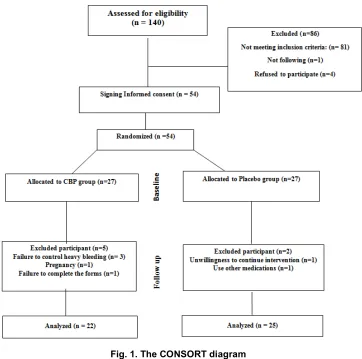
140 women with heavy menstrual bleeding and uterine leiomyoma were evaluated for their eligibility to study.81 patients did not meet the inclusion criteria, 4 of them did not accept to participate and one of them did not follow the next steps. Finally, 54 eligible patients were randomized in two groups, intervention (n=27) and placebo (n=27). In the first month of study, three patients in intervention group were excluded because lack of control of heavy bleeding and one in placebo group was excluded for unwillingness to continue the intervention. In the second month, one patient in intervention group was excluded because of she of pregnancy. In the third month, one patient in intervention group was excluded due to failure to deliver the form of bleeding and one in placebo group because of consumption of another herbal medicine with the drug. Finally, the results of the study were analyzed with 47 subjects, 22 patients in intervention group and 25 ones in placebo group (Fig. 1). After completing the study, the nature of the drug samples were disclosed by the pharmacologist.
The baseline demographic characteristics (Table 1) including age, level of education, marital status, body mass index, and blood pressure were analyzed. Two group are homogenous in BMI 28.4±5.75 vs. 30.74±5.23 (p=0.151), systolic BP 112.01 ± 12.66 Vs. 118.15 ±15.24 (p= 0.136), diastolic BP 76.2±8.86 vs. 76.59±10.84 (p=0.41) and age 41.27±3.15 vs. 40.0±4.70 (p=0.277). Moreover, two groups were same regarding to the educational level (p=0.396) and marital status (p=0.230).
Fig. 1. The CONSORT diagram
Table 1. Comparison the baseline demographic and blood pressure of two studied groups
Characteristic CBP group (n=22) Control group (n=25) P- value
Age 40.0±4.70 41.27±3.15 0.277*
BMI 30.74±5.23 28.4±5.75 0.151*
Systolic BP 118.15±15.24 112.01±12.66 0.136*
Diastolic BP 76.59±10.84 76.2±8.86 0.410*
Marital Status Single 7(28%) 3 (13.6%) 0.230**
Married 18(72%) 19(86.4%)
Education Lower diploma 8(32%) 8(36.4%) 0.396**
Diploma 8(32%) 9(40.9%)
Bachelor and higher 9(36%) 5(22.7%)
*t-test; **Chi square test
Table 2. Comparison of PBAC scores before and after treatment
PBAC score CBP group(n=22) Control group (n=25) P value*
Mean SD Mean SD
Baseline 464.00 283.61 445.92 362.64 0.851
After first month 372.64 225.63 261.36 297.29 0.160
After second month 357.59 242.71 215.40 145.10 0.017
After third month 323.82 207.66 214.36 137.68 0.037
P value** <0.001 <0.001
Table 3. Comparison of duration of bleeding before and after treatment
Duration of bleeding CBP (n=22) Control group (n=25) P value*
Mean SD Mean SD
Baseline 10.32 5.60 9.80 6.23 0.767
After first month 8.50 2.54 8.32 2.88 0.822
After second month 8.54 3.66 7.00 2.96 0.117
After third month 8.91 2.99 7.80 2.39 0.165
P value** <0.001 0.001
*T-test; ** Analysis of variance for repeated measurement
The independent t-test showed that the mean of bleeding duration (Table 3) was not statistically significant between two groups at baseline and each month during the intervention (p>0.05). Nevertheless, analysis of variance for repeated
measurement showed that there was a
significant decreasing trend in bleeding duration in intervention and control groups (p=0.001). However, there was no significant difference between two groups (p=0.308).
In the present study, the menstrual quality of life was same in two groups (55.44±11.96 Vs 47.79±16.81) at baseline (p=0.083) and it is not different between groups (44.84±16.02 vs. 37.71±18.31) after the intervention (p=0.165). However, the improvement of quality of life was observed in two study groups (p<0.001).
In the ultrasound, before and after the study, the number, size, and type of each leiomyoma were recorded. The mean number of leiomyoma in the intervention and control groups was 1.67 ±0.945 and 1.72±0.890, respectively. Based on paired t-test, there was no significant difference in a number of leiomyoma between the two groups before and after the study. T-test also did not show a significant difference in the size of leiomyoma between two groups before and after the study. Moreover, the size of the leiomyoma did not show any significant change after treatment and was not significant between the two groups (p>0.05). The most common typical types of leiomyoma were intramural, subserosal and submucosal, respectively.
3.3 Side Effects
There was no significant difference between two groups regarding to side effects. (p>0.05). In the intervention group, 18.2% (4 patients), and in the placebo group 16% (4 patients), were reported side effects. The complications in the intervention group including hemorrhoid (9.1%), constipation (4%), Skin dryness (4%), and pelvic cramps (4%). The complications in control group
including stomach ache, headache, hair loss, and acne.
4. DISCUSSION
The current study was the first randomized
clinical trial on the effect of CBP in heavy
menstrual bleeding due to UL. Our results showed a significant improvement trend in PBAC score in all studied patients in two groups and there was no significant difference between intervention and control groups. However, the mean of uterine bleeding decreased in the intervention group from 464.00± 283.61 at baseline to 323.82±207.66 in the third month after treatment with CBP. Moreover, the mean of bleeding decreased from 445.92±362.64 to 214.36±137.68 after follow up in control group.
Other studies showed that the extract of CBP is
an effective drug on control of non-structural heavy menstrual bleeding and postpartum haemorrhage [21,22] (1,2). Our results also showed a decrease in duration of bleeding but
there was not the difference between CBP and
control group. The mean of days with bleeding decrease from 10.32±5.60 to 8.91±2.99 in
intervention group and decreased from
9.80±6.23 to 7.80±2.39 in control group.
Although CBP has been effective in reducing
bleeding in this study, other studies on the effect of this plant on unrelated leiomyoma uterine bleeding have reported better results. The study was conducted in Iran by Naafe et al., on the effect of CBP on non-structural uterine bleeding showed a reduction in the amount of menstrual
bleeding by the hydroalcoholic extract of CBP.
This reduction was more significant in the CBP
group, compared to the control group [21]. Another study was conducted by Ghalandari et al., demonstrated that the amount of postpartum
bleeding was lower in the CBP and oxytocin
group first, second, and third hours after the delivery, compared to the oxytocin group [22]. The chemical composition and biological effect of
Some studies assume that its contractile nature
of CBP is due to the presence of oxytocin-like
polypeptides [37]. CBP is rich in phenolic and
flavonoid compounds that show the antioxidant, anti-inflammatory and antibacterial effects of this plant [11,24,25]. In the past, tyramine and choline were responsible for controlling the bleeding by the plant. Todays, new researches have shown that other substances that are not fully recognized may be responsible for such an effect [25-38]. Anyway, the contractile and hemostatic nature of this drug cannot be ignored. Different response to treatment in this study may be due to the mechanism of uterine bleeding in leiomyoma like widening of endometrial veins, vascular weakness, and abnormal contractions of the uterus and leiomyoma superficial vascular bed. Moreover, haemeostatic problems due to abnormal angiogenesis caused a synergistic effect on heavy bleeding [1,39].
Due to the inflammatory environment
surrounding leiomyoma, any anti-inflammatory agent, including flavonoids, can be effective in controlling the complications of these tumors. Perhaps the higher amount of this substance in the plant will be more effective in controlling inflammation and symptoms in the leiomyoma. A study conducted by Memarzadeh et al., showed
that Persian Gulnar significantly reduced
leiomyoma related uterine bleeding. In that study, the flavonoid content of Gulnar was much higher than the current study. Therefore, Gulnar has
been more effective than CBP in controlling
leiomyoma symptoms [40]. Control of
inflammation is only one of the mechanisms of
control of hemorrhage in patients with
leiomyoma. In herbal studies on control of uterine bleeding, Tannins have an astringent property and can cause contraction of uterine vessels that leads to decreased exudation and blood loss [32,36,40,41]. Compared to some materials such as pomegranate peel and oak, tannin content of CBP is relatively low [30,42,43].
The anatomical position, number and size of the uterine leiomyomas are effective factors of the volume of bleeding in patients with UL that caused excessive uterine bleeding as well as prolonged menstrual period [1,6,44].
The ultrasound showed both groups were similar in number and size of the leiomyomas before the study. The mean number and size of the leiomyoma did not change significantly after the study in both groups. Stewart's study, which was based on the effect of two doses of asoprisnil (10
or 25 mg) on uterine bleeding with leiomyoma, after 6 months, showed reduction in size of uterine leiomyoma up to 45% with asoprisnil 10 mg and 54% with asoprisnil 25 mg versus increase in size of uterine leiomyoma up to 44% with placebo [7]. Contrary to Stewart's study in the current study, no increase in leiomyoma size
observed. Short duration of our study or CBP
effect may be responsible for such a result.
The most common typical location of leiomyoma in our study was intramural, subserosal and submucous respectively like other studies such Memarzadeh [40].
Based on the recent studies, UL is a significant related factor in decreasing the quality of life in
women of reproductive age 1. Improvement in
mean scores of menstrual quality of life was same in our and Memarzadeh study. (p<0.001) [40]. In the study by Naafe, the patient's satisfaction rate was significantly higher in the CBP group compare to control group [21]. These results also point to a better performance of CBP in reducing non-structural uterine bleeding over structural causes.
The most side effects in the intervention group were hemorrhoid, constipation, skin dryness, and pelvic cramps. This plant is anti-diarrhea in folklore medicine so constipation was because of the astringent nature of the plant [24]. Hemorrhoid may be due to constipation. Pelvic cramps are also due to contractions was created by the plant [37]. Stomachache, hair loss,
headache, and acne were the most
complications in patients of the intervention group. These complications seem to be more due to blood loss.
The present study assessed the extract effect of CBP on heavy menstrual bleeding and quality of life in patients suffering from uterine leiomyoma for the first time in a pilot study.
Mechanisms of bleeding are different in leiomyoma as structural uterine problems with nonstructural disorders so more studies must have conducted to compare the effect of CBP on bleeding due to structural and nonstructural uterine disorders. It also recommended studying the possible effects of starch on uterine bleeding and leiomyoma.
5. CONCLUSION
decrease the menstrual bleeding duration. Moreover, the menstrual quality of life showed an improvement trend. However, there was no
clinically significant difference between
intervention and control groups regarding to PBAC score, bleeding duration and quality of life.
6. LIMITATION
Small sample size and variety in types of UL were the limitations of this study. Therefore, future studies with larger sample size in one specific type of UL suggested.
CONSENT AND ETHICAL APPROVAL
This study was a double-blind randomized, placebo-controlled clinical trial that conducted in outpatient clinics of Qom University of Medical Sciences from February 2018 to January 2019. It was approved by the ethics committee of Qom University of Medical Science (ethical code:
IR.MUQ.REC.1396.110) and registered at
Iranian registry clinical Trials centre (No IRCT20161226031582N1).
Enrolment of eligible patients was based on convenience methods after a description of study purpose to each patient and signing the informed consent form.
COMPETING INTERESTS
Authors have declared that no competing interests exist.
REFERENCES
1. de la Cruz MSD, Buchanan EM. Uterine
fibroids: Diagnosis and treatment. Am Fam Physician. 2017;95(2):100–7.
2. Ehman EC, Johnson GB,
Villanueva-meyer JE, Cha S, Leynes AP, Eric P, et al. Epidemiology of Uterine Fibroids – From
Menarche to Menopause. Clin Obs
Gynecol. 2017;46(5):1247–62.
DOI: 10.1097/GRF.0000000000000164
3. Berek JS. Berek & Novak’s Gynecology.
16th ed. Berek JS, editor. Vol. 1, Wolters
Kluwer. Philadelphia: Wolters Kluwer. 2020;213.
4. Chwalisz K, Taylor H. Current and
emerging medical treatments for uterine fibroids. In: Seminars in reproductive medicine. Thieme Medical Publishers. 2017;510–22.
DOI: 10.1055/s-0037-1606302
5. Jones HWI, Rock JA. Te linds. pdf. 11th ed.
Philadelphia: Wolters Kluwer. 2016;1160-1193.
6. Hoffman BL, Schorge JO, Bradshaw KD,
Halvorson LM, Schaffer JI, Corton MM. Williams_Gynecology. third. McGraw-Hill Education. 2016;202-212.
7. Stewart EA, Diamond MP, Williams ARW,
Carr BR, Myers ER, Feldman RA, et al. Safety and efficacy of the selective
progesterone receptor modulator
asoprisnil for heavy menstrual bleeding with uterine fibroids: Pooled analysis
of two 12-month, placebo-controlled,
randomized trials. Hum Reprod. 2019;1– 12.
DOI: 10.1093/humrep/dez007
8. Marnach ML, Laughlin-Tommaso SK.
Evaluation and management of abnormal uterine bleeding. Mayo Clin Proc [Internet]. 2019;94(2):326–35.
Available:https://doi.org/10.1016/j.mayocp. 2018.12.012
9. Islam MS, Protic O, Giannubilo SR, Toti P,
Tranquilli AL, Petraglia F, et al. Uterine leiomyoma: Available medical treatments and new possible therapeutic options. J Clin Endocrinol Metab. 2013;98(3):921–34. Available:https://doi.org/10.1210/jc.2012-3237
10. Lewis TD, Malik M, Britten J, San Pablo
AMA, Catherino WH. A comprehensive review of the pharmacologic management of uterine leiomyoma. BioMed Research International; 2018.
Available:https://doi.org/10.1155/2018/241 4609
11. Masullo M, Montoro P, Mari A, Pizza C,
Piacente S. Medicinal plants in the treatment of women’s disorders: Analytical strategies to assure quality, safety and efficacy. J Pharm Biomed Anal [Internet]. 2015;113:189–211.
Available:http://dx.doi.org/10.1016/j.jpba.2 015.03.020
12. Akhtar MM, Ciavattini A, Giannubilo SR,
Protic O, Janjusevic M, Procopio AD, et al.
Use of dietary phytochemicals to
target inflammation, fibrosis, proliferation and angiogenesis in uterine tissues: Promising options for prevention and treatment of uterine fibroids? 2014;1667– 84.
Available:https://doi.org/10.1002/mnfr.2014 00134
13. Tetik F, Civelek S, Cakilcioglu U.
in Malatya (Turkey). J Ethnopharmacol. 2013;146(1):331–46.
Available:https://doi.org/10.1016/j.jep.2012 .12.054
14. Hosseini SE. Report of health care
therapeutic effects of medicinal herbs on reproductive system disorders: A review. 2018;4(3):67–76.
15. Eshaghian R, Mazaheri M, Ghanadian M,
Rouholamin S, Feizi A, Babaeian M. The effect of frankincense (Boswellia serrata, oleoresin) and ginger (Zingiber officinale, rhizoma) on heavy menstrual bleeding: A randomized, placebo-controlled, clinical trial. Complement Ther Med [Internet]. 2019;42:42–7.
Available:https://doi.org/10.1016/j.ctim.201 8.09.022
16. Nasiri M, Gheibi Z, Miri A, Rahmani J,
Asadi M, Sadeghi O, et al. Effects of consuming date fruits (Phoenix dactylifera Linn) on gestation, labor and delivery: An updated systematic review and meta-analysis of clinical trials. Complement Ther Med [Internet]. 2019;74:71-84.
Available:https://doi.org/10.1016/j.ctim.201 9.05.017
17. Choi WJ, Kim SK, Park HK, Sohn UD, Kim
W. Anti-inflammatory and
anti-superbacterial properties of sulforaphane from shepherd’s purse. Korean J Physiol Pharmacol. 2014;18(1):33–9.
Available:https://doi.org/10.4196/kjpp.2014 .18.1.33
18. Hur J, Yoo M, Shin D bin, Lee S. Inhibition
of nitric oxide production corresponds to the sulforaphane content in Korean sheperd’s purse (Capsella bursa-pastoris) and related species in BV-2 cell. Food Sci Biotechnol. 2013;22(4):1085–9.
19. Miraldi E, Ferri S, Mostaghimi V.
Botanical drugs and preparations in the traditional medicine of West Azerbaijan (Iran). J Ethnopharmacol. 2001;75(2–3): 77–87.
Available:https://doi.org/10.1016/S0378-8741(00)00381-0
20. Güler B, Kümüştekin G, Uʇurlu E.
Contribution to the traditional uses of medicinal plants of Turgutlu (Manisa -
Turkey). Vol. 176, Journal of
Ethnopharmacology. 2015;102–8.
Available:https://doi.org/10.1016/j.jep.2015 .10.023.
21. Naafe M, Kariman N, Keshavarz Z,
Khademi N, Mojab F, Mohammadbeigi A. The effect of hydroalcoholic extracts of
Capsella bursa-pastoris on heavy
menstrual bleeding: A randomized clinical trial. J Altern Complement Med. 2018;24 (7):694–700.
Available:https://doi.org/10.1089/acm.2017 .0267
22. Ghalandari S, Kariman N, Sheikhan Z,
Mojab F, Mirzaei M, Shahrahmani H. Effect of hydroalcoholic extract of Capsella bursa pastoris on early postpartum hemorrhage: A clinical trial study. J Altern Complement Med. 2017;23(10):794–9.
Available:https://doi.org/10.1089/acm.2017 .0095
23. Sehhati F, Mirghafourvand M,
Hamzehpour R. The comparative effect of Capsella bursa-pastoris and mefenamic acid on sexual function of copper IUD users. Int J Women’s Heal Reprod Sci [Internet]. 2018;6(2):192–8.
Available:http://dx.doi.org/10.15296/ijwhr.2 018.32
24. Defelice MS. Shepherd’s-purse, Capsella
bursa-pastoris (L.) medic. Weed Technol. 2002;16(4):901–7.
Available:https://doi.org/10.1614/0890-037X(2001)015[0892:SSPCBP]2.0.CO;2
25. Grosso C, Vinhole J, Gonçalves RRFR,
Valentão P, Jäger AAK, Andrade PPB, et al. Chemical composition and biological
screening of Capsella bursa-pastoris. Rev
Bras Farmacogn Brazilian J Pharmacogn. 2011;21(4):635–44.
Available:http://dx.doi.org/10.1590/S0102-695X2011005000107
26. Lans C, Turner N, Khan T, Brauer G,
Boepple W. Ethnoveterinary medicines used for ruminants in British Columbia, Canada. J Ethnobiol Ethnomed. 2007;3:1– 22.
Available:https://doi.org/10.1186/1746-4269-3-11
27. Khare CP. Indian medicinal plants.
springer. New Dehli: Springer. 2017; 119.
28. Lan X, Qing-Hu W, Bai-yin-mu-qi-er W,
A-gu-la1 B. Chemical composition and anti-inflammatory effects of the EtOAc extract
from Capsella bursa-pastoris (L.) medic.
African J Pharm Pharmacol. 2017;11:186-90.
29. Gruenwald J, Brendler T, Jaenicke C. PDR
for herbal Medicines. 2nd ed. Montvale, NJ :
Medical Economics Company. 2000;691.
30. Atanassova M, Christova-Bagdassarian V.
different plant species. J Univ Chem Technol Metall. 2009;44(4):413–5.
Available:https://www.researchgate.net/pu blication/257076247
31. Rebaya A, Belghith SI, Baghdikian B,
Leddet VM, Mabrouki F, Olivier E, et al. Total phenolic, total flavonoid, tannin content, and antioxidant capacity of Halimium halimifolium (Cistaceae). J Appl Pharm Sci. 2015;5(1):052–7.
DOI: 10.7324/JAPS.2015.50110
32. Shafiee M, Heidari A, Amouzegar H, Khani
S, Nojavan F. Evaluation of the effect of roasted lentil flour (lentil savigh) as a functional food in menstrual bleeding reduction. Complement Ther Med. 2019; 44:27–31.
Available:https://doi.org/10.1016/j.ctim.201 9.03.010
33. Bryan-thomas J. A comparative study of
the antioxidant activity (DPPH), total flavonoid, total tannin, total polyphenol
levels in plant extracts of the Annona
muricata, Ribes ningrum and Manilkara
zapota. Int J Sci Res Publ. 2016;6(9): 490-4.
34. El-Nashar SA, Shazly SAM, Famuyide AO.
Pictorial blood loss assessment chart for quantification of menstrual blood loss: A
systematic review. Gynecol Surg.
2015;12(3):157–63.
35. Mazari Z, GoshtasebiI A, Mookhah S, Saki
F. The menorrhagia questionnaire (MQ): Translation and validation study of the Iranian version. PAYESH. 2012;11(1):83– 5.
36. Qaraaty M, Kamali SH, Dabaghian FH,
Zafarghandi N, Mokaberinejad R, Mobli M, et al. Effect of myrtle fruit syrup on abnormal uterine bleeding: A randomized
double-blind, placebo-controlled pilot
study. DARU, J Pharm Sci. 2014;22(1):45. Available:https://doi.org/10.1186/2008-2231-22-45
37. Al-snafi AE. Medicinal plants affected
contractility of smooth muscles: A review. 2018;8(11):22–35.
38. Kuroda K, Takagi K. Physiologically active
substance in capsella bursa-pastoris. Nature. 1968;220(5168):707–8.
39. Ikhena DE, Bulun SE. Literature review on
the role of uterine fibroids in endometrial function. Reproductive Sciences. 2018;25: 635–43.
40. Memarzadeh H, Eftekhar T, Tansaz M,
Hashem Dabaghian F, Kamalinejad M.
Evaluation of efficacy of Punica granatum
L. (Persian gulnar) on uterine leiomyoma related menorrhagia: A pilot study. Int J Biosci. 2015;6(9):18– 25.
41. Bahman M, Mirahi A, Hajimehdipoor H,
Tansaz M. The effect of quince paste on menorrhagia: A clinical study. Int J Pharm Sci Res. 2017;9(4):1654–9.
DOI:
10.13040/IJPSR.0975-8232.9(4).1654-59
42. Russo M, Fanali C, Tripodo G, Dugo P,
Muleo R, Dugo L, et al. Analysis of phenolic compounds in different parts of pomegranate (Punica granatum) fruit by HPLC-PDA-ESI/MS and evaluation of their antioxidant activity: Application to different Italian varieties. Anal Bioanal Chem. 2018;410(15):3507–20.
43. Nabavizadeh MR, Zargaran A, Moazami F,
Askari F, Sahebi S, Farhadpoor A, et al. Comparison of the hemostatic activity of Quercus persica Jaub. & Spach. (Oak) with ferric sulfate in bony crypts. J Evidence-Based Complement Altern Med. 2016;21:34-38.
Available:https://doi.org/10.1177/21565872 15593378
44. Donnez J, Dolmans MM. Uterine fibroid
management: From the present to the future. Hum Reprod Update. 2016;22(6): 665–86.
Available:https://doi.org/10.1093/humupd/d mw023
© 2019 Danesh et al.; This is an Open Access article distributed under the terms of the Creative Commons Attribution License
(http://creativecommons.org/licenses/by/4.0), which permits unrestricted use, distribution, and reproduction in any medium,
provided the original work is properly cited.
Peer-review history: