COMPUTER SCIENCE & TECHNOLOGY
www.computerscijournal.org
December 2013, Vol. 6, No. (4): Pgs. 391-396 An International Open Free Access, Peer Reviewed Research Journal
Published By: Oriental Scientific Publishing Co., India.
INTROdUCTION
The next-generation mobile network will be an integrated global system that provides Heterogeneous services across network providers, network backbones, and geographical regions Global roaming is a basic service of the future mobile networks, where terminal mobility, personal mobility, and service provider portability must be supported. In a wireless network, a node (mobile-phone) will be present in a region and each region
A Methodology in Mobile Networks for Global Roaming
TANvIR HAbIb SARdAR
Department of Information Science and Engineering, P. A. College of Engineering, Mangalore, India
(Received: December 10, 2013; Accepted: December 20, 2013)
AbSTRACT
This mobile network architecture will support terminal mobility, personal mobility, and service provider portability, making global roaming seamless. A location-independent Personal Telecommunication Number (PTN) scheme is conducive to implementing such a global mobile system. However, the non-geographic PTNs coupled with the anticipated large number of mobile user’s in future mobile networks may introduce very large centralized databases. This necessitates research into the design and performance of high-throughput database technologies used in mobile systems to ensure that future systems will be able to carry efficiently the anticipated loads. This is scalable, robust, efficient location database architecture based on the location-independent PTN. The proposed multi tree database architecture consists of a number of database subsystems, each of which is a three-level tree structure and is connected to the others only through its root. By exploiting the localized nature of calling and mobility patterns, the proposed architecture effectively reduces the database loads as well as the signalling traffic incurred by the location registration and call delivery procedures. In addition, two Memory-resident database indices, memory-resident direct file and T-tree are proposed for the location databases to further improve their throughput. Analysis model and numerical results are presented to evaluate the efficiency of the proposed database architecture. Results have revealed that the proposed database architecture for location management can effectively support the anticipated high user density in the future mobile networks.
Key words: Mobile networks, Global roaming, Distributed hierarchical database, Multi-tree database, location database
information about the nodes which are current in its area. The main aim of proposed concept is to provide minimum number of updates or evaluations (queries) when various service providers are going to be combined. That is, there will be different nodes under different service provider under a same area. For example, in a region, there will be 1000 nodes for AIRTEL, 1000 nodes for AIRCEL and 1000 nodes for BSNL. AIRTEL, AIRCEL and BSNL are maintaining different towers to handle their calls. But in future, if all the service providers are going to be combined, then the number of users will be increasing tremendously.
With location-independent personal telecommunication number PTNs, users can access their personalized services regardless of terminal or attachment point to the network; they can move into different service provider’s network and continue to receive subscribed services without changing their PTNs. Another advantage of the flat PTN scheme is that it is much more efficient in terms of capacity than the location-dependent numbering scheme where the capacity of the SN may be exhausted in a highly populated area, whereas the Subscriber Number’s (SN) capacity is wasted in a sparsely populated area. However, using the location-independent numbering plan may introduce large centralized databases into a mobile system. To make things worse, each call may require an interrogation to the centralized databases, thus signaling traffic will grow considerably and call setup time may increase dramatically. The large centralized databases may become the bottleneck of the global mobile system, thus necessitating research into the design and performance of high-throughput database technologies as used in mobile networks to meet future demands.
Growth in telecommunications population directly impacts the economy. Advanced economies have discovered that mobile number portability (MNP) helps the economy. Keeping this in mind, many countries in advanced economies have passed regulations making it mandatory for the mobile network operators to implement MNP, in which a subscriber will keep the number but change the network. Following porting of the mobile number, calls need to be routed to the old number in a new network. GSM (global system for
mobile communications) has proposed various technology models for supporting voice calls in an MNP scenario. GSM has also suggested technology models to support non call-related signalling functions like SMS (short message service) point-to-point in MNP scenario. However, data services and application over SMS (SMS-data) is outside the scope of GSM, and no technology is available as of date to support portability of SMS-data services in an MNP scenario. This paper proposes a technology solution for SMS data portability in MNP scenario. It provides experimental results to support such a claim.
Methodology
This paper proposes scalable, robust, efficient location database architecture based on the location-independent PTNs. The proposed multi-tree database architecture consists of a number of database subsystems, each of which is a three-level tree structure and is connected to the others only through its root. By exploiting the localized nature of calling and mobility patterns, the proposed architecture effectively reduces the database loads as well as the signalling traffic incurred by the location registration and call delivery procedures.
A distributed hierarchical database architecture based on the location independent plan is proposed to support location tracking in a global mobile system. This decreases the end-to-end delays in call setup and location registration and the access time of each database is decreased. This methodology mainly focuses on five modules, which are completely inter-related to each other. The descriptions about the modules are given below.
design of multi-tree database
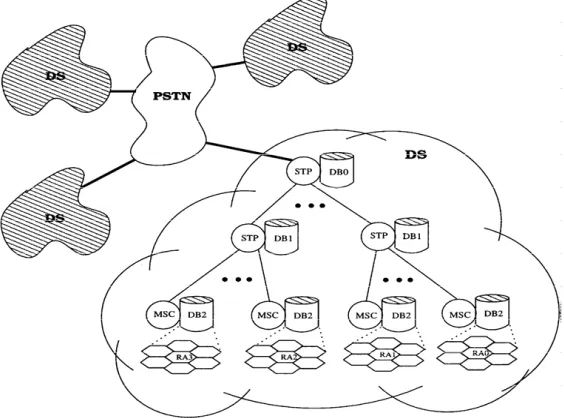
The proposed database architecture for location tracking is a multi-tree structure, where each subsystem is three-level architecture, referred to as a database subsystem (DS) in this thesis. In each DS, databases DB0 and DB2 may correspond to the HLR and the VLR in the two-level database system, respectively. A number of DB2s are grouped into one DB1 and several DB1s are connected to a single DB0.
DB0 (Level 1) DB1 (Level 2) DB2 (Level 3)
database indices
A database usually consists of two parts: an index file and a data file. The Efficient database indices used T- tree.
Organization of Location databases
The proposed database system is a multi-tree structure, consisting of a number of distributed database subsystems (DSs), each of which is a three-level tree structure. In each DS, databases DB0 and DB2 may correspond to the HLR and the VLR in the two-level database system, respectively. Each DB1 has an entry for every currently residing user, storing a pointer to the DB2 the user is currently visiting.
The proposed database architecture for location tracking is a multi-tree structure, where each subsystem is a three-level architecture referred to as a databasesubsystem (DS). Various DSs may represent networks operated possibly by different service providers. All these DSs are interconnected together via a fixed network, such as PSTN or ATM network, and communicate with each other only through their root databases.
Location Registration Procedure
Location registration is the procedure through which a user reports its location to the network whenever the user enters a new location. In this phase, the mobile user periodically notifies the network of its new access point. The notifications allow the network to authenticate the user and update its location profile.
Call delivery Procedure
As an incoming call arrives, the call delivery procedure is invoked to deliver the call to the user. When a call belonging to a user reached the network, a search for the user’s profile is made usually in a local database. Then the call is forwarded to the user based on the information contained in its profile.
Proposed Architecture for location tracking
The proposed database architecture for
location tracking is a multi-tree structure, where each subsystem is three-level architecture, referred to as a Database Subsystem (DS). Various DSs may represent networks operated possibly by different service providers. All these DSs are interconnected together via a fixed network, such as PSTN or ATM network, and communicate with each other only through their root databases. This architecture can support a multi-operator environment which is expected in future mobile networks. In each DS, databases DB0 and DB2 may correspond to the HLR and the VLR in the two-level database system, respectively. Each DB2 may control an RA where a user can roam freely without triggering registrations. Each DB2 is collocated with an MSC, which performs call processing on origination or termination calls. A number of DB2s are grouped into one DB1 and several DB1s are connected to a single DB0. Each DB1 and DB0 also needs a switch, called the STP that provides routing functionality for message exchange between various location databases.
The DB0 maintains the service profile for each user currently residing in its service area, and maintains an entry for each user in the global mobile system. The entry contains either a pointer to another DB0 where the user is residing or a pointer to the user record that contains a pointer to the DB1 with which the user is currently associated. Each DB1 has an entry for every currently residing user, storing a pointer to the DB2 the user is currently visiting. Every DB2 has a copy of the service profiles of the users currently roaming within its area.
delays low, it is critical to reduce the access times to the databases. Thus, investigation into efficient database access indices for the location databases
is as important as research into the overall location database architecture. Fig. 1 shows our proposed architecture.
Fig. 1: Proposed Multi-tree database Architecture
Proposed design of Two database Indices
A database usually consists of two parts: an index file and a data file. The index file contains an access structure called index, which provides search paths for locating the records in the data file. The index determines the database access time, thereby being the critical component for improving database throughput.
Efficient indices should be based on application characteristics such as the types of storage devices available, the affordable storage capacity, and the types of queries required.
T-Tree
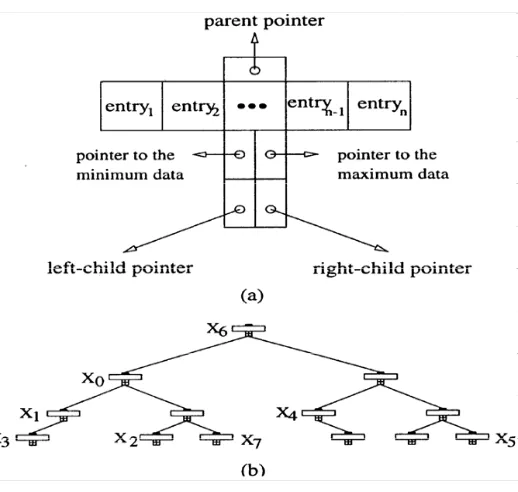
The T-tree, which evolved from the AVL-tree and the B-AVL-tree, is a binary AVL-tree in which each node called T-node contains a number of data items, a parent pointer, a left-child pointer, a right-child pointer, and some other control information. The T-tree is fast since it retains the intrinsic binary search nature of the AVL-tree. On the other hand, unlike the AVL-tree that holds only one data item in each node, the T-tree contains a number of data items in each node similar to the B-tree, thus having good storage utilization. In a T-node, the data items are arranged in increasing order of their keys. To
find a value in the T-tree, a search algorithm for the T-tree is needed. According to, one efficient
search algorithm for the T-tree can be described
as follows:
Each search begins with the root node
If the search value is less than the minimum value of the node, then the left-child node is searched. Otherwise, the current node is marked for future consideration and the search goes down the sub tree pointed to by the right-child pointer. When the search reaches a leaf, the last marked node is searched using a binary search. The search fails when the search value is not found in the marked node that bounds the search value (this node is called the bounding node) or when the bounding node does not exist in the T-tree.
direct File
of direct addressing is that space must be reserved for every possible key value, resulting in wasting large amounts of storage.
However, when the number of possible key values is relatively close to the number of actual key values, direct addressing is very cost effective. Whenever access time is the vital criterion, even
lower packing densities are acceptable. To use direct addressing, the key values must be numeric, in ascending order, and the records must have fixed length. The location-independent PTN numbering plan makes direct addressing quite suitable for large centralized databases. Figure 2 shows these graphically.
Fig. 2: (a) T-node, (b) T-tree
RESULTS
Compared to the existing two-level location database architecture, the proposed database architecture can support a much higher user density while reducing signalling load significantly. Compared to the one-root tree architecture, the proposed architecture provides better scalability and reliability while supporting a larger user population at a lower signalling cost. For performance evaluation, analysis model was developed. Numerical results have revealed that the proposed database architecture can effectively handle the anticipated high update and query rates to the location databases in future mobile networks. The proposed database access structures are also suitable for other large centralized databases in mobile networks, such as the authentication center and the equipment identity register.
We have designed scalable, robust, efficient location database architecture based on the which is Location independent - user can move anywhere the world without roaming cost, so that one can maintain a lifelong PTN number. Also possible to use Personal Mobility, Terminal Mobility - while in motion, to access telecommunication services from different locations, and the capability of the network to identify and locate that terminal. As well as Service provider portability is possible.
CONCLUSIONS
much easier than in one-root database architecture. The proposed multi-tree database system is easy to expand and maintain in the multi operator environment of a global mobile system. This proposed mechanism is much more robust than the one root hierarchical architecture.
There are some limitations of this methodology as (i) Consumers allowed switching operators only 90 days after a connection is activated. (ii) Consumers allowed to change operators within their registered circle only (i.e. if you are within the Maharashtra circle you can’t shift to a Karnataka circle and so on). (iii) Cannot
be carried out by the subscriber on his own. (iv) Hence the process of portability is lengthy and not very reliant.
There are some future work related to this methodology given (i) Customer database can be maintained so that each time an PTN is updated there is no need to re-submit the document. (ii) A customer can be allotted a unique portability ID (i.e. system generated) and password (also system generated with an option to change as per his/her needs) if in case he/she wishes to change the GSM service provider.
REFERENCES
1. Zuji Mao, Member, IEEE, and Christos Douligeris, Senior Member, IEEE ‘A Distributed Database Architecture for GlobalRoaming in Next-Generation Mobile Networks’ 12(1): 149-159 (2004).
2. I. F. Akyildiz, J. Mcnair, J. S. M. Ho, H. Uzunalioglu, and W. Wang, ‘Mobility management in next-generation wireless systems’, Proc. IEEE, 87: 1347-1384 (1999).
3. I.-R. Chen, T.-M. Chen, and C. Lee, ACM/ Baltzer J. Mobile Netw. Applicat ‘Agent-based forwarding strategies for reducing location management cost in mobile networks’, 6(2): 105-115 (2001).
4. S. Dolev, D. K. Pradhan, and J. L. Welch, Comput. Commun., “Modified tree structure
for location management in mobile environments,”, 19(4): 335-345 (1996). 5. R. Elmasri and S. B. Navathe, Fundamentals
of Database Systems, 2nd ed. Menlo Park, CA: Addison-Wesley (1994).
6. J. S. M. Ho and I. F. Akyildiz, IEEE/ACM Trans. Networking, “Dynamic hierarchical database architecture for location management in PCS networks,” 5: 646-660 (1997).
7. IEEE/ACM Trans. Networking ‘Local anchor scheme for reducing signaling costs in personal communications networks,’ 4: 709–725 (1996).