
R E S E A R C H
Open Access
Interventions for improving pharmacist-led
patient counselling in the community
setting: a systematic review
Sinaa Al Aqeel
1*, Norah Abanmy
1, Hiba AlShaya
1and Albatoul Almeshari
2Abstract
Background:Pharmacist counselling is an important service that has been associated with improved outcomes. The primary aim of this review was to identify, describe, and determine the effectiveness of interventions for improving the counselling practice of community pharmacists.
Methods:We searched PubMed (from January 1990 to June 2017) and the Cochrane Library (June 2017). To supplement our database searches, we searched Google Scholar for papers that cited the identified studies. We
included only studies that reported the impact of the intervention on pharmacists’behaviour during counselling.
We searched for data from studies with randomised trials, non-randomised trials, controlled before-after studies, or interrupted time series study designs. Parameters including selection bias, performance bias, detection bias, and attrition bias were assessed. The data were narratively synthesised.
Results:We screened 2335 abstracts and 59 full-text articles and included 17 RCTs. Overall, three studies were determined to have a high risk of bias, and 14 studies were determined to have an unclear risk of bias. Fifteen studies investigated multifaceted interventions that included two or more components. The most commonly used
interventions were educational meetings (n= 14), educational materials (n= 9), educational outreach visits (n= 5),
feedback (n= 5), guidelines (n= 5), and local opinion leaders (n= 2). Outcomes were measured using simulated
patient visits (n= 10), and the self-reported outcomes of patient or pharmacists (n= 6). Most of the included studies
(n= 11) reported some degree of improvement in counselling practices.
Conclusions:The included studies showed that educational meetings combined with educational materials, outreach visits, and feedback can improve pharmacist counselling in community settings. However, the unclear risk of bias and poor quality of reporting intervention components necessitate caution in interpreting the findings. Recommendations for future studies based on the evidence gap identified in this review are presented.
Keywords:Community pharmacy, Community pharmacy services, Pharmacies, Professional practice, Patient education, Counselling
Background
According to the Joint International Pharmaceutical Federation (FIP)/World Health Organization (WHO) guidelines for good pharmacy practice, the mission of pharmacy practice is to “contribute to health improve-ment and to help patients with health problems to make the best use of their medicines” [1]. Pharmacist-led
counselling is an important service that has been associ-ated with improved clinical outcomes, quality of life, drug/ disease knowledge, satisfaction, and reduced health service utilisation among patients [2].
There is no accepted definition of counselling. According to Puspitasari et al. [3], researchers either operationally de-fine counselling or refer to specific counselling guidelines in the literature. Pharmacy researchers operationally define counselling as giving advice or providing information on medications, while others focus more on the goal of coun-selling, i.e. ensuring that patients understand the optimal * Correspondence:[email protected]
1Clinical Pharmacy Department, College of Pharmacy, King Saud University,
Riyadh, Kingdom of Saudi Arabia
Full list of author information is available at the end of the article
© The Author(s). 2018Open AccessThis article is distributed under the terms of the Creative Commons Attribution 4.0
International License (http://creativecommons.org/licenses/by/4.0/), which permits unrestricted use, distribution, and
use of medications to improve their quality of life [3]. In a review focusing on the conceptualisation and measurement of pharmacist-patient communication, Shah and Chewning [4] discuss the differences in counselling definitions between the professional counselling literature and other published pharmacy literature. The professional counselling literature, represented by an international interdisciplinary journal, defines counselling as an“individualised process in-volving guidance and collaborative problem solving to help the patient better manage their health problems”[5], while other published pharmacy literature uses the term “ coun-selling” to refer to the provision of information regarding how to take the drug product properly [4]. Furthermore, the terms“communication”,“counselling”,“education”, and “information provision” have been used interchangeably in the literature, disregarding subtle differences in their mean-ing [4]. Patient education, for example, is defined as “a planned learning experience using a combination of methods such as teaching, counselling, and behaviour modification techniques that influence patients knowledge and behaviour” [5]. Thus, according to this definition, counselling is an aspect of patient education [4].
In addition to dispensing prescription and non-prescription medications, community pharmacists have great potential to be the first contact for patients seeking treatment for minor ailments. Community pharmacists also have an increasing role in public health through the promotion of healthy lifestyles. Pharmacist-patient inter-actions in the community setting may also address diet, device use, exercise, referrals, or other non-medication issues. The community setting offers many advantages, such as long opening hours, accessibility, and familiarity. Studies investigating the counselling practices of com-munity pharmacists have indicated that their elicitation of information prior to supplying medicine, detection of drug interactions, and counselling content are of suboptimal quality [6–11]. Counselling in a community setting is a complex process [12], which may explain the poor quality of community counselling practices.
Previous reviews have examined the impact of com-munity pharmacy services, such as counselling, on patient outcomes [2,13, 14], quality of counselling [10], verbal counselling rates [3], types of information pro-vided during counselling [3], and the conceptualisations, definitions, and measurements of pharmacist-patient communication in the community setting [4]. Few stu-dies, however, have examined interventions to improve community pharmacy services. Patwardhan et al. [15] reviewed literature published up to 2010 on interven-tions for enhancing community pharmacists’ cognitive services, defined as professional services provided by pharmacists to a patient that are either judgemental or educational in nature. Watkins [16] searched six data-bases up to 2014 for literature on implementation
strategies for clinical guidelines to community pharmacy and their impact on the quality of care provided by com-munity pharmacists, such as adherence to recommended practices or guidelines. In December 2017, Seubert et al. [17] published a review of literature published between 2000 and 2017 on interventions aimed at improving communication between consumers and pharmacy personnel during consultations for medicines that are provided without a prescription.
These reviews focused on general cognitive services rather than on counselling specifically; on specific inter-ventions, such as guidelines; or on specific groups of medications. To date, however, no systematic reviews have focused on interventions for improving counselling in different situations, including prescription and non-prescription medications, consultations for minor ailments, and health promotion. Given the suboptimal quality of counselling noted earlier, we need to close the gap in knowledge regarding which interventions might lead to optimal counselling in the community setting.
The primary aim of this review was to identify, describe, and determine the effectiveness of interventions for improving the counselling practice of community pharma-cists. The secondary aim was to provide recommendations for future studies due to the evidence gap identified in this review. In this review, “counselling” is used as a broad umbrella term that encompasses all definitions outlined in the background section.
Methods Study design
The review was guided by the recommendations of the Cochrane Handbook [18] and York Systematic Review Centre for Reviews and Disseminations (CRD) guidelines [19]. The reporting of the review complied with the Pre-ferred Reporting Items for Systematic Reviews and Meta-Analyses (PRISMA) statement [20]. The protocol was not registered on PROSPERO.
Search methods
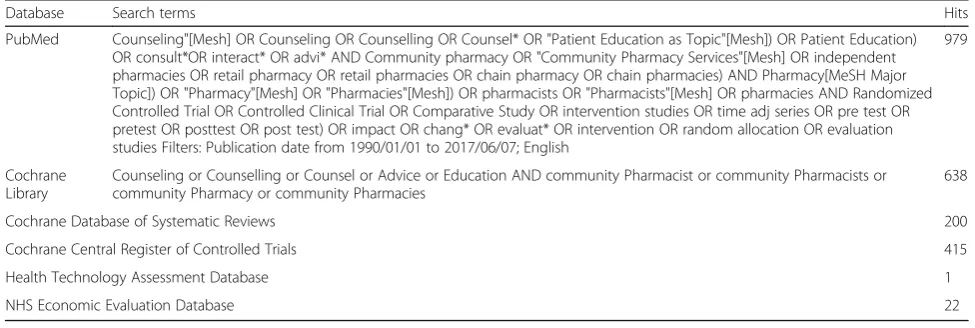
We searched PubMed from January 1990 to June 2017. We limited our search to fully published articles written in the English language. The time and language restric-tions were due to resource limitarestric-tions. The Cochrane Library was also searched, including the Cochrane Central Register of Controlled Trials (CENTRAL), the Health Technology Assessment Database, the National Health Service (NHS) Economic Evaluation Database, and the Cochrane Group’s specialised register (including the Cochrane Effective Practice and Organisation of Care (EPOC) group register).
for each concept and were guided by similar previous stud-ies [2,3, 13] and combined. The terms used to search the databases are listed in Table 1. The search was conducted in June 2017. To supplement the results of the online searches, we searched for articles that cited the identified studies using Google Scholar and screened these articles for potential studies. We also screened the bibliographies of the identified studies. We did not search for grey literature, such as conference abstracts and reports, as the lack of de-tails regarding study design would not allow for risk of bias and quality assessments.
Study selection Types of participants
Studies were eligible for inclusion if they included phar-macists who delivered services in a community pharmacy. The community pharmacy was defined as a pharmacy in the community that is accessible to all and not based in a hospital or clinic or online [5]. As the review question focus on pharmacists, we excluded studies solely targeting pharmacy technicians and studies assessing pharmacy students’counselling skills.
Types of interventions
We included all types of interventions intended to improve pharmacist-led counselling in a community pharmacy setting. The review aim was to identify the types of inter-ventions examined in the literature; therefore, we imposed no restrictions on the characteristics of interventions, such as mode of delivery (e.g. face-to-face, online), format, frequency, or length.
Type of comparison
Control groups should have received no intervention, a different intervention, or “usual care” as defined by the individual study’s authors.
Types of outcomes
We included only studies that measured the impact of the intervention on the pharmacists’ behaviour during counselling, such as asking questions, providing infor-mation, or dispensing appropriate medication. There-fore, we excluded studies that measured pharmacists’ satisfaction, attitudes, or theoretical knowledge after the intervention. We also excluded studies that measured only the feasibility or acceptance of an intervention without reporting the impact of the intervention on counselling practices. Studies that examined the impact of counselling on patient outcomes only and did not re-port outcomes related to the pharmacists’ counselling practice were excluded. One such example is a study that reported the impact of a hypertension management programme delivered by community pharmacists on hypertension control, adherence to prescribed regimens, and quality of life.
Types of studies
We searched for data from studies with randomised trials, non-randomised trials, controlled before-after studies, or interrupted time series study designs as defined in the Cochrane Effective Practice and Organisation of Care (EPOC) guidelines [21]. We did not include other study designs because they provide little, if any, reliable evidence of the effects of interventions.
Data collection
Two authors independently screened the titles and abstracts of identified citations for potential eligibility using a standardised screening guide. Full articles were retrieved for all studies that appeared to be eligible for inclusion in the review and any studies for which it was not possible to draw firm conclusions regarding eligibi-lity based on the abstract alone. Then, two authors (SA and NA) read the full texts of the potential papers to
Table 1Search strategy
Database Search terms Hits
PubMed Counseling"[Mesh] OR Counseling OR Counselling OR Counsel* OR "Patient Education as Topic"[Mesh]) OR Patient Education) OR consult*OR interact* OR advi* AND Community pharmacy OR "Community Pharmacy Services"[Mesh] OR independent pharmacies OR retail pharmacy OR retail pharmacies OR chain pharmacy OR chain pharmacies) AND Pharmacy[MeSH Major Topic]) OR "Pharmacy"[Mesh] OR "Pharmacies"[Mesh]) OR pharmacists OR "Pharmacists"[Mesh] OR pharmacies AND Randomized Controlled Trial OR Controlled Clinical Trial OR Comparative Study OR intervention studies OR time adj series OR pre test OR pretest OR posttest OR post test) OR impact OR chang* OR evaluat* OR intervention OR random allocation OR evaluation studies Filters: Publication date from 1990/01/01 to 2017/06/07; English
979
Cochrane Library
Counseling or Counselling or Counsel or Advice or Education AND community Pharmacist or community Pharmacists or community Pharmacy or community Pharmacies
638
Cochrane Database of Systematic Reviews 200
Cochrane Central Register of Controlled Trials 415
Health Technology Assessment Database 1
confirm whether they satisfied the inclusion criteria. Disagreement was solved by consensus.
The data extraction was performed by a single author (SA) using a data-extraction instrument that encompassed the author, year of the study, setting, participants, sample size, intervention assessed, outcome measures, and main findings. The interventions were grouped according to the EPOC taxonomy of interventions [21], which includes the following four main domains of interventions: delivery arrangements, financial arrangements, governance ar-rangements, and implementation strategies. Other authors (NA, HA, AA) reviewed the extracted data.
Risk of bias
The risk of bias for all included studies was independently assessed using the domains suggested by EPOC [21] to as-sess the risk of bias: random sequence generation, alloca-tion concealment, incomplete outcome data, knowledge of the allocated interventions adequately prevented during the study, protection against contamination, selective out-come reporting, similar baseline outout-come measurements, and similar baseline characteristics, and other outcomes.
Then, we summarised the assessments of the risk of bias across domains for each study. An overall rating of low risk of bias was assigned if a low risk of bias was scored for all key domains. An overall rating of high risk of bias was assigned if a high risk of bias was scored for one or more key domains. An overall rating of unclear risk of bias was assigned if an unclear risk of bias was scored for one or more key domains.
Data synthesis
The data were narratively synthesised due to the pro-found methodological heterogeneity. The guidelines for narrative synthesis in systematic reviews provided by the York Systematic Review Centre for Reviews and Disseminations (CRD) were followed [19].
Results Study selection
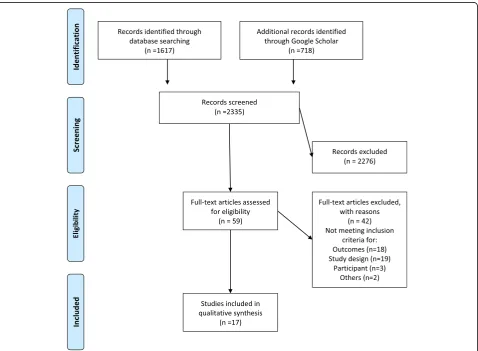
The PRISMA flow diagram of study inclusion and the
PRISMA checklist are provided in Fig. 1 and
Additional file 1, respectively. The initial search yielded 2335 citations. Based on the abstracts and titles, 2276
papers were excluded. The remaining 59 articles were retrieved in full text and reviewed, and 42 articles were excluded. Additional file2lists articles and reason for ex-clusions. In total, 17 papers met the inclusion criteria and were reviewed for this paper [22–38]. No additional refe-rences were identified by searching the bibliographies.
Characteristics of the included studies
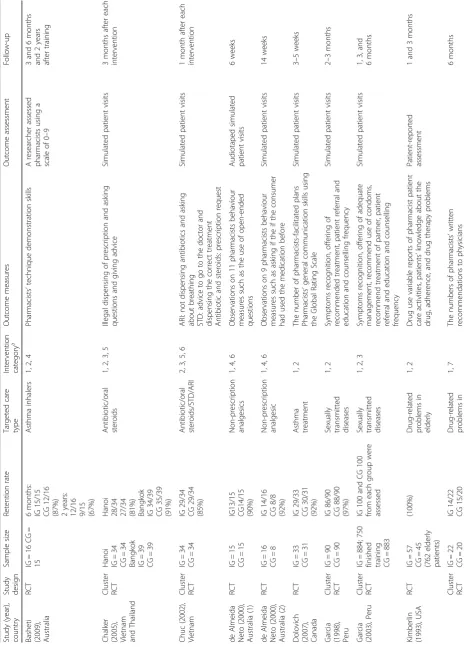
The characteristics of the included studies are described in Table 2. All included studies used randomised trial designs. The unit of randomisation was either phar-macists, pharmacies, or districts. In total, 16 studies in-cluded in this review were at least 10 years old. Four studies were conducted in Australia, four studies were conducted in the USA, two studies each were conducted in Canada, Scotland, Peru, and Vietnam, and one study was conducted in Switzerland.
Only seven studies reported the sample size calcula-tions [22, 24, 27, 35–38]. Twelve studies achieved follow-up with ≥90% of the participants; three studies achieved follow-up with 80–90% of the participants; and in two studies, the follow-up was less than 80% (see Table 2).
Risk of bias
The risk of bias is presented in Table3. Overall, three studies were determined to have a high risk of bias, and 14 studies were determined to have an unclear risk of bias.
In 11 studies, allocation was by pharmacies, commu-nity, or district, and it is unlikely that the control group received the intervention; therefore, the risk of contam-ination was scored low. In seven studies, the authors explicitly stated that the main outcomes were assessed blindly; therefore, the likelihood of detection bias was low. In four studies, the outcomes were extracted from the participating pharmacists’ documentation and thus were judged as unblinded assessments with a high risk of detection bias. We assessed that missing outcome data were unlikely to be related to the true outcome (most commonly, closure of the pharmacy) and that the reasons for missing data were similar across groups. Therefore, we assessed the attrition bias risk as low. In 17 studies, we judged that there was no evidence that outcomes were selectively reported as all the relevant outcomes in the“Methods”section were reported in the “Results” section; hence, the risk of bias from selective outcome reporting was scored as low.
Types of interventions
All the identified interventions were categorised as implementation strategies (i.e. interventions designed to cause changes in the actions of healthcare organisations, the behaviour of healthcare professionals, or the use of
health services by healthcare recipients) [21]. We further grouped these interventions according to the EPOC ta-xonomy [21] into subcategories, such as educational meetings, educational materials, educational outreach visits, reminders, audits, and feedback. Table 4 presents a definition for each category. As shown in Table 2, 15 studies investigated multifaceted interventions that in-cluded two or more components. The most commonly used interventions were educational meetings (n= 14), educational materials (n= 9), educational outreach visits (n= 5), feedback (n= 5), guidelines (n= 5), and local opinion leaders (n= 2). In five studies, pharmacists were supplied with materials to give to patients, such as leaf-lets, brochures, posters, and prompts, such as sunscreen samples. Additional file 3 provides details on the interventions.
The format, frequency, and length of educational meet-ings were categorised according to previously used criteria [39]. The format was categorised as either didactic or interactive. The frequency was categorised as frequent (more than 10), moderate (5–10), infrequent (2–4), and one-time only. The length of the educational meeting was categorised as prolonged (5 days or more), mo-derate (2–4 days), brief (1 day), and very brief (less than 1 day). The majority of the educational meetings
were a combination of didactic and interactive
formats (n= 13), were conducted once (n= 13), and were very brief (n= 14; see additional file 3). Only six studies indicated the framework used to develop the interventions, including the stages of change model (n= 4) [25, 26, 36, 37], the principles of motivational interviewing (n= 2) [25, 26], cognitive-behavioural and multi-modal therapy (n= 1) [30], the social cognitive theory (n= 1) [33], and the health belief model [36]. One study described the creation of the intervention in a qualitative study [33]. The control groups received no intervention (n= 12) or educational meet-ings on a different topic (n= 2). One study compared the dissemination of an evidence-based guideline via educational meetings, outreach visits, educational and
outreach visits, and by post (control) (see
Additional file 3).
The costs of the intervention were reported by three studies [24, 29, 38]. The participants’ opinions of the intervention were measured in three studies [31,35,36].
Outcome measurement
Table 2 Characteristics of included studies Study (year), coun try Stud y desig n Sam ple size Retent ion rate Targeted car e type Interven tion category a O utcome me asures O utcome assessment Fol low-up Bash eti (2009 ), Australia RCT IG = 16 CG = 15 6 mont hs: IG 15/15 CG 12/16
(87%) 2years
:
12/16 9/15 (67%)
Asthm a inhalers 1, 2, 4 Pharm acists ’ techni que demons trati on skil ls A researcher asses sed ph armacist s using a sc ale of 0 – 9 3 and 6 month s an d 2 years afte r training Chalke r (2005 ), Vietn am and Thailand Clust er RCT Han oi IG = 34 CG = 34 Bang kok IG = 39 CG = 39
Hanoi 28/34 27/34 (81%) Bangkok IG
Table 2 Characteristics of included studies (Continued) Study (year), coun try Stud y desig n Sam ple size Retent ion rate Targeted car e type Interven tion category a O utcome me asures O utcome assessment Fol low-up Lalonde (2008 ), Canad a
(69%) 88/102 (86%) pharmac
The change in outcomes was assessed mainly using simulated patient visits (n= 10; see Outcome assessment in Table 2). A simulated patient, also known as a standardised patient, pseudo-patient, or mystery shopper, is a patient actor who is trained to simulate pre-determined situations in the course of teaching or evaluation [40]. Self-reports of patient or pharmacists were included as outcomes in four studies. Pharmacists’ documentations were reported in three studies. No study reported on the validity and reliability of the tool used to measure outcomes.
The outcome assessments occurred a few weeks after the interventions in most of the identified studies (see Follow-up in Table2).
Effects of the interventions
Additional file 3 provides details on interventions and outcomes reported in the included studies. This section provides a narrative synthesis of the evidence. First, we conducted a preliminary synthesis of the findings of the included studies, grouped according to targeted care.
Then, we explored the relationships among the charac-teristics of the individual studies, their reported findings, and the findings of different studies.
We grouped the interventions according to targeted care as follows: promoting healthy life styles (n= 6), dis-pensing non-prescription medications (n= 4), dispensing prescription medications (n= 2), drug-related problems (n= 2), treatment recommendations (n= 2), and use of medical devices (n= 1).
The promotion of healthy lifestyles group involved intervention-targeted pharmacist counselling concerning smoking cessation (n= 3), sexually transmitted diseases (n= 2), and skin cancer prevention (n= 1). The interven-tions involved educational meetings supplemented with educational materials, outreach visits, and feedback. For smoking cessation studies, patient-reported outcome measures demonstrated an improvement in two studies and no effect in one study. For sexually transmitted diseases [28, 29], simulated patients reported signifi-cantly better recognition and management in one study and mixed results in the other. Simulated patients Table 3Risk of bias of included studies
Study (year) Was the
allocation sequence adequately generated?
Was allocation adequately concealed?
Was the study adequately protected against contamination?
Was knowledge of the allocated interventions adequately prevented?
Were incomplete outcome data adequately addressed?
Was baseline outcome measurement similar?
Was baseline characteristics similar?
Was the study free from selective outcome reporting?
Overall riska
1. Basheti (2009) Low Unclear Unclear Unclear Low Low Low Low Unclear
2. Chalker (2005) Unclear Unclear Low Unclear Low Low Unclear Low Unclear
3. Chuc (2002) Low Unclear Low Low Low Low Unclear Low Unclear
4. de Almeida Neto (2000)
Unclear Unclear Unclear Unclear Low Unclear Unclear Low Unclear
5. de Almeida Neto (2000)
Unclear Unclear Unclear Unclear Low Unclear Unclear Low Unclear
6. Dolovich (2007) Low Unclear Unclear Low Low Unclear Low Low Unclear
7. Garcia (1998) Unclear Unclear Low Low Low Unclear Unclear Low Unclear
8. Garcia (2003) Low Unclear Low Low Low Unclear Unclear Low Unclear
9. Kimberlin (1993)
Unclear Low Unclear Unclear Low Unclear Low Low Unclear
10. Lalonde (2008)
Low Low Low High Low Low High Low High
11. Mayer (1998) Unclear Unclear Low Low Low Low Unclear Low Unclear
12. Patwardhan (2012)
Low Low Low Unclear Low Low Low Low Unclear
13. Prokhorov (2010)
Unclear Unclear Low Unclear Low Unclear Low Low Unclear
14. Reeves (2007) Low Unclear Low High Low Unclear Low Low High
15. Sigrist (2002) Unclear Unclear Unclear Low Low Low Unclear Low High
16. Sinclair (1998) High Unclear Low Low Low Unclear Low Low Unclear
17. Watson (2002) Low Unclear Low Unclear Low Low Low Low Unclear
a
reported significantly improved rates of skin cancer counselling [32] in the intervention group (which received educational videos and onsite feedback on counselling performance) compared with the control group.
The dispensing of non-prescription medication group involved three studies on analgesics [25,26, 36] and one study on antifungals [38]. Simulated patient visits were used to assess outcomes in all the studies. The interven-tions, which included educational meetings, onsite feed-back, and protocol, improved significantly the process of non-prescription analgesics counselling. There was no difference in outcomes between the dissemination of an evidence-based guideline for the sale of antifungals by post, educational outreach visits, education meetings, or educational meetings combined with outreach visits.
The studies (n= 2) on dispensing prescription medica-tions involved medicamedica-tions such as antibiotics and oral steroids and were conducted in three study sites [23,
24]. The multifaceted interventions involved educational meetings, educational materials, outreach visits, local opinion leaders, and guidelines. Simulated patients reported reductions in the inappropriate dispensing of medications at two of the three study sites.
Two studies investigated drug-related problems, one in the elderly [31] and the other in kidney disease pa-tients [41]. The outcomes were measured using patient reports and pharmacists’ documentation. The interven-tions had a mixed impact. For example, both studies demonstrated that the pharmacists in the intervention groups interacted more with the patients and intervened more frequently to manage drug-related problems, with no impact on the number of refusals to dispense a
medication, patients’ knowledge about the drug, adhe-rence, or drug therapy problems.
Two studies examined treatment recommendations. One study used simulated patient visits to measure the impact of educational meeting and educational materials on the number of pharmacist-facilitated asthma plans and on pharmacists’general communication skills using the Global Rating Scale [27]. The other study measured the impact of an electronic decision-support prompt to remind pharmacists to discuss the suitability of aspirin therapy with eligible diabetes patients [35]. Both inter-ventions resulted in positive changes in outcome measures.
One study reported on the improvement in pharma-cists’ability to assess and teach correct inhaler technique skills with educational meetings, educational materials, audits, and feedback [22].
Based on the summary above, five studies reported a mixed impact, as some outcomes were favourably changed by the intervention and some outcomes were not changed. The unclear risk of bias in the majority of the studies provides little help in explaining the diffe-rences in reported findings among studies. Additionally, we did not observe any differences in the outcomes and the methods used to measure outcomes that could ex-plain variations in the findings. As many of the studies did not perform sample size calculation, one explanation could be that the sample sizes were inadequate for de-tecting a difference between the intervention and control groups. Interestingly, one study was conducted in two settings using the same interventions, but the implemen-tation of the interventions could explain the differences in effectiveness. For instance, the site at which a negative Table 4Professional interventions as per Cochrane EPOC review group (adapted from reference [21])
Intervention Description
Category: interventions targeted at healthcare workers
Distribution of educational Distribution to individuals, or groups, of educational materials to support clinical care, i.e., any intervention in which knowledge is distributed. For example, this may be facilitated by the Internet, learning critical appraisal skills; skills for electronic retrieval of information, diagnostic formulation; question formulation
Educational meetings Courses, workshops, conferences, or other educational meetings
Educational outreach visits Personal visits by a trained person to health workers in their own settings, to provide information with the aim of changing practice
Audit and feedback Any summary of clinical performance of healthcare over a specified period of time. The summary may also have included recommendations for clinical action. The information may have been obtained from medical records, databases, or patient observations
Clinical practice guidelines Clinical guidelines are systematically developed statements to assist healthcare providers and patients to decide on appropriate health care for specific clinical circumstances (US IOM)
Local opinion leaders The identification and use of identifiable local opinion leaders to promote good clinical practice
Reminders Manual or computerised interventions that prompt health workers to perform an action during a consultation with a patient, for example computer decision support systems
Coordination of care and management of care processes
Communication between providers
effect of the educational intervention was found was a sem-inar for large group and a voluntary peer review [23], while the other site involved face-to-face educational intervention and compulsory peer review [24]. This example illustrates how modifications of any intervention during the imple-mentation process might impact outcomes. Furthermore, the pharmacists’attitudes and working conditions may have differed between the two settings. In another study about smoking cessation, the same educational intervention was delivered to pharmacists and physicians separately, and the outcomes were assessed by patient report 12 months after intervention [34]. An increase in helping patients to quit smoking was found in the physicians in the intervention group, but not in the control group. Among the pharma-cists, there was no difference between the intervention and control groups. This example suggests that factors other than knowledge and competence might impact outcomes. Examples of these factors include community pharmacists’ attitudes towards counselling, work hours, and staffing.
Discussion
This study provides a review of the literature on inter-ventions for improving pharmacist-led counselling in the community setting. The findings of the included 17 studies suggest that educational meetings combined with outreach visits and feedback have a positive effect on community pharmacists’ counselling in the community pharmacy setting. This finding is consistent with previ-ous reviews on interventions for changing healthcare professionals’ behaviour [39, 42–44]. Johnson and May [42] conducted a review of systematic review articles to establish the characteristics of successful behavioural change interventions in healthcare. These authors identi-fied 67 reviews examining the following three main categories of interventions: persuasive interventions (e.g. diffuse persuasive strategies, such as marketing and mass media, or direct persuasion strategies, such as local con-sensus processes and local opinion leaders); educational and informational interventions (e.g. patient-mediated interventions, dissemination of educational materials, educational meetings, and educational outreach); and action and monitoring interventions (e.g. audits, feed-back, and reminders). The authors concluded that interventions focusing on actions or education tended to have more positive effects on professional behaviour than those based on persuasion. Several Cochrane reviews have shown that educational meetings [39], outreach visits [43], and audits and feedback [44] can improve professional practices and patient healthcare outcomes; however, the effect is most likely to be small and to vary according to many factors, such as the com-plexity of the behaviour targeted by the intervention. A previous review identified 11 studies that reported that the use of active learning through training using role
play, feedback, and reflection was important for enhan-cing the communication skills of community pharma-cists during consultations regarding non-prescription medications [17]. Another review identified 21 studies that reported that the use of training delivered as either didactic or interactive sessions had the potential to modify community pharmacists’ behaviour during service delivery [15].
The studies included in the present review contained insufficient information on methodology to permit judgement of the risk of bias, which necessitates caution in interpreting the findings. The subjective nature of outcome measures and the unclear blinding of outcome assessors also lowered our confidence in the findings. Furthermore, the short-term follow-up period precluded firm conclusions regarding sustained changes in the out-comes resulting from the interventions.
Strengths and limitations
The present study offers a different perspective on com-munity pharmacists’ counselling than was provided in most previous studies. In contrast to previous reviews [2–4, 10, 13,14], we focused on studies investigating in-terventions for improving community pharmacist-led patient counselling. We deliberately narrowed the focus of the review to those studies that attempted to measure the impact of the intervention on the pharmacists’ be-haviour during counselling and in a community setting. Our detailed examination of the types of interventions and assessment of the quality of the included studies provides insight into the strength of the evidence from the included studies and a greater understanding of the gaps in the literature.
Some limitations must be considered. Certain relevant papers may not have been included in our review, such as studies that are not indexed in the searched data-bases, studies published in languages other than English, and unpublished studies (grey literature). We attempted to ensure that our search strategy was as comprehensive as possible; however, it is possible that some papers describing counselling used different keywords, and in such cases, these papers could not have been identified for this review. There is no single definition of counsel-ling in community pharmacy. Consequently, subjective assessments of study eligibility were required, which might have introduced some bias in the inclusion of studies. We did not contact the original studies’authors to clarify many unreported study characteristics.
Implications for future studies
manner and describe intervention components in suffi-cient detail to facilitate evaluation and replication by others. We recommend the use of reporting guidelines for describing research and interventions [45,46].
Counselling is a complex process influenced by the pharmacists, the customer, and their interaction [12]. Many factors influence the content and extent of the counselling provided by community pharmacists, inclu-ding the type of medications (prescription only versus non-prescription medicine), the type of prescription (new versus repeat), type of presentation (product re-quests, symptoms, or conditions), and time constraints [12, 41, 47]. Pharmacy users’ expectations of their visit (i.e. buying a product versus obtaining a professional service) can influence the attempts of the pharmacy staff to engage the users in dialogue about their medicine use [48]. Additionally, pharmacy users’ interactions with community pharmacists are influenced by their percep-tions of the professional role of the community pharma-cist [48]. Furthermore, pharmacy users’awareness of the need for questioning and their willingness to answer questions [49] are important factors. For instance, users may perceive the questions pharmacists ask as an attempt to control their medicine use, may find the dia-logue irrelevant, or may not understand the pharmacists’ motivation for asking questions [12]. The discrepancies between pharmacy users and pharmacists’ expectations regarding illness and medicine have also been suggested as a barrier to optimal counselling [12]. Therefore, inter-ventions should not be restricted to improving the knowledge and communication skills of the pharmacists. Counselling practices can be negatively influenced by the pharmacist’s workload, the pharmacy layout, lack of access to the patient’s health information, and the patient’s expectations of community pharmacists. Pro-mising interventions that could be explored in future studies include delivery arrangements, such as staffing models; the use of information and communication technology; and governance arrangements, such as pro-fessional competence, training, and licensing. Future re-views on counselling in community pharmacy should synthesise evidence on interventions that target patients as part of the counselling process.
To identify effective behavioural change tions, it is important to characterise the interven-tions [50]. The characterisation of interventions involves matching all possible intervention types to the behavioural target, the target population, the context in which the intervention is delivered, the underlying behavioural model, and the influencing factors [50]. Only six studies indicated the theore-tical framework that was used to develop the inter-ventions. We suggest that future studies characterise the interventions by describing the constructs of the
framework used and how the constructs were inte-grated into the design of the intervention and the
outcome measurement. Several frameworks for
characterising behavioural change interventions exist. The behaviour change wheel is one of the few frameworks that meet all usefulness criteria of com-prehensiveness, coherence, and a clear link to an overarching model of behaviour [50].
Future studies may consider examining individual in-terventions as the use of multifaceted inin-terventions did not allow a clear understanding of the effectiveness of individual interventions. Previous reviews showed no compelling evidence that multifaceted interventions are more effective than single-component interventions in changing healthcare professionals’ behaviour [39, 51]. Comparisons of different types of interventions are also recommended.
We observed that the outcome measures in the identi-fied studies were mainly subjective and focused on the quantity rather than the quality of counselling. There is a lack of reliable criteria or instruments for assessing the appropriateness of patient counselling in pharmacy practice. The variability in the outcome measures used among the studies further complicated the assessment of the interventions’ effectiveness. Researchers have attempted to describe the criteria used to assess the appropriateness of patient counselling in the community setting [52,53]; however, more studies are needed to re-fine the criteria and establish a reliable instrument that is applicable for use in interventional studies.
Most of the reviewed studies documented changes in outcomes using simulated patient visits, a method that is commonly used in the pharmacy literature to develop and assess communication skills [40, 54]. Future studies should adhere to recommendations to improve the qua-lity and validity of simulated patient visits, such as the use of standard data collection tools and audiotaping, if possible [54].
In this review, we focused on the effectiveness of inter-ventions targeting counselling in the community phar-macy setting. Future reviews should identify evidence of the cost-effectiveness of these interventions. As the development and implementation of an intervention re-quire a substantial resource commitment, it is important to have evidence on cost-effectiveness to aid decisions regarding resource allocation. This area has been neglected by researchers in this field [56].
Conclusion
The included studies showed that educational meetings combined with educational materials, outreach visits, and feedback can improve pharmacists’counselling in commu-nity settings. However, the unclear risk of bias and poor quality of reporting of intervention components necessi-tate caution in interpreting the findings.
Additional files
Additional file 1:PRISMA checklist. (DOC 58 kb)
Additional file 2:Reasons for exclusion. (DOCX 24 kb)
Additional file 3:Summary of interventions and main findings of included studies. (DOCX 35 kb)
Abbreviations
EPOC:The Cochrane Effective Practice and Organisation of Care
Availability of data and materials
All the data generated or analysed during this study are included in this published article [and its additional files].
Authors’contributions
SA conceptualised this review. SA, NA, HA, and AA made substantial contributions to the study design. All the authors contributed to the title screening and abstracting. All the authors provided input and were involved in the interpretation of the results. SA drafted the manuscript. All the authors revised the manuscript. All the authors read and approved the final version.
Competing interests
The authors declare that they have no competing interests.
Publisher’s Note
Springer Nature remains neutral with regard to jurisdictional claims in published maps and institutional affiliations.
Author details 1
Clinical Pharmacy Department, College of Pharmacy, King Saud University, Riyadh, Kingdom of Saudi Arabia.2Pharmaceutical Care Services, King
Abdulaziz Medical City, National Guard Health Affairs, PO Box 376316, Riyadh 11335, Kingdom of Saudi Arabia.
Received: 14 September 2017 Accepted: 11 April 2018
References
1. Joint FIP/WHO guidelines on good pharmacy practice: standards for quality
of pharmacy services.https://www.fip.org/www/uploads/database_file.
php?id=331&table_id=. Accessed 17 Jul 2017.
2. Okumura LM, Rotta I, Correr CJ. Assessment of pharmacist-led patient
counseling in randomized controlled trials: a systematic review. Int J Clin
Pharm. 2014;36:882-91.https://doi.org/10.1007/s11096-014-9982-1.
3. Puspitasari HP, Aslani P, Krass I. A review of counseling practices on
prescription medicines in community pharmacies. Res Soc Adm Pharm.
2009;5:197–210.https://doi.org/10.1016/j.sapharm.2008.08.006.
4. Shah B, Chewning B. Conceptualizing and measuring pharmacist-patient
communication: a review of published studies. Res Social Adm Pharm. 2006;
2:153–85.https://doi.org/10.1016/j.sapharm.2006.05.001.
5. Brown TJ, Todd A, O’Malley C, Moore HJ, Husband AK, Bambra C, et al.
Community pharmacy-delivered interventions for public health priorities: a systematic review of interventions for alcohol reduction, smoking cessation and weight management, including meta-analysis for smoking
cessation. BMJ Open. 2016;6:e009828.
https://doi.org/10.1136/bmjopen-2015-009828.
6. Horvat N, Koder M, Kos M, Watson M, Skelton J, Bond C, et al. Using the
simulated patient methodology to assess paracetamol-related counselling
for headache. PLoS One. 2012;7:e52510.https://doi.org/10.1371/journal.
pone.0052510.
7. Koster ES, van Meeteren MM, van Dijk M, van den Bemt BJF, Ensing HT,
Bouvy ML, et al. Patient–provider interaction during medication encounters:
a study in outpatient pharmacies in the Netherlands. Patient Educ Couns.
2015;98:843–8.https://doi.org/10.1016/j.pec.2015.03.007.
8. Kippist C, Wong K, Bartlett D, Saini B. How do pharmacists respond to
complaints of acute insomnia? A simulated patient study. Int J Clin Pharm.
2011;33:237–45.https://doi.org/10.1007/s11096-011-9482-5.
9. van Dijk M, Blom L, Koopman L, Philbert D, Koster E, Bouvy M, et al.
Patient-provider communication about medication use at the community pharmacy
counter. Int J Pharm Pract. 2016;24:13–21.https://doi.org/10.1111/ijpp.12198.
10. van Eikenhorst L, Salema N-E, Anderson C. A systematic review in select
countries of the role of the pharmacist in consultations and sales of non-prescription medicines in community pharmacy. Res Soc Adm Pharm. 2016;
13:17–38.https://doi.org/10.1016/j.sapharm.2016.02.010.
11. Schneider CR, Everett AW, Geelhoed E, Kendall PA, Clifford RM. Measuring
the assessment and counseling provided with the supply of
nonprescription asthma reliever medication: a simulated patient study. Ann
Pharmacother. 2009;43:1512–8.https://doi.org/10.1345/aph.1M086.
12. Kaae S, Traulsen JM, Nørgaard LS. Challenges to counseling customers at
the pharmacy counter—why do they exist? Res Soc Adm Pharm. 2012;8:
253–7.https://doi.org/10.1016/j.sapharm.2011.05.002.
13. Blalock SJ, Roberts AW, Lauffenburger JC, Thompson T, O’Connor SK. The
effect of community pharmacy-based interventions on patient health
outcomes: a systematic review. Med Care Res Rev. 2013;70:235–66.https://
doi.org/10.1177/1077558712459215.
14. Van Wijk BL, Klungel OH, Heerdink ER, de Boer A. Effectiveness of
interventions by community pharmacists to improve patient adherence to
chronic medication: a systematic review. Ann Pharmacother. 2005;39:319–
28.https://doi.org/10.1345/aph.1E027.
15. Patwardhan PD, Amin ME, Chewning BA. Intervention research to enhance
community pharmacists’cognitive services: a systematic review. Res Social
Adm Pharm. 10:475–93.https://doi.org/10.1016/j.sapharm.2013.07.005.
16. Watkins K. Effectiveness of implementation strategies for clinical guidelines
to community pharmacy: a systematic review. Implement Sci. 2016;https://
doi.org/10.1186/s13012-015-0337-7.
17. Seubert LJ, Whitelaw K, Hattingh L, Watson MC, Clifford RM. Interventions to
enhance effective communication during over-the-counter consultations in the community pharmacy setting: a systematic review. Res Soc Adm Pharm.
2018.https://doi.org/10.1016/j.sapharm.2017.12.001.
18. Higgins JPT, Green S. Cochrane Handbook for Systematic Reviews of
Interventions Version 5.1.0 [updated March 2011]. Cochrane Collaboration.
2011.http://handbook.cochrane.org.
19. Systematic Reviews. CRD’s guidance for undertaking reviews in health care.
Centre for Reviews and Dissemination: University of York; 2009.https://doi.
org/10.1016/S1473-3099(10)70065-7.
20. Moher D, Liberati A, Tetzlaff J, Altman DG, The PRISMA Group. Preferred
reporting items for systematic reviews and MetaAnalyses: the PRISMA
statement. PLoS Med. 2009;6(7):e1000097.https://doi.org/10.1371/journal.
pmed.1000097.
21. Cochrane Effective Practice and Organisation of Care (EPOC). EPOC
resources for review authors, 2018.http://epoc.cochrane.org/resources/
epoc-resources-review-authors.
22. Basheti IA, Armour CL, Reddel HK, Bosnic-Anticevich SZ. Long-term
maintenance of pharmacists’inhaler technique demonstration skills. Am J
23. Chalker J, Ratanawijitrasin S, Chuc NT, Petzold M, Tomson G. Effectiveness of a multi-component intervention on dispensing practices at private
pharmacies in Vietnam and Thailand—a randomized controlled trial. Soc Sci
Med. 2005;60:131–41.https://doi.org/10.1016/j.socscimed.2004.04.019.
24. Chuc NTK, Larsson M, Do NT, Diwan VK, Tomson GB, Falkenberg T.
Improving private pharmacy practice: a multi-intervention experiment in
Hanoi, Vietnam. J Clin Epidemiol. 2002;55:1148–55.https://doi.org/10.1016/
S0895-4356(02)00458-4.
25. De Almeida Neto AC, Benrimoj SI, Kavanagh DJ, Boakes RA. A pharmacy
based protocol and training program for non-prescription analgesics. J Soc
Adm Pharm. 2000;17:183–92.
26. De Almeida AC, Benrimoj SI, Kavanagh DJ, Boakes RA. Neovel educational
training program for community. Pharmacists. 2000;64:302–7.
27. Dolovich L, Sabharwal M, Agro K, Foster G, Lee A, McCarthy L, et al. The
effect of pharmacist education on asthma treatment plans for simulated
patients. Pharm World Sci. 2007;29:228–39.
28. Garcia P, Hughes J, Carcamo C, Holmes KK. Training pharmacy workers in
recognition, management, and prevention of STDs: district-randomized
controlled trial. Bull World Health Organ. 2003;81:806–14.
29. Garcia PJ, Gotuzzo E, Hughes JP, Holmes KK. Syndromic management of
STDs in pharmacies: evaluation and randomised intervention trial. Sex
Transm Infect. 1998;74(Suppl 1):S153–8.
30. Kimberlin CL, Berardo DH, Pendergast JF, McKenzie LC. Effects of an education
program for community pharmacists on detecting drug-related problems in
elderly patients. Med Care. 31:451–68.https://doi.org/10.2307/3766079.
31. Lalonde L, Normandeau M, Lamarre D, Lord A, Berbiche D, Corneille L, et al.
Evaluation of a training and communication-network nephrology program
for community pharmacists. Pharm World Sci. 2008;30:924–33.
32. Mayer JA, Eckhardt L, Stepanski BM, Sallis JF, Elder JP, Slymen DJ, et al.
Promoting skin cancer prevention counseling by pharmacists. Am J Public
Health. 1998;88:1096–9.
33. Patwardhan PD, Chewning BA. Effectiveness of intervention to implement
tobacco cessation counseling in community chain pharmacies. J Am Pharm
Assoc (2003). 2014;52:507–14.https://doi.org/10.1331/JAPhA.2012.10117.
34. Prokhorov AV, Hudmon KS, Marani S, Foxhall L, Ford KH, Luca NS, et al.
Engaging physicians and pharmacists in providing smoking cessation
counseling. Arch Intern Med. 2010;170:1640–6.https://doi.org/10.1001/
archinternmed.2010.344.
35. Reeve JF, Tenni PC, Peterson GM. An electronic prompt in dispensing
software to promote clinical interventions by community pharmacists: a
randomized controlled trial. Br J Clin Pharmacol. 2008;65:377–85.https://doi.
org/10.1111/j.1365-2125.2007.03012.x.
36. Sigrist T, Benrimoj SI, Hersberger K. Changing pharmacists’and pharmacist
assistants’practice in dealing with direct requests for non-prescription
analgesics; 2002. p. 23–9.
37. Sinclair HK, Bond CM, Lennox AS, Silcock J, Winfield AJ, Donnan PT, et al.
Training pharmacists and pharmacy assistants in the stage-of-change model of smoking cessation: a randomised controlled trial in Scotland. Tob
Control. 1998;7:253–61.https://doi.org/10.1136/tc.7.3.253.
38. Watson MC, Bond CM, Grimshaw JM, Mollison J, Ludbrook A, Walker AE.
Educational strategies to promote evidence-based community pharmacy
practice: a cluster randomized controlled trial (RCT). Fam Pract. 2002;19:529–36.
39. Forsetlund L, Bjørndal A, Rashidian A, Jamtvedt G, O’Brien MA, Wolf FM, et
al. Continuing education meetings and workshops: effects on professional practice and health care outcomes. In: Forsetlund L, editor. Cochrane Database of Systematic Reviews. John Wiley & Sons, Ltd: Chichester, UK;
2009.https://doi.org/10.1002/14651858.CD003030.pub2.
40. Mesquita AR, Lyra DP, Brito GC, Balisa-Rocha BJ, Aguiar PM, de Almeida
Neto AC. Developing communication skills in pharmacy: a systematic review of the use of simulated patient methods. Patient Educ Couns. 2010;
78:143–8.https://doi.org/10.1016/j.pec.2009.07.012.
41. Kimberlin CL, Jamison AN, Linden S, Winterstein AG. Patient counseling
practices in U.S. pharmacies: effects of having pharmacists hand the medication to the patient and state regulations on pharmacist counseling. J
Am Pharm Assoc. 2011;51:527–34.https://doi.org/10.1331/JAPhA.2011.10012.
42. Johnson MJ, May CR. Promoting professional behaviour change in
healthcare: what interventions work, and why? A theory-led overview of
systematic reviews. BMJ Open. 2015;5:e008592.https://doi.org/10.1136/
bmjopen-2015-008592.
43. O’Brien MA, Rogers S, Jamtvedt G, Oxman AD, Odgaard-Jensen J,
Kristoffersen DT, et al. Educational outreach visits: effects on professional
practice and health care outcomes. In: In: O’Brien MA, editor. Cochrane
Database of Systematic Reviews. John Wiley & Sons, Ltd: Chichester, UK;
2007.https://doi.org/10.1002/14651858.CD000409.pub2.
44. Ivers N, Jamtvedt G, Flottorp S, Young JM, Odgaard-Jensen J, French SD, et
al. Audit and feedback: effects on professional practice and healthcare outcomes. In: In: Ivers N, editor. Cochrane Database of Systematic Reviews.
John Wiley & Sons, Ltd: Chichester, UK; 2012.https://doi.org/10.1002/
14651858.CD000259.pub3.
45. Schulz KF, Altman DG, Moher D, Group C. CONSORT 2010 statement:
updated guidelines for reporting parallel group randomised trials. PLoS
Med. 2010;7:e1000251.https://doi.org/10.1371/journal.pmed.1000251.
46. Hoffmann TC, Glasziou PP, Boutron I, Milne R, Perera R, Moher D, et al.
Better reporting of interventions: template for intervention description and
replication (TIDieR) checklist and guide. BMJ. 2014;348:1–12.https://doi.org/
10.1136/bmj.g1687.
47. Svarstad BL, Bultman DC, Mount JK. Patient counseling provided in
community pharmacies: effects of state regulation, pharmacist age, and
busyness. J Am Pharm Assoc. 2003;44:22–9.
48. Sabater-Galindo M, Ruiz de Maya S, Benrimoj SI, Gastelurrutia MA,
Martínez-Martínez F, Sabater-Hernández D. Patients’expectations of the role of the
community pharmacist: development and testing of a conceptual model.
Res Soc Adm Pharm. 2016;13:313–20.https://doi.org/10.1016/j.sapharm.
2016.04.001.
49. Morris CJ, Cantrill JA, Weiss MC.“One simple question should be enough”:
consumers’perceptions of pharmacy protocols. Int J Pharm Pract. 1997;5:
64–71.https://doi.org/10.1111/j.2042-7174.1997.tb00887.x.
50. Michie S, van Stralen MM, West R. The behaviour change wheel: a new
method for characterising and designing behaviour change interventions.
Implement Sci. 2011;6:42.https://doi.org/10.1186/1748-5908-6-42.
51. Squires JE, Sullivan K, Eccles MP, Worswick J, Grimshaw JM. Are multifaceted
interventions more effective than single-component interventions in changing
health-care professionals’behaviours? An overview of systematic reviews.
Implement Sci. 2014;9:152.https://doi.org/10.1186/s13012-014-0152-6.
52. Lin H-W, Pickard AS, Mahady GB, Karabatsos G, Crawford SY, Popovich NG.
An instrument to evaluate pharmacists’patient counseling on herbal and
dietary supplements. Am J Pharm Educ. 2010;74:192.
53. Ward PR, Bissell P, Noyce PR. Criteria for assessing the appropriateness of
patient counseling in community pharmacies. Ann Pharmacother. 2000;34: 170–5.https://doi.org/10.1345/aph.19135.
54. Watson M, Norris P, Granas A. A systematic review of the use of simulated
patients and pharmacy practice research. Int J Pharm Pract. 2006;14:83–93.
https://doi.org/10.1211/ijpp.14.2.0002.
55. Sekhon M, Cartwright M, Francis JJ. Acceptability of healthcare interventions:
an overview of reviews and development of a theoretical framework. BMC
Health Serv Res. 2017;17:88.https://doi.org/10.1186/s12913-017-2031-8.
56. Brown CA, Belfield CR, Field SJ. Cost effectiveness of continuing professional
development in health care: a critical review of the evidence. BMJ. 2002;324:

![Table 4 Professional interventions as per Cochrane EPOC review group (adapted from reference [21])](https://thumb-us.123doks.com/thumbv2/123dok_us/9553179.1938312/9.595.58.540.100.315/table-professional-interventions-cochrane-epoc-review-adapted-reference.webp)
