Mixed-Effects Modeling and Non-Reductive Explanation (4975 words)
Abstract: This essay considers a mixed-effects modeling practice and its implications for the philosophical debate surrounding reductive explanation. Mixed-effects modeling is a species of the multilevel modeling practice, where a single model incorporates simultaneously two (or even more) levels of
1. Introduction
Explanatory reductionism is the position which holds that, given a relatively higher-level phenomenon (or state, event, process, etc.), it can be reductively explained by a relatively lower-level feature (Kaiser 2015, 97; see also Sarkar 1998; Weber 2005; Rosenberg 2006; Waters 2008).1 Though philosophers tend to have slightly different conceptions of the position, two central tenets of the position can still be extracted:2
Single level preference: a phenomenon of interest can be fully explained by invoking features that reside at a single, well-defined level of analysis (e.g., molecular level in biology).
1 According to Sarkar (1998), explanatory reduction is an epistemological thesis
which is distinguished from constitutive (ontological) and theory reductionism theses. Kaiser further distinguishes two sub-types of explanatory reduction: (a) “a relation between a higher-level explanation and a lower-level explanation of the same phenomenon” (2015, 97); (b) individual explanations, i.e., given a relatively higher-level phenomenon, it can be reductively explained by a relatively lower-level feature (Ibid., 97). This essay will focus on the second sub-type. Besides, when referring to levels I mean either hierarchical organization such as
universities, faculties, departments etc., or functional organization such as organs, tissues, cells etc. When referring to scales I mean spatial or temporal scaling where levels are not so clearly delimited.
Lower-level obsession: lower-level features always provide the most significant and detailed explanation of the phenomenon in question, so a lower-level explanation is always better than a higher-level explanation.
Philosophers sometimes express these two tenets explicitly in their work. For example, Alex Rosenberg holds that “[…] there is a full and complete explanation of every biological fact, state, event, process, trend, or generalization, and that this explanation will cite only the interaction of macromolecules to provide this explanation” (Rosenberg 2006, 12). Marcel Weber expresses a similar idea in his explanatory hegemony thesis, according to which it’s always some lower-level physicochemical laws (or principles) that ultimately do the explanatory work in experimental biology (Weber 2005, 18-50). John Bickle attempts to motivate a ‘ruthless’ reduction of psychological phenomena (e.g., memory) to the molecular level (Bickle 2003).
However, many philosophers have questioned the plausibility of the position on the basis of scientific practice (Hull 1972; Craver 2007; Bechtel 2010;
Brigandt 2010; Hüttemann and Love 2011; Kaiser 2015). To counter that
position, some authors have pointed to the relevance of an important practice that has not received sufficient attention before: multiscale or multilevel modeling or sometimes called integrative modeling approach, where a set of distinct models ranging over multiple levels or scales—including the macro-phenomenon
(Mitchell 2003, 2009; Craver 2007; Brigandt 2010, 2013a, 2013b; Knuuttila 2011; Batterman 2013; Green 2013; O’ Malley et al. 2014; Green and Batterman 2017). Often these models work together by providing diverse constraints on the potential space of representation (Knuuttila and Loettgers 2010; Knuuttila 2011; Green 2013).
This multilevel modeling surely casts some doubt on explanatory
reductionism, for it seems unclear what reductively explains what—all those facts in the set of models ranging over different levels/scales are involved in doing some explanatory work. However, there is a species of multilevel modeling that has slipped away from most philosophers’ sights: mixed-effects modeling (MEM hereafter)—also called multilevel regression modeling, hierarchical linear
modeling, etc.—in which a single model incorporating simultaneously two (or even more) levels of variables is used to explain a phenomenon. For a mixed-effects model to explain, features of the so-called reducing and reduced levels must be simultaneously incorporated into the model, that is, they must go hand in hand.
MEM deserves special attention because it sheds new light on the
reductionism-antireductionism debate by showing that (a) a mixed-effects model violating the two central tenets of explanatory reductionism can provide
successful explanation, and (b) a single mixed-effects model without integrating with other epistemic means can also provide such successful explanation.
second offers a novel perspective bolstering the multilevel/multiscale integrative approach discussed by many philosophers.
The essay proceeds as follows. Section 2 discusses the challenges faced by the traditional single-level modeling approach, and examines the reasons why the MEM approach is preferable in dealing with these challenges. Section 3 describes a MEM practice using a concrete model. Section 4 elaborates on the implications of MEM for the explanatory reductionism debate. Finally, Section 5 considers potential objections to my viewpoint.
2. Challenges to Reductive Explanatory Strategies
In many fields (e.g., biological, social and behavioral sciences) scientists find that the data collected show an intrinsically hierarchical or nested feature. Consider a simple example: we might be interested in examining relationships between students’ achievement at school (A hereafter) and the time they invest in studying (T).3 In conducting such a research, we might collect data from different classes (say 5 classes in total), with each class providing the same number of samples (say 10 students in each class). The data collected among classes might be taken for granted to be independent. Then we may use certain traditional statistical techniques such as ordinary least-squares (OLS) to analyze the data and build a linear relationship between A and T.
3 For scientific studies of this kind, see Schagen (1990), Wang and Hsieh (2012),
However, this single-level reductive analysis can lead to misleading results, because it ignores the possibility that students within a class may be more similar to each other in important aspects than students from different classes. In other words, each group (class) may have its own features relevant to the relationship between A and T that the other groups lack. Hence, the data collected from the students are in fact not independent, i.e., the subjects are not randomly sampled, because the individuals (students) are clustered within groups (classes). In technical terms, we say our analysis may fall prey to the atomistic fallacy where we base our analysis solely on the individual level—i.e., we reduce all the group-level features to the individuals. Therefore, traditional OLS techniques such as multiple regression cannot be employed in this context, because the case under consideration violates a fundamental assumption of these techniques: the independence of observations (Nezlek 2008, 843).
Conversely, we may face the same problem the other way around if we fail to consider the inherently nested nature of the data. Consider the
student-achievement-at-school case again. We may observe that in classes where the time of study invested by students is very high, the achievements of the students are also very high. Given such an observation, we may reason that students who invest a lot of time in studying would be more likely to get higher achievements at school. However, this inference commits the ecological fallacy, because it
because it reduces the variability in achievement at the individual-level to a group-level variable, and the subsequent analysis is solely based on group’s mean achievement results (Heck and Thomas 2015, 3). Again, traditional statistical techniques such as multiple regression cannot be employed in this context.
In sum, a single-level modeling approach that disrespects the multilevel data structure can commit either an atomistic or an ecological fallacy. Confronted with these problems, one response is to ‘tailor’ the traditional statistical techniques by, e.g., adding an effect variable to the model which indicates the grouping of the individuals. However, many have argued that this approach is unpromising because it may give rise to enormous new problems (Luke 2004; Nezlek 2008; Heck and Thomas 2015). Alternatively, scientists have developed a new
framework that takes the multilevel data structure into full consideration, i.e., the MEM approach, to which we now turn.
3. Case Study: A Mixed-Effects Model
Consider the student-achievement-at-school example again. Since students are typically clustered in different classes, a student’s achievement at school may be both influenced by her own features (e.g., time invested in studying) and her class’s features (e.g., size of the class). Hence here comes two levels of analysis: the individual-level (level-1) and the group-level (level-2), and individuals (
i=1,2,… , N) are clustered in level-2 groups (j=1,2,… , n).4 Now suppose that
students’ achievements at school are represented as scores they get in the exam. The effect of time invested in studying on scores can be described as follows:
Yij=β0j+β1jXij+εij (1)
where Yij refers to the score of individual i in the jth group, β0j is a level-1
intercept representing the mean of scores for the jth group, β1j a level-1 slope
(i.e., different effects of study time on scores) for the predictor variable Xij, and
the residual component (i.e., an error term) εij the deviation of individual i’s score from the level-2 mean in the jth group. Equation (1) looks like a multiple
regression model; however, the subscript j reveals that there is a group-level incorporated in the model. It can also be seen from this equation that both the
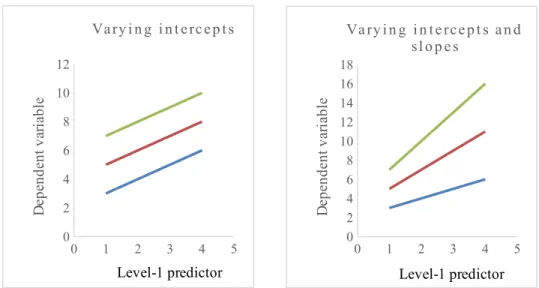
intercept β0j and slope β1j can vary across the level-2 units, that is, different groups can have different intercepts and slopes.
4 Note that, for instructive purposes, our case involves only two levels; however,
The most remarkable thing of MEM is that we treat both the intercept and slope at level-1 as dependent variables (i.e., outcomes) of level-2 predictor variables. So here we write the following equations expressing the relationships between the level-1 parameters and level-2 predictors:
β0j=γ00+γ01Wj+u0j (2)
and
β1j=γ10+γ11Wj+u1j (3)
where β0j refers to the level-1 intercept in level-2 unit j, γ00 denotes the mean
value of the level-1 intercept, controlling for the level-2 predictor Wj, γ01 the
slope for the level-2 variable Wj, and u0j the error (i.e., the random variability) for
unit j. Also, β1j refers to the level-1 slope in level-2 unit j, γ10 the mean value of
the level-1 slope controlling for the level-2 predictor Wj, γ11 the effect of the
level-2 predictor Wj, and u1j the error for unit j.
scores. This kind of effect is called a cross-level interaction for it involves the impact of variables at one level of a data hierarchy on relationships at another level. We will discuss this in detail in the next section.
Now we combine equations (1), (2) and (3) by substituting the level-2 parts of the model into the level-1 equation. We finally obtain the following equation:
Yij=
[
γ00+γ10Xij+γ01Wj+γ11XijWj]
+[
u1jXij+u0j+εij]
(4)This equation can be simply understood that Yij is made up of two components:
the fixed-effect part expressed by the first four terms and the random-effect part
expressed by the last three terms. Note that the term γ11XijWj denotes a cross-level interaction between cross-level-1 and cross-level-2 variables, which is defined as the impact of a level-2 variable on the relationship between a level-1 predictor and
the outcome Yij. We have 7 parameters to estimate in (4), they are four fixed effects: intercept, within-group predictor, between-group predictor and cross-level interaction, two random effects: the randomly varying intercept and slope, and a level-1 residual.
Now a mixed-effects model has been built, and the next step is to estimate the parameters of the model. However, we will skip this step and turn to explore the philosophical implications of the modeling practice relevant to the explanatory reductionism debate.
Looking closely into the MEM practice, we find that a couple of important philosophical implications for the explanatory reductionism debate can be drawn.
4.1. All levels are indispensable
The first, and most obvious, feature of MEM is that it routinely involves many levels of analysis in a single model, and all these levels are indispensable to the model in the sense that no level can be reduced to or replaced by the other levels. These levels consist of both the so-called reducing level in the reductionist’s terminology, typically a lower-level that attempts to reduce another level, and the reduced level, typically a higher-level to be reduced by the reducing level. In our student-achievement-at-school case, for example, a reductionist may state that the group-level will be regarded as the reduced level whereas the student-level as the reducing level.
The indispensability of each level in the model can be understood in two related ways. First, due to the nested nature of data, only when we incorporate different levels of analyses to the model can we avoid either the atomistic or ecological fallacy discussed in Section 2. As discussed in the
information associated with group-level features and thus lead to misleading results. Although it’s true that the problem might be partially mitigated by
tailoring traditional single-level analytical techniques such as multiple regression, it’s also true that this somewhat ad hoc maneuver can simply bring about various new vexing and recalcitrant issues (Luke 2004; Nezlek 2008; Heck and Thomas 2015).
Second, the problem can also be viewed from the perspective of identifying explanatory variables. In building a mixed-effects model, the main consideration is often to find a couple of variables that may play the role of explaining the pattern or phenomenon observed in the data. Here a modeler must be clear about how to assign explanatory variables, for instance, she must consider if there are different levels of analyses and, if so, which explanatory variables should be assigned to what levels, and so on. These considerations may come before her model building because of background knowledge, which paves the way for her to develop a conceptual framework for investigating the problem of interest. However, without such a clear and rigorous consideration of identifying and assigning multilevel explanatory variables, an analysis can flaw simply because it confounds variables at different levels.
Respecting the multilevel nature of explanatory variables has another
explanatory variables, we get a clear idea of how, and to what degrees,
explanatory variables at different levels contribute to variation in outcomes. If these variables do contribute to variation in outcomes, as it always happens in MEM, then the situation suggests an image of explanatory indispensability: all the explanatory variables at different levels are indispensable to explaining the pattern or phenomenon of interest.
Given these considerations, therefore, one implication for the explanatory reductionism debate becomes clear: it isn’t always the case that, given a relatively higher-level phenomenon it can be reductively explained by a relatively lower-level feature. Rather, in cases where the data show a nested structure or, put differently, the phenomenon suggests multilevel explanatory variables, we routinely combine the higher-level with the lower-level in a single (explanatory) model. As a result, one fundamental tenet of explanatory reductionism is violated: single level preference.
4.2. Interactions between levels
Another crucial feature of multilevel modeling is its emphasis on a cross-level interaction, which is defined as
groups is dependent on contextual or organizational features defined by higher-level units”. (Heck and Thomas 2015, 42-43)
Remember that there is a term γ11XijWj in our mixed-effects model discussed in Section 3, which indicates the cross-level interaction between the group-level and the individual-level. More specifically, this term can be best construed as the impact of a group-level variable, e.g., group size, upon the individual-level relationship between a predictor, e.g., study time, and the outcome, e.g., students’ scores.
The cross-level interaction points to the plain fact that an organization or a system can somehow influence its members or components by constraining how they behave within the organization or system. This doesn’t necessarily imply top-down causation (Section 5.3 will turn back to this point). Within the context of scientific explanation, however, it does imply that it isn’t simply that
characteristics at different levels separately contribute to variation in outcomes, but rather that they interact in producing variation in outcomes. In other words, the pattern or phenomenon to be explained can be understood as generated by the interaction between explanatory variables at different levels. Therefore, to
properly explain the phenomenon of interest, we need not only have a clear idea of how to assign explanatory variables to different levels but also an unequivocal conception of whether these explanatory variables may interact.
0 1 2 3 4 5 0 2 4 6 8 10 12
Va ry i n g i n t e rc e p t s
Level-1 predictor D ep en de nt v ar ia bl e
0 1 2 3 4 5
0 2 4 6 8 10 12 14 16 18
Va ry i n g i n t e rc e p t s a n d sl o p e s
Level-1 predictor D ep en de nt v ar ia bl e
Figure 1. Two different models showing varying intercepts or varying intercepts and slopes, respectively. Three lines represent three classes. This figure is adapted from Luke (2004, 12).
Given such a cross-level interaction, therefore, the explanatory reductionist position has been further challenged. This is because any reductive explanation that privileges one level of analysis—usually the lower-level—over the others falls short of capturing this kind of interaction between levels. If they fail to do so, then they are missing important terms relevant to explaining the phenomenon of interest. As a consequence, a mixed-effects model involving interactions between levels simultaneously violates the two fundamental pillars of explanatory
reductionism: first, it violates single level preference because it involves
5. Potential Objections
This section considers two potential objections.
5.1. In-principle argument
One argument that resurfaces all the time in the
reductionism-versus-antireductionism debate is the in-principle argument, the core of which is that even if reductive explanations in a field of study are not available for the time being, it doesn’t follow that we won’t obtain them someday (e.g., Sober 1999; Rosenberg 2006). Therefore, according to some reductionists, the gap between current-science and future-science is simply a matter of time, for advancement in techniques, experimentation and data collecting can surely fill in the gap.
However, I think the argument flaws. To begin with, advancement in techniques, experimentation and data collecting isn’t always followed by
produce useful explanations or predictions (Green 2013; Green and Batterman 2017; Gross and Green 2017).
Nevertheless, reductionists may reply that the situations presented above only constitute an in-practice impediment, for it doesn’t undermine the possibility that lower-level reductive explanations, typically provided by some form of ‘final science’, will be available someday. Let us dwell on the notion of possibility a bit longer. The possibility here may be construed as a logical possibility (Green and Batterman 2017, 21; see also Batterman 2017). Nonetheless, if it’s merely logically possible that there will be some final science providing only reductive explanations, then nothing can exclude another logical possibility that there will be some ‘mixed-science’ providing only multilevel explanations. After all, how can we decide which logical possibility is more possible (or logically more possible)? I doubt that logic alone could provide anything useful in justifying which possibility is more possible, and that appealing to logical possibility could offer anything insightful in helping us understand how science proceeds. As Batterman puts, “Appeals to the possibility of in principle derivations rarely, if ever, come with even the slightest suggestion about how the derivations are supposed to go” (2017, 12; author’s emphasis).
practice can tell that a large portion of scientific explanations proceeds in a non-reductive fashion, as suggested by multilevel modeling (Batterman 2013; Green 2013; O’ Malley et al. 2014; Green and Batterman 2017; Mitchell and
Gronenborn 2017). Moreover, even in areas such as physics which was regarded as a paradigm for the reductionist stance, progressive explanatory reduction doesn’t always happen (Green and Batterman 2017; Batterman 2017).
In sum, we have shown that the in-principle argument fails for it neither offers help in understanding how science proceeds if it’s construed as implying a logical possibility, nor goes in tune with scientific practice if it’s construed as implying real possibilities.
5.2. Top-down causation
In Section 3 we have shown that there is a cross-level interaction taking the form that higher-level features may impact lower-level features. A worry arises: Does this imply top-down causation?
My answer to this question is twofold. First, it’s clear that this short essay isn’t aimed to engage in the philosophical debate about whether, and in what sense, there exists top-down causation (see Craver and Bechtel 2007; Kaiser 2015; Bechtel 2017). Second, what we can do now is to show that the cross-level interaction is a clear and well-defined concept in multilevel modeling. It
discussed in Section 3, we have shown that group-level features may impact some individual-level features through the way that each group possesses its own feature relevant to explaining the differences at the individual-level across groups. This idea is incorporated into the mixed-effects model by assigning some
explanatory variables to the group-level and a cross-level interaction term to the model.
The idea of cross-level-interaction-as-constraint is widely accepted in multilevel modeling broadly construed, where constraint is usually expressed in the form of initial and/or boundary conditions. For example, in modeling cardiac rhythms, due to “the influences of initial and boundary conditions on the solutions of the differential equations used to represent the lower level process” (Noble 2012, 55; Cf. Green and Batterman 2017, 32), a model cannot simply narrowly focus on the level of proteins and DNA but must also consider the levels of cell and tissue working as constraints. The same story happens in cancer research, where scientists are advocating the idea that tumor development can be better understood if we consider the varying constraints exerted by tissue (Nelson and Bissel 2006; Shawky and Davidson 2015; Cf. Green and Batterman 2017, 32).
6. conclusion
References
Batterman, Robert. 2013. The “Tyranny of Scales.” In The Oxford Handbook of Philosophy of Physics, ed. Robert Batterman, 255-286. Oxford: Oxford University Press.
———. 2017. “Autonomy of Theories: An Explanatory Problem.” Noûs 1-16. Bechtel, William. 2010. “The Downs and Ups of Mechanistic Research:
Circadian Rhythm Research as an Exemplar.” Erkenntnis 73:313–328.
———. 2017. “Explicating Top-Down Causation Using Networks and Dynamics.”
Philosophy of Science 84:253–274.
Bickle, John. 2003. Philosophy and Neuroscience: A Ruthlessly Reductive Account. Dordrecht: Kluwer.
Brigandt, Ingo. 2010. “Beyond Reductionism and Pluralism: Toward an
Epistemology of Explanatory Integration in Biology.” Erkenntnis 73 (3): 295-311.
———. 2013a. “Explanation in Biology: Reduction, Pluralism, and Explanatory
Aims.” Science and Education 22:69–91.
———. 2013b. “Integration in Biology: Philosophical Perspectives on the
Dynamics of Interdisciplinarity.” Studies in History and Philosophy of Biological and Biomedical Sciences 44:461–465.
Craver, Carl, and William Bechtel. 2007. “down Causation without Top-Down Causes.” Biology and Philosophy 22:547–563.
Freedman, David. 1999. “Ecological Inference and the Ecological Fallacy.” In International Encyclopedia of the Social and Behavioral Sciences, vol. 6, ed. Neil Smelser, and Paul Baltes, 4027–4030. New York: Elsevier.
Green, Sara. 2013. “When One Model Isn’t Enough: Combining Epistemic Tools in Systems Biology.” Studies in History and Philosophy of Biological and Biomedical Sciences 44:170–180.
Green, Sara, and Robert Batterman. 2017. “Biology Meets Physics: Reductionism and Multi-Scale Modeling of Morphogenesis.” Studies in History and
Philosophy of Biological and Biomedical Sciences 61:20–34.
Gross, Fridolin, and Sara Green. 2017. “The Sum of the Parts: Large-Scale Modeling in Systems Biology.” Philosophy, Theory, and Practice in Biology 9: (10).
Heck, Ronald, and Scott Thomas. 2015. An Introduction to Multilevel Modeling Techniques (3rd Edition). New York: Routledge.
Hull, David. 1972. “Reductionism in Genetics—Biology or Philosophy?” Philosophy of Science 39 (4): 491-499.
Hüttemann, Andreas, and Alan Love. 2011. “Aspects of Reductive Explanation in Biological Science: Intrinsicality, Fundamentality, and Temporality.” British Journal for the Philosophy of Science 62 (3): 519-549.
Knuuttila, Tarja. 2011. “Modelling and Representing: An Artefactual Approach to Model-Based Representation.” Studies in History and Philosophy of Science Part A 42:262–271.
Luke, Douglas. 2004. Multilevel Modeling. London: SAGE Publications, Inc. Maxwell, Sophie, Katherine Reynolds, Eunro Lee, et al. 2017. “The Impact of
School Climate and School Identification on Academic Achievement: Multilevel Modeling with Student and Teacher Data.” Frontiers in Psychology 8:2069.
Mitchell, Sandra. 2003. Biological Complexity and Integrative Pluralism. Cambridge: Cambridge University Press.
———. 2009. Unsimple Truths: Science, Complexity, and Policy. Chicago: University of Chicago Press.
Nezlek, John. 2008. “An Introduction to Multilevel Modeling for Social and Personality Psychology.” Social and Personality Psychology Compass 2/2 (2008):842–860.
Noble, Daniel. 2012. “A Theory of Biological Relativity: No Privileged Level of Causation.” Interface Focus 2(1):55–64.
O’Malley Malley, Ingo Brigandt, Alan Love, et al. 2014. “Multilevel Research Strategies and Biological Systems.” Philosophy of Science 81:811–828. Rosenberg, Alex. 2006. Darwinian Reductionism, or How to Stop Worrying and
Love Molecular Biology. Chicago: University of Chicago Press.
Schagen, I. P. 1990. “Analysis of the Effects of School Variables Using Multilevel Models.” Educational Studies 16:61–73.
Shawky, Joseph, and Lance Davidson. 2015. “Tissue Mechanics and Adhesion during Embryo Development.” Developmental Biology 401(1):152–164. Sober, Elliot. 1999. “The Multiple Realizability Argument against Reductionism.”
Philosophy of science 66:542–564.
Wang, Yau-De, and Hui-Hsien Hsieh. 2012. “Toward a Better Understanding of the Link Between Ethical Climate and Job Satisfaction: A Multilevel
Analysis.” Journal of Business Ethics 105:535–545.
Waters, C. Kenneth. 2008. “Beyond Theoretical Reduction and Layer-Cake Antireduction: How DNA Retooled Genetics and Transformed Biological Practice”. In The Oxford Handbook of Philosophy of Biology, ed. Michael Ruse, 238-262. New York: Oxford University Press.