December 2018, Vol. 2, No. 2 [31-41] O-ISSN 2664-0430
RESEARCH PAPER
Measuring the Practices of Quality Management in Teacher
Training Institutions: A Quantitative Analysis
Muhammad Arshad Javaid1Fariha Sohil2Umair Sohail3
1. Lecturer , Department of Education , University of Education Lahore Sub Campus Dera Ghazi Khan, Punjab, Pakistan
2. Ph. D Scholar , Department of Education , Govt. College University Faisalabad, Punjab, Pakistan
3. Ph. D Scholar , Department of Statistics , Quaid-e-Azam University Islamabad, Punjab, Pakistan
PAPER INFO ABSTRACT
Received:
October 15, 2018
Accepted:
December 12, 2018
Online:
December 30, 2018
This study was intended to determine the practices of quality management adopted by the administrators of the teacher training institutions in Punjab Pakistan. The study was delimited to thirty (30) GCETs and ten (10) campuses of the education university out of which 40 Principals and 60 teachers were selected by using Simple Random Sampling (SRS) technique. A five point rating scale was developed keeping in view the Juran and Demings’ Quality management frame work for the leaders and administrators. The same questionnaire was administered to the Teachers to cross check the opinions of the Principals for authenticity of the results. The collected data were analyzed by applying inferential as well as descriptive statistics. The results revealed the poor practices of quality management adopted by the administrators in these institutions. The paper suggests providing a special training to all the Principals regarding quality management and the inclusion of a new subject entitled “Managing Quality in Teacher Education” in all the teacher training programs
Keywords: Quality, Quality Awareness, Teacher Education, Quality Management Corresponding Author: marshadjavaidly @gmail.com Introduction
field of teaching at different levels” (Aggarwal, 2005). So in this context, it enjoys universal significance and importance and becomes obligatory to all the educational community to make better the teacher education with a new active and dynamic look in to all subsystems of education. The most important means for improving the standards of education in the present scenario is to upgrade the quality management level of teachers training institutions. “The management quality of any educational institution is based upon the traits like vision, capabilities, sincerity, commitment, devotion to duty and the management skills adopted by the manager or head of the institutes. The modern era demands the newly emerging management skills like quality management skills to upgrade and to best achieve the objectives of any educational institute”. (Smith, 2009)
The question arises here is that what is quality and its management principles that a visionary and committed manager must have in his/her mind while managing an organization. The concept of quality is based on the various numerous ideas; for instance it can be viewed in terms of perfection and consistency in achieving the standards of some program, product and organization at excellence level with zero defects (Harvey and Green, 1993). Quality and Quality management are two different concepts ; Quality is a broad and comprehensive in different aspects while Quality management is limited to the managers and is a tool used by the administrators to well manage the human, material and financial resources with a fine touch of quality set benchmarks. They can adopt and implement the quality management principles presented by different experts in this field like Deming and Juran known as the fathers of Quality Management. (Arcaro, 1997)
The term Quality and Quality management was firstly introduced by the Higher Education Commission (HEC) of Pakistan in 2002 in the institutions of higher education particularly, in the Universities including public and private sectors. Therefore, most of the heads of the institutions of higher education are still lacking the complete awareness about quality management (QM). To improve the quality of education at any level is dependent upon the quality of the teachers and teachers are of course, the product of the Teacher Training institutions (TTIs). So in this context, the quality management level of the TTIs seems inevitable in order to enhance the overall quality of the education (Sharma, 1993).
The fate of any nation is shaped in the hands of their teachers because they can make a nation strong and paralyze. In Pakistan, unluckily, the situation of this subsystem of teacher education seems deteriorating owing to the indifferent attitude of the government, administrators, leaders as well as the general public. The NGOs, private agencies have prepared so many reports on the declining management situation of the teachers training institutions in Pakistan. According to UNESCO report (2006):
regarding quality management and meager expertise in managing quality with the lower levels of financial and material resources and the indifferent attitude of the government and leadership. The support of the other factors in managing quality and upgrading standards like teacher commitment and competence, strong evaluation system and the well built monitoring and accountability system seem disappearing which further perish the system of quality management”.
In a recent report published by UNESCO (2010) about teacher education shows that:
“The standards of education at school level generally stands falling , this is owing to the breach in the quality of Pakistani institutions of teacher education, particularly, with reference to quality management that seem in an alarming and declining state, via a deep cause of lowering management practices eventually found below the quality set benchmarks by the higher education commission and owing to least priority based sector and low status of the teachers on behalf of the political government in Pakistan”.
Materials and Methods
In Punjab, there are sixty four (64) teachers training institutes out of which 42 are run by the government sector, 14 have autonomous status and 08 are operated by the private sector. The specific teacher training institutions in Punjab in the government sector are 33 while ten institutes of the University of Education are included in the same status and category (UE, 2009). This study was delimited to 30 GCETs and 10 campuses of the University of Education. All the Principals (40) and randomly selected sixty (60) teachers of these institutes were selected for the generalization of this study.
After a thorough review of the literature related to quality awareness and quality management mechanism as shown in figure 1 and 2, a Likert scale was developed for the Principals and Teachers from GCETS and UE campuses. The questionnaire was consisted of 18 statements, nine (9) concerning quality awareness and the same (9) regarding quality management mechanism. On each statement, the opinions of the Principals were taken along with the teachers in order to validate the statements. In order to find out the difference in opinions of the principals and teachers, the parametric test of significance z was applied. Every statement was divided into five grades and given quantification from 1-5.
A= always, M= mostly, S= sometimes, R= rarely, N= never
A= 5 M= 4 S= 3 R= 2 N= 1
Results and Discussion
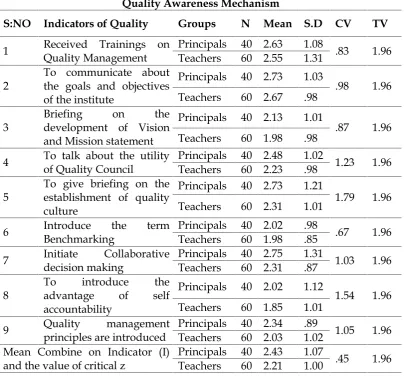
Table 1
Quality Awareness Mechanism
S:NO Indicators of Quality Groups N Mean S.D CV TV
1 Received Trainings onQuality Management Principals 40 2.63Teachers 60 2.55 1.08 .831.31 1.96
2 To communicate aboutthe goals and objectives of the institute
Principals 40 2.73 1.03
.98 1.96 Teachers 60 2.67 .98
3 Briefing development of Visionon the and Mission statement
Principals 40 2.13 1.01
.87 1.96 Teachers 60 1.98 .98
4 To talk about the utilityof Quality Council Principals 40 2.48Teachers 60 2.23 1.02 1.23 1.96.98
5 To give briefing on theestablishment of quality culture
Principals 40 2.73 1.21
1.79 1.96 Teachers 60 2.31 1.01
6 Introduce Benchmarkingthe term Principals 40 2.02Teachers 60 1.98 .98.85 .67 1.96
7 Initiate decision makingCollaborative Principals 40 2.75Teachers 60 2.31 1.31 1.03 1.96.87
8 To advantage introduce of selfthe accountability
Principals 40 2.02 1.12
1.54 1.96 Teachers 60 1.85 1.01
9 Quality principles are introducedmanagement Principals 40 2.34Teachers 60 2.03 .891.02 1.05 1.96 Mean Combine on Indicator (I)
and the value of critical z Principals 40 2.43Teachers 60 2.21 1.07 .451.00 1.96
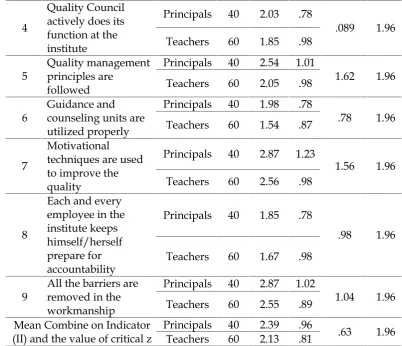
Table2
Quality management mechanism
Sr. Indicator Groups N Mean S.D CV TV
1 Trainings on QualityManagement are held regularly
Principals 40 2.48 1.23
1.65 1.96 Teachers 60 2.23 1.02
4
Quality Council actively does its function at the institute
Principals 40 2.03 .78
.089 1.96
Teachers 60 1.85 .98
5 Quality managementprinciples are followed
Principals 40 2.54 1.01
1.62 1.96
Teachers 60 2.05 .98
6 Guidance andcounseling units are utilized properly
Principals 40 1.98 .78
.78 1.96
Teachers 60 1.54 .87
7
Motivational
techniques are used to improve the quality
Principals 40 2.87 1.23
1.56 1.96
Teachers 60 2.56 .98
8
Each and every employee in the institute keeps himself/herself prepare for accountability
Principals 40 1.85 .78
.98 1.96
Teachers 60 1.67 .98
9 All the barriers areremoved in the workmanship
Principals 40 2.87 1.02
1.04 1.96
Teachers 60 2.55 .89
Mean Combine on Indicator
(II) and the value of critical z PrincipalsTeachers 4060 2.392.13 .96.81 .63 1.96
below the norm score (3). The difference in opinions about the same statement on behalf of the Principals and faculty was insignificant. This shows that the principals do not lay emphasis on the significance of Quality Council and quality culture within their respective institutions. The results on these statements are in line with the results of the study conducted by Akhtar 2007. Benchmarking is another important term which is used in managing quality. The well reputed organizations with quality output are visited and the standards are utilized in the other institutions that are termed as benchmarking. It is considered the paramount responsibility of the managers to introduce the same concept to the faculty and the employees. On this statement, the mean score of both the groups remained below the QP and no significant difference was found between their opinions as z value was 0.67. Collaborative decisions are very significant in upgrading the quality and standards of any institutions which becomes obligatory to all the managers and heads of the institutions. On statement 7, the mean score was found below the QP and duly authenticated by the faculty with mean score 2.31. Z value showed that no significant difference exist between the mean scores of the managers and faculty against statement 7. The statements 8 and 9 also showed the lower mean scores as compare to QP on behalf of the principals and validated with the mean score values 1.01and 2.03 on behalf of the faculty. To create the sense of self accountability in the employees and to make them aware about the quality management principles is the prime duty of the quality manager. The analyses of the statements 8, 9 showed that the principals do not perform this prime responsibility. The overall mean score value on the indicator Quality Awareness Mechanism (QAM) on behalf of the Principals and Faculty were found 2.43 and 2.21 respectively. The results of the studies by Farooq 1999, Hussain 2002 and Dilshad 2010 support the results of this study. No significant difference was found between the opinions of Principals and Faculty on this indicator. The results in this connection show that the quality awareness mechanism on the part of the managers/ principals was too much declining.
References
Aggarwal, J.C. (2005). Teacher and Education in a Developing Society: New Delhi: Vikas Publishing House Pvt. Ltd, Second edition, pp. 415-16.
Akhtar, M. (2007).Application and Analysis of Total Quality Management (TQM) in Colleges of Education in Pakistan (Unpublished Ph.D. Thesis), Rawalpindi: Institute of Education and Research PMAS Arid Agriculture University, Pakistan.
Arcaro, J. S. (1997). Quality in Education an Implementation Hand Book, New Delhi: Vanity Books International.
Farooq, R. A. (1990). A Survey Study of the Problems and Prospects of Teacher Education in Pakistan, Islamabad: Academy of educational planning and management.
Farooq, R. A. (1999). Education System in Pakistan: Problem and Issues. Islamabad; Asia society for promotion of innovation and reforms in Education, Pakistan.
Harvey, L. & Green, D. (1993).Defining Quality Assessment and Evaluation in Higher Education18(1): pp. 9-34.
Hussain, S. & Saeed, M. (2008).Evaluating the Quality of the B.Ed. Program: Students’ Views on their College Experiences, In proceeding of 2nd international conference on assessing quality in higher education, -Pakistan.
Jabeen, F. (2010).A Study on the Evaluation of Post Graduate Programs of Teacher Education in Pakistan (Unpublished Ph.D. Thesis), Rawalpindi: Institute of Education and Research PMAS Arid Agriculture University, Pakistan.
Javaid, M. A. (2008). Investigating the Quality Management Level (QML) of the Pakistani Institutions of Teacher Education(Unpublished M. Phil. Thesis), Multan: Department of Education, BahauddinZakariya University, Pakistan.
Sharma, S. R. (1993). Teacher Education in India Vol.III, New Delhi: Unmole Publications.