Volume 3, Issue 2, 2016
78 Available online at www.ijiere.com
International Journal of Innovative and Emerging
Research in Engineering
e-ISSN: 2394 - 3343 p-ISSN: 2394 - 5494
Learning Aim Oriented Personalized E-learning
Sushma Hans
Division of Computer Engineering, Netaji Subhas Institute of Technology, Delhi, Delhi, India
Abstract
We propose an approach for personalizing students’ learning keeping in mind her learning aim in an e-learning environment. A proposal scheme is introduced for modeling a course as a directed acyclic graph where nodes at a particular level represents a set of different viewpoints of the same concept. All perspectives of a concept encapsulate a set of different LOs suggested by the course experts. This helps a student to enhance her learning along two directions; conceptual breadth of learning it using its various viewpoints contributed by different authors and coverage of the course by learning the most contributed perspectives towards learning aim. This paper utilizes Ant Colony Optimization (ACO) algorithm to personalize e-learning scheme by generating an optimized learning path taking into account the contribution of various concept perspectives towards different learning aims.
Keywords: Personalized E-learning, Learning Aims, Ant Colony Optimization, Directed Acyclic Graph, Concept Perspectives
1. INTRODUCTION
E-learning provides freedom for learners by allowing them to learn at any time and any location conveniently [1]. Recognizing the distinction between diverse learners’ characteristics and their learning objectives require the need to make customized environment for learning. A Personalized e-learning framework tailors the courses as indicated by individual clients' necessities and preferences. A massive work has been done in the field of personalized e-learning in light of learners’ profiles [2]. The profiles are utilized to decide the learner behaviors that lead the e-learning framework in producing a personalized learning path for every learner.
The huge amount of learning material and various learners’ learning preferences compels the requirement for more refined personalization ideas and techniques. Existing works mainly give emphasis on personalization of learning material based on learner's background, her learning style, experience and qualification [3, 4, 5]. These systems do not consider the importance of including the perspectives and LOs in the learner’s learning path according to learners’ Learning Aim (LA).
As an example to explain the motivation for the work in this paper, let us suppose that a learner’s aim of taking up a course is to carry out project work. Then the priority assigned to the various LOs may be ordered as: detailed theoretical concept, case study, and simulation. Another user who aims at gaining cursory knowledge on the subject can choose basic concepts followed by an example. Therefore, we need to bring the primary aim of learning as a steering factor for personalizing a course.
As an illustration to explain the motivation for the research in this paper, each concept of a course can be explained by authors from different fields according to their own perspectives. Moreover, as each e-course is evolving every day, new viewpoints that comes into view when advancement is made in the field must be added to regularly update the course. This allows the growth of the course by enriching it greatly with diverse ideas and perspectives from different experts. In addition, this benefit learners as they can enhance their knowledge fully from the repository of perspectives according to their own interests, preferences and time constraints. An optimized choice of these perspectives lets the learner to widen her vision by studying different explanations, thereby widening her vision and boosting her learning success. We propose a framework in this paper that focuses on the significance of learner's LA while selecting the perspectives and LOs for grasping a concept.
Volume 3, Issue 2, 2016
79
2. PRIOR WORK
The field of personalized e-learning has benefitted from noteworthy contributions made by various authors. Marwah et al. (2009) presented the course content as a Directed Acyclic Graph (DAG) in which each node represents an LO [6]. They worked on Elimination and Optimized Selection (EOS) based algorithm to generate an adaptive learning path for each learner. The authors determine the relevance of each concept in the particular domain to provide appropriate concepts to the learner.
Wong et al. (2009) proposes a course sequencing technique that makes use of prescriptive rules and ACO based inductive planning [7]. They developed a system to determine the most appropriate pathway for each learner. The inductive mechanism of the proposed system is to identify similar learners from user logs and to find out a suitable learning path for the new learner. Marquez et al. (2008) organized the course in the form of a sequencing graph. The pedagogical team chooses the sequence of nodes based on the course requirements [8]. This paper identifies a manner to generate learning path using ACO keeping the help offered by a pedagogical team through Bayesian Networks (BN).
Fung et al. (2011) utilized a concept clustering technique to cluster similar concepts and determine precedence of various course modules based on these clusters obtained [9]. This precedence information is utilized by Genetic Algorithm (GA) to generate an optimized learning sequence of appropriate course modules.
Bhaskar and Chithralekha (2010) examined learners’ intentions and their preferences and identify various LOs of a course such as example, simulation and case study accordingly [10]. The system arranges these LOs in a sequence based on learner’s psychology. The authors utilize GA technique to spawn a learning path personalized to each learner.
Acampora et al. (2008) presented an ontological form of the course where various concepts are connected through three kinds of relations: the Has- Part, the Is-Required-By and the Suggested-Order [11]. The proposed system develops memetic algorithm to determine an optimized learning path from the defined course ontology.
Azough et al. (2010) proposed a GA based system to generate an optimal learning path personalized based on learner's profile [12]. The generated path tries to satisfy the pedagogical objectives set by the course experts.
Hong et al. (2005) determined the degree of relatedness among the concepts using the cosine similarity measure [13].The cosine similarity measure considers the term frequencies and the importance weights assigned to concepts to work upon the relatedness. GA works on these relations obtained to determine the most favorable learning path for an individual learner. Liu and Yang (2005) proposed an adaptive and personalized e-learning system that structures the course in the form of a dual weighted directed graph [14]. Each node represents an LO with its weight signifying the required learning time as defined by the experts. Directed edges show the precedence relationship and their edge weight signify the difficulty level from one node to the next node. The system uses Dijkstra’s algorithm to establish the best learning path. The authors evaluate the quality of the generated path based on user's learning goal and learning achievement. Zhao and Wan worked on the same course structure [15] with a new algorithm to determine the shortest learning path to gain the required knowledge.
Jiuxin et al. (2008) presented a self adaptive framework of LOs based on the learning context of user [16]. The authors consider learning context as the learner's internal and digital environments such as access devices, network and personal information. The framework dynamically creates different versions of learning objects according to learner's learning context.
An analysis of the above mentioned works discloses two lacunae: Firstly, a course is considered closed with its concepts once decided as a part of the curriculum. But in reality, a concept is a changeable artifact that changes dynamically with time. It can be deepened by add-ons from different authors according to their expertise. Besides, as time progresses, fresh viewpoints on the same concept emerge that must get incorporated into the course to make it more relevant for the learners. Learning various perspectives provide additional information that leads to more satisfaction for the learner. So, we realize the need of adding various perspectives for a concept in a dynamic and flexible manner. Depending upon the present state-of-art of a domain, the relative significance of different perspectives may change. Thus, the personalized system that determines an optimal path must be assisted by contributory weights to the various perspectives for different LAs.
Secondly, past work does not recognize the importance of prioritizing various LOs of a concept according to the learner's learning aims. LA is a fundamental parameter that derives the learner's choice of learning material and the learning process.
3. COURSE GRAPH MODEL
Volume 3, Issue 2, 2016
80 Level1 Level2 Level3 Level4 Level5 Level6 Level7
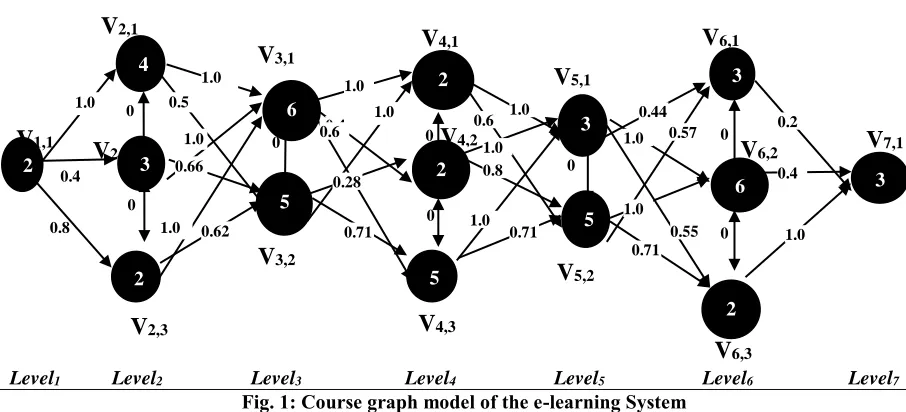
Fig. 1: Course graph model of the e-learning System
3.1.Course Graph Components
Learning Aim: Each student who registers for a course selects one among a list of Learning Aims (LAs). A few of the probable LAs are: Preparation for a job interview, to gain knowledge for research work, to prepare for the end-semester examination etc. nLA indicates the number of learning aims. The LA for the target student sx is denoted by LA(x).
Levels: The course is systematized in a succession of nL levels from Level1 to LevelnL. Each level corresponds to a specific
concept of the course that must be covered to learn the course. Each concept has a different contribution towards the complete learning of the course. Experts set the Maximum Learning Success MLSj achieved by a student after going through the concept
at Levelj.
Perspectives: Each concept can be explained by various content providers such as teachers, practitioners or researchers from their point of view, called Perspectives. A node vj,k symbolizes the kth perspective at Levelj.. It is not mandatory for a
learner to learn a concept from all its perspectives, but she can choose more to increase her learning.
Learning Objects: A concept is explained by a set of Learning Objects (LOs) whatever the perspective may be. LOs may include example, basic theory, detailed theory, simulation, case study, etc. Experts decide a maximum number of LOs i.e. nmaxLOj for concept j. The author of a specific perspective utilizes these LOs to build her content. Therefore, there are different
number and types of LOs for each perspective. the experts decide the priority of these LOs as per their utility for different LAs. The system divides the time assigned to a perspective between various LOs based on their priority.
Node Weight: A node vj,k is associated with a weight Tj,kthat stands for the minimum time that a student is required to spend
on learning kth perspective at Level
j. This value is decided by the experts based on their experience. A learner is free to spend
more time, according to her learning ability.
Edge Weight: An edge weight DLj,k,k’ along edge (vj,k vj+1,k’) represents the level of difficulty in making a transition
from kth perspective at Level
j to a perspective k’ at Levelj+1. Difficulty level within the perspectives of the same level is set to
zero to promote students to take up more perspectives of a concept to enhance their learning.
Completion Time: Experts decide the maximum time Tmax(j) that a learner can spend at Levelj. The completion time for the
whole course Tmax (LA) is the summation of maximum time of all the levels.
3.2.Databases
Maximum Learning Success: Each concept of a course beers a different contribution towards learning of the course. For example, the concept of Linked Lists may be considered to be more significant when compared with the concept of in-built data types in the Data Structures course. Therefore, a student achieves a certain degree of mastery after covering each conceptual level. Experts decide the maximum Learning Success (MLSj) attained when a learner has learnt the concept j.
Perspective Aim Contribution Table: As each perspective is added by different authors of different fields, each perspective contributes differently towards different learning aims. Experts assign these contributing factors to each perspective for different LA. We create a database named Perspective Aim Contribution Table PACT[nLA][nL][nPj]. Table 3 gives the PACT
values for the CG given in Figure 1.
Learning Object Priority Table: Different LOs of a concept have different contribution towards various LAs. For example, a quiz oriented LO is more significant for a learner who wants to prepare for an interview, whereas a simulation LO is more relevant for a researcher. The Learning Object Priority Table LOPT[nLA][nL][nmaxLOj] holds the priorities of different LOs
for various LAs.
V
1,12
V
2,1V
4,12 4
0.4
0.8 0
0 0
1.0
V
4,2V
3,15 2 6
5
2 3
V
2,2V
3,2 0.660 1.0
0.5
1.0
V
2,30
V
4,33
5
3
6
2
V
5,1V
5,2V
6,3V
6,2V
6,10.62 1.0
1.0
0.6 1.0 0.4 0.6
0.28
0.71 1.0 0.71
0.8 1.0 0.6
1.0 0.57
0.44
0
0
0 1.0
0.55 1.0
0.71
0.2
0.4
1.0
3
Volume 3, Issue 2, 2016
81
3.3.Objectives
Let us assume that a student sx registered for a course with LA(x). A candidate path 𝑃̂ consists of a set of perspective nodes
starting from Level1 to last LevelnL. Each level may contain its multiple perspectives. The Learning Success (LS) of a learner sx
after learning the kth perspective of Level
j is given by:
𝐿𝑆𝑗,𝑘= 𝑀𝐿𝑆𝑗(1 − 𝑒−∝𝑡𝑗,𝑘) (1) Where, MLSj is the Maximum Learning Success at Levelj set by the experts. Is the learner’s initial learning ability, determined
through pre-test, and tj,k is the time taken by the learner at the node vj,k she visited.
We consider three objectives that need to be optimized in order to get the best learning path for each learner. These factors are explained below:
a) Coverage Factor (CF): This factor assesses the learning of a student breadthwise across various concepts selected in the learning path. For each level, the system is free to choose one or more perspectives within the time constraint to increase the learning of a student. The contribution ρj,k(x) of kth perspective is calculated by the product of its contribution weight
PACT[LA(x)][j][k] and the LS achieved by the learner.
𝜌𝑗,𝑘(𝑥) = 𝐿𝑆𝑗,𝑘× 𝑃𝐴𝐶𝑇[𝐿𝐴(𝑥)][𝑗][𝑘] 𝑤ℎ𝑒𝑟𝑒 𝑗, 𝑘 ∈ 𝑃̂ (2a) For a given level, we identify a mandatory perspective vmandj(x) at Levelj for student sx that has maximum contribution.
CF is obtained by adding up these contributions of mandatory nodes of each level along the forward path: 𝐶𝐹(𝑃̂, 𝑥) = ∑ 𝜌𝑗,𝑣𝑚𝑎𝑛𝑑𝑗(𝑥)
𝑛𝐿
𝑗=1 (2b) b) Depth Factor (DF): DF evaluates the depth of knowledge of a specific concept accomplished by choosing various perspectives of a concept. The depth of learning is calculated by adding up the relative contributions of all perspectives at a particular level is:
𝐷𝐹𝑗(𝑃̂, 𝑥) =
∑𝑘∈𝑃̂𝐿𝑆𝑗,𝑘×𝑃𝐴𝐶𝑇[𝐿𝐴(𝑥)][𝑗][𝑘]
∑𝑛𝑃(𝑗)𝑘=1 𝑃𝐴𝐶𝑇[𝐿𝐴(𝑥)][𝑗][𝑘] (3a) The Cumulative Depth Factor for the candidate path is calculated by adding up the DF for each level:
𝐶𝐷𝐹(𝑃̂, 𝑥) = ∑𝑛𝐿𝑗=1𝐷𝐹𝑗(𝑃̂, 𝑥) (3b) c) Cumulative Difficulty Level (CDL): CDL signifies the difficulty of the selected path. The transition edges from one level to the next one of the candidate path only contribute to CDL. Adding perspectives of the same level do not increase the difficulty. It is computed through summation of the difficulty level of all these transition edges.
𝐶𝐷𝐿(𝑃̂) = ∑𝑛𝐿𝑗=1𝐷𝐿(𝑣𝑗,𝑘→ 𝑣𝑗+1,𝑘′) (4) These three factors contribute towards the overall fitness f(.) of the candidate path suggested for sx with LA(x) according to
the function
𝑓(𝑃̂, 𝑥) = 𝑤1 × 𝐶𝐹 (𝑃̂, 𝑥) + 𝑤2 × 𝐶𝐷𝐹(𝑃̂, 𝑥) − 𝑤3 × 𝐶𝐷𝐿(𝑃̂) (5) where w1, w2 and w3 are the weights assigned according to these factors significance. The system tried to maximize the fitness
of a solution by maximizing the coverage and depth factor while minimizing the difficulty level of the path.
3.4.Constraints
The system discards all those paths in which time spent tj,k at a node vj,k exceeds the maximum time allocated to the concept
j i.e.
𝑡𝑗,𝑘 ≤ 𝑇𝑚𝑎𝑥(𝑗) (6a) In addition, the total time taken T(𝑃̂) by the candidate path 𝑃̂ should not exceed the maximum time limit i.e.
𝑇(𝑃̂) ≤ 𝑇𝑚𝑎𝑥 (6b) As an initial recommendation, the system prescribes a learning path that includes an optimized combination of perspectives and LOs for each concept as guided by her learning objective and time constraints.
3.5.An ACO Scheme for personalized learning
ACO is a probabilistic population based algorithm used to solve many optimization problems [17, 18]. The ACO meta-heuristic is inspired from the foraging behavior of the ant species. It initializes a set of artificial ants that moves in the input graph to determine an optimized path. The selection of each subsequent node depends on the pheromones laid by the ants already passed on those paths. Ants prefer the route with the relatively high amount of pheromones for it. The pheromones value of the selected path is updated locally whenever an ant chooses a particular node as well as globally after an ant reached the destination along the basis of fitness of the obtained results. The system also provides the provision of pheromone evaporation from the paths to avoid local optimum solution. This procedure replicates for following nodes till all nodes of the current population attain the final destination.
a) Transition Probability: Next node selection is done based on a probability state transition rule that determines the probability based on pheromone factor 𝜏𝑢→𝑣 as given by:
𝑝𝑢→𝑣= 𝜏𝑢→𝑣𝛼
∑𝑤 ∈ 𝑣𝜏𝑢→𝑤𝛼 (7)
Volume 3, Issue 2, 2016
82 b) Pheromone updation: All paths are initialized with an initial amount of pheromone . Let 𝜏𝑢→𝑣𝑜𝑙𝑑 be the pheromone value of edge (u, v) at a given period of time. The local update of pheromone value when an ant moves along edge (u, v) is determined by:
𝜏𝑢→𝑣𝑛𝑒𝑤= 𝜏𝑢→𝑣𝑜𝑙𝑑 + (∈× ( 1 (1−𝐿𝑆𝑢))
𝜑
) (8)
The parameter 𝜑 settles on the impact of the LS factor in updating the pheromone level locally.
The global updation of pheromone value is done on all the edges included in the best path selected by the system. Let say, best denote that particular node. Then,
𝜏𝑢→𝑣𝑛𝑒𝑤 = 𝜏𝑢→𝑣𝑜𝑙𝑑 × (∈× (1 +
|𝑓𝑏𝑒𝑠𝑡(𝑥)|
Ψ ) (9) Where 𝜓 is the constant that decides the strength of the fitness solution to increase the pheromone level.
c) Pheromone Evaporation: Assume µ denotes the pheromone evaporation rate. Pheromones value diminishes steadily until they reach to their initial value.
𝜏𝑢→𝑣(𝑖 + 1) = {𝜏𝑢→𝑣(𝑖) × (1 − µ) 𝐼𝑓 𝜏𝑢→𝑣(𝑖) × (1 − µ) ≥ 𝜖
𝜖 𝑂𝑡ℎ𝑒𝑟𝑤𝑖𝑠𝑒 (10) The system calls upon ACO to generate an optimal learning path from the start node to the final destination. The ACO algorithm gears itself to maximize 𝑓(𝑃̂, 𝑥) to determine the most promising learning path for each student, while in respect of the time constraint.
4. EXPERIMENTAL RESULTS
The proposed algorithm is implemented using IDLE, an Interactive Development Environment (IDE) for python 2.7, on a 2.20 GHz Intel core i5 processor.
4.1 Environmental Variables
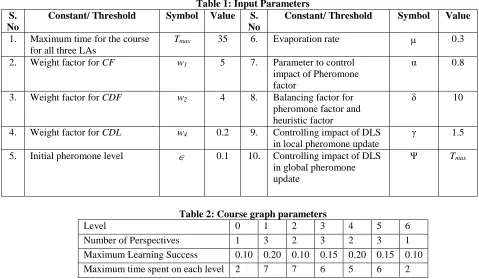
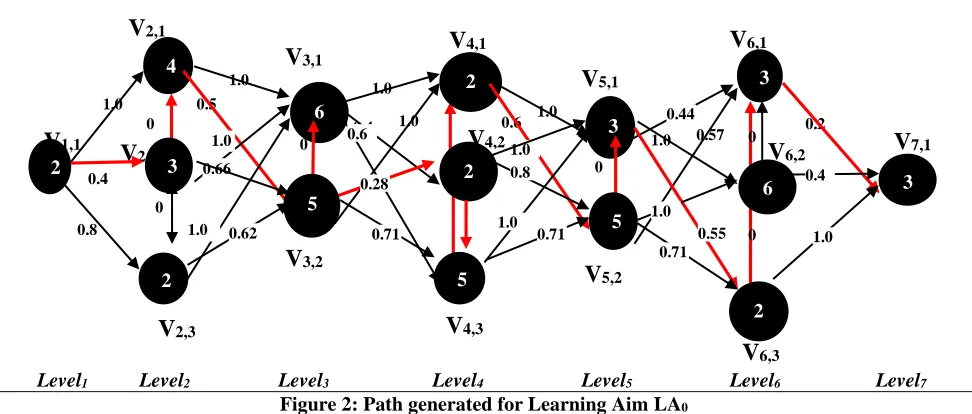
We experimented on the course graph given in Figure 1. The values for various thresholds, constants and databases used are given in Tables 1 to 3. In Table 1, row 1 shows the maximum time assigned for the course for all LAs. Rows 2 to 4 shows the weights assigned to different objectives used for candidate path as described in sub-section 3.3. Rows 5 to 10 show the values for the parameters used in ACO algorithm, as described in sub-section 3.5. Table 2 lists the number of perspectives, Maximum Learning Success, MLS at each level and maximum time spent that a learner can spend at each level for the course graph given in Figure 1. The values of PACT[][] entries are given in Table 3.
Table 1: Input Parameters S.
No
Constant/ Threshold Symbol Value S. No
Constant/ Threshold Symbol Value
1. Maximum time for the course for all three LAs
Tmax 35 6. Evaporation rate 0.3
2. Weight factor for CF w1 5 7. Parameter to control
impact of Pheromone factor
α 0.8
3. Weight factor for CDF w2 4 8. Balancing factor for
pheromone factor and heuristic factor
δ 10
4. Weight factor for CDL w4 0.2 9. Controlling impact of DLS
in local pheromone update
γ 1.5
5. Initial pheromone level 0.1 10. Controlling impact of DLS in global pheromone update
Ψ Tmax
Table 2: Course graph parameters
Level 0 1 2 3 4 5 6
Number of Perspectives 1 3 2 3 2 3 1
Maximum Learning Success 0.10 0.20 0.10 0.15 0.20 0.15 0.10
Volume 3, Issue 2, 2016
83
Table 3: Perspective Aim Contribution Table Learning
Aim
Level1 Level2 Level3 Level4 Level5 Level6 Level7
P1 P1 P2 P3 P1 P2 P1 P2 P3 P1 P2 P1 P2 P3 P1
LA0 1.0 0.40 0.25 0.35 0.60 0.40 0.51 0.20 0.29 0.60 0.40 0.29 0.40 0.31 1.00
LA1 1.0 0.30 0.17 0.53 0.35 0.65 0.29 0.56 0.15 0.65 0.35 0.29 0.56 0.15 1.00 LA2 1.0 0.16 0.54 0.30 0.68 0.32 0.56 0.22 0.22 0.38 0.62 0.56 0.22 0.22 1.00
4.2 Progression in Learning Path for Different Learning Aims
The learning path via the proposed ACO algorithm generated for three learning aims with the initial learning ability as 0.20 is shown below. Figure 2 shows the static path generated shown in red color for LA0. We can confirm from PACT[][] given in Table 3 for LA0 that the system always includes the highest contributing node at each level. Perspective P1 has the highest contribution towards LA0 for Level2, Level3, Level4 and Level5. P2 has the highest contribution towards LA0. These all perspectives are included in the generated path. The system also tries to increase the depth of learning by including more and more perspectives at each level. Also, we can see from the figure, while transition from one level to another, the system always tries to consider the lowest difficulty edge. This we can confirm from the transitions for all the levels from figure 2.
Level1 Level2 Level3 Level4 Level5 Level6 Level7 Figure 2: Path generated for Learning Aim LA0
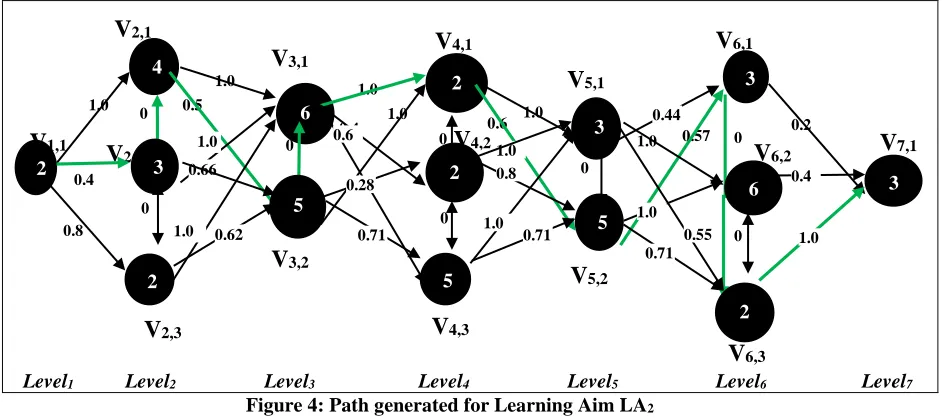
Figure 3 demonstrates the learning path generated as shown in blue color for aim 1. Figure 4 shows the path generated shown with green color for learning aim highlighted with red, blue and green color respectively. We can verify the above observations done in figure 2 for LA1 as well as LA2.
Level1 Level2 Level3 Level4 Level5 Level6 Level7
V
6,1V
4,1V
2,10 1.0
3
V
5,1 3 2 6 4 0.2 0 0.57 0.44 1.0 0.6 0.4 1.0 0.5 1.0 1.0V
3,1V
2,2V
1,1 1.0 0 0.6 1.0 1.0V
V
7,1 6,2V
4,2 3 6 2 3 0 0.66 2 0.4 0.80 5
1.0 0.62 5
0.28
0.71 1.0 0.71
0.8 0 0.55 1.0 0.4 1.0
V
3,2 0.71V
5,2 5 2 2V
4,3V
2,3V
6,3V
6,1V
4,1V
2,1 1.0 3V
5,1 3 2 6 4 0.2 0 0.57 0.44 1.0 0.6 0.4 1.0 0.5 1.0 1.0 0V
3,1V
2,2V
1,1 1.0 0 0.6 1.0 1.0V
V
7,1 6,2V
4,2 3 6 2 3 0 0.66 2 0.4 0.80 5
0
1.0 0.62 5
0.28
0.71 1.0 0.71
0.8 0 1.0 0.4 1.0 0.55
V
3,2 0.71Volume 3, Issue 2, 2016
84
Figure 3: Path generated for Learning Aim LA1
Level1 Level2 Level3 Level4 Level5 Level6 Level7 Figure 4: Path generated for Learning Aim LA2
Experimental results show that ACO generate an optimal learning path for each learner with particular learning aim. The generated path capitalizes learner's learning by giving emphasis to the following factors:
Maximizes the coverage factor by selecting the more contributing perspectives of each concept towards a learner’s learning aim.
Maximizes the depth of learning within the time period Tmax by selecting more and more perspectives of each concept.
Minimizes the difficulty level of the selected path.
5. CONCLUSION AND FUTURE WORK
Although optimal learning path generation scheme is not considered as a novel research in e-learning area, this study can be considered new as this one is the first path generation scheme that works on broadening the learner's vision by explicitly including various viewpoints of a concept to provide more in-depth knowledge. This will lead to more satisfaction towards a learner's learning aim. An ACO based path generation scheme has been developed to generate optimal learning path personalized to learner’s learning aim.
For future work, we would like to transform this static path generation scheme to a personalized dynamic learning path adaptation. Personalizing the evaluation and scoring system based on learner's LA could also be an inventive idea for adaptation as this will give us more concise knowledge about learner's learning that helps in personalizing the learning path.
REFERENCES
[1] Chengling Zhao and Liyong Wan, “A shortest Learning Path Selection Algorithm in E-learning”, In. Proc. of the Sixth International Conference on Advanced Learning Technologies (ICALT'06), IEEE 2006.
[2] S. Schiaffino and A. Almadi, "Intelligent User Profiling", In Proc. of the Artificial Intelligence: An International Perspective 2009, pp. 193-216.
[3] M. K. Khribi, M. Jemni and O. Nasraoui, "Automatic Rrcommendations for E-Learning Personalization Based on Web Usage Mining Techniques and Information Retrieval", In Proc. of the Eighth International Conference of the Advanced Learning Technologies, Santander, July 2008, pp. 241-245.
[4] A. A. Wabil et al. ,"Exploring the Validity of Learning Styles as Personalization Parameters in eLearning Environments: An Eyetracking Study", In Proc. of the ninth IEEE International Conference on the Advanced Learning Technologies, Riga, August 2009, pp. 329-333.
[5] G. Savic and Z. Konjovic, "Learning Style Based Personalization of SCORM E-Learning Courses", In Proc. of the 7th International Symposium on Intelligent Systems and Informatics, Subotica, October 2009, pp. 349-353.
[6] Marwah Alian and Riad Jabri, “A Shortest Adaptive Learning Path in eLearning Systems: Mathematical View”, Journal of American Science 2009, Vol. 5(6), 2009, pp. 32-42.
[7] Lung-Hsiang Wong and Chee-Kit Looi, “Adaptable Learning Pathway Generation with Ant Colony Optimization”, In Proc. of the Educational Technology and Society, National Institute of Education, 12(3), Singapore, 2009, pp. 309-326.
V
6,1V
4,1V
2,11.0
3
V
5,13
0
2
6 4
0.2 0
0.57 0.44 1.0
0.6 0.4
1.0 0.5
1.0 1.0
0
V
3,1V
2,2V
1,1 1.0 0 0.6 1.0 1.0V
V
7,1 6,2V
4,23
6 2
3
0 0.66
2
0.4
0.8
0 5
0
1.0 0.62 5
0.28
0.71 1.0 0.71
0.8
0 0.55 1.0
0.4
1.0
V
3,2 0.71V
5,25 2
2
V
4,3V
2,3Volume 3, Issue 2, 2016
85 [8] Jose Manuel Marquez, Juan Antonio Ortega, Luis Gonzalez-Abril and Francisco Velasco, “Creating Adaptive Learning Path using Ant Colony Optimization (ACO) and Bayesian Networks”, IEEE International Joint Conference on Neural Networks, (IJCNN’08), 2008, pp. 3834-3839.
[9] Fung, Vincent Tam and Edmund Y. Lam, “Enhancing Learning Paths with Concepts Clustering and Rule-Based Optimization”, In. Proc. of the 11th IEEE International Conference on Advanced Learning Technologies 2011.
[10]Manju Bhaskar, Minu M Das, T. Chithralekha and S. Sivasatya, “Genetic Algorithm Based Adaptive Learning Scheme Generation for Context Aware E-Learning”, International Journal of Computer Science and Engineering, Vol. 02(4), 2010, pp. 1271-1279.
[11]Giovanni Acampora and Matteo Gaeta, “Optimizing Learning Path Selection through Memetic Algorithms”, In. Proc. of the International Joint Conference on Neural Networks (IJCNN 2008), IEEE 2008, pp. 3869-3875.
[12]Samia Azough, Mostafa Bellafkih and El Houssine Bouyakhf, “Adaptive E-learning using Genetic Algorithms”, International Journal of Computer Science and Network Security, Vol. 10, No. 7, July 2010.
[13]Chin-Ming Hong, Chih-Ming Chen and Mei-Hui Chang, “Personalized Learning Path Generation Approach for Web-Based Learning”, 4th WSEAS Int. Conf. on E-ACTIVITIES, Miami, Florida, USA, November 17-19, 2005, pp. 62-68.
[14]Huey-Ing Liu and Min-Num Yang, “QoL Guaranteed Adaptation and Personalization in E-learning Systems”, IEEE Transactions on Education, Vol. 48(4), 2005, pp. 676-687.
[15]Chengling Zhao and Liyong Wan, “A shortest Learning Path Selection Algorithm in E-learning”, In. Proc. of the Sixth International Conference on Advanced Learning Technologies (ICALT'06), IEEE 2006.
[16]C. Jiuxin et al, "The Self-adaptive Framework of Learning Object Based on Context", In Proc. of the International Conference on Computer Science and Software Engineering, Wuhan, Hubei, December 2008, pp. 941-944.
[17]Hsiao et al., "Ant Colony Optimization for Best Path Planning", In Proc. of the International Symposium on Communications and Information Technologies 2004, Japan, October 2004, pp. 109-113.
[18]Nada M. A. Al Salami, "Ant Colony Optimization Algorithm", UbiCC Journal, Vol. 4(3), August 2009, pp. 823-826. [19]Fitness proportionate selection, Available: http://en.wikipedia.org/wiki/Fitness_proportionate_selection, Last accessed 1st
March 2012.