TECHNOLOGY FOR 4G WIRELESS COMMUNICATION SYSTEMS
Penmetsa Kishore*1, Rudra venkata Reddy2*1Department of Electronics and Communication Engineering, Swarnandhra College of Engineering
and Technology, Narsapur, (West Godavari), Andhra Pradesh, India.
2Department of Electronics and Communication Engineering, Swarnandhra College of Engineering and
Technology, Narsapur, (West Godavari), Andhra Pradesh, India.
KEYWORDS
:
BER, MC-CDMA, STBC, OFDM and PAPR.ABSTRACT
Space Time Block Code Multi Carrier Code Division Multiple Access (STBC MC-CDMA) is a promising innovation for 4G remote correspondence frameworks. STBC is an exceptional type of Multiple Input Multiple Output (MIMO) initially utilized for 2 transmit reception apparatuses (NT) and 1 get recieving wire (NR) by Alamouti under level blurring conditions. So use of STBC to recurrence particular channel is testing and has pulled in consideration of numerous specialists. Consequently, STBC is coordinated with multicarrier strategies, for example, Orthogonal Frequency Division Multiplexing (OFDM) and Multi Carrier Code Division Multiple Access (MC-CDMA), which change over recurrence particular channel to a few level blurring channels accordingly wiping out ISI and thusly need of balance. Like all other multicarrier systems STBC MC-CDMA additionally experiences high Peak-to-Average Power (PAPR) issue. To battle the issue of high PAPR, numerous systems have been proposed, among which Partial Transmit Sequence (PTS) is thought to be the best PAPR decrease conspire however at an expense of high computational multifaceted nature. This paper basically focuses on execution of PTS procedure to STBC MC-CDMA plan for downlink situation. Likewise, a low intricacy recipient is intended for the above plan where the balance is done in time area premise. Likewise the proposed STBC MC-CDMA with PTS plan is contrasted and Single Input Single Output (SISO) MC-CDMA with PTS plan as far as Complementary Cumulative Distribution Function (CCDF) and Bit Error Rate (BER) execution. The reproduction results confirm that STBC MC-CDMA beats SISO MC-CDMA under blurring conditions. Likewise as the no of clients build, CCDF execution enhances and BER execution debases.
INTRODUCTION
In all multicarrier techniques Inverse Fast Fourier Transform (IFFT) is the main building block for generation of orthogonal subcarriers [1]. Occasionally, all the subcarriers may get added to give a very high transmitted power [2]. This high transmitted power may be significant in deviation from the mean power giving rise to high Peak-to-Average Power Ratio (PAPR) which is given as the ratio of maximum power to average power [3]. This high PAPR may affect the orthogonality of the subcarriers. Once the orthogonality is lost many problems arise. High PAPR has been a bottleneck for multicarrier techniques [4].
Like all multi-carrier techniques, STBC MC-CDMA suffers from high PAPR. The high PAPR of the transmitted signal which in turn results in high input-back-off (IBO) for the power amplifier [5], drives the power amplifier to operate in non-linear region generating inter modulation (IM) products. IM causes out-of-band emissions and in-band distortions. Out-of-band emissions, or spectral regret[6], result an increased transmission bandwidth and causes Adjacent Channel Interference (ACI) and in-band distortion causes self- interference and degrades bit error rates performance at the receiver. So it is highly essential to alleviate this problem. To combat the problem of high PAPR, many techniques [5] have been proposed.
PAPR REDUCTION TECHNIQUES
There are so many PAPR reduction techniques exist. Some of the important PAPR reduction techniques include
Clipping and filtering
Coding
Active constellation extension
Selected mapping (SLM) and
Partial transmit sequence (PTS)
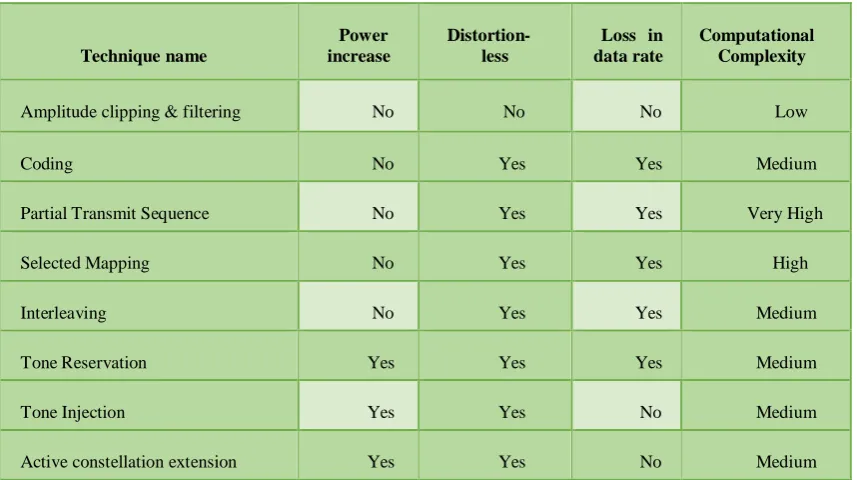
Among all the techniques, PTS [7, 8] is considered to be the best for PAPR reduction scheme but at a cost of high computational complexity. Other techniques are application specific but PTS and SLM are flexible. It has been seen in many occasions PTS has performed better than SLM. Table 4-1 presents the comparison of all the PAPR reduction techniques [9]. Most of the PAPR reduction techniques reduce PAPR at a cost of Bit Error Rate (BER) degradation, signal constellation distortion, increased complexity etc. So choosing a good PAPR reduction technique is a difficult task [10].
Table 1 PAPR reduction techniques comparison
Technique name
Power increase
Distortion- less
Loss in data rate
Computational Complexity
Amplitude clipping & filtering No No No Low
Coding No Yes Yes Medium
Partial Transmit Sequence No Yes Yes Very High
Selected Mapping No Yes Yes High
Interleaving No Yes Yes Medium
Tone Reservation Yes Yes Yes Medium
Tone Injection Yes Yes No Medium
Active constellation extension Yes Yes No Medium
MC-CDMA Transmitter
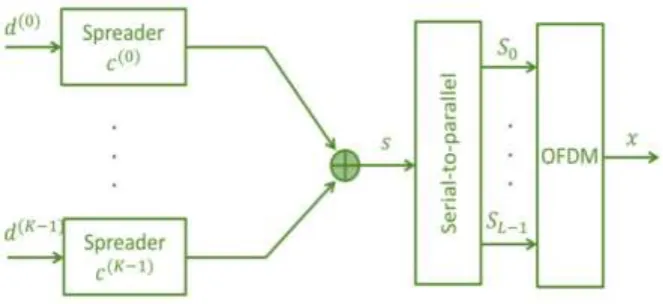
Fig. 1MC-CDMA downlink transmitter
All the user data are spreaded by W-H code and are summed up to produce CDMA signal. Hence, in above figure is essentially CDMA signal. After this OFDM modulation operation is carried out and transmitted through channel.
MC-CDMA Receiver
In the receiver section, first inverse OFDM operation is carried out on the received signal followed by simple equalization. Then the user data are despreaded by using the same spreading code that was used for spreading at the transmitter side to get back the user information bits.
Fig.2 MC-CDMA downlink receiver
Fig. 3 MC-CDMA for a single user for one bit transmission at a time
Here, we can observe that all the bits of a single user are spreaded by a spreading code and transmitted on different sub-carriers. One thing to notice here is that no of sub-carriers have to be taken equal to the spreading factor (SF).
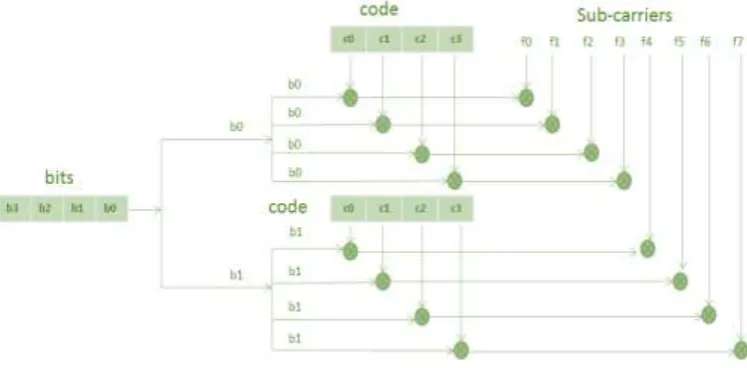
Fig. 4 MC-CDMA for a single user for two bit transmission at a time
The disadvantage of previous scheme is that we have to take no of sub-carriers equal to the spreading factor which is not practically feasible for large no of sub-carriers. In this scheme, two bits are transmitted at a time keeping SF same and no of sub-carriers has been doubled. So this system provides a flexible system design such that number of sub-carriers need not be taken equal to the SF [2, 3].
RESULTS AND DISCUSSION
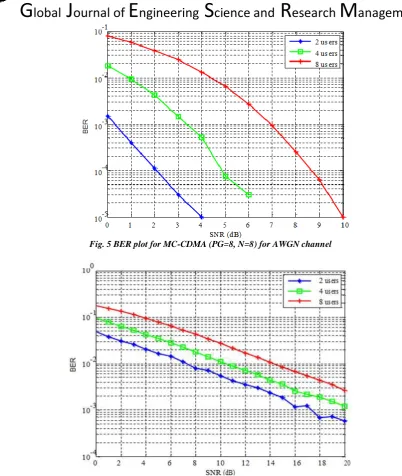
Fig. 5 BER plot for MC-CDMA (PG=8, N=8) for AWGN channel
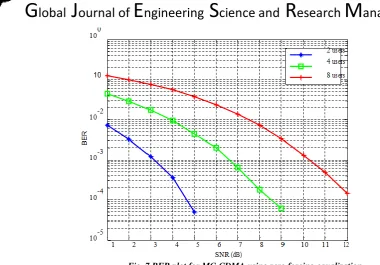
Fig. 7 BER plot for MC-CDMA using zero forcing equalization
Fig. 6 shows the BER plot for multiple users for Rayleigh channel. Here, the channel is considered to be flat fading channel. From both the figures we can conclude that as the no of users increase the BER performance degrades.
Fig. 7 presents the BER plot for MC-CDMA using zero forcing equalization.
Advantages of MC-CDMA
High spectral efficiency: Since MC-CDMA is a superposition of large no of overlapping sub-carriers, it provides high spectral efficiency.
Robustness to channel fading: MC-CDMA converts frequency selective channel to flat fading channels thus eliminating Inter Symbol Interference (ISI).
Flexible system design: Since no of sub-carriers need not be taken equal to the
SF, MC-CDMA offers a flexible system design.
Easy Equalization: Since ISI is eliminated, equalization is almost not required.
High frequency diversity: Since MC-CDMA spreads the signal in frequency direction it achieves high frequency diversity.
Fading resistance: Since it has high frequency diversity it is resistant to fading.
Disadvantages of MC-CDMA
High PAPR: Since it is a combination of large no of independent sub-carriers it exhibits a very high PAPR.
CONCLUSION
MC-CDMA has been the promising innovation for 4G remote correspondence framework. Since it is a blend of both OFDM and CDMA, it investigates the benefits of both the plans. MIMO coordinated with multicarrier procedures can help the information rate and the join's dependability. Likewise by utilizing multi reception apparatus components MIMO can accomplish differences which thusly will enhance BER execution in this way enhancing the unwavering quality at the collector. So STBC MC-CDMA is a suitable applicant in such manner which can accomplish pace, reach and dependability all the while. To lessen PAPR numerous routines have been proposed. The greater part of the systems proposed are application particular, for example, they are just material to paired flagging or specific no of subcarriers. Be that as it may, PTS is an adaptable system which is appropriate for any tweak plan or any no of subcarriers. In this paper, PTS is connected to STBC MC-CDMA for PAPR lessening. Since STBC utilizes 2 transmitting antennas,PTS must be connected to both the receiving wires in both interims.
REFERANCE
1. L.-L. Yang, Multicarrier communications, John Wiley \& Sons, 2009.
2. K. Fazel and S. Kaiser, Multi-carrier and Spread Spectrum Systems: From OFDM and MC-CDMA to LTE and WiMAX, John Wiley \& Sons, 2008.
3. S. Hara and R. Prasad, “Overview of multicarrier CDMA,” IEEE communications Magazine, vol. 35, no. 12, pp. 126-133, 1997.
4. A. J. Paulraj, D. A. Gore, R. U. Nabar and H. Bolcskei, “An overview of MIMO communications-a key to gigcommunications-abit wireless,” Proceedings of the IEEE, vol. 92, no. 2, pp. 198-218, 2004.
5. S. Alamouti, “A simple transmit diversity technique for wireless communications,”Selected Areas in Communications, IEEE Journal on, vol. 16, no. 8, pp. 1451-1458,1983
6. D. Gesbert, M. Shafi, D.-s. Shiu, P. J. Smith and A. Naguib, “From theory to practice: an overview of MIMO space-time coded wireless systems,” Selected Areas in Communications, IEEE Journal on, vol. 21, no. 3, pp. 281-302, 2003.
7. M. D. Hassib, M. Singh, M. Ismail and R. Nordin, “Efficient and low complexity STBC-OFDM scheme over fading channel,” in Communications (APCC), 2012 18th Asia-Pacific Conference on, 2012. 8. L. D'Orazio, C. Sacchi, R. Fedrizzi and F. G. De Natale, “An adaptive minimum-BER approach for multi-user detection in STBC-MIMO MC-CDMA systems,” in Global Telecommunications Conference, 2007. GLOBECOM'07. IEEE, 2007.
9. S. H. Han and J. H. Lee, “An overview of peak-to-average power ratio reduction techniques for multicarrier transmission,” Wireless Communications, IEEE, vol. 12, no. 2, pp. 56-65, 2005.