VOLUME 39, ARTICLE 28, PAGES 795
,
834
PUBLISHED 10 OCTOBER 2018
http://www.demographic-research.org/Volumes/Vol39/28/ DOI: 10.4054/DemRes.2018.39.28
Research Article
Economic uncertainty and first-birth intentions
in Europe
Susanne Fahlén
Livia Sz. Oláh
This publication is part of the Special Collection on “The New Roles of Women and Men and Implications for Families and Societies,” organized by Guest Editors Livia Sz. Oláh, Rudolf Richter, and Irena E. Kotowska.
© 2018 Susanne Fahlén & Livia Sz. Oláh.
This open-access work is published under the terms of the Creative Commons Attribution 3.0 Germany (CC BY 3.0 DE), which permits use, reproduction, and distribution in any medium, provided the original author(s) and source are given credit.
1 Introduction 796
2 Theoretical framework 798
3 Previous research on economic uncertainty and childbearing 799
4 Institutional contexts: Labour market conditions and work–family
reconciliation 802
4.1 Labour market conditions 802
4.2 Work–family reconciliation
5 Methods and data 804
6 Results 808
6.1 Macro-level analyses 808
6.2 Micro-level analyses 809
6.2.1 Economic uncertainty and short-term intentions of entering motherhood
810
6.2.2 Motherhood intentions across welfare regimes 812 6.2.3 Uncertainty and short-term intentions of entering fatherhood 817 6.2.4 Fatherhood intentions across welfare regimes 819
7 Summary and conclusions 823
8 Acknowledgements 824
Economic uncertainty and first-birth intentions in Europe
Susanne Fahlén1
Livia Sz. Oláh2
Abstract
BACKGROUND
The demographic challenge Europe is facing due to long-term low fertility, accompanied by pronounced economic uncertainty, indicates the need for adequate policy response based on a thorough understanding of the economic uncertainty– fertility decisions–public policy nexus.
OBJECTIVE
We address the relationship between societal economic conditions, individual economic uncertainty, and short-term first-birth intentions of women and men in ten European countries, representing various institutional contexts before and after the Great Recession.
METHODS
We analyse European Social Survey data from 2004 and 2011. After addressing the macro-level association, we study the micro-level relationship in regard to perceived security of employment and income situation, based on multiple logistic regression models.
RESULTS
Societal economic uncertainty is negatively associated with short-term parenthood intentions, especially for men. Regarding subjective economic security, men’s labour market position matters irrespectively of the institutional context, but women’s labour market position matters at younger ages only and in particular welfare regimes (the Postsocialist and Familialistic regimes). Perceived income security is less important at higher ages for either gender and for women below age 30, especially in the aftermath of the crisis. Men in their early thirties show the lowest fatherhood intentions in a constrained situation.
1 Department of Sociology, SPaDE, SUDA, Stockholm University. Email:[email protected].
CONTRIBUTION
Our findings highlight the continued importance of economic uncertainty for fertility plans, especially for men, who still seem to consider themselves as the primary earner in couples. For young employed women, a secure position is a precondition for first birth, but motherhood appears as attractive alternative to unemployment above age 30, except for Postsocialist and Universal clusters.
1. Introduction
Europe is facing a demographic challenge, as pointed out in contemporary scholarship of the welfare state, gender, economics, and demography (Oláh and Fahlén 2013). Below-replacement level period fertility rates, displayed in nearly all European countries since the 1990s or even earlier, are accompanied by declining completed cohort fertility of women (and men) born in the mid-1960s and later. In one-third of EU member states, final family size is likely to remain at or below the critical level of low fertility (Myrskylä, Goldstein, and Cheng 2013), known to accelerate population ageing, that prevails in Europe overall, with the prospect of severe consequences for economic development. Also, childlessness levels have increased and in a number of countries about one-fifth of young cohorts may end their reproductive career without becoming a parent (Tanturri et al. 2015), further enhancing concerns about future care-deficit in regards to the elderly (Daly 2012). These demographic trends have been accompanied by relatively high unemployment rates, especially for young people, and high prevalence of precarious jobs across the European Union, resulting in pronounced economic uncertainty for a not negligible part of population (Oláh, Richter, and Kotowska 2014). For adequate policy responses to this situation, a thorough understanding on the economic uncertainty-fertility decisions-public policy nexus is essential. Our study is a modest contribution to that.
run) and expectations about future prospects (Fahlén 2013; Meyers 1997; Rijken and Liefbroer 2009). Short-term intentions are therefore more closely related to the sense of risk and security than general childbearing intentions. Economic situation is important not only for overall wellbeing, but also in relation to fertility trends, as economic uncertainties can constrain men and women’s childbearing plans and, in turn, their fertility (Kotowska et al. 2010; Oláh and Fratczak 2013). Alternatively, uncertain economic situation can boost childbearing intentions as a way to reduce uncertainty in life, by turning the focus to the (more certain) private sphere of the family from the (uncertain) public sphere of the labour market (Friedman, Hechter, and Kanazawa 1994; Pailhé and Solaz 2012). The issue of equality may gain importance here as both alternatives can coexist in a population, but apply to different subgroups related to gender, age, and socioeconomic status (Adserà and Menendez 2011), to name a few. First-birth intentions are of special importance as they influence the transition to parenthood as such, its timing and related to that, also the quantum of fertility (Sobotka 2003).
In our study we seek to shed more light on whether and how economic uncertainty is associated with people’s ability to plan for parenthood in Europe in the early 2000s, before the Great Recession and its aftermath. We analyse women and men of childbearing ages who live in a coresidential partnership and have not yet become parents, hence are likely to consider having a first child soon or delay birth. We address economic uncertainty at two dimensions given its complex nature, both at the macro and the micro levels. For the former, we study changes in unemployment rates and in employment protection legislation (EPL), and their association with fertility intentions. For the latter we rely on measures of individuals’ perceptions on insecurity, while also taking into account the partner’s labour force attachment. We focus on ten countries selected to represent the full range of institutional and policy variations commonly depicted as welfare regime types (Esping-Andersen 1990; Korpi 2000; also see Hobson and Oláh 2006) in Europe to also gain better understanding about the role of the institutional context in the economic uncertainty‒fertility interplay indicated in the literature (Adserà 2011).
2. Theoretical framework
As pointed out in the literature, the sociopsychological theory of planned behaviour (TPB) (Ajzen 1991; Ajzen and Fishbein 2005) provides a framework well suited for analyses of short-term childbearing intentions (Ajzen and Klobas 2013; Philipov and Bernardi 2012). This framework has been increasingly utilised in demographic research addressing the role of intentions as a key issue in the behavioural decision-making process (Dommermuth, Klobas, and Lappegård 2011; Philipov 2009b; also see Billari, Philipov, and Testa 2009 for an overview of earlier studies). In the TPB intentions are seen as a motivation to act. Strong intentions increase the probability that people will realise their intentions. Intentions themselves are influenced by individual characteristics, attitudes, and norms, and perceived behavioural control, suggesting that not only available means and resources, but also a person’s subjective ability to act, based on perceived obstacles and constraints, matter (Ajzen 1991; Ajzen and Fishbein 2005). In this paper we combine the TPB (reflecting the micro level) with an institutional approach (the macro perspective) taking into account variations in societal economic uncertainty and work–family reconciliation policies in different contexts. We seek to deepen the understanding of the interplay between individual life situations and institutional factors that shape people’s perceived behavioural control, which in turn can affect their sense of risk and security regarding their present situation and future prospects.
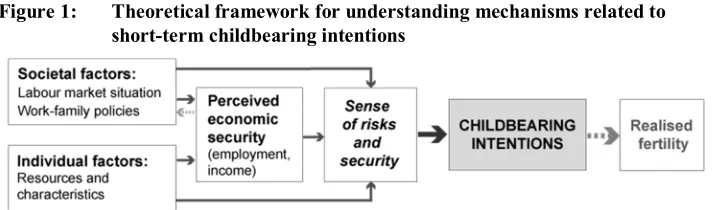
of men and women in a strained macroeconomic situation, socioeconomic characteristics notwithstanding. The institutional context at hand (perceived via expectations regarding employment, measures of work–family reconciliation, and the social protection offered at economic hardship) would shape the leeway for individuals in their specific macro- and microeconomic situation, hence matter for their perceived economic security and, in turn, fertility plans. Thus, short-term first childbearing intentions are shaped by people’s sense of risk and security, which is influenced by societal factors, individual factors, and perceived economic security (see also Fahlén 2013; Fahlén and Oláh 2013). Relying on this theoretical framework we study men and women’s capabilities to become parents in contemporary Europe, as reflected in their short-term first-birth intentions, taking into account variations in the institutional context.
Figure 1: Theoretical framework for understanding mechanisms related to short-term childbearing intentions
3. Previous research on economic uncertainty and childbearing
Matysiak, Sobotka, and Vignoli 2018), the United States (see Schneider 2015; and Comolli 2017 also for overview of relevant studies) and Latin America (Adserà and Menendez 2011). Most studies, however, rely on data that does not cover the Great Recession or its aftermath (unlike Comolli 2017; Schneider 2015). Employment protection legislation (EPL) has been suggested to be relevant for trends in unemployment, but the association is unclear (Nickell, Nunziata, and Ochel 2005; Skedinger 2010), and possibly varies by gender and age groups (Bertola, Blau, and Kahn 2007; Kugler and Pica 2003, Vos 2009). Research on the link between EPL and childbearing intentions is relatively limited and the findings are inconclusive, as both negative (Adserà 2004) and positive fertility effects (Bratti, Del Bono, and Vuri 2005; Prifti and Vuri 2013) have been shown for stricter EPL.
As for perception of insecurity, Kreyenfeld (2005; 2010) finds no clear indication of economic uncertainty leading to a postponement of parenthood in Germany, but highly educated women tend to delay first birth if they perceive their economic situation as insecure. Insecure employment delays this transition for women in France as well (Pailhé and Solaz 2012), but not in Russia (Kohler and Kohler 2012). In addition, previous research suggests that economic uncertainty affects women and men’s fertility differently (Kreyenfeld 2005; Pailhé and Solaz 2012; Schmitt 2012; Tölke and Diewald 2003). With respect to childbearing intentions compared to actual fertility, the association with economic uncertainty has received somewhat less attention in the literature on Europe until quite recently (Hofmann and Hohmeyer 2013, but see the special collections by Kreyenfeld, Andersson, and Pailhé 2012; Oláh and Fratczak 2013, among others). Berninger, Weiß, and Wagner (2011) find a direct effect of income and an indirect effect of job security satisfaction on men’s childbearing intentions for West Germany, whereas for women no direct and only a weak indirect impact of precarious work could be observed. In a comparative study Fahlén (2013) shows that perceived economic uncertainty is negatively associated with women’s first-birth intentions across ten European countries, especially among the less educated in countries with weaker work–family reconciliation policies. The importance of the institutional setting with respect to the relationship between uncertainty and fertility decisions has been noted in other studies as well (see Adserà 2005; Kreyenfeld, Andersson, and Pailhé 2012; Oláh and Fratczak 2013; Özcan, Mayer, and Luedicke 2010; Schmitt 2012).
4. Institutional contexts: Labour market conditions and work
–
family
reconciliation
4.1 Labour market conditions
Labour market arrangements have become important aspects for fertility decisions across Europe in the early 21st century (Adserà 2011). Focusing on employment rates in
2004 and 2011 for men and women in the main childrearing ages in the ten countries we analyse (Figure 2), we see a decrease for men with the exception of Germany, the Czech Republic, and Poland. Among women, the rates decreased in all countries but Germany, the Netherlands, Spain, and Poland. For the year 2004, the largest gender employment gap is seen for Germany, the Netherlands, the United Kingdom, and Spain. By 2011 it has diminished for Spain due to a substantial drop in male employment rates and a slight increase in women’s rates. Thus the macroeconomic situation seems to have deteriorated in varying extent across countries between the years prior to the recession and the aftermath.
Figure 2: Employment rates for men and women in the main childrearing ages (25–49 years), 2004 and 2011
Source:Eurostat (2013a).
However, employment rates per se may be less informative when it comes to macro-level economic uncertainty. Unemployment is probably of greater importance as it can influence childbearing intentions not only for those directly affected by it, but also for employed people, strengthening perception of uncertainty in the society (Kravdal 2002). Such uncertainty, related to arbitrary dismissal among others, may be reduced via the EPL, being indirectly associated with birth plans, affecting the sense of risks and future prospects (Allard 2005). In this study we address these macro-level
0 10 20 30 40 50 60 70 80 90 100
DK FI SW DE NL UK ES CZ HU PL
Men 2004
Men 2011
Women 2004
measures in diverse institutional settings, to enhance our knowledge on the mechanism around economic uncertainty and parenthood intentions.
4.2 Work–family reconciliation
The substantial differences in fertility levels across Europe have been attributed to variations in especially women’s capabilities to combine employment with having a family (OECD 2011a). How the paid work-care nexus is institutionalised, as seen in social policy (e.g., Korpi, Ferrarini, and Englund 2013; Lewis 2009) and labour market arrangements (Blossfeld et al. 2005; Esping-Andersen 1999), varies greatly across countries. In this paper we focus on ten countries that represent the full scale of such variations in Europe, distinguishing among five welfare regime types.
Denmark, Finland, and Sweden represent the Universal model, with generous institutional support for work–family reconciliation (Gornick and Meyers 2005) and high levels of public childcare provision, heavily subsidised (Plantenga and Remery 2009). The Conservative model provides relatively modest institutional support for maternal employment (Gornick and Meyers 2005), as seen in Germany and the Netherlands. Access to formal childcare, especially on full-time basis and for children below age three, is limited (Plantenga and Remery 2009), and the cost of childcare increased in the first decade of the 21st century (OECD 2011b, 2013a). The Liberal
5. Methods and data
The empirical analysis is based on data extracted from the European Social Survey (ESS), waves 2004/2005 and 2010/2011, which are the only ones that include information on short-term childbearing intentions and perceived job security around the years of the Great Recession. Although the ESS has been conducted in more than 20 countries, the information of interest for us would be available only for 17 countries, and not for all of them in both waves, with a substantial overrepresentation of postsocialist countries. We have therefore opted to include three countries of the latter group in our analyses, namely the ones that joined the European Union earliest among them, and to focus on ten countries altogether. The ESS sample is representative of all persons 15 years and older in each country. We analyse a subsample of a total of 2,174 respondents from the ten countries3 studied here, women aged 20–45, and men aged
25–49 living with a partner but without children in the household (1,165 childless women and 1,009 childless men). The reason of using different age-ranges for women and men is that women are younger when they have their first child than men, which means that intentions to become a parent are also formed at younger ages for them. On the other hand, childbearing above age 45 is extremely rare among women, which explains the upper limit of their age-range.
Weights are used to correct for differences in the sample design and population size (see Ganninger 2007). In our analyses first we address the macro-level association between measures of economic uncertainty and aggregated first childbearing intentions in 2004 and 2011 across the selected countries. Thereafter we focus on the micro-level relationships, based on multiple logistic regression models. We have chosen to use this method rather than to rely on multilevel models as analytical tool because we analyse a limited number of countries (i.e., ten) grouped into five welfare regime clusters. A sensitivity test, running separate analyses by regime types, showed no significant differences between countries within each welfare regime cluster and did not improve the respective models. Hence, including the variable regime types into the analyses to control for differences across institutional contexts is feasible. Below we present the variables included in the analyses.
Our dependent variable, short-term first childbearing intention, is based on the question: “Do you plan to have a child within the next three years?” Response alternatives are: definitely not, probably not, probably yes, and definitely yes, which we have recoded to create a dichotomous variable with ‘probably yes’ and ‘definitely yes’ in one category and the two other response alternatives in the other. Don’t know and
3 The number of respondents per country are: DK=158 (women: 82; men: 76); FI=238 (w: 150; m: 88);
missing responses were also included in the latter category, to maximize the size of the working sample. This information has also been used for measuring aggregate childbearing intentions, based on the country- and gender-specific proportions of respondents who intend to have a first child in the near future, for the macro-level analyses. The difference between the proportions for 2004 and 2011 has been calculated to capture the changes between these two points in time, separately by country and gender.
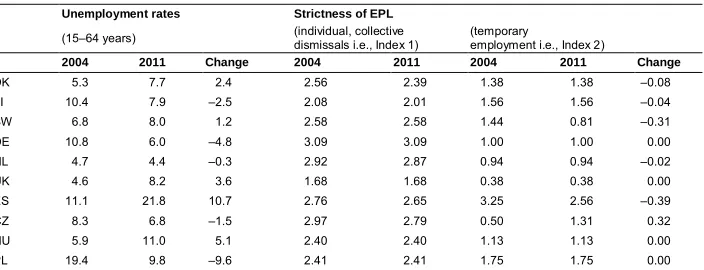
In the macro-level analyses, we rely on indicators most relevant for economic uncertainty in relation to childbearing decisions as discussed above: unemployment rates and strictness of EPL (see Table 1). As we want to capture the societal economic ‘climate’ affecting the sense of uncertainty, and whether and how it has changed from the before-crisis period to the aftermath of the crisis, we use information on overall unemployment provided by Eurostat for ages 15–64 years, instead of a more limited age-range or gender-specific unemployment rates for 2004 and 2011. The difference between the rates in the two years is calculated to capture changes in unemployment.4
Our second measure is based on the OECD index scores of the strictness of EPL that includes two indices (see OECD 2013b and Venn 2009 for index construction): the EPL for individual and collective dismissals and the EPL for temporary employment. These two EPL-indices are summed and divided by two for 2004 and 2011 respectively, and the difference between the values for these years is calculated to capture changes in employment protection.5
Regarding the micro-level analyses, the main variables of interest refer to subjective economic uncertainty, operationalised as perceived job security and perceived income security, based on self-evaluations of a respondent’s employment situation and economic resources. Perceived job security is based on the statement “My job is secure,” referring to an actual or implied promise of continued employment. The responses ‘not at all true’/‘a little true’ are regarded as expressions of feeling insecure whereas ‘quite true’/‘very true’ suggest feeling secure about one’s job. In order to avoid a reduction of the subsample, as the statement was presented only to employed respondents, we added two further categories to the perceived job security variable: unemployed (i.e., respondents not in paid work during the week of the survey) and others (i.e., self-employed and those in unspecified activities, as well as missing responses). Perceived income security, which is our second measure of subjective economic uncertainty, refers to the household income. Responses ‘finding it difficult’/‘very difficult to live on present income’ suggest a constrained economic situation; ‘living comfortably on present income’ indicates comfortable economic situation, and ‘coping on present income’ is considered as manageable economic
4 That is: Change = Unemployment rate 2011 – Unemployment rate 2004.
situation. The latter category includes also the few missing responses. Via the welfare regime variable we account for contextual differences (i.e., societal factors, see Figure 1), discussed in section 4, in the regression model. The Universal welfare regime includes Denmark, Finland, and Sweden, the Conservative regime includes Germany and the Netherlands, the Liberal regime includes the United Kingdom, the Familialistic regime includes Spain, and the Postsocialist regime includes the Czech Republic, Hungary, and Poland. Individual resources and characteristics (see Figure 1) are accounted for in the analysis by the following factors: respondent’s age (in the range of 20–45 years for women and 25–49 years for men),6 respondent’s educational attainment
(the few missing responses, not shown in the tables, are included in the analysis as a separate category), and the co-resident partner’s labour force attachment (see Table 2).7 Table 1: Unemployment rates, strictness of employment protection legislation
(EPL), and changes between 2004 and 2011
Unemployment rates Strictness of EPL
(15–64 years) (individual, collectivedismissals i.e., Index 1) (temporaryemployment i.e., Index 2)
2004 2011 Change 2004 2011 2004 2011 Change
DK 5.3 7.7 2.4 2.56 2.39 1.38 1.38 –0.08 FI 10.4 7.9 –2.5 2.08 2.01 1.56 1.56 –0.04 SW 6.8 8.0 1.2 2.58 2.58 1.44 0.81 –0.31 DE 10.8 6.0 –4.8 3.09 3.09 1.00 1.00 0.00 NL 4.7 4.4 –0.3 2.92 2.87 0.94 0.94 –0.02 UK 4.6 8.2 3.6 1.68 1.68 0.38 0.38 0.00 ES 11.1 21.8 10.7 2.76 2.65 3.25 2.56 –0.39 CZ 8.3 6.8 –1.5 2.97 2.79 0.50 1.31 0.32 HU 5.9 11.0 5.1 2.40 2.40 1.13 1.13 0.00 PL 19.4 9.8 –9.6 2.41 2.41 1.75 1.75 0.00
Note: Higher EPL value denotes stronger employment protection legislation.
Sources: Eurostat (2013b), OECD (2013b).
6 Respondents with missing information about their age were neither included in descriptive statistics table,
nor in the analyses.
7 The few respondents with missing information on this aspect were not included in the analyses, or in the
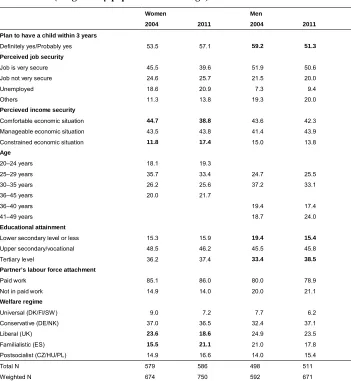
Table 2: Descriptive statistics of the sample by gender and survey year (weighted by population and design)
Women Men
2004 2011 2004 2011
Plan to have a child within 3 years
Definitely yes/Probably yes 53.5 57.1 59.2 51.3 Perceived job security
Job is very secure 45.5 39.6 51.9 50.6 Job not very secure 24.6 25.7 21.5 20.0 Unemployed 18.6 20.9 7.3 9.4 Others 11.3 13.8 19.3 20.0
Percieved income security
Comfortable economic situation 44.7 38.8 43.6 42.3 Manageable economic situation 43.5 43.8 41.4 43.9 Constrained economic situation 11.8 17.4 15.0 13.8
Age
20–24 years 18.1 19.3
25–29 years 35.7 33.4 24.7 25.5 30–35 years 26.2 25.6 37.2 33.1 36–45 years 20.0 21.7
36–40 years 19.4 17.4
41–49 years 18.7 24.0
Educational attainment
Lower secondary level or less 15.3 15.9 19.4 15.4
Upper secondary/vocational 48.5 46.2 45.5 45.8 Tertiary level 36.2 37.4 33.4 38.5 Partner’s labour force attachment
Paid work 85.1 86.0 80.0 78.9 Not in paid work 14.9 14.0 20.0 21.1
Welfare regime
Universal (DK/FI/SW) 9.0 7.2 7.7 6.2 Conservative (DE/NK) 37.0 36.5 32.4 37.1 Liberal (UK) 23.6 18.6 24.9 23.5 Familialistic (ES) 15.5 21.1 21.0 17.8 Postsocialist (CZ/HU/PL) 14.9 16.6 14.0 15.4
Total N 579 586 498 511
Weighted N 674 750 592 671
6. Results
In this section we first present the results of the aggregate analyses on the association between changes in societal-level economic uncertainty, and the difference in country-specific childbearing intentions in 2004 and 2011. Thereafter, we present the results of individual-level logistic regression analyses with separate models by gender and age group.
6.1 Macro-level analyses
To capture the potential impact of changes in societal economic uncertainty on short-term childbearing intentions from the before-crisis years to the afshort-termath of the crisis, we explore the interrelation between changes in unemployment rates and strictness of EPL, respectively, and differences in aggregate first childbearing intentions. Considering changes in unemployment we find a negative gradient (Figure 3), that is a decrease in first childbearing intentions among both women and men in countries where unemployment rates increased.8 This finding is in line with previous studies (see Adserà
2005; Comolli 2017; Hondroyiannis 2010; Matysiak, Sobotka, and Vignoli 2018). The association is stronger for men than for women, possibly because men are still considered to be the main provider in the household, making his unemployment more of a hindrance for the first birth than her unemployment (Sobotka, Skirbekk, and Philipov 2011).
In regard to changes between 2004 and 2011, we find that employment protection matters especially for men’s first childbearing intentions, related to their provider role (Figure 4). The relationship is similar, but much weaker for women. In any case, short-term intentions for entering parenthood has increased in countries where the employment protection legislation has been strengthened between the period before the crisis to 2011, as expected (see Hofmann and Hohmeyer 2013). Thus our macro-level analyses suggest a negative association between increasing societal economic uncertainty as seen in higher unemployment rates and a worsening in employment protection, and short-term first-birth intentions across Europe, especially among men.
8 We have also performed the macro-level analyses using female and male unemployment rates (ages 15–64
Figure 3: Intention difference for childless women and men, and change in unemployment rates
Figure 4: Intention difference for childless women and men, and change in strictness of EPL
6.2 Micro-level analyses
In this section we address the relationship between perceived job and income security on the one hand, and short-term first childbearing intentions on the other. We present separate models for women and men by selected age groups to account for possible interactions between age and other variables. The tables also present interactions
Correlation:–0.33 Correlation:–0.49
Correlation: 0.20 Correlation: 0.62
DK FI SW DE NL UK ES CZ HU PL -30 -25 -20 -15 -10 -5 0 5 10 15 20 25 30
-0.4 -0.3 -0.2 -0.1 0.0 0.1 0.2 0.3 0.4
In te n tio n d iff e re n ce
Change in Strictness in EPL
Childless women DK FI SW DE NL UK ES CZ HU PL -30 -25 -20 -15 -10 -5 0 5 10 15 20 25 30
-0.4 -0.3 -0.2 -0.1 0.0 0.1 0.2 0.3 0.4
In te n tio n d iff e re n ce
Change in Strictness in EPL
Childless men DK FI SW DE NL UK ES CZ HU PL -30 -25 -20 -15 -10 -5 0 5 10 15 20 25 30
-10 -8 -6 -4 -2 0 2 4 6 8 10
In te n tio n d iff e re n ce Unemployment change Childless women DK FI SW DE NL UK ES CZ HU PL -30 -25 -20 -15 -10 -5 0 5 10 15 20 25 30
-10 -8 -6 -4 -2 0 2 4 6 8 10
between the main variables of interest (the survey year, perceived employment security, and perceived income security). Only interactions that significantly improve the model fit are shown.
6.2.1 Economic uncertainty and short-term intentions of entering motherhood
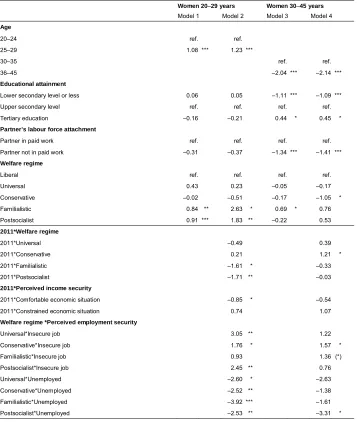
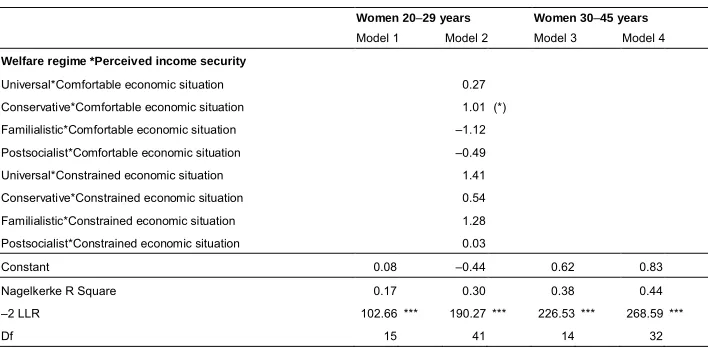
Table 3 shows the results of the regression analysis with separate models for age groups 20–29 and 30–45 years, as previous research indicates more pronounced negative association between economic uncertainty and fertility for women below age 30 than for older ages (see e.g., Oláh and Fratczak 2013; and Comolli 2017 for an overview of relevant studies). We find several significant interactions between our main variables of interest (see Models 2 and 4), discussed in the next section. As for individual characteristics, the gradients are in the expected direction. We see that the youngest (20–24) and oldest (36–45) age groups are least keen to consider entering motherhood in the near future (Models 1–4). Educational attainment is not associated with short-term childbearing intentions for women below age 30 (Models 1–2), whereas in the older age group, the less educated are the least motivated and the tertiary educated are the most prone to plan for motherhood within the next three years (Models 3–4). Living with a partner who is not employed decreases motivations to plan the first birth within short for the older age group only (see Models 3–4).
Table 3: Logistic regression of childbearing intentions of childless women, age groups 20–29 and 30–45 years (coefficients)
Women 20–29 years Women 30–45 years
Model 1 Model 2 Model 3 Model 4
Survey year
Year 2004 ref. ref. ref. ref. Year 2011 0.00 0.68 0.53 ** 0.22
Perceived employment security
Secure job ref. ref. ref. ref. Insecure job –1.02 *** –2.94 *** –0.04 –1.21 (*) Unemployed –0.03 2.33 ** 0.43 2.03 * Other –0.62 * –0.63 0.31 –0.30
Perceived income security
Table 3: (Continued)
Women 20–29 years Women 30–45 years
Model 1 Model 2 Model 3 Model 4
Age
20–24 ref. ref.
25–29 1.08 *** 1.23 ***
30–35 ref. ref.
36–45 –2.04 *** –2.14 ***
Educational attainment
Lower secondary level or less 0.06 0.05 –1.11 *** –1.09 *** Upper secondary level ref. ref. ref. ref. Tertiary education –0.16 –0.21 0.44 * 0.45 *
Partner’s labour force attachment
Partner in paid work ref. ref. ref. ref. Partner not in paid work –0.31 –0.37 –1.34 *** –1.41 ***
Welfare regime
Liberal ref. ref. ref. ref.
Universal 0.43 0.23 –0.05 –0.17 Conservative –0.02 –0.51 –0.17 –1.05 * Familialistic 0.84 ** 2.63 * 0.69 * 0.76 Postsocialist 0.91 *** 1.83 ** –0.22 0.53
2011*Welfare regime
2011*Universal –0.49 0.39
2011*Conservative 0.21 1.21 * 2011*Familialistic –1.61 * –0.33 2011*Postsocialist –1.71 ** –0.03
2011*Perceived income security
2011*Comfortable economic situation –0.85 * –0.54 2011*Constrained economic situation 0.74 1.07
Welfare regime *Perceived employment security
Table 3: (Continued)
Women 20–29 years Women 30–45 years
Model 1 Model 2 Model 3 Model 4
Welfare regime *Perceived income security
Universal*Comfortable economic situation 0.27 Conservative*Comfortable economic situation 1.01 (*) Familialistic*Comfortable economic situation –1.12 Postsocialist*Comfortable economic situation –0.49 Universal*Constrained economic situation 1.41 Conservative*Constrained economic situation 0.54 Familialistic*Constrained economic situation 1.28 Postsocialist*Constrained economic situation 0.03
Constant 0.08 –0.44 0.62 0.83 Nagelkerke R Square 0.17 0.30 0.38 0.44 –2 LLR 102.66 *** 190.27 *** 226.53 *** 268.59 ***
Df 15 41 14 32
Note: ***p ≤0.001; **p ≤0.01; *p ≤0.05; (*)p ≤0.10.
6.2.2 Motherhood intentions across welfare regimes
We have calculated probabilities9 for childless women’s short-term birth intentions,
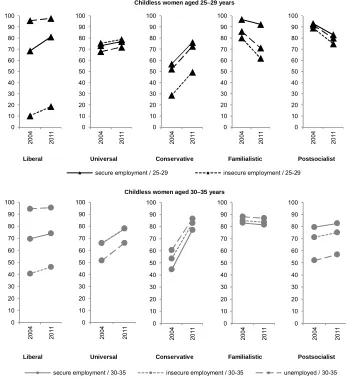
taking into account significant interactions indicated above (Table 3, Models 2 and 4). We see that the association with perceived job security varies across welfare regime clusters by survey year and age group. Figure 5 illustrates these interactions for women aged 25–29 and 30–35 years,10 who are most likely to plan to become mothers in the
near future (see Table 3). In all figures hereafter, lines are used to highlight the difference for the same category between the years 2004 and 2011, but not to imply a continuous change over the period as data is available only for these specific years.
For women aged 25–29 (Figure 5, upper row), we observe a diverse pattern across welfare regime types. In the Postsocialist and the Familialistic regimes, the intention probabilities are lower in the crisis period than in 2004, suggesting that young women’s short-term first-birth intentions in these regimes are more affected by the greater societal economic uncertainties induced by the economic crisis, unlike in the Liberal, the Universal and the Conservative regime types. In all welfare clusters, except for the
9The following formula is used to calculate probabilities from the coefficients in the logistic regression:
P=exp(a+b(var1)+b(var2)+b(var3)+…)/1+exp(a+b(var1)+b(var2)+b(var3)+…), wherea denotes the constant
andb the coefficient value.
10 The calculations also adjust for perceived income security, education, and partner’s labour-force
Universal regime type, women in their late twenties who feel insecure about their job display lower intention probabilities compared to those with secure job, indicating that subjective employment security matters for young women’s childbearing plans. Unemployment appears to matter less than having insecure employment. In fact, in the Liberal regime, intention probabilities for unemployed women are above that of women who perceive their job as secure. The latter pattern applies also to women in their early thirties, and is in line with the literature (Schmitt 2012).
Figure 5: Short-term intention probabilities by perceived job security in the survey years and different welfare regime clusters for childless women aged 25–29 and 30–35
Childless women aged 25–29 years
Liberal Universal Conservative Familialistic Postsocialist
Childless women aged 30–35 years
Liberal Universal Conservative Familialistic Postsocialist
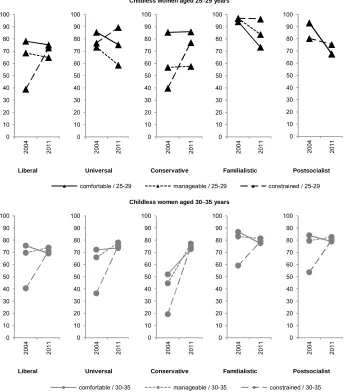
Next we look at interaction effects with respect to subjective income situation. Figure 6 illustrates the interactions between survey year, perceived income security, and
0 10 20 30 40 50 60 70 80 90 100 2 0 0 4 2 0 1 1 0 10 20 30 40 50 60 70 80 90 100 2 0 0 4 2 0 1 1 0 10 20 30 40 50 60 70 80 90 100 2 0 0 4 2 0 1 1 0 10 20 30 40 50 60 70 80 90 100 2 0 0 4 2 0 1 1 0 10 20 30 40 50 60 70 80 90 100 2 0 0 4 2 0 1 1
secure employment / 25-29 insecure employment / 25-29
0 10 20 30 40 50 60 70 80 90 100 2 0 0 4 2 0 1 1 0 10 20 30 40 50 60 70 80 90 100 2 0 0 4 2 0 1 1 0 10 20 30 40 50 60 70 80 90 100 2 0 0 4 2 0 1 1 0 10 20 30 40 50 60 70 80 90 100 2 0 0 4 2 0 1 1 0 10 20 30 40 50 60 70 80 90 100 2 0 0 4 2 0 1 1
welfare regime clusters for childless women aged 25–29 and 30–35 years.11 For women
aged 25–29 (Figure 6, upper row), we find the lowest motherhood intentions in 2004 among those who perceive their economic situation as constrained in all but the Universal and the Familialistic clusters. In 2011, women in a constrained economic situation are not the ones with the lowest first-birth intentions in any welfare regime types, but those in manageable situation are, except for the Familialistic regime type. Thus the patterns indicate that perceived income insecurity matters less for young women’s short-term first birth plans in times of substantial societal economic uncertainty than in economically less uncertain periods.
For women aged 30–35 (Figure 6, lower row), the intention probabilities of those who perceive their income situation as constrained, are higher in all welfare regime types in 2011 than before the crisis. In fact, there is little difference in 2011 between their intentions and those with either manageable or comfortable situations, unlike in 2004 when the lowest intention probabilities were seen for women in constrained economic situations across welfare clusters. Societal economic uncertainty appears to matter more to women with comfortable income situations in the Liberal, the Familialistic, and the Postsocialist regime clusters, as seen in their somewhat lower intention probabilities in 2011 compared to 2004. Taken together, the findings suggests that, in times of greater societal economic uncertainty as compared to more stable periods, perceived income insecurity has little importance for motherhood intentions among women in their early thirties in all welfare regime types, even less than among women in their late twenties. Unlike for the association between perceived job security and motherhood intentions, differences by welfare clusters and age groups are hardly noticeable.
11 The calculations adjust for perceived employment security, education and partner’s labour-force
Figure 6: Short-term intention probabilities by perceived income security in the survey years and different welfare regime clusters for childless women aged 25–29 and 30–35
Childless women aged 25–29 years
Liberal Universal Conservative Familialistic Postsocialist
Childless women aged 30–35 years
Liberal Universal Conservative Familialistic Postsocialist
Note: For the Postsocialist regime, the lines for comfortable and manageable situations, age 25–29 years, overlap. 0 10 20 30 40 50 60 70 80 90 100 2 0 0 4 2 0 1 1 0 10 20 30 40 50 60 70 80 90 100 2 0 0 4 2 0 1 1 0 10 20 30 40 50 60 70 80 90 100 2 0 0 4 2 0 1 1 0 10 20 30 40 50 60 70 80 90 100 2 0 0 4 2 0 1 1 0 10 20 30 40 50 60 70 80 90 100 2 0 0 4 2 0 1 1
comfortable / 25-29 manageable / 25-29 constrained / 25-29
0 10 20 30 40 50 60 70 80 90 100 2 0 0 4 2 0 1 1 0 10 20 30 40 50 60 70 80 90 100 2 0 0 4 2 0 1 1 0 10 20 30 40 50 60 70 80 90 100 2 0 0 4 2 0 1 1 0 10 20 30 40 50 60 70 80 90 100 2 0 0 4 2 0 1 1 0 10 20 30 40 50 60 70 80 90 100 2 0 0 4 2 0 1 1
6.2.3 Uncertainty and short-term intentions of entering fatherhood
Next, we turn to childless men. Table 4 displays the regression results for age groups 25–35 and 36–49 years, analysed separately. We find significant interaction effects for our main variables of interest, presented in the next section. Regarding individual characteristics, age below mid-thirties seems to matter less (Model 2) but men aged 36– 40 are more likely to intend to have a child in the near future than those at ages 41–49 (Models 3–4). As for educational attainment, we find for both age groups that less educated men are less likely to plan to become fathers within short (Models 1–4). Partner’s labour-force attachment matters only for men in more mature ages, as her not being employed decreases fatherhood intentions for men aged 36–49, no matter whether interactions are taken into account or not (Models 1–4).
Table 4: Logistic regression of childbearing intentions of childless men, age groups 25–35 and 36–49 years (coefficients)
Men 25–35 years Men 36–49 years
Model 1 Model 2 Model 3 Model 4
Survey year
Year 2004 ref. ref. ref. ref. Year 2011 –0.28 (*) –0.42 * –0.28 –1.05 (*)
Perceived employment security
Secure job ref. ref. ref. ref. Insecure job 0.06 –2.23 * 0.00 0.81 * Unemployed 0.43 –0.90 –1.05 (*) 0.39 Other 0.24 –2.76 * –0.40 –0.24
Perceived income security
Manageable economic situation ref. ref. ref. ref. Comfortable economic situation 0.44 * –0.35 –0.10 –0.11 Constrained economic situation –0.59 * –2.10 *** 0.23 0.25
Age
25–29 ref. ref.
30–35 0.32 (*) –0.04
36–40 ref. ref.
41–49 –2.00 *** –2.04 ***
Educational attainment
Table 4: (Continued)
Men 25–35 years Men 36–49 years
Model 1 Model 2 Model 3 Model 4
Partner’s labour-force attachment
Partner in paid work ref. ref. ref. ref. Partner not in paid work –0.27 –0.27 –1.83 *** –1.78 ***
Welfare regime
Liberal ref. ref. ref. ref.
Universal 0.04 0.26 –0.35 –1.36 (*) Conservative –0.12 0.33 –0.04 –0.83 (*) Familialistic 0.48 * 0.51 0.52 –0.36 Postsocialist 0.53 * 1.16 (*) 0.01 –1.67 *
2011*Welfare regime
2011*Universal 1.94
2011*Conservative 1.39 *
2011*Familialistic 1.82 *
2011*Postsocialist 2.99 **
2011*Perceived employment security
2011*Insecure job –1.55 **
2011*Unemployed –3.07 *
Welfare regime *Perceived income security
Universal*Comfortable economic situation 0.79 Conservative*Comfortable economic situation 1.32 ** Familialistic*Comfortable economic situation 0.76 Postsocialist*Comfortable economic situation 1.18 Universal*Constrained economic situation 1.62 Conservative*Constrained economic situation 2.72 *** Familialistic*Constrained economic situation 2.16 ** Postsocialist*Constrained economic situation 1.34 (*)
Perceived employment security*Age
Insecure job*30-35 0.88 * Unemployed*30-35 0.55
Constant 0.59 * 1.45 *** 0.75 * 1.22 ** Nagelkerke R Square 0.08 0.13 0.36 0.41 –2 LLR 45.80 *** 72.56 *** 152.26 *** 173.98 ***
Df 15 26 15 22
6.2.4 Fatherhood intentions across welfare regimes
Similarly to the analyses on women, we calculate intention probabilities for men’s plans regarding fatherhood at ages when they are most likely to intend to have a child within short, that is 30–35 and 36–40 years12 (see Table 4, Model 2, and Model 4). As Figure 7
shows, the relationship between birth intentions and job security varies by age group, survey year, and welfare regime clusters. For ages 30–35 (Figure 7, upper row), the intention probabilities are lower in 2011 than in 2004 independently of welfare regime type. For both years, the lowest fatherhood intention probabilities are seen among men who perceive their job as insecure, while unemployment appears to matter less, similarly to the pattern for women in their late twenties (Figure 5). Unlike for women, however, the perception of one’s employment being secure is associated with the highest first-birth intention probabilities among men in their early thirties in all welfare clusters.
For men aged 36–40 (Figure 7, lower row), we find larger differences by perceived job security regarding short-term fatherhood plans in the aftermath of the crisis compared to 2004 in all welfare regime types. Perception of a secure employment seems less important for first-birth intentions prior to the crisis. In 2011 however, unemployed men display the least capability to plan for a child in the near future in all clusters, whereas men with a secure job show highest intention probabilities. Compared to 2004, their fatherhood intention probabilities even increased in all but the Liberal regime, unlike for men with perceived insecure positions or being unemployed. Taken together, the findings indicate that unemployment and perceived employment insecurity are associated with reduced first childbearing intentions for men in their thirties, in times of pronounced societal economic uncertainty, independently of welfare regime types. This may be related to the emphasis on men’s provider responsibilities being strengthened in times of economic crisis across various institutional contexts, unlike for women.
12The calculations adjust for perceived income security, education, and partner’s labour-force attachment.
Figure 7: Short-term intention probabilities by perceived job security in the survey years and different welfare regime clusters for childless men aged 30–35 and 36–40
Childless men aged 30–35 years
Liberal Universal Conservative Familialistic Postsocialist
Childless men aged 36–40 years
Liberal Universal Conservative Familialistic Postsocialist
0 10 20 30 40 50 60 70 80 90 100 2 0 0 4 2 0 1 1 0 10 20 30 40 50 60 70 80 90 100 2 0 0 4 2 0 1 1 0 10 20 30 40 50 60 70 80 90 100 2 0 0 4 2 0 1 1 0 10 20 30 40 50 60 70 80 90 100 2 0 0 4 2 0 1 1 0 10 20 30 40 50 60 70 80 90 100 2 0 0 4 2 0 1 1
secure employment / 30-35 insecure employment / 30-35 unemployed / 30-35
0 10 20 30 40 50 60 70 80 90 100 2 0 0 4 2 0 1 1 0 10 20 30 40 50 60 70 80 90 100 2 0 0 4 2 0 1 1 0 10 20 30 40 50 60 70 80 90 100 2 0 0 4 2 0 1 1 0 10 20 30 40 50 60 70 80 90 100 2 0 0 4 2 0 1 1 0 10 20 30 40 50 60 70 80 90 100 2 0 0 4 2 0 1 1
Next we focus on interaction effects with respect to men’s subjective income security. Childless men ages 30–35 (Figure 8, lower row) have lower intention probabilities to father a child in the near future in 2011 than in 2004 across welfare regimes, and regardless of their perceived income situation. Yet in all welfare clusters, men in constrained economic situation are less likely to intend to become fathers within three years than men with comfortable economic position, both before the crisis and in 2011. The difference between the intention probabilities of men in these subjective income categories varies, however, across regime types, with the most pronounced difference seen in the Liberal regime, followed by the Postsocialist and the Universal clusters where men in constrained economic situation have the lowest intention probabilities to become fathers within a short time. For the Conservative and the Familialistic regime types we find the lowest fatherhood intentions for men in manageable income situation, with little difference to those in constrained situation in the latter. Hence, subjective income security seems to matter for short-term childbearing plans of men in their early thirties, especially in times of greater societal economic uncertainty.
Figure 8: Short-term intention probabilities by perceived income security in the survey years and different welfare regime clusters for childless men aged 30–35 and 36–40
Childless men aged 30–35 years
Liberal Universal Conservative Familialistic Postsocialist
Childless men aged 36–40 years
Liberal Universal Conservative Familialistic Postsocialist
0 10 20 30 40 50 60 70 80 90 100 2 0 0 4 2 0 1 1 0 10 20 30 40 50 60 70 80 90 100 2 0 0 4 2 0 1 1 0 10 20 30 40 50 60 70 80 90 100 2 0 0 4 2 0 1 1 0 10 20 30 40 50 60 70 80 90 100 2 0 0 4 2 0 1 1 0 10 20 30 40 50 60 70 80 90 100 2 0 0 4 2 0 1 1
comfortable / 30-35 manageable / 30-35 constrained / 30-35
0 10 20 30 40 50 60 70 80 90 100 2 0 0 4 2 0 1 1 0 10 20 30 40 50 60 70 80 90 100 2 0 0 4 2 0 1 1 0 10 20 30 40 50 60 70 80 90 100 2 0 0 4 2 0 1 1 0 10 20 30 40 50 60 70 80 90 100 2 0 0 4 2 0 1 1 0 10 20 30 40 50 60 70 80 90 100 2 0 0 4 2 0 1 1
7. Summary and conclusions
In this study we have addressed the interplay between macroeconomic conditions, individual economic uncertainty, and short-term first-birth intentions of men and women in ten European countries representing various institutional and policy contexts. Focusing on changes in unemployment rates and the employment protection legislation, we have found in our macro-level analysis a negative association between increased societal economic uncertainty and aggregated intentions to become a parent within a few years. The strength of the association varies by gender, men being more responsive to increased risks than women, which is likely to reflect men’s role as main provider. The micro-level analyses also indicate that more pronounced societal economic uncertainty, as in the aftermath of the Great Recession, matters more for men seen in their lower fatherhood intentions compared to 2004, whereas motherhood intentions have not changed substantially.
The relationship between individual-level uncertainty and childbearing plans seems to vary across welfare regime types, age, and gender, as revealed by the interaction analyses. Regarding perceived job security, secure employment enhances fatherhood intentions, especially at ages below the mid-thirties, independently of societal economic uncertainty and welfare regime type. In their late thirties, being unemployed suppresses men’s childbearing plans the most, at times of pronounced societal economic uncertainty, while insecure job situations matter less, particuluarly before the economic crisis. For women, secure employment seems to be a precondition of motherhood plans in most welfare regimes, but unemployment does not suppress first-birth intentions much, except for more mature ages in the Postsocialist regime, and somewhat less so in the Universal cluster. Policy support for the dual-earner family is quite substantial in the latter regimes, influencing women’s views on the importance of being employed when considering motherhood. The findings highlight the continued importance of men’s labour market position for family formation in general, independently of institutional contexts and business cycles, while women’s perceived job security matters mainly at younger ages, and in specific policy contexts (most in the Postsocialist and Familialistic clusters, and least in the Liberal regime type).
welfare regimes in 2011. Thus, perceived income security seems to be less important for short-term parenthood intentions at higher ages (men in late thirties and women in early thirties), independently of the institutional context in the aftermath of the crisis, and for men also before the crisis. At younger ages, a constrained income situation appears to impede first-birth plans for men in particular, both before the Great Recession and the aftermath. For young women, subjective income situation matters only in the precrisis year.
Taken together the findings of this study, we conclude that economic security has remained an important aspect in the family building process in times of societal economic uncertainty, especially for men, related to their primary provider role as perceived by themselves and in the society, irrespectively of the institutional context. This can impede the transition to the dual-earner family, considered as supportive for fertility. For women, economic insecurity matters less for motherhood plans, and mainly for ages below 30, with varying extent across welfare regime types at more mature ages in particular.
8. Acknowledgements
References
Adserà, A. (2004). Changing fertility rates in developed countries: The impact of labor market institutions.Journal of Population Economics 17(1): 17–43.doi:10.1007/
s00148-003-0166-x.
Adserà, A. (2005). Vanishing children: From high unemployment to low fertility in developed countries.American Economic Review95(2): 189–193.doi:10.1257/
000282805774669763.
Adserà, A. (2011). Where are the babies? Labor market conditions and fertility in Europe.European Journal of Population 27(1): 1–32.
doi:10.1007/s10680-010-9222-x.
Adserà, A. and Menendez, A. (2011). Fertility changes in Latin America in periods of economic uncertainty. Population Studies 65(1): 37–56.doi:10.1080/00324728.
2010.530291.
Ajzen, I. (1991). The theory of planned behavior. Organizational Behavior and
Decision Processes 50(2): 179–211.doi:10.1016/0749-5978(91)90020-T.
Ajzen, I. and Fishbein, M. (2005). The influence of attitudes on behaviour. In: Albarracín, D., Johnson, B.T., and Zanna, M.P. (eds.). The handbook of
attitudes. Mahwah: Lawrence Erlbaum: 173–221.
Ajzen, I. and Klobas, J. (2013). Fertility intentions: An approach based on the theory of planned behavior. Demographic Research 29(8): 203–232. doi:10.4054/Dem Res.2013.29.8.
Allard, G.J. (2005). Measuring job security over time: In search of a historical indicator for EPL (Employment Protection Legislation). Madrid: Instituto de Empresa (IE working paper WP05–17).
Andersson, G. (2000). The impact of labour-force participation on childbearing behavior: Pro-cyclical fertility in Sweden during the 1980s and the 1990s.
European Journal of Population 16(4): 293–333. doi:10.1023/A:100645490
9642.
Andersson, G., Kreyenfeld, M., and Mika, T. (2014). Welfare state context, female labour-market attachment, and childbearing in Denmark and Germany. Journal
Balbo, N., Billari, F.C., and Mills, M. (2013). Fertility in advanced societies: A review of research. European Journal of Population 29(1): 1–38.
doi:10.1007/s10680-012-9277-y.
Berninger, I., Weiß, B., and Wagner, B. (2011). On the links between employment, partnership quality, and the intention to have a first child: The case of West Germany. Demographic Research 24(24): 579–610. doi:10.4054/DemRes.
2011.24.24.
Bertola, G., Blau, F.D., and Kahn, L.M. (2007). Labor market institutions and demographic employment patterns. Journal of Population Economics 20(4): 833–867.doi:10.1007/s00148-007-0137-8.
Billari, F.C., Philipov, D., and Testa, M.R. (2009). Attitudes, norms, and perceived behavioural control: Explaining fertility intentions in Bulgaria. European
Journal of Population 25(4): 439–465.doi:10.1007/s10680-009-9187-9.
Blossfeld, H.-P., Klijzing, E., Mills, M., and Kurz, K. (2005). Globalization, uncertainty, and youth in society. London: Routledge.
Bratti, M., Del Bono, E., and Vuri, D. (2005). New mothers’ labour force participation in Italy: The role of job characteristics. Labour 19(s1): 79–121. doi:10.1111/
j.1467-9914.2005.00324.x.
Brewster, K.L. and Rindfuss, R.R. (2000). Fertility and women’s employment in industrialized nations.Annual Review of Sociology 26(2000): 271–296. doi:10.
1146/annurev.soc.26.1.271.
Comolli, C.L. (2017). The fertility response to the ‘Great Recession’ in Europe and the United States: Structural economic conditions and perceived economic uncertainty. Demographic Research 36(51): 1549–1600. doi:10.4054/DemRes.
2017.36.51.
Daly, M. (2012). Making policy for care: Experience in Europe and its implications in Asia.International Journal of Sociology and Social Policy 32(11/12): 623–635.
doi:10.1108/01443331211280674.
De la Rica, S. and Iza, A. (2005). Career planning in Spain: Do fixed-term contracts delay marriage and parenthood? Review of Economics of the Household 3(1): 49–73.doi:10.1007/s11150-004-0979-8.
Esping-Andersen, G. (1990).Three worlds of welfare capitalism. Princeton: Princeton University Press.
Esping-Andersen, G. (1999). Social foundations of postindustrial economies. Oxford: Oxford University Press.doi:10.1093/0198742002.001.0001.
Eurostat (2013a). Employment rates by sex, age, and highest level of education attained (%), 25–49 years [electronic resource]. Luxembourg: European Commission, Eurostat. http://appsso.eurostat.ec.europa.eu/nui/show.do?dataset=lfsq_ergaed&
lang=en.
Eurostat (2013b). Unemployment rates by sex, age, and nationality (%), 15–64 years [electronic resource]. Luxembourg: European Commission, Eurostat.
http://appsso.eurostat.ec.europa.eu/nui/show.do?dataset=lfsa_urgacob&lang=en.
Fahlén. S. (2013). Capabilities and childbearing intentions in Europe: The association between work-family reconciliation policies, economic uncertainties, and women’s fertility plans. European Societies 15(5): 639–662. doi:10.1080/
14616696.2013.798018.
Fahlén, S. and Oláh, L.Sz. (2013). Work and childbearing intentions from a capability perspective: Young adult women in Sweden. In: Oláh, L.Sz. and Fratczak, E. (eds.). Childbearing, women’s employment, and work-life balance policies in
contemporary Europe. Basingstoke: Palgrave Macmillan: 28–64.
doi:10.1057/9781137318541_2.
Ferrarini, T. (2006). Families, states, and labour markets: Institutions, causes, and
consequences of family policies in post-war welfare states. Cheltenham: Edward
Elgar Publishing Limited.doi:10.4337/9781847201669.
Ferrera, M. (1996). The ‘southern model’ of welfare in social Europe. Journal of
European Social Policy 6(1): 17–37.doi:10.1177/095892879600600102.
Friedman, D., Hechter, M., and Kanazawa, S. (1994). A theory of the value of children.
Demography 31(3): 375–401.doi:10.2307/2061749.
Ganninger, M. (2007). Weighting the ESS cumulative data set. Bergen: Norwegian Social Science Data Services.
Goldstein, J.R., Kreyenfeld, M., Jasilioniene, A., and Örsal, D.K. (2013). Fertility reactions to the ‘Great Recession’ in Europe. Demographic Research29(4): 85–
104.doi:10.4054/DemRes.2013.29.4.
Gornick, J.C. and Meyers, M.K. (2005). Families that work: Policies for reconciling
Gutiérrez-Domènech, M. (2008). The impact of the labour market on the timing of marriage and births in Spain. Journal of Population Economics21(1): 83–110.
doi:10.1007/s00148-005-0041-z.
Hagewen, K.J. and Morgan, P.S. (2005). Intended and ideal family size in the United States, 1970–2002. Population and Development Review 31(3): 507–527.
doi:10.1111/j.1728-4457.2005.00081.x.
Hobcraft, J. and Kiernan, K. (1995). Becoming a parent in Europe. London: London School of Economics, Toyota Centre, Welfare State Programme (discussion paper WSP/116).
Hobson, B. and Oláh, L.Sz. (2006). Birthstrikes? Agency and capabilities in the reconciliation of employment and family.Marriage and Family Review39(3–4): 197–227.doi:10.1300/J002v39n03_01.
Hoem, B. (2000). Entry into motherhood in Sweden: The influence of economic factors on the rise and fall in fertility, 1986–1997. Demographic Research 2(4).
doi:10.4054/DemRes.2000.2.4.
Hofmann, B. and Hohmeyer, K. (2013). Perceived economic uncertainty and fertility: Evidence from a labor market reform. Journal of Marriage and Family 75(2): 503–521.doi:10.1111/jomf.12011.
Hondroyiannis, G. (2010). Fertility determinants and economic uncertainty: An assessment using european panel data. Journal of Family and Economic Issues
31(1): 33–50.doi:10.1007/s10834-009-9178-3.
Kohler, H.-P. and Kohler, I. (2002). Fertility decline in Russia in the early and mid 1990s: The role of economic uncertainty and labour market crisis. European
Journal of Population 18(3): 233–262.doi:10.1023/A:1019701812709.
Korpi, W. (2000). Faces of inequality: Gender, class, and patterns of inequalities in different types of welfare states. Social Politics 7(2): 127–191. doi:10.1093/
sp/7.2.127.
Korpi, W., Ferrarini, T., and Englund, S. (2013). Women’s opportunities under different family policy constellations: Gender, class, and inequality tradeoffs in Western countries reexamined. Social Politics 20(1): 1–40. doi:10.1093/
sp/jxs028.
Kotowska, I., Matysiak, A., Styrc, M., Pailhé, A., Solaz, A., and Vignoli, D. (2010).
Family life and work: Second European quality of life survey. Luxembourg:
Kravdal, Ø. (2002). The impact of individual and aggregate unemployment on fertility in Norway. Demographic Research 6(10): 263–294. doi:10.4054/DemRes.
2002.6.10.
Kreyenfeld, M. (2005). Economic uncertainty and fertility postponement: Evidence from German panel data. Rostock: Max Planck Institute for Demographic Research (MPIDR working paper WP 2005-034).
Kreyenfeld, M. (2010). Uncertainties in female employment careers and the postponement of parenthood in Germany.European Sociological Review 26(3): 351–366.doi:10.1093/esr/jcp026.
Kreyenfeld, M., Andersson, G., and Pailhé, A. (2012). Economic uncertainty and family dynamics in Europe: Introduction. Demographic Research 27(28): 835–852.
doi:10.4054/DemRes.2012.27.28.
Kugler, A. and Pica, G. (2003). Effects of employment protection and product market regulations on the Italian labor market. Bonn: Institute for the Study of Labor (IZA discussion paper 948).
Lanzieri, G. (2013). Towards a ‘baby recession’ in Europe? Differential fertility trends during the economic crisis. Eurostat: Statistics in Focus13(2013).
Lewis, J. (2009).Work-family balance and gender policy. Cheltenham: Edward Alger.
doi:10.4337/9781848447400.
Livi-Bacci, M. (2001). Comment: Desired family size and the future course of fertility.
Population and Development Review 27(2001): 282–289. doi:10.1017/CBO9
780511528545.013.
Lundström, K.E. and Andersson, G. (2012). Labor-market status, migrant status, and first childbearing in Sweden. Demographic Research 27(25): 719–742.
doi:10.4054/DemRes.2012.27.25.
Matysiak, A., Sobotka, T., and Vignoli, D. (2018). The ‘Great Recession’ and Fertility in Europe: A sub-national analysis. Vienna: Vienna Institute of Demography (VID working papers 2/2018).
Matysiak, A. and Vignoli, D. (2010). Employment around first birth in two adverse institutional settings: Evidence from Italy and Poland. Journal of Family
Research 22(3): 331–349.
Morgan, P.S. and Rackin, H. (2010). The correspondence between fertility intentions and behavior in the United States. Population and Development Review 36(1): 91–118.doi:10.1111/j.1728-4457.2010.00319.x.
Myrskylä, M., Goldstein, J.R., and Cheng, Y.-H.A. (2013). New cohort fertility forecasts for the developed world: Rises, falls, and reversals. Population and
Development Review 39(1): 31–56.doi:10.1111/j.1728-4457.2013.00572.x.
Nickell, S., Nunziata, L., and Ochel, W. (2005). Unemployment in the OECD since the 1960s. What do we know? The Economic Journal 115(500): 1–27.
doi:10.1111/j.1468-0297.2004.00958.x.
OECD (2011a).Doing better for families. Paris: OECD Publishing.
OECD (2011b). Childcare support (2004) [electronic resource]. Paris: Organisation for Economic Co-operation and Development. www.oecd.org/els/social/family/ database.htm.
OECD (2012). Maternal employment rates, 2009 [electronic resource]. Paris: Organisation for Economic Co-operation and Development. www.oecd.org/ els/social/family/database.htm.
OECD (2013a). Childcare support (2008) [electronic resource]. Paris: Organisation for Economic Co-operation and Development. www.oecd.org/els/social/family/ database.htm.
OECD (2013b). Employment protection legislation: Strictness of employment protection legislation. Paris: OECD Publishing.
Oláh, L.Sz. and Fahlén, S. (2013). Introduction: Aspirations and uncertainties: Childbearing choices and work-life realities in Europe. In: Oláh, L.Sz. and Fratczak, E. (eds.). Childbearing, women’s employment, and work-life balance
policies in contemporary Europe. Basingstoke: Palgrave Macmillan: 1–27.
doi:10.1057/9781137318541_1.
Oláh, L.Sz. and Fratczak, E. (2013).Childbearing, women’s employment, and work-life
balance policies in contemporary Europe. Basingstoke: Palgrave Macmillan.
doi:10.1057/9781137318541.
Oláh, L.Sz., Richter, R., and Kotowska, I. (2014). State-of-the-art report: The new roles of men and women and implications for families and societies. In: Doblhammer, G. and Gumà, J. (eds.).A demographic perspective on gender, family, and health
Özcan, B., Mayer, K.U., and Luedicke, J. (2010). The impact of unemployment on the transition to parenthood.Demographic Research 23(29): 807–846.doi:10.4054/
DemRes.2010.23.29.
Pailhé, A. and Solaz, A. (2012). The influence of employment uncertainty on childbearing in France: A tempo or quantum effect? Demographic Research
26(1): 1–40.doi:10.4054/DemRes.2012.26.1.
Philipov, D. (2009a). The effect of competing intentions and behaviour on short-term childbearing intentions and subsequent childbearing. European Journal of
Population 25: 525–548.doi:10.1007/s10680-009-9197-7.
Philipov, D. (2009b). Fertility intentions and outcomes: The role of policies to close the
gap.European Journal of Population 25(4): 355–361.
doi:10.1007/s10680-009-9202-1.
Philipov, D. and Bernardi, L. (2012). Concepts and operationalisation of reproductive decisions implementation in Austria, Germany, and Switzerland. Comparative
Population Studies – Zeitschrift für Bevölkerungswissenschaft 36(2–3): 495–
531.
Philipov, D., Spéder, Z., and Billari, F.C. (2006). Soon, later, or ever? The impact of anomie and social capital on fertility intentions in Bulgaria (2002) and Hungary (2001).Population Studies 60(3): 289–308.doi:10.1080/00324720600896080. Plantenga, J. and Remery, C. (2009). The provision of childcare services: A
comparative review of 30 European countries. Luxembourg: Office for Official
Publications of the European Communities.
Prifti, E. and Vuri, D. (2013). Employment protection and fertility: Evidence from the 1990 Italian reform. Labour Economics 23: 77–88. doi:10.1016/j.labeco.2013.
04.003.
Ranjan, P. (1999). Fertility behaviour under income uncertainty. European Journal of
Population 15(1): 25–43.doi:10.1023/A:1006106527618.
Rijken, A.J. and Liefbroer, A.C. (2009). The influence of partner relationship quality on fertility. European Journal of Population 25(1): 27–44.
doi:10.1007/s10680-008-9156-8.
Santarelli, E. (2011). Economic resources and the first child in Italy: A focus on income and job stability.Demographic Research 25(9): 311–336.doi:10.4054/DemRes.
Saxonberg, S. and Sirovátka, T. (2006). Failing family policy in post-communist Central Europe.Journal of Comparative Policy Analysis: Research and Practice
8(2): 185–202.doi:10.1080/13876980600682089.
Schmitt, C. (2012). Labour market integration, occupational uncertainties, and fertility choices in Germany and the UK. Demographic Research 26(12): 253–292.
doi:10.4054/DemRes.2012.26.12.
Schneider, D. (2015). The ‘Great Recession’, fertility, and uncertainty: Evidence from the United States. Journal of Marriage and Family 77(5): 1144–1156. doi:10.
1111/jomf.12212.
Schoen, R., Astone, N.M., Kim, Y.J., Nathanson, C.A., and Fields, J.M. (1999). Do fertility intentions affect fertility behavior?Journal of Marriage and the Family
61(3): 790–799.doi:10.2307/353578.
Skedinger, P. (2010). Employment protection legislation: Evolution, effects, winners,
and losers. Cheltenham: Edward Elgar.doi:10.4337/9781849805599.
Sobotka, T. (2003). Tempo-quantum and period-cohort interplay in fertility changes in Europe: Evidence from the Czech Republic, Italy, the Netherlands, and Sweden.
Demographic Research 8(6): 151–214.doi:10.4054/DemRes.2003.8.6.
Sobotka, T., Skirbekk, V., and Philipov, D. (2011). Economic recession and fertility in the developed world. Population and Development Review 37(2): 267–306.
doi:10.1111/j.1728-4457.2011.00411.x.
Tanturri, M.-L., Mills, M., Rotkirch, A., Sobotka, T., Takács, J., Miettinen, A., Faludi, C., Kantsa, V., and Nasiri, D. (2015). State-of-the-art report: Childlessness in Europe.Families and Societies32(2015).
Tölke, A. and Diewald, M. (2003). Insecurities in employment and occupational careers and their impact on the transition to fatherhood in Western Germany.
Demographic Research 9(3): 41–67.doi:10.4054/DemRes.2003.9.3.
Venn, D. (2009). Legislation, collective bargaining, and enforcement: Updating the OECD employment protection indicators. Paris: OECD Social, Employment, and Migration (OECD working papers 89).
Vignoli, D., Drefahl, S., and De Santis, G. (2012). Whose job instability affects the likelihood of becoming a parent in Italy? A tale of two partners. Demographic
Research 26(2): 41–62.doi:10.4054/DemRes.2012.26.2.
Vikat, A. (2004). Women’s labor force attachment and childbearing in Finland.
Vos, A.E. (2009). Falling fertility rates: New challenges to the European welfare state.