Experimental Study and CFD Modeling of the Ohmic Heating
Process in a Static Two-Phase Biosolid – Liquid System
M. Keshavarz Moraveji*, E. Ghaderi
Department of Chemical Engineering, Amirkabir University of Technology (Tehran Polytechnic), Tehran, Iran
Abstract
The effective parameters on Ohmic heating in static system containing biosolid-water were studied. The effects of distribution of particles, salinity and electric field strength on electrical conductivity, profiles of temperature, heat generation have been investigated.
The experimental data verification with simulation results using computational fluid dynamics (CFD) method were carried out. Governing equations (heat transfer and electrical equations) were discretized with finite element method.
The experimental data and CFD results showed that in Ohmic heating process, the current diffusion in all the products is faster than traditional methods and the diffusion rates are equal for both biosolid-liquid phases.
Keywords: Ohmic Heating, Biosolid-Liquid, CFD, Electrical Conductivity, Salinity, Electrical Field Strength
1. Introduction
The study of heat transfer into foods is of great importance, because heat processing is the most common technique used for preservation today. Electrical and electro-thermal methods such as microwave, Ohmic heating and pulsed electric field are very interesting processes in foods and biomaterials processing [1]. Ohmic heating is a novel direct heating method as electrical currents pass through materials to heat them. Ohmic heating occurs when an electric current is passed through food, resulting in a temperature rise in the product due to the conversion of the electric energy into heat (Joule effect). Most foods contain ionic
Corresponding author: [email protected]
components such as salts and acids. Therefore, electrical current can pass through the foods and generate heat inside them [2].
Ohmic heating technology has been accepted by the industries for processing of liquids and solid liquid mixture [6].
The rate of Ohmic heating is directly proportional to the square of the electric field strength and the electrical conductivity. The critical property which effects on the Ohmic heating is the electrical conductivity of the food. Variation of the salinity, pH and applied electrical power during the Ohmic heating may alter the electrical conductivity [1].
Design, scale up and optimization of heating technology require the knowledge of transport phenomena such as heat transfer. While there are several experimental procedures for optimizing the operating conditions, the use of computational fluid dynamic (CFD) tools for providing valuable information about the mentioned conditions have attracted considerable attention in recent years.
To ensure a completely safe Ohmically cooked product, a model of the thermal process should first be developed to identify possible hot and cold spots, to quantify heat losses and to evaluate the influence of key variables such as electrical field strength and sample conductivity [5]. Several models have been developed based on Ohmic heating of solid liquid mixtures and experimentally validated for single particle in a static heater [2,3]. There are some models for multiple Particle systems in both static and continuous flow of Ohmic heaters [4,7,8].
The aim of this paper is experimental investigation and CFD simulation on the influences of effective parameters such as electrical conductivity, salinity and electric field strength on the Ohmic heating process.
Also, experimental data were compared with CFD modeling results.
2. Experiments
2-1. Hydrocolloid solution preparation
Starch was used to make a hydrocolloid solution. Starch is a neutral polysaccharide, so heating process has minimum impact on it. Therefore, it was used to study the effects of electrolyte content on the Ohmic heating rate. For this purpose, two types of hydrocolloid solutions (without and with electrolyte) were prepared.
2-2. Hydrocolloid solution preparation without electrolyte content
A sample of commercial starch was obtained and three concentrations of hydrocolloid were prepared in distilled water. Hydrocolloid powder was first solubilized in distilled water using a high speed blender (500 rpm) for 8 minutes. When suspension transparency increased the starch granules swelled. The gelatin was unified by mixing for 5 minutes and then it was put in a refrigerator to decrease its temperature (below 20°C).
2-3. Hydrocolloid solution preparation with electrolyte content
65-70°C. Mixing was continued to complete the gelatinization and then cooled.
The Citric acid (0.05 M) was used to study the effect of pH level of hydrocolloid solutions on Ohmic heating process. The capacity of Ohmic heating cell was 2000 mL. Initially 1970 mL of starch solution with concentration of 8% was prepared and 30 mL of acid was then added. In the next step, the solution was mixed (for 20 minutes) and then cooled.
2-4. Experimental device
The static Ohmic heating cell used in the experiment is made of a Pyrex glass cylinder T-tube, 6.31 cm diameter in which a sample volume was introduced between two stainless steel electrodes. The cross-sectional surface area of electrodes was 28.84 cm2. The gap between the electrodes was 59.5 cm. PT-100 type thermocouples coated with Teflon to prevent interference with the electrical field were fitted at the cylinder. Voltage and AC Current were supplied and controlled by a power unit which included a variable Transformer. Thermal lags due to Teflon coating of the thermocouple were corrected using data from preliminary Calibration experiments involving comparison with a certified mercury-in-glass thermometer and a portable tool which have the ability to measure temperature and pH (WTW, pH/Temp, and model 340i, Germany). Voltage and current values of solution were measured by a digital multimeter
(GwINSSTEK, GDM-8034).For
time-temperature processing, thermocouple was connected to a Transmitter (4NX, Process Temperature controller, Hany Oung Product, China) along with a converter (NUX-CV30) that is connected to the computer.
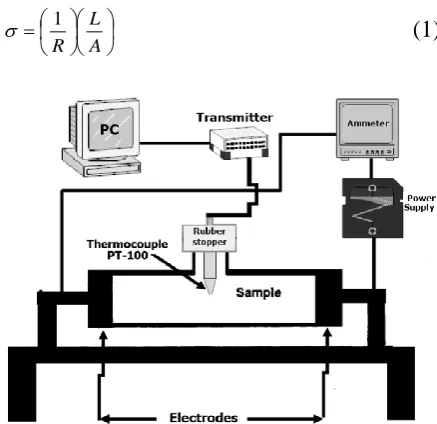
2-5. Electrical conductivity measurement A schematic diagram of the electrical circuitry is shown in Fig. 1. AC current field strength (5.04 kV/m) was applied to induce Ohmic heating. A T-Type thermocouple coated with Teflon was fitted at the geometric centre of the cylinder. 2000 mL of sample was entered into the cylinder. The sample was heated from 20 to 100°C using an AC (with frequency of 60 Hz) at a constant voltage of 300 V. Temperature-time values were recorded in a transmitter with a converter that was connected to the computer. For each experiment, voltage and current values were used to calculate the electrical conductivity and it was plotted against temperature. The electrical conductivity was calculated using the cell dimensions, voltage and current using the following equation [5]:
A L R
1
(1)
Figure 1. Circuit of the static Ohmic heating cell for electrical conductivity measurement.
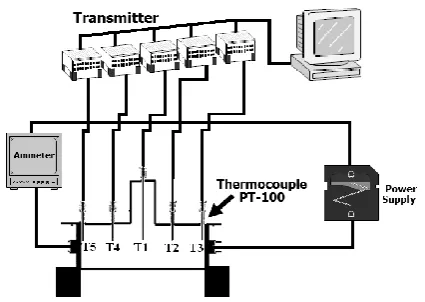
2-6. Heating procedure
An AC power (5.04 kV/m) was applied to
induce Ohmic heating. Five T-Type
thermocouples coated with Teflon were
perpendicularly fitted to the cylinder (Fig. 2).
Two thermocouples were placed close to each
electrode. Two thermocouples were placed
between the centre of the cylinder and the
electrodes in each direction and one
thermocouple was exactly placed at the centre.
3. CFD modeling
In order to generate heat in an Ohmic heating
system, an electric field should be applied.
The electric field (voltage distribution) is a
function of the electrode and system
geometry, electrical conductivity and the used voltage.
Figure 2. Static Ohmic unit cell (cylindrical Teflon cell and five thermocouples).
3-1. Governing equations
The electric field is determined by the Laplace’s equation as shown in the following [3,4]:
∇. (𝜎𝑖. ∇𝑉) = 0 (1)
where σ and V are the electrical
conductivity and voltage gradient,
respectively. This equation was obtained by combination of Ohm’s law and the continuity equation for electric current. It usually is
expressed as the following equation because σ
is a function of both position and temperature.
∇2V = 0 (2)
De Alwis and Fryer [2] solved this
equation for a static Ohmic heater in a single
particle system with the boundary conditions as uniform voltage on the electrodes and
there is no current flux across the particle. In
this case, the electric field was predicted
based on semi empirical models with the
following boundary conditions:
𝑉⃓⃓Z=0= V0 𝑉⃓⃓Z=L= 𝑉𝐿 (3)
For many biomaterials, the electrical conductivity (σ) is assumed linearly dependent on temperature and expressed as
follows:
𝜎 = 𝜎0(1 + 𝑚𝑇) (4)
Temperature distribution in a heater
containing a static medium and an inclusion
particle is governed by thermal conduction
with internal energy generation. Thermal
balances for the static medium and the
inclusion particle are given as shown below,
respectively:
(5)
(6)
In order to Ohmically heat a food, it is
The heat generated in the food by that current
is proportional to the square of its intensity
(I), the proportionality constant being the
electrical resistance (R), thus yielding:
(7)
Alternatively, if both electrical conductivity (σ) and voltage gradient
are known, it is possible to write the heat
generation terms as follows.
) 1
(
0 2
f f f
f V m T
q (8)
) 1 (
0 2
s s s
s V mT
q (9)
Equations (8) and (9) are subject to an
initial condition (10) and an external
boundary condition, which is governed by
convection to the surroundings (9):
Tf = TS = Ti at t=0 (10)
) (
.
. Tn U T Tamb
kf f
(11)
where n and U are unit normal vector and
overall heat transfer coefficient.
3-2. Numerical methodology
The governing equations have been
discertized based on finite element method.
Discrtized equations have been solved with
software package Comsol Multiphysics [9]. This software runs the finite element analysis alongside adaptive meshing and
error control using a variety of iterative
numerical solvers. It generates a mesh that
is tetrahedral in shape and isotropic in size.
The direct solver UMFPACK is employed because it is preferable for 1D and 2D
models. It employs the COLAMD and AMD
approximate minimum degree preordering
algorithms to permute the columns so that the fill-in is minimized.
The empirical parameters obtained from
the experimental results in Table 1 and 2 have
been used to simulate the Ohmic heating
process. Linear regression analysis (R2) is
greater than 0/99 and the corresponding linear
model for electrical conductivity changes with
temperature in the sample.
4. Result and Discussion
4-1. Effect of electrical conductivity
Fig. 3 shows effects of temperature and
concentration of particles on electrical
conductivity. As shown in this figure, electrical
conductivity increased with increasing
temperature and concentration. Most electrical
conductivity was obtained when hydrocolloid
solution with concentration of 1% was used. Electrical conductivity linearly increased with
increasing temperature. Furthermore, electrical
conductivity increased with increasing the salt
concentration. This output’s results are verified
by literature data [2,10,11].
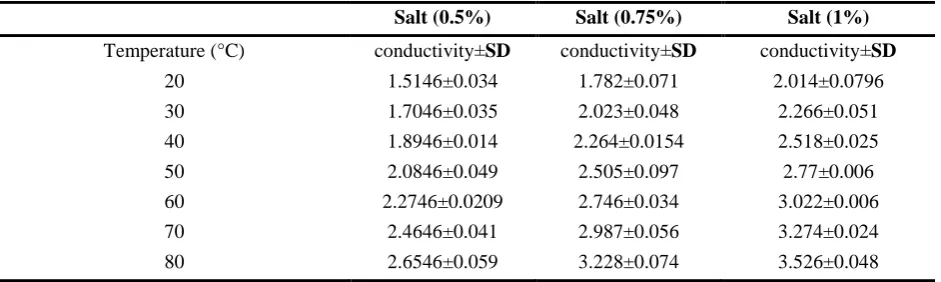
In Table 3, the electrical conductivity
value was calculated in the temperature range
20 to 80oC with three concentrations of salt.
The electrical conductivity for hydrocolloid
solution (3.3% concentration) with 1% salt at
80oC was equal to 3.526 (S/m) and with 1%
salt at the same temperature was 2.6546 (S/m). By increasing the amount of salt, the
mobility of ions increase and therefore the
electrical conductivity of the solution
Table 1
The best linear relationship between electrical conductivity and thermoelectric properties [12] - the physical function of temperature with temperature coefficients for solution starch 3.3% salt with 0/5%.
Unit R2
Curve fitting (T) Property
S / m 0.9992
σ=0.0139T + 0.7825 Electrical conductivity (σ)
W / (m2.K)
0.9566 Cp=0.2857T2-36.804 T+ 4227.2
Specific heat (Cp)
A / m2
0.9992 J=6.9503T+392.56
Current density (J)
Table 2
Physical parameters used in simulation.
Unit Value
Property
S/m 1.1302
Electrical conductivity at 25°C
1 ℃⁄
0.014 Temperature coefficient electrical conductivity
Cm 59.5
Heater length (LH)
Cm 6.31
Heater diameter (Dh)
KV m⁄
5.04 Voltage gradient (∆V)
V 200, 220, 240, 260, 280, 300
Applied Voltage (V)
Table 3
Electrical conductivity values at different temperatures for 3.3% starch solution with a salt concentration 1, 0.75 and 0.5%.
Salt (0.5%) Salt (0.75%) Salt (1%)
Temperature (°C) conductivity±SD conductivity±SD conductivity±SD
20 1.5146±0.034 1.782±0.071 2.014±0.0796 30 1.7046±0.035 2.023±0.048 2.266±0.051 40 1.8946±0.014 2.264±0.0154 2.518±0.025 50 2.0846±0.049 2.505±0.097 2.77±0.006 60 2.2746±0.0209 2.746±0.034 3.022±0.006 70 2.4646±0.041 2.987±0.056 3.274±0.024 80 2.6546±0.059 3.228±0.074 3.526±0.048
In general, electrolytic conduction load is carried by ions, so ionization to solution causes increase in the electrical conductivity. Kinetic energy of ions increases with increasing temperature and so conductive electrolyte resistance generally decreases with increasing temperature and will result in increasing temperature in the solution.
Palaniappan and Sastry [2] for biomass systems under Ohmic process reported that electrical conductivity is a linear function of temperature and is expressed as the following equation:
𝜎 = 𝜎ref[1 + 𝑚(𝑇 − 𝑇𝑟𝑒𝑓)] (12)
Fryer et al. [13] stated the linear solution with higher viscosity differently:
(13)
Value of 0 in zero degrees Celsius temperature is defined, but results of electrical conductivity is generally not reported at zero degrees Celsius. High temperature dependence of electrical conductivity increases with increasing the temperature of the ions in the conductor. Electrical conductivity of the solution as a function of temperature and concentration
using equation 12 at 25°C as reference temperature has been calculated empirically and shown in Tables 2 and 3. Each value represents the average of two repetitions and the standard deviation obtained from two repeated tests for special experimental circumstances.
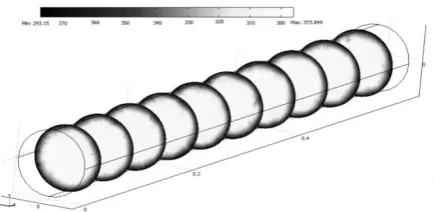
process is observed. Heating was uniform throughout the samples with exponential errors even though there was no mixing in the static.
Figure 4. Temperature cut-off to Ohmic cell colloidal 3.3% starch solution with 0.5% of salt after 300 seconds.
Figure 5. Horizontal cutting to Ohmic cell colloidal 3.3% starch solution with 0.5% of salt after 300 seconds.
Figure 6. Radial cutting to Ohmic cell colloidal 3.3% starch solution with 0.5% of salt after 300 seconds.
Figure 7. Profile of temperature changes in a horizontal cut to the colloidal 3.3% starch solution with 0.5% of salt.
From Fig. 8, a clear trend of increasing temperature can be seen, the temperature of the solution increases particle-liquid over time. When the electrical conductivity for liquid is more, particle temperature will rise faster and occur in a shorter time. It is concluded that Ohmic heating process unlike the other heating processes increases the temperature in a shorter time when the concentration of solid particles increases. The current canals in the solution became more complicated when the solid particles content increased. This leads to higher density of current that passes through solid particles. This phenomenon causes more energy production and higher heating rate inside the solution particles.
From the Figs. 7 and 8, it was concluded that the current diffusion in product is faster than traditional methods and there was an equal rate for both liquid-solid phases. Therefore, maintaining the flavor of the product de-vitamins and other nutrients is a better and more Market-friendly product.
Figure 8. Profile of temperature changes in a radial cut to the colloidal 3.3% starch solution with 0.5% of salt.
4-2. Effect of salt concentration
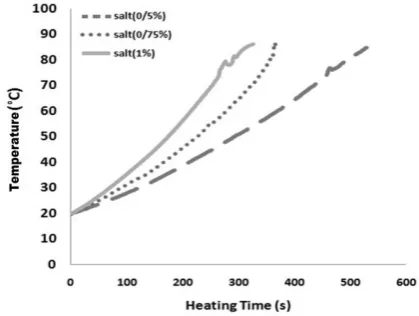
of sodium chloride salt. It was observed that the increase in electrical conductivity as mentioned is linear and matches well with the experimental results. Solution starches (3.3%) with salt (0.5, 0.75, and 1% concentration) were studied experimentally to examine the salinity or electrolyte content on the rate of heating in Fig. 10.
Figure 9. Profile of electrical conductivity changes with time; comparing the experimental data and CFD modeling results.
Figure 10. Effect of salt on the temperature profiles for the colloid solution (3/3%) with 0.5, 0.75 and 1% of salt
Results showed that when the salt concentration increases to 1%, electrical conductivity and Ohmic heating rates will be affected and hydrocolloid solution is less
effective than salt [10,12], also, lower salt concentration requires more time to reach 80oC.
As can be observed in Fig. 10, higher salt content in the solution increases the temperature in a shorter time than without salt. According to the results, it can be seen that for the solution with concentration of salt (1%) the temperature reaches 70oC during 253 seconds that can optimize the energy and time.
Fig. 11 compares temperature profiles for the simulation and experimental results for colloidal solution of 3.3% along with 0.5% sodium chloride. Comparing two places and two points in the cell geometry which places the model in Fig. 1 is clear, there has been a good match.
4-3. Effect of electric field strength
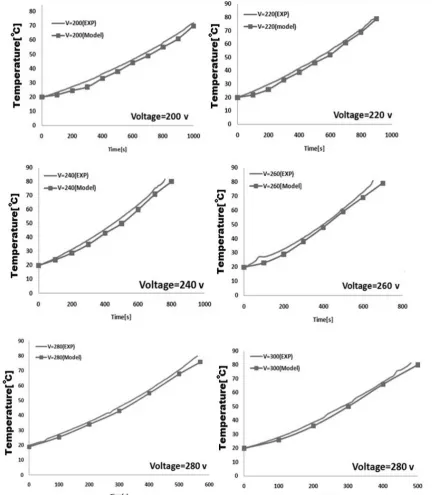
Effect of electric field strength (applied voltage) on the Ohmic heating process was investigated. For this aim, six voltages (200, 220, 240, 260, 280, and 300 volts) were used for the colloid starch 3/3% with sodium chloride concentration of 0/5%.
Figure 11. Comparing the results of CFD modeling with experimental data for Solution starch (3.3%) with 0.5% of salt
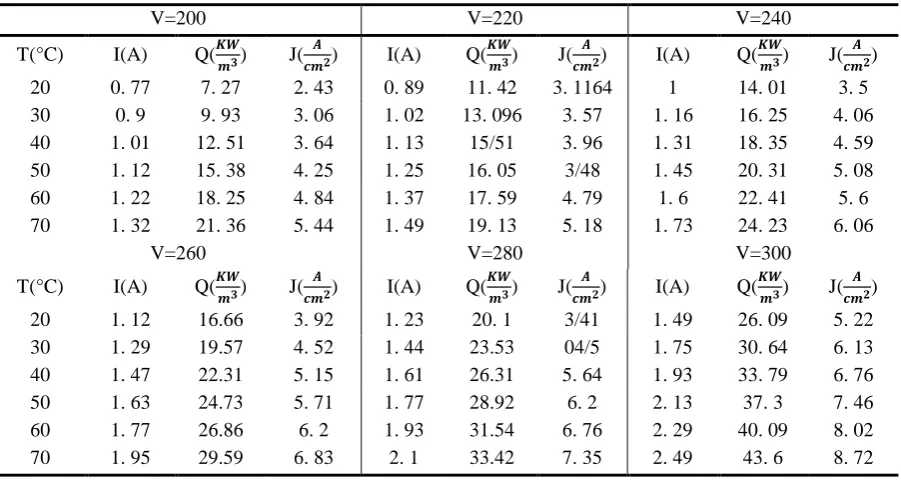
According to Table 4, it can be seen that with increasing voltage, the current through the solution will be increased. For example, at 20oC, the current through the voltage
(200, 220, 240, 260, 280, and 300 volts), respectively, 1.49, 1.23, 1.12, 1, 0.8 and 0.77 amperes were observed, which indicate the
importance of compliance with Ohm's law and increasing the voltage.
The highest current density was observed in the voltage 300 volts from 5.22 [A/cm2] at 20°C to 72.8 amps per square cm at 70°C and the minimum current density in the voltage, 200 in the 2.43 to 5.44 [Amps/cm2] in the temperature range from 20 to 70oC. The rate
of energy generation in 300 V (26.09 to 43.6), 280 V (20/1 to 34/32), 260 V (16.66 to 29.59), 240 (14.01 to 24.23), 220 V (11.42 to 19.13) and 200 V (7.27 to 21.36) [kw/m2] were observed.
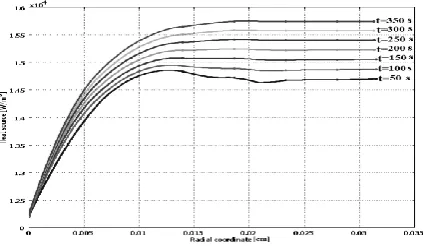
In 260 volt as applied voltage, CFD modeling results for the energy generation rate in a radial cut at different times were shown in Fig. 12. The cells move toward the center of much higher energy generation and in the center of the cell will reach to a constant value.
Table 4
Values, current strength, flow rate and energy density for the colloidal solution of 3/3% with 0/5% salt in different voltages (V) and temperatures (T).
Figure 12. Rate of heat generation with applied voltage (260v) from CFD modeling results.
In Fig. 13 the process of increasing temperature profiles shows various voltages. Good agreement between experimental and simulation results are observed.
5. Conclusions
In this paper, the effects of distribution of particles, salinity and electric field strength on electrical conductivity, profiles of temperature, heat generation have been investigated. Experimental data were compared with simulation results. Governing equations have been discretized with finite element method. Results showed that electrical conductivity increased with increasing temperature and concentration of particles. Also, when the salt concentration increases to 1%, electrical conductivity and
Ohmic heating rates will be affected and hydrocolloid solution is less effective than salt.
This showed higher proficiency for the Ohmic heating process compared with other heating processes.
Nomenclature
A Electrode surface [cm2]
C Specific heat [J/kg K] I Current [ampere]
J Current density u [amp/cm2] k Thermal conductivity [W/m K] L Gap between the electrodes [cm] q Heat generation [W/m2]
R Sample resistance [Ω]
T Temperature [K] t Time (sec) V Voltage [volt]
Greek letters
σ Electrical conductivity [S/m]
ρ Density [kg/m3]
Subscripts
f fluid
Figure 13. Profiles of temperature versus time for a colloidal solution of 3.3% with 0.5% salt at different voltage.
References
[1] Assiry, A. M., Sastry, S. K. and Samaranayake, C. P., "Influence of temperature, electrical conductivity, power and pH on ascorbic acid degradation kinetics during Ohmic Heating using stainless steel electrodes", Bio-electrochem., 68 (1), 7
(2006).
[2] Palaniappan, S. and Sastry, S., "Electrical conductivities of selected solid foods during Ohmic heating", J. Food Proc.
Eng., 14, 221(1991).
[4] Sastry, S. K., "Ohmic heating. In minimal processing of foods and process optimization", (R. R. Singh and F.A.R. Oliveira, eds.), p. 17, CRC, London (1994).
[5] Skudder, P. J., "New system for sterilization of particulate food products by Ohmic heating", In Aseptic Processing of Food, (H. Reuter, ed.), Technomic Publishing Co., Lancaster, p. 95 (1993).
[6] Piette, G., Buteau, M. L., Halleux, D. De, Chiu, L., Raymond, Y., Ramaswamy, H. S. and Dostie, M., "Ohmic cooking of processed meats and its effects on product quality", J. Food Sci., 69 (2), 71(2004).
[7] Salengke, S. and Sastry, S. K., "Models for Ohmic heating of solid–liquid mixtures under worst-case heating scenarios", Agr. Biologic. Eng., 337 (2007).
[8] Ye, X., Ruan, R., Chen, P., Chang, K., Ning, K., Taub, I. A. and Doona, C., "Accurate and fast temperature mapping during Ohmic heating using proton resonance frequency shift MRI thermometry", J. Food
Eng., 59,143(2003).
[9] Moraveji, M. K. and Ghaderi, E., "Effective Parameters Consideration in Ohmic heating process in two phase static system of bio-particle-liquid", Int. J. Food Eng., 7 (1), 1 (2011).
[10] Marcotte, M., "Ohmic heating of viscous liquid", Department of Food Science and Agricultural Chernistry Macdonald Campus of McGill University Sainte- Anne-de- Bellevue, Québec, Canada, (1999).
[11] Tulsiyan, P., Sarang, S. and Sastry, S.
K., "Electrical conductivity of multi-component systems during Ohmic heating",
Int. J. Food Prop., 11, 1 (2008).
[12] De Alwis, A. A. P. and Fryer, P. J. "A finite element analysis of heat generation and transfer during Ohmic Heating of food",
Chem. Eng. Sci., 45 (6), 1547 (1990).
![Table 1 The best linear relationship between electrical conductivity and thermoelectric properties [12] - the physical function](https://thumb-us.123doks.com/thumbv2/123dok_us/8887229.1823163/6.595.56.526.127.224/table-relationship-electrical-conductivity-thermoelectric-properties-physical-function.webp)