Original Article
Validity and Reliability of Iranian Version of eHealth
Literacy Scale
Soheila Bazm1, Masoud Mirzaei2, Hossein Fallahzadeh3, Reihaneh Bazm4
1-School of Health, Shahid Sadoughi University of Medical Sciences and Health Services, Yazd, Iran
2-Center of Prevention and Epidemiology of Non-communicable Disease, School of Health, Shahid Sadoughi University of Medical Sciences and Health Services, Yazd, Iran.
3-Prevention and Epidemiology of Non-communicable Disease Research Center, Shahid Sadoughi University of Medical Sciences, Yazd, Iran.
4-Faculty of management, Islamic Azad University of Yazd, Yazd, Iran.
Received: 2016/03/05 Accepted: 2016/05/14
Abstract
Introduction: eHEALS is an 8-item measure of eHealth literacy developed to measure consumers’ combined
knowledge, comfort, and perceived skills at finding, evaluating, and applying electronic health information to the health problems. Hence, the current study aimed to measure validity and reliability of the Iranian version of eHEALS questionnaire in a population context.
Materials & Methods: This cross-sectional study was conducted on 525 youth’s people, who were randomly
chosen in Iran, Yazd. As a matter of fact, content validity, construct validity and predictive validity of the translated questionnaire were determined. Principal components factor analysis was used to determine the theoretical fit of the measures with the data. The internal consistency of the translated questionnaire was evaluated using Cronbach α coefficient and the results were analyzed applying SPSS software (ver, 16).
Results: The principal component analysis (PCA) produced a single factor solution (70.48% of variance) with
factor loading ranging from 0.723 to 0.862. The internal consistency of the scale was sufficient (alpha= 0.88 , P<0.001) and the test-retest coefficients for the items were reliable (r= 0.96, P<0.001).
Conclusion: The results of the current study revealed that the items in the translated questionnaire were
equivalent to the original scale .The Iranian version of the eHEALS questionnaire showed a good reliability and validity in regard with the screening of eHealth literacy of Iranian people.
Key words: eHealth Literacy; eHEALS questionnaire; Reliability; Validity
Corresponding author: Tel: 035-38219100 email:
Introduction
Every day, people deal with a large amount of
informationwhichinterfereswith making
decision for their health. Health literacy is a
key element demonstrating how people should
use this information. It is estimated that more
than 113 million American obtain health
information from 70000 health related
websites annually[1], most of whom edo not
have enough capability to use such health
information[2]. Therefore, electronic health
tools provide little value if the intended users
lack the skills to get engage with them
effectively.
Health People 2010; the report of department
of Health and Human Services; defines health
literacy as the degree to which individuals
have the capacity to obtain, process and
understand basic health information[3]. Today,
due to the rapid use of internet as a source of
health information, ehealth literacy has
become an important issue to be taken into
account. Indeed, ehealth is the use of emerging
information and communication technology,
specifically the internet to promote health or
health care [4]. Ehealth literacy is defined as the
ability to search, find, understand and appraise
health information from electronic sources and
apply them to solve a problem [4]. The eHealth
Literacy Scale (eHEALS) was designed (A) to
assess consumers’ perceived skills at using
information technology for health and (B) to
aid in determining the fit between eHealth
programs and consumers. In fact, itcomprises
of six skills: traditional literacy, health
literacy, information literacy, scientific
literacy, media literacy and computer literacy
[4]
.
The eHEALS involves an eight-item
self-reported measure of perceived eHealth
literacy. Participants indicate their level of
agreement with eHealth statements on a
five-point Likert type scale (1 = strongly disagree,
5 = strongly agree). Score totals range from 8
to 40. In other words, higher scores reflect
higher perceived levels of eHealth literacy [5].
The findings of some studies revealed that low
eHealth literacy is associated with less
knowledge of diseases like colorectal
cancerand chronic diseases [6-9].Previous
studies have reported thatinternet users with
high eHealth literacy are more likely to have
knowledge compared to those with low health
literacy[6]. Overall, eHealth promotes
efficiency in health services, reduces costs and
improves quality by the comparison made
between various health sectors.[6] Today,
countries have built new IT systems allowing
doctors and health care providers to get secure,
accurate and comprehensive information of
patients quickly and efficiently, thereby saving
valuable time and money.
Findings of a studycarried out in Iran revealed
that patientshada tendency to use IT
technology[10], though no valid information has
been observed regarding the level of eHealth
literacy among Iranian population. Since there
exists no validated Persian language tool to
assess ehealth literacy in Iran and other
Persian language speaking countries, the
present this study aimed to measure validity
and reliability of an Iranian version of
eHEALS questionnaire in a population
context.
Materials and Methods
In this cross sectional study, TOFHLA,
REALM and Newest Vital Sign (NVS) can be
mentioned as three key tools to assess the
health literacy through measuring reading
ability and comprehension test. The eHEALS
questionnaire is a self-report Likert-scaled
questionnaire consisting of 8 questions related
to finding, assessing and using health
information on the internet.
This study comprises as a part of a big project
aiming to assess the relationship between
ehealth literacy and health behavior in adults.
To assess the validity, e-health literacy
questionnaire was filled out by 525 students,
who were randomly selected in Shahid
Sadoughi University of Medical Sciences.
Furthermore,to evaluate the reliability30
individuals were required to fill it out two
times in a few week interval. The length of the
test-retest was long enough for subjects to
forget their response to the questions inthe
pre-test phase.
The second questionnaire consisted of 10
questions to evaluate theparticipants' skills in
regard withuse ofcomputer and internet. In
fact, the computer literacy of participants was
assessed by determining participants'
knowledge with respect to computer, internet
and how they use different strategies to search
information on the internet.
Validity
Validity and reliability of the questionnaire
were assessed using SPSS software (version
16). To approve validity of theIranian version
of the questionnaire, content validity, construct
validity and criterion validity of the
questionnaire wereexamined. Measuring
content validity is of great importance if the
questions are understandable and fluent for
individuals. To this purpose, the questionnaire
was given to relevant specialists as well as
some subjects who were interviewed. At the
end, they were demanded to update terms and
clarify the confusing items.
Construct validity of the questionnaire can be
stated as that aspect reflecting the correlation
between the questions and the underlying
theories[12]. This procedure was examined
using principal component analysis, which the
results were compared applying Comery and
Lee's guidelines (1992). In fact, the guidelines
state that factor loading above0.71 is
considered excellent , 0.63 is reported very
good and 0.55 is indicated good[13]
Criterion-related validity refers to the degree to which a
diagnosis or diagnostic criterion is linked to
prospect outcomes.[14] In the present study,
measuring the relationship between eHealth
score and other variables in computer literacy
questionnaire shows predictive validity of the
questionnaire.
Reliability
Test to retest reliability was evaluated
according to the Fleiss criteria where an ICC
of <0.4 indicates poor, 0.4–0.75 fair-to-good,
and >0.75 excellent reliability [15, 16]. In the
current study, internal consistency was
assessed using Cronbach alpha which was run
on all items within a particular construct. In
general , a Cronbach alpha of 0.7 to 0.8 is
regarded as satisfactory for the scales to be
used as research tools[16].
Results
In this study, 173 males and 379 females
participated, of which61.5% had MSc degree,
34.2% had MA degree and 3.8% had
Doctorate degree. Seventy eight percent of the
subjects were reported to have permanent
access to a computer and 63.7% had access to
internet all the time.
Table1. Demographics of the participants
n=525 Variables
Gender
366 Female
169 Male
Education
329 Bachlor degree
182 MA degree
21 PhD degree
Content validity
The original version of the questionnaire was
translated to Persian. To measure face validity
of the translated questionnaire, it was reviewed
by four experts in public health and medical
informaticsfield. They were requiredto change
incorrect or unambiguous terms as well as to
add additional comments to the translated
questions and afterreviewing, threeterms were
changed. Finally, the modified questionnaire
was administered to the pilot group(n=30) in
the pre-test phase of reliability. They were
asked to write their ideas about the questions,
so asthe review of the results showed that they
did not have any difficulty with the questions.
Construct validity
To assess the suitability of the data for factor
analysis, Kaiser- Meyer-Olkin (KMO)
measure of sampling adequacy and Bartelett's
test of sphericity were administered. In
statistics, Kaiser-Meyer-Olkin measures
sampling adequacy and Bartlett's test were
used to evaluate if k samples were from
populations with equal variances [15].The study
results revealed that the amount of data were
suitable for factor analysis (KMO=0.89,
P≤0.001). Factor analysis was used to
determine the underlying themes using an
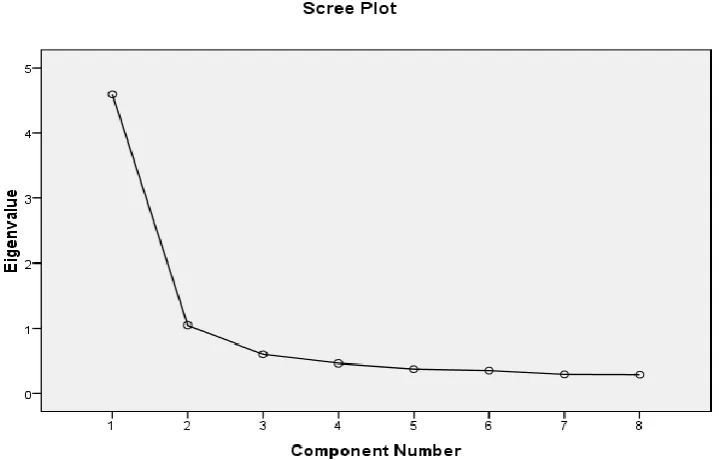
eigenvalue>1, factoring in the two
components. The first component contained
two items and the second one included six
items. Factor one contained 57.40% of
variance and the other one contained 13.09%
of the variance. In addition, varimax rotation
revealed that eight items were loaded on the
right factor (Table 2).
Table 2.Results of the principal component analysis of ehealth literacy questionnaire
Item Component 1 Component 2
Q1.I know what health resources are available on the internet
.842
Q2.I know where to find helpful health resources on the internet
.862
Q3.I know how to find helpful information health resources on the internet
.680
Q4.I know how to use the health information I find on the internet to help me
.723
Q5.I know how to use the internet to answer my health questions
.753
Q6.I have the skills I need to evaluate the health resources I find on the internet
.804
Q7.I can tell high quality from low quality health resources on the internet
.803
I f8. I feel confident in using information from the internet to make health decisions
.847
However scree plot supported two factors with eigenvalue>1(fig 1)
Figure 1 Scree plot for factor analysis of data
Criterion-related Validity
In the present study, criterion validity was
examined applying Pearson correlations
between the measured constructs as well as
computer literacy questionnaire.The results
demonstrated an excellent criterion-related
validity between the two
measurements.(p≤0.001)
Reliability
Target audience members (n=30) took the test
at twodifferent intervals. The responses were
correlated and compared via paired T-Test. All
the questions met reliability criteria (r= 0.96,
P=P<0.001), and the total Cronbach α for 8
items was equalto 0.886.
The value of intra-class correlation coefficients
(ICCs) indicated moderate reproducibility
(ICC=0.556, 95%CI=0.43-0.70, p≤0.001), that
is to say if a subsequent observation is made, it
will probably be similar to the original.
Discussion
The purpose of the current study was to
translate the original English version of
eHEALS questionnaire into Persian as well as
to assess validity and reliability of Iranian
version of eHealth literacy. Although Vaart[17]
and Nahm [18] hesitate about the validity and
reliability of the original version of the
questionnaire, so for, the HEALS
questionnaire is the only valid scale to
measure eHealth literacy. Vaart suggested
further studies to approve validity and
reliability of the mentioned questionnaire.
Nahmemphasized that the questionnaire may
be an appropriate instrument to assess eHealth
literacy of adults. It should be mentioned that
the translation and validity tests of the
questionnaire were conducted on the basis of
recommended valid guide lines[19-21].
Consonant with prior studies, validity and
reliability of eHEALS questionnaire, have
been demonstrated to lie at [9, 19, 20] ahigh level
of validity and reliability comparable to other
translations of this tool. As a matter of fact, all
items of the questionnaire showed a good
consistency.Since exclusion of any item did
not increase Cronbach alpha more than 0.02,
all the eight items were considered in the
translated questionnaire. According to Comery
and Lee's guidelines, the Iranian version of
eHealth literacy showed an excellent construct
validity.
Consistent with findings of the previous
studies (9,19-20), a positive weak-to-moderate
correlation was detected between the eHealth
scores and education, computer
knowledge,internet knowledge and the use of
Internet for health-related purposes and use of
search strategies which is predictable The tool
seemed to be unable to distinguish the
differences between themales' and females'
eHealth literacy. Thus, predictive validity of
the questionnaire showed a moderate validity.
Furthermore, the final version of Iranian
version of eHEAL Squestionnaireis
recommended to be revised in the future.
Limitations
The Iranian version of eHEALS questionnaire
was validated within a youth population. Due
to the rapid growth as well as use of
technology by a wide range of groups,
additional research seems to be required in
order to examine the questionnaire
applicability to the other populations like
illiterateor old people.
Conclusion
The Iranian version of eHEALS literacy
questionnaire was equivalent to the original
version of this questionnaire in terms of
validity and reliability. In the current study,
only some aspects of the validity have been
measured, therefore it is worthwhile to
undertakefurther validity tests on this
questionnairein the future.
Acknowledgement
We would like to thank all professionals and
target groups giving feedback in regard
withtesting the questionnaire.
Conflicts of Interest
The authors report no conflicts of interest
Funding
This study was funded by ShahidS adoughi
University of Medical Sciences and Health
Services.
References
1. Hanik B, Stellefson M. E-health literacy competencies among undergraduate health education students : A priliminary study International Electronic Journal of Health Education. 2011;14:46-58.
2. Mancuso J. Assessment and measurement of health literay:an integrative review of the litrature. Nursing & Health Science. 2009;11(1):77-89.
3. The Health Literacy of America’s Adults: Results from the 2003 National Assessment of Adult Literacy 2006. Available from: http://nces.ed.gov/pubsearch/pubsinfo.asp?pubid=2006483.[Accessed on:3 August 2014]
4. Norman C, Skinner H. eHealth literacy:essaential skills for consumer health in a networked world. Journal of medical internet research. 2006;8(2):e9
5. Mitsutake S, Shibata A, Ishii K, et al. Association of ehealth literacy with colorectal cancer knowledge and screening practice among internt users in Japan. Journal of medical internet research. 2012;14(6):e153. 6. Ishikawa H, Takeuchi T, Yano E. Measuring functional, communicative, and critical health literacy among
diabetic patients. Diabetes Care. 2008;31(5):874-9.
7. Osborn C, Paasche-Orlow M, Bailey S, et al. The mechanisms linking health literacy to behavior and health status. American journal of health behaviour. 2011;35(1): 118-28.
8. US Department of Health and Human Service. Literacy and Health Outcomes. Available from: http://archive.ahrq.gov/clinic/epcsums/litsum.htm.[Last Accessed on:3 August 2014]
9. Mitsutake S, Shibata A, Ishii K, et al. Developing Japanese version of the eHealth literacy scale(eHEALS). Japanese journal of public health. 2011;58(5):361-71.
10. Sadoughi F, Ahmadi M, Gohari M, et al. The role of information literacy in individual health:patients view. Health management. 2010;40(13):31-40.
11. Norman CD, Skinner HA. eHEALS:The eHealth Literacy Scale. journal of medical internet research. 2008;8(4):e27.
12. Donovan JL, Abrams P, Peters TJ, et al. the ICS-BPH study:The psychometric validity and reliability of the ICSmale questionnaire. British journal of urology. 1996;77:554-62.
13. AL C, HB L. A first course in factor analysis. 2nd Eds. Hillsdale,NJ: Lawrence Erlbaum Associates; 1992. 14. Douzenis A, Seretis D. Descriptive and predictive validity of somatic attributions in patients with somatoform disorders: A systematic review of quantitative research. Journal of psychometric research. 2013;75:199-210.
15. Fleiss J. the design ans analysis of clinical expriments. New York: Wiley; 1986.
16. Cronbach LJ. Coefficient alpha and the internal structure of tests. Psychometrica. 1951;16(3):297-334. 17. Van ser Vaart R, Jam Van Deursen A, Dijk Av, et al. does the eHealth literacy scale (eHEALS) measure
what it intends to measure? Validation of a Dutch version of the eHEALS in two adult populations. journal of medical internet research. 2011;13(4):e86.
18. Nahm E-S, An M-J, Ceniceros X, et al. Testing the Reliability and Validity of an eHealth Literacy Scale. Available from: http://www.resourcenter.net.[Last Accessed on:3 August 2014]
19. Diviani N, Schulz P. Validation of an Italian version of the Ehealth literacy scale(I-EHEALTH). Available from: http://www.medicine20congress.com/ocs/index.php/med/med2014b/paper/view/2409 [Last
Accessed on:3 August 2014]
20. Tomas CC, Queiros PJP, Ferreira TdJR. Analysis of the psychometric properties of the Portuguese version of an eHealth literacy assessment tool. Revista de Enfermagem Referência. 2014;4(2):19-28.