(UDC: 66.093.1)
Solvation enthalpies of the proton and electron in polar and non-polar
solvents
Z. Marković1,2*, D. Milenković2, J. Đorović2, S. Jeremić1,2
1 Department of Chemical-Technological Sciences, State University of Novi Pazar, Vuka
Karadţića bb, 36300 Novi Pazar, Republic of Serbia [email protected]
2 Bioengineering Research and Development Center, 34000 Kragujevac, Republic of Serbia *Corresponding author
Abstract
The importance of the proton and electron transfer processes in solution is well-known. Nonetheless, there is still no systematic theoretical study on the proton and electron solvation enthalpies. We investigated the solvation enthalpies of the proton and electron in different solvents of various polarities (water, DMSO, acetonitrile, methanol, ethanol, acetone, aniline, benzene, and penthylethanoate) using the SMD solvation model. All calculations were performed at the B3LYP-D2 and M052-X levels of theory with 6-311++G(d,p) basis set. On the basis of our calculations, it was found that the B3LYP-D2 and M05-2X functionals provide similar solvation enthalpies for the proton. Also, the results obtained for the proton solvation enthalpies are in good agreement with the published results. On the other hand, the electron solvation enthalpies calculated by means of B3LYP-D2, and especially using M05-2X, are significantly different from the reported results.
Keywords: Solvation enthalpies, proton, electron, B3LYP-D2, M05-2X
1. Introduction
Antioxidant properties of natural products, as well as synthetic compounds, have been intensively studied using different experimental methods and theoretical approaches. Theoretical studies of antioxidant action are usually based on thermodynamic properties, such as: bond dissociation enthalpy (BDE), electron transfer enthalpy (ETE), proton affinity (PA), proton dissociation enthalpy (PDA), and ionization potential (IP). Protective role of antioxidants can be described by at least three free radical mechanisms (Wright et al., 2001; Klein et al., 2007; Litwinienko et al., 2007): single-step (Hydrogen Atom Transfer – HAT), and double-step mechanisms (Single Electron Transfer followed by Proton Transfer – SET-PT, and Sequential Proton Loss Electron Transfer – SPLET).
The HAT mechanism is described as follows:
Ar −OH → Ar −O• + H• (1)
HAT is characterized by the BDE value of the OH group. BDE can be calculated using the following equation:
H(Ar−OH) is the enthalpy of the parent polyphenolic molecule, H(Ar−O•) is the enthalpy of the radical generated after the hydrogen atom abstraction, and H(H•) is the enthalpy of the hydrogen atom.
In the first step of the SET-PT mechanism the parent compound loses an electron, thus yielding the corresponding radical cation Ar−OH•+
.
Ar−OH → Ar−OH•+ + e− (3)
The IP value, which describes this step, can be calculated as follows:
IP = H(Ar−OH•+) + H(e−) − H(Ar−OH) (4)
H(Ar−OH•+) is the enthalpy of the radical cation and H(e−) is the enthalpy of the electron.
The second step in SET-PT is a deprotonation of Ar−OH•+:
Ar−OH•+ → Ar−O• + H+ (5)
The PDE value describes this step, and can be calculated using the following equation:
PDE = H(Ar−O•) + H(H+) − H(Ar−OH•+) (6)
H(H+) is the enthalpy of the proton.
The first step in the SPLET mechanism is a deprotonation of the parent molecule where the phenoxide anion Ar−O− is formed (Foti et al., 2004; Litwinienko et al., 2009):
Ar−OH → Ar−O− + H+ (7)
The PA value of the phenoxide anion Ar−O− can be calculated by means of the equation:
PA = H(Ar−O−) + H(H+) − H(Ar−OH) (8)
H(Ar−O−) is the enthalpy of the phenoxide anion.
In the second step Ar−O− loses an electron yielding the corresponding free radical:
Ar−O− → Ar−O• + e− (9)
This step is characterized by the ETE value that can be calculated using the following equation:
ETE = H(Ar−O•) + H(e−) − H(Ar−O−) (10)
For complex studies of antioxidant mechanisms in solution-phase, knowing the proton and electron solvation enthalpies (eqs 4, 6, 8, and 10) in various non-polar and polar solvents is essential. With exception for valuable data for aqueous solution (Jortner et al., 1966, Atkins 1998, Donald et al., 2010), there are no other experimental data. In addition, a systematic theoretical study on the proton and electron solvation enthalpy has not been yet performed. Therefore, the main aim of this paper is to determine the proton and electron solvation enthalpies for some commonly used non-polar and polar solvents.
2. Computational details
polarization functions on heavy and hydrogen atoms. In this manner the error resulting from not using a complete basis set is minimized.
The M05-2X functional proved to yield satisfactory overall performance for the main group thermochemistry and thermochemical kinetics, as well as organic, organometallic, biological, and noncovalent interactions. This functional has been successfully used by independent authors (Marković et al., 2012); Black et al., 2010; Galano et al., 2009; Galano et al., 2010; Marković et al., 2010; Zavala-Oseguera et al., 2009; Alberto et al., 2013). Another successful approach, originally developed by Grimme and called DFT-D (Grimme 2011), can be efficiently coupled with almost any existing DFT-based method. According to Grimme and Bayach (Grimme 2004; Grimme 2006; Bayach et al., 2013) an atom-atom additive damped empirical potential is used to include long-range dispersion contributions to the computed DFT total energy and gradients. In the case of B3LYP-D2 it holds:
EB3LYP-D2 = EB3LYP – EDisp (11)
where B3LYP (Becke 1993; Becke 1988; Lee et al., 1988) is a density functional, and EDisp is
the empirical term.
The geometries of all species obtained in this way were verified by normal mode analysis to be minima on the potential energy surface (no imaginary frequencies were obtained). The influence of solvents of various polarities: water, DMSO, acetonitrile, methanol, ethanol, acetone, aniline, benzene, and penthylethanoate, was approximated by the SMD solvation model (Marenich et al., 2009). SMD is based on the quantum mechanical charge density of a solute molecule interacting with a continuum description of the solvent. ―D‖ in the model name stands for ―density‖ and denotes that full solute electron density is used without defining partial atomic charges.
3. Results and Discussion
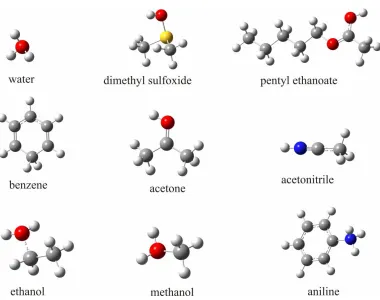
Before we present our results, we need to define the notation used in the present work. X± stands for charged specie (H+ or e−), whereas SOL-X± denotes a complex composed of a solvent molecule and the proton (SOL-X+) or electron (SOL-X−). Actually, SOL-X+ is the protonated solvent molecule (Fig. 1), whereas SOL-X− is the corresponding anion. Then, the solvation enthalpy of X± can be calculated by using the following equation (Mejías et al., 2000):
∆Hsol(X±)=H(SOL - X±sol)- H(X±gas)- H(SOL sol) (12)
where ∆Hsol(X±) represents the solvation enthalpy of the proton or electron, H(SOL- X±sol)
is the enthalpy of the SOL- X±sol complex embedded in a dielectric continuum, and H(SOLsol) is
the enthalpy of a solvent molecule solvated with the molecules of the same kind. The gas-phase enthalpy of the proton, H(H+), is taken as that for an ideal gas (5/2 RT = 6.197 kJ mol–1 (Bartmess 1994)), while the gas-phase enthalpy of the electron, H(e–) amounts to 3.145 kJ mol–1 (Bartmess 1994).
Fig. 1. The optimized geometries of the protonated solvent molecules under investigation.
3.1 Solvation enthalpies for the proton
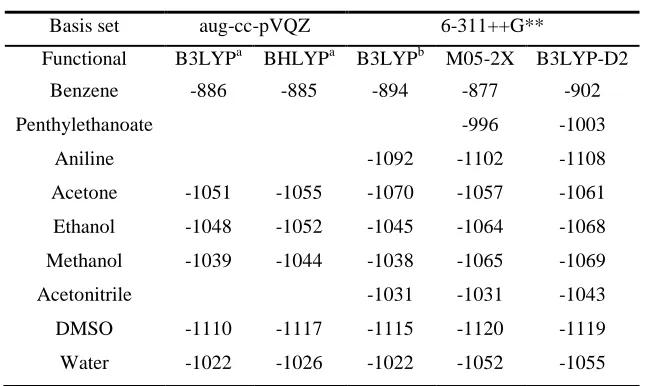
Some calculated solvation enthalpies for proton have been reported by Rimarčík and Fifen (Rimarčík et al., 2010, Fifen et al., 2011). Their values are practically identical: 1022 and -1024 kJ mol–1. To determine the proton hydration enthalpy, Mejías and Lago included in calculations 13 explicit water molecules that solvated H+. They found the value of -1063 kJ mol–1 (Mejías et al., 2000). Tissandler and Coe obtained symilar values of -1150.1 and -1152.6 kJ mol–1 (Tissandler et al., 1998; Coe 1994). These values are very close to the experimental value.
Basis set aug-cc-pVQZ 6-311++G**
Functional B3LYPa BHLYPa B3LYPb M05-2X B3LYP-D2
Benzene -886 -885 -894 -877 -902
Penthylethanoate -996 -1003
Aniline -1092 -1102 -1108
Acetone -1051 -1055 -1070 -1057 -1061
Ethanol -1048 -1052 -1045 -1064 -1068
Methanol -1039 -1044 -1038 -1065 -1069
Acetonitrile -1031 -1031 -1043
DMSO -1110 -1117 -1115 -1120 -1119
Water -1022 -1026 -1022 -1052 -1055
Table 1. Solvation enthalpy of the proton (kJ mol–1) in the studied solvents. a(Rottmannova et al. 2013) and b(Rimarčík et al., 2010).
The results for the proton solvation enthalpies obtained in this paper (Table 1) are generally in good agreement with the published values (Rimarčík et al., 2010; Rottmannova et al., 2013). The differences for M05-2X and B3LYP-D2 do not exceed 30 and 33 and kJ mol–1 in regard to the published values (Rimarčík et al., 2010, Rottmannova et al., 2013). The most notable deviations were found for water, ethanol, and methanol (Table 1). The calculated values for the proton solvation enthalpy in water are in better agreement with the experimental value than those of Rimarčík, Fifen and Rottmannova (Rimarčík et al., 2010; Fifen et al., 2011, Rottmannova et al., 2013). These values are very close to the Mejías‘s value obtained on the basis of a cluster with 13 water molecules (Mejías et al., 2000).
The values for the proton solvation enthalpy in methanol obtained by using M05-2X and B3LYP-D2 are in better agreement with the values of Fifen than with those of Rimarčík. As for the other solvents, the proton solvation enthalpies calculated in the present work agree well with the reported values (Rimarčík et al., 2010; Rottmannova et al., 2013).
3.2 Solvation enthalpies for the electron
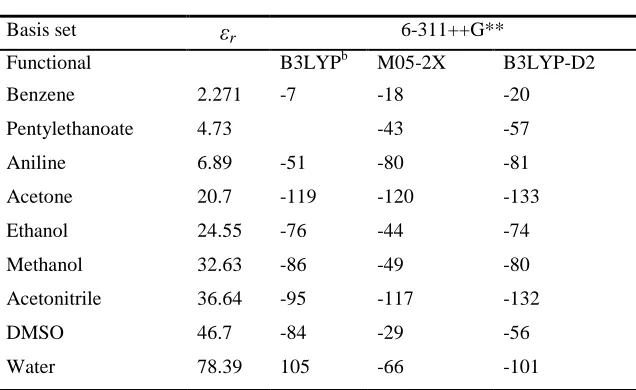
Basis set
ε
r 6-311++G**Functional B3LYPb M05-2X B3LYP-D2
Benzene 2.271 -7 -18 -20
Pentylethanoate 4.73 -43 -57
Aniline 6.89 -51 -80 -81
Acetone 20.7 -119 -120 -133
Ethanol 24.55 -76 -44 -74
Methanol 32.63 -86 -49 -80
Acetonitrile 36.64 -95 -117 -132
DMSO 46.7 -84 -29 -56
Water 78.39 105 -66 -101
Table 2. Solvation enthalpies of the electron (kJ mol–1) in the studied solvents and relative permitivities εr.εr taken from the ref. (Wilhelm et al., 1973), and references therein.
b(Rimarčík
et al., 2010).
The calculated values for the electron solvation enthalpies do not agree so well with the literature data (Rimarčík et al., 2010) as the proton solvation enthalpies (Tables 1 and 2). The M05-2X functional provides a very high value for the electron solvation enthalpies in water, DMSO, methanol, and ethanol in comparison to other two methods. On the other hand, the B3LYP-D2 values are in good accord with the results of Rimarčík et al., 2010. The only exception is acetonitrile. Obviously, it is not easy to decide which of the obtained results are more reliable due to the lack of the experimental results.
4. Conclusions
This paper reports the results of the comparative study on the proton and electron solvation enthalpies for commonly used solvents of various polarities. The B3LYP-D2 and M05-2X functionals produce mutually similar results for the proton solvation enthalpies, while the results for the electron solvation enthalpies mutually differ. The proton solvation enthalpies obtained in this work are in accordance with previously published data. On the other hand, electron solvation enthalpies calculated by B3LYP-D2, and especially by M05-2X, are significantly different in comparison to the published results. The calculated proton and electron solvation enthalpies can be utilized in evaluation of reaction enthalpies of various proton and electron transfer processes in corresponding solvents.
Извод
Eнталпије солватације протона и електрона у поларним и
неполарним растварачима
З. Марковић1,2*, Д. Миленковић2, Ј. Ђоровић2, С. Јеремић1,2
1Департман за хемијско-технолошке науке Државног Универзитета у Новом Пазару, Вука
Караџића бб, Нови Пазар, Република Србија [email protected]
2Истраживачко развојни центар за биоинжењеринг, 34000 Крагујевац, Република Србија *Аутор за контакт
Резиме
Добро је познат утицај растварача на процес преноса електрона и протона. Ипак, још увек не постоје систематична теоријска испитивања енталпија солватисаног протона и електрона. Испитане су енталпије солватације протона и електона у растварачима различите поларности (вода, DMSO, ацетонитрил, метанол, етанол, анилин, бензен, и пентилетаноат) користећи SMD солватациони модел. Сви прорачуни су изведени на B3LYP-D2 и M05-2X нивоима теорије са базним скупом 6-311++G(d,p). На основу извршених прорачуна, утврђено је да B3LYP-D2 и M05-2X функционали показују сличне вредности за енталпије солватације протона. Такође, добијени резултати енталпија солватације протона су у сагласности са објављеним резултатима. Са друге стране, вредности енталпија електрона израчунате са B3LYP-D2 методом, а нарочито резултати добијени помоћу M05-2X методе, значајно се разликују од објављених резултата.
Кључне речи: Енталпија солватације, протон, електрон, B3LYP-D2, M05-2X
References
Alberto ME, Russo N, Grand A, Galano A (2013). A physicochemical examination of the free radical scavenging activity of Trolox: mechanism, kinetics and influence of the environment. Phys. Chem. Chem. Phys., 15, 4642-4650.
Atkins PW (1998). Physical chemistry, 6th ed., Oxford University Press, Oxford.
Bartmess JE (1994). Thermodynamics of the Electron and the Proton. J. Phys. Chem., 98, 6420-6424.
Bayach I, Sancho-García JC, Di Meo F, Weber J-FF, Trouillas P (2013). -Stacked polyphenolic dimers: A case study using dispersion-corrected methods. Chem. Phys. Lett., 578, 120-125.
Becke AD (1993). Density-Functional Thermochemestry. III The Role of Exact Excange. J. Chem. Phys., 98, 5648-5652.
Becke AD (1988). Density-functional excange-energy approximation with correct asymptotic behavior, Phys. Rev. A, 38, 3098-3100.
Black G, Simmie JM (2010). Barrier heights for H-atom abstraction by HO2 from n-butanol-A simple yet exacting test for model chemistries. J. Comput. Chem., 31, 1236-1248.
Donald WA, Demireva M, Leib RD, Aiken MJ, Williams ER (2010). Electron Hydration and Ion-Electron Pairs in Water Clusters Containing Trivalent Metal Ions. J. Am. Chem. Soc., 132, 4633–4640.
Fifen JJ, Nsangou M, Dhaouadi Z, Motapon O, Jaidane N (2011). Solvent effects on the antioxidant activity of 3,4-dihydroxyphenylpyruvic acid: DFT and TD-DFT studies. Comp. Theor. Chem., 966, 232-43.
Fifen JJ, Nsangou M, Dhaouadi Z, Motapon O, Jaidane N (2013). Solvation Energies of the Proton in Methanol. J. Chem. Theory Comput., 9, 1173-181.
Foti MC, Daquino C, Geraci C (2004). Electron-transfer reaction of cinnamic acids and their methyl esters with the DPPH radical in alcoholic solutions. J. Org. Chem., 69, 2309-2314. Frisch MJ, Trucks GW, Schlegel HB, Scuseria GE, Robb MA, Cheeseman JR, Scalmani G,
Barone V, Mennucci B, Petersson GA, Nakatsuji H, Caricato M, Li X, Hratchian HP, Izmaylov AF, Bloino J, Zheng G, Sonnenberg JL, Hada M, Ehara M, Toyota K, Fukuda R, Hasegawa J, Ishida M, Nakajima T, Honda Y, Kitao O, Nakai H, Vreven T, Montgomery JAJr, Peralta JE, Ogliaro F, Bearpark M, Heyd JJ, Brothers E, Kudin KN, Staroverov VN, Kobayashi R, Normand J, Raghavachari K, Rendell A, Burant JC, Iyengar SS, Tomasi J, Cossi M, Rega N, Millam NJ, Klene M, Knox, JE, Cross JB, Bakken V, Adamo C, Jaramillo J, Gomperts R, Stratmann RE, Yazyev O, Austin AJ, Cammi R, Pomelli C, Ochterski JW, Martin RL, Morokuma K, Zakrzewski VG, Voth GA, Salvador P, Dannenberg JJ, Dapprich S, Daniels AD, Farkas Ö, Foresman JB, Ortiz JV, Cioslowski J, Fox DJ (2009). Gaussian 09, Revision C.01, Gaussian, Inc., Wallingford, CT, USA. Galano A, Alvarez-Idaboy JR (2009). Guanosine + OH radical reaction in aqueous solution: A
reinterpretation of the UV-Vis data based on thermodynamic and kinetic calculations. Org. Lett., 11, 5114-5117.
Galano A, Macias-Ruvalcaba NA, Medina-Campos ON, Pedraza-Chaverri J (2010). Mechanism of the OH Radical Scavenging Activity of Nordihydroguaiaretic Acid: A Combined Theoretical and Experimental Study. J. Phys. Chem. B, 114, 6625-6635.
Grimme S (2011). Density functional theory with London dispersion corrections. WIREs. Comput. Mol. Sci., 1, 211−228.
Grimme S (2004). Accurate description of van dr Waals complexes by density functional theory including empirical corrections. J. Comput. Chem., 25, 1463-1473.
Grimme S (2006). Semiempirical GGA-type density functional constructed with a long-range dispersion coorrection. J. Comput. Chem., 27, 1787-1799.
Jortner J, Noyes RM (1966). Some Thermodynamic Properties of the Hydrated Electron. J. Phys. Chem., 70, 770-775.
Klein E, Lukeš V, Ilčin M (2007). DFT/B3LYP study of tocopherols and chromans antioxidant action energetics. Chem. Phys., 336, 51-57.
Lee C, Yang W, Parr RG (1988). Development of the Colle-Salvetti conelation energy formula into a functional of the electron density. Phys. Rev. B, 37, 785-789.
Litwinienko G, Ingold KU (2007). Solvent effects on the rates and mechanisms of reaction of phenols with free radicals. Acc.Chem. Res., 40, 222-230.
Litwinienko G, Mulder P (2009). Comment on ―Temperature and solvent effects on radical scavenging ability of phenols‖. J. Phys. Chem. A, 113, 14014-14016.
Marenich AV, Cramer CJ, Truhlar DG (2009). Universal Solvation Model Based on Solute Electron Density and on a Continuum Model of the Solvent Defined by the Bulk Dielectric Constant and Atomic Surface Tensions. J. Phys. Chem. B, 113, 6378-6396.
Marković Z, Milenković D, Đorović J, Dimitrić Marković JM, Stepanić V, Lučić B, Amić D (2012). Free radical scavenging activity of morin 2‘-O– phenoxide anion. Food. Chem., 135, 2070–2077.
McLean AD, Chandler GS (1980). Contracted Gaussian basis sets for molecular calculations, I. Second row atoms, Z=11–18. J. Chem. Phys., 72, 5639-5648.
Mejías JA, Lago S (2000). Calculation of the absolute hydration enthalpy and free energy of H+ and OH-. J. Chem. Phys., 113, 7306-7316.
Rimarčík J, Lukeš V, Klein E, Ilčin M (2010). Study of the solvent effect on the enthalpies of homolytic and heterolytic N–H bond cleavage in p-phenylenediamine and tetracyano-p-phenylenediamine. J. Mol. Struc.THEOCHEM, 952, 25-30.
Rottmannová L, Škorňa P, Rimarčík J, Lukeš V, Klein E (2013). Solvation enthalpies of the proton in polar and non-polar solvents:Theoretical study. Acta Chim. Slov., 6, 60—63. Tissandier MD, Cowen KA, Feng WY, Gundlach E, Cohen MH, Earhart AD, Coe JV (1998).
The Proton's Absolute Aqueous Enthalpy and Gibbs Free Energy of Solvation from Cluster-Ion Solvation Data. J. Phys. Chem. A, 102, 7787-7794.
Wachters JH (1970) Gaussian Basis Set for Molecular Wavefunctions Containing Third-Row Atoms. J. Chem. Phys., 52, 1033-1036.
Wilhelm E, Battino R (1973). Thermodynamic Functions of the Solubilities of Gases in Liquids at 25°C. Chem. Rev., 73, 1-9.
Wright JS, Johnson ER, DiLabio GA (2001). Predicting the activity of phenolic antioxidants: theoretical method, analysis of substituent effects, and application to major families of antioxidants. J. Am. Chem. Soc., 123, 1173–1183.
Zavala-Oseguera C, Alvarez-Idaboy JR, Merino G, Galano A (2009). OH Radical Gas Phase Reactions with Aliphatic Ethers: A Variation Transition State Theory Study. J. Phys. Chem. A, 113, 13913-13920.
Zhao Y, Truhlar DG (2008). The M06 suite of density functionals for main group thermochemistry, thermochemical kinetics, noncovalent interactions, excited states, and transition elements: two new functionals and systematic testing of four M06-class functionals and 12 other functionals. Theor. Chem. Acc., 120, 215-241.