A control-monitoring-maintenance
framework based on Petri net with objects in
fl exible manufacturing system. Application
to a robot-driven fl exible cell.
Eduardo Rocha Loures
Industrial and Systems Engineering Graduate Program Pontifi cal Catholic University of Parana
Curitiba, PR, Brazil
E-mail: [email protected]
Eduardo Alves Portela Santos
Industrial and Systems Engineering Graduate Program Pontifi cal Catholic University of Parana
Curitiba, PR, Brazil
E-mail: [email protected]
Marco Antonio Busetti de Paula
Industrial and Systems Engineering Graduate Program Pontifi cal Catholic University of Parana
Curitiba, PR, Brazil
E-mail: [email protected]
Abstract
early design stage. It also results in improvement of the system’s functionality in terms of effi ciency, productivity and quality. This paper proposes a control-monitoring-maintenance architecture (CMM) for FMS based on Petri nets with objects (PNO), where stochastic rates are associated to the modelling of maintenance planning. This framework is based on a modular and hierarchic model structured in CMM modules. The integration is based on a development methodology in which the maintenance aspects and policies are taken into account from the conception (modelling) stage. These efforts acts as a basis for the control architecture of a robot-driven fl exible cell, connected to the Ethernet-TCP/IP.
Keywords: Flexible manufacturing system, Supervision, Maintenance, Petri Nets.
INTRODUCTION
The fl exible manufacturing system (FMS) can be considered as a system able to produce a wide variety of products under variable production conditions. Classically, this type of system is constituted by a set of elements and devices such as workstations, transport systems, programmable logic controllers, robots, and vision systems, connected to an industrial communication network. According to the manufacturing cell dimensions’ increase, the control and supervision of its structure becomes more complex. Thus, to keep fl exibility regarding its decision organization, a modular and hierarchic structure is proposed (Zamai et al., 1997). Hierarchic architectures have been subject of many works during the last decades (Gershwin et al., 1988), (Giua & DiCesare, 1994), (Srinivasan & Jafari, 1993) and represent the framework basis of recent approaches concerning the control and monitoring of FMS (Jeng & Liang, 1998), (Pascal, 2000).
The demands for products with higher quality and competitive prices have led to the development of complex manufacturing systems. A consequence is that the number of failures tends to increase as well as the time required to locate and repair them. The occurrence of failures during nominal operation can deeply modify the FMS’s performance or its availability. The improvement of production times and the minimisation of unplanned costly breakdowns of manufacturing systems becomes an important issue. The potential benefi ts of advanced manufacturing technologies (Gouvea et al., 2000) to improve the strategic and competitive position of a fi rm have been shown to be closely sensitive to maintenance policies.
control provision of tools and repair parts. In addition, integrated to a hierarchical supervision architecture it allows a better production scheduling and planning. Then, maintenance has to be planned and scheduled; planning the execution of maintenance tasks in accordance with a production plan. Thus, it is desirable that maintenance management studies be carried out from the system conception stage.
Different methods do not take maintenance into account as an isolated issue, but making it part of a supervision, control and monitoring system. Some works can be mentioned, such as the proposal of a maintenance model integrated into a supervision-control architecture performed by (Ly et al., 2000), (Berruet, 1998), the maintenance and the reconfi guration aspects in (Tang & Zhou, 2001), and the modelling and management of maintenance policies proposed by (Simeu & Sassine, 2001), (Bondavalli & Filippini, 2004), (Mouss et al., 2004), (Bérenguer et al., 2004) by means of a stochastic Petri net and its extensions. Most of these approaches focus maintenance integrated into the monitoring systems in order to support the checking of resources and planning, where real time conditions are not pointed out. In (Jeng & Liang, 1998), a SMT (supervisor - monitor - trouble-shooters) framework presents an integrated design method for supervisory control, monitoring and troubleshooting, where real time aspects are considered.
Our approach looks into these two contexts (system conception stage and real time conditions in operation stage) through a CMM framework based on a development cycle methodology (DCM) proposed in (Loures & de Paula, 1999), (Santos et al., 2004). The methodology consists of a cyclic three stages development – modelling, synthesis and implementation of the CMM structure. Maintenance aspects are also taken into account from the modelling stage (equipments indicators and maintenance policies rates) to the operating stage, where appropriate monitoring techniques feeds back the maintenance policies models triggered by the CMM structure. The proposed method is structured and modular. Following a classical top-down approach, it makes it possible to build simple models, which can be validated according the supervision level, and then interconnected in order to simulate the global system’s behaviour.
One of the advantages of this approach is to consider the control - monitoring - maintenance functions simultaneously. Maintenance must be considered as one of the system’s main functions, linked to the control and monitoring functions. The hierarchical and modular decomposition enables the implementation of maintenance policies, limiting its effects over the global system, allowing it to preserve its availability. Another advantage is the fact that, during maintenance actions, the monitoring is kept active and guarantees a coherent intervention in the process.
application of this architecture, which is under implementation in a real robot-driven fl exible cell.
CONTROL-MONITORING-MAINTENANCE ARCHITECTURE
The real time control of complex Discrete Events Systems (DES) is classically solved by structuring the control system, both hierarchical and modular, on a four-level decision organization: planning, real time scheduling/supervision, co-ordination and local control (Chaillet et al., 1997). The control functioning principle in a hierarchic context requires that only the module that has emitted a request for the lower level is able to modify it (Zamai et al., 1997). Therefore to modify a request that has been emitted, i.e., to reconsider the current control, the monitoring system must take the “request/report” sequence into consideration. Thus, a monitoring system following the control hierarchic levels and the maintenance policies needs is desirable (Ly et al., 2000).
A message fl ow is established between the lower and the higher levels, informing maintenance parameters (e.g. cost functions, time and rate) when it is applied to the lower level. Then, the system’s unavailability may be evaluated at the higher level. Inside a CMM node a communication process (synchronization) is also observed between a reference model (e.g. equipment, workstation), the control model and the maintenance model. This allows the information system to be updated through the monitoring system and the execution of maintenance policies.
Maintenance, according to (Ly et al., 2000), is defi ned as a group of technical and administrative actions, including supervision and control operations, to maintain (preventive/predictive maintenance) or re-establish (correctivemaintenance) an entity to a specifi c state or to specifi c safety operating conditions (RAMS – reliability, maintainability, availability and safety) (Ly et al., 1999). Maintenance policies can be classifi ed in four great categories (Simeu & Sassine, 2001): corrective, preventive, predictive and mixed. In all four cases, triggering a maintenance operation is a decision process based on the state (measured or estimated) of considered resources. The opportunistic maintenance (Bérenguer et al., 2004) may be also considered by modelling maintenance operations grouping procedures, which are used to take advantage of scale economies due to economic or technical dependences between components (e.g. a maintenance operation on a component triggers the maintenance of the complete line).
Control-Monitoring module
First, let us consider the control-monitoring module. Each node is made up of the following elements:
Control Model
• : comprises the operation sequence to be executed, which corresponds to a specifi c process handling.
Reference Model
• : it is a process model that describes its possible states. The module’s state is verifi ed at the moment of a control request and at the moment a process signal (report) is acknowledged. The block’s essential role is to continuously maintain the most perfect image of the real process’s state.
statistic
Local Information System (LIS)
LIS(1)
1 : follow-up 2 : failure
3 : Maintenance Policy MP 4 : knowledge 5 : Maintenance Service MS
reference model detection Operator’s Interface Control-monitoring module decision LIS(2) maintenance module LIS
5 1 2
Node CMM
LN Node CMM
diagnosis UN node CMM 1 Complementary Services failure symptom emergency LN MP
UN: upper node (e.g.: coordination), LN: lower node (e.g.: Local control) recovery maintenance model control model UN
2 4 3
Figure 1. Control-Monitoring-Maintenance (CMM) Module
Detection
part. In case of misbehaviour (a time drift on the events report), symptoms are generated and sent to the diagnostic function. The diagnosis module is thus required. Critical symptoms are also sent to error recovery in order to determine which actions have to be immediately performed to guarantee human and equipment safety.
Diagnosis
• : it carries out the identifi cation of the incident to which symptoms have been acknowledged. The diagnosis is generally broken down to three sub-tasks: localization (to fi nd a functional sub-set of failing process components),
identifi cation (to refi ne localization by identifying the origin of a failure) and prognosis (to determine the consequences of a failure and to analyse its potential consequences and to prepare data required by the recovery function). The diagnosis is simple when it deals with a non-ambiguous symptom; even though it may also need a more sophisticated treatment using, for instance, an information system that completes the information that reports the absence of a process report (Chaillet et al., 1997). The diagnosis engine is based on an algorithm that interprets the causal temporal signatures that characterize the different failures. The linear logic associated to a time fuzzy Petri net may be utilized as in (Künzle et al., 1999).
Recovery
• decision: its role is, according to diagnosis information (prognosis), to modify the control models, activate urgent procedures, trigger recovery procedures and, fi nally, decide about the propagation of failure treatment to the upper level.
Emergency
• : provides the possibility, for the decision block, to immediately take action over the process, carrying out pre-defi ned and priority sequences (re-start, setting idle positions, etc).
Interface
• operator: it is the user interface that allows the dialogue with a
human operator every time his intervention is necessary. The operator has a central decision role.
The monitoring process follows a detection-diagnosis-recovery sequence. A confi nement and propagation mechanism from the decision block decides if the fault is treated at the proper level (confi nement) or if a request must be emitted to the upper level node (propagation).
The maintenance module – the CMM node
Figure 1 shows the architecture of a control-monitoring-maintenance model (CMM) at a given level. The insertion of the maintenance module did not modify the functionality of the described CM module’s elements.
block, it triggers different actions. If there is a risk to the operator or the process, the decision block triggers an emergency procedure and informs the upper level. Otherwise, it establishes a recovery point and the specifi c sequence makes it possible to access it. If the expected state is not coherent with the upper level’s vision, the decision block informs about it; if no recovery process can be established, it sets the system to a maintenance state, informs the upper level and requests the operator. This is the corrective maintenancescenario. In this case it is necessary to ‘‘repair the defective material’’, i.e., eliminate fault effects in order to reach the system’s regular operation status. This requires human intervention. The operator can access a maintenance module that offers a group of maintenance operations that are not necessarily the same as those of the control block. The control module remains in a blocked state during all intervention period. At the end of the maintenance activity, the system is redirected to a coherent state concerning the control model by the maintenance module, which authorizes its evolution.
The maintenance module consists of two blocks: the statistic block and the
maintenance model. The purpose of the statistics block is to use all information issued from the process and control (process data registering) to calculate, estimate and establish a preventive and predictive maintenance plan. It assigns to some transitions of the maintenance model Petri net a transition rate with exponentially distributed triggering time. Random planning of maintenance policies or failure and repair rates are so modelled. The operator is informed that a preventive/predictive maintenance operation has become necessary. This block is supported by a Local Information System (LIS). The LIS is updated by different CMM module blocks and by external information (operators, equipment information, maintenance policies, etc). Concerning maintenance, it presents the following structure:
LIS
• (policy): updates the maintenance intervention database. This registering makes future interventions easier;
LIS
• (knowledge): contains information supplied by operators (experience return), information and indicators about the production system (MDT, MTTF, MTTR, MUT) supported by physical measures from dedicated sensors (vibration, temperatures, etc.). The prognosis function is performed to estimate the remaining life-time of the element leading to a direct predictive maintenance policy;
LIS
• (follow-up): memorizes all control activities and plant events reports and their start and end dates; it enables to keep a control and a process image so as to support the diagnosis algorithm when a failure occurs or a deviation symptom comes about (indirect predictive maintenance policy);
LIS
In addition, it can be used to update the reference models’ temporal windows in order to estimate the average operation time, so as to have a more precise representation of the process and to support the prognosis function.
The maintenance model suggests a group of services and/or sequences of specialized operations that are linked to a maintenance policy and that are not necessarily foreseen by the control under regular operation. A similar context may be found in (Ghoshal et al., 1999), where some concepts were taken into account and adapted to our approach.
Maintenance is triggered by the operator after an unresolved fault case – it is the corrective maintenance policy or when triggered by the statistic block - it is the
preventive and predictive maintenance. When maintenance is required (corrective, preventive or predictive), the modules’ maintenance model inhibits all pre-set operation sequences (regular operating conditions) at the control model level. At this point the maintenance module takes up control of the process. The maintenance mode is, therefore, synchronized with the evolution of the reference model. In fact, it is important to take account of the process restrictions in order to provide a safety mechanism, making it impossible for the operator to trigger operations that are not in conformity with the process state. It is necessary to mention that, prior to any maintenance procedure, an image of the control state is captured by the local information system (LIS) to replace, after the intervention, the process and control into a coherent state.
The communication with the upper level consists in informing the maintenance state and, eventually, the estimated duration to implement the maintenance policy. This information is received by the upper maintenance module (node), which informs the control-monitoring module. The acknowledge of this information by the upper CMM module may lead to a reconfi guration process (Berruet, 1998), (Silveira et al., 2000). The reconfi guration process consists of updating the FMS’s architecture’s fl exibility to compensate the lack of services caused by the faulty resource. This can result in a simple displacement of the operations’ sequence or the use of available resources, thus enabling the expected services.
APPLICATION TO A ROBOT-DRIVEN FLEXIBLE CELL
The fl exible cell
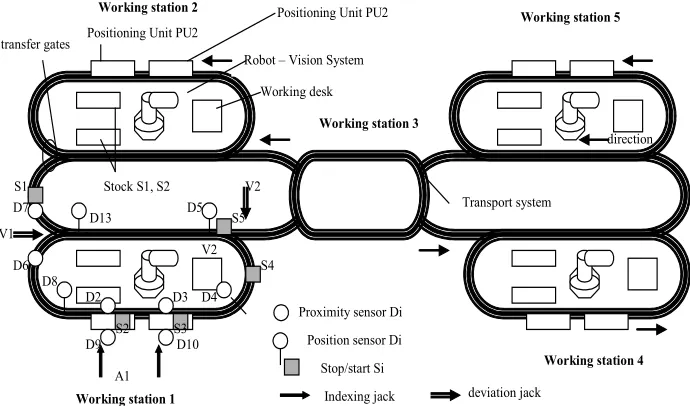
The manufacturing cell is composed by four working stations served by a conveyor system and its pallets with parts to be treated. Each working station has a robot and a
The cell’s functional organization is hierarchic and modular, structured in 5 levels: i) Robots and local control, vision systems and conveyor system zones at the lowest level; ii) The coordinationlevel is organized into a working stations local coordination
(robot, vision system), a conveyor system coordination (organized and controlled by 5 modules) and a general coordination; iii) At the highest levels, the supervision, scheduling and planning (production management).
Working station 2
Working station 1
Working station 5
Working station 4 Working station 3
Robot – Vision System
Working desk Positioning Unit PU2
Positioning Unit PU2
Stock S1, S2 transfer gates
Transport system
Proximity sensor Di
Position sensor Di
Stop/start Si
deviation jack S1
D7
D13
direction
D5 S5
V2
V2 S4
D4 V1
D6 D8
D2
D9 D10 D3
S2 S3
A1
Indexing jack
Figure 2. Robot-driven fl exible cell
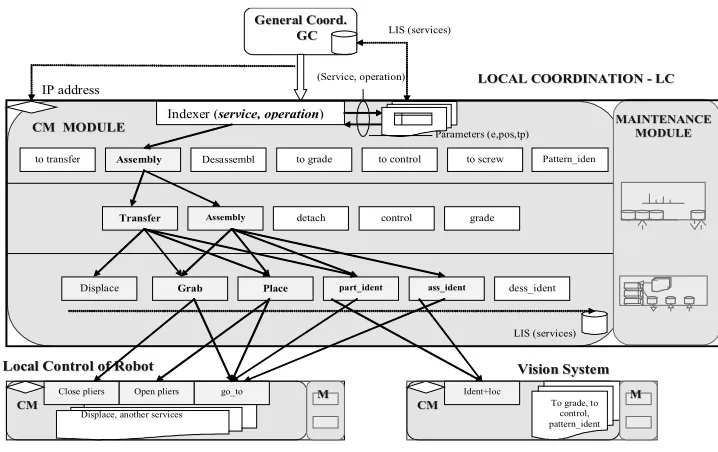
The CMM module
G
Geenneerraall CCoooorrdd.. G GCC
to transfer Assembly Desassembl to grade to control to screw Pattern_iden LIS (services)
Transfer Assembly detach control grade
Grab Place part_ident ass_ident dess_ident
Displace
Indexer (service, operation)
(Service, operation)
IP address
LIS (services) Parameters (e,pos,tp)
L
Looccaall CCoonnttrrooll ooff RRoobboott VViissiioonn SSyysstteemm
Close pliers Open pliers go_to
Displace, another services
Ident+loc
To grade, to control, pattern_ident C
CMM MMOODDUULLEE MMAAMIMINNOOTTDDEEUNUNLLAAEENNCCEE
M
M
C
CMM CCMM
L
LOOCCAALL CCOOOORRDDIINNAATTIIOONN -- LLCC
M
M
Figure 3. The CMM module
Figure 3. The CMM module
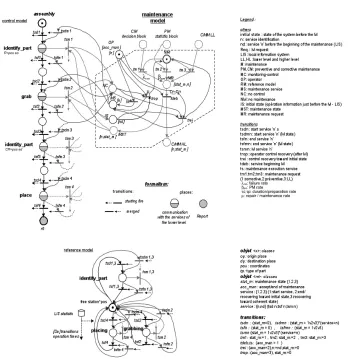
Let us start with the assembly of a spare part issued from the stock, on top of another part located above a working desk. The control, reference and maintenance
models concerning this coordination level are described in Figure 4, and make up the CMM coordination module.
Figure 4. CMM reference-control-maintenance models for coordination of working station
Let us consider the control model. The assembly service starts a sequence of low level services: ‘identify_ part’ service, which identifi es the part’s location in order to recover it (offered by the vision system’s local control), ‘grabbing’ service which grabs and moves the part from and into a placing position, ‘placing’ service which corresponds to the assembly part and ‘grabbing’ service for the removal of the assembly part (offered by the robot local control (Figure 5)). The associated reference model represents the process restrictions (mutual exclusion of operations and estimated operational times).
transition ‘tsd1’ at the reference model, is simultaneously fi red (under the condition that its input place ‘free_station’ is marked, meaning that the requested service is coherent with the process state). Therefore, the reference model evolves towards the ‘part_identifi cation’ state.
Legend:
tsd22: start closing_pliers tsdm22: start closing_pliers (M state) tsf22: end closing_pliers tsfm22: end closing_pliers (M state) tsd42: start opening_pliers tsdm42: start opening_pliers (M state) tsf42: end opening_pliers tsfm42: end opening_pliers (M state) pos closing_pliers Robot opening_pliers reference models tsd22 LIS statistic go_to
tsf21,41 tsm21,41tsfm21,41 tsd21,41 tsm22 tsfm22 tsm42 tsf42 tsfm42 tsf22 tsdm42 tsdm42 tsd42 tsdm21,41 [Do] transitions operation times placing go_to close_pliers grabbing go_to maintenance model control models r2 tsd21 tsf21 tsfm21 tsm22 tsf22 tsfm22 tsm21 tsd22 open_pliers r4 tsm41 tsfm41 tsf42 tsfm42 tsd41 tsm42 tsd42 tsf41 tsdm41 tsdm42 tsdm21 tsdm22 [stat_m,n] tm1 tm2 tm3
tdeb [n;stat_m] OP [acc_man] [n] CMM LL PM statistic block CM decision block CMM HL [n;stat_m] [nd] trop trei ts NC IS MST MS MR NM [n]
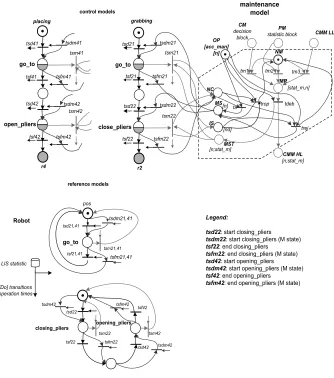
Figure 5. Local command CMM models for robots
If the execution report is received within the temporal window, the control and reference models can evolve (simultaneous fi ring of ‘tsf1’ and ‘tsf13’). The reference model evolves towards the ‘free_station’ state and the control model can request the ‘grabbing’ service. Therefore, a simultaneous fi ring of ‘tsd2’ occurs in the control and reference models and the latter also changes to the ‘taken’ state. The service request is transmitted to the lower level, in this case, to the robot’s local control.
At this level, the control model carries out a sequence of elementary controls over the process: ‘go_to’, then ‘close_pliers’ (Figure 5). Two reference models represent the process’ behaviour associated with the pliers and the arm movement. The evolution of the control and reference models is made as described previously. When this last sequence operation (‘close_pliers’) ends, an execution report of the ‘grabbing’ service (‘cr2’) is transmitted to the CMM module’s upper level. Then, the ‘place’ and ‘grab’
services are executed.
Let us suppose that a failure is detected at the end of the fi nal assembly part operation: the ‘close_pliers’ end-of-execution report is not received within temporal window. Thus, the decision block requires a corrective maintenance action from the operator (CM-tm1-MR sequence at the maintenance model of the CMM module’s local control).
The operator acknowledges the module in a maintenance state and the upper level is informed about it (OP-tdeb-MST/CMM NS sequence). At the upper level, this information will be taken into account by the decision block and by the operator, who will decide, or not, about also placing the module in the maintenance state (CMM LL-tm3-MR-tdeb-MST). The module’s maintenance state means the suspension of the on-going operation and its registering due to its recovery (MST-tsm22-NC/IS sequence).
At this moment the operator is able to require services or operations available in the control model, or trigger operation sequences that are different from the regular control (OP/NC-ts-MS-tsdmn). The detection mechanism still considers the process’ restrictions through the reference model (transitions ‘tsdmn’ and ‘tsfmn’). Sequences, tests or maintenance operations depend on the operator’s experience and can be formulated by means of a rule-based system (expert system). It is possible to use the local information system’s (LIS) data as a reference: failures historic data, interventions maintenance policies adopted, MTBF, MTT indexes, etc. Considering our case, when failure at the ‘close_pliers’ service is detected, the operator is able to request:
pliers opening (
• OP/HS-ts-MS-tsdm42-open_pliers sequence), and if the
pliers repositioning (
• OP/NC-ts-MS-tsdm21-go_to-tsfm21-NC sequence) to make a
pliers closing test with maximum safety; closing the empty pliers (
• MS-tsdm22-close_pliers sequence). If the
end-of-execution report (value of the closing/opening signal is acknowledged and the strength sensor has an empty closing value) is not received within the time window, it is possible to conclude that the closing device is not working (interruption of the air supply, for example).
Once the failure is repaired, the operator is able to perform new tests, requesting a specifi c part in the stock (‘identify_part’ service of the CMM coordination module, after ‘taking’ and fi nally ‘placing’ it in the stock, for example). And fi nally, the operator must replace the control into a coherent state – to the breakdown initial state (registered by the IS location’s stick), i.e., at the beginning of the ‘taking’ service (OP/NC/IS-trei-MS-tsdm2 sequence) or proceed to the fi nalization of the suspended operation, before leaving it to the general control (OP/NC/IS-trop-MS-tsdm2 sequence). In both cases the reference models are equally replaced into coherent states. All interventions are registered in the Local Information Systems (LIS policy) to make future interventions easier.
CONCLUSION
This study presented a hierarchic and modular control-monitoring-maintenance architecture, organized in CMM modules. In each module the interaction of a control module, process’s reference models (allowing the detection of failures) and a maintenance module (consisting of a maintenance model and a statistics module) can be observed. This module allows different maintenance policies to be carried out - corrective and preventive/predictive ones.
The statistics block, coupled to a local information system, enables the registration of all the information issued by the process and control, it estimates and establishes a preventive/predictive maintenance plan and helps the operator during a maintenance intervention. The maintenance model PN may simulate the system’s stochastic behaviour when subject to failures and maintenance procedures and repairs.
The operator can access, via maintenance model, the services and operations offered by the control and can sequence them differently from the expected process. In addition, it is possible to, eventually, access services that are available, but are not being used in the current process. The evolution of reference models during the control stages and during the maintenance stage results in an assurance of a coherent use of the process. This integration process, the maintenance tasks integrated into the control and monitoring structure, are the main advantages of our approach.
presented in a remote maintenance context, e.g.: the remote confi guration of the CMM modules, network and devices, as well as the reliability, safety and real time conditions. Moreover, the planning and scheduling levels will be considered in detail leading to the defi nition of interfaces with the CMM nodes.
The CMM architecture (its models) is based on a development cycle methodology that characterizes the following steps: modelling, analysis/simulation and implementation of the CMM modules. Then, the maintenance aspects may be taken into account from the concept stage to the operation stage of a fl exible manufacturing system. The proposed modelling approach based on Petri nets allows a modular optimisation of the maintenance procedure.
REFERENCES
Bérenguer C.; Châtelet E.; Langeron, Y. (2004) “Modelling and simulation of maintenance strategies using stochastic Petri nets”, Proceedings of 4th International Conference on Mathematical Methods in Reliability Methodology and Practice, Santa Fe, New Mexico.
Berruet P. (1998) “Toward an Implementation of Recovery Procedures for FMS Supervision”, Proceedings of Information Control Problems in Manufacturing, France, pp. 371-376.
Bondavalli, A.; Filippini, R. (2004) “Modelling and Analysis of a Scheduled Maintenance System: a DSPN Approache”, The Computer Journal, BCS, Vol 47, No 6, pp. 634-650.
Chaillet-Subias A.; Zamai, E.; Combacau, M. (1997) “Information fl ow in a control and monitoring architecture”, Proceedings of the IEEE Int. Symposium on Industrial Electronics, pp.53-58, Guimaraes, Portugal.
Gershwin, S.B.; Caramanis, M.; Murray, P. (1998) “Simulation experience with a hierarchical scheduling policy for a simple manufacturing system”, Proceedings of the 27th IEEE Conf. on Dec. and Control, Vol 3, pp. 1841 – 1849.
Ghoshal S. et al. (1999) “An Integrated Process for System Maintenance, Fault Diagnosis and Support”, Invited paper in Proc. IEEE Aerospace Conf., Colorado, USA.
Giua, A.; DiCesare, F. (1994) “Petri net structural analysis for supervisory control”, IEEE Transactions on Robotics and Automation, Vol 10, Issue: 2, pp. 185-195. Gouvea da Costa, S. E.; Platts, K.; Fleury, A. (2000) “Advanced Manufacturing
Technology: defi ning the object and positioning it as an element of manufacturing strategy”, Proceedings of the VI International Conference on Industrial Engineering and Operations Management, São Paulo.
Jeng, W.-H; Liang, G. R. (1998) “Reliable automated manufacturing system design based on SMT framework”, Computers in Industry 35, pp.121-147.
Petri nets”, Fuzziness in Petri Nets – Studies in Fuzziness and Soft Computing, Physica-Verlag, Vol. 22, pp. 146-173.
Loures, E. R.; Paula, Busetti, M. A. (1999) “VIEnCoD - Proposal of an Environment CACSD integrated to an ERP system as a tool in the Support to the Control System Development Cycle Based on VXIbus / LabWindows and MATLAB Platform”, Proceedings of the 7th IEEE Int. Conf. on Emerging Techn. and Factory Automation, Spain, pp. 761-766.
Ly F.; Toguyeni, A. K.; Craye, E. (2000) “Indirect predictive monitoring in fl exible manufacturing systems”, Robotics and Computer Integrated Manufacturing, Elsevier Science Ltd., No 16, pp. 321-338.
Ly, F.; Simeu-Abazi, Z.; Leger, J-B. (1999) “Maintenance terminology review”, Report of the Research Group of Safety Functioning Production, France.
Mouss, H.; Mouss, N.; Smadi, H. (2004) “The Maintenance and Production: Integration Approach”. Proceedings of the 4th Internacional Conference on Mathematical Methods in Reliability Methodology and Practive, Santa Fe, New Mexico.
Pascal, J-C. (2000) “A modular and hierarchical approach for supervisory control of batch processes”, 4th International Conference on Automation of Mixed Processes: Hybrid Dynamic Systems, German, pp.369-374.
Santos, E. A. P.; Paula, M. A. B. de; da Silveira, M. R. (2004) “A methodology for modeling the control of a mechatronic manufacturing cell”, 9th Mechatronics Forum International Conference, Vol 1, pp. 1-6.
Silveira, M. da; Combacau, M.; Boufaied, A. (2000) “Prognosis and recovery evaluation on fl exible manufacturing supervision”, IEPM’01 International Conference on Industrial Engineering and Production Management, Quebec, Canada.
Simeu-Abazi, Z. ; Sassine, C. (2001) “Maitenance Integration in Manufacturing System Evaluation and Decision”, International Journal of Manufacturing Systems, Vol 13, No 3.
Srinivasan, V.S.; Jafari, M.A. (1993) “Fault detection/monitoring using time Petri nets”, IEEE Transactions on Systems, Man and Cybernetics, Vol 23, pp. 1155-1162. Tang, Y.; Zhou, M.C. (2001) “Design of reconfi gurable semiconductor manufacturing
systems with maintenance and failure”. Proc. of the IEEE International Conference on Robotics and Automation, Vol 1, pp. 559 – 564.
Varvatsoulakis, M.N.; Saridis, G.N.; Paraskevopulos, P.N. (2000) “Intelligent organization for fl exible manufacturing” IEEE Trans. on Robotics and Automation, Vol 16, Issue 2, pp. 180 – 189.
Biography
Eduardo de F. R. Loures received his B.Sc. degree in Electrical Engineering from the Universidade Tecnológica Federal do Paraná (UTFPR), Curitiba, Brazil, a MSc degree in Informatics from the Pontifi cia Universidade Católica do Paraná (PUCPR), Curitiba, Brazil, and a PhD in Systèmes Industriels, LAAS, France. He heads the Mechatronics Engineering Department at PUCPR. His research interests include Automated Manufacturing Systems, Failure Identifi cation and Diagnoses, Business Process Management.
Eduardo Alves Portela Santos received his B.Sc. degree in Mechanical Engineering from the Universidade Federal da Bahia (UFBA), Salvador, Brazil, a MSc degree in Mechanical Systems from the Universidade Federal de Santa Catarina (UFSC), Florianópolis, Brazil, and a PhD in Information Systems from the same university(UFSC). His research interests include Automated Manufacturing Systems, Business Process Management, and Conformance checking in business process.