CHAPTER 5: PERFORMING THE LEGACY OF ANIMATIVE AND ITERATIVE APPROACHES TO CO-PRODUCING KNOWLEDGE Mihaela Kelemen, Martin Phillips, Deborah James, Sue Moffat
in Valuing the impact of collaborative research: Theory, methods and tools, (Facer, K. & Pahl, K., Eds), Bristol: Policy Press, pp.107-130, 2017
INTRODUCTION
Various modes of research such as engaged scholarship (see Van de Ven and Johnson, 2006; Van de Ven, 2007), relational scholarship (Bartunek (2007) and dialogical research (Beech et al, 2010; Avenier and Parmentier Cajaiba, 2012, Lorino et al 2011, MacIntosh et al, 2012) have been advocated as forms of collaborative research in which academics and practitioners work together to co-produce knowledge about a complex/problematic/sensitive phenomenon. The collaborative work discussed in this chapter shared many of these engaged, relational and dialogical features and involved a variety of people from three countries (academics from diverse disciplines, community partners from local and national level organisations) all with different ideas about how collaboration should work and what change it should achieve. In this chapter we introduce five theoretical perspectives (Theatre Studies, American
Pragmatism, Critical Theory, Actor Network Theory and Deleuzian Studies) which we used to make sense of our collaborative efforts. We then provide a short account of the research projects undertaken, their creative methodologies and resulting artistic outputs (two
interactive installations, a game and a documentary drama). We examine how our chosen theories have shaped the processes by which we co-defined and co-evaluated the legacies of our research projects. We conclude that any attempt to define legacy of collaborative research involves a strong element of performing it with the community partners.
Making sense of collaboration: five theoretical lenses
Collaborative research and co-creation processes in general (Denis and Lomas, 2003, Shani et al, 2008) are seen as forms of research that facilitate examination of the dynamic relationship between academic and community practice. As outlined below, we made use of five
theoretical perspectives to help make sense of our collaborative, co-creative research endeavours and their resulting legacies. Building on Nicolini’s (2009) work, we switch theoretical lenses and re-positioning in the field so that certain aspects of practice are grounded while others are bracketed. A common thread across our theoretical lenses is that they challenge disciplinary boundaries, emphasise everyday performance, create safer spaces for thinking about existing challenges and about how to tackle them by making visible the creative possibilities that exist within individuals and communities. By adopting an agonistic pluralist stance (Mouffe, 2007), our approach has been to reflect and embrace rather than suppress difference and to find skillful ways to acknowledge and accept that conflict can be co-generative in collaborative efforts.
Theatre Studies
theatre in the 1960s, with working in the round bringing new ideological and creative
possibilities such as ‘verbatim theatre’ and the opportunity to create documentaries concerned with the everyday life struggles and stories of the community. The rigour of the research undertaken for a piece of documentary theatre and the respect for the way people tell their own stories dovetailed well with a methodology of knowledge co-production known as ‘Cultural Animation’ (Kelemen and Hamilton, 2015). The director of New Vic Borderlines and pioneer of Cultural Animation in the UK, Sue Moffat, describes the theatre’s
involvement in the CC programme as follows: “we’ve never done any research before being involved in the CC programme and never connected our stories with existing theories and insights. Working with academics lent credibility to what we had been doing for a decade, providing a powerful language that resonated deeply with our own ambitions and agenda”. Cultural Animation’s main ambition is to create a democratic space, where hierarchies can be dissolved at least temporarily. Playful experiential exercises which draw on a range of theatre traditions including Stanislavski, Brecht and Boal (Bishop, 2006) are adapted to hasten the reduction of barriers and insecurities and to create connections which grow throughout the process. Using Cultural Animation as a research tool allows ‘tricky’, contentious and potentially difficult themes to be explored in a way where opposing narratives can exist side-by-side and common concerns can be identified.
American Pragmatism
The emphasis on the formation of trusting and genuine relationships, based on equality between academics and community partners finds resonance with strands of American Pragmatism, such as John Dewey’s democratic experimentalism. His democratic
experimentalism rejects the idea that science has a special method to access reality, which is different from the way in which we gain knowledge in our everyday lives (Dewey, 1938 [1991]). Thus, scientific inquiry follows the same pattern as common sense inquiry as there is methodological and content continuity between science and common sense. Ordinary experience can produce from within itself questions and criteria of judgment that constitute legitimate knowledge. Just like the theatre tradition above, Pragmatism views academic expertise, commonsensical intelligence and practical knowledge as equal partners in the research conversation. As such the relationship between researchers and community partners during the research process is necessarily democratic. In Dewey's ideal, experimentalism and democratic behaviour become fused (Gouinlock, 1990). Democratic experimentalism does not aim to produce knowledge that represents the truth about the world. Rather, its main ambition is to provide intellectual instruments and practical tools for people to think and act more effectively in a world shot with contingency and ambiguity (Watson, 2011).
Critical Theory
The processes of inter-subjective interactions facilitated by our collaborative research connect to many aspects of the critical theory of commentators such as Jürgen Habermas, Max
Horkheimer and Axel Honneth that both draw on, and distance themselves, from the philosophy of American pragmatism (e.g. see Aboulafia et al., 2002; Rehg and Bohman, 2001). Horkheimer argued that the purpose of theory should not be to "simply … increase knowledge as such" but should have as its goal "emancipation", "the happiness of all
performative or consequentialist understanding of truth, whereby truth is established through, and often operates within, people's practices.
Actor Network Theory
Our collaboration was also influenced by actor-network theories where the 'truth' or 'power' of an interpretation is seen to lie in the connections it can sustain (e.g. see Latour, 1999; Callon, 1986). Such work has frequently claimed that knowledge is produced by networks of heterogenous human and non-or more-than-human entities, or 'actants'. There are clear parallels to the emphasis in American Pragmatism on the practical judgement of knowledge, although arguably this places greater emphasis than actor-network theory does on conceptual revisions and the improvement of the conditions for the thriving of life. A striking feature of our research project was that the research themes and the methodologies of the original projects were able to transfer into new contexts, enrolling support from new participants in the UK but also in other countries: Japan, Canada and Greece.
Deluezian Studies
The writings of the post-structuralist philosopher Giles Deleuze (e.g. see Deleuze, 1994) advance the notion of 'difference within repetition' which was a central aspect of our collaborative work which relied on various forms of iteration. For Deleuze, even within the apparently identical there are always differences: even if the outcome of creating an
understanding is simply a repetition of some earlier understanding, the creation of this understanding has been a unique event or series of events, or as Abel (2002, p. 234) puts it, each interpretation is "a new voyage, one that repeats some of the old movements but [always] introduces new ones". Five modes of iteration have underpinned our collaboration, namely iteration as 'refinement of ideas', 'deepening description', 'inter-subjective engagement with others', 'enrolment', and the 'detailing of difference within repetition'. These modes of iteration are by no means mutually exclusive, although they can produce quite different outputs and can be connected to quite different, and arguably quite incommensurable, epistemologies.
Key resources for thinking about legacy
The suggested sources encourage the readers to approach the concept of legacy through a plurality of theoretical lenses and challenge disciplinary boundaries when exploring the performative nature of research impact and legacy.
Aguinis, H., D. Shapiro., E. Antonacopoulou Gnosis and T. Cummings, (2014). ‘Scholarly Impact: A Pluralist Conceptualization’, Academy of Management Learning & Education. 13, pp. 623–639.
Beech, N., R. MacIntosh and D. MacLean (2010). ‘Dialogues between academics and
practitioners: The role of generative dialogic encounters’, Organization Studies, 31, pp. 1341-1367.
James, D. (2015). Evaluating the legacy of animative and iterative Connected Communities projects: reflections on methodological legacies,
Kelemen, M. and Hamilton, L. (2015), The role of creative methods in redefining the impact agenda, CASIC Working Paper No. 1, https://www.keele.ac.uk/casic/workingpaperseries/
Nicolini, D. (2009). ‘Zooming in and out: studying practices by switching lenses and trailing connections’, Organization Studies, 30, pp. 1391-1418.
PROJECTS IN FOCUS AND THEIR METHODS: CULTURAL ANIMATION AND ITERATION
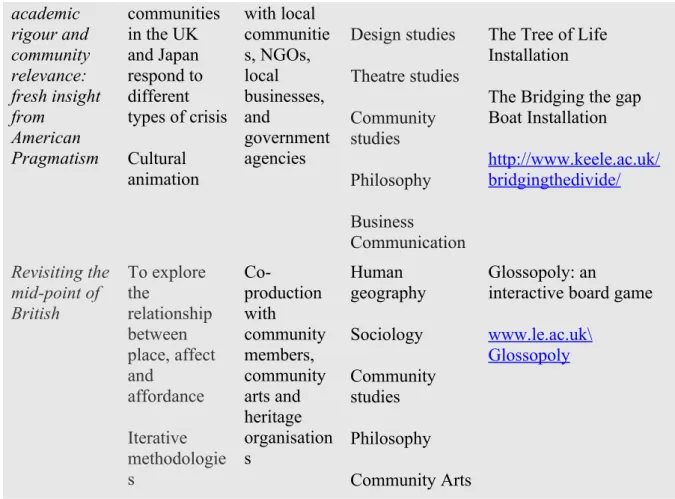
We provide in Table 1 a short summary of the four research projects whose legacy we have evaluated, followed by a summary of the key points of the cultural animation methodology that underpinned the first three projects and of the iterative methodology that led to the development of a community co-produced interactive game called Glossopoly in the fourth project.
Project Title Aims and Methodologi es Type of collaboratio n Interdisciplinarit y Outcomes Exploring Personal Communities : A Review of Volunteering Explore how personal communities contribute to the public good via a scoping review Documentary Theatre Co-design of a documentar y drama with community members Community studies Organisation Studies Sociology Theatre Studies
Literature scoping study: http://www.keele.ac.uk/e xploringpersonalcommu nities/
Documentary drama: ‘Little act of Kindness’ performed in Newcastle under Lyme and London
Untold Stories of Volunteering: A Cultural Animation Project To explore volunteering experiences with a wide range of stakeholders Cultural Animation Documentary theatre Co-design and co-production with community members and other stakeholders (such as NCVO) Philosophy Theatre Studies Human Geography Management Studies Community Art Documentary Drama: Untold Stories of
Volunteering, performed in Newcastle under Lyme, Leicester and London
Mini-performances
Songs
Shadow Puppet Theatre
Installations
http://www.keele.ac.uk/ volunteeringstories/ Bridging the
academic rigour and community relevance: fresh insight from American Pragmatism communities in the UK and Japan respond to different types of crisis
Cultural animation with local communitie s, NGOs, local businesses, and government agencies Design studies Theatre studies Community studies Philosophy Business Communication
The Tree of Life Installation
The Bridging the gap Boat Installation http://www.keele.ac.uk/ bridgingthedivide/ Revisiting the mid-point of British To explore the relationship between place, affect and affordance Iterative methodologie s Co-production with community members, community arts and heritage organisation s Human geography Sociology Community studies Philosophy Community Arts Glossopoly: an
interactive board game
www.le.ac.uk\ Glossopoly
Table 1: Projects Referenced in Chapter 5
Cultural Animation lies within the broad field of Creative Methods (Gauntlett, 2007) which include an array of techniques of a visual, performative and sensory nature (Barone and Eisner, 2007). Yet Cultural Animation eludes simple narrative. Nonetheless, we can summarise it for our present purposes as a form of community arts engagement which literally animates, or "gives life to", the underlying dynamic of a community (Reynolds, 1984). It is this enlivening process that makes this approach a valuable method of social enquiry as well as a powerful way of representing and communicating important issues. Through a variety of drama-based techniques and artefact making, the methodology helps to accentuate the relational, processual and emergent nature of collaborative research and its networks. In a relatively straightforward sense, then, it aims to make the voice of the community more central rather than assuming academic privilege in simplifying and categorising the world for scholarly purposes. Cultural Animation is heavily influenced by theatre studies and American Pragmatism, in particular Dewey’s principle of the
experimental iteration.
that were seen or otherwise sensed as one moved through space. However, a focus on iterative methods came to particular prominence in the development of Glossopoly. The iterative process of playing the game enabled refining of views and helps generate new themes for discussion and analysis. Though iterative and animative methods are different, they have several things in common in terms of their approach and value base:
They are highly participatory, group-based methods. In common with other participatory research methods, the process (engagement of participants with the themes, activities, and, importantly, with each other) is valued alongside the output. They are at heart creative, drawing on play, imagination, art and games as ways to
energise people to articulate ideas and experiences in new and different ways.
Objects, artefacts and creative tasks serve an important purpose as a way to stimulate imagination and conversation.
Given their embodied nature, these methodologies have been effective across national
cultures. Indeed, Japanese and Canadian academics and community partners have been quick to embrace their ethos. While critics may argue that these methodologies are forms of play, our collaboration taught us that “you can discover more about a person in an hour of play than in a year of conversation” (Plato quoted in D’Angour, 2013: 296). Thus, our
collaborative methodologies linked to problem solving in a rather innovative (and playful) way because they complicated the very idea of significant research problems just as they challenged traditional methods for tackling them.
ARTEFACTS CO-PRODUCED IN THESE PROJECTS
We now briefly consider a few artistic artefacts which were co-produced in Cultural Animation workshops and iterative activities, respectively. We start by focusing on two ‘installations’ and a documentary play and then move on to introduce Glossopoly (a game that resulted from iterative collaborative research). It is important to explain how these emerged because this demonstrates the performed and co-creative nature of the collaborative process in close-up and is relevant to our subsequent analysis. The Boat Installation (see image 4) is a seven foot wooden ‘barge’ on wheels with sails made out of silk imprinted with images produced in Cultural Animation workshops that focused on creating ‘new worlds’ in Stoke-on-Trent, a UK city experiencing the aftermath of decline in primary industry (coal mining, steel and pottery production) and with a number of pressing social problems including widespread unemployment and poverty. In seeking to co-design and co-create a physical artefact for imagining new worlds from the ‘lost worlds’ of industry and production, the boat takes participants on imaginary voyages of discovery, inviting them to make
artefacts and write poems or songs about a lost past and an imagined future.
Insert IMAGE 4: The Boat
approaches facilitated story telling through object making: such objects (dolls, flags, poems, etc) were ‘hung’ onto the bare branches of the tree filling it with stories of survival and hopes for the future. Like the boat, this is an installation themed around lost worlds and imagining new ones with communities in crisis.
Insert IMAGE 5: Tree of Life
The third art form is an interactive documentary drama about volunteering performed by project participants and theatre practitioners. Entitled, ‘Untold Stories of Volunteering’, the drama focused on the role of volunteering in our communities, exploring the dynamism and challenges of individual volunteering journeys and organisational practices relating to volunteering (see image 6). It was co-designed using volunteers’ testimonies from 20 interviews, as well as ideas that emerged and artefacts created in five Cultural Animation workshops with diverse community partners and other institutional stakeholders. The performance included voice-over (interview clips), songs and poems written by original participants in the project.
Insert IMAGE 6: Documentary drama on volunteering
Finally, Glossopoly developed as a game-based method of engaging people to interact with each other to reflect on and discuss notions of community. The game was derived from the popular board game Monopoly, but has been redesigned to act as an instrument of iterative research (see image 7). Specifically the game involves people interacting with the views of other people, as expressed through face-to-face discussions with other players of the game and with the comments and images made by people and expressed in images on the board on which the game is played and a series of cards players pick up as they move counters, or themselves in a floor-based version of the game, around the Glossopoly board. The images and words were derived from earlier research, such as the questionnaires and interviews discussed above, but also incorporated materials derived from earlier enactments of the game or produced as part of current game.1 The game is seen to be an expression of iterative research in that there are repeated movements between people's initial viewpoints and the views of others. There was also, in some variants of the game, iteration between the expression of problems and the formulation of potential solutions, as well as interactions between different community constituents. Though initially a board game, Glossopoly evolved into a floor game during the course of this Legacy project as seen in Figure 7.
Insert IMAGE 7: Glossopoly
In setting out some of the artistic outputs that were co-produced in our projects, we suggest that a more refined view of collaboration and change is possible. This, we argue, offers a distinctive way to transcend disciplinary, social and national culture borders and, in a practical way, enables us to reconceptualise what is meant by the legacy of our research. In our next section, we discuss this is more detail by drawing upon the nascent literature on ‘legacy’ and by outlining the collaborative work undertaken in our Legacy Project.
CO-EVALUATING LEGACY: METHODOLOGICAL INSIGHTS
Deborah Jones, a senior evaluator from NCVO worked alongside project partners and community members from the outset. One of her main ambitions was to ensure that the historiographies of the community partners came to the fore and were heard as loudly as the disciplinary backgrounds of the academics.
Our aim was both to understand, create and perform legacy from these four projects. To that end we organised a number of UK-based showcase and taster activities (delivered over five separate events: see Table 2) and the two supported pilots where researchers new to cultural animation and iterative methodologies tried them out with community members (see Table 3). Other evaluative activities took place including meetings with policy-makers and practitioners (e.g., at the Department for Communities and Local Government) and a field trip to Canada involving showcasing the activities via talks and workshops that reached almost 100 delegates (members of a non-profit network, a business school, local academics and members of local communities).
Session Audiences
Drama performance and Cultural animation workshop: A performance of the Untold Stories of Volunteering play followed by a taster workshop to introduce the methods that went into creating the stories
A mixed audience interested in volunteering and the original research findings [47] and a smaller group of volunteer managers,
researchers and policy-makers [11] interested in findings and methods (cultural animation).
Summer camp for Community
Organisers: One cultural animation and one iterative taster workshop (supported by the boat and the game) and an interactive installation (tree) during a summer camp for community activists2
Community Organisers on their annual weekend Summer Camp [50] with an interest in the methods as potential tools to engage communities, as community development/ planning tools.
National volunteering workshop: a taster cultural animation workshop organised by the National Association of Neighbourhood Management for people interested in engaging with volunteers in Big Local areas3 preceded by a
presentation and Q&A on Untold Stories of Volunteering
Residents of Big Local areas - volunteers and members of partnerships engaging their communities to improve local areas [20] with an interest in the findings of the research as well as in the methods as potential tools to engage with volunteers.
Big Local learning events: two short taster cultural animation workshop with residents of Big Local areas preceded by a presentation and Q&A on Untold Stories of Volunteering and cultural animation methods
Residents of Big Local areas - volunteers and members of partnerships engaging their communities to improve local areas [27]. Interest in methods as tools to engage community members and/or to energise planning processes within local partnerships.
2 For more see http://www.cocollaborative.org.uk/about-community-organisers
Legacy project upscaling event: Four intensive half-day tasters – 2 x cultural animation and 2 x Glossopoly
Mixed audience of academics/ practitioners to give in-depth experience of methods [55]. This audience was interested in the methods for engagement and research purposes.
Table 2 : Showcase and Taster Activities
Session Audiences
Green Keele research workshop. A cultural animation workshop delivered in partnership with researchers involved in a university campus-based sustainability project4 - using cultural animation to explore environmental issues and the relevance of sustainability to different groups and disciplines within the university.
Students and lecturers. The group involved 3 researchers and 20 participants and was a part of a wider research project on sustainability.
LGBT research workshop. A Glossopoly/ Cultural animation workshop undertaken in partnership with Middlesex University and a LGBT people’s group based in Stoke.
13 researchers and members of an elderly LGBT group took part in this session which was conceived as part of a wider exploratory piece of research into ageing, sexuality and identity.
Table 3: Research Pilots with New Partners
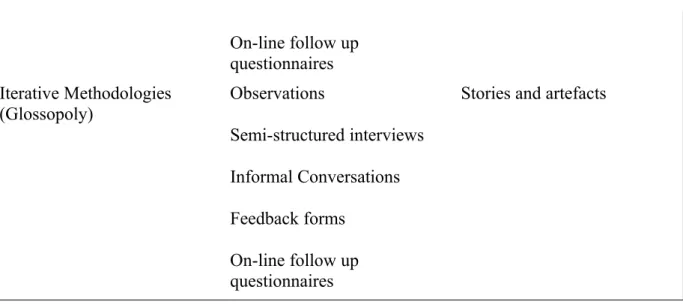
A series of evaluations based on mixed techniques (see table 4) were carried out. This data which had a story like shape was subsequently analysed in light of the five theoretical lenses introduced earlier to shed light on the meanings and dynamics of collaboration and resulting legacies.
Methodologies and artefacts
evaluated Evaluation methods Outputs
Cultural animation (The Boat, the Tree of Life, Untold Stories of Volunteering Drama)
Observations
Semi-structured interviews
Informal Conversations
Feedback forms
Stories and artefacts
On-line follow up questionnaires Iterative Methodologies
(Glossopoly)
Observations
Semi-structured interviews
Informal Conversations
Feedback forms
On-line follow up questionnaires
Stories and artefacts
Table 4 : Evaluation Methods and Outputs
The data analysis suggested that legacies can be both intended or unintended, tangible or intangible, positive or negative. Such views build on both popular understanding and
existing literature which links the term to notions of continuation and sustainability (as in the legacy narrative of large-scale projects and events such as the Olympics or Live Aid)5. The latter importantly adds the consideration that legacy is not just what is left behind but what is being used, or ‘living’, adding weight to the idea that legacies are performative and
processual.
LEGACY-AS-PERFORMANCE
Our research adopted performance in literal senses in that, not only were some of the activities focused around creating an documentary drama enacted in a stage, but also, more frequently, involved people speaking or doing things in front of others. More generally, participants involved in showcase and taster activities and the pilots were immersed in an embodied experience that linked together thinking and artistic processes. Thus, these activities made an impression on those involved precisely because of the embodied and sensory nature of their involvement. But performance carries further theoretical dimensions of meaning, bound up in questions relating to the co-called 'crisis of representation' and associated movements away from viewing knowledge as simply some form of reflection of the world. Applying this to issues of legacy implies that legacy is never something simply to be outlined or mapped, but is always something that has been created, or performed, and the degree and form of its performance, reveals the extent to which people as actors (be they academics or practitioners) have made judgements about the worth of the project activities in regard to their own research/practice contexts (Mason et al 2015).
Moreover, in making sense of these performances, we have found all five theoretical perspectives highlighted in this chapter helpful. For, when participants in a workshop are requested to reflect on a particular problematic such as ‘volunteering’ or ‘crisis’, for example, they are being encouraged to think, feel, do and reflect in collaboration with others and it is
this co-creative process which can be characterised as performative in nature; knowledge is being created by being performed into life. In the case of the boat, for example, principles of Theatre Studies ensured that participants felt included and able to ‘play a part’; Critical Theory facilitated reflection upon social problems and truths; American Pragmatism allowed for an unfolding and iterative process of refinement to take place in creating the artefact, Deleuzian approaches focused on how participants iterate thoughts and actions in order to arrive at new meaning or form closer relationships while ANT provided the framework for thinking about collaboration as a growing connectivity of actors held together over time because of their shared creative goals.
In light of the theoretical lenses that informed our legacy work, we define legacy in five specific ways (see table 8):
Theoretical Perspective Definition of Legacy Theatre Studies (Boal,
Stanislavski, Brecht)
The reproduction and transformation of a theatre tradition for new contexts such as research.
American Pragmatism (Dewey, James)
Changes in ideas or practices (or both).
Critical Theory
(Habermas, Horkheimer, Honneth)
The empowerment of individuals and groups through the intersubjective development of understandings.
Actor Network Theory (Callon, Latour)
The enrolment of new actants into a network.
Deleuzian Studies (Deleuze)
Novelty and change through repetition
Table 5 : Legacy Definitions
LEGACY AS THE REPRODUCTION AND TRANSFORMATION OF A THEATRE TRADITION
The collaborations facilitated by the CC projects allowed New Vic Borderlines to develop its creative processes into a recognisable methodology which is no longer just useful for the theatre in their outreach work but it is a tool of research which encourages academics and community members to collaborate and co-produce knowledge. In the words of Sue Moffat, Director of New Vic Borderlines,
collaborating, creating and connecting accelerates the formation of genuine relationships which do not evaporate as the research ends, but remain an important living legacy in contrast to ‘hit and run’ research”.
The methods at the heart of Cultural Animation are accessible and flexible, and community members as well as the researchers are able very quickly to learn how to use them in different contexts for their own purposes. They worked well across different national cultures such as Japan and Canada. Through these projects, a theatre based methodology has been
transformed to become useful and meaningful for different contexts, in particular the research context. This particular legacy was not intended, and yet it is probably the most powerful legacy that our collaborative research led to. The nature of the relationship between
academics and practitioners encouraged by animative (and iterative) activities was according to the participants unexpected, amazing and democratic. One community organiser said: “It encourages people to work in a democratic way and share their experience, vision, ideas, which might be helpful for community planning”, while a manager from a national charity suggested that “it creates an opportunity for people of different status to work together and make best use of their experience and creativity ... ”. A volunteer described the unexpected, yet democratic nature of our collaboration which made room for a diversity of voices: “One thing I like about this approach is the way that, being slightly unexpected, it levels the difference between residents and managers. In any setting you may get some voices heard more than others, but I felt with this methodology people who may not normally do so, feel safe.”
LEGACY AS CHANGE IN IDEAS OR PRACTICES (OR BOTH)
The research has inspired many participants to reflect on their ideas, practices and to consider different ways of engaging in their communities. Participants to the showcase and taster activities talked about how Glossopoly helped them to think differently, suggesting that it “challenged me to think creatively beyond the boundaries of current systems” (public sector manager); “I thoroughly enjoyed last year's workshop and though I can't strictly say I've used any of the specific practices from the day, it did influence how I understood community organising and how creative practices can tie into it, which meant I felt more comfortable using creative practices in my community setting (community organiser).” Researchers also commented on the long lasting effects of the animative exercises: “I’m sure that the
moments of genuine worry, whilst scavenging for objects during the time pressure, will have done much more for changing minds and reinforcing ideas than any poster or fact-receiving session. This morning was a great way of exploring the concept. Fantastic.” (early career researcher). “It was a very unusual experience but very worthwhile. I keep thinking back on various things we did/I thought which I'm surprised at. The experience seems more persistent than I'd expect for a workshop.” (lecturer). Other participants reflected on how the
experience has changed how they may do things in the future: “I will use this technique to encourage co-operation, idea-sharing and community engagement (local authority
employee)”; “I liked the dramatic aspect, as it gave scope for different skills and creativity. I will take that away and think about new ways to enliven group work (charity manager).”
LEGACY AS EMPOWERMENT OF INDIVIDUALS AND GROUPS.
result of being on benefits. Paula, a participant in the project, describes herself as being ‘sentenced’ to do volunteering as part of her community payback sentence, whereby she avoided a prison sentence. Initially she was a ‘voluntold’ in a charity shop while
simultaneously taking part in a local theatre project called ‘Next Chapter’. After this project finished, she continued to volunteer with the New Vic Theatre and became part of our Connected Communities project, as well as becoming a volunteer at the Citizen’s Advice Bureau. Paula’s story was enacted on stage as part of the ‘Untold stories of volunteering documentary drama’ that toured in Newcastle-under-Lyme, London and Leicester. In conversation, Paula frequently exclaimed ‘look at me now!’ and speaks of her volunteering activities as something that gave her a new life. She said: ‘I have registered for a pre-access course and one day I’ll come to Keele to do a degree’. For her voluntolding turned quickly into volunteering and this helped her to ‘network and expand my mind and vocabulary and meet decent people,.. hard-working, caring people. In the past I was hanging with the wrong crowd but not anymore’. Paula’s story of personal enlightenment and empowerment is a powerful example of how involvement in collaborative research can make a lasting impact on someone’s identity and aspirations. The PI of the grant, whose prior research used to focus on leadership in large corporations also recounts how involvement in the CC programme led to a fundamental change in her own aspirations and priorities as an academic but more importantly as a human being: “ I don’t think I could ever go back to researching in the way I did before the CC programme came along. I have changed immensely as a result of the collaborative work we’ve done with our communities over the last three years: I now speak my mind and stand up for my values without worrying too much about university politics’.
LEGACY AS A GROWING NETWORK
The network developed over the last three years spread at an exponential rate. The initial networks have deepened and widened significantly to include academic and community partners in many parts of the UK (including Newcastle upon Tyne, Edinburgh University, Huddersfield University) as well as across the world (Canada, Japan, Greece, France, Singapore and Finland). Mapping the journeys of our artefacts over the last two years demonstrate the centrality of the non-human actants in enrolling interest and expanding the network. The Boat and the Tree of Life travelled to Rotherham in January 2014, as part of a workshop commemorating the Holocaust. As a result, strong connections were formed with Sheffield University and their community partners. The boat and the tree were centre pieces at a workshop with people with mental health problems held in Huddersfield in November, 2014. Academics from Huddersfield are now working closely with members of the initial network to develop a follow on bid on making mental history come alive through animative methodologies. The ‘Tree of life’ Installation represented the UK Connected Community Programme at The Community Academia Engagement Conference, from University of Victoria, Canada, in May, 2014. Here we connected with academics and community partners from the UK, Canada and Singapore. Some of these connections allowed us to organise a field trip to Canada in June 2015 to work with communities in London, Ontario and the City of Markham. The Tree of Life and Glossopoly were central in the workshops run in Canada where participants embraced wholeheartedly both animative and iterative principles as well as adding a distinct Canadian flavor to our exercises and techniques. In September 2015, Glossopoly and the Tree of Life installation facilitated a number of workshops with
Osaka’s marginalised communities in February 2015 and 2016. Our artistic outputs were showcased at four CC festivals: London and Edinburgh in 2013, Cardiff in 2014 and various Staffordshire venues in 2015. As a result of the growing network, we were in a position to launch in March 2015 a new inter-disciplinary community-based research centre at Keele University, Community Animation and Social Innovation Centre (CASIC), which brings together over 100 academics and community partners from the UK and ten other countries (http://www.keele.ac.uk/casic/).
LEGACY AS NOVELTY AND CHANGE WITHIN REPETITION
One of the challenges in thinking about legacy is the degree to which activities generate new insights. This has been particularly true of the Connected Communities programme which is addressing issues that have been the focus not only extensive research but also extended lines of practice. In the case of the projects discussed in this chapter, it was also clear that many of the activities could be criticised as producing results that were repetitive of existing
understandings. However, it was also clear that many of the individual were deriving new insights about themselves, others and the issue at stake through these activities. In seeking to address this seeming paradox we have come to draw on the insights of Deleuze who
emphasises the significance of recognising the presence of difference within repetition. A clear illustration of this was a cultural animation workshop held at the Society House in London in 2014, which explored the relationship between the volunteer and the state. Mixed groups of researchers, volunteers, volunteer managers and policy makers from Stoke on Trent and London, all arrived at a similar conclusion, namely that relationships between the
individual and the state were ‘paradoxical’. However, in the process of creating this
conclusion many participants learnt new things about volunteering and about each other. For example, a senior manager from the RNIB talked about their long waiting lists for people wanting to volunteer, yet a group of volunteers from Stoke on Trent, 'Mums on a Mission', talked about their struggle to attract people to volunteer for their small organisation. A senior member from an umbrella organisation referred to people on benefits as 'low hanging fruits' that can be picked up and placed in a volunteering jobs without much fuss. A volunteer from Stoke on Trent who was in this position disputed this, saying that people on benefits have been commodified and sold on the market by third parties for profit with no consideration for their skills or aspirations. While the verbal exchange between parties had been at times fraught with conflict, when they engaged in cultural animation techniques and started to make things by organising themselves to deliver answers, the hierarchies felt and enacted through the initial dialogue, started to melt and the roles started to get reversed with Stoke on Trent volunteers taking the lead in their mixed group.
CONCLUSIONS
In documenting the democratic and arts mediated engagement between academics and practitioners, as enacted in our collaborative research, we also have also illuminated the types of evidence constructed to demonstrate that our research methodologies and resulting
research projects as new audiences, across the UK, Canada and Japan, engaged, experienced and learned about it, considered how they could apply and put it into practice in different settings and with different communities. Based on this, our argument is that if we want legacy definitions that are relevant, useful and, above all make a real difference, more performative studies are needed to gain insights into the dynamic between academics and community members as they co-produce knowledge.
Guidance for understanding legacy:
Do not think that just because you have achieved the same outcome, there has not been any change.
Small objects and artefacts can spark extraordinary change.
The presence of absence is important: always ask who is not in the room and why.
Take responsibility for yourself and the others but be yourself
Play is not only fun but can reveal a great deal about human nature and relationships.
Acknowledgements:
Many thanks to Lindsay Hamilton and Jess Steele for their useful comments and insights into the many topics covered in the chapter.
References
Adorno, T. W., with M. Horkheimer. (2002). Dialectic of Enlightenment. Trans. Edmund Jephcott. Stanford: Stanford UP.
Aguinis, H., D. Shapiro., E. Antonacopoulou Gnosis and T. Cummings, (2014). ‘Scholarly impact: a pluralist aonceptualization’, Academy of Management Learning & Education. 13, pp. 623–639.
Aboulafia, M., M. Bookman and C. Kemp (2002). Habermas and Pragmatism. Abingdon: Routledge.
Avenier, M.J. and Parmentier Cajaiba A. (2012). The dialogical model: developing academic knowledge for and from practice. European Management Review, 9, pp. 199-212.
Barone, T. and E. Eisner (1997). Arts-based educational research. In R. Jaeger (ed.), Complimentary methods of educational research, pp. 95-109. New York: Macmillan Publishing.
Beech, N., R. MacIntosh and D. MacLean (2010). ‘Dialogues between academics and practitioners: the role of generative dialogic encounters’, Organization Studies, 31, pp. 1341-1367.
Bernstein, R. J. (1992). ‘The resurgence of Pragmatism’, Social Research: An International Quarterly, 59, pp. 813-840.
Biesta, G. and N. Burbules, N. (2003). Pragmatism and education research. Michigan: Rowman and Littlefield publishers, Inc.
Bishop, C. (Eds) (2006). Participation (Documents of Contemporary Arts). co-published by Whitechapel Gallery and MIT.
Callon, M. (1986). ‘Some elements of a sociology of translation: domestication of the scallops and the fishermen of St Brieuc Bay’. In J. Law (ed.), Power, Action and Belief: A New Sociology of Knowledge?, pp.196-223. London, Routledge.
D’Angour, A. (2013) Plato and play: taking education seriously in ancient Greece, American Journal of Play, 5, pp. 293–307.
Dewey, J. (1938 [1991]). ‘Logic: theory of inquiry’. In Boydston, J. A. (ed.) Later works 12. Carbondale & Edwardsville: Southern Illinois University Press.
Deleuze, G. (1994) Difference and repetition Columbia University Press, New York
Gauntlett, D. (2007). Creative Explorations: New approaches to Identities and Audiences. London: Routledge.
Gouinlock, J. (1990). ‘What is the legacy of instrumentalism? Rorty's interpretation of Dewey’, Journal of the History of Philosophy, 28, pp. 251-269.
Kelemen, M. and Hamilton, L. (2015), The role of creative methods in redefining the impact agenda, CASIC Working Paper No. 1, https://www.keele.ac.uk/casic/workingpaperseries/
Kieser, A., A. Nicolai and D. Seidl, (2015). ‘The practical relevance of management research: turning the debate on relevance into a rigorous scientific research program’, The Academy of Management Annals, 9, pp. 143–233.
Latour, B. (2005). Reassembling the Social: An Introduction to Actor-network-theory. Oxford: Oxford University Press.
Lorino, P., B. Tricard Y. and Clot (2011). ‘Research methods for non-representational approaches to organizational complexity: the dialogical mediated inquiry’, Organization Studies, 32, pp. 769-801.
MacIntosh, R., N. Beech, D. Sims and E. Antonacopoulou (2012). ‘Management practising and knowing: dialogues of theory and practice’, Management Learning, 43, pp. 373-383.
Mouffe, C. (2007), Artistic research and agonistic spaces, Art and Research, 1, pp.1-5
Nicolini, D. (2009). ‘Zooming in and out: studying practices by switching lenses and trailing connections’, Organization Studies, 30, pp. 1391-1418.
Pappas, G. (2008). John Dewey’s ethics: democracy as experience. Bloomington: Indiana University Press.
Rehg, W. and J. Bohman (2001). Pluralism and the pragmatic turn: the transformation of critical theory. Cambridge, Massachusetts: MIT Press.
Reynolds, P. (1984) ‘Cultural Animation: "Just plain folks" building culture -- rather than just consuming it’, Context Institute blog post at http://www.context.org/iclib/ic05/reynolds/, (last accessed 30/11/2015).
Srivastava, P and Hopwood, N. (2009), A practical iterative framework for qualitative data analysis, International Journal of Qualitative Methods, 8, pp. 76-84
Van de Ven, A. H., and P. E. Johnson (2006). ‘Knowledge for theory and practice’, Academy of Management Review, 31, pp. 802-821.
Van de Ven, A.H. (2007). Engaged scholarship: a guide for organizational and social research. Oxford, Oxford University Press.