O R I G I N A L A R T I C L E
Open Access
Western and/or universal social sciences?
György Széll
Correspondence:[email protected]
School of Cultural and Social Sciences, University of Osnabrück, 49069 Osnabrück, Germany
Abstract
Since several decades there is a critical debate, if social sciences are Euro-centric resp. Western. For sure, modern social sciences have emerged since the Renaissance foremost in Europe. The U.S.A. have become since a century also within the social sciences a hegemon. Nevertheless, social sciences as such are not an invention of the West. All cultures had and have some kind of social theory, which was resp. is often embedded within a religious context and framed via legal regulations. Culture is about values, and all science is part of a given culture. Probably the biggest influence on modern social sciences came from the Greek philosophy, transmitted by the Romans and the Arabs. Actually Ibn Khaldun (1332-1406) can be regarded as the first social scientist, long before Machiavelli, Erasmus from Rotterdam or Hobbes, Thomas Morus et al. Humanism was the outcome.
In regard to our topic Zygmunt Bauman makes a pertinent differentiation between global vs. universal. Modern globalisation is a process, which certainly dates back to early modern times, which was coined by a fundamental value change. That leads us to the question: Where do values, ethics come from? From religion, ideology, metaphysics, Enlightenment, common sense, mythology, tradition or/and science? Are there competing values? Postmodernists declare that there are no common values anymore: Everything goes! (Wittgenstein, Feyerabend, Derrida, Foucault…) But then, what about the responsibility of scientists for their writings and actions? When we discuss therefore the issue of Western versus universal structures these are always related to value systems. And we have to concede that 'universal' is an ideal, which will never be reached. Today's increasingly globalized world is dominated by the capitalist mode of production since more than 200 years, and it dominates all sciences as well. Globalisation is driven by capitalism and imperialism. Technology (namely military) allowed Western Europe to dominate nearly the whole world since, although other parts of the world were already more developed in many domains. But this is not a unilinear process, as dialectics set counterforces free.
Keywords:Social sciences, Eurocentrism, Universalism, Cognitive dissonance, Cultural hegemony, Enlightenment
Abstrakt
Seit einigen Jahrzehnten wird eine kritische Debatte darüber geführt, ob
Sozialwissenschaften euro-zentrisch bzw. westlich seien. Sicherlich sind modernen Wissenschaften seit der Renaissance zuvörderst in Europa entstanden. Die U.S.A. sind seit hundert Jahren auch in den Sozialwissenschaften seit einem Jahrhundert zur Hegemonialmacht geworden. Nichtsdestotrotz sind die Sozialwissenschaften keine Erfindung des Westens. Alle Kulturen hatten und haben eine Art von Sozialtheorie, die in einen religiösen Bezugsrahmen eingebettet und durch gesetzliche
Bestimmungen reguliert ist bzw. war. Bei Kultur geht es um Werte, und alle Wissenschaft ist Teil der Kultur. Wahrscheinlich hat die griechische Philosophie -vermittelt über die Römer und Araber - den größten Einfluss auf die modernen Sozialwissenschaften. Tatsächlich kann Ibn Khaldun (1332-1406) als erster moderner Sozialwissenschaftler betrachtet werden - lange vor Machiavelli, Erasmus aus Rotterdam oder Hobbes, Thomas Morus et al. Humanismus war das Ergebnis. In Bezug auf unser Thema macht Zygmunt Bauman eine wesentliche Unterscheidung zwischen global und universal. Moderne Globalisierung ist ein Prozess, der
zweifelsohne auf die Frühe Neuzeit zurück geht, der von einem fundamentalen Wertewandel geprägt wurde. Dies führt uns zu folgender Frage: Woher kommen Werte, woher kommt Ethik? Von der Religion, Ideologie, Metaphysik, Aufklärung, dem gesunden Menschenverstand, der Mythologie, Tradition oder/und Wissenschaft? Gibt es einen Wertestreit? Die Postmodernen erklären, dass es keine gemeinsamen Werte mehr gäbe: Alles geht! (Wittgenstein, Feyerabend, Derrida, Foucault…) Aber wie steht es dann um die Verantwortung der Wissenschaftler für ihre Veröffentlichung und ihr Handeln?
Wenn wir also die Frage nach den westlichen bzw. den universellen Strukturen diskutieren, sind diese immer auf Wertesysteme bezogen. Wobei wir zugestehen müssen, dass es ich bei dem Begriff 'universell' um ein Ideal handelt, das wohl niemals zu erreichen sein wird. Die heutige zunehmend globalisierte Welt ist seit über 200 Jahren durch die kapitalistische Produktionsweise bestimmt. Diese dominiert alle Wissenschaften ebenfalls. Globalisierung wird durch Kapitalismus und Imperialismus angetrieben. Technologie (insbesondere im Militärbereich) ermöglichte es Westeuropa, fast die gesamte Welt zu beherrschen, obwohl andere Weltteile teilweise weiter entwickelt waren. Jedoch ist dies kein unilinearer Prozess, denn dank der Dialektik entwickeln sich Gegenkräfte.
Therefore myself to magic I give,
In hope, through spirit-voice and might,
Secrets now veiled to bring to light,
That I no more, with aching brow,
Need speak of what I nothing know;
That I the force may recognise
That binds creation’s inmost energies;
And fling the trade in empty words away.
Goethe’s Faust I (von Goethe1808: 34)
“Sociology is the Enlightenment of Old Europe about itself in the light of the consequences of Enlightenment.”
(Baier2000: 9)
Introduction
Since several decades there is a critical debate, if social sciences are Euro-centric resp. Western. For sure, modern social sciences have emerged since the Renaissance, i.e. the fifteenth century, mainly in the Italian City Republics and Western Europe. And with the increasing hegemony of the U.S.A. since a century they have become dominant, and largely hegemonic (Kuhn and Yazawa 2012; Simpson 1998). Nevertheless, social sciences as such are not an invention of the West. All cultures had and have some kind of social theory, which was resp. is often embedded within a religious context and framed via legal regulations. Culture is about values, and all science is part of a given culture (Nisbett2005). It is not the space here to elaborate on all these emanations. Just to cut short, probably the biggest influence on modern social sciences came from the Greek philosophy, transmitted by the Romans and the Arabs. Actually Ibn Khaldun (1332–1406) can be regarded as the first social scientist (Freely 2009), long before Machiavelli, Erasmus from Rotterdam or Hobbes, Thomas Morus et al. Humanism was the outcome (Comte1969).
Since the age of Enlightenment, i.e. about 1600, Reason against unfounded prejudice and faith came to the fore and led to the bourgeois revolutions (Kant 1977). However, often it remained a limited reason, i.e. techne, as religion never died out, and on the contrary knows even a renaissance nowadays. This Reason embodied itself in rationality, of which Max Weber distinguishes between the rationality of means versus those of targets (Horkheimer and Adorno 1972). Rationality not only in industry, military and bureaucracy is a power relationship (Flyvbjerg1998).
In regard to our topic Zygmunt Bauman makes a pertinent differentiation between global vs. universal (Bauman 1997, 1998). Globalisation is a process, which certainly dates back to early modern times (Széll 2005a), whereas universalism corresponds to values. That leads us to the question: Where do values, ethics come from? (Zagzebski 1996) From religion, ideology, metaphysics (Staudinger 1987), Enlightenment (Zafirovski 2010), common sense, mythology, tradition or/and science? Are there competing values? Postmodernists declare that there are no common values anymore: Everything goes! (Wittgenstein, Feyerabend, Derrida, Foucault ...) But then, what about the responsibility of scientists for their writings and actions?
questions have to be raised (Baehr 2011; Széll and Yazawa 1993; Goldman 2010; Greco 2002; Kvanvig1992).
To compare over time and different units, we need common notions and a common methodology (Széll 1985). Intercultural communication is based on equivalent notions. Theories provide the coherent structure via its notions and methodology. Since the begin-ning of science there were always competing theories. Radical changes for scientific progress are linked with the change of paradigms. A good overview on our topic can be found in vol-umes like theInternational Encyclopedia of the Social & Behavioral Sciencesby Smelser and Baltes (2001), in William Outhwaite’sThe Blackwell Dictionary of Modern Social Thought (Outhwaite2003), and as well in George Ritzer’sEncyclopedia of Social Theory(Ritzer2004) (cf. also for general overviews: Wikipedia 2017a, 2017b, 2017c, 2017d, 2014a; Smelser 1994).
When we discuss the issue Western versus universal structures these are always related to value systems. And we have to concede that‘universal’is an ideal, which will never be reached. Today’s increasingly globalized world is dominated by the capitalist mode of production since 200 years, and it dominates all sciences as well (Marx 1989; Braudel 1992; Sachsenmaier2011; Wallerstein1974–1989). But this is not a uni-linear proces, as there work dialectics too (Polányi1957). Globalisation is driven by capitalism and imperi-alism (Hardt and Negri2000). Technology (namely military) allowed Western Europe to dominate nearly the whole world since, although other parts of the world were already more developed in many domains. Before I try to answer the question, if today’s social sciences are Western or universal, I will ask some more questions:
What is science?
Science is the systematic search for new knowledge according to criteria, which allow to control and eventually repeat the experiments. Traditionally its target is‘truth’1. Generally accepted criteria are: validity, reliability, objectivity and comprehensiveness. However, this understanding is with researching on the Nano-level and the universe more and more ques-tioned, even in natural sciences. E.g. the question: What was before the Big Bang some 15 billion years ago? The natural laws discovered in the last couple of centuries do not function anymore at the Nano-level. And what about the Fifth dimension? The presence of humans and the way experiments with their machines are handled, are influencing the outcome. Sci-ence developed with humankind since its first civilizations some 10,000 years ago. However, Knowledge is not yet science (cf. Fig.1).
There were from the very beginning‘hard’as well as‘soft’sciences (Bernal1969,1971). Science was needed and was useful for production and with it for power. Therefore mathematics and astronomy were the first sciences (Bernal 1969; de Solla Price 2009), quickly joined by astrology. The Indians invented the Zero‘0’, without which no computer could have been developed. Abstraction and generalization are unique human features. With them virtual realities come into play. An essential tool is writing. With printing, the
so-called Gutenberg revolution (although moving letters/signs already existed earlier in Korea e.g.), a qualitative break-through could be realized for humanity, as knowledge and science could be spread to large parts of society and with it democratization of knowledge and science is possible. Nevertheless even today the majority of humanity is analphabetic,2 and has therefore no access to science.
All economic and technological progress is coupled with science. Huge advances were performed with the ‘scientific-technological revolutions’ over the last 500 years (Shapin 1996). The industrial revolutions since 200 years were major accomplishments, leading to the industrial society, later to knowledge-based, information, network societies (Castells 1996-1998).
The success of natural sciences is largely based on their mathematisation and their impact on technologies. These structures date back to the Greek antiquity,
where episteme and techne were the main scientific approaches and are regarded
as universal. The accumulation of data led to new theories via induction. Their determinism and the causal relationship of scientific research remain their main characteristics. The power of science is its capacity of forecasting. The military was one of the major driving forces of scientific and technological progress since the antiquity. As Heraclitus already wrote some 2500 years ago: “War is the father of all and king of all, who manifested some as gods and some as men, who made
some slaves and some freemen.” (Internet Encyclopedia of Philosophy 2017:
DK22B53).
As scientific and technological knowledge is quite often linked to power and wealth, quite early secrecy was implemented, especially when this knowledge questioned existing power relationships, which were based on religious power (Foucault 1980; Fricker2007). Those questioning this power via scientific research were often forced to negate (Galileo Galilei), imprisoned, exiled or burned (Bruno Giordano). As rightly Rosa Luxemburg already said more than 100 years ago:“Knowledge is power.”(Luxemburg2006).
Since Enlightenment a kind of ‘communism of knowledge’ (Merton 1965) existed for many decades, or as Karl Marx phrased it in regard to economics as a ‘free productive force’ (Marx 1989). But secrecy is also relevant in the capitalist mode of production to gain advantage over competitors. Property rights, patents are means to prevent the spreading of knowledge. Scientific Social Darwinism can also be observed as a kind of struggle for survival in the scientific community (Lemaine et al.1969; Djerassi1989; von Lutterotti2003). The driving force in the scientific communities is since several decades the pressure on output, expressed in the slogan“Publish or perish!”(Queisser2002) The temptations to falsify results increases with the honours, money and power linked to it (Foucart 2011a,2011b; Gegenworte1998; Heller 1986; Mirowski and Sent 2002; Broad and Wade1984; Mirowski and Sent2002). One third of US scientists confessed that they have falisified results (Witthuhn 2005). Even attempted murder has been testified in Germany (Wormer 1999). Also various fashions and styles can be observed (Galtung 1988). By the way, most studies fail, but mostly are never reported or documented (Koschorke2004; von Lutterotti2003). And is it not by wrong methodologies that we pro-duce quite a few researchartefacts? (Kriz1980,1985).
His intention was to demonstrate that social sciences are not serious and any non-sense is accepted (Sokal and Bricmont1999; Sokal2009; Gross1997; Renn1997; Flyvbjerg2001).3 With the development and success of the natural sciences a kind of ‘scientism’emerged (Feyerabend 2011; Renan1995; Wallerstein et al. 1996), and some time later anti-scient-ism, expressed today in post-modernity on the one hand and religious fundamentalism, e.g. creationism, on the other. Science can also be used for obscuring findings, which do not fit vested interests. Examples for the tobacco (Foucart2011b; Proctor2011) and petrol industries are given by Proctor and Schiebinger (Proctor and Schiebinger 2008; cf. also Foucart2011a), and they call this phenomenon rightlyAgnotology.
What are social sciences?
“Welcome in the universe of sociology! This treatise is written to present one of the most important and fascinating scientific disciplines.”
(Gabler and Trémoulinas2013.4
That is how the book La sociologie pour les nuls (The sociology for the stupid) is announced. Well, definitely social sciences are much more demanding than natural sciences as their object is permanently changing, and the scientist is “part of the problem or of its solution” (slogan of theBlack Panthersmovement in the USA in the 1960s). Humanity with theHomo sapiensdeveloped some 1,000,000 years ago in Africa. So, all human beings are descendants from them. Today some 6000 languages remain, which came out from two main language structures.5If we look back into history over the past 10,000 years we discover quite diverse roots (Table1).
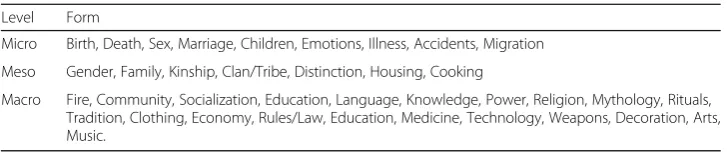
There are some basic features of humanity, which are universal and which are reflected in all social sciences: birth, marriage, death, economy, socialization, education, arts, music, fashion, decoration, religion, criminality, power, distinction, gender, and age (cf. Table2). As always some categories are overlapping. So, e.g. migration may be an individual deci-sion, however, whole societies migrate too. In regard to cooking this is often an individual activity, but the invention of fire, the recipes are cultural phenomena, which are shared by a group. Decoration distinguishes whole cultures, even if it is applied by individuals.
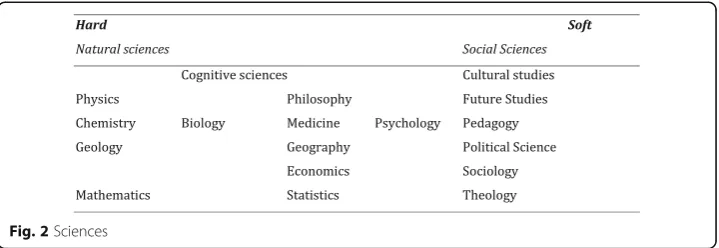
Evidently the macro, meso- and micro levels are not exclusive, but complementary. Apparently in contrast to natural sciences the repeatability of studies, e.g. in a laboratory, is mostly not feasible in social sciences, although psychologists try sometimes to do it. Economists operate occasionally with theclausula rebussicstantibus, i.e. they try to con-trol the circumstances to allow comparisons–in time or between different units (Heller 1984). Figure2presents a continuum from diverse hard to soft sciences.
Let me start with some theses to further structure my arguments:
Social sciences are by principle universal, however, due to their historical and cultural origins are always context-bound and specific in their concretization.
Therefore there are no laws of society–against the dream of the fathers of modern social sciences in the nineteenth century (Comte1969).
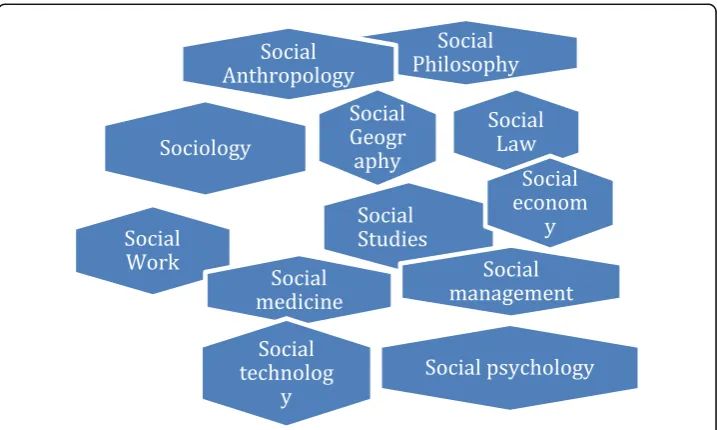
The social sciences cover a large variety of disciplines, which are represented in the following figure (Fig.3):
But they are not all equal. There is a hierarchy within them (Fig.4).
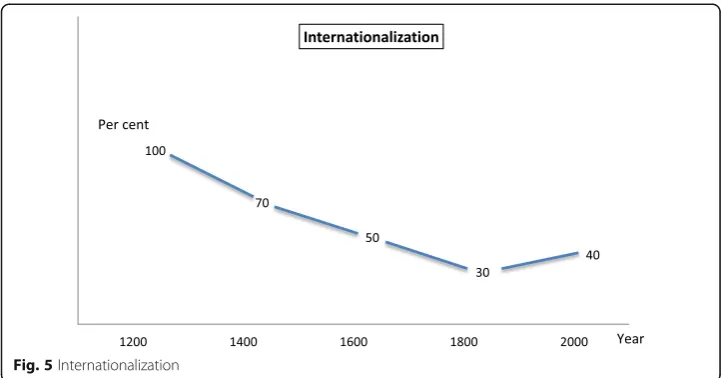
And looking back into history we find different degrees of internationalization (Fig.5): However, there are three axioms, which are basic for any social analysis: Without history, without economy, and without dialectics we do not understand and cannot explain anything. The target of all social science should be the sustainable improvement of the quality of life for all human beings, in Greek Phrónêsis, i.e. the ‘Good society’ (Aristotle1984; Eikeland2008; Nussbaum1992). Philosophy is the mother of all social sciences and humanities. In the Renaissance, when the ancient Greek culture was reintroduced –via the Arabs –to EuropePhrónêsis was forgotten. Onlyepisteme and technewere transmitted. This neglect is leading to the under- respectively wrong devel-opment in social sciences (Frank1971). The rediscovery of this tradition is fundamental for reallyuniversal, non-hegemonicsocial sciences (Flyvbjerg2001).
Table 1Roots of social sciences
Year Period Discipline
2000 Globalization, Fundamentalism Media sciences, cognitive sciences, cultural studies, future studies
1900 Imperialism, Really existing Socialism, Fascism, Decolonization
Psychology, Racism, Marxism-Leninism, ethnology, ecology
1800 Industrialization, Abolition of Slavery Sociology, anthropology
1700 Encyclopedia, Enlightenment, French Revolution, American Independence
Economics, pedagogy, statistics
1600 Nation-building, English Revolution Political science
1500 Humanism, Colonialism Natural Sciences
1400 Renaissance Medicine, Law
1200 First modern universities, capitalism, Bourgeoisie Theology, business administration
1000 Islam Social Sciences
500 Christianity Universalism
0 Roman Empire Law, libraries
−500 Greek antiquity, Confucianism, Buddhism Philosophy, Mathematics
−1000 Judaism Universalism
−3000 Ancient Egypt, China Bureaucracy
−5000 Indus culture Mathematics, Astronomy, Astrology, Medicine
−8000 Mesopotamia Writing, History, Geography, Law
Table 2Fundamentals of human societies
Level Form
Micro Birth, Death, Sex, Marriage, Children, Emotions, Illness, Accidents, Migration
Meso Gender, Family, Kinship, Clan/Tribe, Distinction, Housing, Cooking
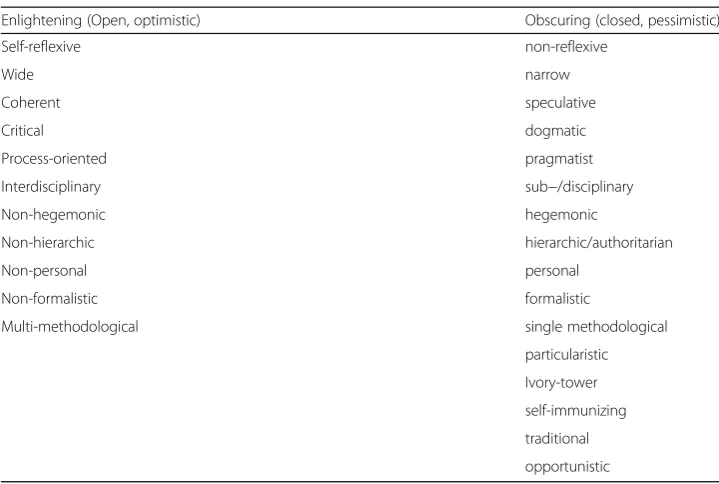
In the West, i.e. Western Europe, given unique historic and cultural circumstances, modern social sciences emerged and became dominant over the last 500 years (Delanty 2005). This emergence builds on the contributions from other cultures and civilizations over thousands of years. However, if we speak of ‘Western’social sciences, we have to admit that there are substantial differences between European and US-American societies and their social sciences (Herpin 1973; Martinelli2008). And within all social sciences, including the Western ones, the main differences are those between Enlightening and Obscuringsocial sciences.
The main change in regard to the subject and object of social sciences is the (re-) discovery of the individual (Kupiek 2008; Libera 2014; Martucelli and de Singly 2012). This was partly linked to Christianity, where the individual had a prominent role in his relationship to God, notably in Protestantism. In Western social sciences this focus on the individual had a pertaining influence, developing individualism at its centre (Bajoit2013; Le Bart 2008, 2013). Nevertheless all great religions, i.e. Judaism, Islam, and Buddhism, had the individual at their centres, but did not develop an appropriate social theory. For sure every individual is unique (genes, fingerprints, eyes etc.), but what repercussions has this on social theory (Weinberg2014)? Do we remain on the descriptive level? Then no social theory–Western or universal–is possible (Széll2005b).
Multicultural societies are not a result of modern globalization; on the contrary they were even the rule before, not only in the Roman, Chinese, Ottoman, Russian, British and Habsburg Empires, but in the USA from its very beginning, and certainly in the Soviet Union too. However, it is true that modern social sciences and humanities developed first mainly within the nation-state (Delanty and O’Mahony2002; Henry2005). Although this is not completely true. As well Karl Marx’and Max Weber’s contribution covered much more than the national level, just to take the two as the most prominent examples. Western Europe dominated social sciences until the Second World War. The roots were French and Germany philosophy as well as British political economy. Talcott Parsons, who was a great name in the 1950s and 1960s, did nothing else than to combine–in his own words– Durk-heim (1964). And although Immanuel Wallerstein from the USA has reached some notori-ety, especially due to his presidency of the International Sociological Association/ISA from 1994 to 1998, his contribution is more or less a spin-off of Fernand Braudel’s approach, as he is rightly giving his own research centre the name of the latter. Nevertheless in the last couple of decades substantial differences have emerged between Europe and the USA, espe-cially if we include some quite original French, Italian and Spanish evolutions (e.g. Castells, Foucault, Bourdieu et al.). On this background Yoshimichi Sato asks: Are Asian sociologies possible? (Sato2010) Today we find a large scope of social science theories (Table3).
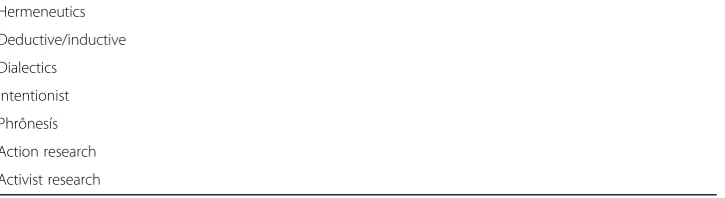
In Table4I differentiate between closed and open theories. Open theories are in my eyes those, which are not dogmatic, flexible and self-reflective (Bourdieu2001). Each theoretical approach has its own methodology, although in praxis there is no clear-cut direct relation-ship (Bourdieu1990). And most social scientists apply a mix of methodologies and methods (Morin 1977-2013,1992, 20086; Széll1985). The following table gives an overview of the main social methodologies. They are universal (Table5).
Grand social theories
The Norwegian sociologist Bjørn Gustavsen named those theories, which have a universal character,‘Grand theories’(Gustavsen 1983). In these theories there is no West-East or North-South dichotomy (Snow2012). Grand theories (e.g. Marx, Weber, Popper, Parsons, Luhmann are all Westerners) are concerned with the universal elements of humankind and have by this a quasi-anthropological dimension. Religion is–as mentioned above–a universal phenomenon, but has again local, regional, national etc. variations. This explains
Fig. 3The social sciences in all its variations
the large number of sects, and divisions, which often lead since thousands of years to vio-lence (Sen2007), although producing without any doubt great art and music at the same time. There exist Buddhist, Christian, Hindu and Islamic social theories. A fundamental question to be asked remains: Which are driving forces in this world: idealism or material-ism? Or both in a dialectical relationship?!
Middle range or meso social theories
Middle range or meso theories are concerned with historic and cultural specificities. To explain social phenomena, we have to climb from the general (grand theories) to the specific, i.e. middle-range and micro theories. Social life is always culture-specific, i.e. the knowledge of the context is essential. Language structure incorporates a world-view via its grammar or notions. We have quite a number of social theories – as the tables above show –and most are certainly Western by origin. Even globalisation pro-duces its cultural specific variations (Heintz 1982; cf. for China e.g. He 2010; or for
Fig. 5Internationalization
Table 3Types of social science theories
Level
Meta-theories Transcendentalism
Anti-theories Post-modernism, Anti-sociology
Grand theories (universal) Structuralism
Action theory
Critique of Political Economy
Middle-range/meso theories (culture-bound) Differentiation theory (Luhmann)
Communication theory
Life-world (Lefebvre, Habermas)
Tianxiaism (Huang)
Micro-theories Group (Homans)
Group (Homans)
Rational Choice
Japan Yazawa 2013). Let us take one concrete example: Modern concentration camps exist since about a century, actually they started in South Africa at the beginning of the twentieth century. They have spread unfortunately all around the world, but have dif-ferent reasons, forms and structure. They cannot be explained by any grand theory.
Anthony Giddens – as many authors before and certainly also after him – relates
action and structure in society, i.e. middle-range and micro levels. In the centre of middle-range theories is the civil society, including social movements (Széll2013).
Micro social theories
Each individual, community has its own practical social theory, which is not scientific, it is aWeltanschauung, often based on religion. It helps to differentiate between‘good’and
‘bad’, and by this may give orientations. Micro social theories should be able to explain the differences in behaviour in time and space.
Each subject has a name, which relates to other subjects in society and refers to individual responsibilities (Arino2007). Apparently there exist many dialectics between individual and society. On the micro level we can also allocate groups, families and other forms of social life. Since the very beginning of modern social sciences deviant behaviour (Merton1961) stood at the centre of many studies. Very famous on this issue is Émile Durkheim’s one on suicide from 1897 (Durkheim 1951). Psychoanalysis–although sometimes contested –is probably the most popular micro social theory (Freud1979). Definitely, concepts like‘homo oeconomicus’ (Kirchgässner 1991) or ‘homo sociologicus’ (Dahrendorf 2006) are very Table 4Main social science theories
Closed theories
1. Positivism (Comte)
2. Empirism (Durkheim)
3. Circulation of elites (Pareto)
4. Hermeneutics (Weber)
5. Functional-structural (Parsons)
6. Systems theory (Luhmann)
7. Reflexive modernisation (Beck)
Open theories
1. Critique of political economy (Marx)
2. Critical Rationalism (Popper)
3. Life-world (Lefebvre, Habermas)
4. Social/symbolic capital (Bourdieu)
Table 5Main social science methodologies
Hermeneutics
Deductive/inductive
Dialectics
Intentionist
Phrônesís
Action research
Western, as they suppose rational behaviour. In the same line lies the theory of Rational Choice (Schneider 2002). Eric Robertson Dodds, however, rightly points to the irrational dimension of European antique philosophy (Dodds1962).
Who is dominating?
All social relations at the end are power relations. In relation to that phenomenon some fundamental questions have to be asked: For what is research good? Who needs social sci-ences for what purposes? Science today is in general organized and practised in more or less large institutions, organisations and associations (Clark1972). ThePrivatgelehrte (sin-gle researcher) of the 19th and early twentieth century is dying out. Who speaks of science institutions, has to speak also about hierarchy, i.e. power relations. There is a double he-gemony: inner and outer. Social sciences are mainly part of the dominating relations of production.
Which social sciences dominate? Within the sciences themselves, and in the public? Certainly economics, and psychology are dominant, whereas e.g. ethnology remains marginal. Adam Smith’s theory of the market’s‘Invisible hand’(1976; originally 1776) is certainly still today as powerful as Malthus’population studies (Malthus1798). Ideologies like Humanism, liberalism, neo-liberalism, conservatism, fascism, socialism, communism, anarchism etc. are all influenced by diverse social theories. Karl Polányi in his famous bookThe Great Transformation(Polányi1957) argues that economics had more influence on modern societies, i.e. capitalism, than the productive forces, because they delivered the main ideology of our times. This is in line with Karl Marx’analysis. The French author Viviane Forrester calls this hegemonyThe economic horror(Forrester1999). Max Weber’s protestant ethics, as another explanation for the rise of capitalism, had and has quite an impact as well.
Economists do not only enter banks, governments, and consulting companies, but via scientific councils, and assessment via commissions they control largely the public debate. Economic growth and the argument for jobs to pacify unions has become the dominant mantra in public life. In our realm it is all about‘cultural hegemony’(Gramsci1971).
Sociology had a great time in the 1960s/1970s (Kilminster1998)–since then neoliberal-ism and egotneoliberal-ism (de Tocqueville1965) became again much more influential (Gurvitch 1945; Mendras and Étienne1996; Smelser1994). Since then quite a number of sociology departments have been closed down, although there is some renaissance in the Third World (Oommen1991; Kendall2009). A critical self-assessment is a precondition for the liberation of social sciences from vested interests and their critical role in society. With this we arrive at another fundamental question:
What is the impact of social sciences?
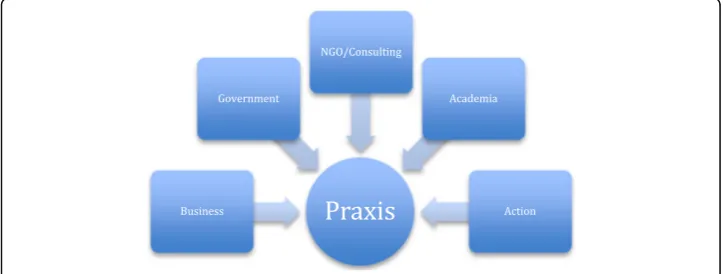
Actually in practice –as nearly always–many theories have a double-use perspective, and their authors are implied in both worlds. Is this universal? I guess so. But what about the more essential question, i.e. the impact on society, politics, policies? (Heilbron et al. 2013; Meyer1997) (Figs.6and7).
The biggest public impacts come from Marxism, psychoanalysis, neo-liberalism, and existentialism. We can therefore rightly speak of an‘economisation’(Heredia2014) and the psychologisation of the world. Let us take Lorenz von Stein–who may not be well known outside Germany –but is in my eyes an excellent example of public impact of social sciences. He invented the ‘state sciences’ (Staatswissenschaften) (Quesel 1989; Roth 1963; von Stein 1970). They are in the tradition of building up the nation-state top-down, namely for latecomers. The principles proclaimed there, were the‘carrot and stick’strategy of the (authoritarian) Prussian state against the rising proletariat.7This strategy was followed nearly one by one by Prussia in the late nineteenth century, and certainly was –on the one hand –one of the reasons of the strengthening of Prussia, catching up with Britain as the leading nation and Empire. But on the other hand also the reason for its decline and disaster of the First World War. It may be not a surprise that Lorenz von Stein was most successful, besides Prussia, in Japan.
Political sciences in its modern form (main stream) developed mostly in the USA. It has become a real business, where scientists easily move between academia, companies and government. However, social scientists as politiciansfailed mostly: e.g. Max Weber, Ralf Dahrendorf, and Fernando H. Cardoso. Apparently it is not so easy to implement one’s own ideas into practice. Probably the most popular political scientist remains Niccoló Macchiavelli, who wrote in the early sixteenth century works, which are steadily repub-lished and his name is even associated with a kind of politics (Macchiavelli2013).
Table 6Division of labour in social sciences
Knowledge Audience
Academic Extra-acad./open Private Government
Instrumental Professional Policy/Consulting Business Military, spying
Reflexive Critical Public NGO
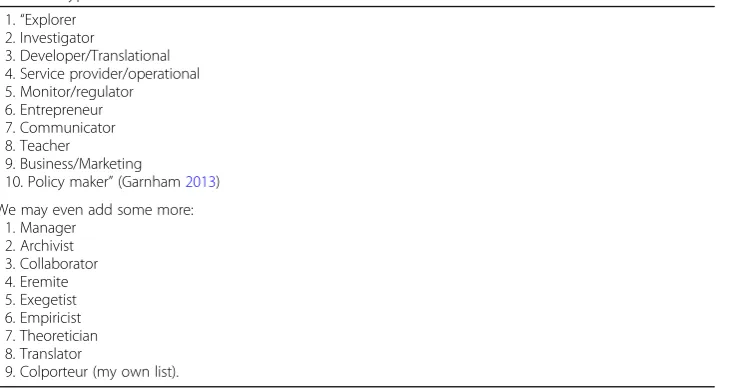
Table 7Types of scientist
1.“Explorer 2. Investigator
3. Developer/Translational 4. Service provider/operational 5. Monitor/regulator 6. Entrepreneur 7. Communicator 8. Teacher
9. Business/Marketing
10. Policy maker”(Garnham2013) We may even add some more:
1. Manager 2. Archivist 3. Collaborator 4. Eremite 5. Exegetist 6. Empiricist 7. Theoretician 8. Translator
Other affirmative theories, i.e. those which confirm or support existing power rela-tions, are in general allappliedsocial sciences, e.g. development theories, legal sciences, demography, psychology, family sociology etc. But as in life, where there is a position, there is always also a counter-position. In the case of development theories this was expressed by the dependence theory, which had quite an impact on social movements, notably in Latin America (Frank 1969,1971,1978). The workers’movements and trade unions are largely influenced by Karl Marx’class and alienation theories (Lukács1971). As a counterstrategy, very quickly the ‘end of class society’ was proclaimed (Schelsky 1965; Braun1989).
Bureaucratisationwas defined by Max Weber (1978) and many others as a mega-trend.8 Michael Young invented the term ‘meritocracy’ (Young 1958), to describe the new phenomenon of social hierarchy according to merits instead of heritage etc. He had a broad public success. Maslow’s‘pyramid of needs’is another example of a widespread theorem (Maslow1954). Whereas the famousFrankfurt Schoolwith prestigious names like Theodor W. Adorno, Max Horkheimer and Walter Benjamin had definitely much less impact for the general public than within the scientific community. However, with one exception, i.e. the study on theAuthoritarian Personality(Adorno et al.1950). The situation is similar for Karl Raimund Popper’sCritical Rationalism, who is for sure one of the most prominent social philosophers, namely with hisThe open society and its enemies(Popper1949). He had some public impact on politicians like the late German Chancellor Helmut Schmidt.
Historyis definitely one of the most influential sciences, not only because it is one of the main subjects in schools. The impact goes back thousands of years. How scientific is history, or is it largely biased (Orwell1996)? A new sub-discipline as‘applied history’
Fig. 6Triangle of social sciences
is emerging. The debate about the responsibility for war, e.g. the First World War, is highly emotional and basis for nationalism. Authors like the German Oswald Spengler in hisThe Decline of the West, written after the First World War (Spengler2006, first 1919), or the US-American Samuel P. Huntington with his The Clash of Civilizations and the Remaking of World Order (Huntington 1996), and Francis Fukuyama with his The End of History and the Last Man (Fukuyama1992), both after the break-down of the Soviet Union, sold millions of copies.
The public sphere (Habermas 1989; Jeffries 2011) is a central element to constitute society and democracy. So, the impact of social sciences via the media, as the fourth pillar of a democratic society is essential. In a world, which becomes more and more virtual, it seems that we live in a global village (McLuhan and Powers 1992). The newest global tendency is characterized by the US-American George Ritzer asThe McDonaldization of Society (Ritzer 1995, 1997). The German author Ulrich Beck beacme quite prominent with his book The Risk Society: Towards a New Modernity(Beck 1992), arguing that a second, reflexive modernization is in the making (Beck and Lau 2004; Beck and Bonß 2001). However, the risk is that this argument is historically not enough reflected and too sociologistic, neglecting the economic dimension (Széll 2001). Actually the theory of
‘Self-fulfilling prophecies’might be one of the most influential in daily life (Merton1968). Coping with the issue of universality I would like to mention two more, rather neglected approaches: Franco Ferrarotti proposes the notion of ‘Polycentric Society’ (Ferrarotti 1992) and Wolfgang Pape ‘Omnilateralism’ (Pape 2009). However, religion, astrology, mythology, literature, arts and oracles had and have so far more impact on history and society than all social sciences together (Cipriani2000; Colonomos2013; Esquerre2013).
But, how to measure the impact of given authors? Within the scientific communities e.g. citation indices, bibliometrics etc. are practiced (Forschungskommission Niedersachsen 1994; Kaube2008). Let us take the examples of the following rankings: In a list of the 102 most cited works in sociology (2008–2012; Caren2012), Bourdieu comes first, and none from outside the West. (Pereira2017)9However, there is not just one type of scientist, but at least 10 different ones (Table8).
So, their impact depends very much on the role social scientists are taking. To end this part on an easier note (Lourau1977), we should address ourselves to some of the most popular social theories. They had quite often a much bigger impact on the public than most‘serious’theories. Let us take e.g.:
The‘Peter principle’, i.e. that somebody climbs up the hierarchy, until s/he reaches her/his level of incompetence (Peter and Hull1969),
‘Murphy’s laws’, i.e. everything goes wrong, which can go wrong (Wikipedia 2014c), and
‘Parkinson’s law’, i.e. the permanent growth of bureaucracy (Parkinson1957).
Challenges
there are still some 30 million still today, and modern forms of slavery, bondage, selling of humans, mainly girls have developed. We are far away from global peace, which is proclaimed by all religions and humanism (Galtung1996), although the study by Steven Pinker The Better Angels of Our Nature: Why Violence Has Declined (Pinker 2011) seems to prove that there is progress in this regard. And fortunately arms-spending after several decades of permanent increase has been slightly reduced since 2013, however, starting again to increase in 2016.
Although colonialism has been largely overcome, neo-colonialisms still continues (Fanon1968; Prakash1999). Hunger, misery, poverty, lack of proper drinking water are for billions of people daily challenges (Datta2013), although life expectancy in average has increased, creating new problems for the social security systems. And inequality and discrimination have grown again. Two hundred companies rule nearly the whole
world economy (Clairmont 1997; Soros 1998). And the diverse Mafias control an
increasing part of it–about 20%. Do they share capitalist, i.e. universal values?
Definitely, social and environmental sustainability is the biggest challenge of all (Brundtland et al.1987; Bourdieu1999). Since 1988 theInternational Panel on Climate Changeraises awareness on the issue, after many global conferences the break-through has finally been realized in Paris in 2015. However, in 2017 the U.S.A. stepped out of the agreement. Also the famous Stern report had nearly no effect (Stern 2007, 2009). Also theInternational Social Science Council, a real global, interdisciplinary institution, addresses the problem (ISSC 2013; Hackmann et al. 2011; Hackmann and St. Clair 2012; Crowley2012; Platt2002).
Probably the irrational in the rational and the rational within the irrational as universal phenomena are amongst the biggest challenges for humanity and especially Enlighten-ment.10 It manifests itself within all social units, i.e. politics, democracy, organisations, and even within science, but not at least in gambling and drugs. One explanation of the Table 8Social science theories
Enlightening (Open, optimistic) Obscuring (closed, pessimistic)
Self-reflexive non-reflexive
Wide narrow
Coherent speculative
Critical dogmatic
Process-oriented pragmatist
Interdisciplinary sub−/disciplinary
Non-hegemonic hegemonic
Non-hierarchic hierarchic/authoritarian
Non-personal personal
Non-formalistic formalistic
Multi-methodological single methodological
particularistic
Ivory-tower
self-immunizing
traditional
persistence of irrationality may be, what Leon Festinger has named‘cognitive dissonance’ (Festinger 1957), i.e. that we only accept those informations, which fit our own Weltanschauungand interests. This pertinent social theorem is certainly the reason, why Festinger ranks as fourth most cited author (N.N. 2002). The social world is full of contradictions and paradoxes (Handy1994; Dahrendorf et al.2000),11which are amongst the most serious challenges for social theory. One of the most prominent is in regard to Enlightenment, that humanists thought they could/should be able to overcome supersti-tion, of which all religions are the most elaborate forms (Osborne 1998). But not at all, religion is resurging strongly in the twenty-first century all over the world, often in very violent and fundamentalist forms. Actually, concerning any religion, if an individual is formulating these ideas, s/he will be regarded as crazy. And even most scientists and also social scientists are religious (Gottlieb 2004). This can only be characterized as schizo-phrenic. The same holds true for racism and nationalism,12 which are largely based on obscuring social sciences.
Conclusion
Social sciences have failed to predict the environmental crisis, the breakdown of the Soviet Empire (except perhaps Wallerstein et al.2013), the diverse economic and financial crises, terrorism and the crisis of democracy. Is there any progress over the last couple of decades? (Aron1976; Bell1981; Deutsch 1982; Danell et al.2013; Genov2004) So, it is quite doubtful what relevance social sciences had in the past and have today, or will have in the future. We are speaking permanently of the crisis of society and with it of social sciences (Széll 2002). So, how to treat the declaration by Michel Foucault of the end of theories, and Richard Sennett’s‘End of sociology’(Foucault1994)? Or the end of Enlight-enment at all? (Széll 2001, 2008a, 2009; Claußen 2003). There are different scenarios possible:
Disappearance of social sciences
Social sciences are completely subdued to capital
Fundamentalist social sciences: Islamic, Christian, Hindu, Marxist, neo-liberal… dominate
Esoteric social sciences
Niche social sciences
Social repair institutions
Localist social sciences or/and a
Second Enlightenment.
(1974–1995; Bolz 2012). Ulrich Beck speaks of Ecological Enlightenment (Beck 1995). Some authors build on evolution as the basic structure (Gilgenmann et al.2013; Stichweh 2007). The German Günter Ortmann sees contingency, recursivityand path-dependency at work over millions of years (Ortmann1995). That brings us to the issue of biologism (Lemerle2013; Weingart2000), which may lead to a kind of Social Darwinism. Neurosci-ences question more and more the freedom of action, because they argue that every human action is determined by our biological condition (Roth1996; Singer2004; Brédart and van der Linden 2012). But is uncertainty not freedom? (Berthelot 1995) There is another attack on social sciences from the opposite side as well: Postmodernity (Foucault, Baudrillard, Lyotard) and de-constructivism (Wittgenstein, Feyerabend). Perhaps as no surprise an US-American, Philip Wexler, launches The Mystical Society (Wexler 2000, 2003; Liesner and Rohde 2002). Another issue in this context is the scientific non-knowledge (Wehling2006). One other attack came from one of the most prominent German sociologists of the twentieth century, Helmut Schelsky, who declared himself an anti-sociologist (Schelsky1981; Gallus2013). So we have the choice between two kinds of social theories:
At the end, to answer my initial question, there are Western and Universal Social Sciences. Which one is hegemonic? Finally, I am not against hegemony, but in the sense of, i.e. cultural hegemony for a peaceful, not-exploiting, humanist world. Actually that is in my eyes for which enlightening versus obscuring (main-stream) social sciences are striving for.13And this is not an issue of West vs. East, North vs. South, global vs. local, but for the ‘liberation of man’ (cf. e.g. Vanek1975). Western social sciences have deep structures (Gurvitch 1945) like all social entities, and build on the progress made over thousands of years and many civilizations (Elias1978-1982; Merton1965,1993). It is for-tunately not the end of history–against what Francis Fukuyama proclaimed in Fukuyama 1992, because we do not live in the best possible world. In Max Weber’s trilogy of domin-ance, i.e. traditional, charismatic and bureaucratic, there is no place for democracy. The same holds true for Niklas Luhmann’s system theory. Neil Postman sees the entertain-ment–like in ancient Rome with itspanem et circenses–asthechallenge for
Enlighten-ment (Postman 1985). Is this the end of democracy as well? (Crouch 2004) But
democracy and freedom are preconditions for science, especially social sciences (Sen 1997; Széll2008b) (Table9).
Is this the end of democracy as well? (Crouch2004) But democracy and Freedom are preconditions for democratic, public science, especially democratic social sciences (Sen 1997; Széll2008b). For a‘good society’we have to overcome the dominant capitalist mode of production and with its four forms of alienation. However, China is just copying it. On the other hand China could contribute to a real universal tool for international communi-cation: If the world would adopt the several thousand year old Chinese system of writing, at least we could all understand the writings in any language. That would be a huge step forward for universal knowledge and by it of non-hegemonic social sciences.
The challenges are great to make the world better, to create a‘Good society’(Phrónêsis). This is in my eyes the main task of universal social sciences. We need for this purpose a Second Enlightenment (Postman 1985; Strydom 2000)? Or a Post-Enlightenment? (Gubrium and Silverman 1989) Definitely a lot of Sociological Imagination(Mills 1959) and social innovation are necessary (Harrisson et al.2009; Franz et al.2012). The French Edgar Morin is sketching a way (Morin 2008). He differentiates betweenHomo sapiens and homo demens, by this referring to the contradictory and at the same time comple-mentary nature of humanity. His main contribution is, however, his insistence on com-plexity of all life – in contrast to Niklas Luhmann, who argues that the role of social sciences is to reduce complexity. Finally, we may ask with Max Weber: Is science a
vocation? (Weber 2004; Lassman et al. 2014) The universal answer for a Second
Enlightenment may be:“Everybody is a scientist!”(Széll1992,2012)14This in the line with the famous German artist Joseph Beuys’ slogan “Everybody is an artist!“(Beuys and Bodenmann-Ritter1972).
Endnotes
1
Interestingly also all religions are searching for or proclaiming‘truth‘.
2
Even in the G8-countries, the richest and most developed countries, some 10% of the population is still analphabetic.
3
Fortunately natural scientists can make also joke on themselves since many years, cf. Annals of Improbable Research.
4
Translation from French by G.S.; cf. too Neumann 1995.
5
Through globalization every year dozens of languages disappear.
6
Unfortunately this most eminent contribution to universal social sciences, embed-ding them into the whole process of nature and life since its beginning has been trans-lated so far only into Spanish and Italian; the first volume into English and German.
7
According to Hegel the Prussian State was the emanation of the Weltgeist (world spirit).
8
Chinese bureaucracy already developed more than 4000 years ago (Aschmoneit 1980).
9
Similar rankings can be found for economists, as well for countries and states within the U.S.A., and for names (Ideas/Repec2017), for psychologists (N. N2002), for philosophers (Leiter Report 2015), and for all others (Thomson Reuters2014).
10
Buddhism uses the notion of Enlightenment as well, however, in a completely un-scientific, mystical way.
11
Charles Handy, who has sold more than one million copies of his books, argues in his The Age of Unreason to be ‘unreasonable’to be innovative. This argument goes, however, more into the direction of undogmatic, non-traditional thinking.
Table 9Parochial vs. universal social sciences
Parochial Universal
Political Science Business Administration; Future Studies
Law Military Studies; Economics; Pedagogy; Sociology
Ethnology Culture Studies; Psychology; Anthropology; Religious Studies
12
As a side-remark it sounds strange to speak of ‘American’,‘German or ‘French’ sociology. These simply do not exist. We should only speak of ‘sociology in the U.S.A., in Germany or in France.
13
As we can see in the case of David Horowitz, authors are changing over time between Enlightening and Obscuring positions (Horowitz1967,2009).
14
In the same vein Antonio Gramsci’s“All men are intellectuals, but not all men have in society the function of intellectuals.”(Gramsci1971) may be understood.
Availability of data and materials
Data sharing not applicable to this article as no datasets were generated or analysed during the current study.
Authors’contributions
The author read and approved the final manuscript.
Competing interests
The author declares that he/she has no competing interests.
Publisher’s Note
Springer Nature remains neutral with regard to jurisdictional claims in published maps and institutional affiliations.
Received: 14 December 2017 Accepted: 30 May 2018
References
Adorno, Theodor W., et al. 1950.The authoritarian personality. New York: Harper & Row. Arino, Martine. 2007.La subjectivité du chercheur en sciences humaines. Paris: L’Harmattan. Aristotle. 1984.The complete works of Aristotle. Vol. 2. Princeton: Princeton UP. Aron, Raymond. 1976.Les étapes de la pensée sociologique. Paris: Gallimard.
Aschmoneit, Walter. 1980.Theoretische Aspekte der Struktur und soziale Bedingungen der Entstehung des bürokratischen
Staates im alten China. Hamburg: Gesellschaft für Natur- und Völkerkunde Ostasiens.
Baehr, Jason. 2011.The inquiring mind. On intellectual virtues and virtue epistemology. Oxford: Oxford UP. Baier, Horst. 2000.Soziologie als Aufklärung, oder die Vertreibung der Transzendenz aus der Gesellschaft. Konstanz:
Universitäts-Verlag.
Bajoit, Guy. 2013.L’individu sujet de lui-même. Paris: Armand Colin.
Bastow, Simon, Patrick Dunleavy, and Jane Tinkler. 2014.The impact of the social sciences. How academics and their
research make a difference. Los Angeles: SAGE.
Bauman, Zygmunt. 1997.Postmodernity and its discontents. New York: New York UP. Bauman, Zygmunt. 1998.Globalisation: the human consequences. Cambridge: Polity Press. Beck, Ulrich. 1992.The risk society: towards a new modernity. London: SAGE.
Beck, Ulrich. 1995.Ecological enlightenment. Essays on the politics of the risk society. Atlantic Highlands: Humanities Press. Beck, Ulrich, and Wolfgang Bonß, eds. 2001.Die Modernisierung der Moderne. Frankfurt: Suhrkamp.
Beck, Ulrich, and Christoph Lau, eds. 2004.Entgrenzung und Entscheidung. Was ist neu an der Theorie reflexiver
Modernisierung?Frankfurt: Suhrkamp.
Bell, Daniel. 1981.The social sciences since the second world war. Piscataway: Transaction.
Bernal, John Desmond. 1969.Science in history. 4th ed. London: C.A. Watts & Harmondsworth: Pelican [1954]. Bernal, John Desmond. 1971.The social sciences: a conclusion. Science in history. Vol. 4. Cambridge: MIT Press. Berthelot, Jean-Michel. 1995.Les vertus de l’incertitude. Le travail de l’analyse dans les sciences sociales. Paris: PUF. Beuys, Joseph, and Clara Bodenmann-Ritter. 1972.Jeder Mensch ein Künstler. Gespräche auf der documenta 5/1972.
Berlin: Ullstein [1988].
Bickel, Cornelius. 1991.Ferdinand Tönnies: Soziologie als skeptische Aufklärung zwischen Historismus und Rationalismus. Opladen: Westdeutscher Verlag.
Bolz, Norbert. 2012.Ratten im Labyrinth: Niklas Luhmann und die Grenzen der Aufklärung. München et al: Fink. Bourdieu, Pierre. 1990.The logic of practice. Stanford: Stanford UP.
Bourdieu, Pierre, ed. 1999.The weight of the world: social suffering in contemporary societies. Stanford: Stanford UP. Bourdieu, Pierre. 2001.Science de la science et réflexivité. Paris: Éditions Raisons d’agir.
Braudel, Fernand. 1992.Civilization and capitalism 15th–18th century. Vol. 3. Berkeley: University of California Press. Braun, Hans. 1989. Helmut Schelskys Konzept der“nivellierten Mittelstandsgesellschaft”und die Bundesrepublik der
50er Jahre.Archiv für SozialgeschichteXXIX: 199–223.
Brédart, Serge, and Martial van der Linden, eds. 2012.Identité et cognition. Apports de la psychologie et de la
neuroscience cognitives. Bruxelles: de Boeck.
Broad, William, and Nicolas Wade. 1984.Betrug und Fälschung in der Wissenschaft. Basel: Birkhäuser. Brundtland, Gro Harlem, et al. 1987.Our common future, report to the United Nations. The world commission on
environment and development. Oxford: Oxford UP.
Caren, Neal. 2012. The 102 most cited works in sociology, 2008–2012, http://nealcaren.web.unc.edu/the-102-most-cited-works-in-sociology-2008-2012/. Accessed 10 Dec 2017.
Castells, Manuel. 1996-1998.The information age: economy, society and culture. Vol. 3. Oxford: Malden & Blackwell. Cipriani, Roberto. 2000.Sociology of religion: an historical introduction. Hawthorne: Aldine.
Clairmont, F.F. 1997.Vers un gouvernement planétaire. Ces deux cents sociétés qui contrôlent le monde. Le Monde Diplomatique, No. 1, 16–17.
Clark, Terry Nichols. 1972. Les étapes de l'institutionnalisation scientifique.Revue Internationale des Sciences
Sociales.XXIV (4): 699–714.
Claußen, Bernhard. 2003. Konzepte für die Bedeutungslosigkeit der Politischen Bildung?Sozialwissenschaftliche Literatur
Rundschau45: 73–111.
Colonomos, Ariel. 2013.La politique des oracles. Raconter le futur aujourd’hui. Paris: Albin Michel.
Comte, Auguste. 1969.Système de politique positive, ou traité de sociologie instituant la religion de l'humanité. Vol. 4. Bruxelles: Culture et Civilisation [1851–1854].
Crouch, Colin. 2004.Post-democracy (themes for the 21st century). Chichester: Wiley.
Crowley, John. 2012.Making knowledge work. From social science research to socially reflexive sustainability. Paris: UNESCO & ISSC. Dahrendorf, Ralf. 1965.Die angewandte Aufklärung: Gesellschaft und Soziologie in Amerika. Frankfurt: Fischer.
Dahrendorf, Ralf. 2006.Homo Sociologicus: Ein Versuch zur Geschichte, Bedeutung und Kritik der Kategorie der sozialen
Rolle. 16th ed. Wiesbaden: VS.
Dahrendorf, Ralf, Yehuda Elkana, and Aryeh Neier, eds. 2000.The Paradoxes of Unintended Consequences. Budapest: Central European UP.
Danell, Rickard, Anne Larsson, and Per Wisselgren, eds. 2013.Social science in context: Historical, sociological, and global
perspectives. Oslo: Nordic Academic Press.
Datta, Asit. 2013.Armutszeugnis. Warum heute mehr Menschen hungern als vor 20 Jahren. München: dtv. de Solla Price, Derek. 2009.Science since Babylon. New Haven & London: Yale UP [1959].
de Tocqueville, Alexis. 1965.Democracy in America. London: Oxford UP. Delanty, Gerard. 2005.Social science. New York: McGraw-Hill International.
Delanty, Gerard, and Patrick O’Mahony. 2002.Nationalism and social theory: modernity and the recalcitrance of the
nation. London: SAGE.
Deutsch, Karl W. 1982.Advances in the social sciences, 1900–1980: What, who, where, how?Berlin: International Institute for Comparative Social Research of the Science Center Berlin # 1982.06.
Djerassi, Carl. 1989.Cantor’s dilemma. New York: Penguin.
Dodds, Eric Robertson. 1962.The Greeks and the Irrational. Berkeley: University of California Press. Dubois, Michel. 1999.Introduction à la sociologie des sciences. Paris: PUF.
Durkheim, Émile. 1951.Suicide: a study in sociology. Glencoe: The Free Press. Durkheim, Émile. 1964.The rules of the sociological method. New York: Oxford UP.
Eikeland, Olav, ed. 2008.The ways of Aristotle. Aristotelian Phrónêsis, Aristotelian philosophy of dialogue, and action
research. Frankfurt: Peter Lang.
Elias, Norbert. 1978-1982.The civilizing process. Oxford: Blackwell & New York: Pantheon.
Elkana, Yehuda. 1986.Anthropologie der Erkenntnis. Die Entwicklung des Wissens als episches Theater der Vernunft. Frankfurt: Suhrkamp.
Esquerre, Arnaud. 2013.Prédire. L’astrologie au XXIe siècle en France. Paris: Fayard. Fanon, Frantz. 1968.The wretched of the earth. New York: Grove.
Ferrarotti, Franco. 1992. Polycentric society. InConcise encyclopedia of participation and co-management, ed. György Széll, 644–654. Berlin & New York: de Gruyter.
Festinger, Leon. 1957.A theory of cognitive dissonance. Stanford: Stanford UP. Feyerabend, Paul. 2011.The tyranny of science. Chichester: Wiley.
Flyvbjerg, Bent. 1998.Rationality & power. Democracy in practice. Chicago: The University of Chicago Press. Flyvbjerg, Bent. 2001.Making social science matter–why social inquiry fails and how it can succeed again.
Cambridge: Cambridge UP.
Forrester, Viviane. 1999.The economic horror. Malden: Blackwell.
Forschungskommission Niedersachsen. 1994.Bericht. Hannover: Niedersächsisches Ministerium für Wissenschaft und Kultur. Foucart, Stéphane. 2011a. Le climatologue à la“crosse de hockey”. Le Monde, Science & Techno, 24/25/26 décembre: 2. Foucart, Stéphane. 2011b. Tabac: un précis de corruption de la science. Le Monde, Science & Techno, 24/25/26 décembre: 7. Foucault, Michel. 1980.Power/knowledge. New York: Pantheon Books.
Foucault, Michel. 1994.The order of things: an archaeology of human sciences. Reissue. New York: Vintage.
Frank, André Gunder. 1969.Capitalism and underdevelopment in Latin America: historical studies of Chile and Brazil. New York: Monthly Review Press.
Frank, André Gunder. 1971.Sociology of development and underdevelopment of sociology. London: Pluto Press. Frank, André Gunder. 1978.Dependent accumulation & underdevelopment. London: Macmillan.
Franz, Hans-Werner, Josef Hochgerner, and Jürgen Howaldt, eds. 2012.Challenge social innovation. Berlin: Springer. Freely, John. 2009.Aladdin’s lamp: how Greek science came to Europe through the Islamic world. New York: A. Knopf. Freud, Sigmund. 1979.Civilization and it’s discontents. London: Hogarth Press.
Fricker, Miranda. 2007.Epistemic injustice. Power and the ethics of knowing. New York: Oxford UP. Fukuyama, Francis. 1992.The end of history and the last man. New York: The Free Press.
Gabler, Jay, and Alexis Trémoulinas. 2013.La sociologie pour les nuls. Paris: Éditions first & first interactive. Gallus, Alexander, ed. 2013.Helmut Schelsky–der politische Anti-Soziologe. Eine Neurezeption. Göttingen: Wallstein. Galtung, Johan. 1977.Methodology and ideology. Essays in methodology. Copenhagen: Christian Ejlers.
Galtung, Johan. 1988. Intellectual styles: Saxonic, Teutonic, Gallic, Nipponic. InMethodology and development, Johan
Galtung, 27–55. Copenhagen: Christian Ejlers.
Garnham, Diana. 2013. 10 types of scientist. Science Council (UK),http://www.sciencecouncil.org/10-types-scientist. Accessed 11 Dec 2017.
Gegenworte (ed.). 1998. Lug und Trug in den Wissenschaften. Herbst (2).
Genov, Nikolai, ed. 2004.Advances in sociological knowledge–over half a century. Wiesbaden: VS (initiated by the ISSC). Gilgenmann, Klaus, Peter Mersche, and Alfred K. Treml (eds.). 2013. Kulturelle Vererbung: Erziehung und Bildung in
evolutionstheoretischer Sicht. Books on Demand [2010].
Goldman, Alvin. 2010. Why social epistemology is real epistemology. InSocial epistemology, ed. Adrian Haddock, Alan Millar, and Duncan Pritchard, 1–29. Oxford: Oxford UP.
Gottlieb, Jeffrey. 2004. Science journal under fire for article on power of prayer. Japan Times, 23 August: 13. Gramsci, Antonio. 1971.Selection from the Prison Notebooks, 1929-1935. London: Lawrence & Wishart & New York:
International Publishers.
Greco, John. 2002. Virtues in epistemology. InThe Oxford handbook of epistemology, ed. Paul Kenneth Moser, 287–315. Oxford: Oxford UP.
Gross, Paul R. 1997.Higher superstition: the academic left and its quarrels with science. Baltimore: John Hopkins UP. Gubrium, Jaber F., and David Silverman. 1989.The Politics of field research: sociology beyond enlightenment. London: SAGE. Gurvitch, Georges, ed. 1945.Twentieth century sociology. New York: Philosophical Library.
Gustavsen, Bjørn. 1983.Sociology as action. On the constitution of alternative realities. Oslo: Work Research Institute. Habermas, Jürgen. 1989.The structural transformation of the public sphere. Cambridge: Polity [1962].
Hackmann, Heide, Barrett C. Brown, and Eleanor Hadley Kershaw. 2011.ISSC–Belmont forum agenda setting workshop.
Synthesis report and resource document. Paris: ISSC.
Hackmann, Heide, and Asunción Lera St. Clair. 2012.Transformative cornerstones of social science research for global
change. Paris: UNESCO/ISSC.
Handy, Charles. 1994.The age of paradox. Boston: Harvard Business School Press. Hardt, Michael, and Antonio Negri. 2000.Empire. Cambridge: MA & London: Harvard UP.
Harrisson, Denis, György Széll, and Reynald Bourque, eds. 2009.Social innovation, the social economy and world
economic development. Democracy and labour rights in an era of globalization. Frankfurt: Peter Lang.
He, Huang. 2010. China’s historical encounter with western social sciences. InInternationalization of the social
sciences: Asia–Latin America–Middle East–Africa–Eurasia, ed. Michael Kuhn and Doris Weidemann, 21–
44. Bielefeld: Transcript.
Heilbron, Johan, Lars Magnusson, and Björn Wittrock, eds. 2013.The rise of the social sciences and the formation of
modernity: conceptual change in context, 1750–1850. Berlin: Springer.
Heintz, Peter. 1982. Introduction: code sociologique pour la description de la société mondiale.Revue Internationale des
Sciences SocialesXXXIV(1), # 91: 11–22.
Heller, Agnes. 1984. Can cultural patterns be compared?Dialectical Anthropology8: 269–276. Heller, Frank, ed. 1986.The use and abuse of social science. London: SAGE.
Henry, John. 2005. National styles in science. A possible factor in the scientific revolution? InGeography and revolution, ed. David N. Livingstone and Charles W.J. Withers, 43–74. Chicago & London: Univ. of Chicago Press.
Heredia, Mariana. 2014.A quoi sert un économiste ?Paris: La Découverte. Herpin, Nicolas. 1973.Les sociologues américains et le siècle. Paris: PUF.
Horkheimer, Max, and Theodor W. Adorno. 1972.The dialectic of enlightenment. London: Verso [1947].
Horowitz, David, ed. 1967.Containment and revolution western policy towards social revolution: 1917 to Vietnam. London: Blond.
Horowitz, David. 2009.One-party classroom: how radical professors at America’s top colleges indoctrinate students and
undermine our democracy. New York: Crown Forum.
Huntington, Samuel P. 1996.The clash of civilizations and the remaking of world order. New York: Simon & Schuster. Ideas/Repec. 2017. Most cited economists. Top 10% Authors, as of November 2017.https://ideas.repec.org/top/top.
person.all.html. Accessed 11 Dec 2017.
International Social Science Council. 2013. World social science report 2013: changing global environments Paris. Internet Encyclopedia of Philosophy. 2017. Heraclitus.http://www.iep.utm.edu/heraclit/. Accessed 10 Dec 2017. Jeffries, Vincent, ed. 2011.Handbook of public sociology. Lanham: Rowman & Littlefield.
Kant, Immanuel. 1977.Kant’s political writings. Cambridge: Cambridge UP [1790].
Kaube, Jürgen. 2008. Die bibliometrische Verblendung. Frankfurter Allgemeine Zeitung, 24 July. Kendall, Diana. 2009.Sociology in our times. Stamford: Cengage Learning.
Kilminster, Richard. 1998.The sociological revolution: from the enlightenment to the global age. London: Routledge. Kirchgässner, Gebhard. 1991.Homo oeconomicus. Das ökonomische Modell individuellen Verhaltens und seine Anwendung
in den Wirtschafts- und Sozialwissenschaften. Tübingen: Mohr.
Koschorke, Albrecht. 2004. Wissenschaftsbetrieb als Wissenschaftsvernichtung. InUniversität ohne Zukunft?ed. Dorothee Kimmenich and Alexander Thumfarth, 142–157. Frankfurt: Suhrkamp.
Kriz, Jürgen. 1980.Artefakte in der Sozialforschung. Zeitschrift für Markt-, Meinungs- und Zukunftsforschung, 61–112. Kriz, Jürgen. 1985. Die Wirklichkeit empirischer Sozialforschung. Aspekte einer Theorie sozialwissenschaftlicher
Forschungsartefakte. InEntzauberte Wissenschaft, ed. Wolfgang Bonß and Heinz Hartmann, 77–90 Sonderband 3
derSozialen Welt.
Kuhn, Michael, and Shujiro Yazawa, eds. 2012.Theories about and strategies against hegemonic social sciences. Tokyo: Seijo University, Center for Glocal Studies.
Kupiek, Jean-Jacques. 2008.L’origine des individus. Paris: Fayard.
Kvanvig, Jonathan. 1992. The intellectual virtues and the life of the mind. InOn the place of the virtues in epistemology. Lanham: Rowman & Littlefield.
Lassman, Peter, Irving Velody, and Herminio Martens, eds. 2014.Max Weber’s‘science as a vocation’. London: Routledge. Latour, Bruno. 1987.Science in action (How to follow scientists and engineers through society).Milton Keynes: Open UP. Le Bart, Christina. 2008.L’individualisation. Paris: Presses de Sciences Po.
Lemaine, Gérard, Benjamin Matalon, and Bernard Provansal. 1969. La lutte pour la vie dans la cité scientifique.Revue
Française de Sociologie10 (2): 139–165.
Lemerle, Sébastien. 2013.Le singe, le gène et le neurone. Du retour du biologisme en France. Paris: PUF. Libera, Alain de. 2014.Archéologie du sujet. Tome III: La double révolution. Paris: PUF.
Liesner, Andrea, and Christian Rohde. 2002. Die Wiederkehr des Heiligen: Zur Zukunft der Bildung in Philipp Wexlers Mystical Society.Sozialwissenschaftliche Literatur Rundschau45: 41–52.
Lourau, René. 1977.Le gai savoir des sociologues. Paris: UGE 10/18, # 1117.
Lukács, György. 1971.History and class consciousness. London: Merlin & Cambridge: MIT Press. Luxemburg, Rosa. 2006.Reform or revolution and other writings. New York: Dover.
Macchiavelli, Niccolò. 2013. Greatest works of Niccolò Machiavelli: The prince, the art of war, discourses on the first decade of Titus Livius & History of Florence. Kindle [1531–1532].
Malthus, Thomas R. 1798. An essay on the principle of population, as it affects the future improvement of society with remarks on the speculations of Mr. Godwin, M. Condorcet, and other writers. N.p.: n.pb.
Mannheim, Karl. 1936.Ideology and utopia. An introduction to the sociology of knowledge. London & New York: Routledge & Kegan Paul [1929].
Markl, Hubert, et al., eds. 1995.Wissenschaft in der globalen Herausforderung. Stuttgart: Wissenschaftliche Verlagsgesellschaft.
Martinelli, Alberto. 2008.Transatlantic Divide. Comparing American and European Society. Oxford: Oxford UP. Martucelli, Danilo, and François de Singly. 2012.Les sociologies de l’individu. Paris: Armand Colin.
Marx, Karl. 1989.Capital. A critique of political economy. Vol. 3. Harmondsworth: Penguin [1883]. Maslow, Abraham H. 1954.Motivation and personality. New York: Harper & Row.
McLuhan, Marshall, and Bruce R. Powers. 1992.The global village: transformations in world life and media in the 21st
century. New York: Oxford UP.
Mendras, Henri, and Jean Étienne. 1996.Les grands auteurs de la Sociologie Tocqueville, Marx, Durkheim, Weber. Paris: Hatier.
Merton, Robert K. 1961. InContemporary social problems: An introduction into the sociology of deviant behavior an social
disorganisation, ed. Robert A. Nisbet. New York: Harcourt, Brace & World.
Merton, Robert K. 1965.On the shoulders of giants. Glencoe: Free Press. Merton, Robert K. 1968.Social theory and social structure. New York: Free Press.
Merton, Robert K. 1993.On the shoulders of giants: a Shandean postscript. Chicago: University of Chicago Press. Meyer, Hansgünter. 1997. Ansichten zur Politikwirksamkeit sozialwissenschaftlicher Forschung.Perspektiven14 (2): 125–131. Mills, Charles W. 1959.The sociological imagination. New York: Oxford UP.
Mirowski, Philip, and Esther Mirjam Sent. 2002.Science bought and sold. Essays in the economics of science. Chicago: Chicago UP.
Morin, Edgar. 1977-2013.De la méthode. Vol. 6. Paris: PUF & Seuil.
Morin, Edgar. 1992.Method. Vol. 1: the nature of nature. New York: Peter Lang.
Morin, Edgar. 2008.On complexity advances in systems theory, complexity, and the human sciences. New York: Hampton Press.
N. N. 2002. Eminent psychologists of the 20thcentury. The Review of General Psychology 6(29) & 33(7): 29. Nisbett, Richard E. 2005.The geography of thought–how Asians and Westerners think differently–and why. London &
Boston: Nicholas Brealey.
Nussbaum, Martha C. 1992. Non-relative virtues: an Aristotelian approach. InThe quality of life, ed. Marta C. Nussbaum and Amartya Kumar Sen, 242–269. Oxford: Oxford UP.
Oommen, T.K. 1991. Internationalization of sociology: a view from developing countries.Current Sociology39: 67–85. Ortmann, Günter. 1995. Formen der Produktion. InOrganisation und Rekursivität. Opladen & Wiesbaden:
Westdeutscher Verlag.
Orwell, George. 1996.Nineteen eighty-four. London: Secker & Warburg [1949].
Osborne, Thomas. 1998.Aspects of enlightenment: social theory and the ethics of truth. Lanham: Rowman & Littlefield. Outhwaite, William. 2003.The Blackwell dictionary of modern social thought. Oxford: Blackwell.
Pape, Wolfgang. 2009. European integration and East Asia: Learning from each other towards Omnilateralism. In
European social integration–a model for East Asia?ed. György Széll, Werner Kamppeter, and Woosik Moon, 291–
302. Frankfurt: Peter Lang.
Parkinson, Cyril Northcote. 1957.Parkinson's law, or the pursuit of progress. London: Penguin.
Pereira, Rafael M. 2017. The most cited authors in sociology https://urbandemographics.blogspot.de/2013/01/the-most-cited-authors-in-sociology.html. Accessed 11 Dec 2017.
Peter, Laurence J., and Raymond Hull. 1969.The Peter principle: why things always go wrong. New York: William Morrow. Pinker, Steven. 2011.The better angels of our nature: why violence has declined. London: Viking Adult.
Platt, Jennifer. 2002. Fifty years of the international social science council.http://www.worldsocialscience.org/ documents/50-years-of-the-international-social-science-council.pdf. Accessed 11 Dec 2017.
Polányi, Karl. 1957.The great transformation [The political and economic origins of our time]. Boston: Beacon Press [1944]. Popper, Karl R. 1949.The open society and its enemies. Vol. 2. London: Routledge & Kegan Paul.
Postman, Neil. 1985.Amusing ourselves to death. Public discourse in the age of show business. New York: Viking Penguin. Prakash, Gyan. 1999.Another reason. Science and the imagination of modern India. Princeton: Princeton UP.
Proctor, Robert N. 2011.Golden Holocaust. Berkeley: University of California press.
Proctor, Robert N., and Londa Schiebinger. 2008.Agnotology. The making and unmaking of ignorance. Stanford: Stanford UP. Queisser, Hans-Joachim. 2002. Veröffentliche oder verende. Frankfurter Allgemeine Zeitung, 2 October.
Quesel, Carsten. 1989.Soziologie und soziale Frage. Lorenz von Stein und die Entstehung der Gesellschaftswissenschaft in
Deutschland. Wiesbaden: Deutscher Universitätsverlag.
Renan, Ernest. 1995.L’avenir de la science. Paris: Flammarion [1890].
Renn, Jürgen. 1997. Absturz bei einer schwierigen Gratwanderung. InAmerika bekämpfen sich Natur- und