City, University of London Institutional Repository
Citation:
Samson, Deborah (2016). Making it count: Explorations of time limitation and meaning. (Unpublished Doctoral thesis, City University London)This is the accepted version of the paper.
This version of the publication may differ from the final published
version.
Permanent repository link:
http://openaccess.city.ac.uk/15150/Link to published version:
Copyright and reuse: City Research Online aims to make research
outputs of City, University of London available to a wider audience.
Copyright and Moral Rights remain with the author(s) and/or copyright
holders. URLs from City Research Online may be freely distributed and
linked to.
Making it count:
Explorations of time limitation and meaning
Deborah Samson
Portfolio submitted in fulfilment of the requirements of the Professional
Doctorate in Counselling Psychology (DPsych)
City University
Department of Psychology
THE FOLLOWING PART OF THIS THESIS HAS BEEN
REDACTED FOR COPYRIGHT REASONS:
pp. 209-234:
Part 2. Journal article. ‘But I just feel that the limited amount of
time that I’ve got – I want it to be meaningful’: Exploring transitional
experiences of late midlife women.
THE FOLLOWING PART OF THIS THESIS HAS BEEN
REDACTED FOR DATA PROTECTION/CONFIDENTIALITY
REASONS:
pp. 235-262:
Part 3. Client study. ACT and terminal patietients: when existential
concerns enter the therapy room.
Acknowledgments
I would like to thank my supervisor, Dr. Aylish O’Driscoll, for her unfailing patience,
encouragement and thoughtful guidance. I am also extremely grateful to the
participants whose generosity and openness was the most essential component of this
research.
I could not have got through my training without the family, friends and fellow students whose kind words and practical support have kept me on track. I also need to
acknowledge my parents for teaching me the benefits of perseverance and wish my
father could have been here to see this portfolio completed. My children, Joel and
Bella, have been constant reminders of what really matters in life and I am grateful for
the (mostly) good grace with which they have shared me with my studies. Lastly and most importantly, I have to say thank you to Michael who makes it all worthwhile and
City University Declaration
I grant powers of discretion to the University Librarian to allow this thesis
to be copied in whole or in part without further reference to me. This
permission covers only single copies made for study purposes, subject to
TABLE OF CONTENTS
PREFACE 7
REFERENCES 11
PART I: THE RESEARCH 13
LIST OF ABBREVIATIONS 14
ABSTRACT 15
1. INTRODUCTION 16
1. 1. INTRODUCTIONOVERVIEW 16
1. 2. BABYBOOMER: PLACINGAGENERATIONINCONTEXT 17
1. 3. PERCEPTIONSOFAGEANDAGEING: OLDERADULTS. 21
1. 4. AGEANDAGEING: MIDLIFEANDITSRELEVANCETOOLDERADULTHOOD 24
1. 5. WOMEN’SEXPERIENCE/FEMINISTRESEARCH 25
1. 6. WOMENANDMIDLIFERESEARCH 27
1. 7. COUNSELLING PSYCHOLOGYANDTHELIFESPAN 32
1. 8. RATIONALEFORSTUDYANDRESEARCHQUESTION 34
2. METHODOLOGY 36
2. 1. OUTLINE 36
2. 2. RATIONALEFOR QUALITATIVE APPROACH 36
2. 3. METHODOLOGICAL CONSIDERATIONS 37
2. 4. METHODOLOGICAL APPROACH 37
2. 5. RATIONALEFOR IPA 38
2. 5. 1. AIMSOF IPA 38
2. 5. 2. RELEVANCEOF IPA TOTHISRESEARCH 40
2. 6. EPISTEMOLOGICAL STANDPOINT 41
2. 7. BRIEFOVERVIEWOFRESEARCHDESIGN 42
2. 8. SAMPLING 43
2. 9. RECRUITMENT 44
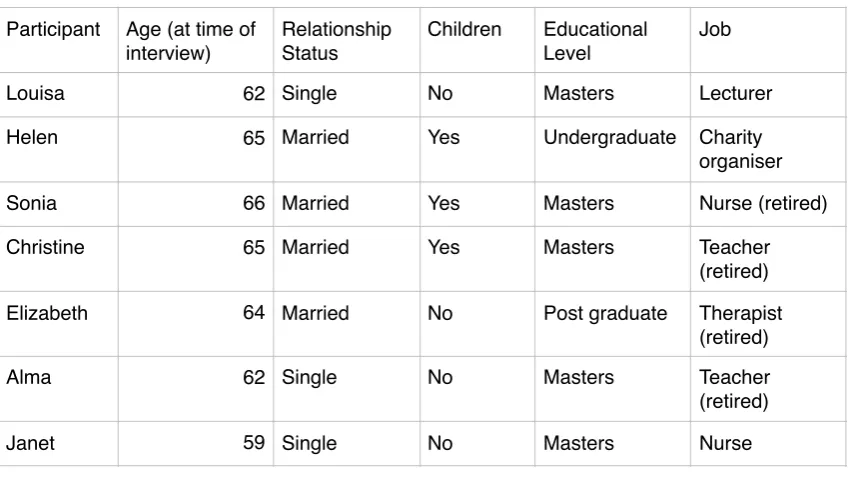
2. 10. PARTICIPANTS 45
2. 11. ETHICAL CONSIDERATIONS 46
2. 12. PROCEDURE 49
2. 12. 1. PRE-INTERVIEW 49
2. 12. 2. INTERVIEW 49
2. 12. 3. POST-INTERVIEW 52
2. 13. ANALYTIC STRATEGY 53
2. 13. 1. TRANSCRIPTION 53
2. 13. 2. CODING 54
2. 13. 3. EMERGENT THEMES 56
2. 13. 4. MASTER THEMES 56
2. 13. 5. ANALYSISACROSSCASES 57
2. 14. REFLEXIVITY 58
2. 15. TRUSTWORTHINESS 60
3. ANALYSIS 62
3. 1. OVERVIEW 62
3. 2. THEME I: SOMETHINGABOUTTHISFEELSDIFFERENT 62
3. 2. 1. DISAPPEARANCEOFTHEKNOWN 63
3. 2. 2. CHANGINGROLES: FREEDOM, CHOICEANDRESPONSIBILITYFORCARE 66
3. 2. 3. INTIMATERELATIONSHIPS 69
3. 2. 4. PHYSICALCHANGEANDFEARSOFDEPENDENCY 72
3. 2. 5. THEMEANSOFPERCEIVINGCHANGE 77
3. 3. THEME II: PERCEPTIONS, ASSUMPTIONSANDJUDGEMENTSABOUTAGE 79
3. 3. 2. THEJUDGEMENTOFOTHERS: INSTITUTIONALISEDSTEREOTYPING 82
3. 3. 3. JUDGEMENTOFOTHERS: EXAMPLESINEVERYDAYLIFE 83
3. 3. 4. THEJUDGEMENTOFOTHERS: PHYSICALAPPEARANCE 84
3. 3. 5. HOWTHEJUDGEMENTOFOTHERSAFFECTSJUDGEMENTOFSELF: NEGATIVEAGE
-RELATEDASSUMPTIONS 85
3. 3. 6. AGEINGWITHOUTAROADMAP 88
3. 4. THEME III: TIMELIMITATIONANDINCREASEDEMPHASISONMEANINGAND
FULFILMENT 89
3. 4. 1. TIMELIMITATIONANDLIVINGINTHEPRESENT 90
3. 4. 2. TIMELIMITATIONANDLETTINGGO 91
3. 4. 3. THEIMPORTANCEOFMEANING 92
3. 4. 3. MEANINGTHROUGHCURIOSITY, ADVENTUREANDENGAGEMENT 93
3. 4. 4. MEANINGTHROUGHACCOMPLISHMENT 97
3. 4. 5. MEANINGTHROUGHSELF-CARE 98
3. 4. 6. MEANINGANDCONNECTIONWITHOTHERS 100
4. DISCUSSION 105
4. 1. OVERVIEW 105
4. 2. A SHIFTTOSOMETHINGDIFFERENT 106
4. 3. PERCEPTIONS, ASSUMPTIONSANDJUDGEMENTSCONCERNINGAGE 108
4. 4. TIMELIMITATIONANDMEANING 112
4. 4. 1. MEANINGWITHREFERENCETOTHISAGEGROUP 114
4. 4. 2. HOWMEANINGWASREFLECTEDINTHISSTUDY 115
4. 5. THECONNECTIONOFMEANINGWITHASENSEOFSHIFTANDPERCEPTIONSOFAGE 118
4. 6. RELEVANCETOCOUNSELLINGPSYCHOLOGY 121
4. 7. EVALUATIONOFTHERESEARCHANDOPPORTUNITIESFORFURTHERSTUDY 123
4. 8. REFLEXIVITY 126
4. 9. CONCLUSION 131
REFERENCES 133
APPENDICES 166
APPENDIX A: SUGGESTEDQUESTIONS/PROMPTS 166
APPENDIX B: RECRUITMENTLEAFLET 169
APPENDIX C: GRANSNETADVERT 170
APPENDIX D: EMAILTOFRIENDS/ACQUAINTANCESWITHTHELEAFLETATTACHED. 171
APPENDIX E: DETAILEDEXPLANATIONOFSTUDY 172
APPENDIX F: CONSENTFORM 175
APPENDIX G: SOURCESOFSUPPORT/INFORMATION: 176
APPENDIX H: EXAMPLEOFCODING 177
APPENDIX I: EXAMPLE (INDIVIDUAL) OFTABLELINKINGMASTERANDSUB-THEMESWITH
QUOTES 180
APPENDIX J: FREQUENCYTABLEOFTHEMESACROSSPARTICIPANTS 190
APPENDIX K: EXAMPLE (ACROSSPARTICIPANTS) LINKINGMASTERANDSUB-THEMESWITH
QUOTES 194
PART II: JOURNAL ARTICLE 207
ABSTRACTANDSHORTTITLE 208
INTRODUCTION 209
AGEANDTHELIFECOURSE 209
MIDLIFEWOMEN: A LITERATUREREVIEW 209
TRANSITION 211
METHOD 212
ANALYSIS 213
ENDINGS 213
NEUTRALSPACE 217
MAKING A BEGINNING 220
LINKINGMEANINGANDTRANSITION. 225
THERAPEUTIC APPLICATIONS 225
EVALUATIONOFTHESTUDYANDSUGGESTIONSFORFUTURERESEARCH 226
CONCLUSION 227
REFERENCES 229
Preface
This portfolio is comprised of the three pieces of work required to meet the
specifications of the Professional Doctorate of Counselling Psychology. It includes a
piece of original research examining age and ageing through the lived experience of
women who are currently on the cusp of becoming older adults, a prepared journal
article digesting the research for dissemination amongst a wider audience and a client study relating to my therapeutic work at my final placement. The pieces were not
created around a specific theme but one has emerged organically, reflecting my own
personal and therapeutic focus as I approach the end of my formal training period.
All three pieces are linked by a sense of time limitation resulting in a readjustment of priorities and focus including the increased salience of living meaningfully. Yalom
(2008) refers to the reassessment that the perspective from the “crest of life”(p.5)
provokes and separates the destructive nature of physical death from the idea that
psychological benefits can be drawn through increased awareness of the phenomenon. This has echoes in Heidegger’s (1962) concept of “Being-towards-the-end”(Sein zum
Ende) where he suggests that by resisting the perception of death as something distinct from the idea of Being-in-the-world (Dasein) and considering it as more
connected with the concept, it would allow the possibility of this space as being filled
with potential and opportunity. For Rogers (1995) and Maslow (1962), making meaning
was seen as an instinctive process for humans whereas Yalom (1980) depicts meaning
as one of the givens of human existence and a major focus within existential therapy. It
should not be considered the exclusive province of the middle-aged, old or dying and has resonance throughout the lifespan, although expressions of meaning may differ at
different times of life (Devogler & Ebersole, 1983; Newton & Stewart, 2010), as well as
being linked to protective factors and wellbeing (Brassai, Piko & Steger, 2011; Brassai,
Piko & Steger, 2015; Steger, Oishi and Kashdan, 2009). However, as Dorothy Parker
remarked, “Time doth flit; oh shit.”(p.555) and the explicit recognition of a desire to
often be detected in those who appreciate that there is more life behind than in front of
them.
The research project focuses on the lived experience of women who are approaching
or have reached the age of state pension - a marker point chosen because of the
complexities involved in attempting to categorise age. I wished to explore what it might feel like to be at this stage of life for women who were part of the large and influential
cohort implicated in and affected by the social, cultural, political and economic changes
that emerged following the end of the second world war. I was curious to know what
ageing meant to them – this appeared particularly in the context of a youth-orientated
society - and I also wanted to understand more about how this might be experienced in the here and now.
Three themes emerged from the women’s narratives - the experiencing of this stage of
life as distinctly different from earlier incarnations of adulthood, the negotiation of
assumptions and judgements about age and the salience of meaning to this group. The
emphasis on the importance of meaning found expression in diverse ways - through creative growth, self-care and well-being, curiosity and adventure-seeking as well as
through connection and relationships. The importance of living a meaningful life was
expressed both explicitly and implicitly amongst the participants but there were also
indications of what may occur when this desire is thwarted by physical health or
personal circumstances.
The journal article approaches the findings of the research project through the
perspective of William Bridges’ (1980) model of transition and aims to present a
counselling psychology viewpoint to a wider audience. The struggle to create a
meaningful existence is once again foregrounded and the therapeutic resonance of the
The client study was written halfway through my final year on the doctorate and related
to my placement at a Cancer and Palliative Psychological Service within an NHS
hospital. Although I had formerly worked in bereavement counselling, it was a very
different experience to engage with mortality that was directly and/or imminently under
threat. The service provided support to cancer sufferers at all stages of the disease -
including being in remission or terminal - and was delivered in hospital consulting rooms or on the wards, depending on circumstances. Those receiving palliative care
for other conditions also came under the remit of the service and this support was also
sometimes extended to families and carers. A common theme amongst the clients was
the need to have a space to contemplate meaning, heightened by their encounter with
the fragility and temporal nature of life. This is described in Kubler Ross’(1986)
writings on the connection between death and growth:
….For when we know and understand completely that our time on this earth is
limited, and that we have no way of knowing when it will be over, then we must
live each day as if it were the only one we had. (p.166)
The client study focuses on my work with James whose pre-diagnosis life had been
both creative and fulfilling. Sometimes, living meaningfully can be perceived as a fixed
way of being whereas it is both vulnerable to external threat and evolutionary in its
nature, as Jung (2001) recognised in his writings on human purpose and meaning. For this client, the terminal prognosis had shaken his sense of self-knowledge and purpose
and he sought assistance to make sense of living in this new context alongside
contemplation of what death might mean to him.
The thread of this portfolio also has resonance with my own personal journey during
the training in terms of exploring a sense of limited time and the desire to live
meaningfully. Age-wise, I am separated from my research participants by just over a decade but appreciate that I, now, probably have more years behind me than ahead - a
feeling that I was not consciously aware of when embarking on this research. My
slipping way - my father’s death shortly after being accepted on the course and my
mother’s continued physical decline has meant that existential concerns have inevitably
come to play a larger role in my life, The striving towards meaning, evident both in the
narratives of the participants and in the therapeutic collaboration outlined in the client
study, spoke to me of Maslow’s (1962) ideas of self-actualisation and Roger’s (1995)
belief in the human potential of growth and facilitated my recognition of the increased value I place on living a meaningful life. This has partly been the result of the personal
therapy that accompanied my training but it also pre-dates this, as it was a motivating
force in my decision to change career in my 40s and retrain for a more fulfilling career.
As counselling psychologists, irrespective of the therapeutic model we embrace, we
strive to understand our clients from a holistic perspective and choose to help our clients to find ways to live optimally, whatever their circumstances. The focus on
meaning-making and the recognition of its various forms and functions throughout the
lifespan can contribute to how we conceptualise and work therapeutically with
References
Brassai, L., Piko, B. F., & Steger, M. F. (2011). Meaning in life: Is it a protective factor
for adolescents’psychological health? International Journal of Behavioral Medicine,
18(1), 44-51.
Brassai, L., Piko, B. F., & Steger, M. F. (2015). A reason to stay healthy: The role of
meaning in life in relation to physical activity and healthy eating among adolescents.
Journal of Health Psychology, 20(5), 473-482.
Bridges, W. (1980). Transitions: Making sense of life’s changes. New York:
Addison-Wesley.
Devogler, K. L., & Ebersole, P. (1983). Young adolescents’meaning in life.
Psychological Reports, 52(2), 427-43.
Heidegger, M. (1962). Being and time. (J. Macquarrie & E.Robinson, Trans.). Malden, MA: Blackwell.
Jung, C.G. (2001). Modern man in search of a soul. (W.S.Dell & C.F.Baynes, Trans.).
London: Routledge.
Maslow, A.H. (1943). A theory of human motivation. Psychological Review, 50,
370-396.
Maslow, A. H. (1962). Toward a psychology of being. New York, NY: Van Nostrand.
Parker, D. (2006). The portable Dorothy Parker (2nd Ed.). New York: Penguin.
Rogers, C. R. (1995). On becoming a person: A therapist’s view of psychotherapy.
Boston, MA: Houghton Mifflin.
Steger, M.F., Oishi, S., & Kashdan, T.B. (2009). Meaning in life across the life span: Levels and correlates of meaning in life from emerging adulthood to older adulthood.
The Journal of Positive Psychology, 4(1), 43-52.
http://dx.doi.org/10.1080/17439760802303127
Yalom, I. D. (1980). Existential psychotherapy. New York: Basic Books.
Part I: The Research
“You know you’re getting older when your toy-boy
goes grey”: An IPA study of female experience of
List of Abbreviations
D: Diary Transcript
I: Interview Transcript
Abstract
This research explores the lived experience of women living in Britain aged between 59
and 66. Previous research on ageing has produced theories on specific aspects of
ageing or particular challenges that face older adults but this study aimed to explore
contemporary experiences of approaching or reaching pensionable age through the holistic perspective embraced by counselling psychology. Interpretative
phenomenological analysis was conducted on the interviews and diaries of seven
women in order to better understand how each individual experienced the themes that
appeared to link them together. Findings included recognition of this period as a new
and distinctive entity. Participants also displayed a degree of self-knowledge and acceptance connected with age but appeared to be wrestling with a sense of transition
that could sometimes leave them feeling vulnerable, particularly to the judgement of
others and to fears connected with an uncertain future. Another key finding was the
recognition, verbalisation and prioritisation of the activities and behaviours that are
perceived as meaningful as well as renewed emphasis on pursuing these. These
findings offer insight into what it means to be a woman at the threshold of older adulthood in the world today and may help inform ways in which counselling
psychology can help support the emerging cohort of older adults to meet the
1. Introduction
1. 1. Introduction overview
Britain is in the midst of a significant demographic shift and it is estimated that by mid
2039,the number of people in the UK of state pensionable age will reach 16.5 million
(Office of National Statistics, 2015a), pushing gerontological concerns even higher in the list of priorities for policy makers and service providers. The cohort that is now
approaching or reaching this stage of life is often identified in the media, as well as in
academic research, with the term “baby boomers”. Throughout their life, the members
of this cohort have experienced seismic social, cultural and economic change, raising
questions about how they might perceive the challenges of growing older and how their approach might differ from previous generations. Whilst the effect of these contextual
changes can be perceived in both genders, women’s lives have been transformed
during the life course of this cohort, with increased educational and career
opportunities (Gilleard & Higgs, 2007) that would have been unimaginable to their
mothers and which have been further facilitated by technological advance as well as by
improvements to and increased availability of contraception. How can we, as
practitioner psychologists, begin to make sense of what growing older might mean to
emergent and future populations of older adults whose expectations may be
fundamentally different from previous generations? What issues and concerns will have
relevance for them as they navigate through a climate of economic uncertainty and a
culture that prizes youth, often at the expense of age? And how will any new knowledge sit with existing theory and knowledge about adults in later life, ageing
through the lifespan and the experience of this cohort? I wondered if a possible
starting point might be to explore what it feels like to be approaching or on the cusp of
life as an older adult. I have chosen to focus on women - a section of the cohort who
may be perceived to have reaped the most dramatic benefits associated with the social
and cultural changes that started to emerge in the aftermath of World War II. I wish to begin the journey towards a better contextual understanding by attempting to engage
holistically with those who are now somewhere in the blurred landscape of late middle
Staudinger & Bluck, 2001). My hope is that this exploration will allow for tentative
speculation on how the findings might relate to navigating the transition to and
negotiating life as an older adult, rather than analysing individual experience in order to
generalise. This introductory chapter will seek to discuss the literature and ideas that
have shaped my research question, concluding with a summary of the rationale behind
the study.
1. 2. Baby boomer: Placing a generation in context
“Baby boomer” is a sociological term broadly pertaining to those born between 1947
and 1964. This period witnessed peaks in the UK birth rate, creating a cohort of significant size whose contextual needs and expectations have had an inevitable
impact on how support and services have been provided (Leach, Phillipson, Biggs &
Money, 2013) and will continue to do so as they progress into and through older
adulthood (Karel, Gatz & Smyer, 2012). From a starting point as a sizeable,
chronologically defined group, the baby boomers have been able to maintain their
numbers through improved health and life expectancy, suggesting that they will be the largest ever cohort to reach pensionable age, significantly affecting the U.K.
dependency ratio . Size is not the only exceptional characteristic of this group - 1
Gilleard and Higgs (2002) have described them as “the generation that broke the
mould of the modern life course” (p.376). Reared in a climate of increasing social and
educational opportunity, underpinned by a lengthy period of economic stability and characterised by notable cultural and political upheaval (Leach et al., 2013), this group
have been constantly identified with change throughout their existence - change that
has been both externally and internally generated. Their experience has been
noticeably different from previous cohorts and this raises a new raft of contextual
issues as they begin to transition into older adulthood. Born into a world that was being
refashioned in response to the collective trauma of the second world war, this cohort of children grew up alongside the establishment of a welfare state that promised to care
The age dependency ratio is a calculation by the World Bank. It is created by contrasting the
1
for them “from the cradle to the grave” (Churchill, 1943), suggesting they may have
been conditioned from birth to have greater expectations of governmental and
institutional support (Jeste et al., 1999; Quine, Bernard & Kendig, 2006). There is
governmental recognition of some of the challenges faced by society in terms of an
increasingly older population - for example, dementia has a deservedly high media
profile and has received significant funds for research whilst the planning of dementia care needs and dementia-friendly environments has become a priority within the NHS
and Social Care. In addition, there have been attempts to think more laterally about
the needs of increasing numbers of older adults such as the overlap between social
and health needs and the establishment of the Better Care Fund, where some of the
NHS budget is allocated to Social Care in order to reduce the pressure on hospital beds. However, in real terms the funding for Social Care offered to local councils has
been cut by over 40% in real terms, according to the Kings Fund (2015) and this along
with other austerity measures may have repercussions in the range of support is
available and how it can be delivered. What resources will this cohort call upon to
manage the gulf between previous expectations of support and current and future
reality?
In addition to the more established needs of older adults, support may now be called
upon for a whole range of emergent issues. For example, there will be larger numbers
of individuals who are entering older adulthood living alone (Esbaugh, 2008; Lin &
Brown, 2012) and although this is not necessarily an unwelcome or problematic
situation (Esbaugh, 2008), it poses questions about how to best address potential issues of isolation and dependency. There may also be greater numbers of older adults
requiring psychological support due to the combination of numerical size and cultural
shift (Feliciano, Yochim, Steers, Jay & Segal, 2011; Jeste et al., 1999). Support for
older adults may need to expand to encompass a range of issues including substance
abuse and dependency (Epstein, Fischer-Elber & Al-Otaiba, 2007; Iparraguirre, 2015; Karel, Gatz & Smyer, 2012; Rollins, 2008) as well as more frequent occurrences of
resulted in new challenges presented by comorbid conditions, such as managing the
symptoms of HIV alongside the normative changes of an ageing physique
(Brennan-Int, Seidel, London, Cahill & Karpiak 2014). Schofield & Beard (2005) considered the
possible effects of large numbers of Australian baby boomer doctors and nurses
retiring in conjunction with an increase in the number of ageing bodies and associated
challenges and it is possible that this dynamic may have repercussions in other services. Increased life expectancy has also meant that this generation may still find
themselves caring for elderly parents when entering older adulthood themselves
(Fingerman, Pillemer, Silverstein & Suitor, 2012). The form of retirement for this cohort
may be notably different from past incarnations - economic decline (Karel et al., 2012),
the financial reshaping of pensions (Davies & Jenkins, 2013) and varying types and times of retirement (Byles et al., 2013) have already transformed the idea of an abrupt
end to working life at a specific age from a certainty to an option. There are also
questions over how this generation will adapt to growing older in a culture whose
celebration of youth is frequently achieved through the denigration of age (Westerhof &
Barrett, 2005). This is particularly pertinent as the baby boomers have ofen been
perceived as the originators of youth culture (Gilleard & Higgs 2002). In addition to the perception of growing numbers of older adults as problematic or burdensome
(Townsend, Godfrey & Denby, 2006), there is sometimes an increasing sense of
animosity towards this particular cohort. They have been identified with wealth and
consumer power (Yoon & Powell, 2012) and the resentment surrounding their
economic and social advantages, when compared to the contraction of social and
economic opportunity for the cohorts that followed them (Gillon, 2004; Hutton, 2010; Kapp, 2012; Willetts, 2010), has now merged with existing forms of ageism. This has
led to portrayals of baby boomer ageing as a negative and problematic development
within society.
There are criticisms of the use of the term “baby boomer” arguing that it has differing forms across countries and does not account for the vast diversity in wealth, race and
Wallace, Bagdasaryan & Aranda, 2012). Leach et al. argue that Britain did not
experience one continuous baby boom but two separate waves - one that was
grounded in post-war Britain and one lodged in the social and cultural whirlpool of the
1960s - meaning that there may be reduced levels of identification within the cohort.
This identifies the problematic aspect of the length of the cohort and also begs the
question of how closely the life experience and outlook of a 50 year old might resemble that of a 66 year old. Hudson & Gonyea (2012) suggests that it is old age that will
fragment the apparent cohesion of this cohort, splitting them into contenders and
dependents, depending on their economic and physical resilience. Race, gender and
sexuality all further confuse a perceived sense of homogeneity and it is important to
recognise that the identity ascribed to the baby boomers may not necessarily reflect how they see themselves (Guberman, Lavoie, Blein & Olazabal, 2012). However, these
critiques are partly addressed by the suggestion put forward by Gilleard & Higgs (2002)
that this group should be reshaped as a generation and arguing that they should be
perceived as such, rather than simply in temporally bound cohort terms, because of the
extraordinary historical and socio-cultural contexts that have surrounded them. Whilst
the opportunities and possibilities that were on offer may have been less developed or established for those born in the late 1940s as compared with those born in the early to
mid 1960s, all were able to benefit from them in a way that distinguishes their
experience from older and younger cohorts. Whilst there may, indeed, be differences
between the life experiences and concerns of a 50 year old and a 66 year old, they
represent the smudging at the boundaries of this cohort as well as the debate that
characterises attempts to define chronologically bound groups. Barak (2009) has argued that youth culture displays universal similarities for chronological and subjective
age differences that - potentially - may well be reproduced in other cohorts and
dimensions and this carries cross-cultural implications, suggesting that there may be a
level of shared generational experience that is apparent within differing experience and
contexts. I consider the baby boomer designation to be a useful sociological and historical contextual device, offering a generational identity marked by a birth date
experienced the changes that were implemented as part of the post war reconstruction
of society. I can recognise that, in terms of the influence, their size may be more
important than a sense of cohesion, as suggested by Gilleard and Higgs (2007).
However, as a psychologist I am aware of the advantages and limitations of
categorisation alongside an appreciation of the individual nature of contextual
experience and recognise that there is something to be learnt from both approaches. I acknowledge a generational identity alongside the awareness that this can encompass
a plethora of differing experience, so have chosen to narrow my focus in order to
understand in more depth, what it might mean to be on the cusp of older adulthood.
Consequently, for this study I have opted to focus on the older subset of this
generation, theorising that they are the individuals for whom older adulthood may be most salient at this time.
1. 3. Perceptions of age and ageing: Older adults.
The changing contextual parameters of age definitions were one element that originally
intrigued me but it made the process of refining and categorising my chosen sample group far more challenging. For many years, 65 had been the official age of male
retirement and 60 the female equivalent, offering an easy heuristic for older adulthood
that was widely accepted as a norm in social and health policy, academic literature and
in everyday perception (Neugarten, More & Lowe, 1965). However, in 2011 age
discrimination legislation dispensed with the concept of a default retirement age,
removing one of the legislatively identifying features of age and complicating the task of
classification. Fortunately, the age that one can claim a state pension in the UK
continues to be more clearly defined in government literature, despite its evolving
nature , and offered me a means for categorisation. 2
The State Pension Age for women is increasing to bring it into line with the male equivalent by
2
Age, particularly but not exclusively, in midlife and older adults has always been more
complex than a mere number as it is vulnerable to the effects of loss and growth across
varying aspects of life (Steverink, Westerhof, Bode & Dittman-Kohli, 2001). Individuals
appear to perceive a gulf between their chronological and internally experienced age,
which is also sometimes known as actual and subjective or felt age (Biggs et al., 2007;
Montpare & Lachman, 1989; Peters, 1971), and the differences between these perceptions have been linked with effects on health (Demakakos, Gionca, & Nazroo,
2007). However age also conveys a public identity (Logan, Ward & Source 1992) that,
particularly for older adults, can sometimes be seen to overwhelm all other identities
(Cruikshank, 2008). This may present a challenge to one’s own sense of self,
especially when the relevant public identity has links to negative stereotypes (Levy, 2003). Ageism is applicable throughout the lifespan but is most apparent, particularly in
western culture, in the attitudes displayed towards older adults (Durost, 2011) and their
cultural portrayal. For some older adults, notably white, western males, this may be
their first experience of discrimination - Segal (2013) reminds us of de Beauvoir’s
assumption that ageing is worse for men than women, as they have to adapt to the
secondary position that women have always been forced to occupy. For others, who have been discriminated against throughout their lives for other reasons such as
gender, sexuality, disability or race, this may deepen and complicate the inequality that
affects their lives (Age Reference Group, 2005; Averett, Yoon & Jenkins, 2011). The
disparity between public images and individual perception may be further affected by
widely accepted assumptions of what constitutes older adulthood. Even if we were to
accept the proposition by Neugarten, Moore & Lowe (1965) that old age begins at 65, it means that the term encompasses a broad sweep of age (Queniart & Charpentier,
2012; Roth et al., 2012). No other age classification - other than the general use of the
term adult - is used to reference so many decades and the identification of distinctive
subsets, such as the young-old (Feliciano, Yochim, Steers, Jay & Segal, 2011; Spiro,
2001), old-old (Gillett, Scott & Davis, 2015; Roose et al, 2004; Spiro, 2001) oldest-old (Spiro, 2001), for academic, health and marketing purposes is not always reflected in
Ageing is a process which occurs throughout the lifespan and facilitates development
but the popular conception of “ageing” appears to bypass children and younger adults
and is more frequently associated with older adults. Literature on age and ageing with
reference to this population has moved on from the theories of loss and disengagement
espoused by Cummings and Henry (1961) which suggested that by the time adults
were approaching their mid-sixties, they should be engaged in a process of retreating from their public roles and that this should be considered a natural part of their
psychological preparation for leaving the world. Rowe and Kahn (1987) embraced a
contrary and more pro-active approach to growing older by encouraging engagement
with the world and the selection and compensation process (Baltes & Baltes, 1990)
created a model that offered a developmental resonance throughout the lifespan but that seemed particularly appropriate for midlife and older adults. The idea of
moderating and balancing is evident in the work of Charles and Carstensen (2008) who
suggest that physiological decline and increasing psychological strength should not be
seen as potential source of conflict but rather perceived as capable of working
symbiotically, in order to allow challenges to be met and for life to be experienced as
fulfilling and worthwhile.
Some of the theories of “successful” ageing have been criticised for focusing on the
maintenance of youthful characteristics (Byrski, 2014) rather than embracing what it
might mean to be older, particularly for white western women (Casalanti, 2008),whilst
other researchers have studied how the deliberate rejection of this by individuals,
choosing to embrace the experience of growing older in a more creative fashion, such as by the members of the Red Hat Society (Radina, Lynch, Stalp & Manning, 2008;
Van Bohemen, Van Zoonen & Aupers, 2013; Van Bohemen, Van Zoonen & Aupers,
2014). One might also question how relevant some of the concerns of “successful”
ageing might be within more collective societies. Sugarman (2001, 2007) suggests a
less rigid approach to chronology - her concept of the life course includes replacing the idea of self with a life space where various transitions and challenges are played out,
operate. It will be interesting to observe how the history and expectations of the baby
boomer generation might affect their negotiation of this. Sugarman also recognises an
ambivalence towards age in that it is both irrelevant and contextually important and this
observation has resonance for me, both throughout this project and in my own life.
1. 4. Age and ageing: Midlife and its relevance to older adulthood
Sugarman’s (2003) work on the life course acknowledges the connection between past
occurrences and their bearing on how the present is managed. Other researchers have
also identified links or a sense of continuity between midlife behaviour, wellbeing and
attitudes in later life (Alpass et al, 2007; Britton, Shipley, Singh-Manoux & Marmot, 2008; Defina et al., 2013; Fingerman, Pillemer, Silverstein & Suitor, 2012; Guberman,
Lavoie, Blein & Olazabal, 2012; Hartmann-Stein & Potkanowicz, 2003; Morris, 2002).
The middle years are also noted as a period of emerging awareness about time
limitation, signs and concerns associated with old age (Freixas, Luque & Reina, 2012;
Lachman, 2004; Versey & Stewart, 2013). Staudinger & Bluck (2001) argue that midlife
exploration is an important element in understanding the life course and they espouse an on-going developmental approach that highlights the continued presence of
challenge and need for adaptation across the lifespan. This plasticity results in multiple
possible outcomes and suggests that the ability to adapt to contextual change at this
transitional point in life may have longer-term benefits (Miche, Elasser, Schilling &
Wahl, 2014) - a more constructive interpretation of the turmoil and crisis that Levinson, Darrow, Klein, Levinson & McKee (1978) and Sheehy (1976) describe. However, it is
important not to overstate the predictive value of midlife – a life course approach would
conceive development as a fluid process (Sugarman, 2001) and recognise that multiple
potential outcomes exist. Lachman, Teschale and Agrigoroaei (2015) acknowledge that
sources of stress can be experienced throughout the adult lifespan - such as divorce
and unemployment - but may be felt more keenly as the perception of opportunity for an alternative declines. It seems pertinent to note that any assessment of stress needs
to have an appreciation on what the long term implications might be for mental
the pressures of midlife may resonate in older adulthood. However, Lachman,
Teschale and Agrigoroaei also recognise this period as an opportunity to demonstrate
resilience in the face of pressure rather than one characterised by a sense of crisis.
Neugarten (1968) perceives this period as time of optimum functioning and
responsibility whilst Sugarman (2001) references an increased sense of perspective,
likening midlife to standing in the middle of a see-saw conferring an ability to see in both directions of life and this is echoed in Staudinger & Bluck’s (2001) suggestion that
midlife might be the levelling point in the life-long negotiation of gains and losses.
These perspectives have the advantage of broad relevance to midlife adults, including
in terms of mental health, despite the difference in challenges that socio-economic
disparity within this age group might present (Lang, Llewellyn, Hubbard, Langa & Melzer, 2010; Nandi & Welch, 2013).
Existing definitions of midlife are complex - Biggs (2003) considers it to be a
chronologically vague term. A PEW survey carried out in 2009 noted that baby
boomers themselves thought that midlife ended and old age began around 72 whereas
Arnold’s 2005 work on midlife women narrowed the focus to those between 50 and 65. Others note the start as earlier, placing the onset of midlife at 45 (Howell, 2001;
Niemela & Lento, 1993). Lachman, who has written extensively on midlife issues,
places the midlife period at between 40-65 (Lachman, 2004: Lachman, Lewkowicz,
Marcus & Peng, 1994), allowing for indistinct periods of five years at either end of the
boundaries (Colarusso & Nemiroff, 1985). I have chosen to explore the life-world of
individuals who are situated in the latter part of most midlife definitions, in the hope that their contextual experience will not only facilitate better current understanding but may
also - embracing the suggestion that there is the potential for midlife experience to
have a resonance in later life - help illuminate aspects of their future life.
1. 5. Women’s experience/Feminist research
My original interest in how this period of life was experienced by those approaching
recognise that although societal, economic, education and medical changes have
affected both men and women, the difference in opportunity for women has been more
pronounced, suggesting a stronger contextual divergence in the experience of midlife
and older women from earlier cohorts. There are gender differentiations in life
expectancy, with women aged 65 now expected to live longer than their male
contemporaries (Office of National Statistics, 2015b) and anticipation of this in addition to the lasting effects of a life time of gender inequality (Hallerod, 2013) may influence
how women plan and operate within their current context. Women’s life experiences
and attitudes do not necessarily match those of men - Miller (1986) argued that
women could not be fully understood though a patriarchal lens that valued strength in
isolation over and above connection and shared vulnerability. Relational understanding (Gilligan, 1982) is the means by which women and girls discover their identity and
embark upon personal growth, as opposed to more traditional exponents of
development that place a much stronger emphasis on individualism and separation as
evidence of developmental progress (Erikson, 1963; Erikson, 1990; Kohlberg, 1981).
As most earlier research scrutinised women through this perspective and/or compared
them to men, they were inevitably found wanting and this helped perpetuate concepts of women as weaker and less capable. Whilst comparative studies that do
acknowledge these differences can be both relative and informative as is seen in
Russell’s 2007 exploration of older adults, there is an argument that such studies might
require a generalisation or homogenisation of experience in order to emphasise
contrast (Price & Nesteruk, 2010), meaning that it would be possible for both or either
gender to lose something of their unique characters. Feminist critiques on research have also been influential in challenging the dominance of a positivist scientific
approach and aspects of feminist counselling psychology approaches are reflected in
some of the qualities that are deemed desirable in robust qualitative research (Willig,
2012). These include an awareness of inherent power differentials, the recognition and
embracing of diversity, care and commitment and the importance of reflexivity (Kagan & Tindall, 2003) - ideas which are echoed in the criteria that Yardley (2000) uses to
criticised, along with other disciplines, for a reluctance to focus on post menopausal
and older women (Moe, 2014). With these factors in mind, I decided to narrow the
parameters of my chosen age group to focus on women and to study their experience
in a way that more closely reflects their understanding of the world.
1. 6. Women and midlife research
There has been research carried out on women in this age range across psychological,
sociological and medical disciplines and that encompasses both qualitative and
quantitative research. Despite the connections between feminist thinking and
qualitative research, methodological and epistemological approaches need to be appropriate to the phenomena that they are examining and qualitative research does
not produce the statistical “facts” that are often the preferred form of evidence
underpinning funding decisions. Much of the research on midlife women focuses on
individual aspects of life and single issue research has a vital role in forming our overall
perceptions, such as the studies that have added to our understanding of how women
approach and respond to retirement (Barnes & Parry, 2004; Hooyman, Browne, Ray & Richardson, 2002; Winston & Barnes, 2007). Midlife women have also been examined
in terms of how they respond to the demands of being the “sandwich
generation” (Putney & Bengtson, 2001; Taylor, Parker, Patten & Motel, 2013) and are
recognised as being in the forefront of intergenerational caregiving (Barnes & Parry,
2004; Guberman et al., 2012; Weitz & Estes, 2001). There is also research on the significant numbers of women within this demographic who are not situated in the midst
of family and who live alone through either choice or circumstance (Esbaugh, 2008; Lin
& Brown, 2012). The focus of female midlife research has often been on biological
change, particularly the menopause which has been examined from many angles
including its overlap with depressive symptoms (Dennerstein & Soares 2008;
Rubenstein & Foster, 2013; Walter, 2000). Demakakos, Gionca & Nazroo (2007) identified an interest in health and wellbeing as a concern of this age group and
pressure concerning physical appearance, inescapable for many women throughout
(Twigg, 2009; Ward & Holland, 2011) and self-esteem and sexuality (Covan, 2005;
Lovgren, 2013; Montemurro & Gillen, 2013; Sandberg, 2013). Although all of these
contribute significant parts of the jigsaw that constitutes human existence, using the
Wertheimer’s Gestalt principle that the whole differs from the sum of the parts (as cited
in Wertheimer, 2014) it becomes apparent that there is an additional need to examine
women in midlife from a broader perspective.
One way of doing this is by collecting literature on various aspects of life and collating
them as an edited book, such as Lachman’s (2001) Handbook of Midlife Development
which examines the topic across gender but which also contains many pertinent
observations about female experience. This major study built an overview of midlife at the beginning of the 21st century by collecting chapters written by experts on their
specialist areas and arranging them in categorised sections. These included structures
and models for studying age, reflections on psychological phenomena associated with
this period and an examination of physical realities of midlife and considerations of the
social environment. There are concepts and theories that continue to have relevance
and which are frequently cited such as Staudinger and Bluck’s (2001) consideration of midlife as an essential part of the chain of lifespan development or Kim & Moen’s
(2001) contemplation of retirement which acknowledged the need for a broader lens on
the topic encompassing individual, social and historical contexts. The collection of
studies was an important marker in the struggle to reshape midlife as a phenomenon
worthy of study and more than merely a time of stress and crisis. However, even as it
was being written, the authors recognised that the world around them was evolving - Putney and Bengtson (2001) queried the idea of the sandwich generation feeling
particularly pressured about their responsibilities but recognised that this might not
necessarily continue to be the case in the future. I certainly wonder if the current
contexts surrounding the responsibilities faced by adults in midlife might sometimes
arouse more complex reactions than were prevalent in their study. Shifting contexts also may have an effect on the findings in Aldwin & Levenson’s (2001) chapter on
primarily experienced this part of their life as a period of re-evaluation. Uncertainties
surrounding job security and financial futures due to evolving demands for skills and
expertise and pension concerns might contribute to heightened levels of stress when
this is taken into account with Lachman, Teshale & Agriroroaei’s (2015) idea of the
perception of contracting opportunity. Wiggs (2010) attempted to capture a more
holistic perspective of midlife, focusing exclusively on female experience. She
lamented the lack of focus on late middle age women - an observation that has been
echoed by Walsh (2009) in her study on depression throughout the lifespan. Wiggs’
painstaking examination of the relevant literature certainly depicts a broader
understanding of the experience of being a woman at a certain time in life, noting
creativity and transcendence as part of the process. However, some of the research in her meta-analysis goes harks back to the 1990s and whilst, as a former historian, I
would never reject older knowledge as obsolete, I am curious to know if and how
current experience might reflect changing contexts. In addition, whilst there are insights
to be made from such a thorough meta-analysis, my interest lies in the individual
nature of the experience as well as what can be drawn from it. I acknowledge the debt
my thinking owes to both these texts but cannot help feel that there is room for a more contemporary perspective when looking more broadly at midlife women.
A similar consideration concerns Arnold’s 2005 exploration of midlife that targeted
women aged 50-63 through a wider scope. She argued that this period of life required
a wider, more contextual examination - an idea I agree with and which has resonance
with Rafalin’s (2010) description of the broader lens of counselling psychology.
Although the data collection was in questionnaire form, the open-ended narrative form
of questioning allowed for individuals to expand and describe experience in their own
voices that were then examined phenomenologically. Her analysis revealed that
although there was an undercurrent of turmoil from one’s late 40s, rather than
conceptualising this as a period of crisis and upset, it could be viewed as a time of reassessment and redefinition that was calibrated more carefully in line with the needs
renegotiating their place in the world rather than rejecting it in favour of retreat. So if
there is already an informative study that looks at how women experience midlife and
some of the findings pertain to transitions that will help shape later life, why embark
upon another one? Firstly the contextual changes that were alluded to in the above
paragraph also have a resonance here. Since Arnold’s study was carried out in 2005,
the world has undergone a global economic crisis in 2007 and 2008, which destabilised many financial institutions and assumptions (Karel, Gatz & Smyer, 2012). The resulting
changes in political outlook have had a notable effect on economic and social policy as
well as on public opinion, just at a point when future dependency becomes more
tangible for late mid-lifers. When this is coupled with the animosity which is increasingly
levied at the perceived wealth and opportunity of older age groups (Gillon, 2004; Hutton, 2010; Kapp, 2012; Willetts, 2010; Yoon & Powell, 2012), it suggests that those
moving towards the end of the midlife period might find themselves in a confusing
position - sought after as potential voters and consumers because of their size and
comparative wealth and yet attacked in the media and popular conception for being a
drain on resources. In addition, whilst Arnold chose to think about women aged 50 to
63, her analytic findings focused on moving into one’s fifties rather than moving out of them. Whilst I would aim to retain the openness and breadth of her exploration, in this
study, I aim to restrict the age boundaries so that the focus is positioned more closely
towards older adulthood. I would also argue that another contextual shift in the last
decade has been significant. The upward shift in the age of women choosing to start
families means that although the average age of first time mothers is 28.3 years (Office
for National Statistics, 2014), the outer edges of the mean group stretch into the 40s suggesting it is increasingly likely that today’s 50 year olds are more likely to be dealing
with younger children than was common in earlier cohorts. This could result in busy
family life being positioned firmly in the here and now rather than looking towards
empty nests and the future. By situating my participants in their late 50s and into their
60s, the concerns are less bound by rearing younger children. Some of the younger women represented in Arnold’s study would now fit the criteria of my study, suggesting
In 2002, Howell and Beth studied women between the ages of 40 and 60, using
grounded theory to analyse their reflections on life that were generated in a focus
group setting. Their sample of New York women produced an idea of three separate
stages of midlife: rejecting the stereotypes attributed to them, exploring loss and
meaning; and adjusting to new demands and expectations. They presented a bold, positive impression of mid-lifers who felt able to reject the negative labels others
attempted to place upon them. Whilst there are themes that connect midlife
experience across the span of ages, I would argue that specific concerns at the polar
ends of the midlife scale might often be very differently experienced, affected by the
age and dependency of one’s children and parents, whether retirement is a distant fantasy or a realistic concern and in terms of one’s own physical state. Reflecting on
my own experience, I would say that I feel distinctly different from my 40-year-old self
in terms of my preoccupations and choices and would also expect these to evolve in
the next few years. In addition, I wonder how accessing these experiences through a
focus group might have affected what the participants were prepared to share. Group
dynamics operational in a focus group setting may encourage a shared and welcome social identity (Tajfel, 1978), reducing the power of the negative stereotypes within that
context - which may be evident in the strong rejection of the labels foisted upon them -
and if experienced as a safe place may offer increased opportunities and the wish to
share painful experience. Conversely, the influence of conformity (Asch, 1951; Sherif,
1936) and desire to identify with the group may have meant that some individuals felt
less able to share some of their difficult experiences if they diverged from a more optimistic group consensus. By focusing on a subsection of women for whom older
adulthood is more salient and by seeking expressions of experience in a more intimate
environment, I would hope to overcome the potential limitations of group dynamics and
to move closer to individual perceptions of the crossover period between midlife and
individual experience within a contemporary context suggesting the type of issues that
counselling psychologists might face when working with this population.
1. 7. Counselling Psychology and the lifespan
As counselling psychologists, the commitment to wellbeing across the lifespan
underpins how we approach our work (Woolfe & Biggs, 1997; Fry 1992; Werth, 2003).
However, in practice and in terms of counselling psychology research, this commitment
is not always undertaken wholeheartedly, particularly in relation to late mid-life and
older adults. The FPOP or Faculty for the Psychology of Older People (formerly
PSIGE), although open and welcoming to other disciplines, is firmly situated in the Division of Clinical Psychology and whilst there is sometimes overlap in approach of
clinical and counselling psychology, the distinctiveness of our professional identity
should encourage a desire for a greater presence in debates throughout the lifespan.
Fry’s seminal 1992 work presents a useful summary of the writings and debates
around older adults from a counselling psychology perspective but the intervening 23
years have seen enormous shifts in the contextual understanding of older adults, meaning that his questions about dealing with social, economic and psychological
liberation now take place in a significantly different environment. Werth’s concerns
over the perceived lack of training and research in relation to adults in later life do not
appear to have been comprehensively addressed - I followed Werth’s example and
examined published papers in The Counseling Psychologist, The Journal of
Counselling Psychology, The Counselling Psychology Quarterly and The Counselling
Psychology Review from 2005 to the present day and noted that this yielded
surprisingly little in the way of articles and studies focused on midlife and older adult
experience. Edwards and Milton’s 2014 article in the Counselling Psychology Review,
which examined the relevance of existential therapeutic approaches to working with
issues raised by the transition to retirement, was a rare example of focus on midlife or older adults being linked to a counselling psychology perspective. This oversight is
dangerous because it fuels the destructive cycle linking lack of research with a dearth
the challenge of finding participants as one reason why counselling psychology may
have remained anchored in younger adults, Durost (2011) identified that the age bias of
practitioners (including psychologists) combined with the internalised ageism that older
adults displayed, creates barriers to providing and accessing services. The dearth of
literature within the division is worrying and short sighted in terms of practice, as there
is every indication that mental health provision for this population will become an increasing part of our workload (Karel, Gatz & Smyer, 2012). Having expressed an
interest in working with older adults whilst on placement at a GP surgery, it was
noticeable that the number of clients who were aged between 60 and 70 exceeded
those who were 70 and above. This, of course, is purely anecdotal and can be ascribed
to many factors including mobility and demographics. However, the observation caused me to wonder about evolving attitudes towards and expectations of therapeutic
services by older adults. Lack of research may also ultimately have consequences in
terms of the suitability of counselling psychologists to influence and advise on policy
and provision of care. As counselling psychologists, we should be uniquely placed
through our holistic perspective to conceptualise academically the physical and
psychological stresses that later life might bring as well as to formulate the clients we see in our practice, Rafalin’s (2010) broad gaze and emphasis on wellbeing rather than
cure coupled with Sugarman’s (2003) life course perspective suggests that as
practitioners we should be able to offer new perspectives on detection of and debates
about the depression and anxiety (Charles & Carstensen, 2009; Fisk, Wetherall &
Gatz, 2009; Rodda, Walker & Carter, 2011), presentations often seen in mid to older
adults in primary care. The vicissitudes of the lifespan are equally relevant to the more complex individuals who are seen in secondary and tertiary care. In addition to this
holistic perspective, counselling psychologists are committed to building on the
strengths of individuals (Altmaier & Ali, 2011), giving us a significant role in preventative
1. 8. Rationale for study and research question
Examination of the relevant literature shows that whether one considers “baby
boomers” to be a media stereotype, a chronological cohort or a broader concept of
generation or even merely a meaningless piece of clever alliteration, there is
consensus that the period between 1948 and 1964 witnessed an increase in birthrate -
albeit with fluctuations - in the UK. For the individuals born during this period, the
narratives of their lives have been accompanied by significant economic, social,
political and educational upheaval resulting in a world view and expectations that differ
from those who have gone before them and this is particularly true for women. Although there is a considerable body of work about baby boomers - indeed in 2012,
The Gerontologist dedicated a whole issue to them - there appears to be an
opportunity for a contextual reappraisal, focusing in particular on women to reflect their
vastly altered life trajectories. The size and transformed outlook of this cohort of women
would already provide justification for studying this period of their lives but their
experience is made more intriguing by the context they find themselves in as they stand on the threshold of older adulthood. The global economic and banking crisis has
affected social, economic and political perceptions of older adults, often repositioning
them as a selfish and/or problematic group, and removing some of their financial and
social assumptions of the future. Whilst external perceptions may not be an accurate
reflection of how this cohort recognise themselves, the psychological ramifications of ageing cannot be avoided - nor can they be fully addressed in the focus on dementia,
however valuable work in that area may be. Life course challenges and the capacity for
adaptation has a relevance to all the populations that we work with, whether they are in
primary, secondary or tertiary care, and the connection of midlife - to the lifespan as a
whole and to older adulthood in particular - has been demonstrated in the literature.
Whilst previous research has contemplated the challenges of older adulthood, the earlier experience of baby boomers, the lives of women across the breadth of the
midlife period or focused on single aspects such as the menopause, there appears to
be space for a study that explores the current individual experience of women in the
one that recognises contextual effects and resonates with the qualities that Counselling
Psychology espouses. The discipline’s interest in the lifespan is unevenly represented
in its research literature, sometimes appearing to be weighted away from late midlife
and older adults, and this limits our debate on how the midlife and older adults that we
encounter in our practice can best be supported both now and in the future. I hope this
2. Methodology
2. 1. Outline
The question that I wished to ask was deceptively simplebut aimed to explore and
engage with the factors that contribute towards a sense of older adulthood - what does the experience feel like for seven women approaching or reaching this age in Britain
today?
2. 2. Rationale for Qualitative Approach
Whilst I chose a qualitative approach, I recognise that there is an important role for the
quantitative paradigm grounded in the modernist ontologies that have dominated
research in recent history and which is echoed epistemologically in the identity of the
detached quantitative researcher - a common assumption of what a “scientist” should
be. This stance has relevance for practitioner psychologists who have a commitment to evidence based practice (Strawbridge & Woolfe, 2003) but needs to be
acknowledged alongside alternative methods of scientific enquiry in order to reflect the
breadth of the psychologist role. However, with an acceptance of differing types of
knowledge comes a broadening of expectations of how this can be accessed and in
addition to realist approaches, I would also recognise subjective knowledge as making
an important contribution to our canon of understanding. Idiographic approaches are not new and some of psychology’s most notable earlier scholars such as William
James and Gordon Allport embraced learning through case studies (Eatough & Smith,
2008). I favoured a qualitative method for this particular research project as I wished to
understand the phenomena of ageing and to engage with the individuality and
subjectivity that characterises the experience. My research question was aimed at
perceiving experiences in a contextual, rather than generalisable way (Yardley, 2008) –
something that Willig (2012a) recognises as one of the common features of qualitative research - and to offer a voice to individual experience whilst recognising that this will
The use of qualitative methods also offers a more reflexive and subjective identity
affording me the opportunity to integrate aspects of my researcher identity with that of
my practitioner stance and allowing for a more congruent form of awareness (Mearns &
Thorne, 2007; Rafalin, 2010). I am enmeshed and invested in my research, both
personally and professionally, and a qualitative approach allows me to own my place
within it.
2. 3. Methodological Considerations
Qualitative approaches have been described as a family of approaches (Drisko, 1997),
placing emphasis on the commonalities but Willig (2012a) also reflects upon the differences in their aims and philosophical underpinnings and these considerations
helped guide where I chose to shine the spotlight of my research (Smith, Flowers, &
Larkin, 2009).
2. 4. Methodological Approach
I struggled, initially, with settling on a method because so many incorporated ideas and
concepts resonated with me. For example, I recognise the importance of language and
how it influences our self-perceptions and the understanding of others but I felt it could
not fully address the question I wished to ask (Willig, 2007). Eatough and Smith (2008)
position language as a valid part of the analytic process but also conceptualise the individual as possessing more agency in their interactions than linguistic approaches
might allow. Whether it is the power differentials highlighted by Foucauldian Discourse
or the nature of the interaction as in Discursive Psychology(Smith, Flowers & Larkin,
2009), I experience these approaches as marginally more externally focused than my
interests, reflecting theirsocial constructionist underpinnings (Eatough & Smith, 2008). This was not only true in terms of the knowledge I sought - the lived experience of the
participants - but in the way that I chose to analyse the data which not only included an
appreciation of social context but also examined my subjectivity through internal
interrogation (Finlay, 2003). Grounded theory offers the possibility of insights that are