Theranostics in Nuclear Medicine Practice
Anna Yordanova 1,*, Elisabeth Eppard 1, Stefan Kürpig 1, Stefan Schönberger 2, Maria
Gonzalez-Carmona 3, Georg Feldmann 4, Hojjat Ahmadzadehfar 1 and Markus Essler 1
1 Department of Nuclear Medicine, University Hospital Bonn, 53127 Bonn,
Germany
2 Department of Paediatric Haematology and Oncology, University Hospital Bonn,
53113 Bonn, Germany
3 Department of Medicine 1, University Hospital Bonn, 53127 Bonn, Germany 4 Department of Medicine 3, University Hospital Bonn, 53127 Bonn, Germany
* Correspondence: [email protected]; Tel: +49 228 287 16814; Fax: +49 228 287 90 19107
Abstract:
The importance of personalized medicine is growing, since there is an urged need to avoid unnecessary and expensive treatments. In nuclear medicine, the theranostic approach is an established tool for a specific molecular targeting in means of diagnostics and therapy. The visualisation of potential targets can help to predict if a patient would benefit from a particular treatment or not. Thanks to the quick development of radiopharmaceuticals and diagnostic techniques, the use of theranostic agents is constantly rising. In this article important milestones of nuclear therapies and diagnostics in the context of theranostics are highlighted. It begins with the well-known radioiodine therapy in patients with thyroid cancer and then guides through different approaches for the treatment of advanced cancer with targeted therapies. The aim of this review is to provide a summary of background knowledge, current applications and advantages of targeted therapies and imaging in nuclear medicine practice.
Keywords: theranostics, nuclear medicine, personalized medicine
Introduction
Challenging for the modern oncology is the fact that the patients are getting older and commonly unfit for conventional chemotherapy regimens because of comorbidities or poor performance status [1]. Furthermore, the occurrence of side effects may aggravate the compliance in young and elderly patients as well [2]. To manage these problems, it is important to improve the selection of patients, to reduce the side effects and to enhance the therapeutic efficacy. Taking this into account, the combination of targeted cancer imaging and therapy is a considerable achievement for personalized medicine.
can help to predict if a patient would benefit from a particular treatment or not. After a proper preselection of candidates, targeted nuclear therapies have proven themselves to be effective in the majority of cases with a favourable safety profile [3–6].
Nuclear imaging utilizes gamma-emitters and positron emitters (ß+). Gamma-emitters such
as technetium-99m or iodine-123 (123I) can be located using gamma cameras (planar
imaging) or SPECT (single photon emission computed tomography) [7]. Better resolution can be achieved via PET (positron emission tomography) using positron emitters, for example gallium-68 (68Ga) and fluor-18 (18F) [8].
Most therapeutic tracers are labelled with beta-particles (ß-), which penetrate tissues and
have potential cytocidal effect [3]. Beta-emitters in the routine nuclear oncology practice are lutetium-177 (177Lu, tissue penetration 0.5–0.6 mm, max 2 mm, 497 keV, half-life 6.7 days)
[5,9] and yttrium-90 (90Y, tissue penetration: mean 2.5 mm, max 11 mm, 935 keV, half-life 64
h) [3,10–12].
The first theranostic radiopharmaceutical in the nuclear medicine history is the well-known radioiodine, used for therapy and imaging in thyroid diseases [13]. Since then the use of theranostic agents is constantly rising. Nuclear targeted therapies play an essential role especially in patients with advanced neuroendocrine tumours such as carcinoids, phaeochromocytoma and neuroblastoma [5,6,12,14–17]. Furthermore, there is a positive experience with radioligand therapies in metastatic prostate cancer [3,10,11,18] and metastatic melanoma [19].
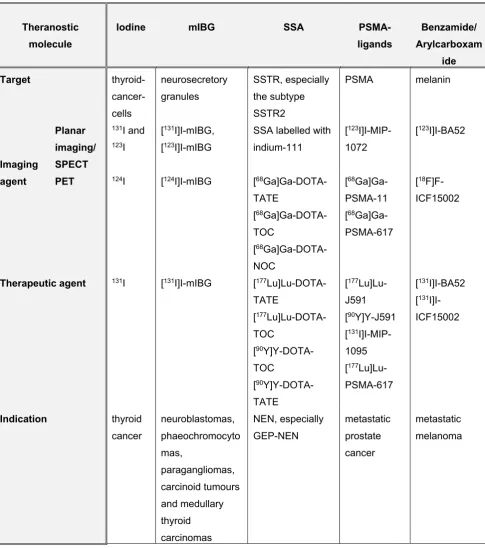
The aim of this review is to guide through the most important milestones of nuclear theranostics in practice (Table 1), providing a summarized background knowledge and overview of current applications and advantages of targeted therapies and imaging.
Radioiodine therapy: “the gold standard” in thyroid diseases
Iodine (stable isotope iodine-127) is absorbed from the thyroid gland for producing thyroid hormones: thyroxine (T4) and triiodothyronine (T3) [20]. Thyroid hormones are vital for the pre- and neonatal development of the brain [21], growth and metabolic balance [4,22,23]. In the late 1936, Dr. Saul Hertz, director of the Thyroid clinic in Massachusetts (1931-1943), came up with the idea to administer radioactive iodine in patients with thyroid diseases. Iodine and external beam radiation were well known tools in the therapy of thyroid diseases at that time, but the combination of both was a considerably innovative approach. This idea followed a few years of preclinical studies in collaboration with the Massachusetts Institute of Technology (MIT), where the first cyclotron for medical uses had been built. The MIT-Cyclotron produced 90% iodine-130 (130I, half time 12 h) and 10% iodine-131 (131I, half time 8
days). Finally, on the 31th of March 1941, Dr. Hertz treated the very first patient with radioiodine (RAI, 130I) [13,24,25].
The first RAI with 131I in patients with thyroid cancer was performed by the group of Seidlin et
131I is still a gold standard in the therapy and diagnosis of differentiated thyroid cancer (TC)
[29]. It is a low-cost nuclear reactor product from the neutron bombardment of tellurium-131.
131I combines the characteristics of beta- (ß-, about 90% of the radiation, mean 192 keV,
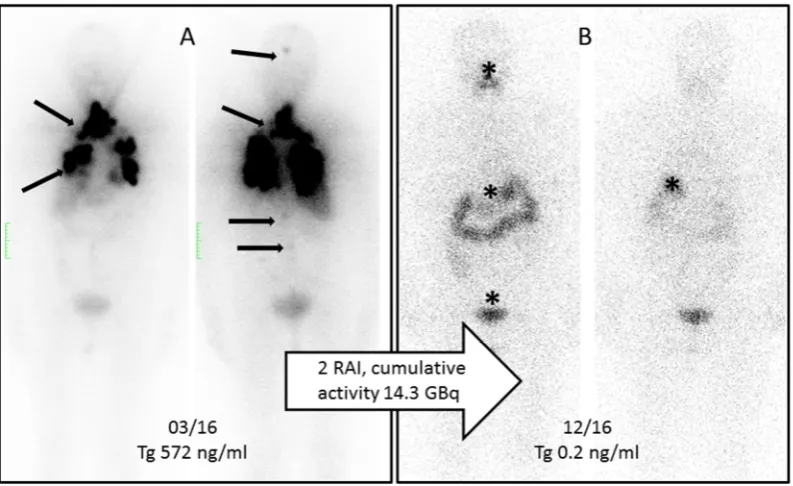
mean tissue penetration 0.4 mm) and gamma emitter (about 10% of the radiation, mean 383 keV). In this way itirradiates the TC and the thyroid remnant from the inside and at the same time targeted lesions can be visualised using a gamma camera or SPECT [4,22,23]. Figure 2A shows the initial 131I-planar images of a 74-year-old female with a metastatic TC
(lung, bone and intracranial soft tissue metastases). The tumour marker thyroglobulin (Tg) before RAI was 572 ng/ml. After two administrations of RAI (cumulative activity 14.3 GBq), the patient was in complete remission with Tg of 0.2 ng/ml (Figure 2B).
Diagnostics and therapy with meta-iodobenzylguanidine
Meta-iodobenzylguanidine (mIBG) or Iobenguane, is a molecule similar to noradrenaline and enters neuroendocrine cells from the sympathetic nervous system either by endocytosis or by passive diffusion before being stored in the neurosecretory granules [30].
Among the used radiolabeled molecules [123I]I-mIBG has a lower gamma energy than [131
I]I-mIBG (159 keV vs. 360 keV), which makes it more suitable for planar imaging / SPECT. Furthermore, the pure gamma emitter [123I]I-mIBG consists of a shorter half time of 13 hours
compared to 8 days of the combined beta and gamma emitter [131I]I-mIBG leading to smaller
radiation burden. Thus, higher activities of [123I]I-mIBG can be injected [31]. Both [131I]I-mIBG
and [123I]I-mIBG are used in MIBG scintigraphy for detection of neuroendocrine tumours such
as neuroblastomas, phaeochromocytomas, paragangliomas, carcinoid tumours and medullary thyroid carcinomas [32]. Especially in patients with inoperable or advanced tumours with distant metastases the mIBG-imaging plays an essential role in response assessment after therapy and evaluation of potential [131I]I-mIBG-therapy [33,34]. In patients
with neuroblastoma and phaechromocytoma [123I]I-mIBG presents high sensitivity (97% and
94%) and specifity (up to 96% and 92%), respectively [35–37]. If available, [124I]I-mIBG-PET
can be equally used for planning of mIBG targeted therapy [38,39].
Targeted therapy with [131I]I-mIBG presents encouraging efficacy with tolerable toxicity in
relapsed or refractory neuroblastoma with response rates between 20-40% being used alone or in combination with high-dose chemotherapy followed by autologous stem cell transplantation [15–17,40]. Recently, the NB2004 trial for risk adapted treatment of children with neuroblastoma closed and further analysis of the usage of mIBG therapy as first-line therapy is outstanding [15,17].
Radiolabelled Somatostatin analogous
especially the subtype SSTR2. Thus, SSTR is a well-established theranostic target in NEN for almost three decades [44–46].
SSTR-imaging is necessary for staging, therapy planning and follow-up. In the PET-diagnostics there are three routine somatostatin analogues (SSA)-tracers labelled with gallium-68: DOTA-TATE / DOTA-TOC and DOTA-NOC. All three tracers bind with high affinity SSTR. PET with 68Ga-labelled SSTR has a high sensitivity (82-97%) and specifity
(80-92%) in the detection of small primary tumours or metastases [47–49].
Peptide receptor radionuclide therapy (PRRT) is a systematic therapy in patients with advanced metastatic NEN. Required for the PRRT is a good tumour uptake in the SSTR- imaging. For therapeutic purposes the peptides DOTA-TATE and DOTA-TOC can be labelled either with 90Y or 177Lu. Because of the mainly renal excretion and the proximal
tubular reabsorption of these tracers, the kidneys are one of the most limiting organs [50]. Due to the smaller range (2mm) and lower energy 177Lu is less nephrotoxic as 90Y (range
max. 11 mm, pure beta emitter, higher energy). For that reason [177
Lu]Lu-DOTA-TATE / DOTA-TOC are in many centres the preferred agents for the therapy of NEN [5,6,51,52].
PRRT is increasingly gaining an attention. The first randomised controlled phase III study NETTER-1 (started 2012) compared the standard therapy sandostatin LAR with PRRT in patients with midgut-NEN. The study showed recently a significant clinical benefit from the therapy, achieving a prolonged progression free survival (not reached, approximately 40 months, p < 0.001), overall response (18%) as well as presumable longer overall survival (not reached, p = 0.004) [6].
Radiolabelled PSMA-ligands
Prostate cancer (PC) is the most common cancer in men in the western countries [53]. Hormone- and chemotherapy-refractory patients with metastatic PC have a poor prognosis [3,54,55]. The main cause of death in these patients is the progression to androgen-independent stage [3].
PC cells overexpress PSMA (prostate-specific membrane antigen) on the cell surface [56– 59]. There are several available radiopharmaceuticals targeting PSMA: [68
Ga]Ga-PSMA-HBED-CC, also known as [68Ga]Ga-PSMA-11 (PET), a monoclonal antibody (mAb)
[177Lu]Lu / [90Y]Y-J591 (therapy), [123I]I-MIP-1072 (planar / SPECT), [131I]I-MIP-1095
(therapy), and the theranostic agent DKFZ-PSMA-617 (PSMA-617), labelled with 68Ga for
PET or with 177Lu for therapy.
The specifity of the two commercially available PET-tracers, [68Ga]Ga-PSMA-617 and
[68Ga]Ga-PSMA-11 is similar: 99% vs. 100%. However, [68Ga]Ga-PSMA-617 has a better
sensitivity: 91% vs. 76.6% [60–62].
The latest studies in patients show that the treatment with [177Lu]Lu-PSMA-617 is effective
and well tolerated. Nearly 70% of patients benefit from the therapy [10,18,63–68].
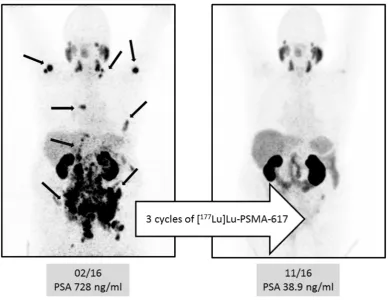
Figure 4A shows the pre-therapeutic [68Ga]Ga-PSMA-11-images of a patient with multiple
second line), enzalutamide and abiraterone. After three cycles of [177Lu]Lu-PSMA-617 the
follow-up-images showed a very good response with a substantial PSA-decline (Figure 4B).
Melanin-targeting in patients with metastatic melanoma
Promising approach in patients with metastatic melanoma is the specific targeting of melanin. The new developed theranostic agents: [123I]I- / [131I]I-BA52 and [18F]F- / [131I]F-ICF15002
may play a considerable role in the future.
BA52 is a melanin-binding benzamide. Labelled with I123, it shows a specific binding of the
metastases in the planar imaging / SPECT and can help selecting patients, who would probably benefit from the therapy. In a pilot study [131I]I-BA52 proved to be effective in 3/5
patients, who were treated with more than 4.3 GBq [19].
ICF15002 is an arylcarboxamide derivative and as a small molecule can passively enter the cell and bind to melanin. The PET-tracer is radiolabelled with 18F and [131I]I-ICF15002 is
designed for the therapy. However, both tracers are still in the preclinical phase of their studies [69].
Conclusion
In nuclear medicine, theranostics combines diagnostic imaging and therapy with the same but differently radiolabelled molecule. The visualisation of potential targets can help to predict if a patient would benefit from a particular treatment or not. In properly preselected patients targeted nuclear therapies have proven themselves to be effective with a favourable safety profile. To conclude, the combination of targeted cancer imaging and therapy is a considerable contribution to personalized medicine and may play an increasingly important role in the future.
References
1. Gridelli, C. Does chemotherapy have a role as palliative therapy for unfit or elderly patients with non-small-cell lung cancer? Lung Cancer 2002, 38, 45–50.
2. Richardson, J.L.; Marks, G.; Levine, A. The influence of symptoms of disease and side effects of treatment on compliance with cancer therapy. Journal of clinical oncology : official journal of the American Society of Clinical Oncology 1988, 6, 1746–1752.
3. Ahmadzadehfar, H. Targeted Therapy for Metastatic Prostate Cancer with Radionuclides 2016.
5. Kwekkeboom, D.J.; Herder, W.W. de; Kam, B.L.; van Eijck, C.H.; van Essen, M.; Kooij, P.P.; Feelders, R.A.; van Aken, M.O.; Krenning, E.P. Treatment with the radiolabeled somatostatin analog 177 Lu-DOTA 0,Tyr3octreotate: toxicity, efficacy, and survival. Journal of clinical oncology : official journal of the American Society of Clinical Oncology 2008, 26, 2124–2130.
6. Strosberg, J.; El-Haddad, G.; Wolin, E.; Hendifar, A.; Yao, J.; Chasen, B.; Mittra, E.; Kunz, P.L.; Kulke, M.H.; Jacene, H.; et al. Phase 3 Trial of 177Lu-Dotatate for Midgut Neuroendocrine Tumors. The New England journal of medicine 2017, 376, 125–135.
7. Holman, B.L.; Tumeh, S.S. Single-photon emission computed tomography (SPECT): applications and potential. Jama 1990, 263, 561–564.
8. Eckelman, W.C.; Gibson, R.E. The design of site-directed radiopharmaceuticals for use in drug discovery. In Nuclear imaging in drug discovery, development, and approval: Springer 1993, pp. 113–134.
9. Pillai, M.; Chakraborty, S.; Das, T.; Venkatesh, M.; Ramamoorthy, N. Production logistics of 177Lu for radionuclide therapy. Applied Radiation and Isotopes 2003, 59, 109–118.
10. Ahmadzadehfar, H.; Eppard, E.; Kurpig, S.; Fimmers, R.; Yordanova, A.; Schlenkhoff, C.D.; Gartner, F.; Rogenhofer, S.; Essler, M. Therapeutic response and side effects of repeated radioligand therapy with 177Lu-PSMA-DKFZ-617 of castrate-resistant metastatic prostate cancer. Oncotarget 2016, 7, 12477–12488.
11. Ahmadzadehfar, H.; Biersack, H.-J.; Ezziddin, S. Radioembolization of liver tumors with yttrium-90 microspheres. Seminars in nuclear medicine 2010, 40, 105–121.
12. Teunissen, J.J.M.; Kwekkeboom, D.J.; Jong, M. de; Esser, J.-P.; Valkema, R.; Krenning, E.P. Endocrine tumours of the gastrointestinal tract. Peptide receptor radionuclide therapy. Best practice & research. Clinical gastroenterology 2005, 19, 595–616.
13. Hertz, B. Dr. Saul Hertz (1905–1950) Discovers the Medical Uses of Radioactive Iodine: The First Targeted Cancer Therapy. Thyroid Cancer 2016, 1.
14. Klingebiel, T.; Bader, P.; Bares, R.; Beck, J.; Hero, B.; Jurgens, H.; Lang, P.; Niethammer, D.; Rath, B.; Handgretinger, R. Treatment of neuroblastoma stage 4 with 131I-meta-iodo-benzylguanidine, high-dose chemotherapy and immunotherapy. A pilot study. European journal of cancer (Oxford, England : 1990) 1998, 34, 1398–1402.
16. Matthay, K.K.; Yanik, G.; Messina, J.; Quach, A.; Huberty, J.; Cheng, S.-C.; Veatch, J.; Goldsby, R.; Brophy, P.; Kersun, L.S.; et al. Phase II study on the effect of disease sites, age, and prior therapy on response to iodine-131-metaiodobenzylguanidine therapy in refractory neuroblastoma. Journal of clinical oncology : official journal of the American Society of Clinical Oncology 2007, 25, 1054–1060.
17. Yanik, G.A.; Villablanca, J.G.; Maris, J.M.; Weiss, B.; Groshen, S.; Marachelian, A.; Park, J.R.; Tsao-Wei, D.; Hawkins, R.; Shulkin, B.L.; et al. 131I-metaiodobenzylguanidine with intensive chemotherapy and autologous stem cell transplantation for high-risk neuroblastoma. A new approaches to neuroblastoma therapy (NANT) phase II study. Biology of blood and marrow transplantation : journal of the American Society for Blood and Marrow Transplantation 2015, 21, 673–681.
18. Ferdinandus, J.; Eppard, E.; Gartner, F.; Kurpig, S.; Fimmers, R.; Yordanova, A.; Hauser, S.; Feldmann, G.; Essler, M.; Ahmadzadehfar, H. Predictors of response to radioligand therapy of metastatic castrate-resistant prostate cancer with 177Lu-PSMA-617. Journal of nuclear medicine : official publication, Society of Nuclear Medicine 2016.
19. Mier, W.; Kratochwil, C.; Hassel, J.C.; Giesel, F.L.; Beijer, B.; Babich, J.W.; Friebe, M.; Eisenhut, M.; Enk, A.; Haberkorn, U. Radiopharmaceutical therapy of patients with metastasized melanoma with the melanin-binding benzamide 131I-BA52. Journal of nuclear medicine : official publication, Society of Nuclear Medicine 2014, 55, 9–14.
20. Zhang, J.; Lazar, M.A. The Mechanism of Action of Thyroid Hormones. Annu. Rev. Physiol. 2000, 62, 439–466.
21. Porterfield, S.P.; Hendrich, C.E. The role of thyroid hormones in prenatal and neonatal neurological development--current perspectives. Endocrine reviews 1993, 14, 94–106.
22. Bauer, F.K.; Barrett, T.F.; Cassen, B.C. Scintigrams of the thyroid gland; the diagnosis of morphologic abnormalities with I131. California medicine 1952, 77, 380–382.
23. Hänscheid, H.; Lassmann, M. Dosimetrie bei der Radioiodtherapie benigner und maligner Schilddrüsenerkrankungen. Nuklearmediziner 2012, 35, 30–36.
24. Hertz, B.; Schuller, K. Saul Hertz, MD (1905-1950): A Pioneer in the Use of Radioactive Iodine. Endocrine Practice 2010, 16, 713–715.
26. Seidlin, S.M.; Rossman, I. Radioiodine therapy of metastases from carcinoma of the thyroid; a 6-year progress report. The Journal of clinical endocrinology and metabolism 1949, 9, 1122-37, illust.
27. Seidlin, S.M. Radioiodine in the treatment of metastatic thyroid carcinoma. The Medical clinics of North America 1952, 36, 663–680.
28. Seidlin, S.M.; Siegel, E.; Yalow, A.A.; Melamed, S. Acute Myeloid Leukemia Following Prolonged Iodine-131 Therapy for Metastatic Thyroid Carcinoma. Science 1956, 123, 800–801.
29. Luster, M.; Clarke, S.E.; Dietlein, M.; Lassmann, M.; Lind, P.; Oyen, W.J.G.; Tennvall, J.; Bombardieri, E. Guidelines for radioiodine therapy of differentiated thyroid cancer. European journal of nuclear medicine and molecular imaging 2008, 35, 1941–1959.
30. Nakajo, M.; Shapiro, B.; Copp, J.; Kalff, V.; Gross, M.D.; Sisson, J.C.; Beierwaltes, W.H. The normal and abnormal distribution of the adrenomedullary imaging agent m-I-131iodobenzylguanidine (I-131 MIBG) in man: evaluation by scintigraphy. Journal of nuclear medicine : official publication, Society of Nuclear Medicine 1983, 24, 672–682.
31. Shapiro, B.; Gross, M.D. Radiochemistry, biochemistry, and kinetics of 131I-metaiodobenzylguanidine (MIBG) and MIBG: clinical implications of the use of 123I-MIBG. Medical and pediatric oncology 1987, 15, 170–177.
32. Bombardieri, E.; Giammarile, F.; Aktolun, C.; Baum, R.P.; Bischof Delaloye, A.; Maffioli, L.; Moncayo, R.; Mortelmans, L.; Pepe, G.; Reske, S.N.; et al. 131I/123I-metaiodobenzylguanidine (mIBG) scintigraphy: procedure guidelines for tumour imaging. European journal of nuclear medicine and molecular imaging 2010, 37, 2436–2446.
33. Schmidt, M.; Simon, T.; Hero, B.; Schicha, H.; Berthold, F. The prognostic impact of functional imaging with (123)I-mIBG in patients with stage 4 neuroblastoma 1 year of age on a high-risk treatment protocol: results of the German Neuroblastoma Trial NB97. European journal of cancer (Oxford, England : 1990) 2008, 44, 1552–1558.
34. Decarolis, B.; Schneider, C.; Hero, B.; Simon, T.; Volland, R.; Roels, F.; Dietlein, M.; Berthold, F.; Schmidt, M. Iodine-123 metaiodobenzylguanidine scintigraphy scoring allows prediction of outcome in patients with stage 4 neuroblastoma: results of the Cologne interscore comparison study. Journal of clinical oncology : official journal of the American Society of Clinical Oncology 2013, 31, 944–951.
36. Rufini, V.; Fisher, G.A.; Shulkin, B.L.; Sisson, J.C.; Shapiro, B. Iodine-123-MIBG imaging of neuroblastoma: utility of SPECT and delayed imaging. Journal of nuclear medicine : official publication, Society of Nuclear Medicine 1996, 37, 1464–1468.
37. Leung, A.; Shapiro, B.; Hattner, R.; Kim, E.; Kraker, J. de; Ghazzar, N.; Hartmann, O.; Hoefnagel, C.A.; Jamadar, D.A.; Kloos, R.; et al. Specificity of radioiodinated MIBG for neural crest tumors in childhood. Journal of nuclear medicine : official publication, Society of Nuclear Medicine 1997, 38, 1352–1357.
38. Ott, R.J.; Tait, D.; Flower, M.A.; Babich, J.W.; Lambrecht, R.M. Treatment planning for 131I-mIBG radiotherapy of neural crest tumours using 124I-mIBG positron emission tomography. The British journal of radiology 1992, 65, 787–791.
39. Huang, S.-y.; Bolch, W.E.; Lee, C.; van Brocklin, H.F.; Pampaloni, M.H.; Hawkins, R.A.; Sznewajs, A.; DuBois, S.G.; Matthay, K.K.; Seo, Y. Patient-specific dosimetry using pretherapy (1)(2)(4)Im-iodobenzylguanidine ((1)(2)(4)ImIBG) dynamic PET/CT imaging before (1)(3)(1)ImIBG targeted radionuclide therapy for neuroblastoma. Molecular imaging and biology : MIB : the official publication of the Academy of Molecular Imaging 2015, 17, 284–294.
40. Zhou, M.J.; Doral, M.Y.; DuBois, S.G.; Villablanca, J.G.; Yanik, G.A.; Matthay, K.K. Different outcomes for relapsed versus refractory neuroblastoma after therapy with (131)I-metaiodobenzylguanidine ((131)I-MIBG). European journal of cancer (Oxford, England : 1990) 2015, 51, 2465–2472.
41. Kloppel, G. Classification and pathology of gastroenteropancreatic neuroendocrine neoplasms. Endocrine-related cancer 2011, 18 Suppl 1, S1-16.
42. Kloppel, G.; Rindi, G.; Anlauf, M.; Perren, A.; Komminoth, P. Site-specific biology and pathology of gastroenteropancreatic neuroendocrine tumors. Virchows Archiv : an international journal of pathology 2007, 451 Suppl 1, S9-27.
43. Rindi, G.; Kloppel, G.; Couvelard, A.; Komminoth, P.; Korner, M.; Lopes, J.M.; McNicol, A.-M.; Nilsson, O.; Perren, A.; Scarpa, A.; et al. TNM staging of midgut and hindgut (neuro) endocrine tumors: a consensus proposal including a grading system. Virchows Archiv : an international journal of pathology 2007, 451, 757–762.
44. Lamberts, S.W.; Bakker, W.H.; Reubi, J.C.; Krenning, E.P. Treatment with Sandostatin and in vivo localization of tumors with radiolabeled somatostatin analogs. Metabolism: clinical and experimental 1990, 39, 152–155.
46. Krenning, E.P.; Bakker, W.H.; Breeman, W.A.; Koper, J.W.; Kooij, P.P.; Ausema, L.; Lameris, J.S.; Reubi, J.C.; Lamberts, S.W. Localisation of endocrine-related tumours with radioiodinated analogue of somatostatin. Lancet (London, England) 1989, 1, 242–244.
47. Gabriel, M.; Decristoforo, C.; Kendler, D.; Dobrozemsky, G.; Heute, D.; Uprimny, C.; Kovacs, P.; Guggenberg, E. von; Bale, R.; Virgolini, I.J. 68Ga-DOTA-Tyr3-Octreotide PET in Neuroendocrine Tumors: Comparison with Somatostatin Receptor Scintigraphy and CT. Journal of Nuclear Medicine 2007, 48, 508–518.
48. Haug, A.; Auernhammer, C.J.; Wangler, B.; Tiling, R.; Schmidt, G.; Goke, B.; Bartenstein, P.; Popperl, G. Intraindividual comparison of 68Ga-DOTA-TATE and 18F-DOPA PET in patients with well-differentiated metastatic neuroendocrine tumours. European journal of nuclear medicine and molecular imaging 2009, 36, 765–770.
49. Kayani, I.; Bomanji, J.B.; Groves, A.; Conway, G.; Gacinovic, S.; Win, T.; Dickson, J.; Caplin, M.; Ell, P.J. Functional imaging of neuroendocrine tumors with combined PET/CT using 68Ga-DOTATATE (DOTA-DPhe1,Tyr3-octreotate) and 18F-FDG. Cancer 2008, 112, 2447–2455.
50. Sabet, A.; Ezziddin, K.; Pape, U.-F.; Reichman, K.; Haslerud, T.; Ahmadzadehfar, H.; Biersack, H.-J.; Nagarajah, J.; Ezziddin, S. Accurate assessment of long-term nephrotoxicity after peptide receptor radionuclide therapy with (177)Lu-octreotate. European journal of nuclear medicine and molecular imaging 2014, 41, 505–510.
51. Wong, F.C.; Kim, E.E. Therapeutic Applications of Radiopharmaceuticals. Handbook of Nuclear Medicine and Molecular Imaging: Principles and Clinical Applications 2012, 401.
52. Cwikla, J.B.; Sankowski, A.; Seklecka, N.; Buscombe, J.R.; Nasierowska-Guttmejer, A.; Jeziorski, K.G.; Mikolajczak, R.; Pawlak, D.; Stepien, K.; Walecki, J. Efficacy of radionuclide treatment DOTATATE Y-90 in patients with progressive metastatic gastroenteropancreatic neuroendocrine carcinomas (GEP-NETs): a phase II study. Annals of oncology : official journal of the European Society for Medical Oncology / ESMO 2010, 21, 787–794.
53. Ferlay, J.; Soerjomataram, I.; Dikshit, R.; Eser, S.; Mathers, C.; Rebelo, M.; Parkin, D.M.; Forman, D.; Bray, F. Cancer incidence and mortality worldwide: sources, methods and major patterns in GLOBOCAN 2012. International journal of cancer 2015, 136, E359-86.
55. Tolcher, A.W.; Quinn, D.I.; Ferrari, A.; Ahmann, F.; Giaccone, G.; Drake, T.; Keating, A.; Bono, J.S. de. A phase II study of YM155, a novel small-molecule suppressor of survivin, in castration-resistant taxane-pretreated prostate cancer. Annals of oncology : official journal of the European Society for Medical Oncology 2012, 23, 968–973.
56. Ghosh, A.; Heston, W.D.W. Tumor target prostate specific membrane antigen (PSMA) and its regulation in prostate cancer. Journal of cellular biochemistry 2004, 91, 528–539.
57. Mhawech-Fauceglia, P.; Zhang, S.; Terracciano, L.; Sauter, G.; Chadhuri, A.; Herrmann, F.R.; Penetrante, R. Prostate-specific membrane antigen (PSMA) protein expression in normal and neoplastic tissues and its sensitivity and specificity in prostate adenocarcinoma: an immunohistochemical study using mutiple tumour tissue microarray technique. Histopathology 2007, 50, 472–483.
58. Santoni, M.; Scarpelli, M.; Mazzucchelli, R.; Lopez-Beltran, A.; Cheng, L.; Cascinu, S.; Montironi, R. Targeting prostate-specific membrane antigen for personalized therapies in prostate cancer: morphologic and molecular backgrounds and future promises. Journal of biological regulators and homeostatic agents 2014, 28, 555–563.
59. Silver, D.A.; Pellicer, I.; Fair, W.R.; Heston, W.D.; Cordon-Cardo, C. Prostate-specific membrane antigen expression in normal and malignant human tissues. Clinical cancer research : an official journal of the American Association for Cancer Research 1997, 3, 81–85.
60. Afshar-Oromieh, A.; Avtzi, E.; Giesel, F.L.; Holland-Letz, T.; Linhart, H.G.; Eder, M.; Eisenhut, M.; Boxler, S.; Hadaschik, B.A.; Kratochwil, C.; et al. The diagnostic value of PET/CT imaging with the (68)Ga-labelled PSMA ligand HBED-CC in the diagnosis of recurrent prostate cancer. European journal of nuclear medicine and molecular imaging 2015, 42, 197–209.
61. Hijazi, S.; Meller, B.; Leitsmann, C.; Strauss, A.; Meller, J.; Ritter, C.O.; Lotz, J.; Schildhaus, H.-U.; Trojan, L.; Sahlmann, C.O. Pelvic lymph node dissection for nodal oligometastatic prostate cancer detected by 68Ga-PSMA-positron emission tomography/computerized tomography. The Prostate 2015, 75, 1934–1940.
62. Perera, M.; Papa, N.; Christidis, D.; Wetherell, D.; Hofman, M.S.; Murphy, D.G.; Bolton, D.; Lawrentschuk, N. Sensitivity, Specificity, and Predictors of Positive 68Ga-Prostate-specific Membrane Antigen Positron Emission Tomography in Advanced Prostate Cancer: A Systematic Review and Meta-analysis. European urology 2016, 70, 926–937.
patients. Journal of nuclear medicine : official publication, Society of Nuclear Medicine 2016.
64. Rahbar, K.; Bode, A.; Weckesser, M.; Avramovic, N.; Claesener, M.; Stegger, L.; Bogemann, M. Radioligand Therapy With 177Lu-PSMA-617 as A Novel Therapeutic Option in Patients With Metastatic Castration Resistant Prostate Cancer. Clinical nuclear medicine 2016, 41, 522–528.
65. Rahbar, K.; Schmidt, M.; Heinzel, A.; Eppard, E.; Bode, A.; Yordanova, A.; Claesener, M.; Ahmadzadehfar, H. Response and tolerability of a single dose of 177Lu-PSMA-617 in patients with metastatic castration-resistant prostate cancer: a multicenter retrospective analysis. Journal of nuclear medicine : official publication, Society of Nuclear Medicine 2016.
66. Ahmadzadehfar, H.; Rahbar, K.; Kurpig, S.; Bogemann, M.; Claesener, M.; Eppard, E.; Gartner, F.; Rogenhofer, S.; Schafers, M.; Essler, M. Early side effects and first results of radioligand therapy with (177)Lu-DKFZ-617 PSMA of castrate-resistant metastatic prostate cancer: a two-centre study. EJNMMI research 2015, 5, 114.
67. Becker, A.; Eppard, E.; Kuerpig, S.; Fisang, C.; Yordanova, A.; Essler, M.; Ahmadzadehfar, H. Nephro- and hepatotoxicity after radioligand therapy of metastatic castrate-resistant prostate cancer with 177Lu-PSMA-617. Journal of Nuclear Medicine 2016, 57, 1430.
68. Zimbelmann, S.; Eppard, E.; Hauser, S.; Kuerpig, S.; Yordanova, A.; Essler, M.; Ahmadzadehfar, H. Hematotoxicity after radioligand therapy of metastatic castrate-resistant prostate cancer with 177Lu-PSMA-617. Journal of Nuclear Medicine 2016, 57, 1429.
Table 1: Overview of theranostic agents
Legend: mIBG: meta-iodobenzylguanidine; SSA: somatostatin analogous; SSTR: somatostatin receptors; NEN: neuroendocrine neoplasia; GEP: gastroenteropancreatic system
Theranostic molecule
Iodine mIBG SSA
PSMA-ligands
Benzamide/ Arylcarboxam
ide
Target
thyroid- cancer-cells neurosecretory granules SSTR, especially the subtype SSTR2
PSMA melanin
Imaging agent
Planar imaging/ SPECT
131I and
123I
[131I]I-mIBG,
[123I]I-mIBG
SSA labelled with indium-111
[123
I]I-MIP-1072
[123I]I-BA52
PET 124I [124I]I-mIBG [68Ga]Ga-DOTA-
TATE
[68Ga]Ga-DOTA-
TOC
[68Ga]Ga-DOTA-
NOC
[68Ga]Ga-
PSMA-11
[68
Ga]Ga-PSMA-617
[18
F]F-ICF15002
Therapeutic agent 131I [131I]I-mIBG [177
Lu]Lu-DOTA-TATE
[177Lu]Lu-DOTA-
TOC
[90Y]Y-DOTA-
TOC
[90
Y]Y-DOTA-TATE
[177
Lu]Lu-J591
[90Y]Y-J591
[131
I]I-MIP-1095
[177
Lu]Lu-PSMA-617
[131I]I-BA52
[131
I]I-ICF15002
Indication thyroid
Figure 1: Theranostic principle in the nuclear medicine: combining diagnostic imaging and therapy with the same molecule, but differently radiolabelled. In case of RAI, the radioisotope (131I or 123I) can be directly mediated by the sodium-iodide symporter in the thyroid cells. In
Figure 2:
2A: Initial 131I-planar images of a 74-year-old female with a metastatic TC (lung, bone and
intracranial soft tissue metastases, marked with arrows). The tumour marker thyroglobulin (Tg) before RAI was 572 ng/ml.
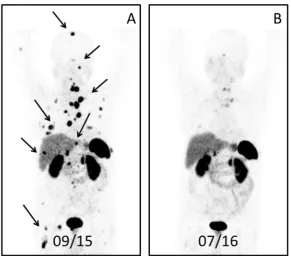
Figure 3:
3A: Maximum intensity projection (MIP) PET image ([68Ga]Ga-DOTA-TOC) of a male patient
with neuroendocrine tumour (unknown origin) 23 months after the baseline PRRT (three cycles, cumulative activity 19.6 GBq). The patient had a recurrence of disease with multiple metastases in the bone, lung, liver and lymph nodes (marked with arrows).
Figure 4:
4A: Pre-therapeutic [68Ga]Ga-PSMA-11-images of a patient with multiple lymph node,
peritoneal and bone metastases (arrows) and history of chemotherapy (first and second line), enzalutamide and abiraterone.
4B: After three cycles of [177Lu]Lu-PSMA-617 the follow-up-images showed a very good
response with a substantial PSA-decline.