Abstract—This paper presents a joint radio resource allocation scheme in LTE/LTE-A systems. In order to maximize system throughput while satisfying the minimum user rate requirement, the resource allocation is modeled as a convex optimization with constraints in this paper, which is proved to be NP-hard. Hence, a heuristic approach based on joint Particle Swarm Optimization (PSO) and Genetic Algorithm (GA) is proposed. The proposed method exploits the benefits of GA and PSO so that it could avoid the low speed problem of genetic algorithm and the local optimum trap concern in particle swarm optimization algorithm. Simulation results show that the proposed algorithm can overcome the disadvantages of genetic algorithm and particle swarm optimization algorithm, and achieve better performance, e.g., a faster convergence and global optimum.
Key words—LTE, Radio Resource Management (RRM), Particle Swarm Optimization (PSO), Genetic Algorithm (GA)
I. INTRODUCTION
Radio communication technology developments have advanced rapidly in the past few years. After the third generation (3G) of radio communication based on CDMA [1], the Long Term Evolution-Advanced (LTE-A) (or 4G) and beyond becomes more and more influential. The LTE-A employs Orthogonal Frequency Division Multiplexing Access (OFDMA) in its downlink transmission channels [2] and aims to provide high data-rate, low-latency, packet-optimized radio-access and flexible bandwidth deployments.
The radio resource allocation in OFDMA systems has attracted tremendous researches. In the systems, the radio resources such as power and bandwidth are limited while the channel condition of each user may vary from time to time. Given channel state information (CSI), the available system resource is allocated to users according to certain performance metrics such as throughput and the traffic requirements [3]. Three traditional allocation algorithms, i.e., Max C/I, Round Robin (RR) and Proportional Fair (PF) Scheduling are widely deployed in practice [4]. However, all these algorithms could
not take care of Quality of Services (QoS) very well. Moreover, under the constraints of the user minimum rate requirements and total resource, various resource allocation algorithms have been proposed to maximize the overall data rate or minimize total transmission power. The authors in [5] proposed a Lagrangian-based algorithm to maximize system throughput while ensuring fairness in LTE downlink (DL) transmission. A Lagrangian-based relaxing algorithm is introduced to minimize system total power consumption subject to user transmission rate constrains in [6]. Moreover, a multiuser adaptive radio resource allocation method is proposed in [7] to maximize the overall throughput while satisfying user minimum rate requirement. In [8], it is proved that the total capacity is maximized when each resource block (RB) is assigned to the subscriber with the best channel gain and power distributed through water-filling algorithm.
In general, the computational complexity of existing OFDMA resource allocation algorithms are high. Some heuristic algorithms with lower complexity have been proposed to find optimal solutions of the problems [9] [10]. In [9], a method using genetic algorithm (GA) to solve resource allocation problem is proposed. The approach in [10] is based on particle swarm optimization (PSO) for solving optimal power allocation problem. GA algorithm tries to develop a viable solution for an optimization problem through the operating of crossover operator and mutation operator on a population of candidate solutions to generate new points in the search space. However, the GA has disadvantages of the slower convergence speed and the probability of generating bad genetic factors while performing crossover and mutation operation. The PSO algorithm does not execute the crossover and mutation processes as done in GA. It searches for the optimum solution by swarm following the best particle. Though PSO algorithm has faster convergence speed in solving problems, it may converge to local optimum in later evolution stage easily.
In this paper, we propose an improved algorithm named Genetic Algorithm based Particle Swarm Optimization (GA-PSO) which combines GA and PSO together so that the advantages from the both can be exploited jointly. The proposed GA-PSO algorithm is used for resource allocation under the minimum user rate requirements and the maximum transmission power constraints.
Using Joint Particle Swarm Optimization and
Genetic Algorithm for Resource Allocation in
TD-LTE Systems
Jianbo Du
1, Liqiang Zhao
1, Jie Xin
1, Jen-Ming Wu
2, and Jie Zeng
31 State Key Laboratory of Integrated Service Networks, Xidian University, Xi’an, Shaanxi, China.
2 National Tsing Hua University, Hsinchu, Taiwan
3 Research Institute of Information Technology, Tsinghua University, Beijing, China
Email: [email protected], [email protected], [email protected], [email protected], [email protected]
This work was supported in part by National Natural Science Foundation of China (No. 61372070), Natural Science Basic Research Plan in Shaanxi Province of China (2015JM6324), Hong Kong, Macao and Taiwan Science & Technology Cooperation Program of China (2014DFT10320), EU FP7 Project MONICA (PIRSES-GA-2011-295222), and the 111 Project (B08038).
QSHINE 2015, August 19-20, Taipei, Taiwan Copyright © 2015 ICST
The rest of this paper is organized as follows. In Section II we present the system model and the problem formulation. In Section III, the proposed resource allocation algorithm is detailed. In Section IV, simulations are carried out to evaluate the performance of the proposed algorithm. Finally, the paper is summarized with concluding remarks in Section V.
II. SYSTEM MODEL AND PROBLEM FORMULATION The radio resource defined in the LTE system includes the resource blocks (RB), the specific modulation and coding schemes (MCS), the power allocation schemes and the antenna options. In other words, we have five resource domains, i.e., the time, the frequency, the code, the power, and the space domain, respectively. A RB, which is composed of 12 consecutive sub-carriers occupying 180 kHz in the frequency domain (FD) and one time slot of 0.5ms duration in the time domain (TD), is the minimum frequency-time resource unit that can be scheduled. A time slot (TS) hosts 6 or 7 OFDM symbols in the DL or SC-FDMA symbols in the UL. This allows us to formulate the RB allocation in a matrix-like structure. However, in line with other standards, LTE standards do not explicitly specify the Radio Resource Management (RRM) schemes because different service-providers and operators have different spectrum allocations. Furthermore, this open structure facilitates the creation of new innovative algorithms. As mentioned, there are five resource domains in LTE, we only consider RB and power allocation in this paper for simplicity.
We consider the downlink LTE network of a single cell and 𝐾 active users sharing N RBs, with the total transmit power constraint Ptotal. It is assumed that the channel coherence time is
longer than the time slot. Our objective is to optimize the RB and power allocation so as to achieve a much higher overall system throughput under the given Ptotal and the minimum user
rate requirements constraintRk,min.
Assumed that each RB is exclusively assigned to at most one user in each time slot to avoid interference among different users in a cell. Denote instantaneous transmission power and channel power gain from the eNB to the kth user on the nth RB as pk,n and gk,n, respectively, and then the maximum
instantaneous transmission rate of the kth user on the nth RB is then
, ,
, 0 2
0 0
log 1 k n k n k n
g p
r B
N B
(1)
where N0 and B0 represents the single-sided noise spectral
density and the bandwidth of a RB, respectively. Consequently, the throughput of the user k is defined as
, ,
1 N k k n k n
n
R r
(2)where ρk,n can only be either 1 or 0, indicating whether the nth
RB is occupied by user k or not.
Based on cooperative game theory, the RRM problem in this paper can be modeled as the following optimization problem,
, ,
, ,
, 0 2
1 1
, 0 0
log (1 )
max
k n k n
K N
k n k n k n k n p p g B N B
(3)subject to:
, 1 1 , , min , , 1 0 , 0,1 , 1 K Nk n total k n k n k k k n K k n k p P
p k n
R R k
k n n
(4)The optimization problem in (3) involving both continuous variables pk,n and binary variables ρk,n is called a binary and
mixed integer programming problem which is NP-hard. Furthermore, the nonlinear constraints in (4) makes it even more difficult in finding the optimal solution.
In a system with K user and N RBs, our goal is to allocate the N RBs and the power Ptotal to the K users under the
constraints in (4) to maximize the total system throughput. It’s clear that joint RB and power allocation with one step is most intuitive. However, the computational complexity prevents the system from obtaining the optimum solution. In this paper, we develop a complexity significantly reduced resource allocation algorithm while maintaining the near optimum performance. The proposed method divided the RB allocation and the power distribution into two steps.
Moreover, an alternative approach [9] to lessen the difficulty of the optimization problem in (3) is to relax the constraint ρk,n={0,1} that one RB can only be exclusively used
by one user. As a result, a sharing factor of the nth RB by user k
is introduced and is denoted by ρk,n , which can be any value
amid the half-open interval of (0,1] now as follows
, (0,1] ,
k n for all k n
(5)
III. EXISTENCE AND UNIQUENESS OF THE GLOBAL OPTIMAL SOLUTION
Formula (3) shows that the objective function is a linear combination of ρk,n and rk,n, now we choose it as the utility
function. In order to prove it is convex, we should demonstrate its component functions, i.e. Rk, is convex basically.
First we relax ρk,n by
( )1 1 ea x b
sigmoid x
(6)
where a and b are control parameters, the empirical values of
a=-10 and b=0 in this paper. That is, we use (6) to relax the expression ρk,n={0,1} into the expression (5) as mentioned
above.
Based on (3), the throughput of the kth subscriber, Thk, is defined as
, , ,min 1
,min
, , , min
1 , ( ( , ) , R ) ( ) 1 1 N k n k n k n
k k
N
k k n k n k
n k n
a r R b
k n a k n
R b
r sigm
Th r R
now let
,
( ) , 0
1 k n
x
r
f x x
e
(8)
we could have
, 2
(x) 0 0
1 x k n
x
r e
f x
e
, (9)
2 ,
3 1
(x) 0 0
1 x x k n
x
r e e
f x
e
, (10)
Based on the convex programming theory, f(x) is a strict monotonous concave function among the region (0, +∞). We can see from literature [11] that Rk in equation (2) is a rigorous
concave function of ρk,n and pk,n. According to the property of
concave function we know that if f(x) satisfies both concave and non-decreasing simultaneously, and g(x) is a concave function, then the composite function h(x)=f(g(x)) is also a concave function, too. Hence, we can conclude that the throughput of the kth user is a concave function.
As we can see, the following constraint in (11) is convex,
, , , , ,min
1 N
k k n t k n t k n
R r R
(11)equivalently,
, , , , ,min
1 N
k k n t k n t k n
R r R
(12)Thus it can be known that the kth user’s throughput Thk is a
continuous and differentiable concave function of ρk,n and pk,n.
IV. SUBOPTIMAL RB AND POWER ALLOCATION As aforementioned, to obtain the optimal solution of (3), the RBs and power allocation needs be considered simultaneously. However, the computational complexity prohibits the simultaneous optimization from practice. Furthermore, the scheduler in base station complete its scheduling procedure on the basis of previous feedbacks of CSI, in order that the channel feedback could reflect the CSI within time constraint accurately, the scheduler has to compute the optimal RB assignment and power allocation with great rapidity as the wireless channel could vary rapidly. On this account, low-complexity suboptimal algorithms are much preferred because of the cheapness and delay-sensitive implementations, and separating RB allocation and power allocation is one of the suboptimal ways, because variable numbers in the objective function is almost reduced by half. The following section A discusses a RB allocation scheme, and the optimal power distribution based on GA-PSO will be presented in section B.
A. RB allocation
In this section, we develop an optimal RB algorithm, in which power is assumed to be distributed equally across all RBs in initialization stage. This algorithm is depicted in the following Algorithm 1, where Ωk is the set of RBs assigned to
the user k, and 𝒦 = {1, 2, …, 𝐾} and 𝒩 = {1, 2, …, 𝑁} denote the sets of active users and all RBs, respectively.
The principle of the proposed optimal RB algorithm can be summarized in a word that each subscriber employs the RBs with high channel-to-noise ratio as much as possible. When the
required minimum throughput is satisfied, the rest RBs will not be allocated to the subscriber any more. Thus the RB allocation scheme strikes a compromise between the maximum throughput and system fairness considerably.
TABLEI ALGORITHM 1
Algorithm 1: RB Allocation Algorithm
Initialize: Set Ωk = ∅, Rk = 0, for k =1, 2, …, K.
repeat
(a) find k satisfying gk,n ≥ gj,n, for j∈𝒦;
(b) let Ωk = Ωk∪{n}, 𝒩=𝒩−{n}, update Rk
according to equation (1) and (2). (c) if Rk ≥ Rk,min, then 𝒦=𝒦−{k}
until𝒦 = ∅ or 𝒩 = ∅
Output:the RB allocation matrix ρ = {ρk,n}
B. Power Distribution for given RB Allocation
Based on the existing GA and PSO algorithms, this section describes the design and implementation of the proposed GA-PSO algorithm to solve the power allocation problem.
As is well-known, PSO has faster convergence speed but in later evolution stages it may converge to local optimum values easily. This is also known as premature convergence. On the other hand, the crossover and mutation operation of GA can maintain population diversity and extend the region of search so that it is not easy to fall into local optimum solutions but it converges slowly. So we propose a new algorithm GA-PSO combining the two algorithms together to overcome their disadvantages while their advantages are retained, too.
The PSO is a swarm intelligence algorithm that has been proved to be an effective approach in obtaining global optima and it has been applied in various areas successfully, such as neural network training, traveling salesmen’s problem and so on. PSO emulates the behavior of bird flocking in which each bird represents a particle. The flight of each individual is influenced by the experience both itself and its companions. All particles have their own positions, velocity, and fitness values. In the actual optimization problems each particle represents a feasible solution of the objective functions. There are generally two updating formulas in PSO algorithm: velocity updating and position updating. The two updating formulas are given below, respectively
1
1 1 2 2
t t t t t t t
v w v c r pBest x c r pBest x (13)
t1 t t1
x x v (14)
where v(t+1) is the updated velocity of a particle; w(t) is a
parameter named inertia weight used to control the impact of the previous velocities on the current velocity; c1 and c2 are
called acceleration coefficients; r1 and r2 are two random
variables obeying uniform distribution between the closed interval [0,1]; v(t) is the current velocity and x(t) is the current
position of the particle. The pBest represents the best value of the particle that it has achieved at iteration t and gBest
represents the global optimum value of the population after each iteration.
In GA, for two chromosomes (also called particles here) selected with crossover possibility pc, we apply arithmetical
offspring by combining their features. Mutation is an important part of the genetic search, through producing spontaneous random variation in different particles it helps to prevent the population from stagnating at local optimum solutions. For a chosen particle with mutation probability pm, each element will
be replaced with a random new value. Fitness function is a particular objective function that could quantify the optimality of all the solutions, i.e., all particles in GA so that they could be measured and sorted. In this paper, equation (3) above is defined as the fitness function.
The proposed GA-PSO algorithm is depicted in Algorithm 2 in detail below.
TABLEII ALGORITHM 2
Algorithm 2: Power Allocation Optimization Algorithm step1: Parameter setting. Set iteration times L, particle swarm
scales m, and algorithm parameters including inertia weight, learning factor, boundary values of positon and velocity, respectively.
step2: Population initialization. Initialize swarm with a group of random particles (solutions), calculate the fitness value of each particle, Set pBest of each particle and select the best of them as gBest.
step3: Update the velocity and position of each particle according to equations (13) and (14).
step4: Calculate the fitness value of each particle.
step5: Introduce genetic operators. Firstly, sort the swarm according to particles fitness values, and let the first third particles go into the later updating generation directly; secondly, employ crossover operator act on the first third particles and then replace the middle third particles with them; finally, perform mutation operation on the last third particles. The introduction of crossover and mutation operators facilitates the algorithm to avoid falling into local optimum effectively.
step6: Update the pBest of each particle and gBest.
step7: If termination condition is satisfied, go to step 8; otherwise, go to step 3.
step8: Stop and regard the gBest as the final solution. V. SIMULATION RESULTS
A. Simulation of Benchmark Functions
In the simulation, four traditional test functions, including Spherical, Rosenbrock, Griewank and Rastrigin, are used to evaluate the effectiveness of GA-PSO. They are regarded as objective fitness functions respectively to evaluate the algorithm performance, which means we consider them as our optimal target, and their values as the fitness values. The solution of the four functions are zero. Spherical and Rosenbrock are unimodal functions with only one minimum value, while Griewan and Rastrigin are multimodal functions with many local minimums. Their expressions are given as follows.
f1:Spherical function
21 1
, 100 100 n
i i
i
f x x x
(15)f2:Griewank function
22
1 1
1
cos 1, 100 100
4000
n n
i
i i
i i
x
f x x x
i
(16)f3:Rastrigin function
2
3
1
100 cos 2 10 , 100 100
n
i i i
i
f x x x x
(17)f4:Rosenbrock function
2
2
24 1
1
100 1 , 30 30
n
i i i i
i
f x x x x x
(18)Then, the GA, the PSO, and the proposed GA-PSO, are applied to the four benchmark functions severally to find their fitness values. Necessary parameters are set as follows: set the maximum iteration number at 100, swarm scale m at 30, the number of swarm at 100, inertia weight wstartat 0.9 and wend at
0.4, c1 and c2 at 1.4962, crossover possibility pc at 0.65,
mutation probability pmat 0.05.
Corresponding simulation results are shown below.
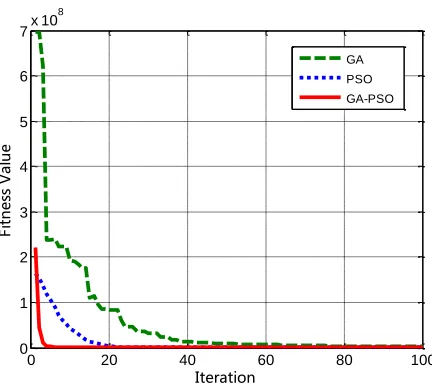
Fig. 1. GA, PSO, GAPSO test function Spherical
Fig. 2. GA, PSO, GAPSO test function Griewank
0 20 40 60 80 100 0
1 2 3 4 5 6 7x 10
8
Iteration
Fi
tn
es
s
V
al
ue
GA PSO GA-PSO
0 20 40 60 80 100 0
100 200 300 400 500 600 700 800 900 1000
iteration
fit
ne
ss
va
lu
e
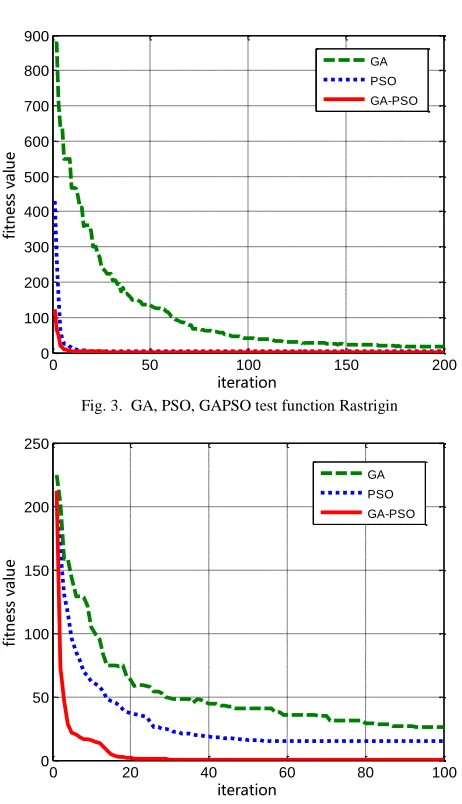
Fig. 3. GA, PSO, GAPSO test function Rastrigin
Fig. 4. GA, PSO, GAPSO test function Rosenbrock
Fig. 1 to Fig. 4 show the simulated fitness value curves of the four benchmark functions with GA, PSO and GA-PSO, respectively. From the four figures the following observations can be summarized. For convergence velocity, in terms of how many generations it needs to reach the optimal solution 0, GA converges the slowest, followed by PSO, and GA-PSO is the fast one. Especially in Griewank test as shown in Fig.2 it is the most significant that GA-PSO only needs 10 iterations to reach convergence, but PSO needs 20, and GA needs more than 100 generations.
As to convergence precision, in terms of how closely an algorithm could reach its best solution convergence, we can get the same observation. Especially in Rosenbrock test as shown in Fig.4, we can see that GA-PSO can reach 0 exactly after the 30th iterations, PSO reaches a solution 20 when in the 60th generation and keeps unchanged later on, GA gets a solution 30 after the 95th generation and keeps constant from then on, that indicates that PSO and GA have fallen in local optimal and will not obtain the optimal solution 0 anymore.
Thus, we can conclude that the performance of GA-PSO is the best among the three algorithms in searching solution. It could obtain better results than GA and PSO in doing both local search and global search, no matter in convergence velocity or
precision aspect. Thus, the proposed algorithm GA-PSO has better application foreground in searching global optimum and avoiding premature convergence, meanwhile.
B. Simulation of the objective function
To evaluate the performance of GA-PSO in obtaining system throughput, simulations are carried out in TD-LTE system. The key parameters are listed in Table I. A rectangular area of 50km×50km is considered, and it is covered by a eNBs set according to wrap-around model [12] with 7 eNBs in it. Each UE randomly chooses one of the four services uniformly, including VoIP, web-browsing, file-download and video, with data rates being 64kbps, 128kbps, 384kbps and 1024kbps, respectively.
TABLE IIISystem parameters
Parameters Value
Carrier frequency 2.6 GHz
System Bandwidth 20 MHz
Transmission time interval 1 ms
Antenna gain 15 dBi
Maximum transmit power of eNBs 46 dBm Maximum transmit power of UEs 23 dBm
Noise power -106 dBm
Propagation model Free space propagation
When applying the three algorithms above to solve the fitness function, we can obtain their numerical results as shown in Fig.5.
Fig. 5. Convergence of fitness function
We can see that the fitness function converges after the 20th generation when using GA-PSO, the 30th generations when applying PSO, and the 150th generations when employing GA. On the other hand, when the three algorithms converge, GA-PSO has the largest fitness value of nearly 1.862, which means that system throughput here can reach 1.862Mb/s. It is known that the larger the achievable system capacity, the lower the outage probability of the received signal. Thus, we can reach a conclusion that the proposed algorithm achieves better performance than GA and PSO in both convergence speed and performance.
The reason or challenge for the basic PSO is that it does not apply genetic and mutation operation. So, as the iteration
0 50 100 150 200 0
100 200 300 400 500 600 700 800 900
iteration
fitn
es
s
va
lu
e
GA PSO GA-PSO
0 20 40 60 80 100 0
50 100 150 200 250
iteration
fitn
es
s
va
lu
e
GA PSO GA-PSO
0 50 100 150 200 1.78
1.79 1.8 1.81 1.82 1.83 1.84 1.85 1.86 1.87 1.88
Iteration
Fi
tn
es
s
V
al
ue
(M
bp
s)
increase, the population gathers constantly and the population variety drops gradually meanwhile, which will lead to a decrease of convergence or even stop at the end. The advantage of GA is that it has higher population diversity. But in doing random searching in the entire solution space, it does not utilize the historical optimizing results, and hence leads to a lower convergence speed. The proposed GA-PSO exploits the advantages of both algorithms. It brings genetic and mutation operation in PSO, which could increase the population diversity so that to reduce the probability of falling into local optimum solutions, this improvement finally brings enhancement to its searching capability and convergence performance.
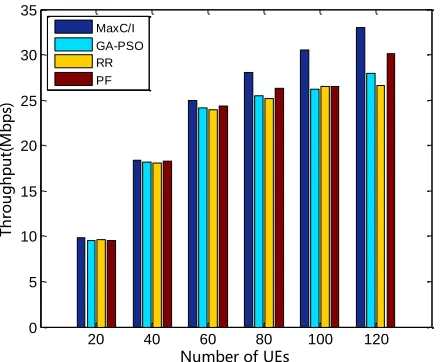
Fig. 6. The throughput versus the number of users
The resource allocation simulation for throughput versus the number of users is shown in Fig.6. For comparison, three classical well-established resource management algorithms including round robin (RR), maximum carrier-to-interference ratio (Max-C/I), and proportional fairness (PF) are compared. We discuss the system throughput when using GA-PSO and the three resource management algorithms in the given simulation condition.
In allocating radio resource with different schedulers, different results are obtained. Max C/I scheduler serves the subscriber with the maximum C/I, i.e., the user with the best channel conditions, to maximize the whole system throughput, so its obtained throughput can be considered as the throughput upper bound of all scheduler algorithms. In RR scheduling each user has equal chance to access the system resource, and user channel condition is not considered at all. Through RR has the best fairness but the lowest throughput among all scheduling algorithms, so it is regarded as the reference lower bound. PF strikes a balance between system throughput and fairness, so its obtained throughput lies between Max C/I and RR. The throughput of the algorithm proposed here also lies between that of the upper bound Max-C/I and lower bound RR.
VI. CONCLUSION
In this paper, we first propose an optimal radio resource allocation problem to maximize the overall system throughput in LTE system. We formulate the problem as a mixed binary and integer programming optimization problem. For simplification, RB and power allocation are carried out
separately. The proposed GA-PSO algorithm exploits the combined advantages of GA and PSO is applied in power allocation procedure. Simulation results show that the proposed algorithm could achieve better QoS and faster convergence rate as compared with traditional PSO and GA approaches.
REFERENCES
[1] J. Wang and J. Chen, "Performance of wideband CDMA systems with complex spreading and imperfect channel estimation," IEEE Selected Areas in Commun., vol. 19, Jan. 2001, pp. 152-163.
[2] 3GPP TSG RAN TR 25.913 v8.0.0, Requirement for Evolved Universal Terrestrial Radio Access (UTRA) and Universal Terrestrial Radio Access Network (UTRAN), 2008.
[3] Haya Shajaiah, Ahmed Abdel-Hadi and Charles Clancy, "Utility Proportional Fairness Resource Allocation with Carrier Aggregation in 4G-LTE," IEEE Military Communications Conference, 2013.
[4] A. Jalalt, R. Padovant, R. Pankaj, "Data Throughput of CDMA-HDR a High Efficiency-high Data Rate Personal Communication Wireless System," IEEE VTC,May. 2000, pp. 611-640.
[5] L. Anchora, L.Canzian, L.Badia, M. Zorzi, “A characterization of resource allocation in LTE systems aimed at game theoretical approaches,” IEEE International Workshop on CAMAD, 2010, pp.47–52.
[6] C.Y. Wong, R.S. Cheng, K.B. Letaief, and R.D. Murch, "Multiuser OFDM with adaptive subcarrier, bit, and power allocation," IEEE J.Select. Areas Commun.(JSAC), vol 17, May. 2000, pp. 611-640.
[7] Y.J. Zhang, K.B. Letaief, "Multiuser adaptive subcarrier-and-bit allocation withadaptive cell selection for OFDM systems," IEEE Trans On Wireless Commun., vol. 3, Sept. 2004, pp. 1566-1575.
[8] J. Jang and K. B. Lee, “Transmit power adaptation for multiuser OFDM systems,” IEEE J. Sel. Areas Commun., vol. 21, no. 2, pp. 171–178, Feb. 2003.
[9] Changchang Zeng, Yunxiao Zu, "Cognitive radio resource allocation based on niche adaptive genetic algorithm," Communication Technology and Application, Oct. 2011, pp. 566-571.
[10] Motiian, S., Aghababaie, M., Soltanian-Zadeh, H., "Particle Swarm Optimization (PSO) of power allocation in cognitive radio systems with interference constraints," Broadband Network and Multimedia Technology, Oct. 2011, pp. 558-562.
[11] W. Yu and J. M. Coffi. “FMDA capacity of Gaussian multiple-access channel with ISI”. IEEE Transaction on Communications, vol.50, no.1. pp.102–111, 2002.
[12] F. Sallabi, A. Lakas, K. Shuaib and M. Boulmalf, “WCDMA downlink simulator with efficient wrap-around technique”, IEEE Int’l Conf. on Wireless and Optical Communications Networks,. (WOCN), 2005.
20 40 60 80 100 120 0
5 10 15 20 25 30 35
Number of UEs
Th
ro
ug
hp
ut(
M
bp
s)