Research Article
Assessment of genetic diversity for
quantitative traits in sunflower
germplasm
Naila Gandahi
1, Aftab Ahmed Mahar
2, Abdul Wahid Baloch
1, Sarfraz
Ahmed Ansari
3, Tauqeer Ahmad Yasir
4, Munaiza Baloch
1*, Liaquat Ali
Bhutto
5, Asad Mari
6and Tanweer Fatah Abro
11. Department of Plant Breeding & Genetics, Sindh Agriculture University, Tandojam-Pakistan 2. Wheat Section, Agriculture Research Institute, Tandojam-Pakistan
3. Southern Wheat Research Station, Tandojam-Pakistan
4. College of Agriculture, Bahauddin Zakaria University, Bahadur Sub-Campus Layyah-Pakistan 5. Oilseeds Section, Agriculture Research Institute, Tandojam-Pakistan
6. Institute of Food Sciences & Technology, Sindh Agriculture University, Tandojam -Pakistan
*Corresponding author’s email: [email protected] Citation
Naila Gandahi, Aftab Ahmed Mahar, Abdul Wahid Baloch, Sarfraz Ahmed Ansari, Tauqeer Ahmad Yasir, Munaiza Baloch, Liaquat Ali Bhutto, Asad Mari and Tanweer Fatah Abro. Assessment of genetic diversity for quantitative traits in sunflower germplasm. Pure and Applied Biology. Vol. 6, Issue 1, pp261-266.
http://dx.doi.org/10.19045/bspab.2017.60022
Received: 17/09/2016 Revised: 06/02/2017 Accepted: 12/02/2017 Online First: 18/02/2017
Abstract
Evaluating genetic diversity in germplasm resources is a prerequisite for any effective breeding program. In this context, an investigation was carried out for analyzing genetic diversity in a set of 18 sunflower lines, which were grown at Oilseeds Section, Agriculture Research Institute, Tandojam, Sindh, Pakistan. Results demonstrated that mean squares were highly significantly different (P< 0.01) for days to flowering, days to maturity, plant height, head diameter, seeds
head-1, seed index and grain yield plant-1. It represents that studied sunflower germplasm tend to
have useful genetic resources for further breeding programs. In respect to genetic distance, a number of pairs were identified, which possess wide as well as narrow genetic distance; hence these pairs may be utilized for heterosis and backcross breeding purpose, respectively. Principal component analysis depicted that first three components showed a very high percentage of genetic variance (91.60%), indicating a great amount of genetic diversity in studied germplasm. Considering cluster analysis, diverse parents have also been identified through different clusters, signifying their importance for upcoming hybridization programs in sunflower.
Keywords: Genetic diversity; Sunflower; Cluster analysis; Quantitative traits
Introduction
Sunflower is considered as a major source of edible oil and a nice fit in the cropping system of Pakistan. Sunflower has potential to meet the country’s domestic needs [1]. Sunflower has a worth in bridging the gap
between closely related lines [3]. In turn to get improvement in the crop production, plant breeders are being associated to
evaluate the genotypes contemplating
essential aspects in the production process
[4]. Improvement in sunflower, highlights
the earnestness of breeding a heterotic hybrid that is attained by heterotic vigour offered in the genetically assorted parental genotypes. Hybridization that involves genetically divergent parents will result in improved vigour in the resultant hybrid. In this regard, several studies have been conducted in order to assess the genetic divergence in sunflower crop by using morphoagronomic characters [2, 3, 5, 6, 7]. In this context, an attempt was made to explore genetic diversity in a set of sunflower genotypes.
Materials and methods
A set of sunflower germplasm, including eighteen new sunflower lines (1, Line-2, Line-3, Line-4, Line-5, Line-6, Line-7, Line-8, Line-9, Line-10, Line-11, Line-12, Line-13, Line-14, Line-15, Line-16, Line-17 and Line-18) were sown in the experimental field of Oilseeds Section, A.R.I., Tandojam during the spring growing season, 2015. The research was conducted in a randomized
complete block design with four repeats. The distance of 25 and 60 cm was maintained between plant to plant and row to row, respectively. At maturity, ten plants per genotype per replication were selected and tagged as index plants for recording data on days to 90% flowering, days to maturity, plant height (cm), head diameter (cm), seeds head-1, seed index (1000-achene weight, g)
and seed yield plant-1 (g). Analysis of
variance and principal component analysis (PCA) was carried out through computer package Statistix Ver. 8.1, while genetic distance and cluster analysis was done through SPSS (Ver. 21) computer package.
Results and discussion Analysis of variances
The mean squares of different quantitative traits (Table 1) exhibited that genotypes were significantly different (P≤0.01) for days to 90% flowering, days to maturity, plant height, head diameter, seeds head-1, seed index and seed yield plant-1. It signifies
the presence of considerably high genetic diversity among the tested sunflower lines for studied traits. Similar results were also
obtained by Khan et al. [8] and Memon et
al.[9].
Table 1. Mean squares from analysis of variance for various traits in sunflower genotypes
** = indicates significant level at 0.01 of probability level
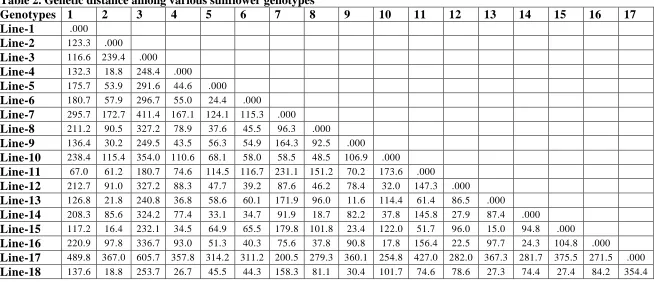
Genetic distance (427.0), Line-3 and Line-7 (411.4), Line-15
Source of variation
D.F Days to
flowering
Days to maturity
Plant height
Head diameter
Seeds head-1
Seed index
Seed yield plant-1
Replications 3 20.30 12.53 100.70 43.75 779.1 14.66 20.25
Genotypes 17 34.46** 33.86** 1239.71** 7.83** 61147.5** 125.22** 201.40**
traits. However, the narrow genetic distance was found between Line-9 and Line-13 (11.6), followed Line-13 and Line-15 (15.0), Line-2 and Line-15 (16.4), Line-10 and Line-15 (17.8), Line-8 and Line-14 (18.7), Line-2 and Line-4 (18.8) and Line-2 and Line-13 (21.8). Hence, these pairs of genotypes could be proved reliable breeding
materials for backcross breeding. In
agreement to our findings, Punitha et al. [2]
and Shamshad et al.[6] also reported a wide
divergence between sunflower lines.
Principal component analysis
PCA analysis is a very useful statistical technique for identification of genetic diversity, tracing the pathway to evolution of crops, parental selection, centre of origin and diversity, and to study the interaction
between environments [10]. PCA analysis
revealed that first three components
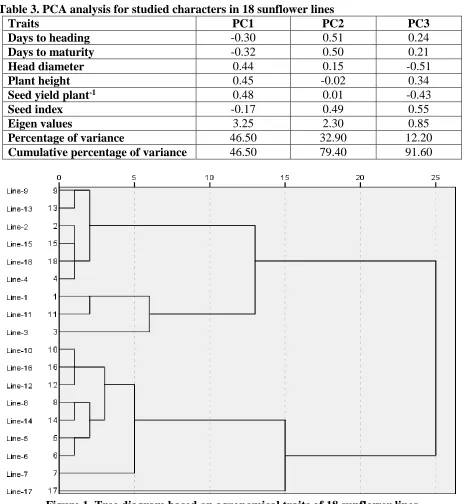
explained 91.60% of the total variations, which is consider a very huge genetic variance for the studied traits among the sunflower genotypes (Table 3). The first, second and third components accounted 46.50%, 32.90% and 12.20% of the variation found in the Eigen vector analysis (Table 3). In the first principal component, seed yield plant-1 (0.48), plant height (0.45) and head diameter (0.44) were the most important contributing characters. Similarly, days to heading (0.51), days to maturity (0.50) and seed index (0.49) were the important genetic parameters in second principal component. It is clearly noted that germplasm tend to possess a very wide genetic distance for quantitative traits, yet these sunflower lines may be preferred in
breeding programs to improve existing cultivars. The significance of PCA analysis
also suggested by other sunflower
researchers in conventional breeding for genetic divergence, germplasm assortment
and cultivar development [7, 11, 12].
Cluster analysis
Cluster analysis is one of the most important multivariate analyses, which assist grouping of genotypes based on genetic diversity that is existed for various traits among the
genotypes [13]. The un-weighted pair group
method using arithmetic average (UPGMA) classified the 18 sunflower lines into 4 small clusters (Figure 1). This indicates the presence of wide genetic diversity among the tested genotypes. The first cluster consisted of six sunflower lines, including Line-9, Line-13, Line-2, Line-15, Line-18 and Line-4; while, second cluster comprised of three germplasm of sunflower, such as Line-1, Line-11 and Line-3. The third
cluster retained maximum (7 lines)
sunflower lines, namely Line-10, Line-16, 12, 8, 14, 5 and Line-6; whereas, last and fourth cluster contained only one sunflower line (Line-17). It reveals that there is good enough genetic diversity available in the tested genotypes, hence it is proposed that different sunflower lines from different clusters may be hybridized in order to get maximum heterosis for various quantitative traits. In agreement to our results, various researchers [2, 3, 6] also reported a wide genetic diversity in
sunflower germplasm through cluster
Table 2. Genetic distance among various sunflower genotypes
Genotypes 1 2 3 4 5 6 7 8 9 10 11 12 13 14 15 16 17
Line-1 .000
Line-2 123.3 .000
Line-3 116.6 239.4 .000
Line-4 132.3 18.8 248.4 .000
Line-5 175.7 53.9 291.6 44.6 .000
Line-6 180.7 57.9 296.7 55.0 24.4 .000
Line-7 295.7 172.7 411.4 167.1 124.1 115.3 .000
Line-8 211.2 90.5 327.2 78.9 37.6 45.5 96.3 .000
Line-9 136.4 30.2 249.5 43.5 56.3 54.9 164.3 92.5 .000
Line-10 238.4 115.4 354.0 110.6 68.1 58.0 58.5 48.5 106.9 .000
Line-11 67.0 61.2 180.7 74.6 114.5 116.7 231.1 151.2 70.2 173.6 .000
Line-12 212.7 91.0 327.2 88.3 47.7 39.2 87.6 46.2 78.4 32.0 147.3 .000
Line-13 126.8 21.8 240.8 36.8 58.6 60.1 171.9 96.0 11.6 114.4 61.4 86.5 .000
Line-14 208.3 85.6 324.2 77.4 33.1 34.7 91.9 18.7 82.2 37.8 145.8 27.9 87.4 .000
Line-15 117.2 16.4 232.1 34.5 64.9 65.5 179.8 101.8 23.4 122.0 51.7 96.0 15.0 94.8 .000
Line-16 220.9 97.8 336.7 93.0 51.3 40.3 75.6 37.8 90.8 17.8 156.4 22.5 97.7 24.3 104.8 .000
Line-17 489.8 367.0 605.7 357.8 314.2 311.2 200.5 279.3 360.1 254.8 427.0 282.0 367.3 281.7 375.5 271.5 .000
Table 3. PCA analysis for studied characters in 18 sunflower lines
Traits PC1 PC2 PC3
Days to heading -0.30 0.51 0.24
Days to maturity -0.32 0.50 0.21
Head diameter 0.44 0.15 -0.51
Plant height 0.45 -0.02 0.34
Seed yield plant-1 0.48 0.01 -0.43
Seed index -0.17 0.49 0.55
Eigen values 3.25 2.30 0.85
Percentage of variance 46.50 32.90 12.20
Cumulative percentage of variance 46.50 79.40 91.60
Figure 1. Tree diagram based on agronomical traits of 18 sunflower lines
Conclusions
It is concluded that highly significant differences were observed among sunflower genotypes evaluated for all the seven studied traits. The results of the current study show the presence of genetic diversity among selected sunflower genotypes. Parents from divergent clusters may be used for
hybridization in order to isolate useful recombinants in the segregating generations.
Author’s contributions
Wrote the paper: N Gandahi, AW Baloch, SA Ansari, M Baloch
References
1. Habib H, Mehdi SY, Anjum MA,
Mohyuddin ME & Zafar M (2007). Correlation and path analysis for seed
yield in sunflower (Helianthus annuus
L.) under charcoal rot (Macrophomina
phaseolina) stress conditions. Int J Agri Bio 9(2): 362-264.
2. Punitha B, Vindhiyavarman P &
Manivannan N (2010). Genetic
divergence study in sunflower
(Helianthus annuus L.). Elect J Plant Breed 1(4): 426-430.
3. Sujatha K & Nadaf HL (2013).
Correlation for yield and yield related
traits in mutant and segregating
genotypes in sunflower (Helianthus
annus. L). Mol Plant Breed 32: 265-266.
4. Messetti AVL & Padovani CR (2004). O
uso da dispersão gráfica por variáveis canônicas com ênfase em melhoramento
genetic, Uberlândia 2: 373- 376.
5. Arshad M, Ilyas MK & Khan MA (2007).
Genetic divergence and path coefficient analysis for seed yield traits in sunflower (Helianthus annuus L.) hybrids. Pak J
Bot 39: 2009-2015.
6. Shamshad M, Dhillon SK, Tyagi V &
Akhtar J (2014). Assessment of genetic
diversity in sunflower (Helianthus
annuus L.) germplasm. Int J Agri Food Sci Tech 5(4): 267-272.
7. Masvodza DR, Gasura E, Zifodya N,
Sibanda P & Chisikaurayi B (2015). Genetic diversity analysis of local and
foreign sunflower germplasm (Helianthus
annuus) for the national breeding
program: Zimbabwe. J Cereals Oilseeds
6(1): 1-7.
8. Khan H, Rehman HU, Bakht J, Khan AK,
Hussain I, Khan A & Ali S (2013). Genotype × environment interaction and heritability estimates for some agronomic characters in sunflower. The J Ani Plant
Sci 23(4): 1177-1184.
9. Memon S, Baloch MJ, Baloch GM &
Keerio MI (2014). Heritability and correlation studies for phenological, seed yield and oil traits in sunflower (Helianthus annuus L). Pak J Agri Agril Engg Vet Sci 30 (2): 159-171.
10.Khodadadi M, Fotokian MH &
Miransari M (2011). Genetic diversity
of wheat (Triticum aestivum L.)
genotypes based on cluster and
principal component analyses for
breeding strategies. Aus J Crop Sci 5(1): 17-24.
11.Ghaffari M (2004). Use of principal
component analysis method for
selection of superior three way crosses
hybrids in sunflower. Seed and Plant
19(4): 513-527.
12.Ghaffoor A & Arshad M (2008).
Multivariate analysis for quantitative traits to determine genetic diversity of
black gram (Vigna mungo L. Hepper)
germplasm. Pak J Bot 40(6):
2307-2313.
13.Baloch AW, Baloch M, Jatoi SH, Baloch
MJ, Baloch GM, Mugheri MA, Depar MS, Mallani IA, Baloch AM, Gandhai N, Baloch IA & Ali M (2015). Genetic
diversity analysis in genetically
modified cotton (Gossypium hirsutum