International Journal of Business and Information
Critical Success Factors in Online Retail –
An Application of Quality Function Deployment
And Interpretive Structural Modeling
Sangeeta Sahney
Vinod Gupta School of Management Indian Institute of Technology Kharagpur, West Bengal 721302, India e-mail: [email protected] e-mail: [email protected]
ABSTRACT
The retail infrastructure has witnessed a transformation with the rapid growth of electronic commerce, especially in the last two decades. E-business all over the world has become a popular medium for buyer-seller transaction as a means that complements and supplements the experiences of a physical store. Although the application of technology-based online retail services has grown rapidly in recent years, an understanding to attract, retain, and satisfy customers in such contexts remains limited. A marketer often encounters the difficulty of constituting a framework that could be used for constructing, managing, and evaluating its service delivery through the Internet. Based on a literature review, followed by an empirical study, this paper outlines the results of a study conducted to identify the critical success factors in online retailing. The literature review helped conceptualize the variables for the study. The Quality Function Deployment Technique was applied to identify performance indicators critical to success of online retailing. These were prioritized qualitatively through Interpretive structural modeling. Such an integrated framework of critical success factors would enable a better understanding of customers’ needs and assist marketers while constructing, managing, and evaluating their online marketing strategies in the Indian context.
Volume 3, Number 1, June 2008 1. INTRODUCTION
The application of technology-based online retail services has grown rapidly in recent years. There has been a shift from the traditional physical store format to the more sophisticated non-store formats, with online retail sales having just crossed the $100 billion in 2007. Use of electronic means and advanced technology has led to a transformation in businesses today that are moving online. As a means that complements and supplements the experiences of a physical store, the conduct of business online is a business requirement. Sound consumer behavioral research is required to understand the dynamics of what would constitute a success model in such a context.
2. THEORETICAL BACKGROUND
With a large percentage of the population all over the world accessing the Internet and transacting online [Keen et al., 2002; Xing et al., 2004; McQuitty and Peterrson, 2000], the conduct of business via electronic means is going to grow all over the world [Joines et al., 2003], affording a huge marketing opportunity [Pollack, 1999; Hoffman, 2000].
Bakos [1991] describes an e-market as ―an interorganisational information system that allows the participating buyers and sellers to exchange information about prices and product offerings.‖ Meuter et al. [2000] have defined e-retailing in terms of the Internet market as ―a virtual realm where products and services exist as digital information and can be delivered through information-based channels.‖ We may define online retailing as use of an electronic media through which the customer and the marketer enter into a transaction for sale and purchase, to the benefit both parties.
Today, businesses all over the world are adopting the Internet as a means to sell goods and services. The rapid adoption of the Internet by buyers at large to transact online has been due to advances in technology, consumer characteristics (both demographic and psychographic), and situational influences.
From the perspective of the seller, online retailing is an attempt to attract and persuade the prospective buyer to conduct the purchase decision-making process, while ensuring the buyer’s satisfaction and loyalty. Despite the challenges, sellers are increasingly using the Internet because it reaches such a large number of consumers worldwide, especially younger consumers who form a major part of the buyer population. This is also the segment that is ready to take risks and try what is ―new.‖
From the perspective of the buyer, online purchase behavior is the degree to which the buyer accesses, browses, shops, transacts purchases, and repeats the behavior. Several factors have contributed to the increased use by consumers of electronic means to shop online. These include:
International Journal of Business and Information Easy and wide access to products, services and information, leading to overall convenience [Bhatnagar et al., 2000; McQuitty and Peterrson, 2000; Rohm and Swaminathan, 2004]
Enjoyment on the part of the customer [Hirschman, 1983; Childers et al., 2001; Menon and Kahn, 2002]
Consumer demographic and personality traits [Eastlick and Lotz, 1999; Burke, 2002; Dabholkar and Bagozzi, 2002; Swinyard and Smith 2003; Wu, 2003]
Situational factors [Wolfinbarger and Gilly, 2001]
Previous online shopping experiences [Weber and Roehl, 1999; Shim et al., 2001]
The increase in online shopping has occurred despite factors that often affect the consumer’s willingness to buy online. These factors include:
Computer illiteracy, technological complexity, and lack of understanding of the buying/transaction process via the Internet [Seiders et al., 2000] Lack of physical presence and interactivity [Wee and Ramachandra,
2000; Ruyter et al., 2001; La and Kandampully, 2002]
Concerns about risk, security, and privacy [Rohm and Milne 1998; Kargaonkar and Wolin, 1999; Bhatnagar et al., 2000; Liebermann and Stashevsky, 2002; Lim, 2003; Merriman et al., 2002]
Factors like trust and confidence, privacy, and security are important elements affecting consumer acceptance of online services because of concerns relating either to money transaction or personal information [Hoffman et al., 1999; Yoon, 2002; Balasubramanian et al. 2003, Koufaris and Hampton-Sosa, 2004, Flavian and Guinaliu, 2006].
Online buying is further moderated by individual differences such as:
Demographics and psychographics (Zumd's, 1979; Harrison and Rainer, 1992; Dabholkar and Bagozzi, 2002)
Volume 3, Number 1, June 2008
format in which the Web site serves as a store. These differences pertain to the seller and the buyer. From the seller’s perspective, they would include, first, the product service mix offered across the two formats, and, second, the advantages and disadvantages of each. From the buyer’s perspective, they would include the underlying motives and desires to shop online and the purchase decision process.
3. EMPIRICAL STUDY
This section discusses the objectives of this research and describes the methodology used in the study.
3.1. Objectives of the Study
The success of a business is based on customer satisfaction. Customer satisfaction has been defined as the extent to which actual performance meets or exceeds customers’ expectations. Understanding and managing the dynamics of customer requirements and expectations is the key to identifying the critical success factors for a business. Keeping customer satisfaction in mind, the study has been conducted to design a system based on components and design elements that can meet the interests of the customer. Specifically, the objectives are:
To identify the minimum set of design characteristics for a system that would meet the online customer requirements
To sequence, categorize, and prioritize these design characteristics and then to structure them into a comprehensive systemic model which, when adopted, would ensure customer satisfaction, retention, loyalty, and patronage
The Quality Function Deployment Technique was applied to identify, as critical success factors, the minimum design characteristics of a system that would meet the requirements of online customers. To corroborate the qualitative and quantitative efficacy and worthiness of such design characteristics, Interpretive Structural Modeling was used, which helped classify the design characteristics in order of priority, graphically represented as drivers, enablers, and dependents.
3.2. Methodology of the Study
This section defines the scope of the study, discusses variable conceptualization and instruments used, and explains research techniques.
3.2.1. Scope of the study
International Journal of Business and Information 102 pilot test responses were found to be complete and valid for analysis. The statistically proven questionnaire was then used subsequently in the next two stages.
In the second stage, the questionnaire was modified to facilitate application of QFD. An effort was made to contact the same respondents, and a total of 45 responses were collected and analyzed.
In the third stage, the questionnaire was further modified to facilitate application of ISM. A total of 32 responses were collected and analyzed in this final stage.
3.2.2. Variable conceptualization and instruments used
The objective of the study was to identify the minimum set of design characteristics that would meet the requirements of online customers. Theoretical and empirical studies of online buying were reviewed and measures were identified under two broad heads – customer requirements and design characteristics. Customer requirements refer to the expectations of the customers from an online purchase process. Design characteristics refer to the design elements that make up an online retail system. The design characteristics for this study refer to such components and elements that would ensure quality and prove to be critical to the success of an online retail service. A pilot study was conducted to examine the validity and reliability of the scale. Exploratory factor analysis was conducted to test the quantitative; factor loadings above values of 0.50 were considered. Internal consistency was examined through a reliability analysis.
The quantitatively and statistically proven items and attributes under the two broad heads were then incorporated into the questionnaires that were distributed to respondents.
Volume 3, Number 1, June 2008
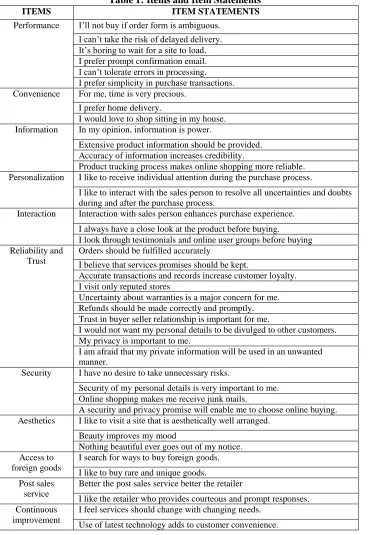
Table 1: Items and Item Statements
ITEMS ITEM STATEMENTS
Performance I’ll not buy if order form is ambiguous. I can’t take the risk of delayed delivery. It’s boring to wait for a site to load. I prefer prompt confirmation email. I can’t tolerate errors in processing. I prefer simplicity in purchase transactions. Convenience For me, time is very precious.
I prefer home delivery.
I would love to shop sitting in my house. Information In my opinion, information is power.
Extensive product information should be provided. Accuracy of information increases credibility.
Product tracking process makes online shopping more reliable. Personalization I like to receive individual attention during the purchase process.
I like to interact with the sales person to resolve all uncertainties and doubts during and after the purchase process.
Interaction Interaction with sales person enhances purchase experience. I always have a close look at the product before buying. I look through testimonials and online user groups before buying Reliability and
Trust
Orders should be fulfilled accurately
I believe that services promises should be kept.
Accurate transactions and records increase customer loyalty. I visit only reputed stores
Uncertainty about warranties is a major concern for me. Refunds should be made correctly and promptly. Trust in buyer seller relationship is important for me.
I would not want my personal details to be divulged to other customers. My privacy is important to me.
I am afraid that my private information will be used in an unwanted manner.
Security I have no desire to take unnecessary risks.
Security of my personal details is very important to me. Online shopping makes me receive junk mails.
A security and privacy promise will enable me to choose online buying. Aesthetics I like to visit a site that is aesthetically well arranged.
Beauty improves my mood
Nothing beautiful ever goes out of my notice. Access to
foreign goods
I search for ways to buy foreign goods. I like to buy rare and unique goods. Post sales
service
Better the post sales service better the retailer
I like the retailer who provides courteous and prompt responses. Continuous
improvement
International Journal of Business and Information The 12 design characteristics were:
Easy accessibility of products and services Clear transaction policies
Clear return policies and refund
Simple and unambiguous purchase transactions Ease of navigation and search
Quick loading times Error free processing Accurate delivery system Transaction privacy Transaction safety Individualized attention
Online interactivity between buyer and seller
3.2.3. Techniques used for the study
The Quality Function Deployment (QFD) Technique was used to identify the minimum set of design characteristics of a system that would meet online customer requirements. Relationships between each of the customer requirements and the design characteristics were identified and established. Thereafter, the design characteristics were ranked in absolute and relative terms to identify order of importance. For further analysis through Interpretive Structural Modeling, only those items that emerged as the first five through the QFD technique were chosen. With expert opinion, it was decided to also include items that proved to be strongly correlated to each other. Thus, Interpretive Structural Modeling was applied to a total of eight elements that were regarded to be critical to an online retail transaction process. These items were sequenced, categorized, and prioritized with a focus on priority, precedence, and causality, and were then structured into a comprehensive systemic model.
4. QUALITY FUNCTION DEPLOYMENT (QFD)
Developed by Mizuno and Akao, the Quality Function Deployment (QFD) Technique has been used worldwide for the design of products and services, by incorporating the voice of the customer. Because the matrix resembles the shape of a house, it has also been called the ―house of quality.‖ After an integrative process that focuses on first establishing relationships between the ―Whats,‖ representing the customer requirements and the ―Hows,‖ representing the design characteristics, the next stage is to relate the design characteristics themselves, arriving finally at a set of design characteristics to best satisfy the customer requirements [Hauser and Clausing, 1988; Pitman et al., 1995].
Volume 3, Number 1, June 2008
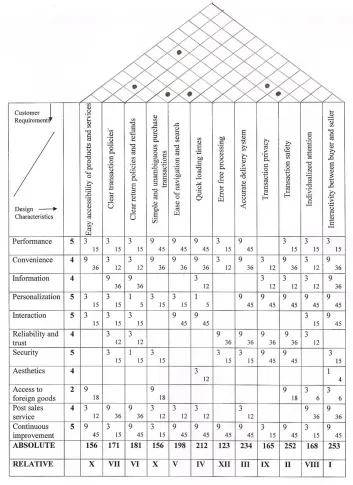
[Akao, 1990; Shin et al.2002; Masui et al., 2003]. The QFD matrix, also called the ―house of quality,‖ comprises two basic dimensions (Figure 1).
International Journal of Business and Information
The exterior walls on the left of the house in Figure 1 represent the ―Whats,‖ or the customer requirements. The ceiling of the house represent the ―Hows,‖ or the design characteristics. The rows, representing the ―What,‖ and the columns, representing the ―Hows,‖ cut across each other, creating the cells or interior walls of the house, which represent the relationship between the items of the ―Whats‖ and the items of the ―Hows.‖ The foundation of the house is the prioritized design characteristics, which are ranked both absolutely and relatively. The roof of the house portrays the interrelationship between the various design characteristics. The ―Whats‖ are first measured in terms of importance on a scale of 1-5; next, the relationship between the ―Whats‖ and the ―Hows‖ are expressed in numeric terms of strong, moderate, and weak (9, 3, and 1, respectively). After the ―Whats‖ have been assigned a numeric relative importance score and the relationship between the ―Whats‖ and the ―Hows‖ have been expressed in numeric values, the relative importance for the column items ―Hows‖ or the design characteristics is calculated, and priorities set, both absolutely and relatively.
4.1. Application of QFD to the Study
As stated earlier, tests of reliability and validity identified a total of 11 customer requirements and 12 design characteristics. These were incorporated in a questionnaire that was used in the second stage of the study. A QFD matrix was prepared, and the respondents were asked to assign numeric relative importance scores to the various customer requirements, from the lowest to the highest, on a scale from 1 to 5. They were also asked to express, in numeric values, the strong-moderate-weak relationship between the ―Whats‖ and the ―Hows,‖ on a scale of 9, 3, and 1.
Volume 3, Number 1, June 2008
Table 2. Relative Ranking of Items
Relative Rank Items
I Online interactivity between buyer and seller
II Transaction safety
III Accurate delivery system
IV Quick loading times
V Ease of navigation and search
VI Clear return policies and refunds VII Clear transaction policies VIII Individualized attention
IX Transaction privacy
X Easy accessibility of products and services X Simple and unambiguous purchase transactions
XII Error free processing
Table 3. Important Pairs after Correlation
Clear transaction policies AND Simple and unambiguous purchase transactions Clear transaction policies AND Accurate delivery system
Simple and unambiguous purchase transactions AND Ease of navigation and search Ease of navigation and search AND Quick loading times
Accurate delivery system AND Transaction safety Transaction privacy AND Transaction safety
4.2. Findings
The minimum set of design characteristics that was identified and prioritized after the ranking and the correlation analysis is as follows:
Accurate product/service delivery Clear transaction policies
Simple and unambiguous purchase transaction Ease of navigation and search
Quick loading times Transaction privacy Transaction safety
Online interactivity between buyer and seller.
International Journal of Business and Information 5. INTERPRETIVE STRUCTURAL MODELING (ISM)
Comprehending and simplifying the complex interrelationships between various elements requires a methodical, systematic, and logical approach. Interpretive structural modeling (ISM) is a qualitative tool that was developed by Warfield with the objective of understanding the complex relationships among elements related to a subject. The process starts with the identification of elements in a system, their prioritization and categorization through an understanding of their primacy, precedence, and causality over and among each other through independent and dependent linkages that are represented through a multi-level structural model [Warfield, 1976; Gorvett, 2006].
―The method is interpretive in that the group’s judgement decides whether and how the items are related; structural in that, on the basis of the relationships, an overall structure is extracted from the complex set of items, and; modeling in that specific relationships and overall structure are portrayed in a digraph (directed graph) model‖ [Sharma et al., 1994].
First, certain elements that are related to the main subject are identified. The existing autonomous, direct linkages and indirect linkages among these elements are identified. On the basis of primacy, precedence, and causality, these elements are structured into a multi-level structure. The ultimate result presents a hierarchical structure of elements representative of their networks and relationships, with their classification into various levels, as drivers, enablers, and dependents. Through a sequential and systematic methodology, the ISM aims at developing an arrangement wherein a set of elements related directly and indirectly are structured into a model, after analyzing the complex relationships among them.
5.1. Application of ISM to the Study
The direct and indirect relationships between the various components of a system describe the relationships and the situation more accurately than the individual factors taken into consideration in isolation of each other. In this study, ISM was applied to eight items that were ranked in the first five and proved to be strongly related during correlation analysis. These were identified as the minimum set of design characteristics necessary to meet the various customer requirements.
These were arranged in a matrix, with the items coded and arranged in descending order along the x-axis (or the columns) and the same items arranged in ascending order along the y-axis (or the rows). Items in each row were related to items in each column. Contextual relationships were arranged in terms of ―Will help achieve,‖ ―Will be achieved by,‖ ―Help achieve each other,‖ and ―Unrelated.‖
Volume 3, Number 1, June 2008
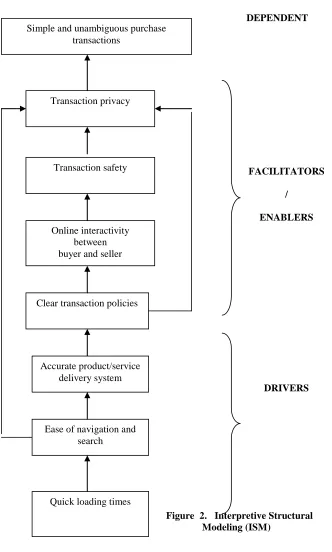
iterations, the direct and indirect relationships between the various design characteristics were identified, and the various levels were identified. These levels determined the hierarchical structure, where autonomous, direct, and indirectly related elements were expressed through arrows (Figure 2).
The ISM technique helped prioritize the strategic issues qualitatively, so as to propose a hierarchical structure through prioritizing, sequencing, and categorizing of ideas. The methodology provided a means by which order can be imposed on the complexity of the various design characteristics.
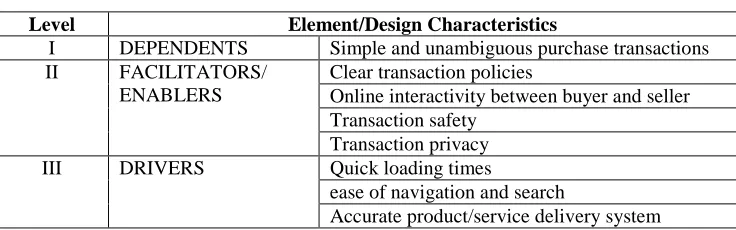
Not all the design characteristics require the same focus and attention on the part of decision makers. Instead, there is a set of items known as ―drivers,‖ which need maximum attention and form the base. They are the most important in terms of precedence. Thereafter are the ―facilitators‖ or ―enablers,‖ and finally the ―dependents.‖ The latter are those that are reliant on the ―drivers‖ and ―facilitators/enablers.‖ The elements were thus classified as ―drivers‖ (the lowest three levels), ―facilitators‖ or ―enablers‖ (the middle four levels), and ―dependents‖ (top level) (Table 4). In order of precedence and priority, and driving force, the ―drivers‖ were the most important, followed by the ―facilitators,‖ and then the ―dependents.‖
5.2. Findings
The ISM technique presents a hierarchical structure that depicts the direct and indirect linkages between the various components in a system, based on primacy, precedence, and causality over and among each other. There exists a group of design characteristics that are critical to the success of a system and require maximum detail and attention. They have the highest driving force and the lowest dependence in the system. These are ―drivers.‖ Another set of design characteristics have high dependence. These are the ―dependents.‖ In between are the ―facilitators‖ or ―enablers,‖ those design characteristics that are dependent on the ―drivers,‖ but assist the existence and functioning of ―dependents.‖
The findings from the application of the ISM technique are as follows:
Drivers: Quick loading times, ease of navigation and search, accurate product/service delivery
Facilitators or Enablers: Clear transaction policies, online interactivity between buyer and seller, transaction safety, transaction privacy
International Journal of Business and Information Figure 2. Interpretive Structural
Modeling (ISM)
Simple and unambiguous purchase transactions
Transaction safety
Online interactivity between buyer and seller
Clear transaction policies
Accurate product/service delivery system
Ease of navigation and search
Quick loading times Transaction privacy
DEPENDENT
FACILITATORS
/
ENABLERS
Volume 3, Number 1, June 2008
Table 4. Levels with Corresponding Design Characteristics
Level Element/Design Characteristics
I DEPENDENTS Simple and unambiguous purchase transactions
II FACILITATORS/
ENABLERS
Clear transaction policies
Online interactivity between buyer and seller Transaction safety
Transaction privacy
III DRIVERS Quick loading times
ease of navigation and search
Accurate product/service delivery system
6. IMPLICATIONS
The growing interest in the Internet as a shopping medium has attracted the attention of both academic researchers and marketing practitioners. Between them, a tremendous amount of insight and knowledge could be generated. One of the basic reasons this study was undertaken was to enable the conceptualization, development, and adoption of critical components for the success of an online retail system from the customers’ perspective. The study focuses on critical success factors that are to be reckoned with from both theoretical and practical perspectives. The online retail system has certain design elements that affect consumers' perceptions, attitude, intentions, and actual behavior to purchase online. The implications require the knowledge of behavioral sciences and management, blending together academic and theoretical as well as marketing and practical orientations.
6.1. Academic/Theoretical Implications
The application of technology-based online retail services has grown rapidly in recent years, but an understanding of what it takes to attract, retain, and satisfy customers in such contexts remains limited. Online marketing is an area where research pertaining to critical success factors is lacking and fragmented. The phenomenal growth of the online retail system and its diffusion among the masses raise interesting issues in academic research. Although the number of individuals buying products and services online continues to increase in India, the success of some e-retailers and the failure of others emphasize the need for an analysis from the customers’ perspective.
International Journal of Business and Information India and to identify those attributes that would lead to easy adoption of online retail shopping.
6.2. Business/Managerial/Practical Implications
Current retail marketing trends show a shift from the traditional store format to an increased use of technology via the Internet. In India, online experiences are still looked upon as complex and uncomfortable. In such a scenario, the seller would have to devise strategies that are based on sound consumer behavioral research and a knowledge of management. With increasing competition, online providers need to cope with the realities of e-retailing and re-evaluate their strategies. The factors presented in this study will give online retailers a better understanding of their customers’ needs. A customer-oriented system based on these critical components can facilitate a quicker diffusion of the online retail system by attracting customers, eliciting a positive response through trial, encouraging repeat purchases, and maintaining customer retention and loyalty. Footfalls would increase and the marketers would be able to convert the walk-in shoppers into online purchasers. This would lead to an increase in sales and revenue. The implication of this study is that online retailers may use the findings while constructing, managing, and evaluating their marketing strategies (especially in India) so as to compete and gain market leadership. Understanding and managing the dynamics of an online retail business have become essential.
7. CONCLUSIONS
Marketing trends all over the world show a shift from a purely traditional store format to a mix of both physical and virtual stores. An important part of the gamut of services that a marketer has to offer is through the Internet. The number of people using the Internet as a medium to transact is growing exponentially the world over, and India is no exception. Today, access to products and services is facilitated through global technological networks. A wide assortment of goods and services can be accessed and compared with regard to attributes, features, and price, thereby affecting purchase decisions favorably.
Volume 3, Number 1, June 2008
regarding the product/service are essential. The delivery system should also be prompt and error free.
Clear transaction policies, online interactivity between buyer and seller, transaction safety, and transaction privacy were identified as facilitators/enablers of the online retail system. The retailer's Web site acts as a platform for interaction between an online retailer and a buyer. The audiovisual impact of the web site and its product or service is crucial for effective performance, both for functional and hedonic benefits. Web site design elements and aesthetics, the audiovisual impact, and customization affect consumer psychographics and consumer interest in buying online. The retailer should provide details about the product/service alternatives available, features, and price, as well as information about delivery schedules, warranty services, return and exchange policies, post-sales service, and related technical support. Establishing, communicating, and maintaining customer trust and confidence on issues of personal information are critical to an online retail business. The retailer should strive to cultivate customer feelings of safety, security, and trust in the system. The retailer, for example, may encourage customers to make a trial purchase initially,with the goal of securing a repeat purchase if the customer is satisfied.
A simple and unambiguous purchase transaction process was identified as a major driver, which will necessarily impact the facilitators and the dependents. Customers are often apprehensive and wary of shopping online because of computer illiteracy, technological complexity, or a lack of understanding of the buying/transaction process via the Internet. A customer should be able to search the Web and transact with ease.
REFERENCES
Akao, Y. 1990. History of quality function deployment in Japan, The best on quality, International Academy for Book Series, 3, Hanser, pp. 83-96.
Akao, Y. 1990. Quality Function Deployment, ss, Cambridge, MA: Productivity Press. Bakos, J.Y. 1991. A strategic analysis of electronic marketplaces, MIS Quarterly 15(3),
295-310.
Balasubramanian, S.; Konana, P.; and Menon, N.M. 2003. Customer satisfaction in virtual environments: A study of online investing, Management Science 49(7), 871-89.
Bhatnagar, A.; Misra, S.; and Rao, H.R. 2000. On risk, convenience, and Internet shopping behaviour, Communications of the ACM 43(11), 98-105.
Black, G.S. 2005. Predictors of consumer trust: Likelihood to pay online, Marketing Intelligence & Planning 23(7), 648-58.
Burke, R.R. 2002. Technology and the customer interface: What consumers want in the physical and virtual store, Journal of the Academy of Marketing Science 30(4), 411-32.
International Journal of Business and Information Childers, T.; Carr, C.; Peck, J.; and Carson, S. 2001. Hedonic and utilitarian motivations
for online retail shopping behavior, Journal of Retailing 77(4), 511-38.
Compeau, D.R.; Higgins, C.A.; and Huff, S. 1999. Social cognitive theory and individual reactions to computing technology: A longitudinal study, MIS Quarterly 23(2), 145-58.
Cronbach, L.J. 1951. Coefficient alpha and the internal structure of test, Psychometrica 16, 297-300.
Dabholkar, P.A., and Bagozzi, R.P. 2002. An attitudinal model of technology-based self-service: Moderating effects of consumer traits and situational factors, Journal of the Academy Marketing Science 30(3), 184-201.
Donthu, N., and Garcia, A. 1999. The Internet shopper, Journal of Advertising Research 39(2), 52-8.
Eastin, M.S., and LaRose, R. 2000. Internet self-efficacy and the psychology of the digital divide, Journal of Computer-Mediated Communication 6(1).
Eastlick, M.A., and Lotz, S. 1999. Profiling potential adopters and non-adopters of an interactive electronic shopping medium, International Journal of Retail & Distribution Management 27(6), 209-23.
Flavian, C., and Guinaliu, M. 2006. Consumer trust, perceived security and privacy policy: Three basic elements of loyalty to a web site, Industrial Management & Data Systems 106(5), 601-20.
Goldsmith, R.E. 2001. Using the domain specific innovativeness scale to identify innovative Internet consumers, Internet Research: Electronic Networking Applications and Policy 11(2), 149-58.
Gorvett, R. 2006. Interpretive Structural Modeling of interactive risks, Call Paper Program, Enterprise Risk Management Symposium , Chicago, IL
Harrison, A.W., and Rainer, R.K. Jr. 1992). The influence of individual differences on skill in end-user computing, Journal of Management Information Systems 9(1), 93-111.
Hauser, J.R., and Clausing, D. 1988. The House of Quality, Harvard Business Review, May-June, quoted in Lam, K. and Zhao, X. (1998), An application of quality function deployment to improve the quality of teaching, International Journal of Quality and Reliability Management 15(4), 389-413.
Hirschman, E.C. 1983. Predictors of self-projection, fantasy fulfillment, and escapism, Journal of Social Psychology 120, 63-76.
Hoffman, D. 2000. The revolution will not be televised, Introduction to the special issue on marketing science and the internet, Marketing Science 19(1), 1-3.
Hoffman, D.L.; Novak, T.P.; and Peralta, M. 1999. Building consumer trust online, Communications of the ACM 42(4), 80-5.
Jayawardhena, C.; Wright, L.T.; and Masterson, R. 2003. An investigation of online purchasing, Journal of Qualitative Market Research: An International Journal 6(1), 58-65.
Volume 3, Number 1, June 2008
Joines, J.L.; Scherer, C.W.; and Scheufele, D.A. 2003. Exploring motivations for consumer web use and their implications for E-Commerce, Journal of Consumer Marketing 20(2), 90-108.
Keen, C.; Wetzels, M.; de Ruyter, K.; and Feinberg, R. 2002. E-tailers versus retailers: Which factors determine consumer preferences?, Working Paper 2001-02, Maxx Working Paper Series.
Korgaonkar, P.K., and Wolin, L.D. 1999. A multivariate analysis of web usage, Journal of Advertising Research 39(2), 53-68.
Koufaris, M., and Hampton-Sosa, W. 2004. The development of initial trust in an online company by new customers, Information & Management 41, 377-97.
La, V.K., and Kandampully, J. 2002. Electronic retailing and distribution of services: Cyber intermediaries that serve customers and service providers, Managing Service Quality 12(2), 100-16.
Liebermann, Y., and Stashevsky, S. 2002. Perceived risks as barriers to Internet and E-commerce usage, Qualitative Market Research: An International Journal 5(4), 291-300.
Lim, N. 2003) Consumer perceived risk: Sources versus consequences, Electronic Consumer Research and Applications 2, 216-28.
Masui, K.; Sakao, T.; Kobayashi, M.; and Inaba, A. 2003. Applying quality function deployment to environmentally conscious design, International Journal of Quality and Reliability Management 20(1), 90-106.
McQuitty, S., and Peterson, R.T. 2000. Selling home entertainment on the internet: an overview of a dynamic marketplace, Journal of Consumer Marketing 17(3), 233-48. Menon, S., and Kahn, B. 2002. Cross-category effects of induced arousal and pleasure on
the Internet shopping experience, Journal of Retailing 78(1), 31-40.
Merriman, I.; Ward, P.; and Davies, B. 2002. Buying online: An exploratory investigation of risk perception within internet shoppers and non-shoppers, Academy of Marketing Conference, University of Nottingham, Nottingham, July.
Meuter, M.L.; Ostrom, A.L.; Roundtree, R.I.; and Bitner, M.J. 2000. Self-service technologies: Understanding customer satisfaction with technology based service encounters, Journal of Marketing 64, 50–64.
Monsuwé, T; Dellaert, B.; and Ruyter, K. 2004. What drives consumers to shop online? A literature review, International Journal of Service Industry Management 15(1), 102-21.
Nunnally, J. C. 1978. Psychometric Theory, New York: McGraw-Hill.
Nunnally, J.C., and Bernstein, I.H. 1994. Psychometric Theory, 3rd ed., New York: McGraw-Hill.
O'Cass, A., and Fenech, T. 2003. Web retailing adoption: Exploring the nature of Internet users' web retailing behaviour, Journal of Retailing and Consumer Services 10, 81-94.
Pitman, G.; Motwani, J.; Kumar, A.; and Cheng, C.H. 1995. QFD application in an educational setting: a pilot field study, International Journal of Quality & Reliability Management 12(6), 63-72.
Pollack, B. 1999. The state of Internet marketing—1999, Direct Marketing 61(9), 18-21. Rohm, A.J., and Milne G.R. 1998. Emerging marketing and policy issues in electronic
International Journal of Business and Information Proceedings, 8th edited by Alan Andreasen, Alex Simonson, and N. Craig Smith, Chicago: American Marketing Association, pp. 73-79.
Rohm, A., and Swaminathan, V. 2004. A typology of online shoppers based on shopping motivations, Journal of Business Research 57, 748-57.
Ruyter, K.; Wetzels, M.; and Kleijnen, M. 2001. Customer adoption of E-service: An experimental study, International Journal of Service Industry Management 1(2), 184-207.
Sahney, S. 2006. Critical success factors in online retailing: A study in the Indian context, Marketing in the New Global Order, International Conference on Marketing in the New Global Order at Indian Institute of Management, Indore.
Seiders, K.; Berry, L.L.; and Gresham, L.G. 2000. Attention, retailers! How convenient is your convenience strategy? Sloan Management Review 41(3), 79-89.
Sharma, H.D.; Sushil; and Gupta, A.D. 1994. A structural approach to analysis of causes of system waste in the Indian economy, System’s Research 11(2),17-41, International Federation for System’s Research.
Shim, S.; Eastlick, M.A.; Lotz, S.L.; and Warrington, P. 2001. An online prepurchase intentions model: The role of intention to search, Journal of Retailing 77, 397-416. Shin, J.S.; Kim, K.J.; and Chandra, M.J. 2002. Consistency check of a house of quality
chart, International Journal of Quality and Reliability Management 19(4), 471-84. Sorce, P.; Perotti, V.; and Widrick, S. 2005. Attitude and age differences in online
buying, International Journal of Retail & Distribution Management 33(2), 122-32. Swinyard, W., and Smith, S. 2003. Why people (don’t) shop online: A lifestyle study of
the Internet consumer, Psychology & Marketing 20(7), 567-97.
Venkatesh, V., and Morris, M.G. 2000. Why don’t men ever stop to ask for directions? Gender, social influence, and their role in technology acceptance and usage behavior, MIS Quarterly 24(1), 115-39.
Warfield, J.N. 1976. Societal Systems, New York: Wiley & Sons.
Weber, K., and Roehl, W.S. 1999. Profiling people searching for and purchasing travel products on the worldwide web, Journal of Travel Research 37, 291-98.
Wee, K.N.L., and Ramachandra, R. 2000. Cyberbuying in China, Hong Kong and Singapore: Tracking the who, where, why and what of online buying, International Journal of Retail & Distribution Management 28(7), 307-16.
Wolfinbarger, M., and Gilly, M.C. 2001. Shopping online for freedom, control, and fun, California Management Review 43(2), 34-55.
Wu, S. 2003. The relationship between consumer characteristics and attitude toward online shopping, Marketing Intelligence & Planning 21 (1), 37-44.
Xing, X.; Tang, F.; and Yang, Z. 2004. Pricing dynamics in the online consumer electronics market, Journal of Product & Brand Management 13(6), 429–41.
Yoon, S.J. 2002. The antecedents and consequences of trust in online purchase decisions, Journal of Interactive Marketing 16(2), 47-63.
Volume 3, Number 1, June 2008
ABOUT THE AUTHOR